35th Annual Field Observations of North Cascade Glaciers

The 2018 field season observations, conditions and summary. Field team Mariama Dryak, Erin McConnell, Jill Pelto and Mauri Pelto.

For the 35th consecutive year I headed to the North Cascade Range, Washington to monitor the response of glaciers to climate change.  Two of the glaciers the North Cascade Glacier Climate Project (NCGCP) monitors are now part of the 42 glaciers comprising the World Glacier Monitoring Service  (WGMS) reference glacier network, where annual mass balance has been assessed for more than 30 years consecutively.

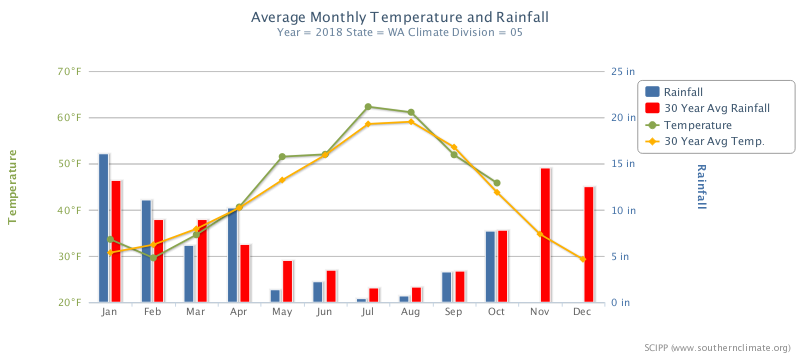
The 2018 winter season featured relatively normal snowpack despite a winter of wide temperature fluctuations, February freezing levels 400 m below the mean and December 500 m above the mean. Summer melt conditions featured temperatures 1.1 C above the 1984-2017 mean. The summer melt season through August was warm and exceptionally dry, which has also helped foster forest fires. The melt rate during the August field season was 35% above normal.

Washington Climate Division Five, western North Cascades

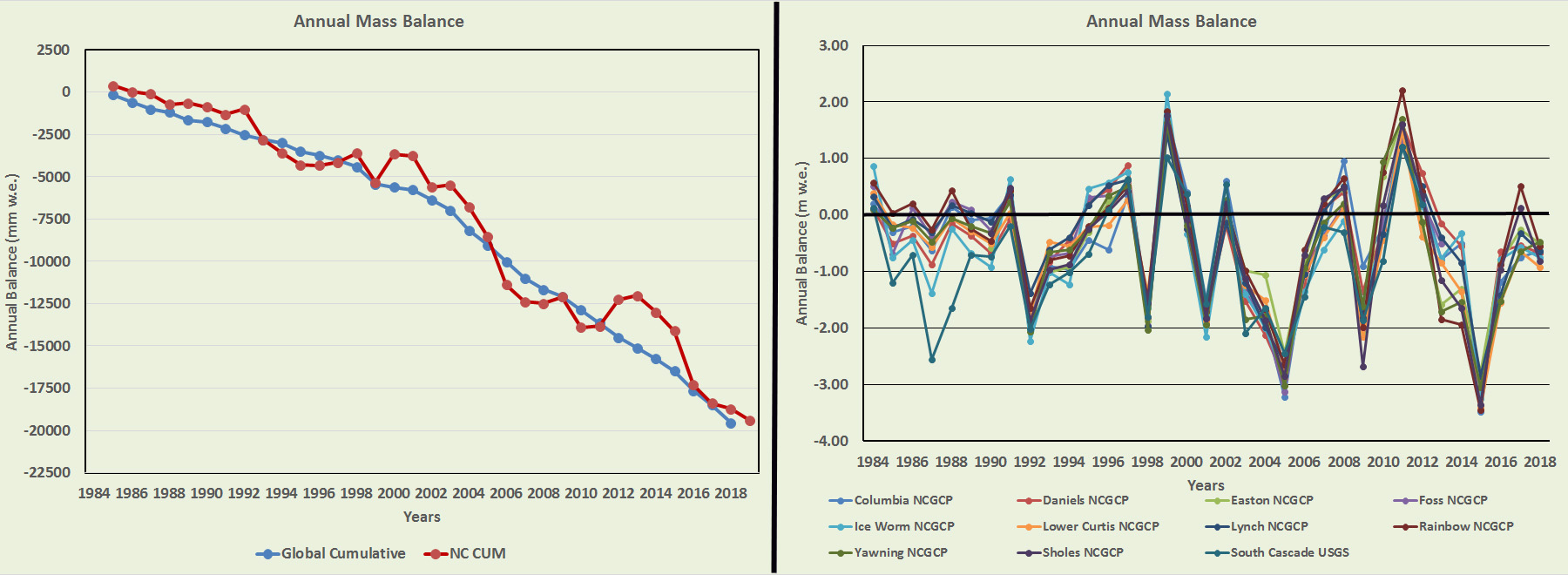
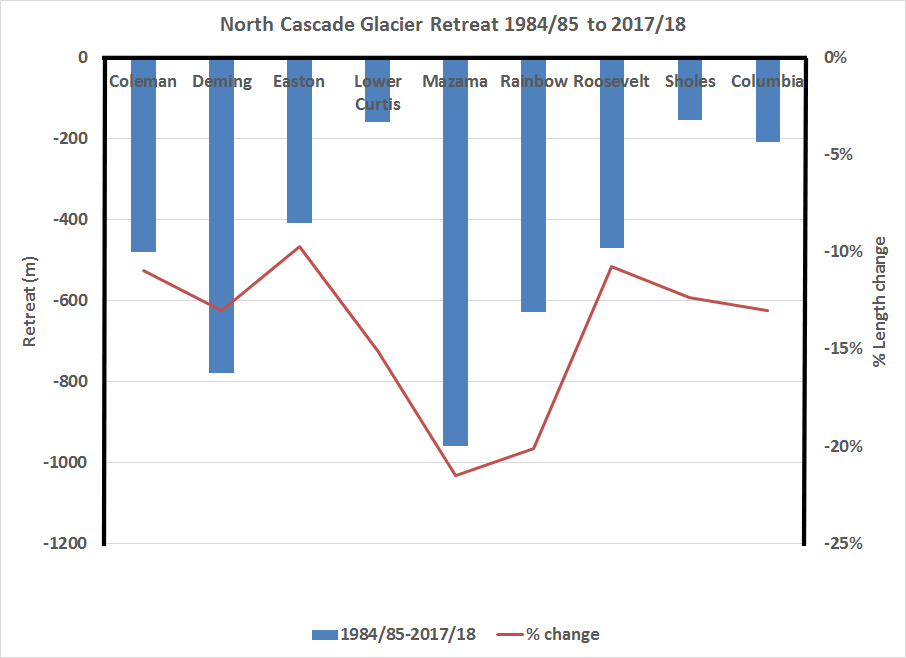
We assessed the mass balance of eight glaciers.  All eight will have significant negative mass balances in 2018, between -0.5 m and -1.0 m.  Retreat was measured on seven of the glaciers where the terminus was exposed, all had retreated since 2017 with the retreat ranging from 7-21 m. This continues the pattern of significant retreat each year that began in 2014. The overall length loss as a percentage of total length falls into a relatively narrow range of 10-22%.  The mass balance losses has also led to additional rock outcrops emerging in what had been the elevation of the accumulation zone.  We continued to measure runoff below Sholes Glacier and to assess crevasse depth.  The average crevasse depth in 2018 was 10 m, with the deepest at 16 m on Lower Curtis Glacier.

Annual  mass balance of North Cascade glaciers 1984-2018 (right).  Cumulative glacier mass balance from NCGCP compared to WGMS global cumulative mass balance.  Below is the retreat of selected North Cascade glaciers during the last 35 years, in meters and as a percentage of the total length.  Locations for all but Columbia Glacier are in image below. 

Mount Baker and Mount Shuskan glaciers identified in a Landsat image from 8-9-2018. Blue indicates mass balance and terminus change are observed.  Orange indicates only terminus change is observed. C=Coleman, D=Deming, E=Easton, LC=Lower Curtis, M=Mazama, N=Nooksack, P=Price, R=Rainbow, Rv=Roosevelt, SH=Sholes. 

Major Late July Meltdown on Lowell Glacier, Yukon

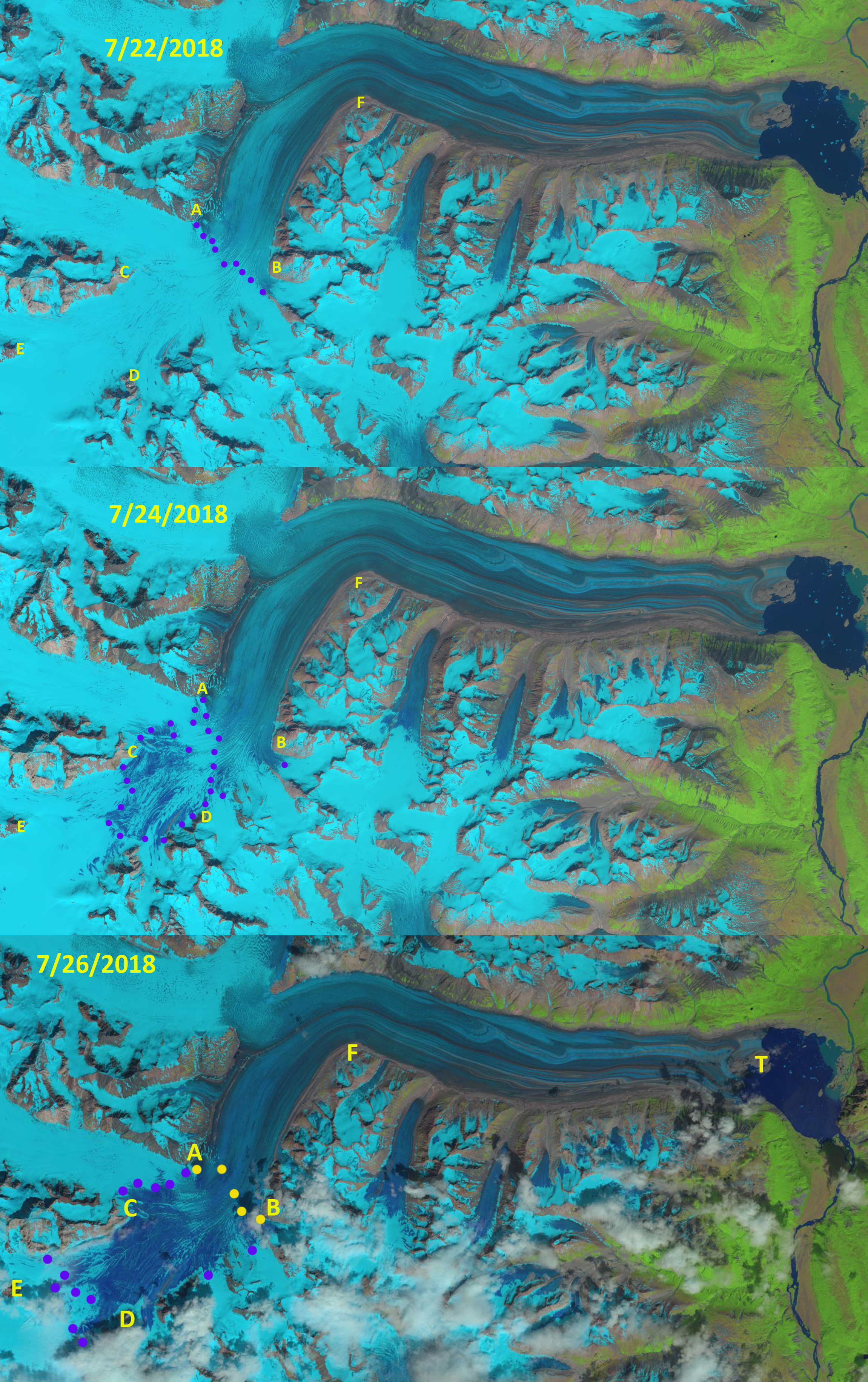
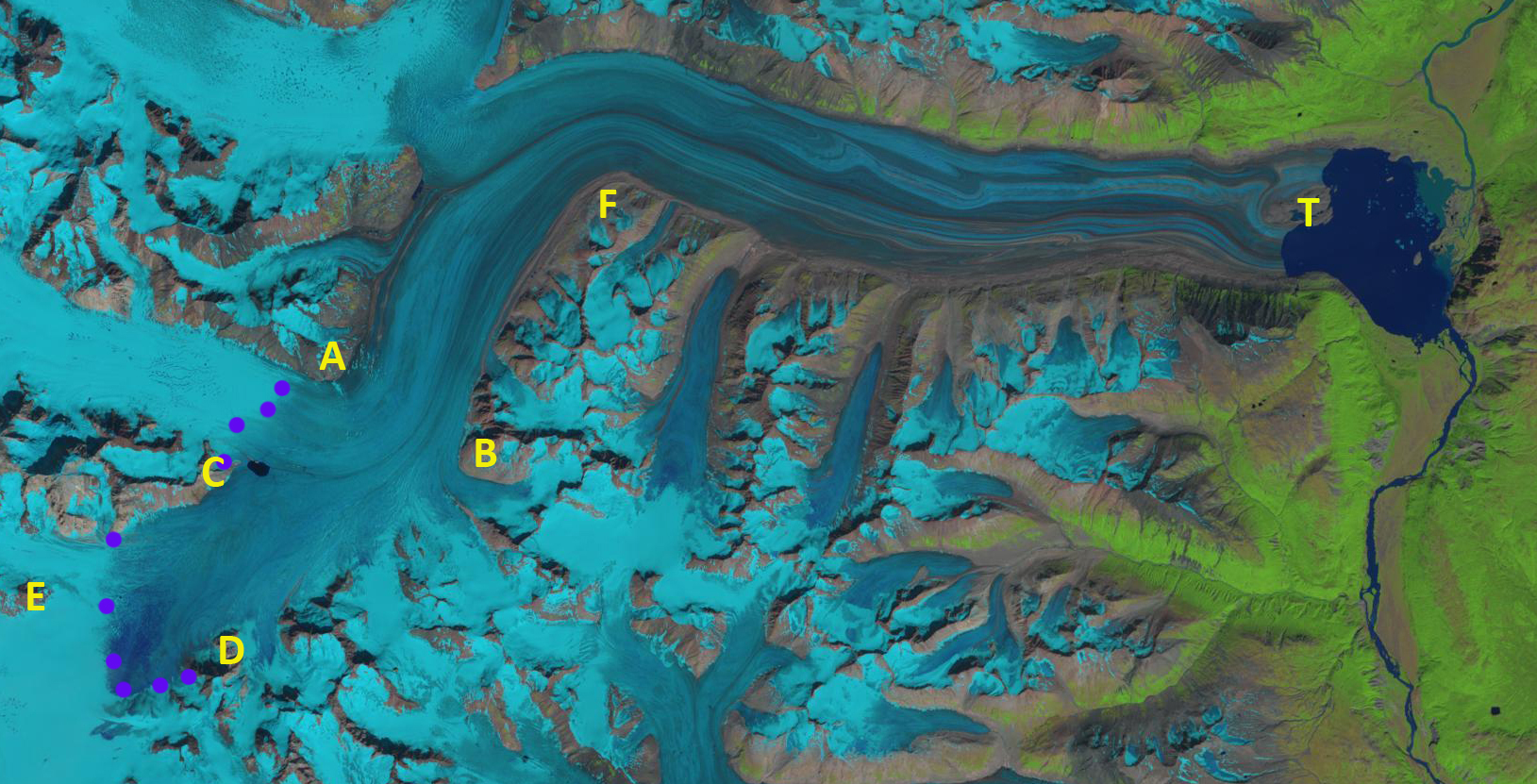
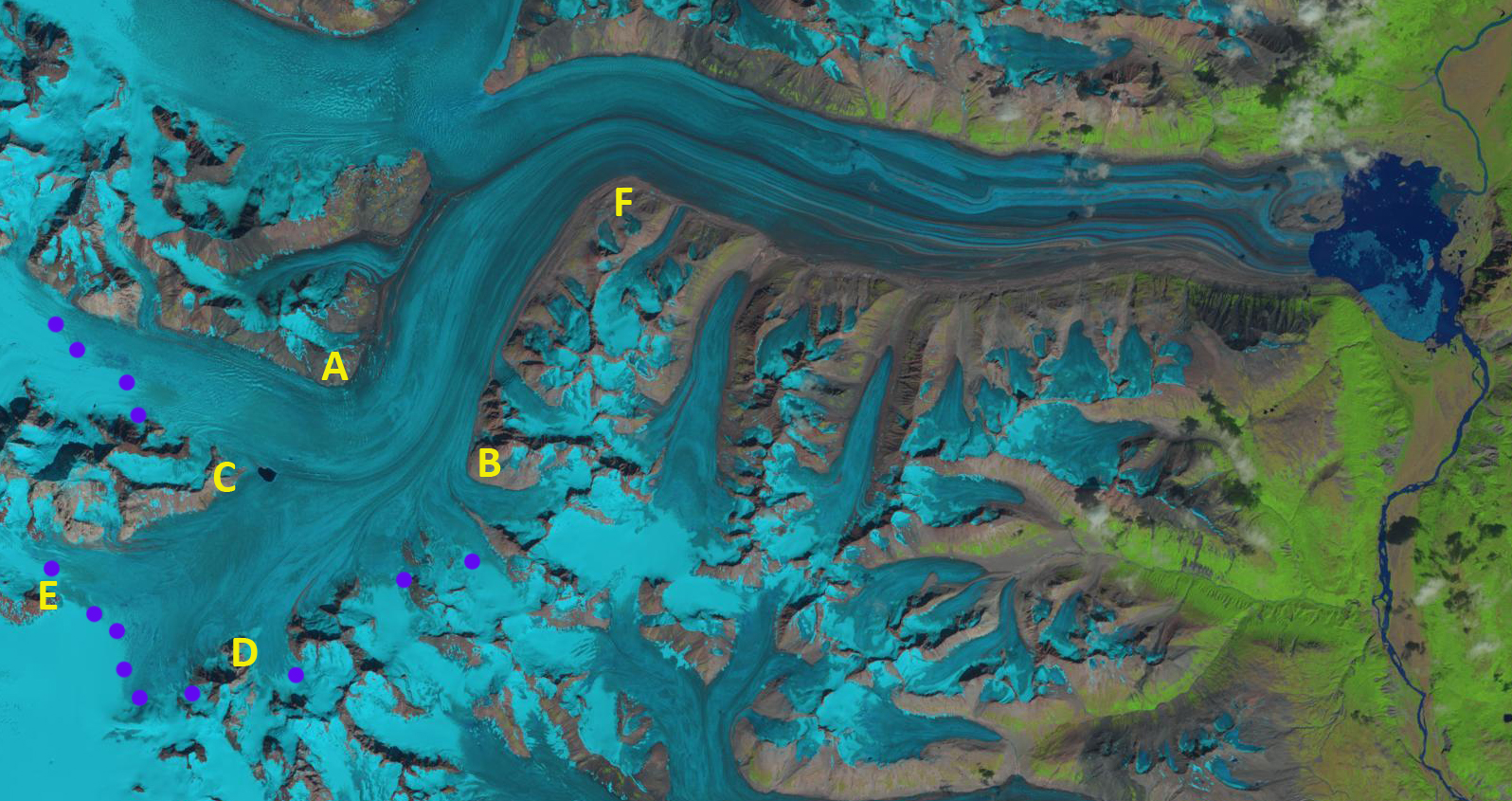
Lowell Glacier in Landsat images from 7/4, 7/26 and 8/11 with Sentinel images from 7/22 .  The snowline is shown with purple dots. Point A-F are fixed reference locations.  The snowline migrated upglacier 20 km and 300 m in elevation.  A significant snow swamp is between the yellow and purple dots on 7/26, that was not present on 7/22. 

The Lowell Glacier drains east from the St.Elias Range on the Yukon-Alaska border.  A sequence of images from July 4-Aug. 11 indicate the rapid snowline rise, with a particularly rapid transition from July 22-July 26.  During this period weather records from Haines Junction, Yukon indicate daily high temperatures of:  7/22=29.5 C, 7/23= 28.1, 7/24=26.8, 7/25=25.5, 7/26=25.1. This equates to project freezing levels above 4200 m each day.

(NASA Post follow up to this research)

On July 4th the transient snowline on Lowell Glacier was near Point F at 1240 m.  By July 22 the transient snowline had moved 9 km upglacier to 1400 m between Point A and B. Just two days later the region from 1400-1560 m an area of 40+square kilometers was under rapid transition with the snowline rising and an area of slush developing, saturated snowpack, really a “snow swamp”.  By July 26th the slush line was at 1520 to 1560 m, with the slush indicated by a royal blue color distinguishing it from the graying blue bare ice or old firn, and the white blue snow from the previous winter than was not fully saturated with water.  It is unusual to develop such a large “snow swamp” so quickly, this was accomplished by the rapid ablation due to the high temperatures. By Aug. 11th the transient snowline had shifted above this slush zone, with all of the saturated snow having ablated away, to Point E at 1560-1600 m.  The snowline in late summer of 2010, 2015 and 2017 also reached near Point E at an elevation of 1520-1600 m.  In 2015 and 2017 a supraglacial lake developed just east of Point C.  Another good example of a large snow swamp is in Svalbard on Hinlopenbreen. Taku Glacier, AK had the highest snowline in over 70 years of observation in 2018.

If a good image is acquired in September I will add to this post.  The consistently high late summer snowline, above 1500 m cannot sustain the Lowell Glacier, which will drive further retreat.  The retreat of this glacier be both enhanced and mitigated by surges, during the surge cylcle.  The glacier has surged five times since 1948 (Bevington and Copland, 2014).  The surge cycle has been getting shorter and will not offset the overall mass loss that will drive retreat, just as has occurred on Svalbard glaciers.

Sentinel from 7/22, 7/24 and Landsat from 7/26 indicating the change in snowline and snow swamp development, purple dots.  T indicates terminus of glacier.

Landsat image from 8/8/2017 indicating snowline near Point D and E at m on Lowell Glacier.

Landsat image from 8/3/2015 indicating snowline near Point D and E at m on Lowell Glacier.

Landsat image from 9/14/2010 indicating snowline near Point D and E at m on Lowell Glacier.


Alpine Glacier-BAMS State of the Climate 2017

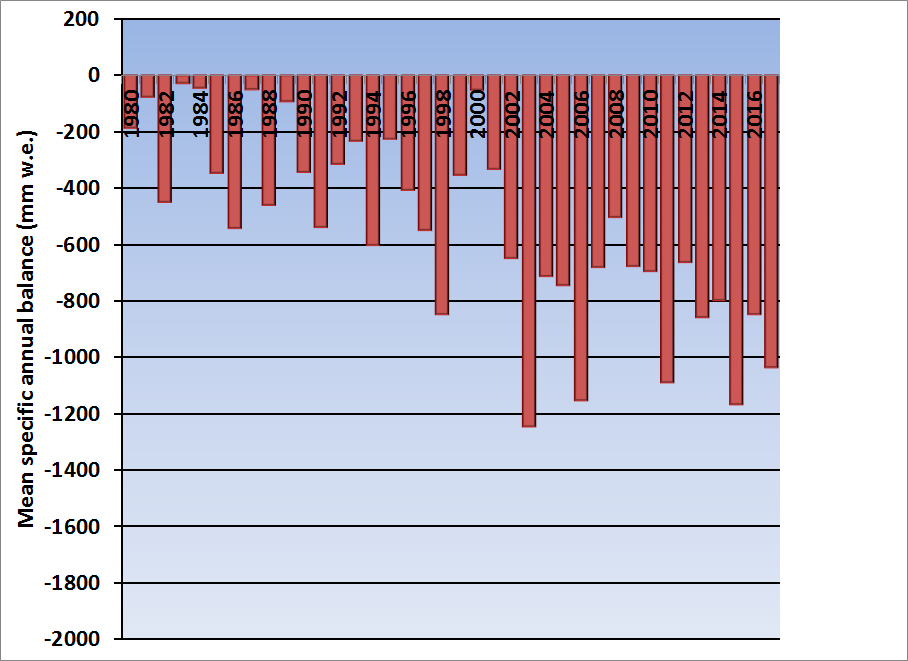
Global alpine glacier annual mass balance record of reference glaciers submitted to the World Glacier Monitoring Service, with 2017 continuing the trend of significant negative mass balance. 

The Bulletin of the American Meteorological Society: State of the Climate 2017 has been published.  Since 2008 I have written the chapter on alpine glaciers.

The World Glacier Monitoring Service (WGMS)record of mass balance and terminus behavior (WGMS 2017) provides a global index for alpine glacier behavior. Glacier mass balance is the difference between accumulation and ablation, reported here in mm of water equivalence. Mean annual glacier mass balance in 2016 was −847 mm for the 37 long-term reference glaciers and −761 mm for all 140 monitored glaciers. Of the reporting reference glaciers, only one had a positive mass balance. Preliminary data reported to the WGMS in 2017 from Austria, Canada, China, France, Italy, Kazakhstan, Norway, Russia, Switzerland, and United States indicate that 2017 will be the 38th consecutive year of negative annual balances with a mean loss of −1036 mm for 29 reporting reference glaciers, with three glacier reporting a positive mass balance (http://wgms.ch/latest-glacier-mass-balance-data/).

The ongoing global glacier retreat is currently affecting human society by raising sea levels, changing seasonal stream runoff, and increasing geohazards (Huss et al. 2017a). Huss and Hock (2018) indicate that approximately half of 56 glaciated watersheds globally have already passed peak glacier runoff. Rounce et al. (2017) identify the widespread expansion of glacier lakes due to retreat in Nepal from 2000 to 2015, which pose a glacier lake outburst flood hazard. Glacier retreat is a reflection of strongly negative mass balances over the last 30 years (Zemp et al. 2015). Marzeion et al. (2014) indicate that most of the recent mass loss, 1991–2010, is due to anthropogenic forcing.

The cumulative mass balance loss from 1980–2016 is −19.9 m, the equivalent of cutting a 22-m thick slice off the top of the average glacier .  The trend is remarkably consistent from region to region (WGMS 2017). WGMS mass balance based on 41 reference glaciers with a minimum of 30 years of record is not appreciably different from that of all glaciers at −19.1 m. The decadal mean annual mass balance was −228 mm in the 1980s, −443 mm in the 1990s, −676 mm for 2000s, and –896 mm for 2010–17 (WGMS 2017). The declining mass balance trend during a period of retreat indicates alpine glaciers are not approaching equilibrium and retreat will continue to be the dominant terminus response.

Exceptional glacier melt was noted across the European Alps, leading to high snowlines and contributing to large negative mass balance of glaciers on this continent (Swiss Academy of Sciences 2017). In the European Alps, annual mass balance has been reported for nine reference glaciers from Austria, France, Italy, and Switzerland. All had negative annual balances: exceeding −1000 m with a mean of −1664 mm. This continues the pattern of substantial negative balances in the Alps that continue to lead to terminus retreat. In 2016, in Switzerland 94 glaciers were observed: 82 retreated, 7 were stable, and 5 advanced (Huss et al. 2017b). In 2016, Austria observed 90 glaciers: 87 retreated, 2 were stable, and 1 advanced; the average retreat rate was 14 m (Fischer 2017).

In Norway and Svalbard, terminus fluctuation data from 36 glaciers with ongoing assessment, indicates that in 2016 32 retreated, 3 advanced, and 1 was stable. The average terminus change was −12.5 m (Kjøllmoen, 2017). Mass balance surveys with completed results are available for nine glaciers; seven of the nine had negative mass balances with an average loss of −80 mm w.e.

In western North America data have been submitted from eight reference glaciers in Alaska and Washington in the United States, and British Columbia in Canada. Seven of the eight glaciers reported negative mass balances with a mean loss of −1020 mm. Winter and spring 2017 had above-average snowfall, while ablation conditions were above average. In Alaska mass losses from 2002 to 2014 have been −52 ± 4 gigatons yr−1, as large as any alpine region in the world (Wahr et al. 2016).

In the high mountains of central Asia four glaciers reported data from China, Kazakhstan, and Nepal. All four were negative, with a mean of −674 mm. This is a continuation of regional mass losses, such as reported by King et al. (2017) who found for 2000–15 the mean annual mass balance of 32 glaciers in the Mount Everest region was −520 ± 220mm.


Landsat image from 8/19/2017 illustrating the snowline on Mont Blanc glaciers with one month left in the melt season (M=Mer de Glace, A=Argentière, S=Saleina, L=Le Tour, T=Trient)


How Unusual Was 2015 in the 1984–2015 Period of the North Cascade Glacier Annual Mass Balance?

Sholes Glacier during the first week of August 2015 versus and average year such as in 2017.  Note stream gage and weather station at this site. The greater extent of bare ice enhances ablation as for a given temperature there is a higher ablation rate for ice then snow. Columbia Glacier a WGMS reference glacier viewed from above the glacier at Monte Cristo Pass at the start of August in 2015 and 2016.  Note the lack of retained snow in 2015 and the multiple firn layers exposed. 

This post is a shortened version of the publication out this week in Water.

In 1983, the North Cascade Glacier Climate Project (NCGCP) began the annual monitoring of the mass balance on 10 glaciers throughout the Washington mountain range, in order to identify their response to climate change. Annual mass balance (Ba) measurements have continued on seven original glaciers, with an additional two glaciers being added in 1990. The measurements were discontinued on two glaciers that  disappeared and one was that separated into several sections. This comparatively long record from nine glaciers in one region, using the same methods, offers some useful comparative data in order to place the impact of the regional climate warmth of 2015 in perspective.  This led to the most negative annual balance of the last 26 years on every glacier.

2015 Climate

The 2015 winter accumulation season featured 51% of the mean (1984–2014) winter snow accumulation at six long-term USDA SNOTEL stations in the North Cascades, namely, Fish Creek, Lyman Lake, Park Creek, Rainy Pass, Stevens Pass, and Stampede Pass. This was exceptional as it was the second lowest out of the 32 years of the mass balance observation series. The winter season was exceptional for warmth, being the warmest winter season on record in the state of Washington. The freezing level in 2015 averaged 1645 m in the Mount Baker region from November–March, compared with an average of 1077 m (John Abatzoglou, Freezing Level Tracker). The previous record for the mean November–March freezing level, since the record began in 1948, was 1500 m.

Freezing Level November-March on Mount Baker, WA from Freezing Level Tracker 1948-2017.

In 2015, the mean May–September temperature at Diablo Dam was 2.2 °C warmer than the long term mean, and it was the second warmest to 1958 in the 1950–2015 record. For June–September, the mean temperature was 2.0 °C warmer than the long term mean, and was also second to 1958 as the warmest. The combination of the warmest melt season in over 50 years and the second lowest accumulation season snowpack in the last 30 years was a good indication that the glacier mass balance would be quite negative.
In 2015, the sea surface temperature waters that had developed in the winter of 2013/14, persisted off the coast of the Pacific Northwest, with anomalies generally exceeding 2 °C (Di Lorenzo and Mantua, 2016)

Glacier Mass Balance 2015

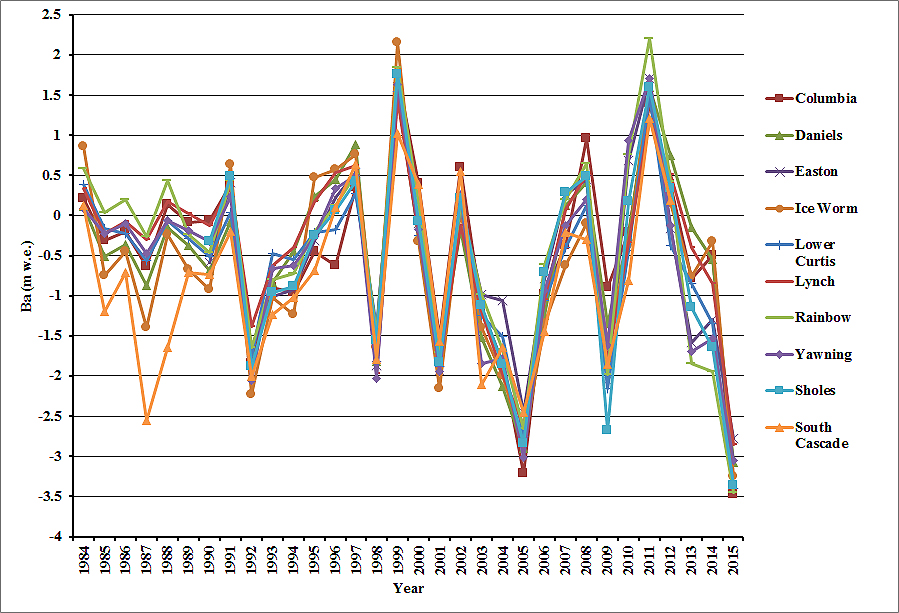
The mean annual balance of the NCGCP glaciers is reported to the World Glacier Monitoring Service (WGMS), with two glaciers, Columbia and Rainbow Glacier, being reference glaciers.  The mean Ba of the NCGCP glaciers from 1984 to 2015, was −0.54 m w.e.a−1 (water equivalent per year), ranging from −0.44 to −0.67 m w.e.a−1 for individual glaciers. In 2015, the mean Ba of nine North Cascade glaciers was −3.10 m w.e., the most negative result in the 32-year record. The correlation coefficient of Ba was above 0.80 between all North Cascade glaciers, indicating that the response was regional and not controlled by local factors. In 2015, out of the nine glaciers where the Ba was examined, the AAR was 0.00 on seven of the glaciers, 0.05 on the Rainbow Glacier, and 0.26 on the Easton Glacier. For each glacier, the 2015 Ba was the most negative of any year in their entire record. The South Cascade Glacier had a negative mass balance of −2.72 m w.e. in 2015, which was the most negative Ba reported since the suite of continuous mass balance measurements began in 1959 [USGS, 2017].  The probability of achieving the observed 2015 Ba of −3.10 is 0.34%.
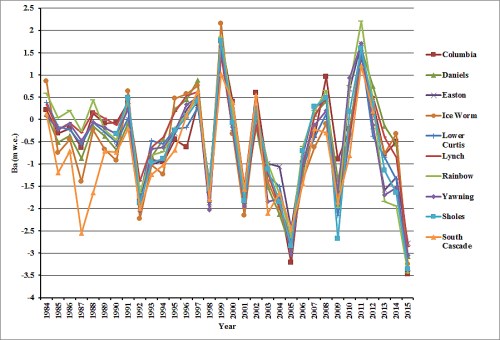
 
Annual mass balance of North Cascade glaciers, note the similar annual response indicating regional climate conditions are the overriding driver of mass balance. 

On June 15, when the automatic weather station and discharge station were installed adjacent to the Sholes Glacier, the snowpack was similar to a typical early August snow cover. On the Sholes Glacier, the AAR fell from 0.55 on 9 July to 0.00 on 9 September. This was the first year since the monitoring had begun in 1984 that the mean AAR in early August was below 0.25. The result was an exposure of the older firn layers and a general decrease in albedo. In early August, the AAR was below 0.1 for all of the glaciers, except for the Easton Glacier. On the Columbia Glacier, the AAR on August 1 was the lowest observed yet at 0.12, with six weeks remaining in the melt season. The early exposure of glacier ice was important as the melt rate was faster, as was indicated by the greater melt factor.  The North Cascade mass balance cumulatively over the last 30 years matches closely the global mean mass balance loss.

Map of North Cascade glaciers observed in this study. 
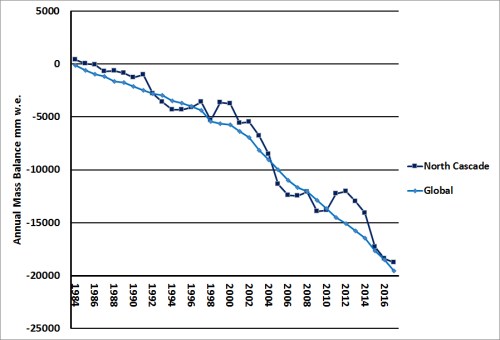
Comparison of North Cascade cumulative and Global cumulative glacier mass balance


Lower Curtis Glacier Annual Terminus Response to Climate Change

Side view of Lower Curtis Glacier in 2013, 2015 and 2017, illustrating the reduced slope and height of glacier front in just four years.

Terminus observations have been reported to the WGMS from 2500 glaciers with 46,500 specific observations since the late 19th century, which you can explore with the glacier viewer application. Here we examine what it looks like to report from a glacier each year.  I have visited this glacier 34 consecutive years, each time camping in a tent near the glacier, a fun spot indeed when the weather cooperates. The Lower Curtis Glacier is an avalanche fed cirque glacier on Mount Shuksan in the North Cascades of Washington. It is a south facing and low elevation glacier for the range. This is an unusual combination that is supported by the heavy accumulation via avalanching from the upper slopes of Mount Shuksan. The glacier displays a magnificent set of annual layers in its terminus tongue. The terminus tongue is a spectacular wall of seracs that quickly rises 55 m above the bedrock. There are typically 50 layers visible indicating that this most of the ice in the glacier is 50 years of less in age.

Lower Curtis Glacier Front in 2007 and 2017 taken from same location.  Both retreat and thinning of the front in the decade is evident. 

From 1908 to 1950 the glacier retreated from the valley bottom into the cirque. The glacier advanced from 1950-1985 down slope and has retreated since.  Each year we survey the terminus location, measure the mass balance and survey the glacier surface elevation on a cross profile. Here we report on the annual terminus survey from 2007-2017.  The frontal change reported to the World Glacier Monitoring Service has been 2007=-13 m, 2008=-17 m, 2009=-20 m, 2010=-7 m, 2011=-5 m, 2012=-6 m, 2013=-5 m, 2014=-12 m, 2015=16 m, 2016=-16 m and 2017=12 m. This is a total of 129 m of retreat in 11 years, nearly 12 m per year. A longitudinal profile up the middle of the glacier indicates that it thinned 30 meters from 1908-1984 and 22 m from 1985-2016. Because of its heavy accumulation via avalanching the glacier moves rapidly and is quite crevassed at the terminus with large high seracs at the glacier front. In 2007 the height of the terminus seracs was 45 m, by 2014 the seracs were 37 m high and in 2017 had shrunk to 26 m high and not as steep.  The imposing tongue has certainly diminished. The glacier retreat fits the pattern in the region, with all Mount Baker a glaciers retreating (Pelto, 2015).

From a Glaciologists Perspective AGU Day 3

Snapshot of day 3  of Glaciology poster presentations at AGU.  The amount of glaciology research is impressive, there is much we do not know.  We can no longer say that we know very little about any aspect or region.  Before saying that explore the vast literature that is now available.

Jeff La Freniere at Gustavus Adolphus College used several new technologies,  aerial and terrestrial LIDAR and structure-from-motion photogrammetry from drones make mass balance measurements using geodetic approaches increasingly feasible in remote mountain locations like Volcán Chimborazo, Ecuador. The result combined with a unique, 5-meter resolution digital elevation model derived from 1997 aerial imagery, reveal the magnitude and spatial patterns of mass balance behavior over the past two decades. Above are the results they found more specifically that on the Hans Meyer Glacier terminus, the mean surface elevation change since 1997 has been nearly 3 m yr-1, while on the lower-elevation Reschreiter Glacier the mean elevation change has been approximately 1 m yr-1 .

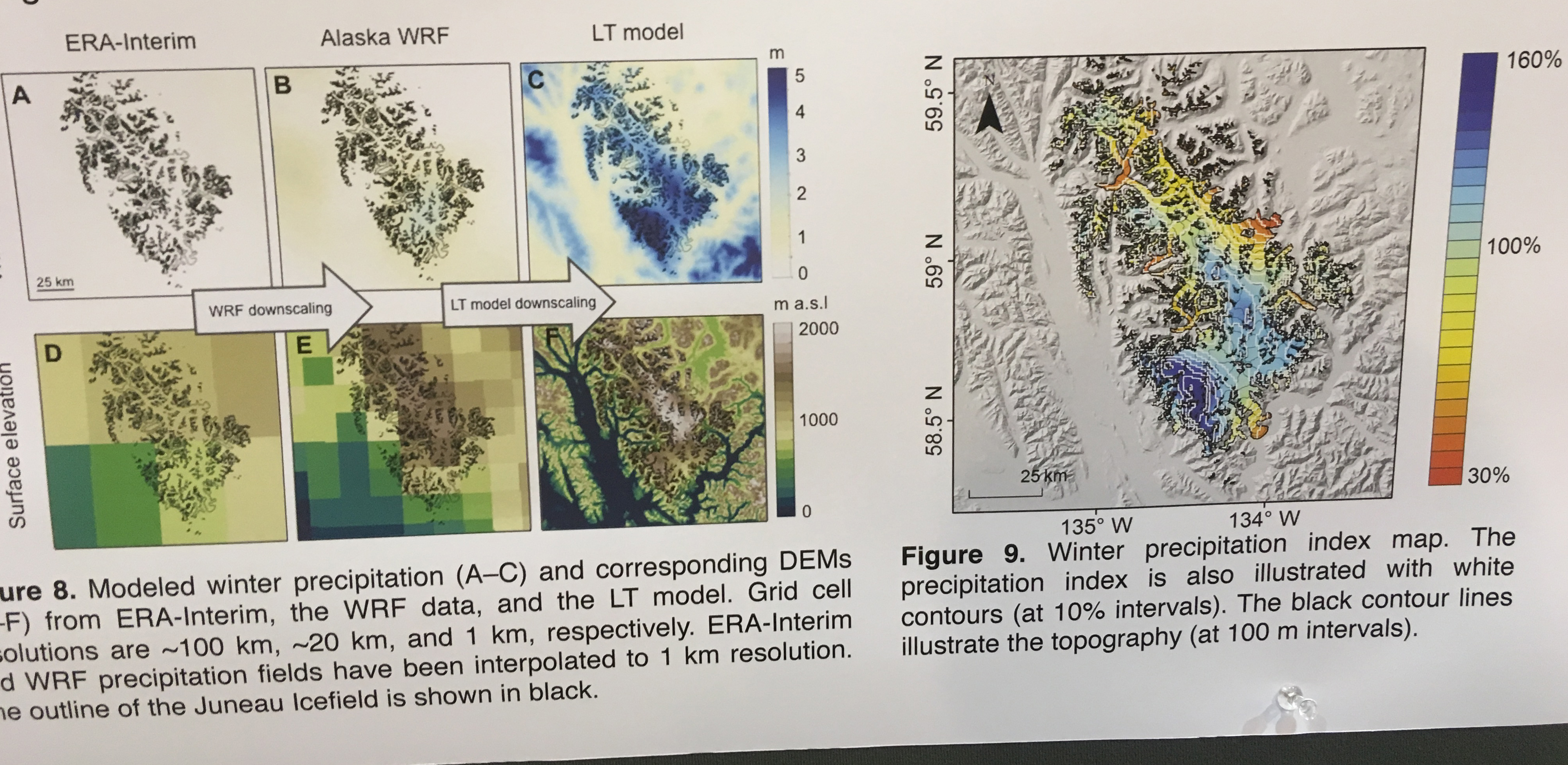
Aurora Roth, University of Alaska Fairbanks  developed and applied a linear theory of orographic precipitation model to downscale precipitation to the Juneau Icefield region over the period 1979-2013. This LT model is a unique parameterization that requires knowing the snow fall speed and rain fall speed as tuning parameters to calculate cloud time delay. The downscaled precipitation pattern produced by the LT model captures the orographic precipitation pattern absent from the coarse resolution WRF and ERA-Interim precipitation fields. Key glaciological observations were used to calibrate the LT model. The results of the reference run showed reasonable agreement with the available glaciological measurements, which is what glacier mass balance observations have shown. The precipitation pattern produced was consistent regardless of horizontal resolution, and climate input data, but the precipitation amount varied strongly with these factors.  The import is to help model mass loss from glaciers in Southeast Alaska which will alter downstream ecological systems as runoff patterns change. 

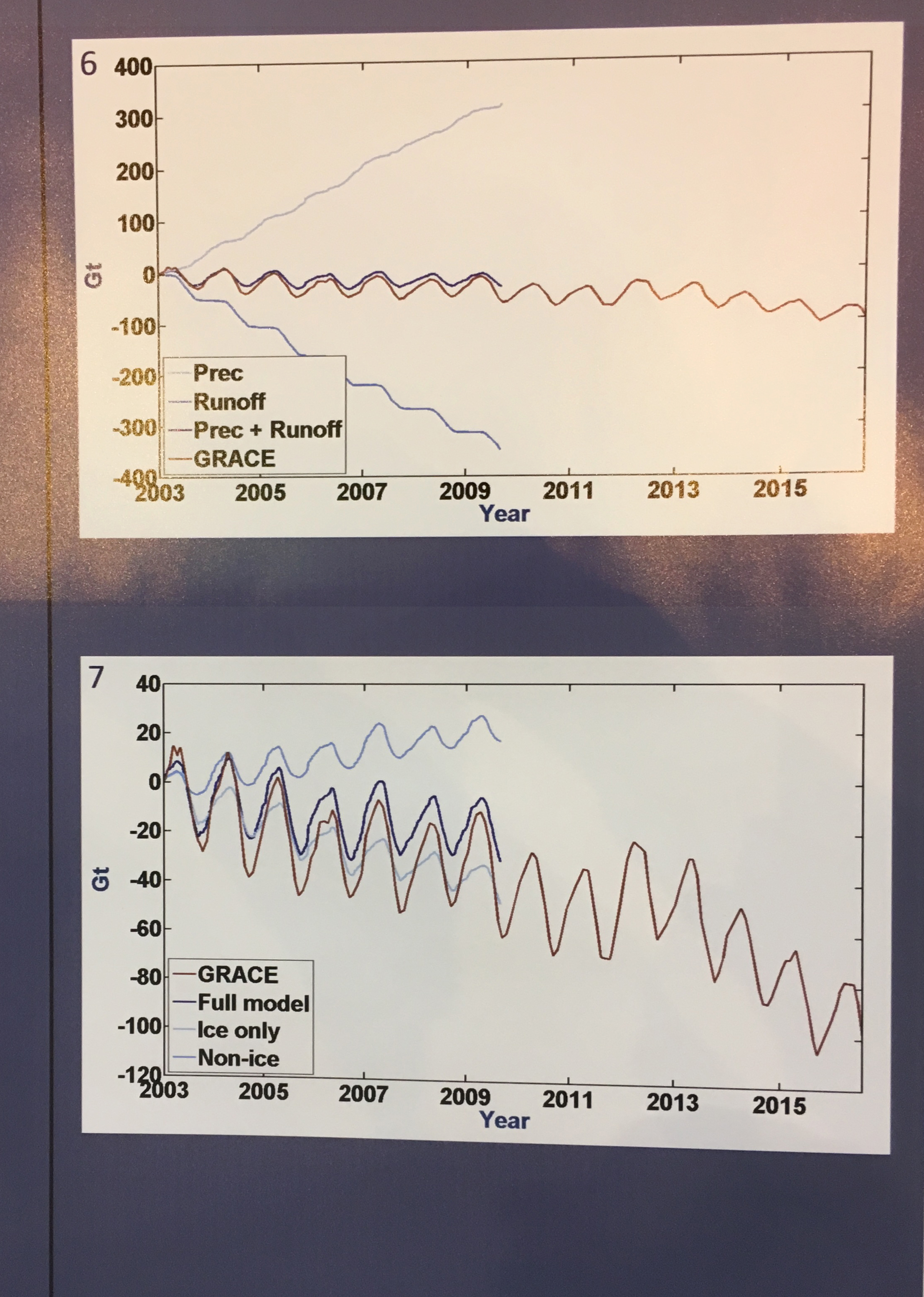
Joanna Young, University of Alaska Fairbanks  focuses on partitioning GRACE glacier mass changes from terrestrial water storage changes both seasonally and in long-term trends using the Juneau Icefield, which has long term glacier mass balance data, as a case study for . They leverage the modeling tool SnowModel to generate a time series of mass changes using assimilated field observations and airborne laser altimetry, and  compare to GRACE solution from the NASA Goddard Space Flight Center Geodesy Laboratory .  This is one of the first to analyze GRACE at the sub-mountain range scale, and to examine terrestrial water storage trends at a smaller scale than the full Gulf of Alaska. The figure above looks at subannual and long-term changes of the Juneau Icefield from 2003 to present.
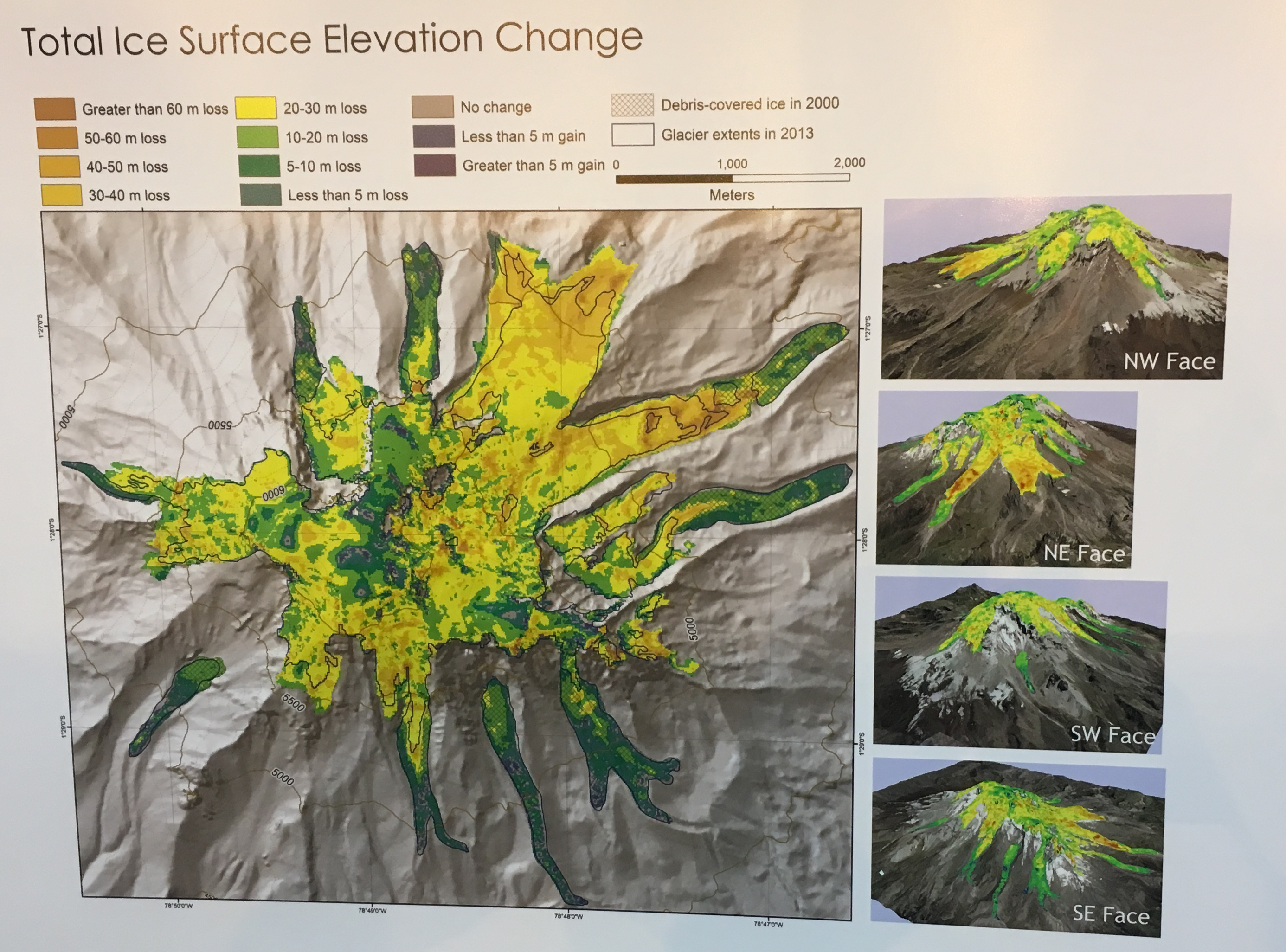
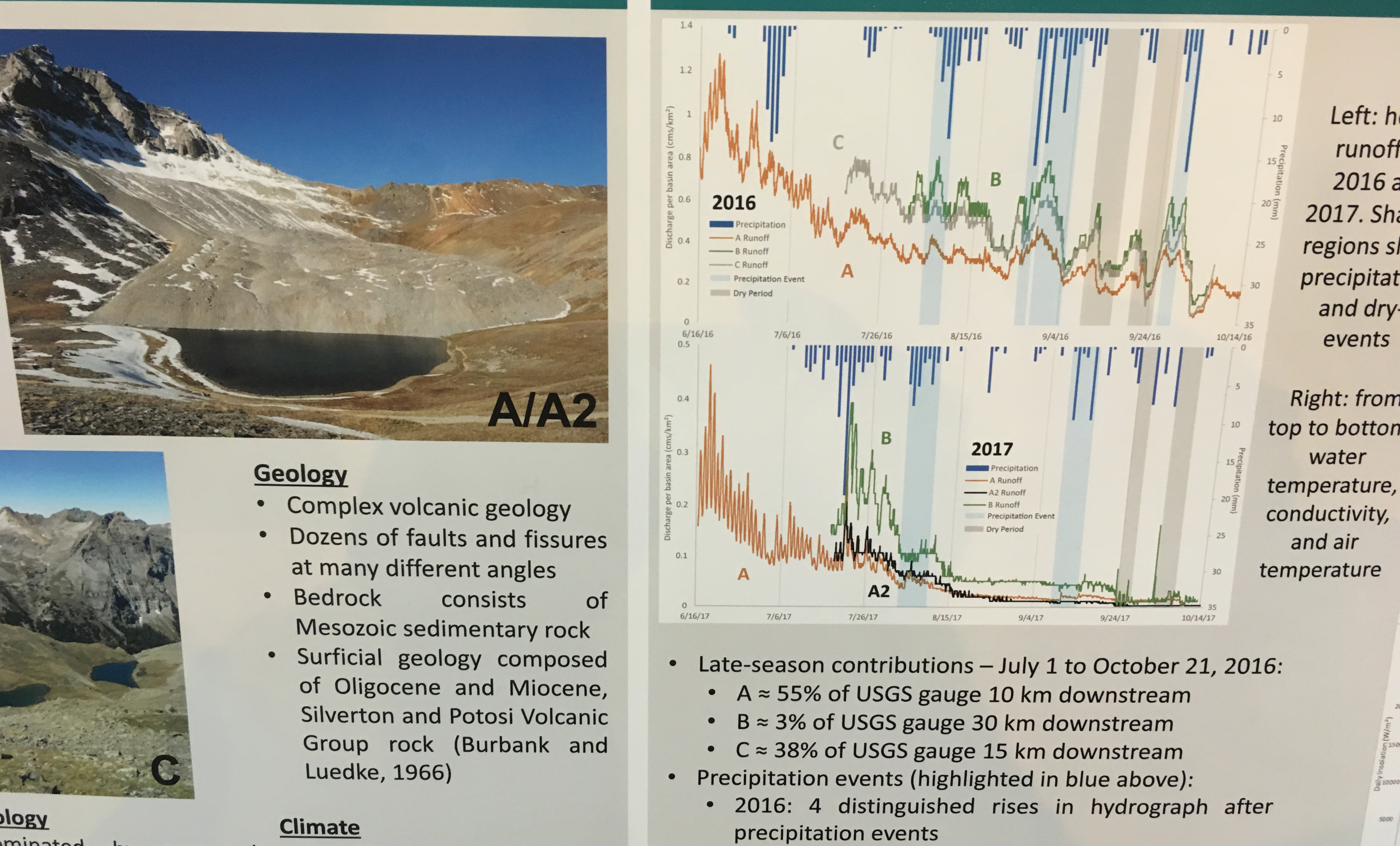
Emilio Ian Mateo, University of Denver  Looked at rock glaciers in the San Juan Mountains of Colorado examining how slope aspect and rising air temperatures influenced the hydrological processes of streams below rock glaciers. Detailed findings  illustrated above from 2016 and 2017 show that air temperature significantly influenced stream discharge below each rock glacier. Discharge and air temperature patterns indicate an air temperature threshold during late summer when rock glacier melt increased at a greater rate. The results suggest that slope aspect influences stream discharge, but temperature and precipitation are likely the most components of the melt regimes. 

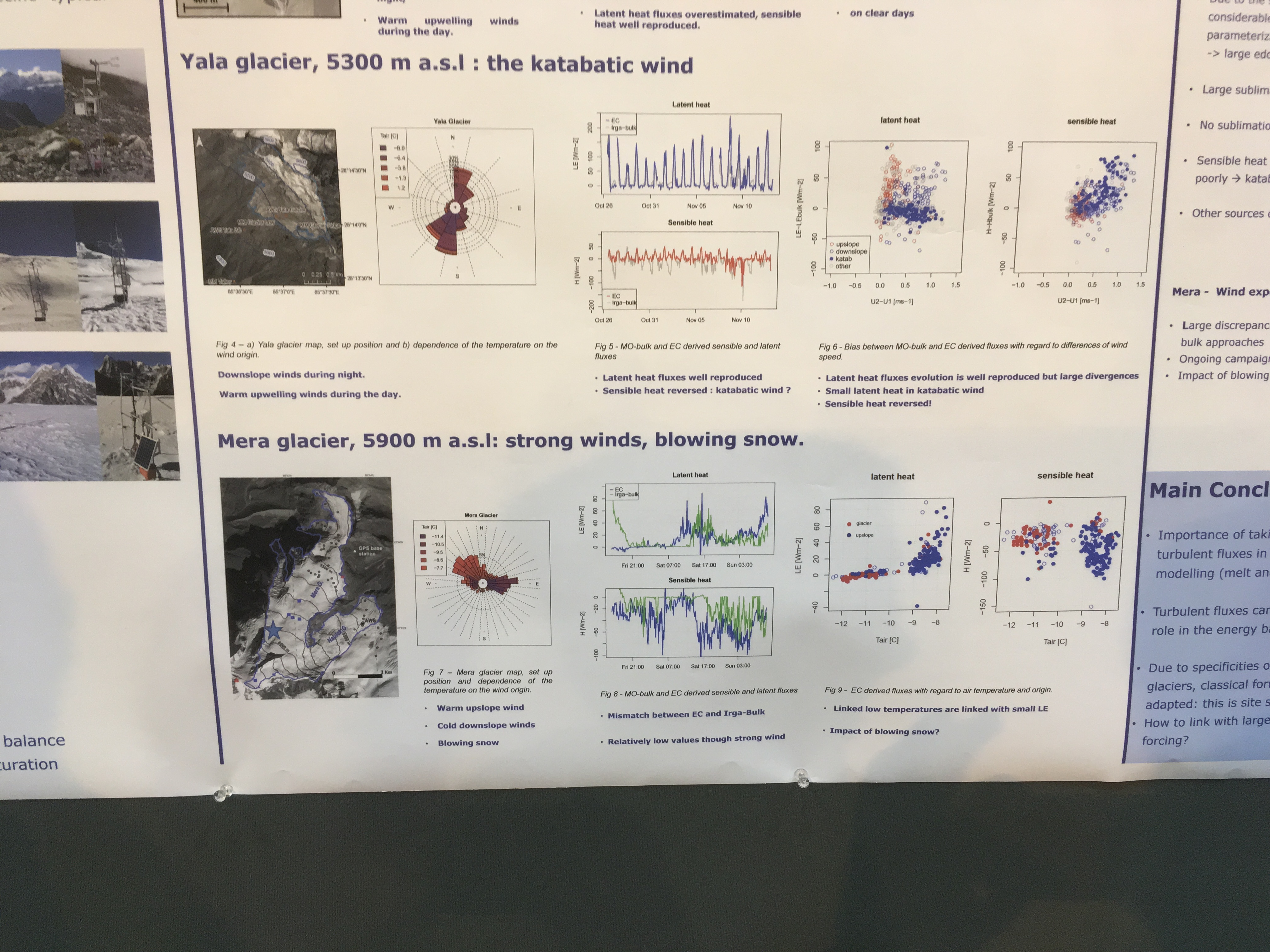
Maxime Litt, Utrecht University installed an eddy-correlation system (Campbell IRGASON) during a period of 15 days over the Lirung glacier in the Langtang Valley in Nepal , during the transition period between the monsoon and the dry season to examine surface energy balance.  Results are also reported from Mera Glacier and Yala Glacier. At Lirung Glacier during the day, moderate winds blow up-valley and the atmospheric surface layer is unstable. Latent (sensible) heat fluxes scale between 50 and 150 (50 and 250) Wm– 2 during the day, thus drying and cooling the debris and significantly impact SEB. At night, weak down-glacier winds are observed and fluxes remain weak. Yala and Mera Glacier are different environments and illustrate the variations in position on SEB.

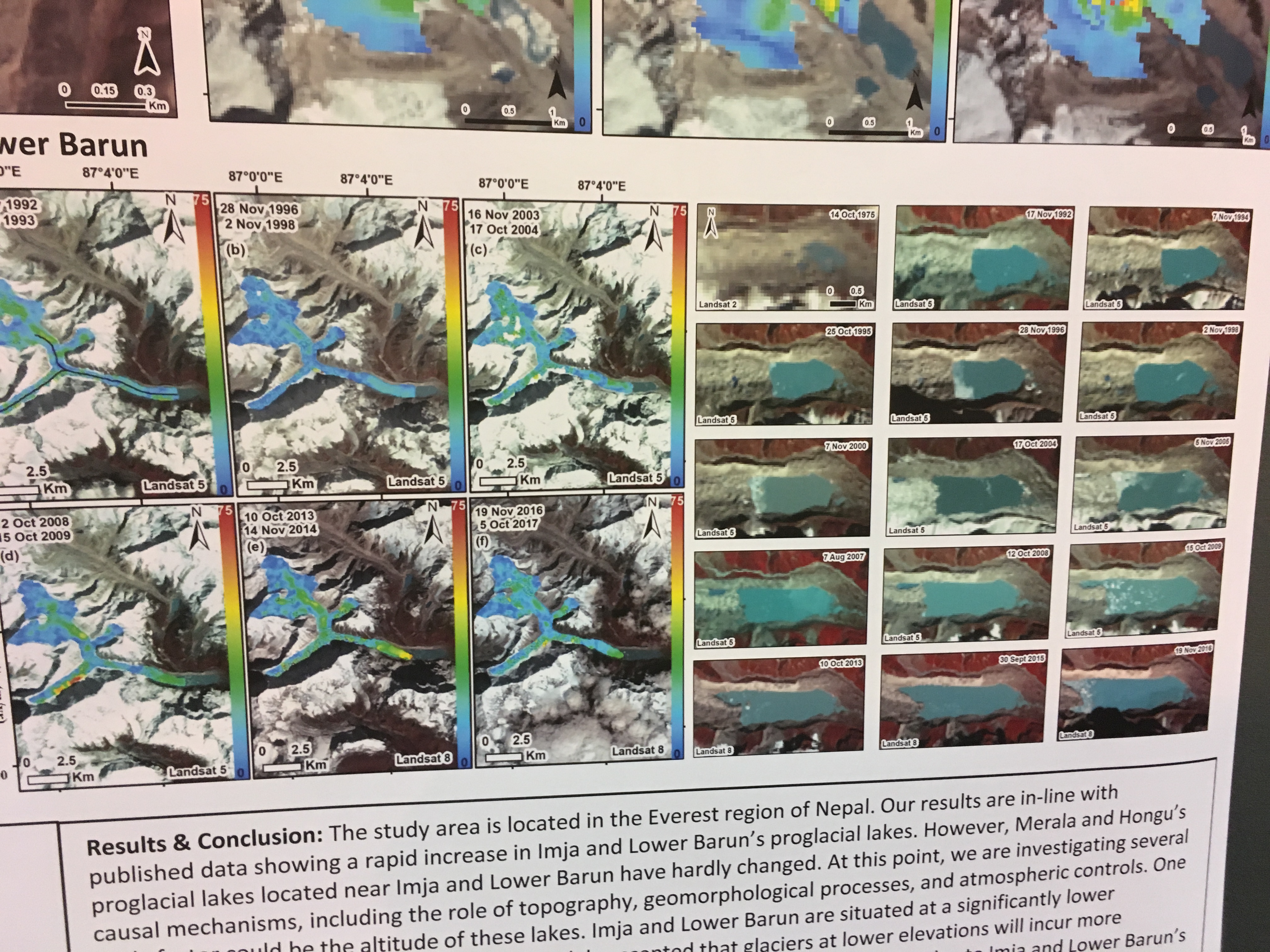
Katherine Strattman, University of Dayton reported on a study of the  Imja, Lower Barun, and Thulagi Glaciers in the Nepal Himalaya. The retreat of the glaciers has led to proglacial lakes continuing to dramatically increase in area. They used Landsat, ASTER, and Sentinel satellite imagery to study the conditions of these glaciers. They assessed interannual changes in surface ice velocity from the early 1990s to present. They found both long-term and short-term velocity variations.  Satellite imagery indicates the three lakes exhibit three contrasting trends of lake growth: Imja Lake has a strong accelerating growth history since the 1960s, Lower Barun a very slow accelerating growth, and Thulagi a decelerating growth, even as the glaciers of all three lakes have thinned. Above is the velocity of Barun Glacier showing velocity changes and growth of the lake.

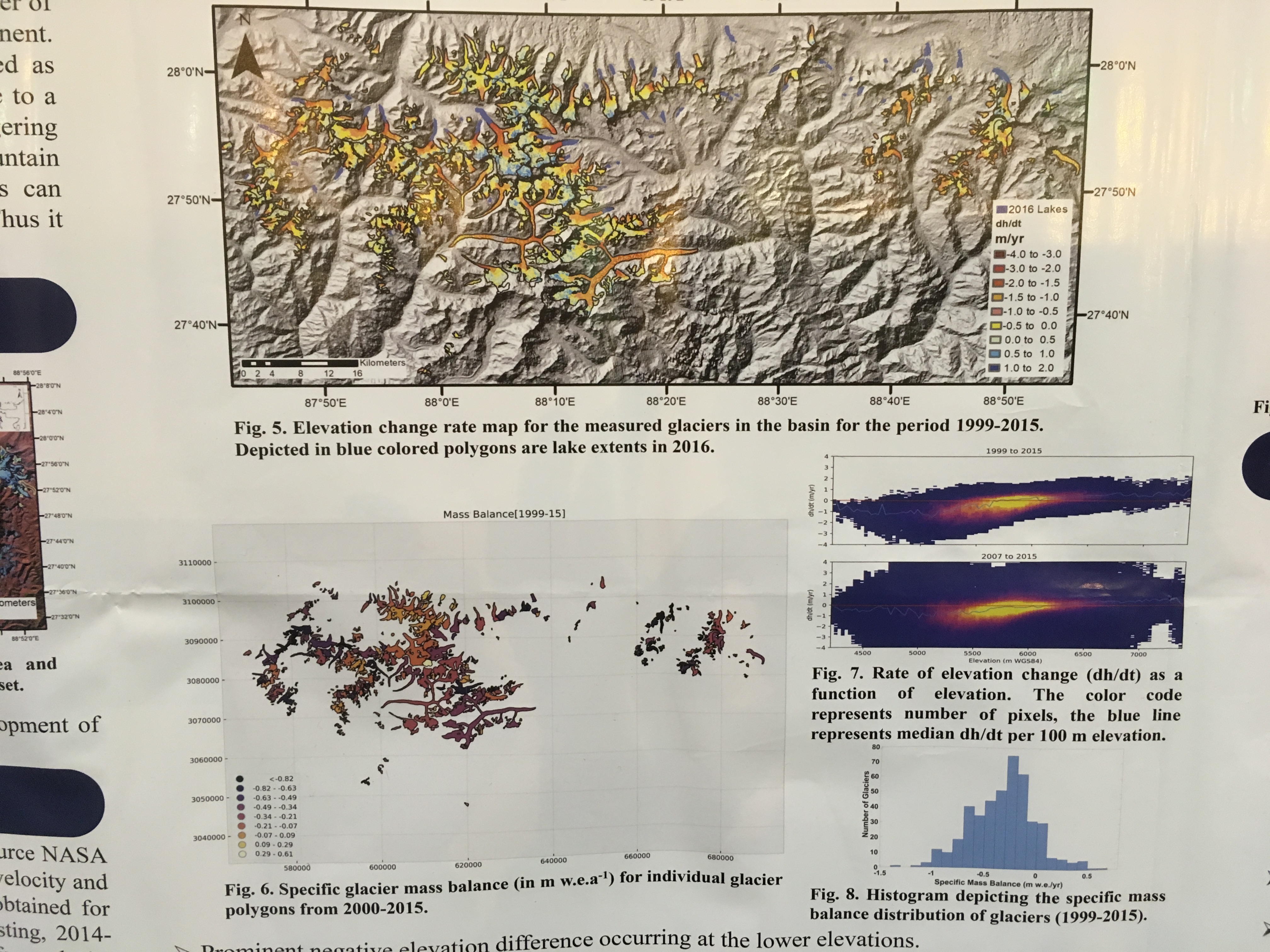
Shashank Bhushan, Indian Institute of Technology Dhanbad developed a hazard assessment of  moraine dammed glacial lakes in Sikkim Himalayas. They generated high-resolution DEMs using the open-source NASA Ames Stereo Pipeline (ASP) and other open-source tools to calculate surface velocity and patterns of glacier downwasting over time. Geodetic glacier mass balance was obtained for three periods using high-resolution WorldView/GeoEye stereo DEMs, Cartosat-1 stereo DEMs and SRTM. Initial results revealed a region-wide negative annual mass balance of -0.31± m w.eq. for the 2007-2015 period. 
From a Glaciologists Perspective AGU Day 2

It has been 30 years since my first experience at the AGU, at that time glaciology and the cryosphere played a small role.  Today that is clearly not the case.  Today just a glimpse of a few of the many interesting glaciers studies are provided to again illustrate the vast array and amazing detail of work being conducted.

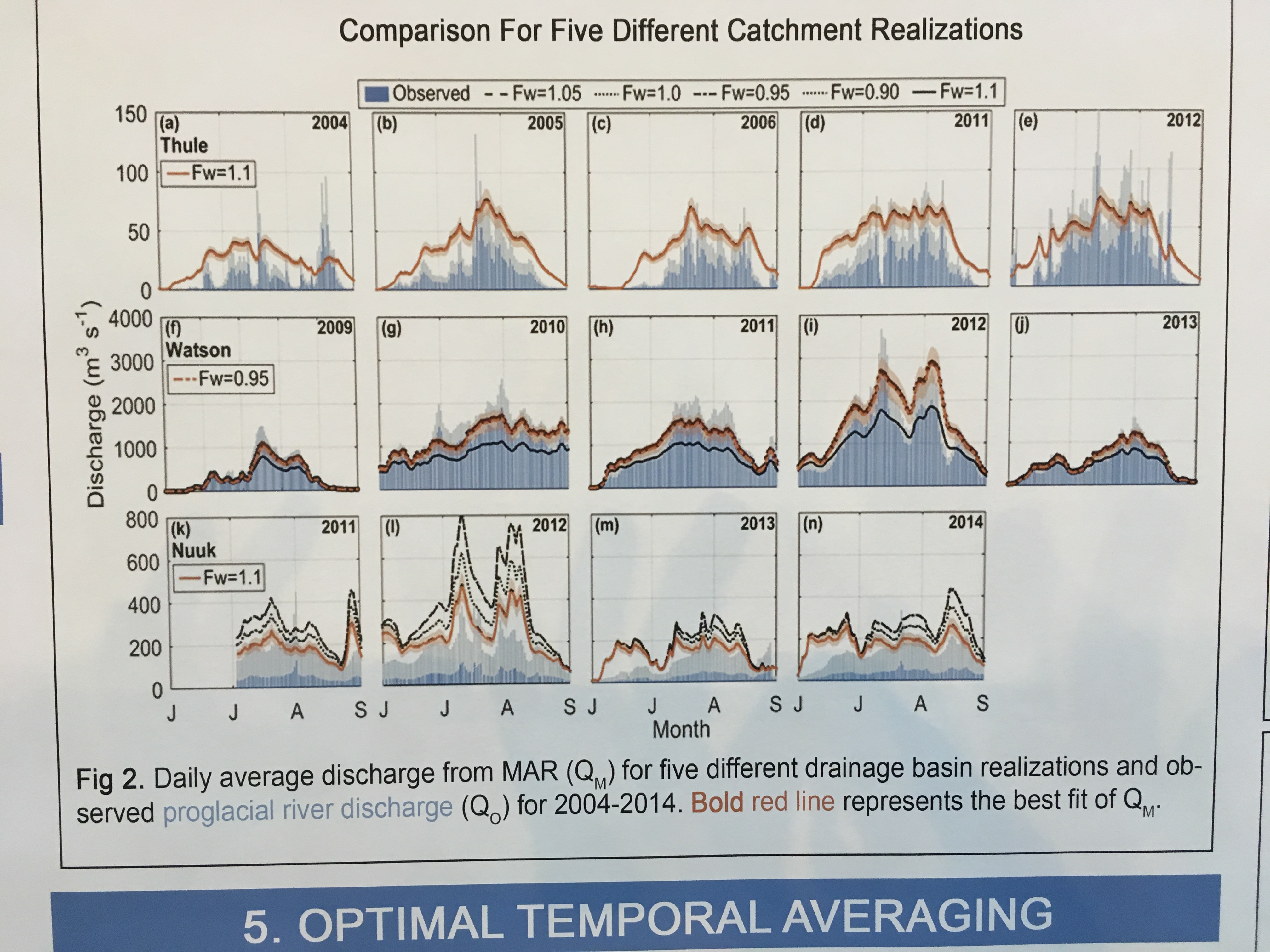
Samiah Mustafa, Brown University presented research looking at the ability of a melt model to generate accurate discharge at three watersheds in West Greenland; North River (Thule), Watson River (Kangerlussuaq), and Naujat Kuat River (Nuuk). In each watershed they modeled melt at daily, 5, 10 and 20 day time scales.  They found Nuuk and Thule basins did not do well at a daily time scale, but do capture variability over 5-, 10-, and 20-day means (r2 > 0.7). Results at Watson River were in good agreement at each time scale. Model agreement with river flow data  is reduced during periods of peak discharge, particularly for the exceptional melt and discharge events of July 2012 evident in chart above.

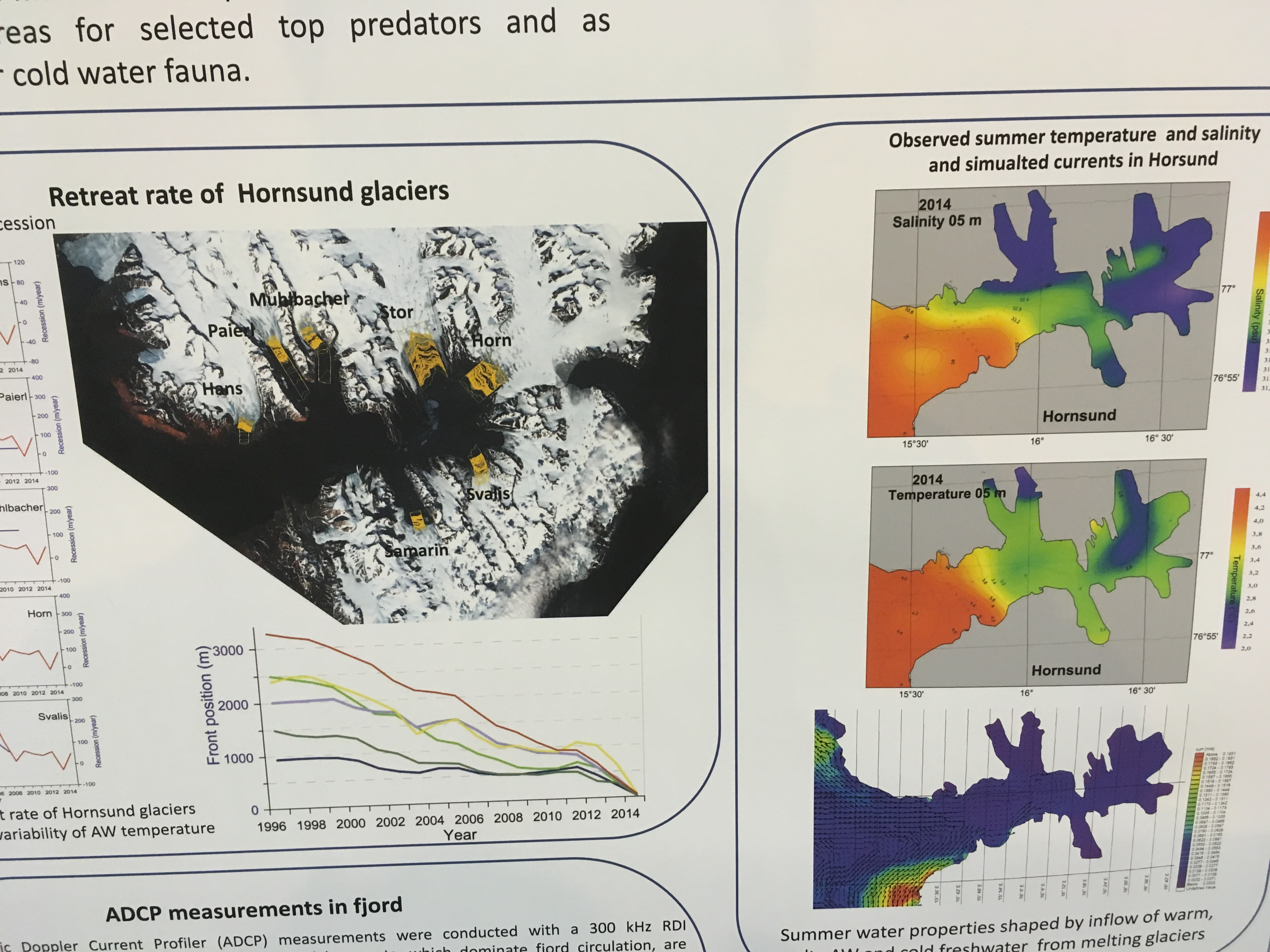
Waldemar Walczowski, Institute of Oceanology Polish Academy of Sciences reported on a study combining glacier retreat and examination of water temperatures in the Hornsund fjord (southern Svalbard), collected under the Polish-Norwegian projects GLAERE and AWAKE-2.  The observed direct contact of warm oceanic water with a glacier’s calving face enhances submarine melting, undercutting and glacier calving.  The turbulent plumes of subglacial meltwater were key in heat transfer and influence glacier retreat. 

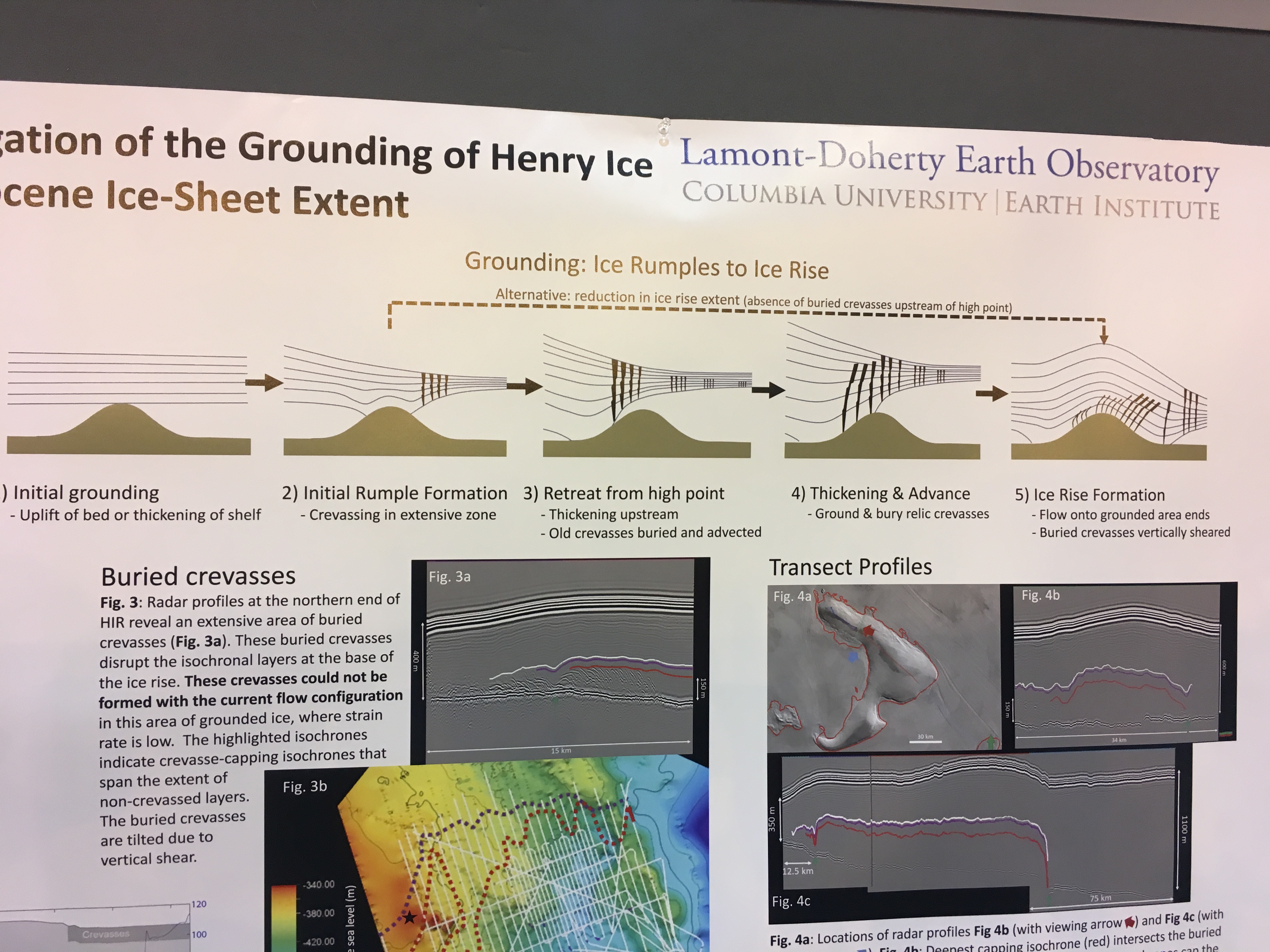
Martin Wearing from Lamont Doherty examined the development of crevasses in the past as the Ronne Ice Shelf advanced over the Henry Ice Rise.  The ice shelf thickened and advanced coming in contact with the bedrock high and generating crevasses that first formed around 600o years ago.  They discovered the featured in radar profiles of the ice shelf.  The sequence of crevasse development is seen above.

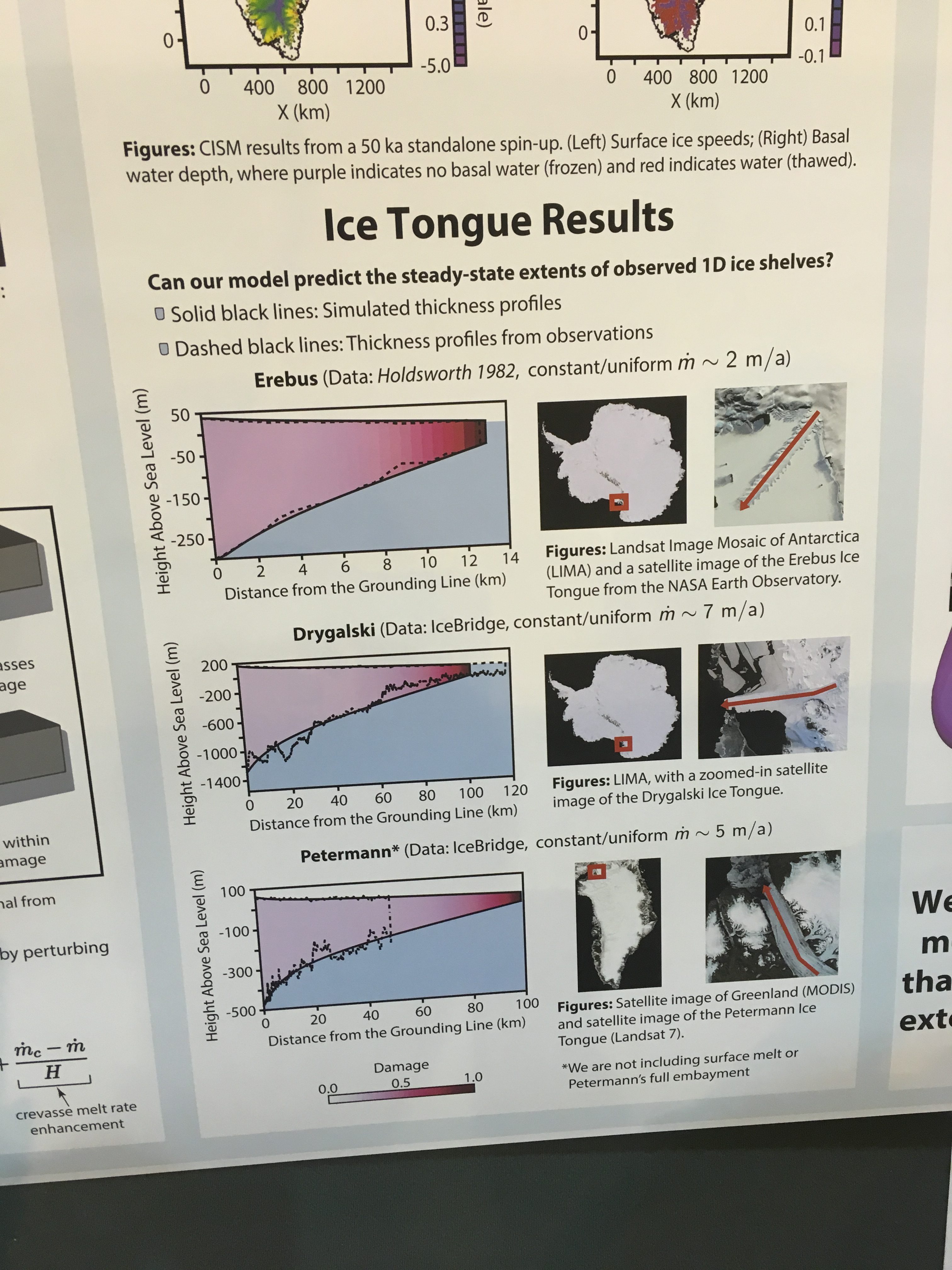
Morgan Whitcomb from University of Michigan used a simple damage evolution law, based on crevasse distributions as a continuum field to yield estimates of ice shelf calving rates when combined with the Community Ice Sheet Model (CISM).  Their basal melt function enhanced crevasse growth near the ice shelf terminus, leading to increased iceberg calving.  The diagram above shows the model predicts broadly correct calving rates for ice tongues ranging in length from 10 km  on Erebus to over 100 km  on Drygalski Glacier.


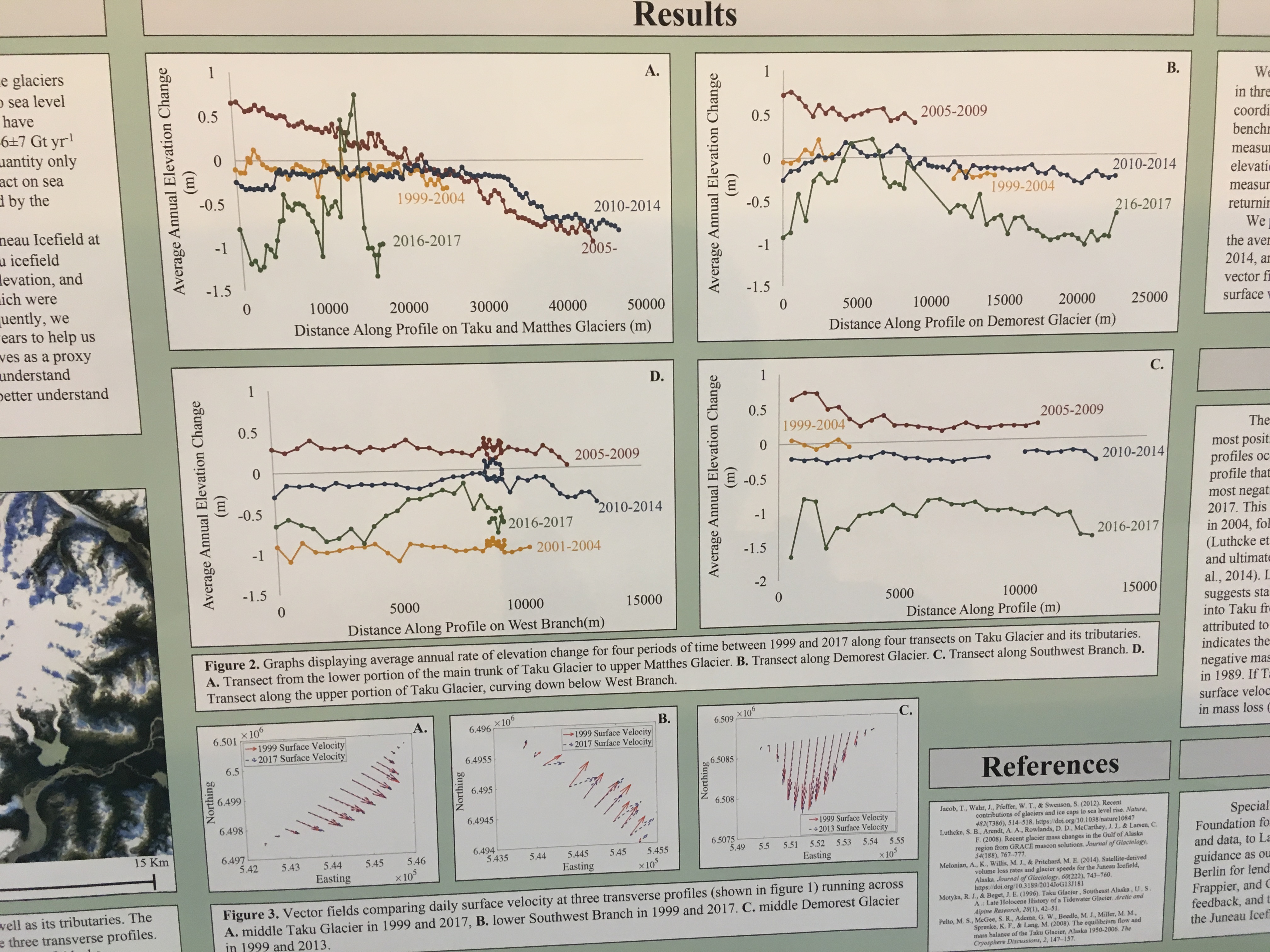
Ann Hill, Skidmore college working with the Juneau Icefield Research Programs velocity monitoring program reports on a comparison of velocity and surface elevation on Taku Glacier from 1997-2017.  The velocity on the main profile was consistent, as it had been back to 1950.  The surface elevation has experienced thinning after 1997 after a prolonged period of thickening.  Above are three velocity profiles with red and blue arrows from 1997 and 2017 mostly overlaying each other because velocity did not change.  Above are profiles of height changes for various periods.

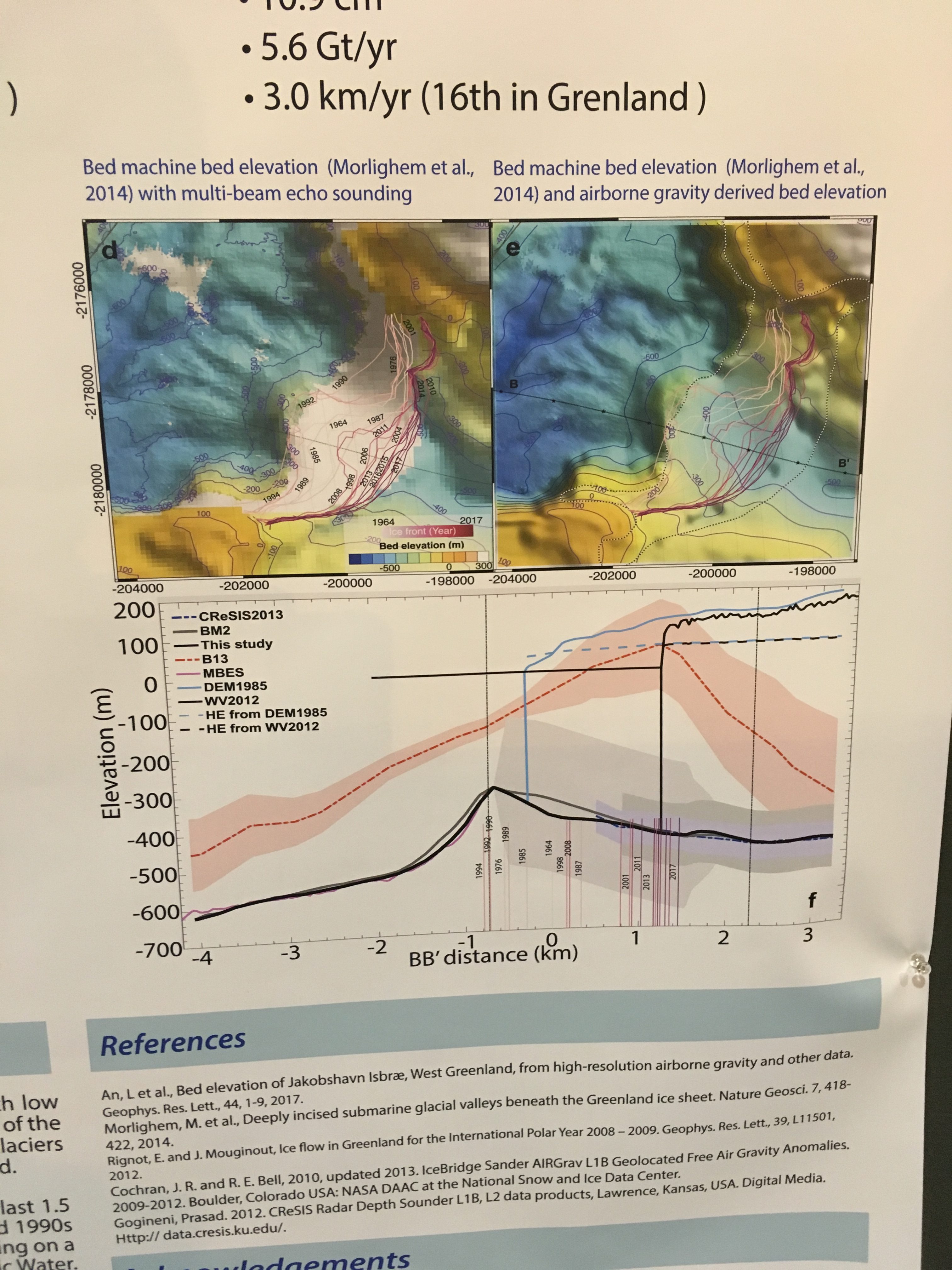
 Lu An from UCal Irvine used multiple sources to reconstruct bathymetry glacier bed topography near the grounding line of Sermeq Avangnardleq (AVA) and Sermeq Kujatdleq (KUJ) in central West Greenland.  They used high resolution airborne gravity data from AIRGrav and MultiBeam Echo Sounding data collected in the fjord. The seamless topography obtained across the grounding line reveal the presence of a 300-m sill for AVA that has stabilized its terminus.  For KUJ shown above the sill has helped stabilize the glacier though it has still retreated ~1 km and has led to iceberg stranding.

From a Glaciologists Perspective AGU Day 1

The theme changes from a glaciers to a glaciologists perspective with a focus on selected work at the AGU 2017. The research discussed here is from the Poster Paper sessions the most interactive part of the convention.  The following are some interesting snapshots of the breadth and depth of ongoing research.  The most compelling figure from each poster is used.

Richard Forster, U of Utah team presented work on the firn aquifer in Greenland.  A feature we did not even know existed until 2011. They have conducted four field seasons,  using ground penetrating radar  and magnetic resonance soundings to map water table elevation, thickness and volume in several areas.  They found the aquifer thickness has a typical thickness of 10-30 m.  Further they found that firn aquifers have existed since at least 1993 and have expanded and shifted with time see above image.

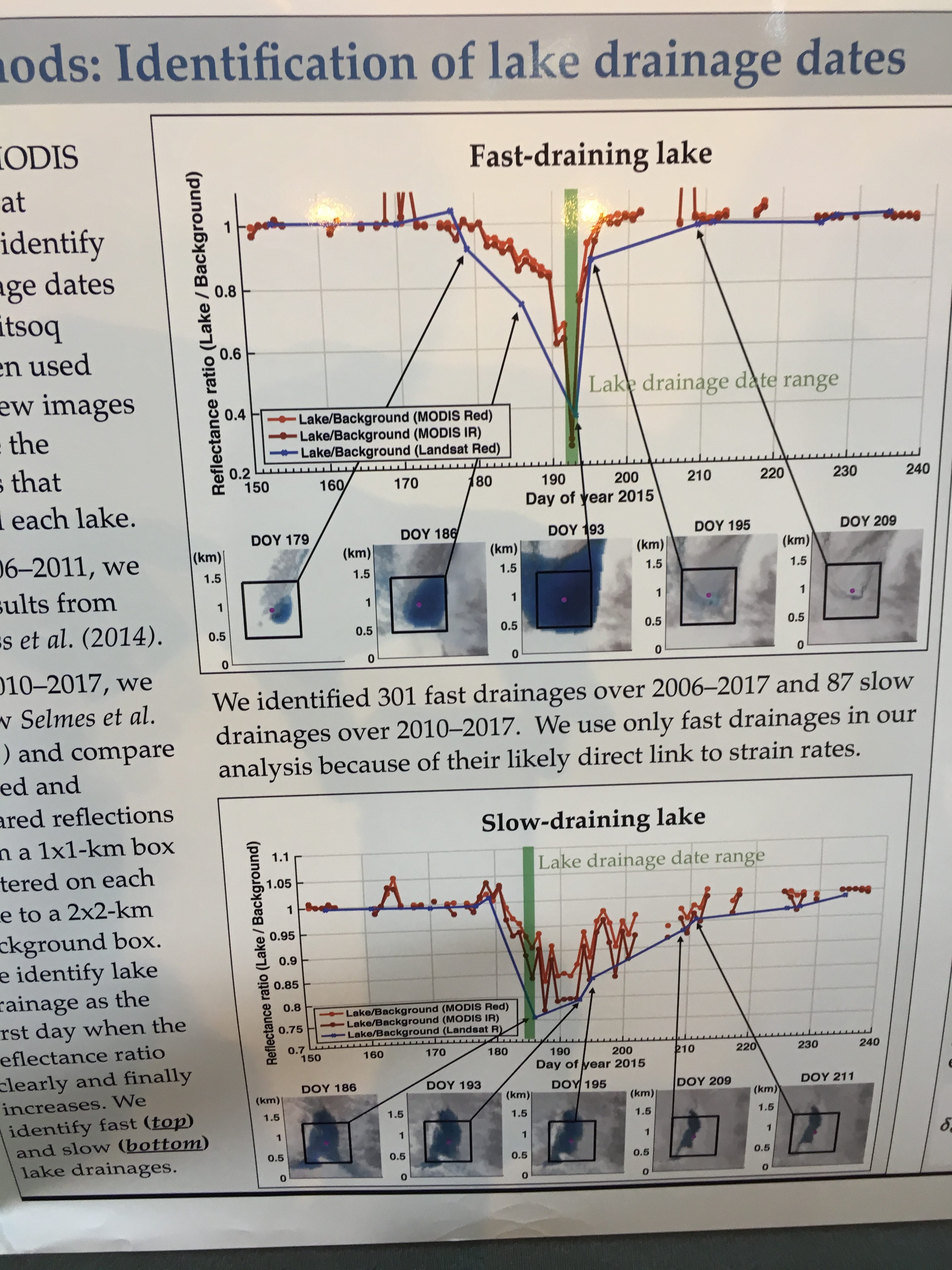
Kristin Poinar, NASA GSFC team examined the drainage of supraglacial lakes in Greenland. They investigated factors that control when and where the lakes drain to the ice sheet base. They observed  359 lake drainage events in a west Greenland region and compare the dates of these drainage events to strain rates calculated from satellite data. They noted both slow draining and fast draining lakes, the faster drainages occurring later in the summer on average. They found that strain rates did not satisfactorily predict lake drainage date.  
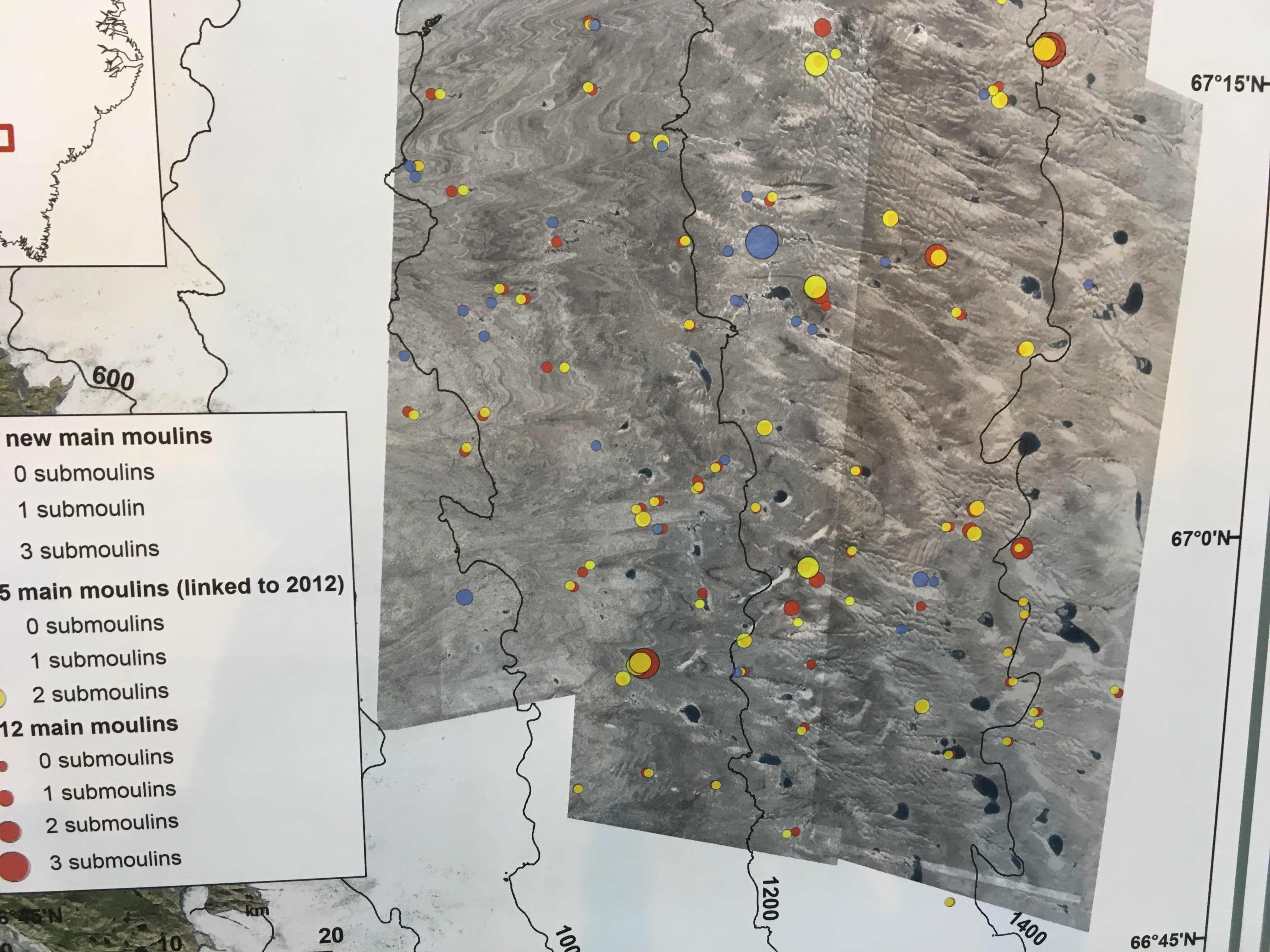
Vena Chu at UC-Santa Barbara’s team mapped river networks On Russell Glacier that terminate into moulins which connect surface melt to englacial and subglacial drainage networks. They used WorldView imagery to show development of molins and their migration between 2012 and 2015.   The majority of moulins they mapped in 2015 were  moulins in 2012. New moulins most commonly formed in crevassed, thinner ice areas near the ice margin, and a lesser but significant quantity at higher elevations above 1300 m.

Rohi Muthyala, Rutgers University team measured the discharge of supraglacial streams for three months, constructing rating curves.  They compared air temperature and discharge in the upper and lower basin.  The upper basin was more related to the daily air temperature. The stream system feeds into a moulin system.

Mariah Radue, University of Maine’s team mapped and dated the moraines and erratics adjacent to Potanin Glacier in the Mongolian Altai (49°N, 88°E). They used 10Be surface-exposure chronology to date glacial landforms mapped using satellite and Drone imagery. Based on our glacial reconstruction, we estimate changes in atmospheric temperature from the Last Glacial Maximum to the Late Holocene using snowline reconstruction techniques. Mongolia is a unique location because it is isolated from oceanic influences and a climate could provide insight into the roles of local radiation forcing from earth orbital changes, greenhouse gases, and a Asian climate dynamics.

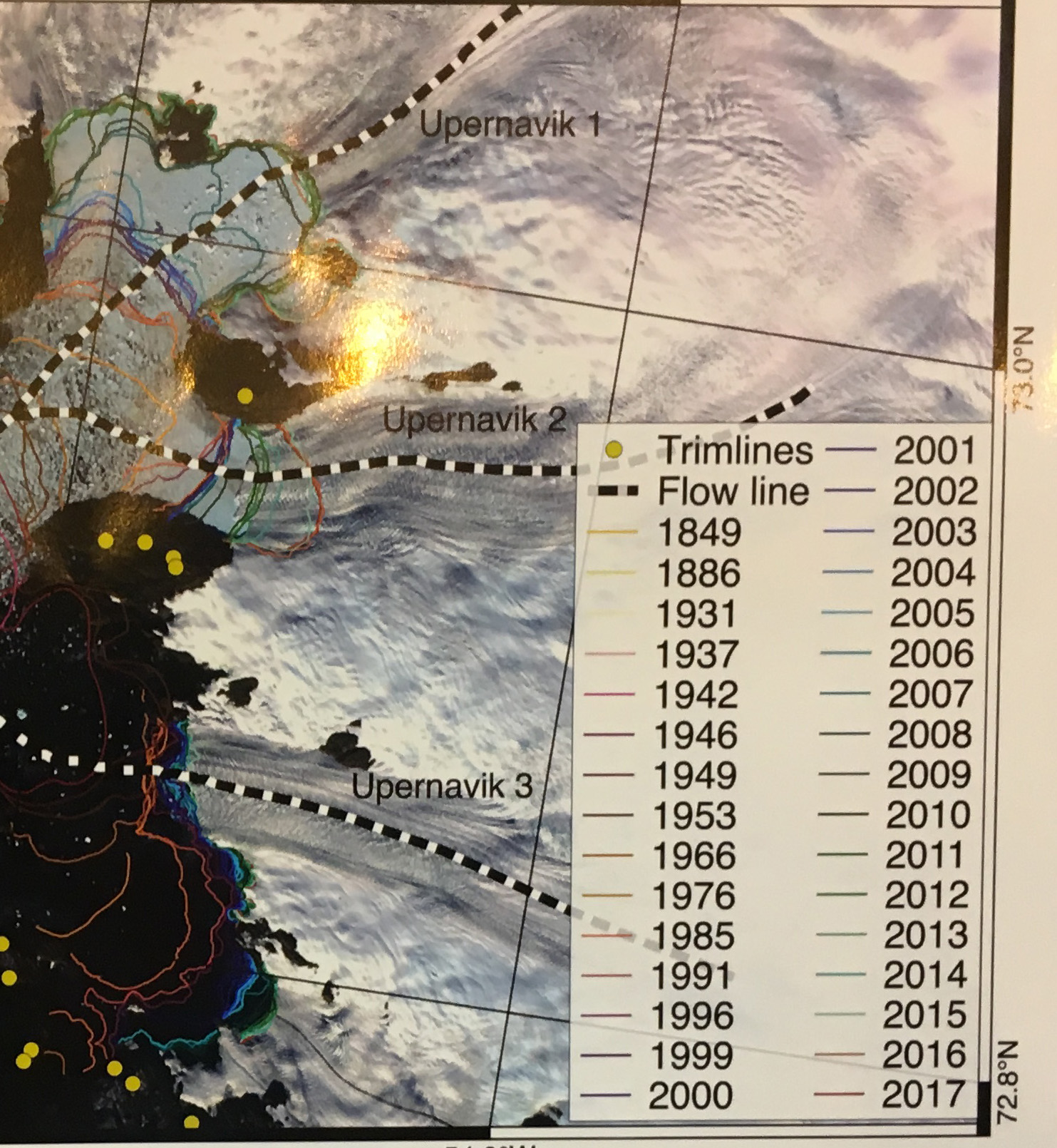
Konstanz Haubner, with a team from GEUS in Denmark provided a model simulating velocity and ice thickness change at Upernavik Glacier, Greenland from 1849-2017. In the image above the retreat is illustrated, separating into three separate glaciers with a more bedrock pinning points to stabilize.  They noted  a changing contribution to Upernavik’s ice mass loss from surface melt and ice dynamics in different time periods.


Glacier Retreat Generating New Islands List

Climate change has been driving the recession of glaciers and ice sheets, which in turn has been changing our maps.  One notable category of physical geographic features indicative of the change due to the retreat is the formation of new islands.  Below is a list of new islands that this blog has identified and reported.  This is not a comprehensive list of all islands that have been formed.  

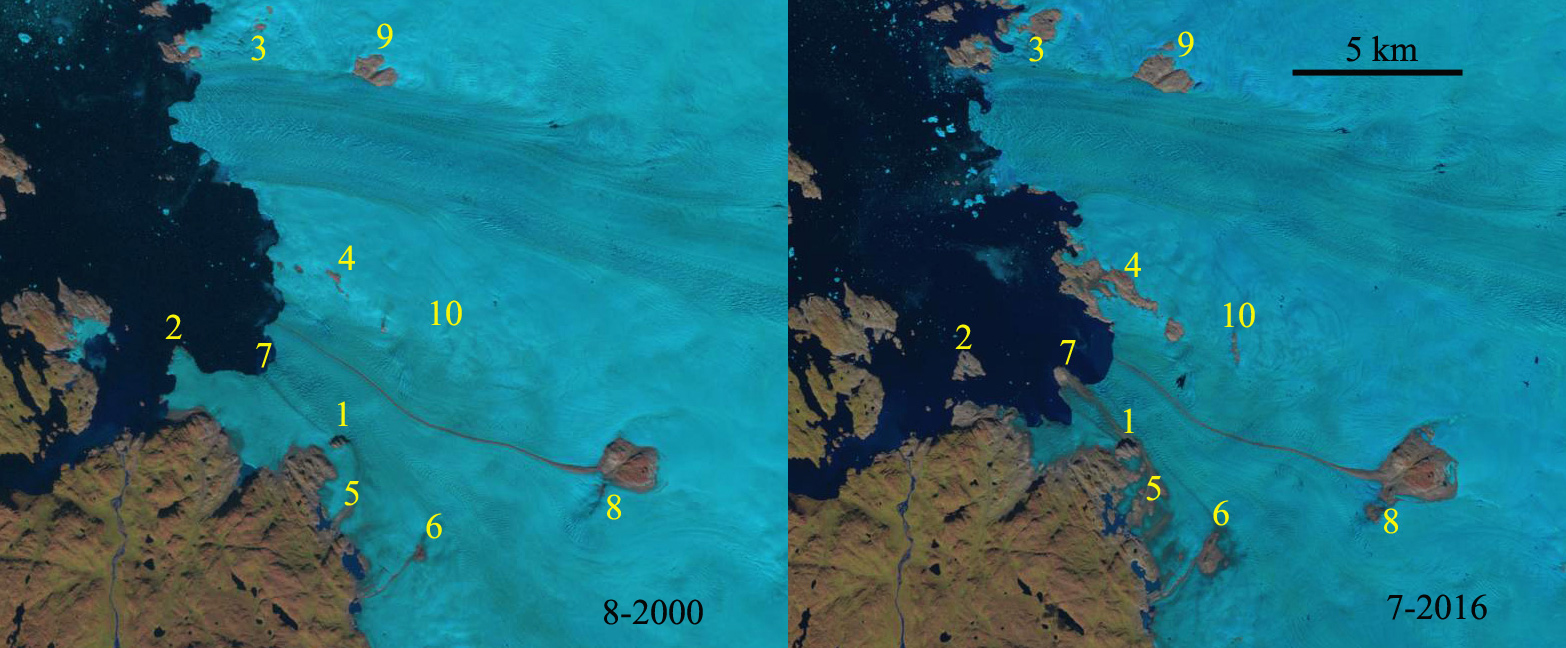
Upernavik Glacier, Greenland in Landsat images from August 2000 and August 2016.  Each Point is at the same location in both image, and the changes are noted in the discussion below.  The same locations are also identified in the July 2001 and Aug. 2016 image below. 

Kong OscarGreenland: Island A forms with B and C on the verge.

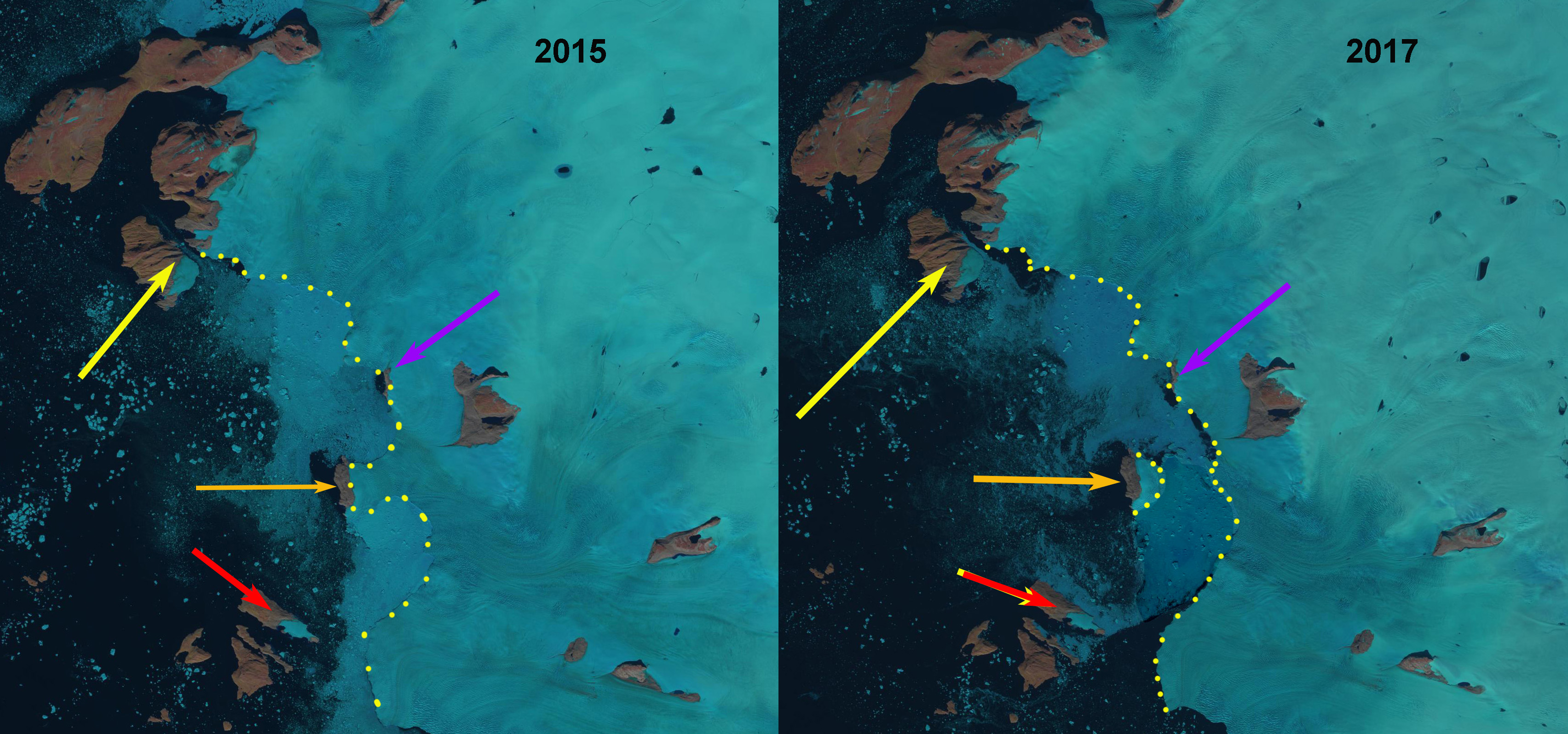
Steenstrup Glacier, Greenland front in 2015 and 2017 illustrating location with respect to the new islands at: Red Head-red arrow, Tugtuligssup Sarqardlerssuua at yellow arrow , and the 2017 new island at orange arrow.  Yellow dots indicate icefront and purple arrow another future island to be released from the glacier.  

corontation-compare-copy

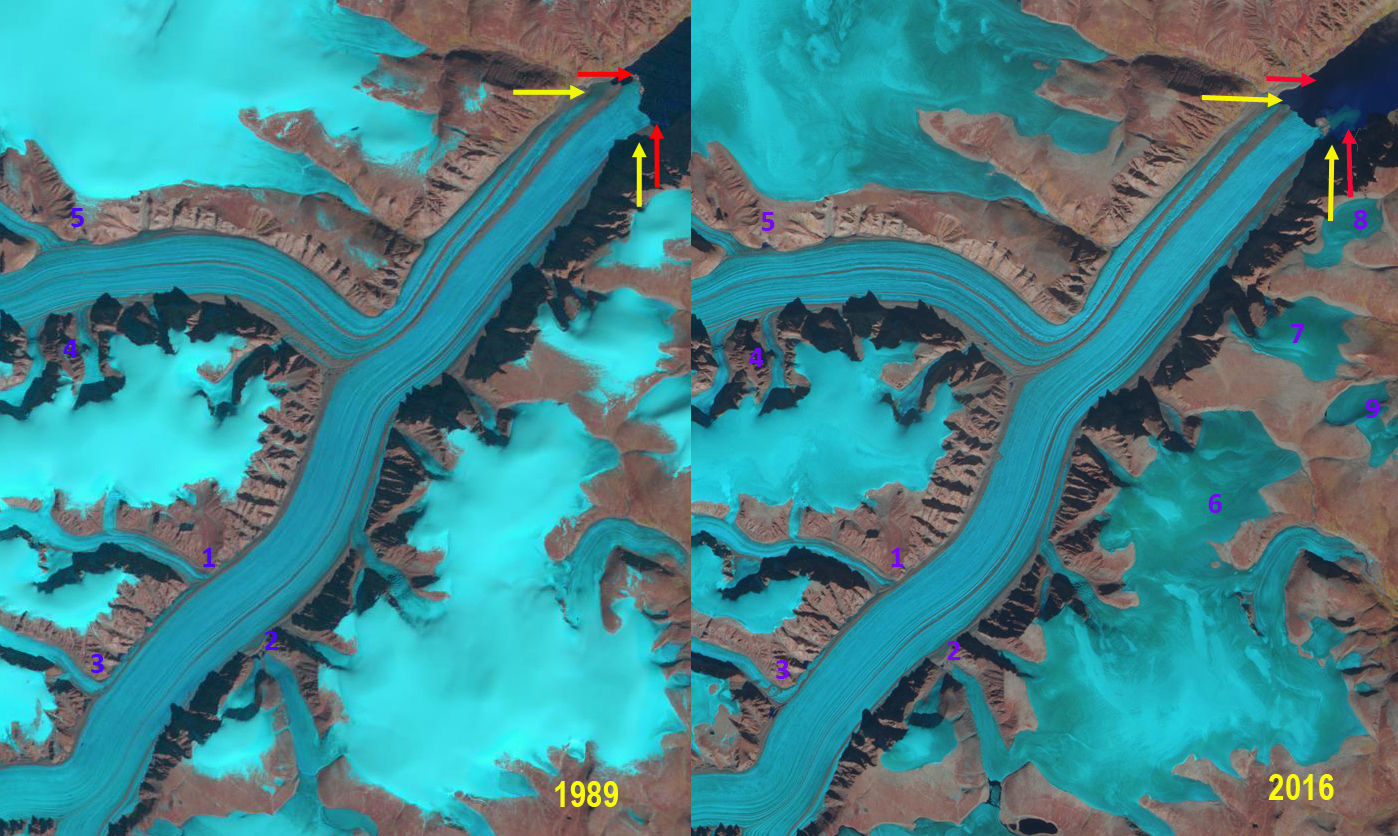
Coronation Glacier, Canada: A Landsat image from 1989 and a Sentinel 2 image from 2016 illustrate the retreat of Coronation Glacier.  Red arrows indicate the 1989 terminus and yellow arrows the 2016 terminus location.  Purple numbers 1-5 indicate locations of tributary retreat or thinning. Purple numbers 6-9 are icecaps that did not retain snowcover in 2016. 

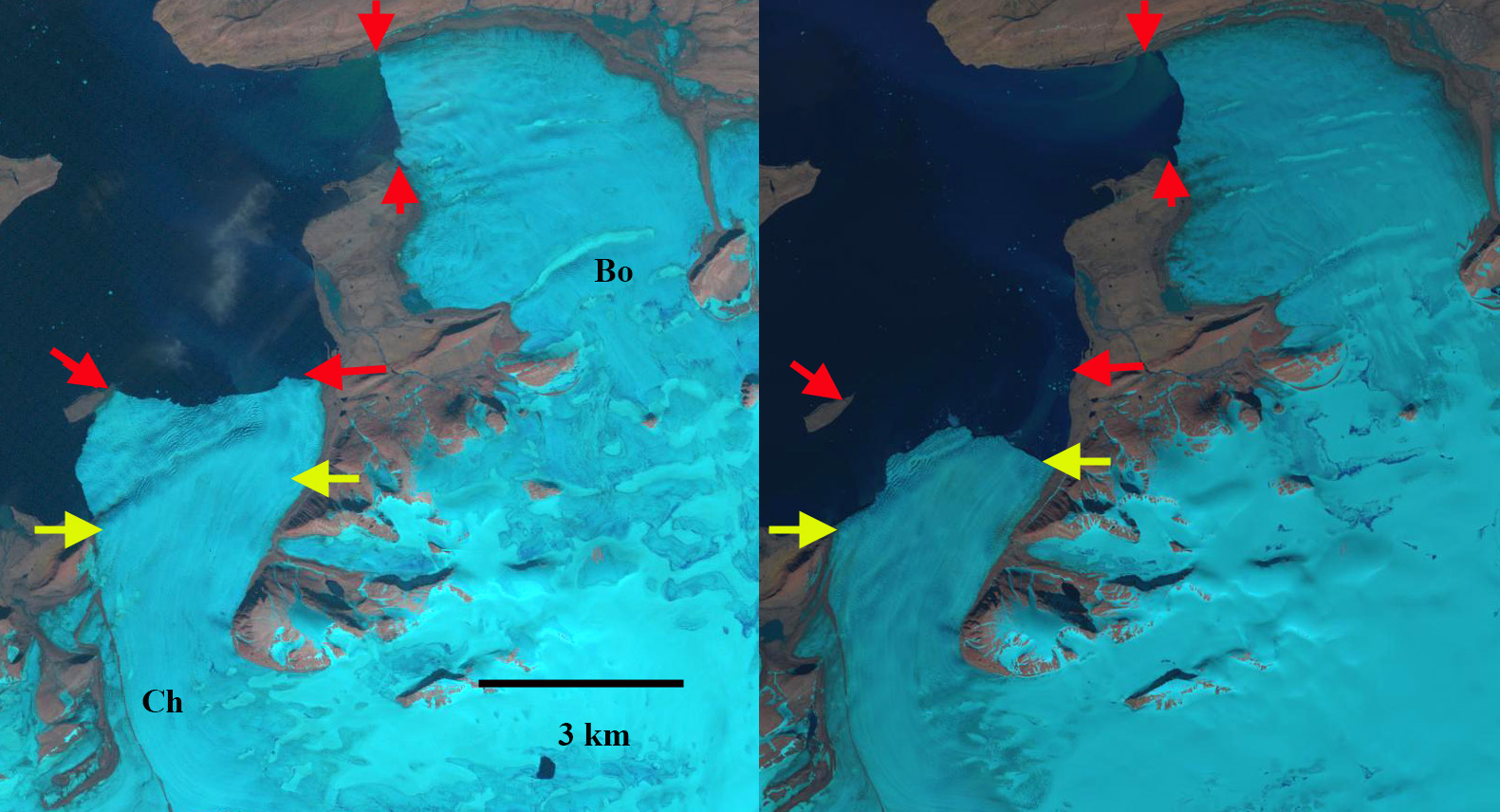
Chernysheva Glacier and Borozova, Novaya Zemlya comparison in 1990 and 2015 Landsat images. Red arrows indicates 1990 terminus and yellow arrow 2015 terminus position. Island has formed at the 1990 terminus position of Chernysheva.

Tasija and Krayniy GlacierNovaya Zemlya: Tasija Glacier (T) and Krayniy Glacier (Ky) compared in 1990 and 2015 Landsat images.  Red arrows indicate 1990 terminus positions, yellow arrows 2015 terminus positions and purple arrows upglacier thinning. A new island formed upper right red arrow.

Nizkiy Glacier, Novaya ZemlyaNizky Glacier (N) and Glasnova Glacier (G) compared in 1990 and 2015 Landsat images.  Red arrows indicate 1990 terminus positions, yellow arrows 2015 terminus positions and purple arrows upglacier thinning.  An island has formed at the second red arrow from the bottom.

Krivosheina GlacierNovaya Zemlya:  Krivosheina Glacier compared in 1990 and 2015 Landsat images.  Red arrows indicate 1990 terminus positions, yellow arrows 2015 terminus positions and purple arrows upglacier thinning.  Point A indicates a new island that has formed.

Vilkitskogo GlacierNovaya ZemlyaVilkitskogo South Glacier (Vs) and Vilkitskogo North Glacier (Vn) compared in 1990 and 2015 Landsat images.  Red arrows indicate 1990 terminus positions, yellow arrows 2015 terminus positions and purple arrows upglacier thinning.


Vasilievebreen, Svalbard: retreat from 1990-2017 has led to the creation of one island at the pink arrow, while the island at the orange arrow has eroded and an island at the white arrow is on the verge of being released by the glacier.  

Samarinbreen, Svalbard: Landsat imagery from 1990-2014 illustrates that the retreat of the glacier has been 2.1 km including the formation of an island.

Record High Mont Blanc, France Glacier August Snow Lines 2017

Landsat image of the transient snow line on Mont Blanc Glaciers, France on 8/19/2017.  The average snow line (Purple dots) is at 3100 m.  Glaciers on Mer de Glace (M), Argentiere (A), Tour Glacier (L), Trient Glacier (T) and Saleina Glacier (S). 

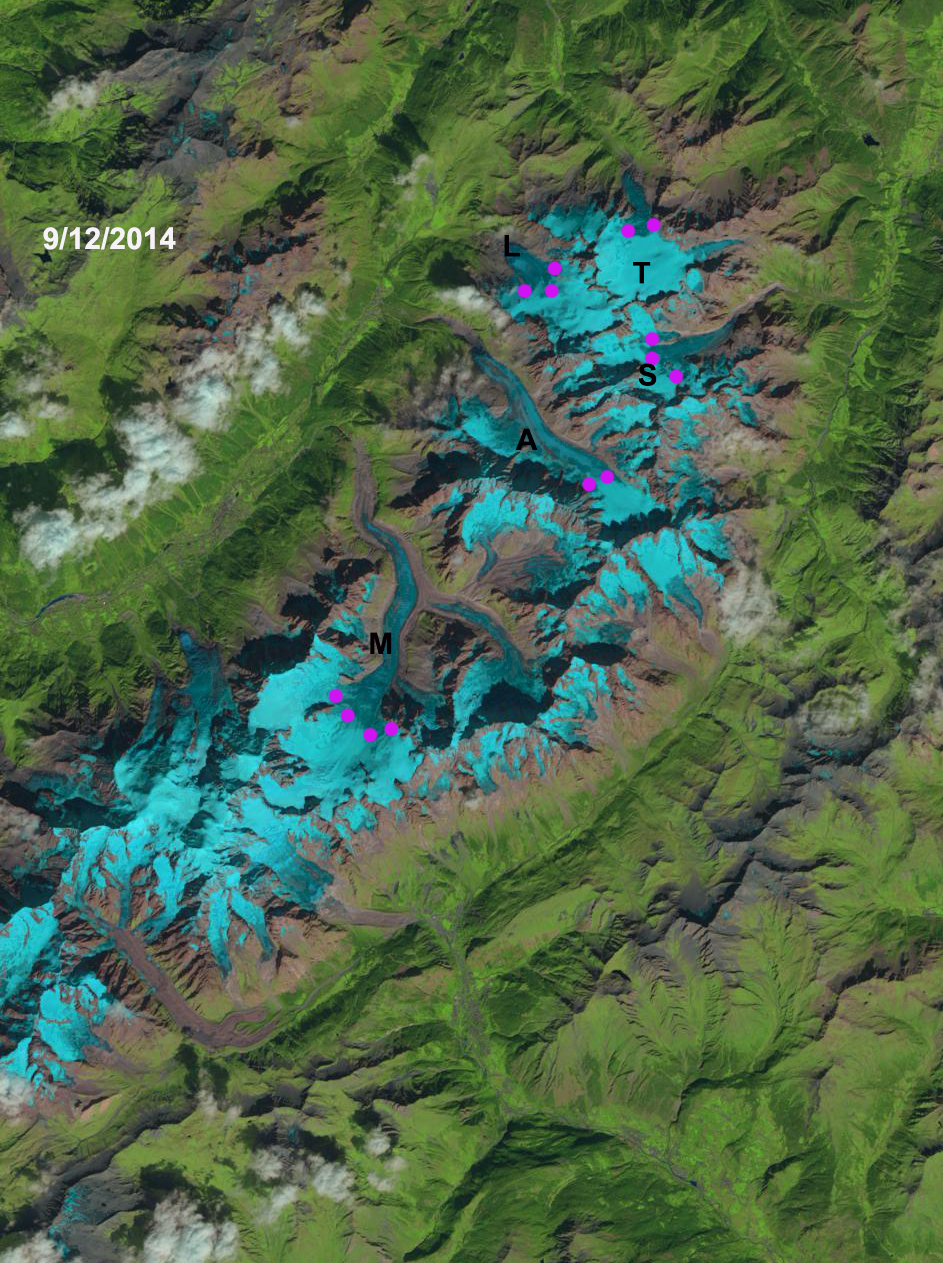
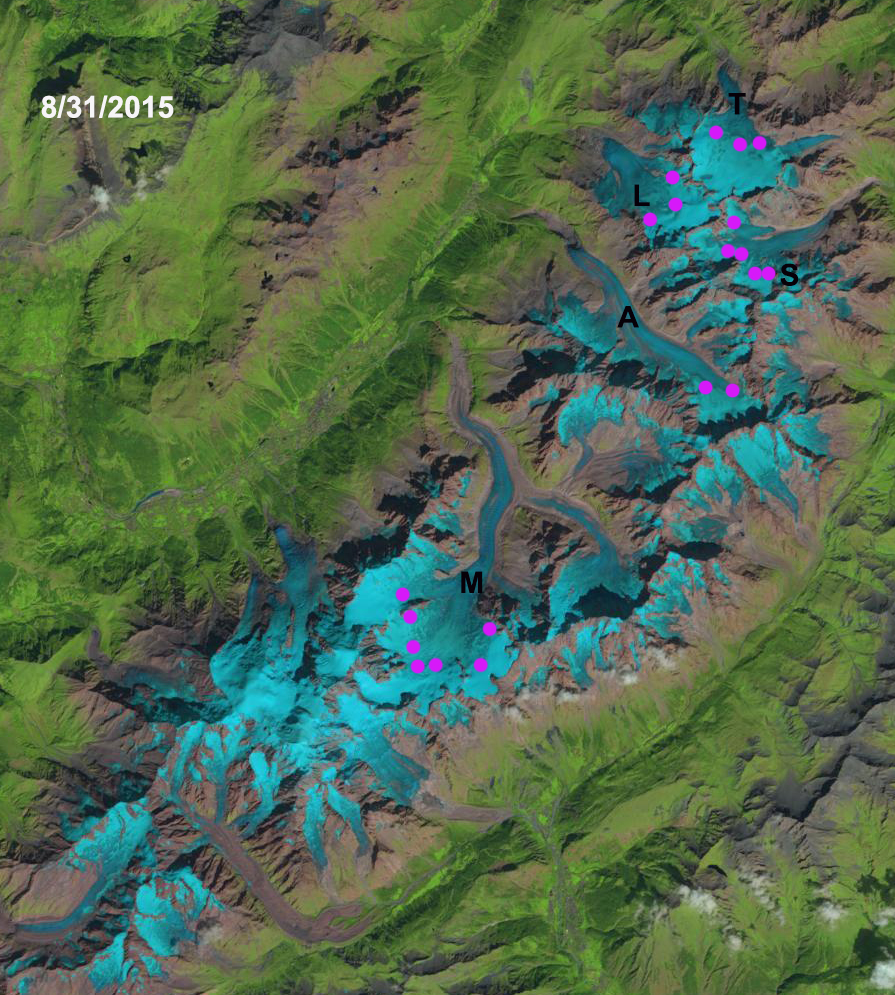
This has been a warmer summer in the Alps with reports emerging of various summer ski areas that take advantage of glaciers closing early or adding snow guns to stay open, Molltal Glacier, Les2Alpes,, Stelvio Glacier  Here we compare in Landsat images the transient snow line on five Mont Blanc glaciers from 1985, 1988, 2003, 2014, 2015 and 2017.  The transient snow line is indicated with purple dots in each image.  A comparison of the transient snow line on Mont Blanc glaciers on 8/19/2017 to other years indicates it is already higher than all other years examined, but a month remains in the melt season. 

Rabatel et al (2013)  examined the equilibrium line altitude (ELA) of glaciers in the region from 1984-2010.  The ELA is the snowline at the end of the summer melt season.  The transient snow line is simply the snow line altitude on a specific day during the melt season. Rabatel et al (2013) found the average snow line of 3000 m on Trient Glacier, 2900 m on Tour Glacier, 2800 m on Argentiere Glacier and 2975 m on Saleina Glacier.  They also observed the maximum snowline occurred in the western Alps in 2003 with an average of ~3250 m, this average is higher than for just the Mont Blanc glaciers. 

On August 11, 1985 the snow line averages 2800 m on the five glaciers.  In 1988 on Sept. 12 the snowline averages 2900 m.  On August 5, 2003 the average snow line is at 3025 m.  On Sept. 12 2014 the average snow line is at 2850 m.  On Aug. 31, 2015 the average snow line is at 3050 m.  On Aug. 19th 2017 the average snow line is at 3100 m.  This is the highest observed August snow line on Mont Blanc. With several weeks to go the snow line is competition with 2003 for the highest snow lines on Mont Blanc glaciers in the last 50 years by the end of the melt season. 

Six and Vincent (2014) noted for Argentiere Glacier that for each 1 C rise in temperature the ELA rises 50 m.  The higher snow line in 2017 indicates a year of significant negative mass balance, which will further enhance retreat of the the Mont Blanc glaciers, such as Mer de Glace and Tour Glacier. 

Landsat image of the transient snow line on Mont Blanc Glaciers, France on 8/5/2003.  The average snow line (Purple dots) is at 3000 m.  Glaciers on Mer de Glace (M), Argentiere (A), Tour Glacier (L), Trient Glacier (T) and Saleina Glacier (S).

Landsat image of the transient snow line on Mont Blanc Glaciers, France on 8/11/1985.  The average snow line (Purple dots) is at 2800 m.  Glaciers on Mer de Glace (M), Argentiere (A), Tour Glacier (L), Trient Glacier (T) and Saleina Glacier (S).


Landsat image of the transient snow line on Mont Blanc Glaciers, France on 9/12/1988.  The average snow line (Purple dots) is at 2900 m.  Glaciers on Mer de Glace (M), Argentiere (A), Tour Glacier (L), Trient Glacier (T) and Saleina Glacier (S). 

Landsat image of the transient snow line on Mont Blanc Glaciers, France on 9/12/2014.  The average snow line (Purple dots) is at 2850 m.  Glaciers on Mer de Glace (M), Argentiere (A), Tour Glacier (L), Trient Glacier (T) and Saleina Glacier (S). 

Landsat image of the transient snow line on Mont Blanc Glaciers, France on 8/31/2015.  The average snow line (Purple dots) is at 3050 m.  Glaciers on Mer de Glace (M), Argentiere (A), Tour Glacier (L), Trient Glacier (T) and Saleina Glacier (S). 

Mensu Glacier, Siberia Russia Retreat 1994-2016

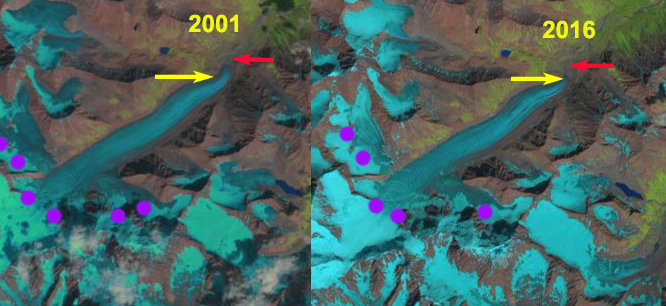
Mensu Glacier, Russia in comparison of 1994 and 2016 Landsat images.  Red arrow is the 1994 terminus, yellow arrow 2016 terminus, purple arrow a tributary and purple dots the snowline. 

Mensu Glacier (Lednik Mensu) drains northeast from Gora Belukha in the Russian Altai.  The glacier drains into the Ob River and then the Arctic Ocean.  This glacier has not been the focus of detailed research to date. Khromova et al (2014) report that at the end of the century the glacier degradation in Russian mountain ranges strengthened including glacier area loss of 13% in the Tien Shan, 19% in the Altai and 22.3% in the Polar Urals.  The icecap draining west from Gora Belukha was cored to look at longer term climate records (Fujita et al 2004).  The core at 4500 m is high enough so that significant melt events affecting the record were rare. Shahgedanova et al (2010) noted that the retreat has largely been driven by summer warming. 

In 1994 the glacier terminates at the red arrow at 2150 m.  The glacier has an icefall from 3200 m to 2700 m that generates annual ogives, note Google Earth image below. The snowline in the 1994 Landsat  image averages 3000 m.  There is a tributary joining the main glacier at the purple arrow.  A neighboring glacier terminates in a proglacial lake at the orange arrow.  By 2001 the glacier has retreated and the snowline is at 3100 m. By 2016 the glacier terminates at 2200 m and has retreated 600  m to the yellow arrow.  The tributary at the purple arrow has separated from the main glacier.  This illustrates substantial glacier thinning  6 km above the terminus. The glacier at the orange arrow  no longer reaches the proglacial lake. In August 2016 below the snowline is at 3100 m in September 2016 the snowline has descended to 2800 m.  The lowest 800 m of the glacier has few crevasses, appears stagnant and will be lost to retreat.

Retreat is similar to the nearby Potanin Glacier, Mongolia. 

Mensu Glacier, Russia in comparison of 2001 and 2016 Landsat images.  Red arrow is the 1994 terminus, yellow arrow 2016 terminus, purple arrow a tributary and purple dots the snowline. 

Google Earth image indicating the snowline at the top of the icefall and the ogives beginning at the bottom near the orange arrow.


Terminus of Mensu Glacier in 2013 note lack of crevassing.

Llewellyn Glacier, BC Proglacial Lake Merging From Retreat

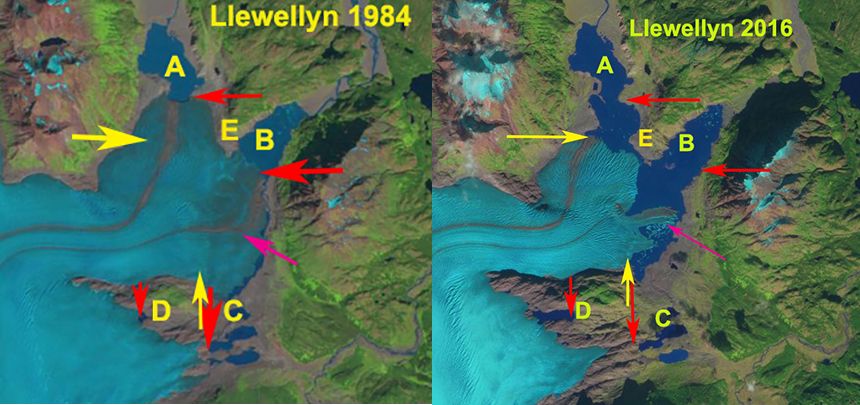
Llewellyn Glacier comparison in 1984 Landsat and 2016 Sentinel images.  Red arrows the 1984 terminus locations for proglacial lakes A-D, yellow arrows the 2016 terminus locations for A and B. Point E was the peninsula separating proglacial lakes A and B, which are now joined due to glacier retreat. 

The second largest glacier of the Juneau Icefield is the Llewellyn Glacier which is in British Columbia. The Juneau Icefield Research Program has a research camp, C-26 on this glacier and it is the typical exit route from the icefield at the end of the field season.  Here we examine changes in the terminus from 1984-2016 as a result of higher snowlines indicative of an expanded ablation zone and negative mass balance. 

I first visited the glacier in 1981 and I was also on the icefield in 1984 when the Landsat image was acquired that is used as the start point for comparison. In 1984 the glacier had several termini ending in proglacial lakes A-D. We exited the glacier on the west side of proglacial lake A in 1984 onto a proglacial outwash plain referred to as the ball bearing highway.   At Point B the terminus ended in a deeper wider proglacial lake than Lake A. At Point C and D the glacier ended in a series of small lakes.  Point E is the peninsula separating proglacial lake A and B in 1984. Proglacial Lake B had a surface water level 10-15 m higher than Lake A in 1984. In 2011 the glacier still reached Point E  separating the two lakes, which still had different water levels. In 2013 the gap first opened between the two lakes, and the water level fell in Lake B. In the summer of 2016 and spring of 2017 the gap has persisted and widened to  150 m.  From 1984 to 2016 the terminus in Lake A has retreated 1300 m, the terminus at Lake B 2100 m, terminus at Point C 800 m and terminus at Point D 1100 m. The narrow tongue of ice at the pink arrow will not survive long. The crevasse pattern suggests the glacier has another 1.5- 2 km to retreat before lake development will cease. 

The snowline during the 1998-2013 period averaged 1900 m too high for an equilibrium balance.  In a sequence of images from 2013 illustrates the rise is snowline from  1450 m on June 21,  to 1780 m on August 1 and  1810 m on Sept. 2.   The persistently higher snowlines since 1990 have led substantial thinning, Melkonian et al. (2013) note thinning of more than 1 m per year at the terminus diminishing to little change above 1500 m from 2000-2009. This will drive continued retreat, supplemented by calving into the still growing proglacial Lake at Point A and B.  The retreat of this glacier follows that of other glaciers of the Juneau Icefield including nearby Tulsequah Glacier, noted by Pelto et al (2013) and Pelto (2016) .

[ngg_images source=”recent_images” display_type=”photocrati-nextgen_basic_slideshow” gallery_width=”600″ gallery_height=”400″ cycle_effect=”fade” cycle_interval=”5″ show_thumbnail_link=”1″ thumbnail_link_text=”[Show thumbnails]” order_by=”sortorder” order_direction=”ASC” returns=”included” maximum_entity_count=”4″]