Aavatsmarkbreen, Svalbard More Calving & Less Accumulation a Deadly Recipe

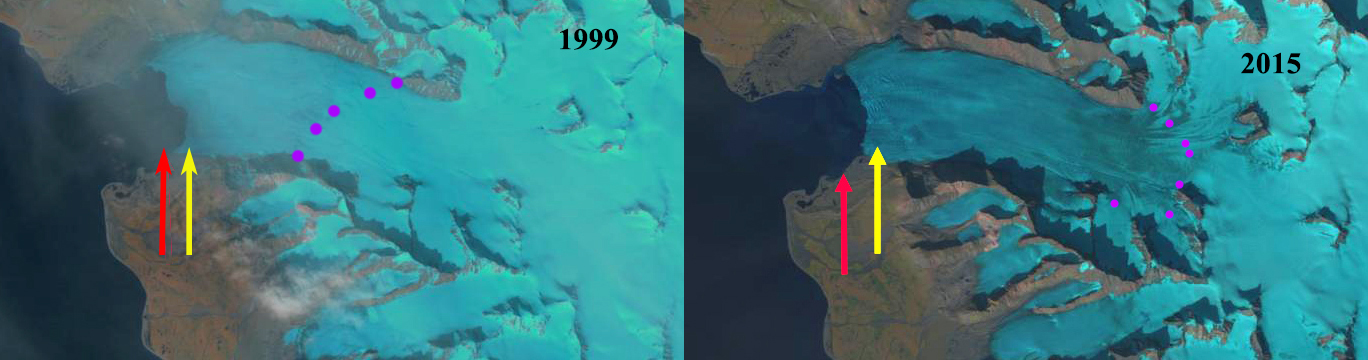
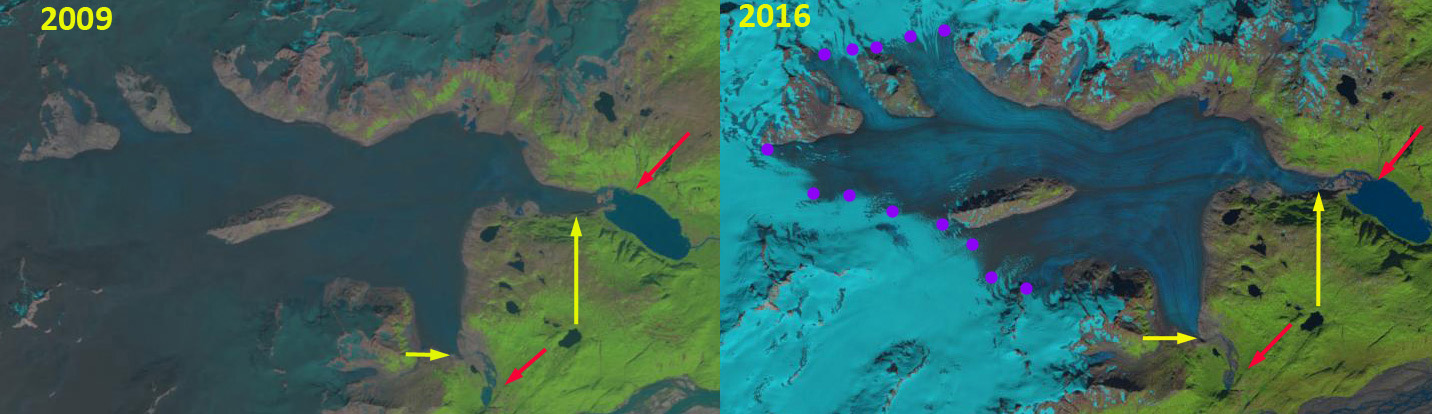
Aavatsmarkbreen, Svalbard in 1987 and 2017 Landsat images. Red arrow 1987 terminus, yellow arrow 2017 terminus  and purple dots the snowline. 

Aavatsmarkbreen is a tidewater glacier on the west side of Svalbard.  The glacier is the fjord just south of Kongsfjord and Kronebreen Glacier.   Nuth et al (2013) determined that the glacier area over the entire archipelago has decreased by an average of 80 kmper year over the past 30 years, a 7% reduction.  Here we examine Landsat imagery from 1987 to 2017.

In 1987 the glacier terminated at the red arrow and had a 4 km wide front. By 1999 the glacier had retreated 400 m with the retreat being largest in the center of the glacier. In 2015 the calving front was 3.5 km long and nearly straight from north to south.  The snowline in 2015 was at 500 m.  By 2017 the glacier front had developed a significantly concave front with retreat of 1400 m since 1987 in the glacier center and 700 m on the southern and northern margin.  The snowline in 2017 again at 500 m.  The head of the glacier is at 600 m, and a snowline at 500 m leaves much too limited an accumulation zone to sustain the glacier.  A view of the terminus from Toposvalbard indicates the substantial crevassing that indicates greater ice velocity and calving the glacier center.  The combination of reduced accumulation on the glacier and enhanced calving is dangerous recipe for a glacier, one that will drive further significant retreat. The retreat is less than Hinlopenbreen to the northwest and the neighboring Kronebreen Glacier

Aavatsmarkbreen, Svalbard in 1987 and 2017 Landsat images. Red arrow 1987 terminus, yellow arrow 2017 terminus  and purple dots the snowline.

Calving front of Aavatsbreen in 2017, red arrows indicating crevassing indicating acceleration. Black line center retreat. 

Rio Engaño, Chile Headwater Glacier Retreat GLOF Threat Drops

Comparison of glaciers at the headwaters of Rio Engaño in 1984 and 2018 Landsat images. The 1984 terminus location with red arrows, yellow arrows the 2018 terminus location, purple arrows wind drift patterns.

Rio Engaño drains into Lago General Carrera and its headwaters is a group of alpine glaciers.  In March of 1977 one of the glaciers, generated a glacier lake outburst flood (GLOF) that reached a depth of 1.5 m  at the small village of Bahía Murta Viejo 25 km down river (Anacona, et al 2015).  Davies and Glasser (2012) observe that glaciers just northeast of the Northern Patagonia Icefield lost area at a rate of 0.2% per year from 1986-2011.  Paul and Molg (2014) observed a more rapid retreat of 25% total area lost from glaciers in northern Patagonia from 1985-2011, the study area was north of the Northern Patagonia Icefield, including the Cordillera Lago General Carrera icefield.

Here we examine changes of four glaciers at the headwaters of Rio Engaño using Landsat imagery for the 1984 to 2018 period.

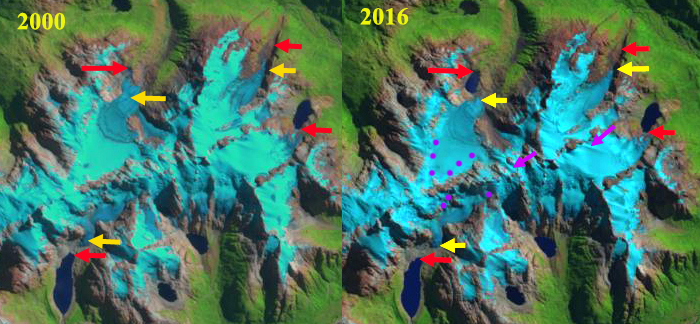
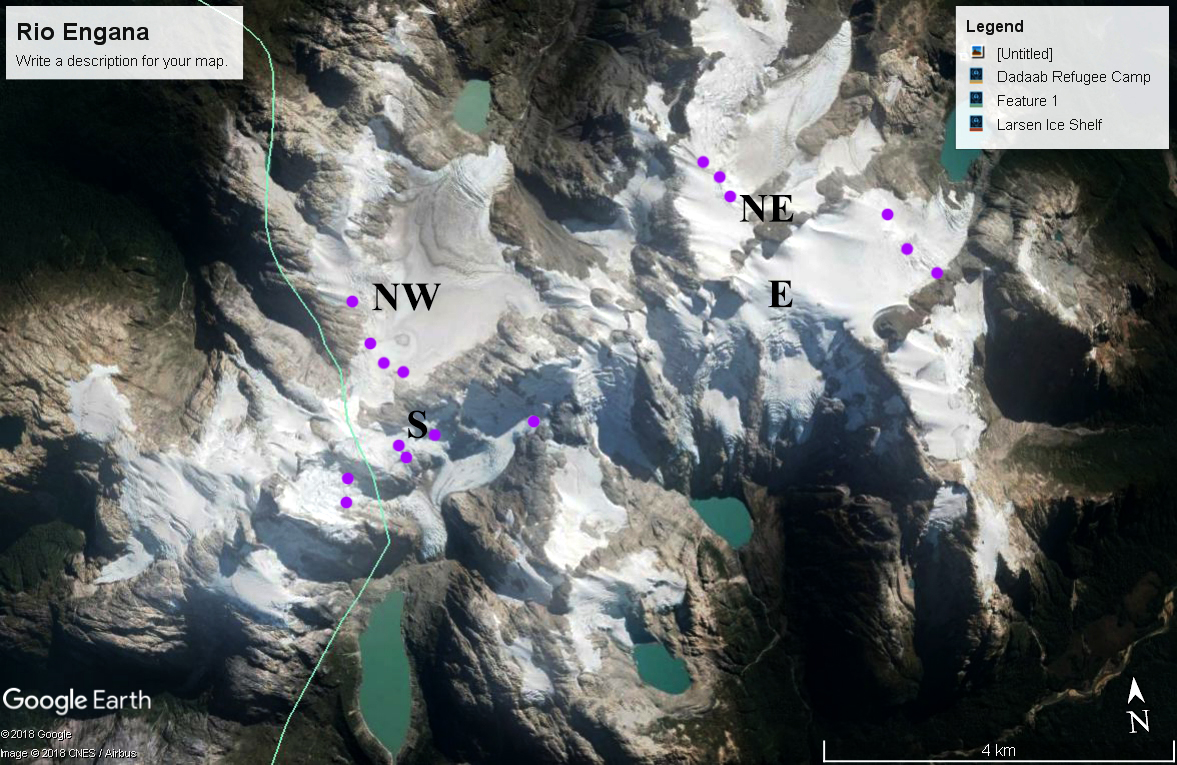
In 1984 the Northwest (NW) glacier had two terminus tongues and no lake at the terminus, red arrow. The Northeast (NE) glacier had a length of 4 km. The East (E) glacier terminated at the margin of a proglacial lake. The South (S) Glacier which experienced the GLOF, terminated on the northern end of a proglacial lake. By 2000 the NW glacier had lost its eastern terminus and a small lake is forming at the western terminus. The NE glacier had retreated 400 m. The S glacier no longer reaches the proglacial lake. In 2016 the snowline is quite high on the NW and S glacier, purple dots. The wind features, purple arrow indicate the strong wind sculpted features from the west winds. In 2018 the NW glacier no longer reaches the proglacial lake that began forming after 1984, total retreat 800 m. The NE Glacier has retreated 700 m and is now 3.3 km long. The E glacier terminates at the base of a steep slope 200 m from the proglacial lake it reached in 1984. The S glacier has retreated 600 m from the lake it reached in 1984. The NE and E glacier have substantial areas above 1600 m and have retained snowpack each year over a significant portion of the glacier. The NW and S glaciers have little area above 1600 m and in several years have retained minimal snowpack and will continue a rapid retreat.

Wilson et al (2018)  documented a 43% increase in the number of glacial lakes and 7% in the area of lakes in the central and Patagonian Andes. In the Rio Engaño headwaters both the area and number of lakes has increased. The threat of GLOF in for these specific glaciers appears to be declining as the glaciers retreat further from the lakes.  Iribarren et al (2014) list that glacier contact and glacier steepness adjacent to the lake are variables that raise GLOF hazards, and these factors are declining at the Rio Engaño headwaters.  They also noted that the GLOF in 1977 had a volume of 7.36 million cubic meters the second largest in their record of 16 GLOF’s.

Comparison of glaciers at the headwaters of Rio Engaño in 2000 and 2016 Landsat images. The 1984 terminus location with red arrows, yellow arrows the 2018 terminus location, purple arrows wind drift patterns and purple dots the snowline in 2016.

Google Earth image from 2017 indicating the snowline leaving limited snowcovered area on NW and S glacier. 

Lower Curtis Glacier Annual Terminus Response to Climate Change

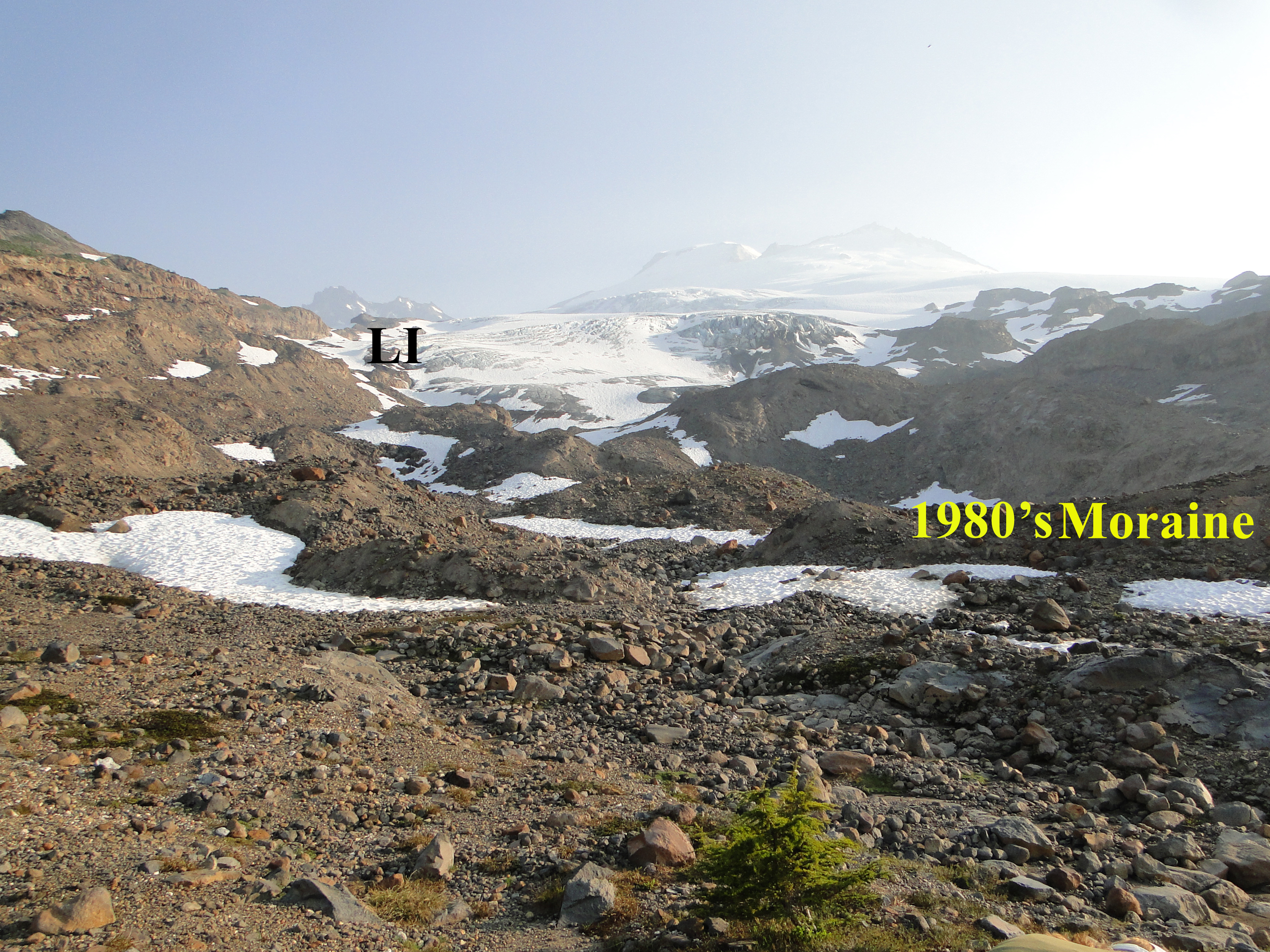
Side view of Lower Curtis Glacier in 2013, 2015 and 2017, illustrating the reduced slope and height of glacier front in just four years.

Terminus observations have been reported to the WGMS from 2500 glaciers with 46,500 specific observations since the late 19th century, which you can explore with the glacier viewer application. Here we examine what it looks like to report from a glacier each year.  I have visited this glacier 34 consecutive years, each time camping in a tent near the glacier, a fun spot indeed when the weather cooperates. The Lower Curtis Glacier is an avalanche fed cirque glacier on Mount Shuksan in the North Cascades of Washington. It is a south facing and low elevation glacier for the range. This is an unusual combination that is supported by the heavy accumulation via avalanching from the upper slopes of Mount Shuksan. The glacier displays a magnificent set of annual layers in its terminus tongue. The terminus tongue is a spectacular wall of seracs that quickly rises 55 m above the bedrock. There are typically 50 layers visible indicating that this most of the ice in the glacier is 50 years of less in age.

Lower Curtis Glacier Front in 2007 and 2017 taken from same location.  Both retreat and thinning of the front in the decade is evident. 

From 1908 to 1950 the glacier retreated from the valley bottom into the cirque. The glacier advanced from 1950-1985 down slope and has retreated since.  Each year we survey the terminus location, measure the mass balance and survey the glacier surface elevation on a cross profile. Here we report on the annual terminus survey from 2007-2017.  The frontal change reported to the World Glacier Monitoring Service has been 2007=-13 m, 2008=-17 m, 2009=-20 m, 2010=-7 m, 2011=-5 m, 2012=-6 m, 2013=-5 m, 2014=-12 m, 2015=16 m, 2016=-16 m and 2017=12 m. This is a total of 129 m of retreat in 11 years, nearly 12 m per year. A longitudinal profile up the middle of the glacier indicates that it thinned 30 meters from 1908-1984 and 22 m from 1985-2016. Because of its heavy accumulation via avalanching the glacier moves rapidly and is quite crevassed at the terminus with large high seracs at the glacier front. In 2007 the height of the terminus seracs was 45 m, by 2014 the seracs were 37 m high and in 2017 had shrunk to 26 m high and not as steep.  The imposing tongue has certainly diminished. The glacier retreat fits the pattern in the region, with all Mount Baker a glaciers retreating (Pelto, 2015).

Mueller Glacier, NZ Terminus Collapse

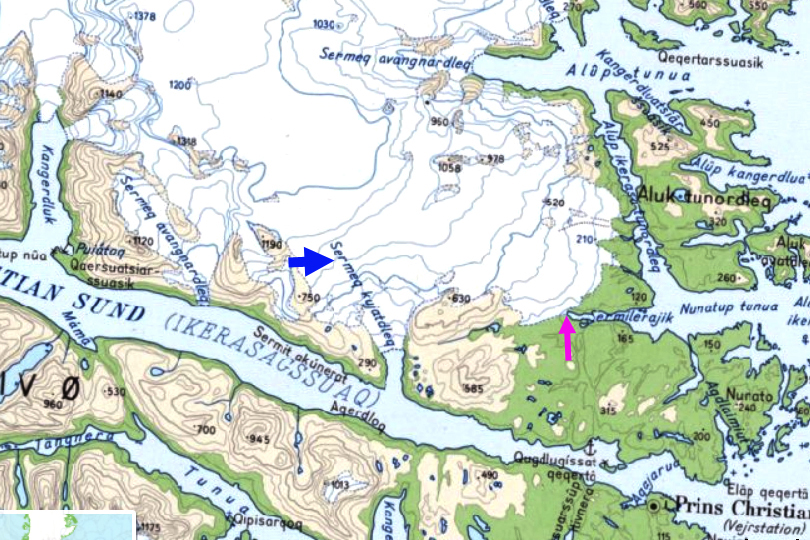
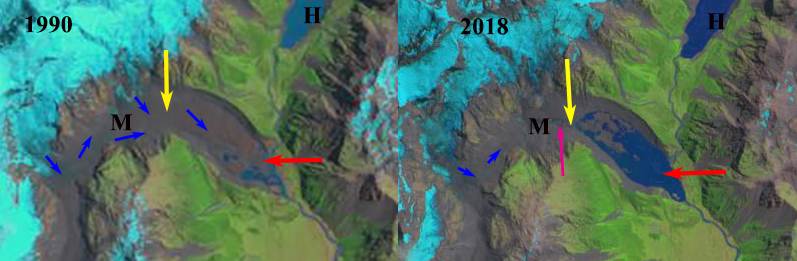
Mueller Glacier (M) in a Landsat image from 1990 and a Sentinel image from 2018. Red arrow is 1990 terminus, yellow arrow 2018 terminus, blue arrow glacier flow, and pink arrow in 2018 ablation valley cut into glacier.

Glaciers of the Southern Alps of New Zealand have been losing ice volume since 1978, with an increasing rate in the last decade (Pelto, 2017).  The NIWA glacier monitoring program has noted that volume of ice in New Zealand’s Southern Alps has decreased 5.8 cubic kilometres, more than 10% in the past 30 years. More than 90% of this loss is from 12 of the largest glaciers in response to rising temperatures over the 20th century. Three of these glaciers are the Tasman, Mueller and Hooker Glacier.   If we look back to the 1972 Mount Cook Map, see below, no lakes are evident at the terminus of Hooker (H), Mueller (M) or Tasman Glacier (T), pink dots indicate terminus location, top image. Now it is a developing lake district.

Mueller Glacier drains the eastern side of Mount Sefton, Mount Thompson and Mount Isabel. The lower section of the glacier is debris covered in the 2.5 km long valley reach from the terminus at 950 m to 1250 m. A comparison of the Mueller Glacier in a sequence of Landsat images indicates a fringing discontinuous area of water along the southern glacier margin in 1990. In 2000 the lake at the end of Hooker Glacier had developed and was 400 meters long. By 2004 the Mueller Glacier Lake had expanded to a length of 700 meters. By 2011 the lake had reached 1400 meters in length. By 2015 the lake had reached 1800 meters in length. Mueller Lake had a surface area of 0.87 km2 and a maximum depth of 83 m (Robertson et al, 2012). From 2015-2018 the terminus has collapsed into the lake with icebergs and other attached ice remnants.  The retreat has left a lake that is 2700 m long,  a retreat of 2300 m since 2000.  The lake basin is 1.6 km2 with 15% filled with remnant ice. Above the current terminus in not a typical convex valley glacier, but a concave reach of debris covered ice with significant melt valleys and hollows indicating stagnation in the lowest 1.6 km.  Pictures of the terminus from 2018 taken by Jill Pelto, UMaine indicate the high turbidity of the lake, which is expected from a debris covered ablation zone. The lack of relief of the relict ice is also evident.
Mueller Glaier drains into Lake Pukaki,a along with Murchison,Hooker and Tasman Glacier, where water level has been raised 9 m for hydropower purposes. Water from Lake Pukaki is sent through a canal into the Lake Ohau watershed and then through six hydropower plants of the Waitaki hydro scheme: Ohau A, B and C. Benmore, Aviemore and Waitaki with a combined output of 1340 MW.  Meridian owns and operates all six hydro stations located from Lake Pūkaki to Waitaki.  Reductions in glacier area in the watershed will lead to reduced summer runoff into the Lake Pukaki system.

The glacier has been fed by three different glaciers flowing off of Mount Sefton. Two of them Tuckett and Huddlesoton (pink arrow) are no longer delivering significant ice to the Mueller, only modest avalanching now spills onto the Mueller Glacier. Only the Frind Glacier (yellow arrow) is contributing to the Mueller Glacier. This is similar to the situation on nearby Murchison Glacier. Further the lack of ice connection from Huddleston and Tuckett Glaciers to Mueller is again evident, pink arrow. The lake will continue to expand through minor calving and downwasting.

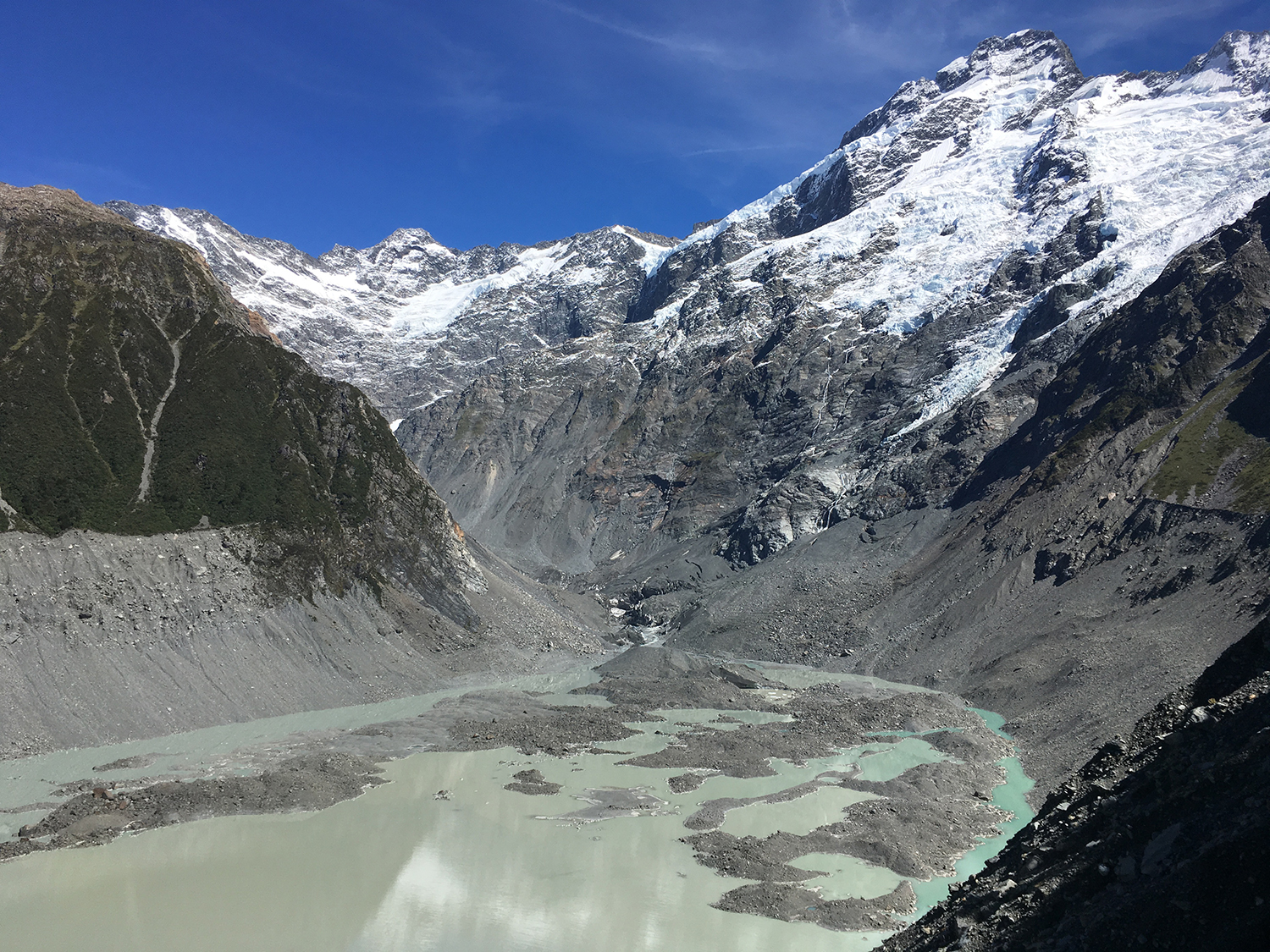
Field work images from Jill Pelto looking across Mueller Lake towards Hooker Lake and Mt. Cook. Some remnant ice is visible.

View southwest toward the head of Mueller Lake and terminus of Mueller Glacier notice stream dissecting stagnant ice at head of lake.  Picture is from Noel Potter, UMaine,  2/2018 


Mueller Glacier (M) in a Landsat image from 2000 and 2015. Red arrow is 1990 terminus, and yellow arrow 2018 terminus.

1972 Map of region when Tasman, Mueller and Hooker Glacier lacked proglacial lakes and Landsat image in 2011 after lake development.


Pared Nord Glacier, Chile Retreat & Landslide Transport 1987-2018

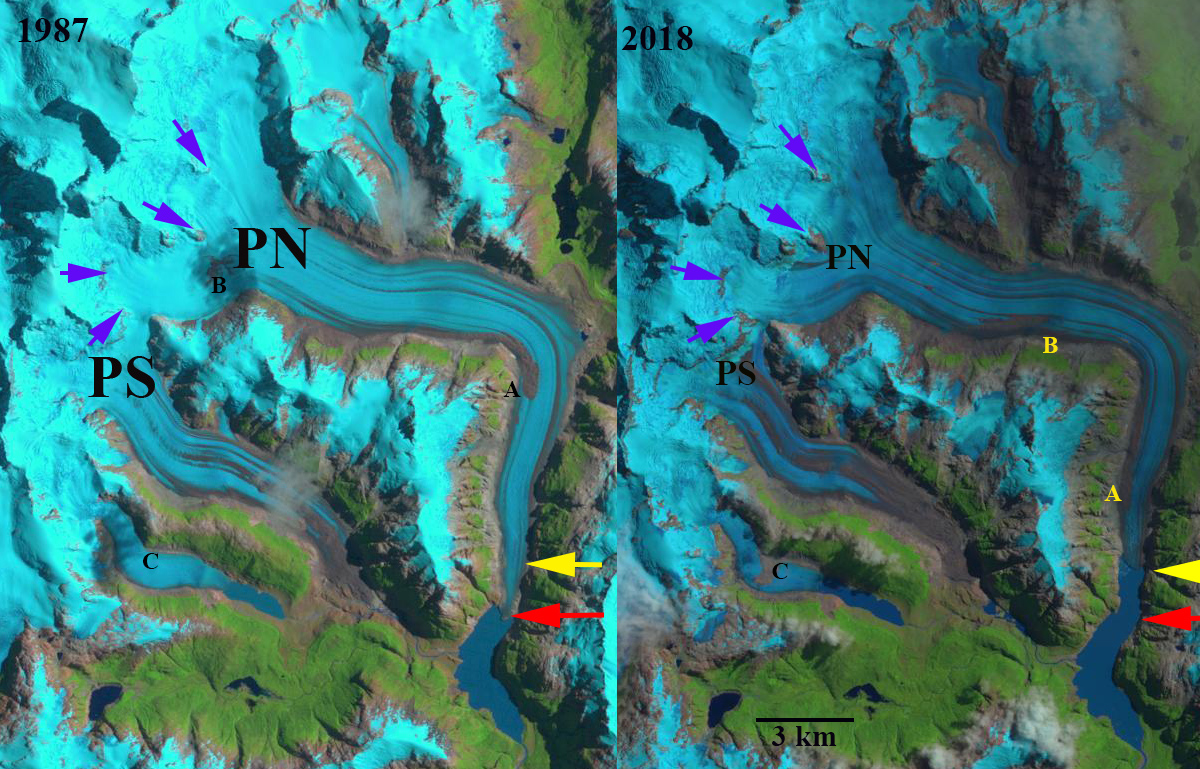
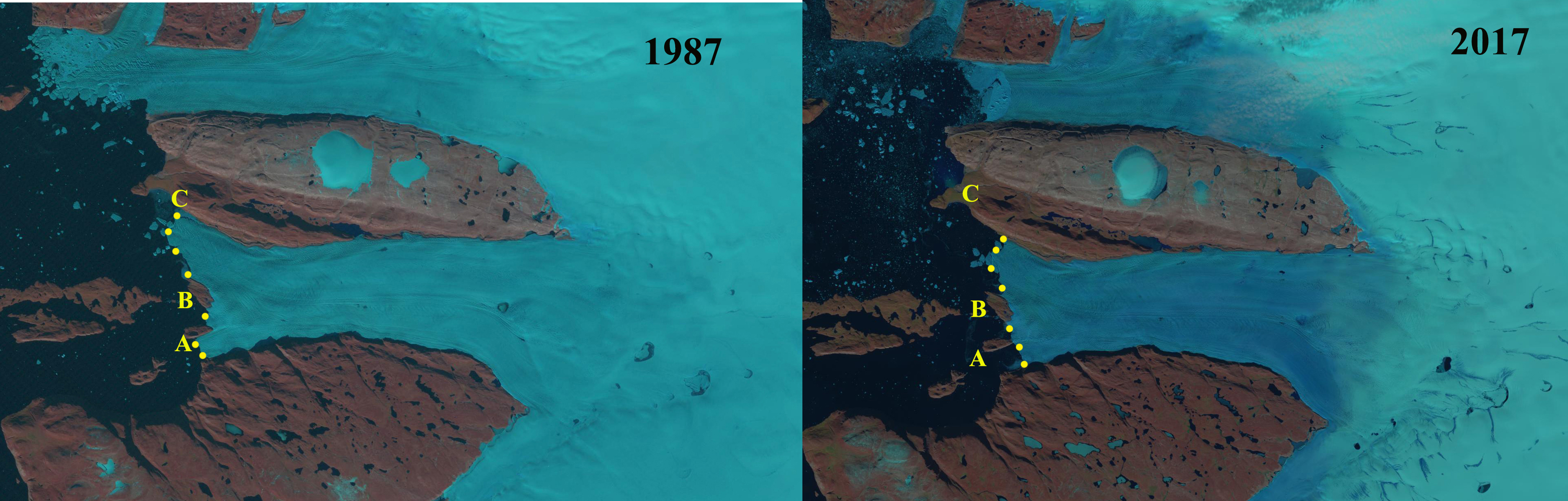
Pared Nord Glacier, Chile in 1987 and 2018 Landsat images.  The red arrow indicates the 1987 terminus location, yellow arrow the 2018 terminus location and purple arrows areas of expanding rock in the lower accumulation zone.  Point A is the front of a wide debris zone from a former landslide, Point B is the front of another landslide deposited debris zone. Point C is a recent landslide deposit on a an unnamed glacier.  The movement f debirs at Point A and B indicate glacier velocity

Pared Nord (Norte) Glacier is a southeast outlet glacier of the Northern Patagonia Icefield (NPI).  Davies and Glasser, (2012)  identify this region of the icefield as retreating faster from 1975-1986 than during any measured period since 1870, the retreat since 2001 has been relatively rapid.   Loriaux and Casassa (2013) examined the expansion of lakes of the Northern Patagonia Ice Cap. From 1945 to 2011 lake area expanded 65%, 66 square kilometers.   Glasser et al (2016) note on Pared Nord that ice-surface debris was transported and redistributed down-ice by glacier flow merging with marginal supraglacial debris.

In 1987 Pared Nord Glacier terminates at a narrow point in the proglacial lake, red arrow.  The debris band at Point A has just turned the corner south towards the terminus and the debris at Point B is near the snowline at the base of the icefall. By 2001 Point B had shifted 4 km downglacier entering the main glacial valley and Point A had shifted 2.5 km towards the terminus.  The terminus had retreated some but was still at the narrow pinning point of the valley.  In 2015 at Point C a landslide had spread across the unnamed glacier. The debris band at Point B had reached the head of a valley from the south side of  the glacier.  In 2018 the purple arrows indicate substantial expansion of bedrock areas near the snowline indicating a rising snowline and glacier thinning.  Glasser et al (2016) note the recent 100 m rise in snowline elevations for the NPI, which along with landslide transport explains the large increase in debris cover since 1987 on Pared Nord.  The main glacier terminus has retreated 1400-1500 m and is currently one kilometer from a widening of the valley, which should lead to an increased calving retreat. The glacier  in 2013 has numerous glacial drainage features, purple arrow in Google Earth image below and substantial crevassing which will lead to calving at the terminus, green arrow. The movement of Point B has been ~4.8 km in 31 years, and of Point A ~3.3 km in 31 years, a velocity of 160 m/year and ~100 m/year respectively.

The retreat of this glacier is less than that of Colonia Glacier to the north and  more than HPN4 glacier to the west.  All the outlet glaciers of NPI have retreated in the last 30 years most leading to expanding proglacial lakes (Pelto, 2017).

Pared Nord Glacier, Chile in 2001 and 2015 Landsat images.  The red arrow indicates the 1987 terminus location and yellow arrow the 2018 terminus location. Point A is the front of a wide debris zone from a former landslide, Point B is the front of another landslide deposited debris zone. Point C is a recent landslide deposit on a an unnamed glacier.  The movement of debris at Point A and B indicate glacier velocity.

Pared Nord terminus in 2013 Google Earth image.  Purple arrows indicate relict glacial drainage features and green arrow large crevasses near the calving front.

Gora Gvandra Glaciers, Caucasus Mountains, No Accumulation Zone in 2017

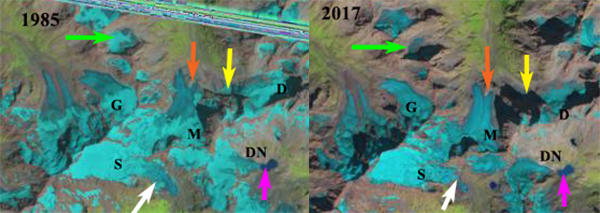
Comparison of glaciers around Gora Gvandra, Caucasus Mountians in 1985 and 2017 Landsat images.  G=Gvandra Glacier, D=Dalar galcier, DN =North Dalari Glacier, S=Sakeni Glacier and M=Morde Glacier. 

Gora Gvandra Mountain is southwest of Mount Elbrus of the Caucasus Mountains of Georgia and is surrounded by a group of glaciers that in recent years have not exhibited an accumulation zone.  Stokes et al (2006) note that 94% of Caucasus Mountain glaciers retreated from 1985 to 2000. Tielidze and Wheate (2018) updated these observations to 2014 documenting the 1986 glacier surface area at 1482 square kilometers decreasing to 1193 square kilometers by 2014, a 29% decline. Here we examine Landsat images from 1985 to 2017 to illustrate the profound changes. In 2017 five of the six glaciers in the area had no retained snowpack, like the Alps this was a summer of high melt.
A comparison from 1985 to 2017 of Dalari North Glacier (DN), pink arrow indicates the glacier ending in a lake in 1985 and 1998, and terminates short of the lake in 2013.  In 2013 the accumulation zone is small and in 2017 the accumulation zone does not exist. Note the contraction of the unnamed glacier from 1985-2017 at the green arrow, with an expanding bedrock area in the midst of what was the glacier and no retained snow in 2017. The Morde Glacier (M) terminus separated around a bedrock knob at the orange arrow in 1985 and the western arm terminates beyond the knob. The glacier has retreated 400 m by 2017, driven by a the lack of an accumulation zone with no retained snowpack in 2013 or 2017.  The terminus of Dalar Galcier (D), yellow arrow, is below a steep slope in 1985 and 1998.  By 2013 the steep slope is bare rock separating the former terminus from the rest of the glacier.  In  2017 there is no retained snowpack on the glacier.  Gvandra Glacier has lost all of its snowpack in 2017. The Sakeni Glacier has a 500 m wide terminus tongue in 1985 and 1998, white arrow.  By 2013 and in 2017 the tongue has narrowed to 150 m and is going to either separate from the upper glacier or melt away soon. There is retained snowpack on the upper part of Sakeni Glacier in each year.

Of the six glaciers examined only one glacier had an accumulation zone in 2017 and in 2013 the accumulation zone was only significant on one glacier.   Pelto (2010) noted that a glacier cannot survive without a persistent and consistent accumulation zone.  This has been noted to be case even on some larger glacier of Mount Elbrus. Psysh Glacier in the western Caucasus is also disappearing.

Comparison of glaciers around Gora Gvandra, Caucasus Mountians in 1985 and 2017 Landsat images. yellow arrow=Dalar glacier, pink arrow=North Dalari Glacier, whtie arrow=Sakeni Glacier and orange arrow=Morde Glacier.


Risting Glacier, South Georgia Retreat Expands Drygalski Fjord

Risting Glacier right and Jenkins Glacier left in Landsat images from 2002, 2015 and 2016.  Red arrow is the 2002 terminus lcoation and yellow arrow at 2016 terminus location.  Dryglaski fjord extends southeast from the glaciers. 

Risting Glacier terminates in Drygalski Fjord on the southeast coast of South Georgia.  Risting and Jenkins Glacier were joined until the 1980’s.  Cook et al (2010) note the glacier had a relatively uniform retreat rate from 1955-1999 of 40 to 50 meters/year, with retreat increasing after 2000. (BAS map).   Gordon et al., (2008) observed that South Georgia’s larger tidewater and sea-calving valley and outlet glaciers generally remained in relatively advanced positions until the 1980’s, Risting Glacier was ahead of this timing in its retreat.
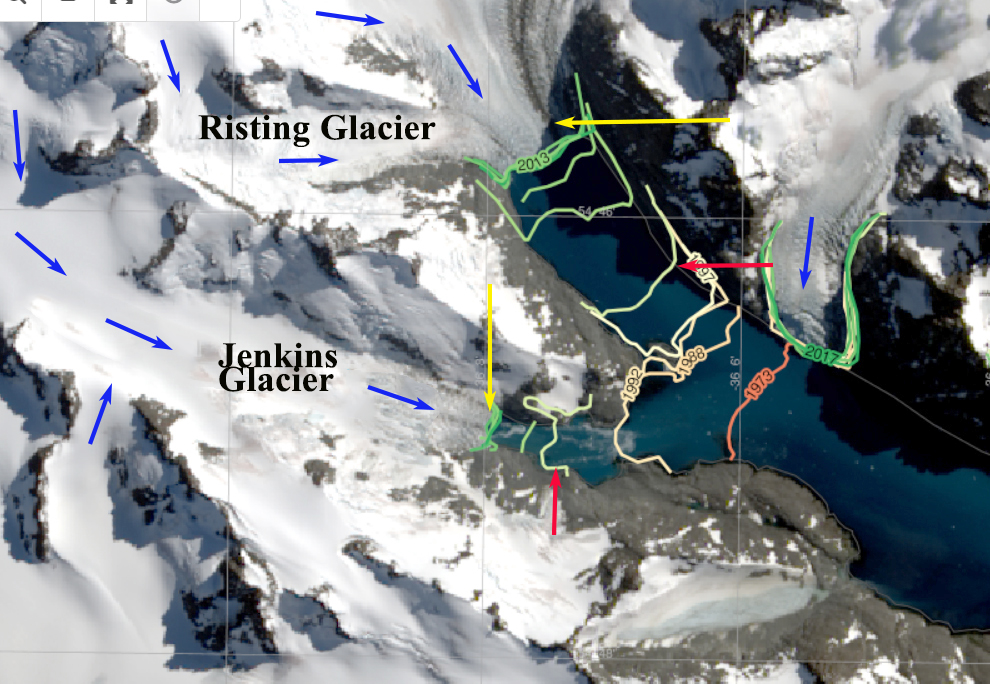
From 2002-2016 Risting Glacier retreated 1100 m, a rate of ~80 m/year twice the 1955-1999 rate. Jenkins Glacier retreated 500 m from 2002-2016 a rate of ~40 m/year.  In the Google Earth image below the slope of Jenkins Glacier suggests the glacier is near the head of the fjord. On Risting Glacier the steepest slope is 2 km behind the calving front, suggestive that the head of fjord is at that point. This location is exceedingly cloudy, making identification of the snowline difficult. The retreat hear is much less than Ross and Hindle Glacier just to the north.  The separation of Jenkins and Risting Glacier is like the separation of Konig and Neumayer Glacier  or Ross and Hindle Glacier.

From the British Antarctic Survey South Geogia GIS online viewer indicating terminus front positions.  Red arrows indicate 2002 positions and 2017 terminus is at yellow arrows.

Front of Jenkins glacier left and Risting Glacier above left, note extensive crevassing of Risting Glacier in particular. 

Double Glacier, Alaska Retreat at the Double & A Volcanic Ash Blanket

Double Glacier, Alaska in 1986 and 2017 Landsat images.  The 1986 terminus location of the northern Big River Lobe and Southern Drift River Lobe are shown with red arrows. Yellow arrows indicate the 2017 terminus locations.  Purple dots indicate the snowline.  Point A indicates a prominent and expanding nunatak that is below the snowline.

Double Glacier is the largest glacier contained within the Lake Clark National Park (LCNP) with an area of 137 km2 (Arendt et al, 2012). The glacier has a double eastern terminus with the northern or Big River Lobe terminus feeding the South Branch Big River and the southern terminus or Drift River Lobe feeding the Drift River.  From 2001-2008 Arendt et al (2012) found that Double Glacier had large elevation losses of ~2 m/year below 1400 m. From 1956-2007 Double Glacier lost 7% of its area, which was below average in the region (NPS, 2012). Here we examine Landsat imagery from1986-2017 to identify changes of the glacier including the surface impact of Mt. Redoubt volcano 2009 eruption.

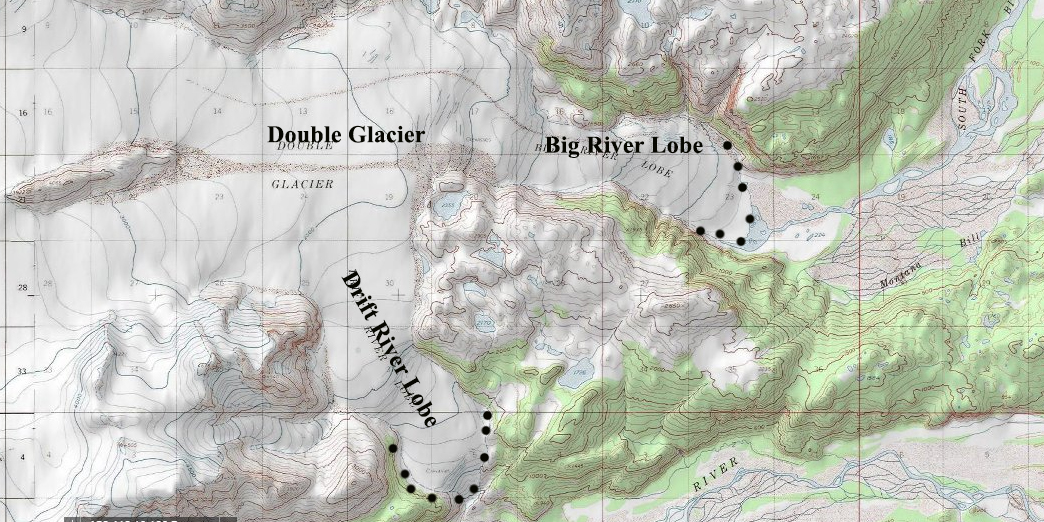
In the 1956 Kenai Topographic map the Drift River Lobe extends to  an elevation of 150 m almost to the Drift River Valley bottom.  The Big River Lobe terminates near the eastern end of the proglacial lake that is just a small fringing water body. In 1986 the Big River Lobe reached the western margin of a 2.5 km long proglacial lake (Big River Lobe Lake), red arrow.  The Drift River Lobe terminated at a ridge at 300 m, red arrow.  A prominent nunatak, Point A extends 4 km up the middle of the glacier from 850 m to 1050 m in elevation.  The snowline is at 1050 m. In 2009 the most striking visual is volcanic ash covers the entire glacier.  This is from Redoubt volcano which the  Alaskan Volcano Observatory reports on the 2009 eruption of this stratovolcano on the west side of Cook Inlet beginning in March 2009. Nineteen major ash-producing explosions generated ash clouds that reached heights between 5200 m and 18900 m. During ash fall in Anchorage, the Ted Stevens International Airport was shut down on for part of March 28  and March 29. The explosive phase ended on April 4 with a dome collapse and an ash cloud that reached 15,200 m and travelled southeast, depositing up to 2 mm of ash fall in Homer, Anchor Point, and Seldovia. The final lava dome ceased growth by July 1, 2009. In 2009 the Big River Lobe has retreated 500 m from the 1986 position.  The Drift River Lobe has had a 1600 m retreat since 1986.  This retreat was not driven by the ash that fell just months before the Landsat image was acquired. In 2016 the snowline is at 1050 m.  The ash remains evident in the ablation zone. In 2017 the snowline is again at 1050 m in late July, with six-eight weeks left in the melt season.  The Drift River Lobe terminus retreat from 1986-2017 has been 1700 m.  The Big River Lobe terminus retreat from 1986-2017 has been 1400 m.  The decreased albedo from the ash between 1986 and 2017 is evident and will lead to enhanced ablation zone melting and retreat. The Nunatak, Point A is located below the snowline each year.  Glacier thinning has led to the expansion in width and vertical relief from the glacier of this nunatak. The lowest 1 km of the glacier today is narrow and fed by a thin ice tongue. The retreat of this glacier is similar to that of Blockade GlacierHallo and Spotted Glacier in the same region, each have had substantial retreats with lake expansion.

Double Glacier, Alaska in 2009 and 2016 Landsat images.  The 2009 image indicates ash fall from Redoubt Volcano covering the glacier. The 1986 terminus location of the northern Big River Lobe and Southern Drift River Lobe are shown with red arrows. Yellow arrows indicate the 2017 terminus locations.  Purple dots indicate the snowline.  Point A indicates a prominent and expanding nunatak that is below the snowline.

Kenai Topographic map indicating glacier margins in 1956. 


Franz Josef Islands Separate due to Glacier Retreat

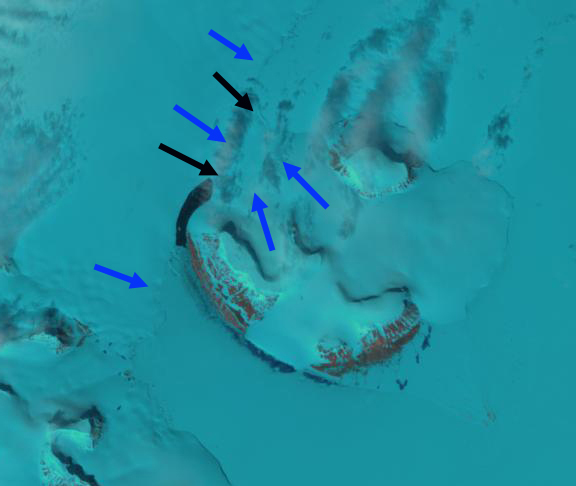
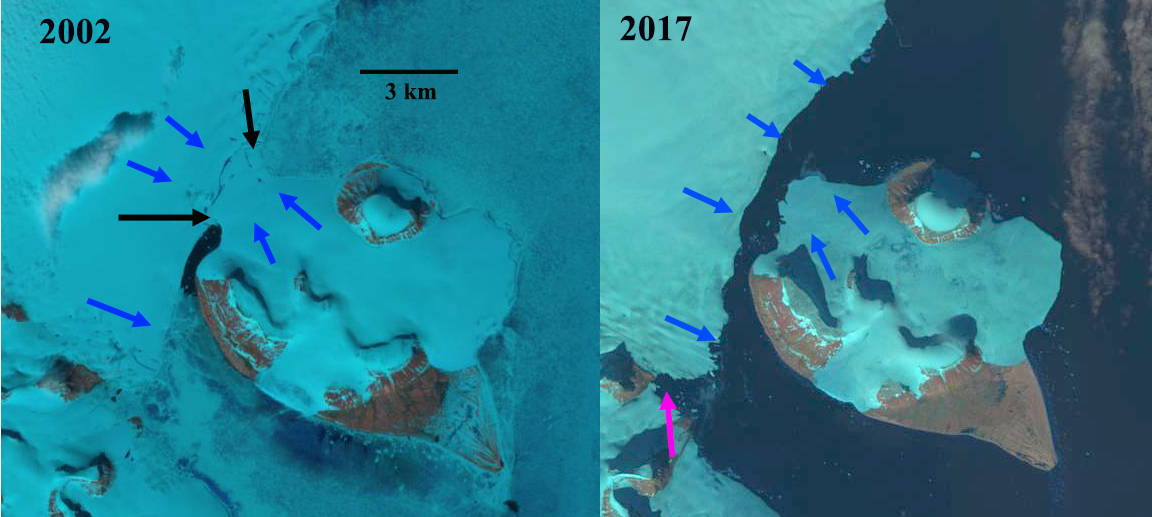
Hall Island (left) and Littrow Island (right) in 2002 and 2017 Landsat images.  The islands are connected by glacier in 2002 between the black arrows.  The blue arrows indicate glacier flow.  In 2017 the glacier connection has failed and Nordenskjold Strait has formed. 

Hall and Littrow Island are two islands in the southern part of Franz Josef Land, Russia that have until 2016 been connected by glacier. Sharov et al (2014) generated a map with the MAIRES Project illustrating the glacier connection was failing, see below. Sharov and Nikolskiy (2017) further report on the failure of this glacier connection.  Here we utilize Landsat imagery from 2000-2017 to illustrate the change.

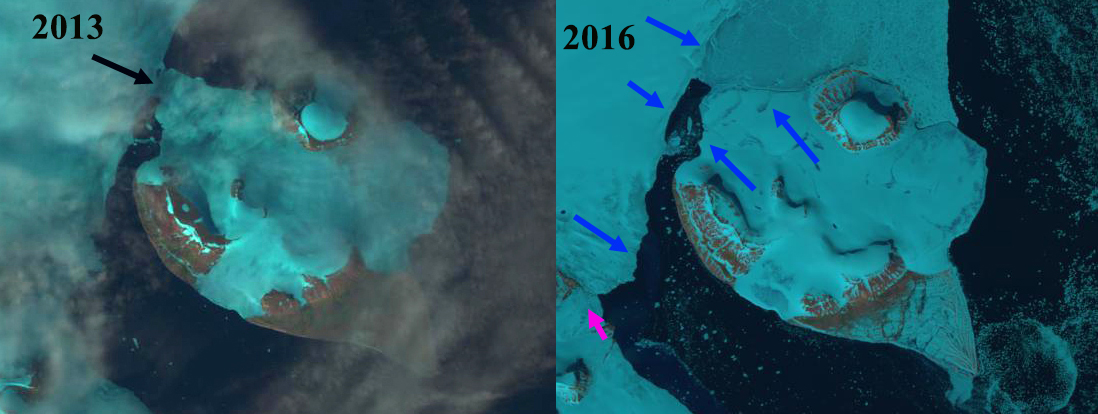
In 2000 the island are surrounded by considerable sea ice and there is a 3 km wide glacier connection, black arrows.  In 2002 the island are again surrounded by considerable sea ice that is distinguishable from the glacier ice.  The glacier connection between the island remains 3 km wide, black arrows, with blue arrows showing the direction of ice movement.  By 2013 the connection has narrowed to 0.7 km and there is no sea ice.  In 2016 the glacier connection is gone between hall and Littrow Island and Nordenskjold Strait has formed.  There is sea ice on the northern shore of Littrow Island reaching to Hall Island. To the southwest the pink arrow indicates where the Sonklar Glacier connects with an unnamed glacier in 2016.  In 2017 there again is no sea ice and the open water between Littrow Island and Hall Island is more apparent. The inlet averages 800 m in width.  The connection between Sonklar Glacier and the neighboring glacier, at the pink arrow, has failed. The lack of sea ice in the region is exposing the marine margins of the ice caps in Franz Josef Land to enhanced melting.  This has and will lead to more coastal changes and island separations.

Hall Island and Littrow Island in 2013 and 2016 Landsat images.  The black arrow indicates a narrow connection in 2013.  In 2016 the glacier connection has failed and Nordenskjold Strait has formed.

Map from MAIRES (Monitoring Arctic Land and Sea Ice from Russian and European satellites) showing the changing connection between islands. 

2000 Landsat image indicating connection between islands at black arrows.


Blockade Glacier, Alaska Retreat Generates Expanding Lake

Blockade Glacier in 2000 and 2017 Landsat images.  Red arrow indicates 2000 terminus locations, yellow arrows 2017 terminus locations and purple dots the snowline. 

Blockade Glacier drains east from the Neacola Mountains in southern Alaska.  The glacier has two prominent terminus locations, the western terminus is in Blockade Lake, blocked by the glacier and the eastern terminus is in a new expanding lake at the headwaters of the MacArthur River. Arendt and Larsen (2012) assessed the glacier changes in Alaska National Parks and found in Lake Clark NP that glacier area declined by 11% from 1956 to 2008.  Hallo and Spotted Glacier in the same region have had substantial retreats with lake expansion.

In 2000 the eastern terminus of Blockade Glacier terminates on an outwash plain with a narrow discontinuous fringe of open water. In 2000 and 2003 the western terminus in Blockade Lake is actively calving across the 1.5 km front, making the front difficult to distinguish.   The snowline is at 1000 m.  The eastern terminus has not changed since 2000 and the snowline is at 900 m.  By 2016 the western terminus has retreated 600 m and with retreat the width of the calving front has increased to 1.8 km.  The wider calving front along with what should be increasing lake depth should lead to a greater calving flux and retreat of the western terminus. The eastern terminus has two embayments filled with a glacier lobe.  The southern lobe has collapsed opening up a a 1 square kilometer lake area.  The snowline in 2016 is at 1000 m. By 2017 the eastern terminus has retreated 1200 m on the south side and 1700 m on the north side.  The northern lobe has now largely collapsed like the southern lobe leading to a lake expansion of 1.5 square kilometers.  The lake depth should be increasing and when the center pulls back from the outwash plain it is still grounded on, glacier retreat will increase.  The snowline is at 1200 m in 2017.

Blockade Glacier USGS map, indicating the lack of a lake at the eastern terminus. 

Blockade Glacier in 2003 Landsat image.  Red arrow indicates 2000 terminus locations, yellow arrows 2017 terminus locations and purple dots the snowline.

Blockade Glacier in 2016 Landsat image.  Red arrow indicates 2000 terminus locations, yellow arrows 2017 terminus locations and purple dots the snowline.

Dickson Glacier, Argentina/Chile Retreat, Separation &Lake Opening

Dickson Glacier (D) retreat illustrated by 1985 and 2017 Landsat images. Red arrows the 1985 terminus position, yellow arrows the 2017 terminus position, C=Cubo Glacier, A=Island, pink arrow indicates where islands form, purple dots indicate snowline and LD=Lago Dickson.

Dickson Glacier is located in Southern Patagonian Icefield (SPI) in Torres del Paine National Park straddling the Argentina and Chile border.  The glacier in 1985 had both an eastern and southern terminus, the southern terminus was in Lago Dickson and the eastern terminus merged with Cubo Glacier (C). From 1986 to 1998, the glacier retreated on both fronts, the Lago Dickson in 1998 was same elevation as the newly forming glacier lake between Dickson and Cubo Glacier (Rivera et al, 2004).  In 1999 the lakes joined and in a bold voyage Andrés Rivera and Heiner Lange crossed by boat from Lago Dickson through the narrow channel in front of Dickson Glacier into the upper lake.  Between 1999 and 2003 Rivera et al (2004) notes that the Dickson Glacier front was relatively stable partly due to the appearance of rocks at the base of the front, see image below.  Here we examine the changes from 1985 to 2017 using Landsat imagery.

In 1985 Dickson Glacier descends from the icefield with the eastern margin merging at a lateral moraine with Cubo Glacier.  The southern terminus extends to the bend in the Lago Dickson basin with a 1.5 km wide calving front. By 2000 the eastern terminus had separated from Cubo Glacier, retreating 1.5 km from Cubo Glacier. This led to the expansion of Lago Dickson and connection to the main lake.  Cubo Glacier terminates on a bedrock island in 2000, Point A, with a small lobe going north and beyond this island.  The southern terminus has retreated and terminates on two islands, pink arrow.  The islands acted as stabilizing points for the southern terminus up to 2010. This kept the width of the lake connection at 250-300m.  By 2016 the eastern terminus had retreated to the Dickson Glacier valley extending NW  to the SPI. Cubo Glacier still terminates at the Island, Point A, but the northern lobe is now gone.  The southern terminus has retreated from the bedrock islands, pink arrow.  In 2016 the southern terminus had a narrow tongue extending almost to the islands, pink arrow.  By 2017 this unstable terminus tongue had disintegrated and the terminus of Dickson Glacier is now a single 1.6 km wide front across the mouth of the NW trending valley to the SPI. The eastern terminus has retreated 2.9 km since 1985 and the southern terminus has retreated 1 km since 1985. Lago Dickson had a length of 11 km in 1985 and in 2017 is 15 km long.  The Dickson Glacier has lost most of its low elevation terminus lobe, which will reduce ablation.  The calving front overall length had declined leading to less calving losses.  Both factors should lead to a reduced rate of retreat in the near future.  Cubo Glacier remains pinned on the island at Point A, retreat from this spot will lead to further expansion of Lago Dickson. The retreat of this glacier follows the pattern of other glaciers on the east side of the SPI Olvidado Glacier,  Onelli Glacier and Grey Glacier

.

Dickson Glacier (D) retreat illustrated by 2000 and 2016 Landsat images. Red arrows the 1985 terminus position, yellow arrows the 2017 terminus position, C=Cubo Glacier, A=Island, pink arrow indicates where islands will form, purple dots indicate snowline and LD=Lago Dickson.

Map of terminus change of Dickson, Cubo and Frias Glacier from Rivera et al (2004)

Konig Glacier, South Georgia Separates from Neumayer Glacier in 2017

Konig Glacier (K) terminus retreat compared in 1999 and 2017 Landsat images.  The red arrow indicate the 1999 terminus location, yellow arrows 2017 terminus location and blue arrows the surface movement. The southern terminus formerly connected with Neumayer Glacier (N) is now separate.

Konig Glacier is a land terminating glacier just north of the Neumayer Glacier, on the northwest coast of South Georgia.  The glacier has a split terminus, a northern terminus ending on an outwash plain near Fortuna Bay and a southern terminus that has merged with Neumayer Glacier. In 1977 the glacier extended to within 300 m of Fortuna Bay and no proglacial lake existed (BAS map).  Neumayer Glacier is a calving glacier that has retreated 5600 m from 1999 to 2016 and is dynamically connected to the Konig Glacier along its southern margin just where the glacier turns northeast. Gordon et al., (2008) observed that larger tidewater and sea-calving valley and outlet glaciers generally remained in relatively advanced positions until the 1980’s.  After 1980 most glaciers receded; some of these retreats have been dramatic and a number of small mountain glaciers will soon disappear.  Here we examine 1999-2017 Landsat imagery to identify glacier change.

In 1999 the southern terminus merged with Neumayer Glacier and extended several kilometers down the fjord.  The northern terminus ended in a proglacial lake adjacent to a tributary joining from the west.  By 2002 glacier retreat had expanded the lake at the northern terminus while limited retreat had changed little at the southern terminus.  In 2006 the northern terminus is at the southern margin of the proglacial lake.  By 2015 the northern terminus had separated from the western tributary and the terminus had retreated from the proglacial lake.  The proglacial lake had expanded in width possibly due to ice cored moraine metling.  The snowline, purple dots, in 2015 is at 550 m.  By 2017 the southern terminus of Konig Glacier has separated from the rapidly retreating main trunk of Neumayer Glacier.  The northern terminus has retreated 1100 m since 1999 and a new upper proglacial lake is forming at the terminus. The western tributary no longer approaches Konig Glacier. The medial moraine running down both the southern and northern arm have expanded in prominence suggesting enhanced ablation.  The snowline in December 2017 is at 450 m with several months of the melt season to go.  The retreat of Konig Glacier is like that of land terminating Purvis Glacier. While glacier separation has also been since at Ross and Hindle Glacier.

Map of terminus positions of Konig and Neumayer Glacier, South Georgia from the British Antarctic Survey online map site.

Konig Glacier (K) terminus retreat compared in 2002 and 2015 Landsat images.  The red arrow indicate the 1999 terminus location, yellow arrows 2017 terminus location and blue arrows the surface movement. The southern terminus is still connected with Neumayer Glacier (N).

Konig Glacier in 2006 Google Earth image indicating northern terminus (2) and southern terminus (1).