Pared Nord Glacier, Chile Retreat & Landslide Transport 1987-2018

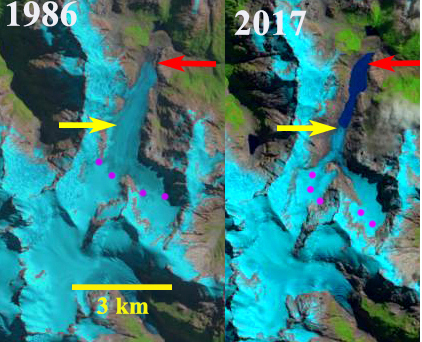
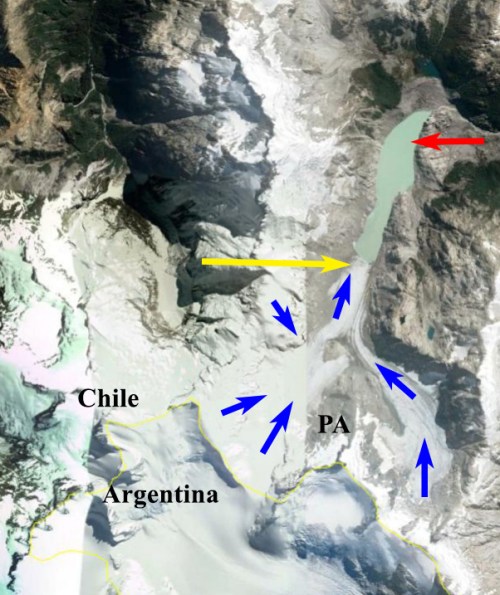
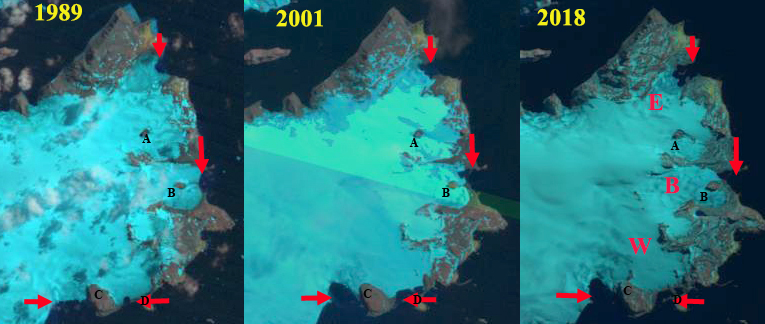
Pared Nord Glacier, Chile in 1987 and 2018 Landsat images.  The red arrow indicates the 1987 terminus location, yellow arrow the 2018 terminus location and purple arrows areas of expanding rock in the lower accumulation zone.  Point A is the front of a wide debris zone from a former landslide, Point B is the front of another landslide deposited debris zone. Point C is a recent landslide deposit on a an unnamed glacier.  The movement f debirs at Point A and B indicate glacier velocity

Pared Nord (Norte) Glacier is a southeast outlet glacier of the Northern Patagonia Icefield (NPI).  Davies and Glasser, (2012)  identify this region of the icefield as retreating faster from 1975-1986 than during any measured period since 1870, the retreat since 2001 has been relatively rapid.   Loriaux and Casassa (2013) examined the expansion of lakes of the Northern Patagonia Ice Cap. From 1945 to 2011 lake area expanded 65%, 66 square kilometers.   Glasser et al (2016) note on Pared Nord that ice-surface debris was transported and redistributed down-ice by glacier flow merging with marginal supraglacial debris.

In 1987 Pared Nord Glacier terminates at a narrow point in the proglacial lake, red arrow.  The debris band at Point A has just turned the corner south towards the terminus and the debris at Point B is near the snowline at the base of the icefall. By 2001 Point B had shifted 4 km downglacier entering the main glacial valley and Point A had shifted 2.5 km towards the terminus.  The terminus had retreated some but was still at the narrow pinning point of the valley.  In 2015 at Point C a landslide had spread across the unnamed glacier. The debris band at Point B had reached the head of a valley from the south side of  the glacier.  In 2018 the purple arrows indicate substantial expansion of bedrock areas near the snowline indicating a rising snowline and glacier thinning.  Glasser et al (2016) note the recent 100 m rise in snowline elevations for the NPI, which along with landslide transport explains the large increase in debris cover since 1987 on Pared Nord.  The main glacier terminus has retreated 1400-1500 m and is currently one kilometer from a widening of the valley, which should lead to an increased calving retreat. The glacier  in 2013 has numerous glacial drainage features, purple arrow in Google Earth image below and substantial crevassing which will lead to calving at the terminus, green arrow. The movement of Point B has been ~4.8 km in 31 years, and of Point A ~3.3 km in 31 years, a velocity of 160 m/year and ~100 m/year respectively.

The retreat of this glacier is less than that of Colonia Glacier to the north and  more than HPN4 glacier to the west.  All the outlet glaciers of NPI have retreated in the last 30 years most leading to expanding proglacial lakes (Pelto, 2017).
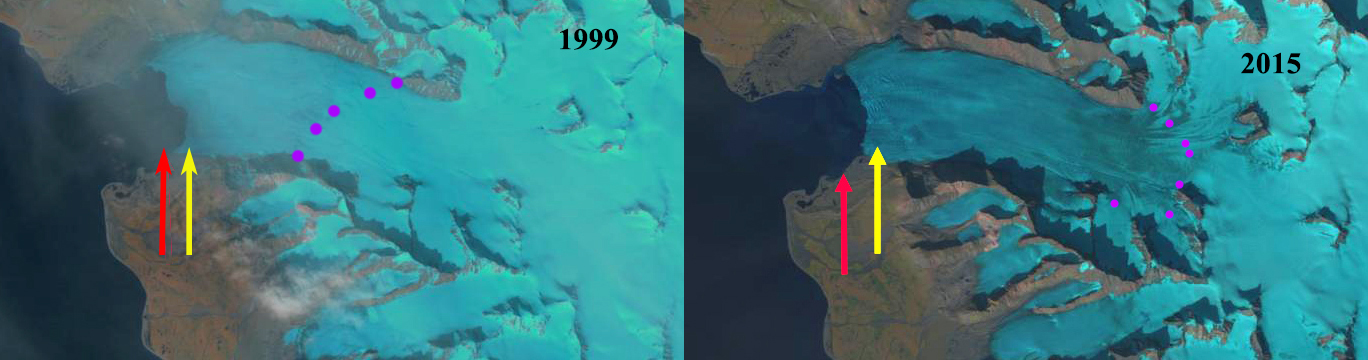
Pared Nord Glacier, Chile in 2001 and 2015 Landsat images.  The red arrow indicates the 1987 terminus location and yellow arrow the 2018 terminus location. Point A is the front of a wide debris zone from a former landslide, Point B is the front of another landslide deposited debris zone. Point C is a recent landslide deposit on a an unnamed glacier.  The movement of debris at Point A and B indicate glacier velocity.

Pared Nord terminus in 2013 Google Earth image.  Purple arrows indicate relict glacial drainage features and green arrow large crevasses near the calving front.

Gora Gvandra Glaciers, Caucasus Mountains, No Accumulation Zone in 2017

Comparison of glaciers around Gora Gvandra, Caucasus Mountians in 1985 and 2017 Landsat images.  G=Gvandra Glacier, D=Dalar galcier, DN =North Dalari Glacier, S=Sakeni Glacier and M=Morde Glacier. 

Gora Gvandra Mountain is southwest of Mount Elbrus of the Caucasus Mountains of Georgia and is surrounded by a group of glaciers that in recent years have not exhibited an accumulation zone.  Stokes et al (2006) note that 94% of Caucasus Mountain glaciers retreated from 1985 to 2000. Tielidze and Wheate (2018) updated these observations to 2014 documenting the 1986 glacier surface area at 1482 square kilometers decreasing to 1193 square kilometers by 2014, a 29% decline. Here we examine Landsat images from 1985 to 2017 to illustrate the profound changes. In 2017 five of the six glaciers in the area had no retained snowpack, like the Alps this was a summer of high melt.
A comparison from 1985 to 2017 of Dalari North Glacier (DN), pink arrow indicates the glacier ending in a lake in 1985 and 1998, and terminates short of the lake in 2013.  In 2013 the accumulation zone is small and in 2017 the accumulation zone does not exist. Note the contraction of the unnamed glacier from 1985-2017 at the green arrow, with an expanding bedrock area in the midst of what was the glacier and no retained snow in 2017. The Morde Glacier (M) terminus separated around a bedrock knob at the orange arrow in 1985 and the western arm terminates beyond the knob. The glacier has retreated 400 m by 2017, driven by a the lack of an accumulation zone with no retained snowpack in 2013 or 2017.  The terminus of Dalar Galcier (D), yellow arrow, is below a steep slope in 1985 and 1998.  By 2013 the steep slope is bare rock separating the former terminus from the rest of the glacier.  In  2017 there is no retained snowpack on the glacier.  Gvandra Glacier has lost all of its snowpack in 2017. The Sakeni Glacier has a 500 m wide terminus tongue in 1985 and 1998, white arrow.  By 2013 and in 2017 the tongue has narrowed to 150 m and is going to either separate from the upper glacier or melt away soon. There is retained snowpack on the upper part of Sakeni Glacier in each year.

Of the six glaciers examined only one glacier had an accumulation zone in 2017 and in 2013 the accumulation zone was only significant on one glacier.   Pelto (2010) noted that a glacier cannot survive without a persistent and consistent accumulation zone.  This has been noted to be case even on some larger glacier of Mount Elbrus. Psysh Glacier in the western Caucasus is also disappearing.

Comparison of glaciers around Gora Gvandra, Caucasus Mountians in 1985 and 2017 Landsat images. yellow arrow=Dalar glacier, pink arrow=North Dalari Glacier, whtie arrow=Sakeni Glacier and orange arrow=Morde Glacier.


Risting Glacier, South Georgia Retreat Expands Drygalski Fjord

Risting Glacier right and Jenkins Glacier left in Landsat images from 2002, 2015 and 2016.  Red arrow is the 2002 terminus lcoation and yellow arrow at 2016 terminus location.  Dryglaski fjord extends southeast from the glaciers. 

Risting Glacier terminates in Drygalski Fjord on the southeast coast of South Georgia.  Risting and Jenkins Glacier were joined until the 1980’s.  Cook et al (2010) note the glacier had a relatively uniform retreat rate from 1955-1999 of 40 to 50 meters/year, with retreat increasing after 2000. (BAS map).   Gordon et al., (2008) observed that South Georgia’s larger tidewater and sea-calving valley and outlet glaciers generally remained in relatively advanced positions until the 1980’s, Risting Glacier was ahead of this timing in its retreat.

From 2002-2016 Risting Glacier retreated 1100 m, a rate of ~80 m/year twice the 1955-1999 rate. Jenkins Glacier retreated 500 m from 2002-2016 a rate of ~40 m/year.  In the Google Earth image below the slope of Jenkins Glacier suggests the glacier is near the head of the fjord. On Risting Glacier the steepest slope is 2 km behind the calving front, suggestive that the head of fjord is at that point. This location is exceedingly cloudy, making identification of the snowline difficult. The retreat hear is much less than Ross and Hindle Glacier just to the north.  The separation of Jenkins and Risting Glacier is like the separation of Konig and Neumayer Glacier  or Ross and Hindle Glacier.

From the British Antarctic Survey South Geogia GIS online viewer indicating terminus front positions.  Red arrows indicate 2002 positions and 2017 terminus is at yellow arrows.

Front of Jenkins glacier left and Risting Glacier above left, note extensive crevassing of Risting Glacier in particular. 

Double Glacier, Alaska Retreat at the Double & A Volcanic Ash Blanket

Double Glacier, Alaska in 1986 and 2017 Landsat images.  The 1986 terminus location of the northern Big River Lobe and Southern Drift River Lobe are shown with red arrows. Yellow arrows indicate the 2017 terminus locations.  Purple dots indicate the snowline.  Point A indicates a prominent and expanding nunatak that is below the snowline.

Double Glacier is the largest glacier contained within the Lake Clark National Park (LCNP) with an area of 137 km2 (Arendt et al, 2012). The glacier has a double eastern terminus with the northern or Big River Lobe terminus feeding the South Branch Big River and the southern terminus or Drift River Lobe feeding the Drift River.  From 2001-2008 Arendt et al (2012) found that Double Glacier had large elevation losses of ~2 m/year below 1400 m. From 1956-2007 Double Glacier lost 7% of its area, which was below average in the region (NPS, 2012). Here we examine Landsat imagery from1986-2017 to identify changes of the glacier including the surface impact of Mt. Redoubt volcano 2009 eruption.

In the 1956 Kenai Topographic map the Drift River Lobe extends to  an elevation of 150 m almost to the Drift River Valley bottom.  The Big River Lobe terminates near the eastern end of the proglacial lake that is just a small fringing water body. In 1986 the Big River Lobe reached the western margin of a 2.5 km long proglacial lake (Big River Lobe Lake), red arrow.  The Drift River Lobe terminated at a ridge at 300 m, red arrow.  A prominent nunatak, Point A extends 4 km up the middle of the glacier from 850 m to 1050 m in elevation.  The snowline is at 1050 m. In 2009 the most striking visual is volcanic ash covers the entire glacier.  This is from Redoubt volcano which the  Alaskan Volcano Observatory reports on the 2009 eruption of this stratovolcano on the west side of Cook Inlet beginning in March 2009. Nineteen major ash-producing explosions generated ash clouds that reached heights between 5200 m and 18900 m. During ash fall in Anchorage, the Ted Stevens International Airport was shut down on for part of March 28  and March 29. The explosive phase ended on April 4 with a dome collapse and an ash cloud that reached 15,200 m and travelled southeast, depositing up to 2 mm of ash fall in Homer, Anchor Point, and Seldovia. The final lava dome ceased growth by July 1, 2009. In 2009 the Big River Lobe has retreated 500 m from the 1986 position.  The Drift River Lobe has had a 1600 m retreat since 1986.  This retreat was not driven by the ash that fell just months before the Landsat image was acquired. In 2016 the snowline is at 1050 m.  The ash remains evident in the ablation zone. In 2017 the snowline is again at 1050 m in late July, with six-eight weeks left in the melt season.  The Drift River Lobe terminus retreat from 1986-2017 has been 1700 m.  The Big River Lobe terminus retreat from 1986-2017 has been 1400 m.  The decreased albedo from the ash between 1986 and 2017 is evident and will lead to enhanced ablation zone melting and retreat. The Nunatak, Point A is located below the snowline each year.  Glacier thinning has led to the expansion in width and vertical relief from the glacier of this nunatak. The lowest 1 km of the glacier today is narrow and fed by a thin ice tongue. The retreat of this glacier is similar to that of Blockade GlacierHallo and Spotted Glacier in the same region, each have had substantial retreats with lake expansion.

Double Glacier, Alaska in 2009 and 2016 Landsat images.  The 2009 image indicates ash fall from Redoubt Volcano covering the glacier. The 1986 terminus location of the northern Big River Lobe and Southern Drift River Lobe are shown with red arrows. Yellow arrows indicate the 2017 terminus locations.  Purple dots indicate the snowline.  Point A indicates a prominent and expanding nunatak that is below the snowline.

Kenai Topographic map indicating glacier margins in 1956. 


Franz Josef Islands Separate due to Glacier Retreat

Hall Island (left) and Littrow Island (right) in 2002 and 2017 Landsat images.  The islands are connected by glacier in 2002 between the black arrows.  The blue arrows indicate glacier flow.  In 2017 the glacier connection has failed and Nordenskjold Strait has formed. 

Hall and Littrow Island are two islands in the southern part of Franz Josef Land, Russia that have until 2016 been connected by glacier. Sharov et al (2014) generated a map with the MAIRES Project illustrating the glacier connection was failing, see below. Sharov and Nikolskiy (2017) further report on the failure of this glacier connection.  Here we utilize Landsat imagery from 2000-2017 to illustrate the change.

In 2000 the island are surrounded by considerable sea ice and there is a 3 km wide glacier connection, black arrows.  In 2002 the island are again surrounded by considerable sea ice that is distinguishable from the glacier ice.  The glacier connection between the island remains 3 km wide, black arrows, with blue arrows showing the direction of ice movement.  By 2013 the connection has narrowed to 0.7 km and there is no sea ice.  In 2016 the glacier connection is gone between hall and Littrow Island and Nordenskjold Strait has formed.  There is sea ice on the northern shore of Littrow Island reaching to Hall Island. To the southwest the pink arrow indicates where the Sonklar Glacier connects with an unnamed glacier in 2016.  In 2017 there again is no sea ice and the open water between Littrow Island and Hall Island is more apparent. The inlet averages 800 m in width.  The connection between Sonklar Glacier and the neighboring glacier, at the pink arrow, has failed. The lack of sea ice in the region is exposing the marine margins of the ice caps in Franz Josef Land to enhanced melting.  This has and will lead to more coastal changes and island separations.

Hall Island and Littrow Island in 2013 and 2016 Landsat images.  The black arrow indicates a narrow connection in 2013.  In 2016 the glacier connection has failed and Nordenskjold Strait has formed.

Map from MAIRES (Monitoring Arctic Land and Sea Ice from Russian and European satellites) showing the changing connection between islands. 

2000 Landsat image indicating connection between islands at black arrows.


Blockade Glacier, Alaska Retreat Generates Expanding Lake

Blockade Glacier in 2000 and 2017 Landsat images.  Red arrow indicates 2000 terminus locations, yellow arrows 2017 terminus locations and purple dots the snowline. 

Blockade Glacier drains east from the Neacola Mountains in southern Alaska.  The glacier has two prominent terminus locations, the western terminus is in Blockade Lake, blocked by the glacier and the eastern terminus is in a new expanding lake at the headwaters of the MacArthur River. Arendt and Larsen (2012) assessed the glacier changes in Alaska National Parks and found in Lake Clark NP that glacier area declined by 11% from 1956 to 2008.  Hallo and Spotted Glacier in the same region have had substantial retreats with lake expansion.

In 2000 the eastern terminus of Blockade Glacier terminates on an outwash plain with a narrow discontinuous fringe of open water. In 2000 and 2003 the western terminus in Blockade Lake is actively calving across the 1.5 km front, making the front difficult to distinguish.   The snowline is at 1000 m.  The eastern terminus has not changed since 2000 and the snowline is at 900 m.  By 2016 the western terminus has retreated 600 m and with retreat the width of the calving front has increased to 1.8 km.  The wider calving front along with what should be increasing lake depth should lead to a greater calving flux and retreat of the western terminus. The eastern terminus has two embayments filled with a glacier lobe.  The southern lobe has collapsed opening up a a 1 square kilometer lake area.  The snowline in 2016 is at 1000 m. By 2017 the eastern terminus has retreated 1200 m on the south side and 1700 m on the north side.  The northern lobe has now largely collapsed like the southern lobe leading to a lake expansion of 1.5 square kilometers.  The lake depth should be increasing and when the center pulls back from the outwash plain it is still grounded on, glacier retreat will increase.  The snowline is at 1200 m in 2017.

Blockade Glacier USGS map, indicating the lack of a lake at the eastern terminus. 

Blockade Glacier in 2003 Landsat image.  Red arrow indicates 2000 terminus locations, yellow arrows 2017 terminus locations and purple dots the snowline.

Blockade Glacier in 2016 Landsat image.  Red arrow indicates 2000 terminus locations, yellow arrows 2017 terminus locations and purple dots the snowline.

Dickson Glacier, Argentina/Chile Retreat, Separation &Lake Opening

Dickson Glacier (D) retreat illustrated by 1985 and 2017 Landsat images. Red arrows the 1985 terminus position, yellow arrows the 2017 terminus position, C=Cubo Glacier, A=Island, pink arrow indicates where islands form, purple dots indicate snowline and LD=Lago Dickson.

Dickson Glacier is located in Southern Patagonian Icefield (SPI) in Torres del Paine National Park straddling the Argentina and Chile border.  The glacier in 1985 had both an eastern and southern terminus, the southern terminus was in Lago Dickson and the eastern terminus merged with Cubo Glacier (C). From 1986 to 1998, the glacier retreated on both fronts, the Lago Dickson in 1998 was same elevation as the newly forming glacier lake between Dickson and Cubo Glacier (Rivera et al, 2004).  In 1999 the lakes joined and in a bold voyage Andrés Rivera and Heiner Lange crossed by boat from Lago Dickson through the narrow channel in front of Dickson Glacier into the upper lake.  Between 1999 and 2003 Rivera et al (2004) notes that the Dickson Glacier front was relatively stable partly due to the appearance of rocks at the base of the front, see image below.  Here we examine the changes from 1985 to 2017 using Landsat imagery.

In 1985 Dickson Glacier descends from the icefield with the eastern margin merging at a lateral moraine with Cubo Glacier.  The southern terminus extends to the bend in the Lago Dickson basin with a 1.5 km wide calving front. By 2000 the eastern terminus had separated from Cubo Glacier, retreating 1.5 km from Cubo Glacier. This led to the expansion of Lago Dickson and connection to the main lake.  Cubo Glacier terminates on a bedrock island in 2000, Point A, with a small lobe going north and beyond this island.  The southern terminus has retreated and terminates on two islands, pink arrow.  The islands acted as stabilizing points for the southern terminus up to 2010. This kept the width of the lake connection at 250-300m.  By 2016 the eastern terminus had retreated to the Dickson Glacier valley extending NW  to the SPI. Cubo Glacier still terminates at the Island, Point A, but the northern lobe is now gone.  The southern terminus has retreated from the bedrock islands, pink arrow.  In 2016 the southern terminus had a narrow tongue extending almost to the islands, pink arrow.  By 2017 this unstable terminus tongue had disintegrated and the terminus of Dickson Glacier is now a single 1.6 km wide front across the mouth of the NW trending valley to the SPI. The eastern terminus has retreated 2.9 km since 1985 and the southern terminus has retreated 1 km since 1985. Lago Dickson had a length of 11 km in 1985 and in 2017 is 15 km long.  The Dickson Glacier has lost most of its low elevation terminus lobe, which will reduce ablation.  The calving front overall length had declined leading to less calving losses.  Both factors should lead to a reduced rate of retreat in the near future.  Cubo Glacier remains pinned on the island at Point A, retreat from this spot will lead to further expansion of Lago Dickson. The retreat of this glacier follows the pattern of other glaciers on the east side of the SPI Olvidado Glacier,  Onelli Glacier and Grey Glacier

.

Dickson Glacier (D) retreat illustrated by 2000 and 2016 Landsat images. Red arrows the 1985 terminus position, yellow arrows the 2017 terminus position, C=Cubo Glacier, A=Island, pink arrow indicates where islands will form, purple dots indicate snowline and LD=Lago Dickson.

Map of terminus change of Dickson, Cubo and Frias Glacier from Rivera et al (2004)

Konig Glacier, South Georgia Separates from Neumayer Glacier in 2017

Konig Glacier (K) terminus retreat compared in 1999 and 2017 Landsat images.  The red arrow indicate the 1999 terminus location, yellow arrows 2017 terminus location and blue arrows the surface movement. The southern terminus formerly connected with Neumayer Glacier (N) is now separate.

Konig Glacier is a land terminating glacier just north of the Neumayer Glacier, on the northwest coast of South Georgia.  The glacier has a split terminus, a northern terminus ending on an outwash plain near Fortuna Bay and a southern terminus that has merged with Neumayer Glacier. In 1977 the glacier extended to within 300 m of Fortuna Bay and no proglacial lake existed (BAS map).  Neumayer Glacier is a calving glacier that has retreated 5600 m from 1999 to 2016 and is dynamically connected to the Konig Glacier along its southern margin just where the glacier turns northeast. Gordon et al., (2008) observed that larger tidewater and sea-calving valley and outlet glaciers generally remained in relatively advanced positions until the 1980’s.  After 1980 most glaciers receded; some of these retreats have been dramatic and a number of small mountain glaciers will soon disappear.  Here we examine 1999-2017 Landsat imagery to identify glacier change.

In 1999 the southern terminus merged with Neumayer Glacier and extended several kilometers down the fjord.  The northern terminus ended in a proglacial lake adjacent to a tributary joining from the west.  By 2002 glacier retreat had expanded the lake at the northern terminus while limited retreat had changed little at the southern terminus.  In 2006 the northern terminus is at the southern margin of the proglacial lake.  By 2015 the northern terminus had separated from the western tributary and the terminus had retreated from the proglacial lake.  The proglacial lake had expanded in width possibly due to ice cored moraine metling.  The snowline, purple dots, in 2015 is at 550 m.  By 2017 the southern terminus of Konig Glacier has separated from the rapidly retreating main trunk of Neumayer Glacier.  The northern terminus has retreated 1100 m since 1999 and a new upper proglacial lake is forming at the terminus. The western tributary no longer approaches Konig Glacier. The medial moraine running down both the southern and northern arm have expanded in prominence suggesting enhanced ablation.  The snowline in December 2017 is at 450 m with several months of the melt season to go.  The retreat of Konig Glacier is like that of land terminating Purvis Glacier. While glacier separation has also been since at Ross and Hindle Glacier.

Map of terminus positions of Konig and Neumayer Glacier, South Georgia from the British Antarctic Survey online map site.

Konig Glacier (K) terminus retreat compared in 2002 and 2015 Landsat images.  The red arrow indicate the 1999 terminus location, yellow arrows 2017 terminus location and blue arrows the surface movement. The southern terminus is still connected with Neumayer Glacier (N).

Konig Glacier in 2006 Google Earth image indicating northern terminus (2) and southern terminus (1).


Glaciar Olvidado, Chile Retreat Lake Expansion 1985-2017

Glaciar Olvidado (O) retreat illustrated in 1985 and 2017 Landsat images.  Red arrow is 1985 terminus location, yellow arrow is 2017 terminus location and purple dots are the snowline.  This illustrates an 1800 m retreat. 

Glaciar Olvidado (G) is a glacier in the southeast portion of the Southern Patagonia Icefield (SPI), adjacent to Grey Glacier (G).  The glacier terminates in a proglacial lake. Rivera and Casassa (2004) report the glacier terminating in a newly formed lake in 1986 and retreating slowly from 1986 to 2000.  Here we examine changes in the glacier from 1985 to 2017 using Landsat imagery.

In 1985 the glacier terminates in small newly formed proglacial lake that is just 200 m long.  The snowline in 1985 is at 1050 m. In 2000 the lake has expanded to a length of 900 m.  The snowline in 2000 is at 950 m.  By 2016 the proglacial lake has expanded to  a length of 2 km.  The snowline in 2016 is at 1100 m.  In 2017 the glacier has retreated 1800 m since 1986.  The snowline is at the base of the steep slopes at 1150 m.  The high snowline leaves less than 30% of the glacier in the accumulation zone.  The high snowlines indicate a limited accumulation zone, which generates a negative mass balance and drives retreat.  The glacier continues to calve into this terminus lake adding to the negative mass balance and consequent retreat.  This glacier adds to the growth of proglacial lakes seen in the Northern Patagonia Icefield  (Glasser et al 2016) and SPI (Iribarren et al 2014).  Olvidado Glacier retreat in terms of distance is similar to the adjacent Grey Glacier, but does represent 20% of its total length.  The retreat is much less than the HPS-12 glacier on the west side of the SPI. 

Glaciar Olvidado retreat illustrated in 2000 and 2016 Landsat images.  Red arrow is 1985 terminus location, yellow arrow is 2017 terminus location and purple dots are the snowline. 

Olvidado Glacier in 2016 Google Earth image. 


Safuna & Arhuey Glacier, Peru Retreat from Lakes

Safuna Glacier (S) and Arhuey Glacier (A) in 1992 and 2017 Landsat images indicating glacier retreat from the 1992 terminus red arrow to the 2017 terminus position yellow arrow.  Snowline indicated by purple dots.

Safuna Glacier (S) is at the northern end of the Cordillera Blanca Range, Peru flowing north from Nevados Pucajirca.  Arhuey Glacier (A) is adjacent to Safuna and flows west formerly terminating in Arhuey Lagunacocha impounded by a moraine. Safuna Glacier in 1992 terminated in Laguna Safuna Alta, which is impounded by a moraine dam and has a history of water level fluctuations.   Reynolds Geosciences (2003) provides a detailed look at the lake, moraine and associated engineering.  The moraine appeared unstable in the 1960’s prompting excavation of  a tunnel through the moraine in 1970, which ended up below the lake water level after the lake surface elevation dropped 25 m in late 1970.  In 1978 a second tunnel was constructed, that to date remains above the lake waterline and has not been used.  The Peruvian Government was early in their proactive engineering to address glacier lake outburst flood hazards (Carey, 2008). In 2002, a rockslide created a wave of at least 80 meters in height (Reynolds Geosciences , 2003), overtopping the moraine and damaging both tunnels but not damaging the moraine.  This landslide also filled in the lake reducing depth significantly. Here we examine changes  from 1992 to 2017 using Landsat imagery from July of Safuna Glacier (S) and Arhuey Glacier (A). Though glacier outburst floods have capture more attention it is the overall reduction in glacier water runoff that has more impact on local communities (GlacierHub-Angle, 2017).

In 1992 the glacier terminated in the 800 m long Laguna Safuan Alta, red arrow .  The lower glacier featured a long narrow valley tongue extending into the lake.  By 1995 retreat had led to further lake expansion, with the glacier still reaching the lake across a narrower front.  In 1996 as was the case in 1992 and 1995 the snowline on the glacier is above the main icefall area where the valley tongue descends from the accumulation zone, purple dots at an elevation of 4950 m. By 2015 the glacier had receded from the shore of the lake and the terminus is covered in debris from the 2002 landslide.  In 2015 and 2016 the snowline is higher than in the 1990  at 5100 m.  In 2017 the glacier terminates 200 m from the lake shore and 500 m from the 1992 terminus location.  The lake is now 1100 m long. The glacier no longer can easily release ice avalanches into the lake

The retreat of this glacier mirrors that of Arhuey Glacier (A), which terminated in the newly forming Arhuey Lagunacocha. By 1995 and 1996 the terminus tongue is more distinct and the lake is 400-500 m long.  By 2015 and 2016 the glacier has retreated to the far end of the lake basin, though still in contact with the lake  By 2017 the lake is 1150 m long, indicating a 700 m retreat since 1992.  The upper portion of the glacier remains incredibly crevassed indicate vigorous accumulation and motion.  The glacier has a relatively small ablation zone with the loss of the flatter terminus reach, and should have a reduced rate of retreat.  The glacier now has a reduced but still significant ability to release ice avalanches into the lake.  The glacier fits into the  Cordillera Blanca regional pattern which has experienced a 22% glacier loss from 1970-2003 (Racoviteanu et al, 2008).

Emmer et al (2016) note that the number of GLOF’s were greater from moraine dammed lakes in the region early in the retreat phase in the 1940’s and 1050’s.  This suggest the moraines are becoming more stable with time since formation and glacier retreat.  The broader impact of climate change is examined by the GlacierHub (Marconi, 2016). 


Safuna Glacier, Laguna Safuna Alta and Laguna Safuna Baja (SB), blue arrow recent 2002 landslide scar and yellow arrow 2017 terminus.


Arhuey Glacier and Arhuey Lagunacocha. Black arrows indicate heavy crevassing, blue arrow recent landslide scars and yellow arrow 2017 terminus.

Safuna Glacier (S) and Arhuey Glacier in 1995 and 2015 Landsat images indicating glacier retreat from the 1992 terminus red arrow to the 2017 terminus position yellow arrow.  Snowline indicated by purple dots.

Safuna Glacier (S) and Arhuey Glacier in 1996 and 2016 Landsat images indicating glacier retreat from the 1992 terminus red arrow to the 2017 terminus position yellow arrow.  Snowline indicated by purple dots.  

Tajuco Glacier Lake, China Expands with Glacier Retreat

Tajuco Glacier terminating in Tajuco Lake retreat in 1994 and 2017 Landsat comparison. Red arrow is 1997 terminus location, yellow arrow is the 2017 terminus location and the purple dots are the snowline in 2017. 

Tajuco Glacier Lake is a moraine dammed glacier lake in the Tingri district of China.  It drains into the Amur River which flows south into Nepal. Shijin et al (2015) reported on the expansion of the lake from 1990 to 2010 expanding from 0.65 square kilometers to 1.14 square kilometers.  They further reported that the Chinese Himalaya had 329 moraine dammed glacier lakes greater than 0.02 square kilometers in area, 116 of these posing a potential hazard, average size of 0.4 square kilometers. The number of lakes across the region is increasing (Kathmandu Post, 2017), though the number of GLOF’s has not.  The greater volume of expanding lakes puts more pressure on the moraine, the moraines if they have any ice core or permafrost can also weaken,  The moraines with time and distance from the glacier also can consolidate and become more stable.

In 1994 Tajuco Lake was 1.85 km long and had an area of about 0.7 square kilometers.  The snowline was at 6400 m.  In 1997 glacier retreat had led to an expansion of the lake to 2.05 km.  By 2016 the glacier retreat had led to expansion of the lake to a length of 3 km.  The snowline is at 6500 m near the crest of the glacier.  By 2017 the glacier had retreated 1200 m from 1994 to 2017, a rate of 24 m/year. The snowline was again at 6500 m near the crest of the glacier.  The high snowline indicates a glacier that will not survive. retreat will continue to expand the lake.  It is likely based on the Google Earth imagery below that the lake will not increase by more than 500 m in length, area in 2017 is 1.20 square kilometers. The retreat and lake expansion is similar to that of other glaciers on the north side of the Himalaya Range in China; Chaxiqudong Glacier, Chutanjima Glacier and Yanong Glacier. The high snowlines have been observed on nearby Rongbuk Glacier at Nup La and on Gangotri Glacier.

Tajuco Glacier terminating in Tajuco Lake retreat in 1997 and 2016 Landsat comparison. Red arrow is 1994 terminus location, yellow arrow is the 2017 terminus location and the purple dots are the snowline in 2016. 

Google Earth image of Tajuco Glacier illustrating flow. 

Queulat Norte Glacier, Chile Retreat Creates Two Lakes

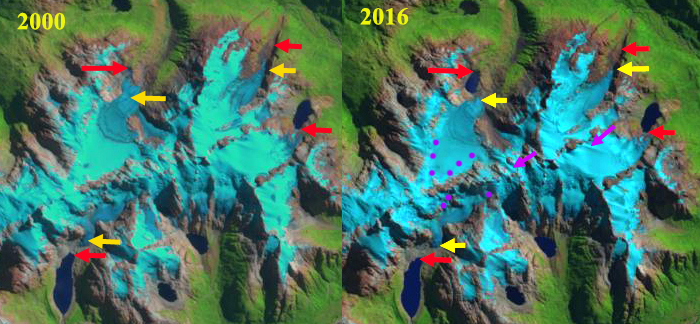
 Queulat Norte Glacier in 1987, 2000 and 2016 Landsat images indicating retreat from 1987 (red arrow) to 2016 (yellow arrow). Green arrow indicates former tributary, orange arrow area of  new bedrock exposure and pink arrow expanding medial moraine. Two new lakes have formed due to the 1950 m retreat. 

Nevado Queulat, Chile is the centerpiece of the Queulat National Park in the Aysen Region.  The largest glacier draining the substantial ice cap on this mountain flows north draining into Lago Rosselot and then the Rio Palena.  Here we examine 1987 to 2016 Landsat imagery to identify changes in this glacier.    Paul and Molg (2014) observed a rapid retreat in general of 25% total area lost from glaciers in the Palena district of northern Patagonia from 1985-2011.

In 1987 the glacier terminates against the valley where the valley turns to the east, red arrow.  There is no lake at the terminus. The tributary at the green arrow connects to the main glacier.  There is no evident medial moraine at pink arrow.  There is no exposed bedrock in the accumulation zone at orange arrow.  In 2000 glacier retreat has exposed a new lake that is 900 m across.  The tributary at the green arrow is no longer connected.  A medial moraine s evident at the pink arrow and bedrock is exposed at orange arrow. By 2016 the glacier has retreated south of a second lake that is 700 m across.  Total retreat from 1987-2016 has been 1950 m, 65 m per year.  This is the loss of  15% of the entire glacier length.  The medial moraine has expanded up and downglacier indicating greater melting and an upward shift of the snowline.  The area at the orange arrow is a significant band of bedrock, indicating that this is no longer an accumulation zone. This bedrock is at 1700 m, the current terminus is at 600 m and the top of the glacier is at 2000 m, leaving only a 300 m elevation band in the accumulation zone. Examination of the region just above the terminus indicates significant ablation hollows/depressions indicative of stagnant ice, green arrows.  There is also an area of debris from a subglacial stream emerging at the surface yellow arrow. The retreat is as significant as that of Erasmo Glacier as a percentage of glacier size.


2016 Google Earth image of Queulat Norte Glacier indicating retreat from 1987 (red arrow) to 2016 (yellow arrow). Green arrow indicates former tributary, orange arrow area of  new bedrock exposure and blue arrows indicating flow. 

Stagnant nature of the lower glacier in 2016 with ablation hollows/depressions at green arrows and yellow arrow indicating sub-glacial stream that emerges at surface and deposits debris.