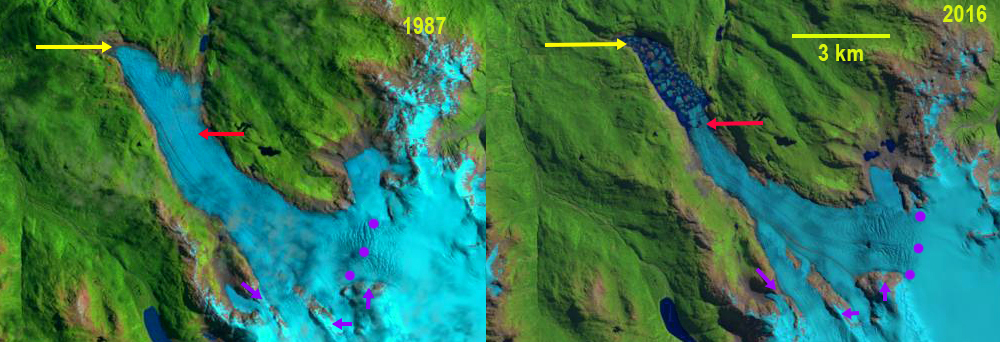
Hornopirén Glaciers, Chile in Spectacular Retreat

hornopiren-landsat-compare

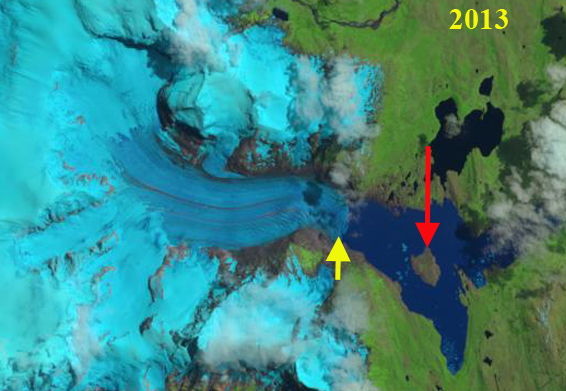
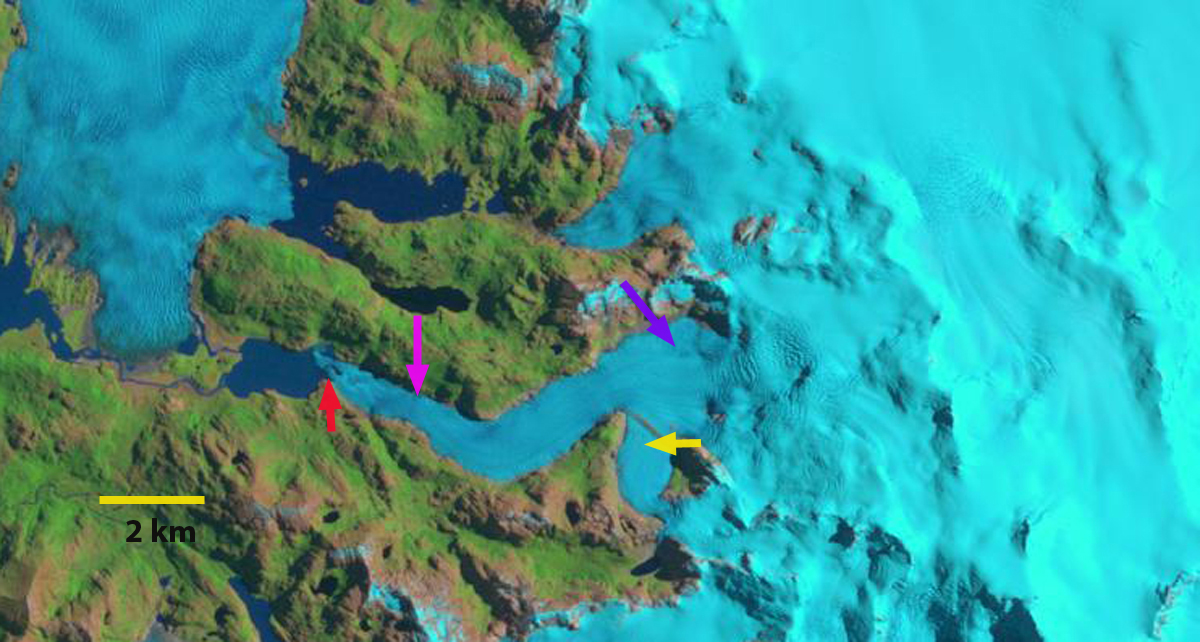
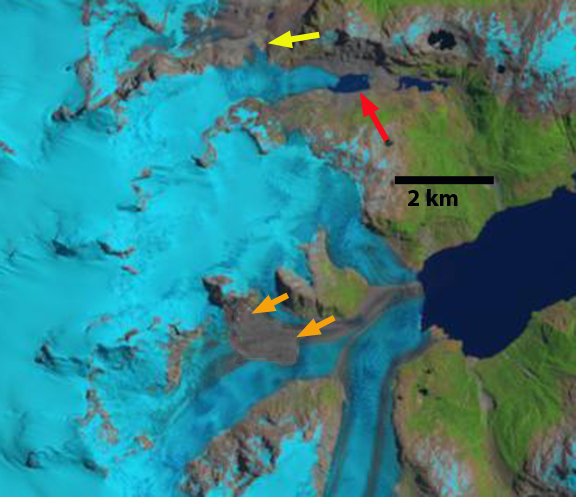
Landsat comparison of Rio Blanca Glaciers in Hornopirén National Park, Chile from 1985 to 2016.  Red arrow 1985 terminus, yellow arrow 2016 terminus, purple dots the snowline and purple arrows expanding bedrock areas amidst the glacier.

Hornopirén National Park is in the Los Lagos region of Chile.  The park is host to a number of glaciers that are in rapid retreat.  Davies and Glasser (2012) mapped the area of these glaciers with 113 square kilometers in 1986 and 96 square kilometers in 2011.  The retreat of the largest glaciers in the park is nothing short of spectacular in recent years.  Here we examine Landsat imagery to identify changes in two or the larger valley glaciers from 1985-2016.  These glaciers from the headwaters of the Rio Blanco and are designated Rio Blanco North (RBN) and Rio Blanco South (RBS).  Rio Blanco enters the ocean just east of the community of Hornopirén.

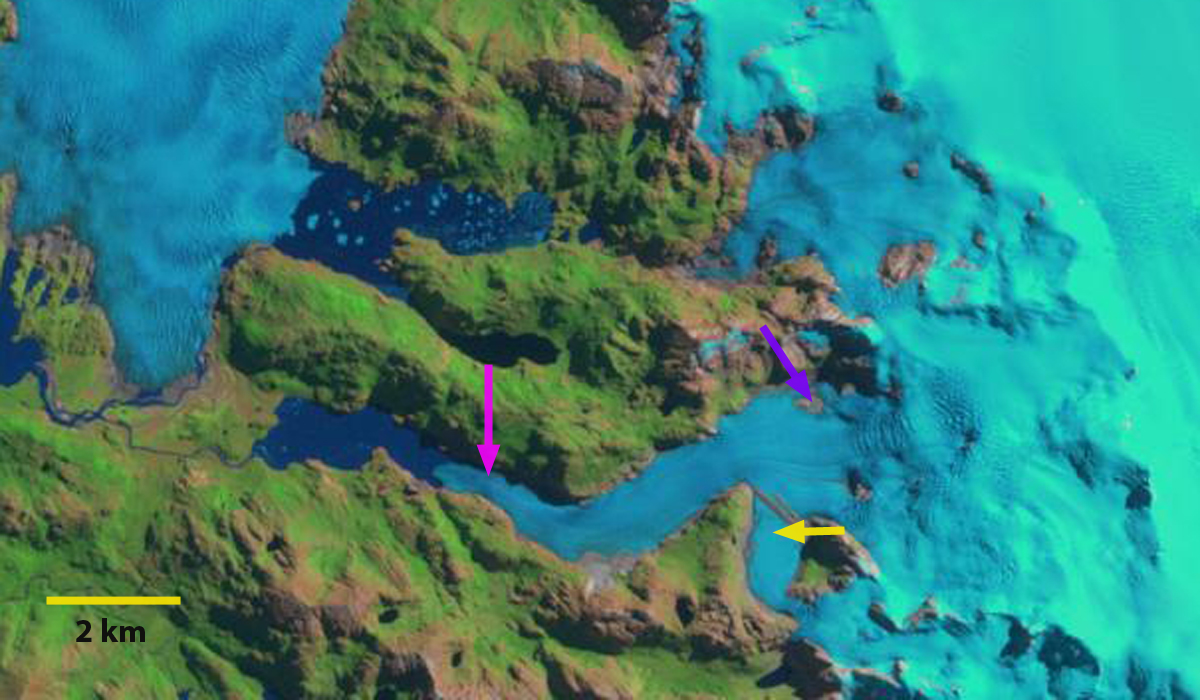
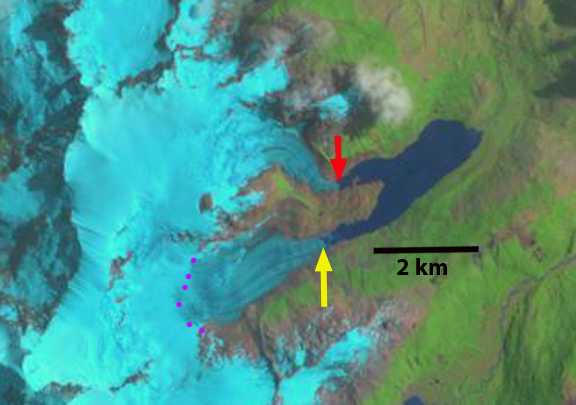
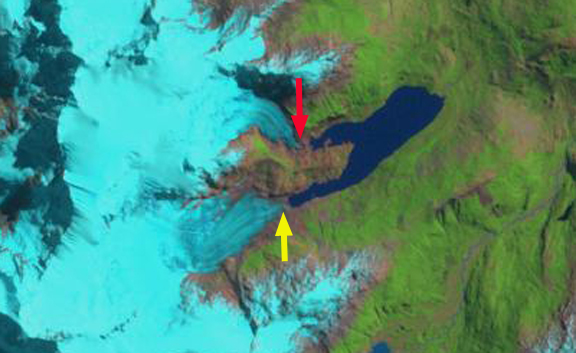
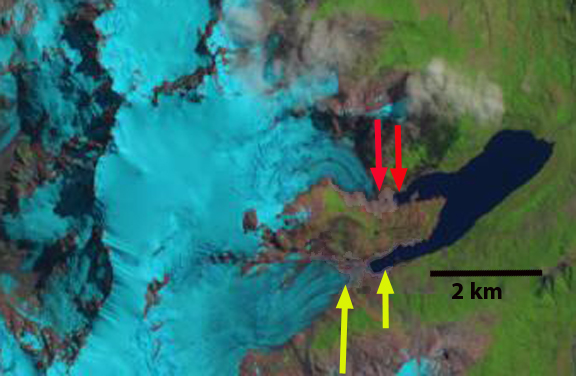
In 1985 the two glaciers merged just before the western terminus of the icefield at 820 m, red arrow. The snowline was at 1300 m. There is also an eastern outlet of RBN, terminating at the north end of a basin, red arrow. By 1998 RBN and RBS had separated by over 1 km with the formation of a new lake at the former terminus. The eastern terminus of RBN has begun retreat and is now ending in a proglacial lake.  RBS is developing a nunatak at the purple arrow. The snowline was again near 1300 m.  By 2016 RBN has retreated 4.5 km, and now terminates at 1200 m, yellow arrow.  The deglaciated valley now hosts three alpine lakes that did not exist in 1985.  The eastern terminus of RBN has retreated 1100 m and is still terminating in an expanding alpine lake, yellow arrow. By 2016 RBS had retreated 3.4 km since 1985, terminating at 1180 m, yellow arrow. The nunatak in the lower section of RBS, purple arrow, has continued to expand.  RBN has lost 56% of its length since 1985 and RBS 37% of its length.The snowline in 2015 and 2016 is at 1600-1700 m.  This leaves only a small percentage of the glacier area above the snowline.  The large valley glaciers that just 30 years dominated the headwaters of Rio Blanco have lost much or their area and will soon be small slope glaciers clinging to the highest peaks.  Retreat here is more extensive than seen 100 km to the northwest at Calbuco Volcano and for the Northern Patagonia Icefield.

hornopiren-glaciers

Landsat comparison of Rio Blanca Glaciers in Hornopirén National Park, CVhile from 1998 to 2015.  Red arrow 1985 terminus, purple dots the snowline and purple arrows expanding bedrock areas amidst the glacier.

hornopiren-terminus

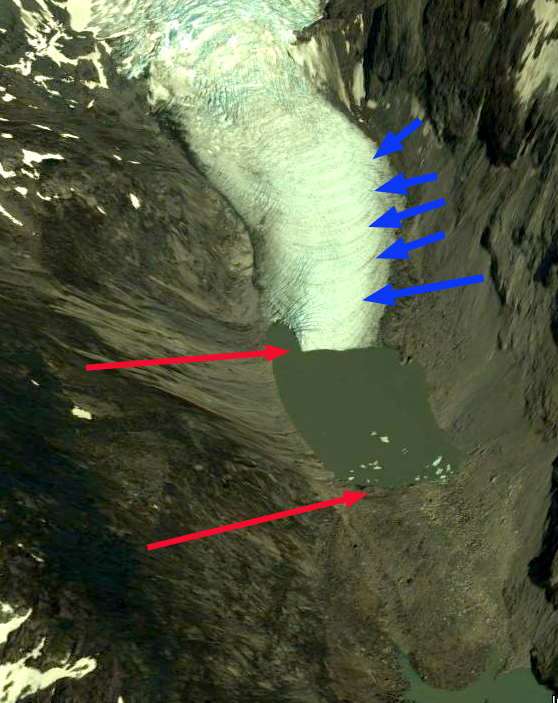
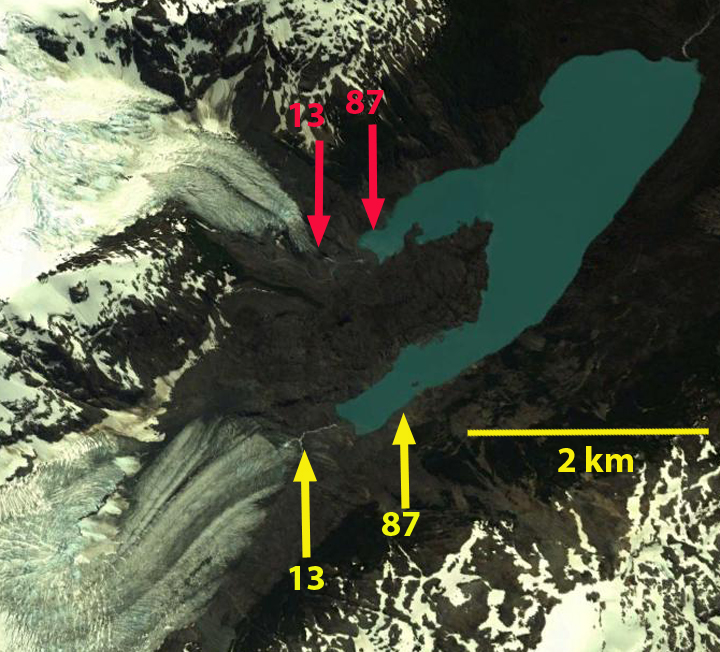
East Terminus of Rio Blanca North, with the newly formed lake.  This terminus is above 1300 m and has retreated largely via iceberg calving.

RG150-17.01019 Glacier Retreat, Southern Patagonia Forms Lake


peel-landsat-compare

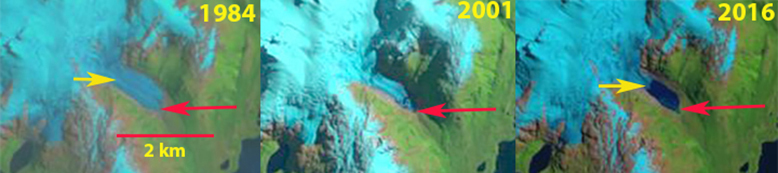
Retreat of RG150 indicated in Landsat images from 1984, 2001 and 2015.  Red arrow indicates 1984 terminus and yellow arrow 2015 terminus. 

RG150 is a 3.5 km long glacier in Bernardo O’Higgins National Park on the western edge of the Southern Patagonia Icefield, Chile.  RG150 is an unnamed glacier given this designation as part of the Randolph Glacier Inventory.  The glacier terminates in a lake that drains into Seno Andrew.  Willis et al (2012) observed that between February 2000 and March 2012 that the Southern Patagonia Icefield is rapidly losing volume and that thinning extends even to high elevations.  The mass balance loss is occurring at a rate of −20.0 ± Gt/year, which is +0.055 mm/year of sea level rise. The retreat has been driven by increasing calving rates from the 1975-2000 to the 2000-10 period (Schaefer et al, 2015). The pattern of retreat is consistent between these glaciers and the region as noted by Davies and Glasser (2012), annual rates of shrinkage in the Patagonian Andes increased in from 0.10% year from 1870-1986, 0.14% year from 1986-2001, and 0.22% year from 2001-2011. Davies and Glasser (2012), note the all the glaciers in the complex inclusive of RG150 had their fastest retreat period from 2001-2015. Glasser et al (2016) observed both an increase in glacier proximal lakes and in debris cover on glaciers with glacier retreat from 1987-2015. These losses have led to retreat such as at Balmaceda Glacier,  Glaciar Marconi and Glacier Onelli.  Here we examine Landsat imagery from 1984 to 2015 to identify glacier change and the formation of a new lake.

In 1984 there was no glacier lake at the terminus, with the lower 1 km of the glacier being a low sloped glacier tongue.  By 2001 a small proglacial lake had developed 250-300 m long.  In 2005 the glacier retreat had led to continued lake expansion.  The glacier had filled the lake with numerous small icebergs.  By 2015 the glacier still terminates in the proglacial lake that is not 850-900 m long.   The glacier retreat of 850 m since 1984 is 20-25% of the total glacier length.  The low slope region is minimal in length in 2015 indicating the lake basin is almost complete.  This will lead to a reduced rate of retreat.  This is a very cloudy region, and the images here are not at the end of the melt season.  Hence, the equilibrium line altitude can be ascertained.  At the crest of the glacier 1300 m, there are a number of wind sculpted features that are 400-600 m long, attesting to the strong westerly winds in the region. RG150 has significant retained accumulation each year and can survive the current climate.

peel-ge-compare

Retreat of RG150 indicated in Google Earth images from 2005 and 2015.  Red arrow indicates 1984 terminus and purple arrows indicate wind features at the top of the glacier.

peel-oblique

RG150  in Google Earth image looking upglacier in 2015.  Red arrow indicates 1984 terminus and yellow arrow 2015 terminus and purple arrows indicate wind features at the top of the glacier.

Glacier Nef, Patagonia, Chile retreat 1987-2016.

nef compare

Comparison of 1987 and 2015 Landsat images of Nef Glacier at right and Cachet Glacier at left.  Indicating retreat of Nef Glacier from red arrows to yellow arrows of 1.8 km and development of a new lake at the terminus. Purple arrows indicate upglacier thinning leading to separation of glacier tributaries. 

Glacier retreat and thinning is particularly strong in the Patagonian icefields of South America. The two largest temperate ice bodies of the Southern Hemisphere are the Northern Patagonia Icefield 4,000 km2 and the Southern Patagonia Icefield, 13,000 km2. It has been estimated that the wastage of the two icefields from 1995–2000 has contributed to sea level rise by 0.105 ± 0.011 mm year,which is double the ice loss calculated for 1975-2000 (Rignot et al. 2003).   Davies and Glasser (2012) work, has an excellent figure indicating two periods of fastest recession since 1870, are 1975-1986 and 2001-2011 for NPI glaciers, which suggests that ice volume loss increased after 2000. They noted the loss was 0.07% from 1870-1986, 0.14% annually from 1986-2001 and 0.22% annually from 2001-2011. Glasser et al (2011) find the recent ice volume rate loss is an order of magnitude faster than at other time intervals since the Little Ice Age. Baker River (Rio Baker) is located to the east of the Northern Patagonia Icefield and is fed mainly by glacier melt water originating from the eastern outlet glaciers of the icefield Leones, Soler, Nef, Colonia. Rio Baker is the most important Chilean river in terms of runoff, with an annual mean discharge of about 1000 m3/s Lopez and Casassa (2009). Glacier Nef is one of the main glaciers feeding Rio Baker. Rio Baker was a proposed critical hydropower resource for Chile. Hidroaysen Project had proposed 5 dams on the Baker and Pascua River generating 2750 MW of power, all three proposed dams on the Rio Baker have been cancelled.

Glacier Nef began to retreat into a moraine dammed proglacial lake in 1945 (Loriaux and Casassa, 2014). By 1987 the lake remained less than 1 km long, with glacier thinning predominating over retreat. From 1987 to 2015 the glacier has retreated 1.8 km calving into the growing lake.  The lake width was essentially uniform during this phase of retreat There is not significant retreat from 2015 to 2016. The lake is currently about 5.4 square kilometers and has a mean depth of ~125 m (Loriaux and Casassa, 2014).  In 2015 Glacier Nef has not reached the head of this proglacial lake and will continue to retreat. The west side of the terminus is debris covered and has a fringing proglacial lake that has developed after 2000 and will aid in the continuing retreat. The terminus is currently at a pinning point, where the valley is constricted providing greater terminus stability. Further retreat will lead to an expansion of the embayment and calving front, leading to a further increase in glacier retreat. The lack of elevation change of the lower glacier and the isolated proglacial lake here suggests the lake will expand laterally as well as in length. The debris cover is slowing the thinning and retreat of the western margin. The purple arrows indicate thinning upglacier in a former tributary glacier. The 2016 Landsat image indicates a high snowline at 1350 m, purple dots.  Willis et al (2011) observed that the thinning rate of NPI glaciers below the equilibrium line has increased substantially from 2000-2012, partly an indication of a higher snowline indicative of greater ablation and a longer snow free period lower in the ablation zone. For example on Nef Glacier by January 8, 2016  the snowline was at 1300 m and remained high up until at least the mid-march image below. The retreat follows the pattern of enhanced calving in a proglacial lake for NPI glaciers such as Gualas GlacierReichert Glacier, Steffen Glacier, and Colonia Glacier.
nef 2016

2016 Landsat image of Nef Glacier indicating terminus yellow arrow and source of the debris for the debris covered terminus. 

nef terminus

Closeup of Nef Terminus from Chile Topographic Application.  Notice the widening valley just above terminus.  Debris cover is insulating ice on west side of terminus.  

San Quintin Glacier, Chile terminus disintegration 1987-2015

san quentin compare

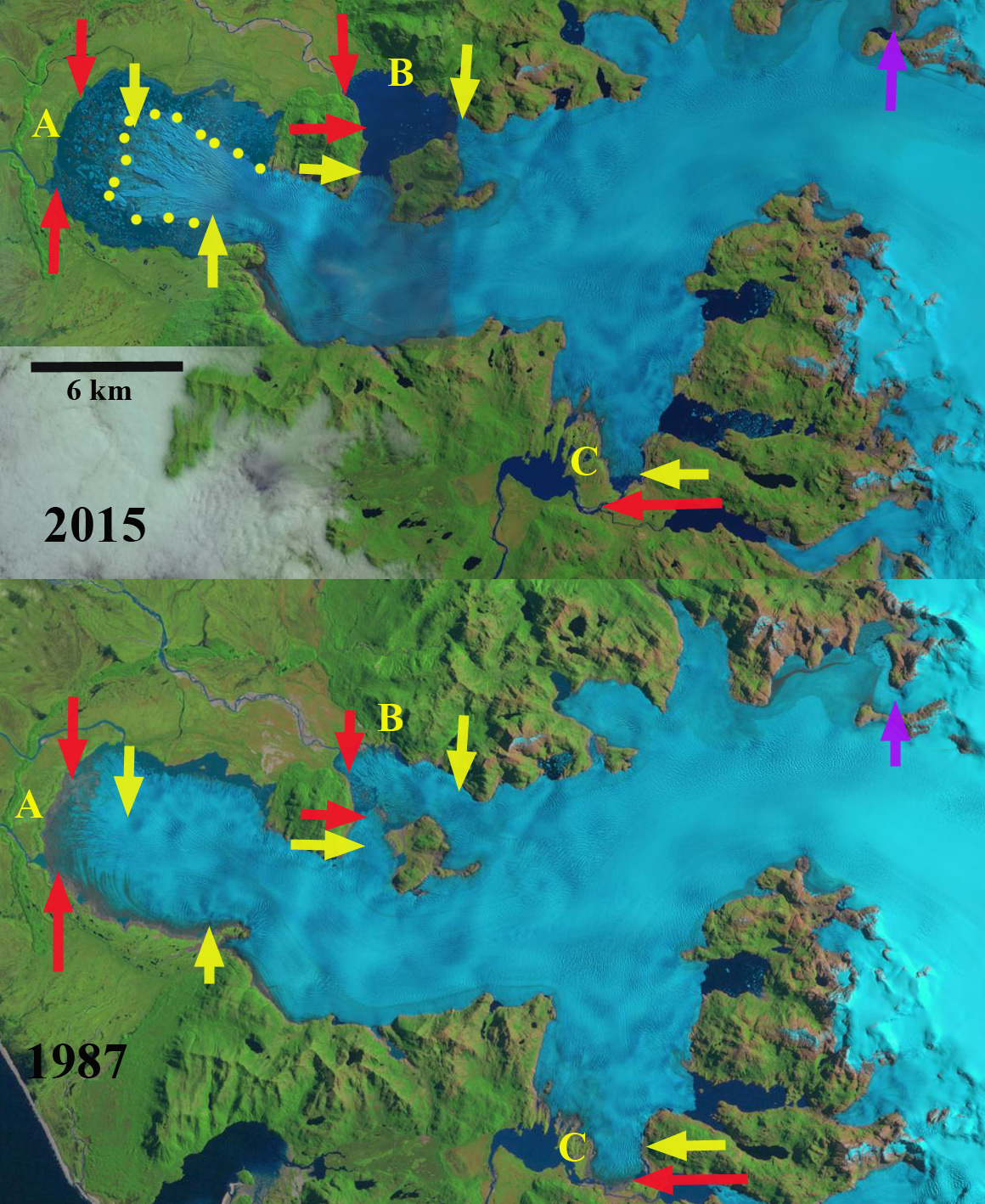
Landsat comparison of San Quintin Glacier in 1987 and 2015: red arrow indicates 1987 terminus location, yellow arrow indicates 2015 terminus location of the three main termini, and the purple arrow indicates upglacier thinning.

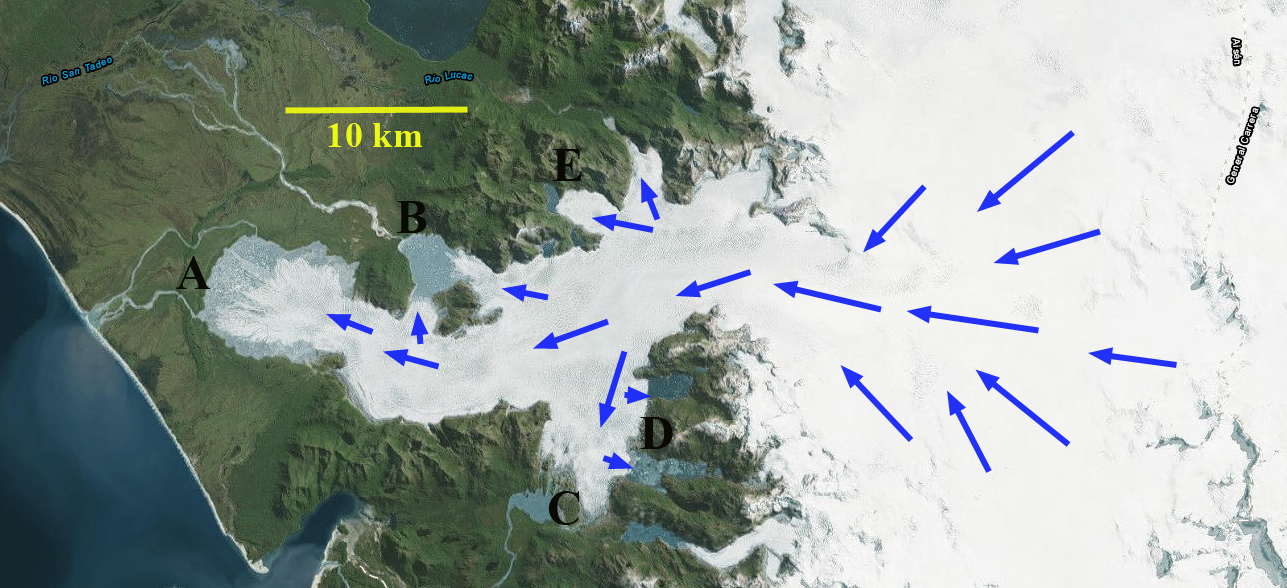
San Quintin is the largest glacier of the NPI at 790 km2 in 2001 (Rivera et al, 2007).  The glacier extends 50 km from the ice divide in the center of the ice cap.  The peak velocity is 1100 m/year near the ELA (Rivera et al 2007), declining below 350 m/year in the terminus region.  The velocity at the terminus has increased from 1987 to 2014 as the glacier has retreated into the proglacial lake (Mouginot and Rignot, 2015).  The high velocity zone extends more than 40 km inland an even greater distance than at San Rafael (Mouginot and Rignot, 2015).  Thinning rates in the ablation zone of the glacier are 2.3 m/year (Willis et al, 2012).  The glacier has a low slope rising 700 m in the first 22 km. The low slope, broad piedmont lobe and many distributary terminus lobes is like the Brady Glacier, Alaska.

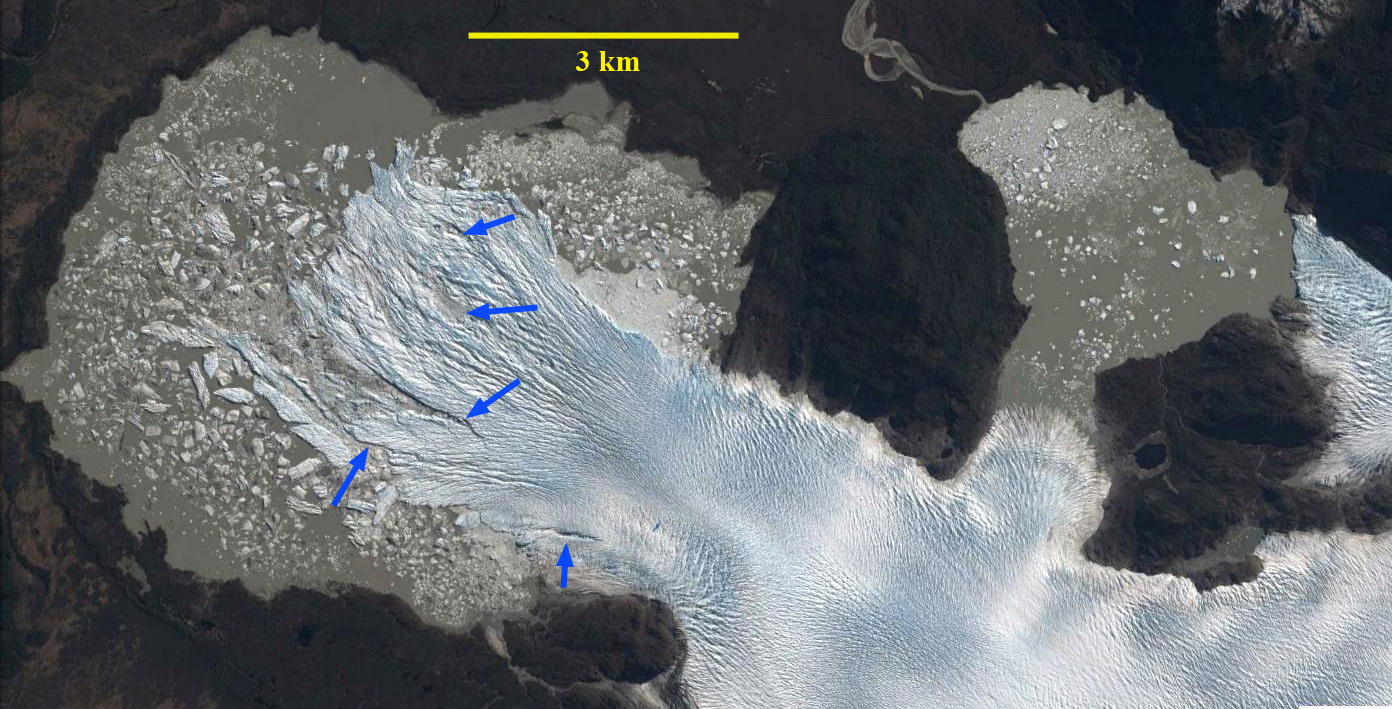
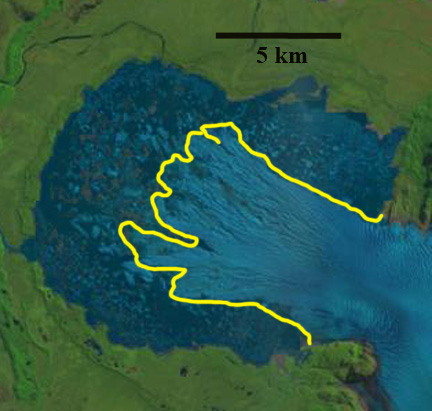
Davies and Glasser (2012) note that San Quintin Glacier terminated largely on land until 1991. The glacier has lost 15 % of its area in the last century (Davies and Glasser, 2012).  The glacier has a main terminus and many subsidiary termini.  In 1987 it is a piedmont lobe with evident minimal marginal proglacial lake development beginning. There is limited lake development at the main southern and northern terminus Point C and B respectively. Harrison et al (2001) observed that in 1993 the glacier terminus was advancing strongly into vegetated ground, while from 1996 to May 2000 the glacier underwent a transition between advance and retreat.  The high rates of thinning are leading to the retreat not just of main terminus but the distributary terminus areas extending north and south into lake basins from the main glacier. From 1987 to 2015 the main terminus retreated 2200 m, almost all after 2000, largely through a disintegration of the terminus tongue in a proglacial lake.  Extensive rifting of the terminus lobe in 2013 and 2015 is still apparent in imagery below, indicating this rapid area loss is not finished.  The main lake, Point A, had an area of 23.8 square kilometers in 2011 (Loriaux and Cassasa, 2013) . The lake at Point B developing on the north side of the glacier, due to a 3500 m retreat, is now over 8 square kilometers.  The southern terminus at Point C, has a narrow fringing lake and a retreat of 1100 meters from 1987-2015. The retreat here follows the pattern of Fraenkel GlacierAcodado Glacier and Steffen Glacier to the south.

san quintin overview

Digital Globe image of San Quintin Glacier in 2011.

san quintin terminus 2013

2013 Google Earth image, with the large rifts indicating glacier weakness noted with blue arrows. 

san quintin terminus 2015

2015 Landsat image, yellow line indicates terminus. Note the tongue is surrounded on three sides by water.


Balmaceda Glacier Retreat, Chile Releases Island

balmaceda compare

1986 and 2015 Landsat images of the Balmaceda Glacier, Chile region.  Red arrow indicates 1986 ice front, yellow arrow 2015 ice front and purple arrow a tributary that has detached.

Balmaceda Glacier (Felicia Glacier) is at the southeastern end of the Southern Patagonia Ice Cap (SPI) field and drains into the Serrano River.  There is another glacier referred to as Balmaceda  that descends steeply almost to the shores of Fiordo Ultima Esperanza, hence Felicia Glacier will be used here.  Willis et al (2012) observed that between February 2000 and March 2012, indicate that SPI is rapidly losing volume, that thinning extends to the highest elevations.  The mass balance loss is occurring at a rate of −20.0 ± Gt/year, which is +0.055 mm/year of sea level rise. The retreat is driven by increasing calving rates from the 1975-2000 to the 2000-10 period (Schaefer et al, 2015). The pattern of retreat is consistent between these glaciers and the region as noted by Davies and Glasser (2012),  annual rates of shrinkage in the Patagonian Andes increased in  from 0.10% year from 1870-1986, 0.14% year from 1986-2001, and 0.22% year from 2001-2011. These losses have led to retreat such as at Glaciar Marconi and Glacier Onelli

In 1986 the glacier terminated on an island in that acts as pinning point stabilizing the glacier front.  The calving front is over 2.5 km wide. By 2000 Landsat imagery indicates the glacier has retreated from the island with the greatest retreat on the north side.  By 2013 the glacier has receded into a narrow western arm of the lake, the snowline is at 600 m. By 2015 a southern tributary has separated from the main glacier at the purple arrow. The terminus at the yellow arrow is 1 km from an increase in surface slope indicating a rise in bedrock that may be the inland margin of the lake. The retreat from 1986 to 2015 is 2100 m and the current calving front is 1.2 km wide.  The snowline in 2015 is at 1000 m is quite high.  De Angelis (2014) notes the ELA for this glacier at 690 m.  Above the snowline the linear wind sculpted features oriented west to east indicate the ferocious winds of the region Schaefer et al (2015) note the exceptional accumulation rates in the region

The Balmaceda Glacier drains into the Serrano River, the headwaters being Del Toro Lake on the southern boundary of Torres del Paine National Park.  The river is home to numerous giant Chinook salmon which can weigh up to 35 kg with fishing season from June to December.  Chinook salmon have just recently started populating rivers in Chile and Argentina. Fish hatcheries in southern Chile release thousands of Chinook smolts. The introduced Chinook originate from tributaries of the Columbia River of Washington and Oregon.

balmaceda 2000

2000 Landsat Image

balmaceda 2013

2013 landsat image

balmaceda 2015

2015 Landsat image the purple dots are the snowline which at 1100 m is quite high.  Also note the long wind drift features extending west to east above the snowline.


Colonia Glacier, Chile Retreat and Periodic Lake Outbursts


colonia-compare-1024x495

Comparison of 1987 and 2015 Landsat images indicating retreat from red arrows to yellow arrows of 2.5 km and development of a new lake at the terminus. orange arrow indicates glacier dammed lake that fills and empties periodically. 

Colonia Glacier drains east from the Northern Patagonia Icefield feeding the Baker River, Chile. It is the largest glacier draining east from the NPI.  A comparison of the 1987  and 2015 images indicate a 2.5 km retreat of the glacier front, development of a large lake and areas of thinning well upglacier at the purple arrows. The recent substantial retreat of Colonia Glacier like Glacier Nef just to its north is posing new hazards. The glacier is unusual in the number of lakes that are adjacent to or feed into the adjacent glacier dammed or proglacial lakes. In the image below Lake A=Arco Lake, Lake B=East Terminal Lake, Lake C=Cachet 1 , Lake D= West terminal Lake, Lake E=Colonia Lake and Lake F=Cachet 2. In the case of Baker River the outburst floods are a threat to the planned hydropower developments as documented by Dusaillant and others (2009).  Hidroaysen Project proposed 5 dams on the Baker and Pascua River generating 2750 MW of power that after initial permit approval in 2011Chile’s Committee of Ministers overturned the environmental permits in 2015.

Slide1

Google Earth image from 2005.

The glaciers recent retreat and glacier lake outburst floods have been closely monitored by the Laboratorio de Glaciología in Valdivia, Chile.  Aniya and others (1999) observed that Colonia Glacier began a rapid retreat after 1985 from 1997-2005 that has further accelerated, with a general frontal retreat of 2 km. Rivera and others (2007) observed that the Colonia Glacier had lost 9.1 square kilometers of area from 1979-2001, which is 3% of the total glacier area and thinned 1.1 m per year in the ablation zone.

Image from Laboratorio de Glaciologia, frontal change 1944-2005.

The Laboratorio de Glaciologia’s observed in the spring of 2008 Baker River suddenly tripled in size, in less than 48 hours, roads, bridges, and farms were severely damaged. Lake Cachet 2 had vanished the 5 square kilometer glacial lake had emptied 200 million cubic meters of water in just a matter of hours. This lake drained beneath the glacier after sufficient water had filled the lake to buoy part of the glacier and subglacial conduits had begun to develop. Since Cachet 2 emptied in April 2008, the lake has emptied at least six more times October, December 2008, March and September 2009, March 2010, and early 2013 with peak flows released of 3000 cubic meters per second. Below are images of Cachet 2 full iand empty in 2008 from Laboratorio de Glaciologia’s. Also a  comparison of before and after drainage in Landsat images from Sept. 2012 and Feb. 2013.

cachet 2 empty

Cachhet Lake full looking toward Colonia Dam 2008

Cachet Lake after emptying looking upvalley away from Colonia Glacier 2008. 

colonia outburst 2013

Cachet lake full in Sept. 2012 and emptied in Feb. 2013 Landsat images.

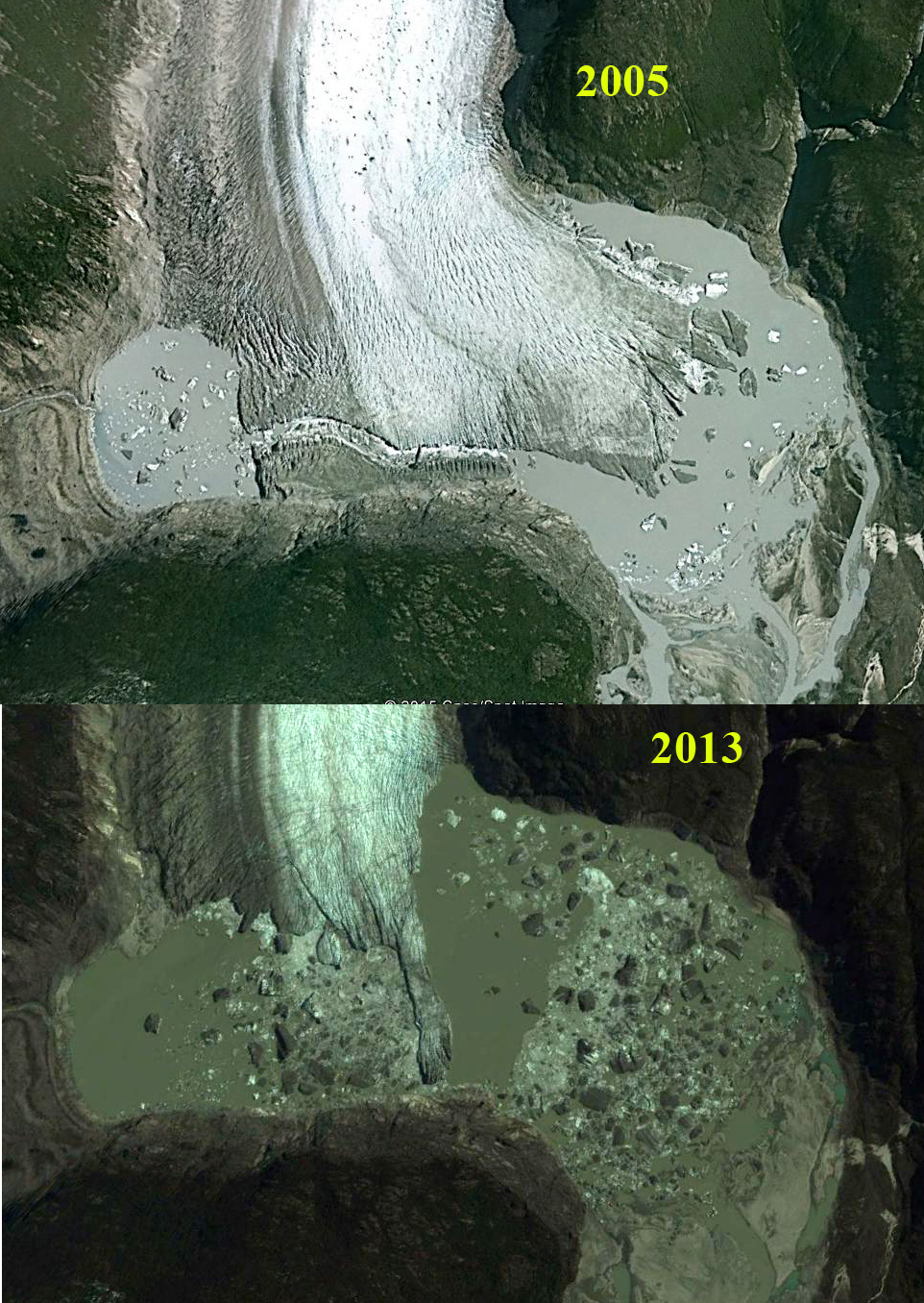
The two lakes at the terminus of the glacier did not exist in 1979, the western most terminus lake drained into the easternmost terminus lake (D) via a sub-glacial tunnel after formation in the late 1980’s until 2005 when a channel was cut right through the glacier terminus. Retreat of the glacier terminus first led to significant lake development in 2001.  This is evident in the image below, there is still glacier ice on both sides of this drainage channel.  By 2015 the lakes have merged into a single large proglacial lake at the terminus that is 3.2 km wide.The development and demise of glacier dammed lakes and the resultant problem of glacier lake outburst floods is not rare today, Imja Glacier, and Tulsequah Glacier are other examples.

Lake expansion at the end of the Colonia Glacier from 2005 to 2013, Google Earth images. 

colonia terminus lake

Acodado Glacier, Chile Rapid Retreat 1987-2015

acodado compare
Landsat image comparison 1987 and 2015
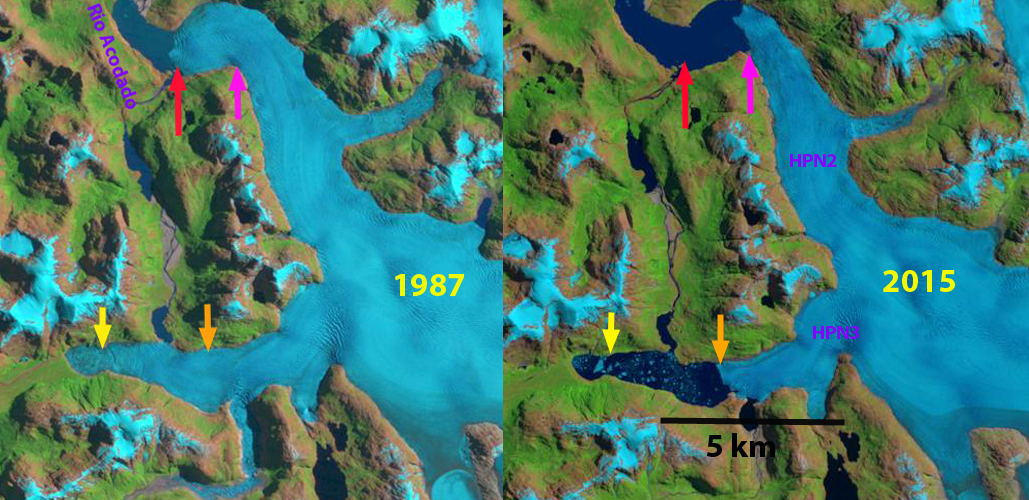
Loriaux and Casassa (2013) examined the expansion of lakes of the Northern Patagonia Ice Cap. From 1945 to 2011 lake area expanded 65%, 66 square kilometers. Rio Acodado has two large glacier termini at its headwater, HPN2 and HPN3. that are fed by the same accumulation zone and comprise the Acodado Glacier. The glacier separates from Steffen Glacier at 900 m. The lakes at the terminus of each were first observed in 1976 and had an area of 2.4 and 5.0 square kilometers in 2011. (Loriaux and Casassa, 2013). Willis et al (2012) noted a 3.5 m loss per year from 2001-2011 in the ablation zone of the Acodado Glacier, they also note annual velocity is less than 300 m/year in the ablation zone. Davies and Glasser (2012) noted that the Acodado Glacier termini, HPN2 and HPN3, had retreated at a steadily increasing rate from 1870 to 2011. Here we examine the substantial changes in Acodado Glacier from 1987 to 2015 using Landsat imagery. acodado ge
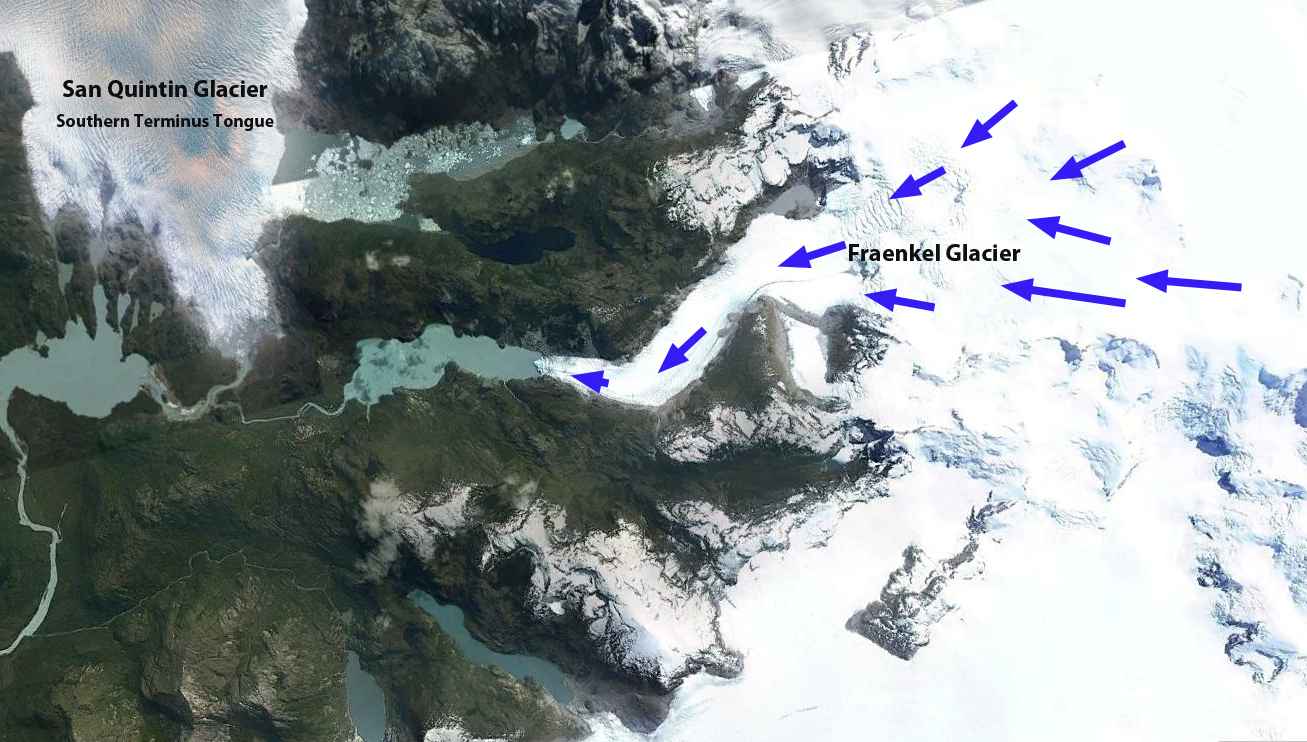
Digital Globe image of Acodado Glacier and the termini HPN2 and HPN3.

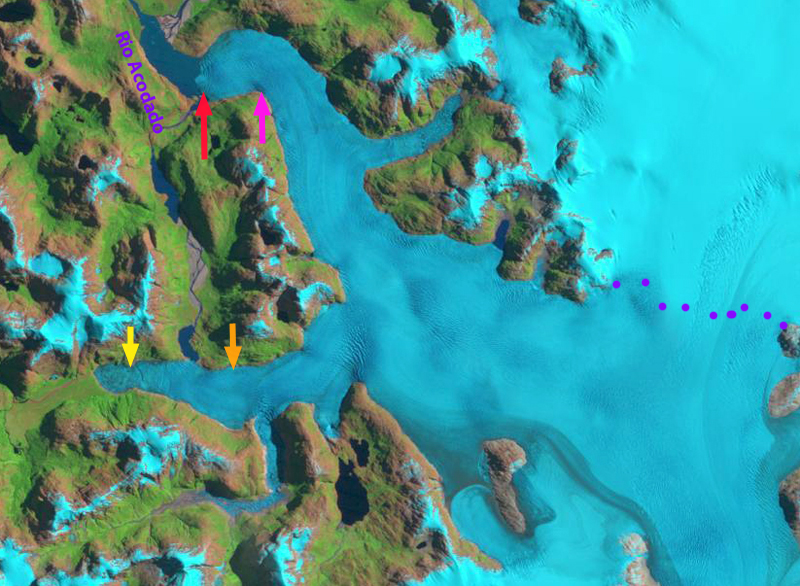
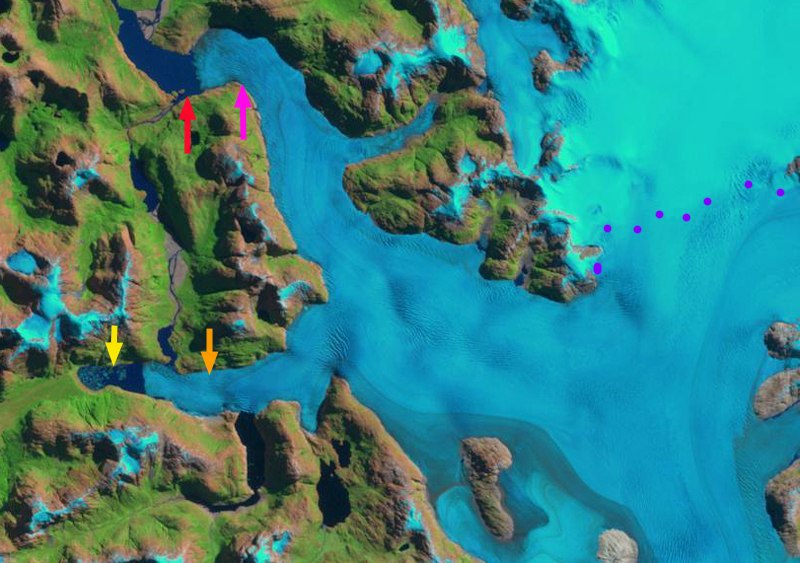
In HPN2 terminates at the red arrow in 1987 and HPN3 at the yellow arrow, the snowline is at the purple dots at 1000 m. By 2000 the glacier has retreated from the red and yellow arrow by 400 m and 900 m respectively, and the snowline is at 1100 m.   In 2014 there are many large icebergs in the lake at the terminus of HPN3, these are from recent calving retreat.  This is not an area where the lakes develop even seasonal lake ice cover.  The  snowline is again at 1100 m.  In 2015 it is apparent that HPN2 has retreated 2100 m from the red arrow to the pink arrow.  HPN3 has retreated 3200 m from the yellow to the orange arrow.  The snowline is again at 1100 m.  The retreat accelerated after 2000 for both glaciers. This high of a snowline indicates warm temperatures generating high ablation rates, which will lead to more retreat. HPN3 has a sharp rise in elevation 2.5 km above the terminus, before it joins the main Acodado Glacier, it should retreat rapidly toward this point and then calving will end and retreat will slow.  The retreat here is synonymous with the pattern observed at other Northern Patagonia Ice Cap outlet glaciers each with rapid calving retreats in expanding proglacial lakes; Fraenkel Glacier, Gualas and Reichert Glacierand Steffen Glacier.
acodado 1987
Landsat image from 1987

acodado 2000
Landsat image from 2000

acodado 2014
Landsat image from 2014

acodado 2015
Landsat image from 2015

Fraenkel Glacier Retreat, Patagonia, Chile

Fraenkel Glacier drains the west side of the Northern Patagonia Ice Cap (NPI) just south of Glaciar San Quintin. The retreat of this glacier in the last 30 years mirrors that of Gualas and Reichert Glacier, which also terminate in an expanding proglacial lake.   Davies and Glasser (2012) work, had an excellent Figure indicating two periods of fastest recession since 1870, are 1975-1986 and 2001-2011 for NPI glaciers.  They noted the loss was 0.07% from 1870-1986, 0.14% annually from 1986-2001 and 0.22% annually from 2001-2011. Willis et al (2011) observed that the thinning rate of NPI glaciers below the equilibrium line has increased substantially from 2000-2012. On Fraenkel Glacier they observed a 2.4 m per year thinning in the ablation zone. Here we examine the changes in this glacier from 1987 to 2015 using Landsat Image.

fraenkel ge

In 1987 the glacier terminus was at the end of a peninsula red arrow and the proglacial lake it terminates in is 2 km long. There is a medial moraine on the glacier at the yellow arrow and the glacier covers the terrain below an icefall at the purple arrow. By 2000 at the purple arrow bedrock is appearing from the base of the glacier. The medial moraine at yellow arrow is little changed. The terminus has retreated 800 m. By 2015 the area around the purple arrow has been deglaciated emphasizing the amount of thinning in the ablation zone even well upglacier of the terminus. At the yellow arrow the medial moraine has been replaced by a wide rock rib separating the glacier from a former tributary. The main terminus is at the pink arrow, indicating a retreat of 1.4 km since 1987. The retreat rate of 50 meters per years though large is less than on Reichert Glacier or Gualas Glacier.  Mouginot and Rignot (2014) observe that Fraenkel Glacier does not have the high velocity of the neighboring Benito and San Quintin Glacier or the Gualas and Reichert Glacier, this leads to the potential for greater mass loss of the ablation zone and even faster retreat.

fraenkel Glacier 1987
Fraenkel Glacier Landsat Image 1987
fraenkel glacier 2000
Fraenkel Glacier Landsat Image 2000

fraenkel glacier 2015
Fraenkel Glacier Landsat Image 2015

North Leones Glacier Retreat and new Landslide, Patagonia, Chile

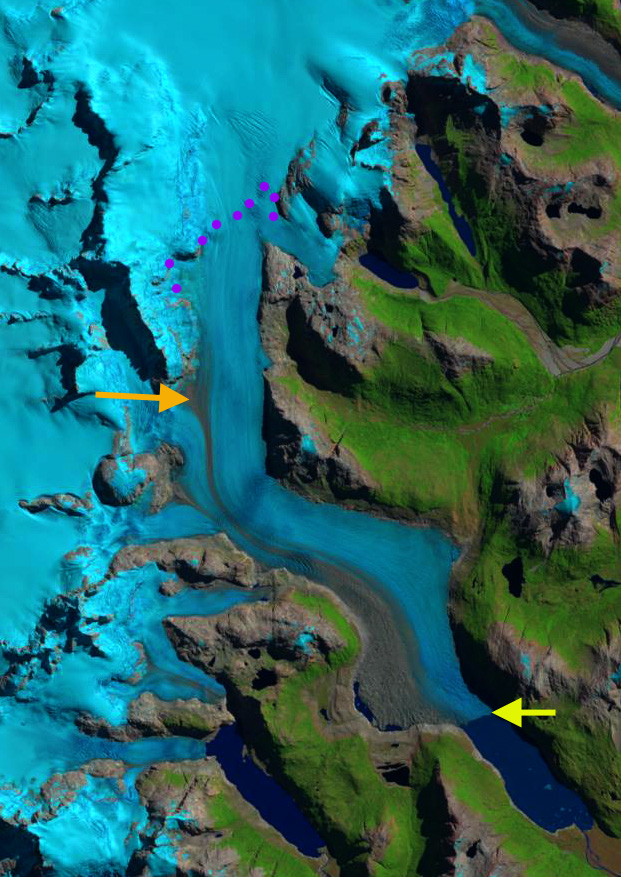
Jill Pelto, my daughter returning from fieldwork with UMaine in the Falkland Island took a picture last week out the plane window of Leones Glacier of the northern Patagonia Icefield. The picture illustrated two changes worth further examination, and the fact that if you have a glacier picture that you would like more information on let me know. The picture indicates outlet glaciers of the Northern Patagonia icefield fed by the snowcovered expanse.  Also evident is a large landslide that is both fresh and that I knew had not been there before, orange arrow,and it showed a new lake had formed due to retreat of the glacier north of Leones Glacier, red arrow, hereafter designated North Leones Glacier. The landslide extends 2 km across the glacier and is 3 km from the terminus. Here we use 1985 to 2014 Landsat imagery to identify changes in North Leones Glacier and the landslide appearance.

npi tri glacier
Jill Pelto took this picture on March 13th, 2015

In 1985 there are medial moraines on the glacier surface, but no large landslide deposit. The Northern Leones Glacier terminates on land, red arrow. A distributary terminus almost connects with another glacier to the north at the yellow arrow. In 1987 there is little evident change from 1985. By 2002 a small lake is beginning to form at the terminus of Northern Leones Glacier. By Feb. 2014 a substantial lake has formed at the end of the North Leones Glacier. There is considerable separation between the distributary terminus at the yellow arrow and the next glacier. There is no landslide deposit either. Google Earth imagery indicates the lack of a landslide deposit as well. A closeup of the terminus of North Leones Glacier in 2013, with Google Earth imagery, indicates ogives (blue arrows), which are annually formed due to seasonal velocity changes through an icefall. In January 2015 the landslide deposit is evident, extending about 2 km across Leones Glacier and 3 km from the terminus. The North Leones Glacier has retreated 700 meters from 1985-2015. The retreat of the distributary terminus indicates thinning upglacier of the icefall on North Leones Glacier. The landslide adds mass to Leones Glacier, which will lead to a velocity increase. The debris is thick enough to reduce melting in this portion of the ablation zone. The velocity of this glacier is indicated by (Mouginot and Rignot, 2015) as 200-400 meters per year, indicating that for the next decade at least this landslide will impact the lower Leones Glacier. (Willis et al, 2012) identify thinning of the Leones Glacier area around 1 m per year, which will be reduced on the landslide arm of the glacier.
(Davies and Glasser, 2012), indicate that this region experienced increased area loss from 1986-2011.  Lago Leones feeds the Leones River which is also fed by the retreating General Lago Carerra Glacier.

leones glacier 1985
Landsat image 1985

leones glacier 1987
Landsat image 1987

leones galcier 2002
Landsat image 2002

leones glacier 2014
Landsat image 2014

leones north ge
Google Earth Image 2010

leones landslide
Google Earth image 2013

Leones Glacier 2015
Landsat image 2015

Cordillera Lago General Carrera Glacier Retreat, Chile

You know southern Chile has lots of glaciers when an icefield with an area of 132 square kilometers has no named glaciers.  Davies and Glasser (2012) referred to this icefield as Cordillera Lago General Carrera, since it drains into that lake, the icefield is just east of the Northern Patagonia Icefield.   Davies and Glasser (2012)  noted that the icefield has a mean elevation of 1670 m and has declined from an area of 190 square kilometers in 1870, to 139 square kilometers in 1986, and 132 square kilometers in 2011.  They further noted that the area loss of Patagonia glaciers has been most rapid from 2001 to 2011.  Paul and Molg (2014) observed a more rapid retreat of 25% total area lost from glaciers in northern Patagonia from 1985-2011, the study area was north of the Northern Patagonia Icefield. Lago General Carrera drains into the Baker River, which is fed by most glaciers on the east side of the Northern Patagonia Icefield.  This river had a series of proposed hydropower projects that have now been cancelled by the Chilean government.

clcg

Here we examine Landsat imagery from 1987 to 2014 to identify the changes in a pair of outlet glaciers that drain the eastern side of the icefield, images below. In 1987 both outlet glaciers terminated in an unnamed lake that drains into the Leones River. The southern glacier is 5.5 km long beginning at 2400 m and terminates at the yellow arrow, with the snowline marked by purple dots, in the images below.  The northern glacier is 5.0 km long beginning at 2200 m with the terminus at the red arrow. In 1987 the glaciers were in shallow enough water  that calving was limited and no icebergs are evident. By 2001 both glaciers are no longer terminating in the lake.  The retreat can no longer be enhanced by calving into the lake.  By 2014 both glaciers have retreated several hundred meters from the lake.  It is easier to measure the retreat in the 2013 Google Earth image.  The retreat from the 1987 to 2013 position are indicated by the pair of arrows.  The northern glacier has retreated 400 m and the southern glacier 600 m from 1987 to 2013.  In both cases this is approximately 10% of the glacier length.  The beautiful green color of the lake is indicative of the contribution of glacier flour from actively moving and eroding glaciers.  This glaciers retreat is similar to that of the nearby Nef Glacier and Verde Glacier.

clgc 1987
1987 Landsat image
clgc icefield 2001

2001 Landsat image
clgc 2014

2014 Landsat image

clgc ge 2013
2013 Google Earth image.  With arrows indicating terminus change from 1987 to 2013.

Roncagli Glacier Retreat, Tierra del Fuego, Chile

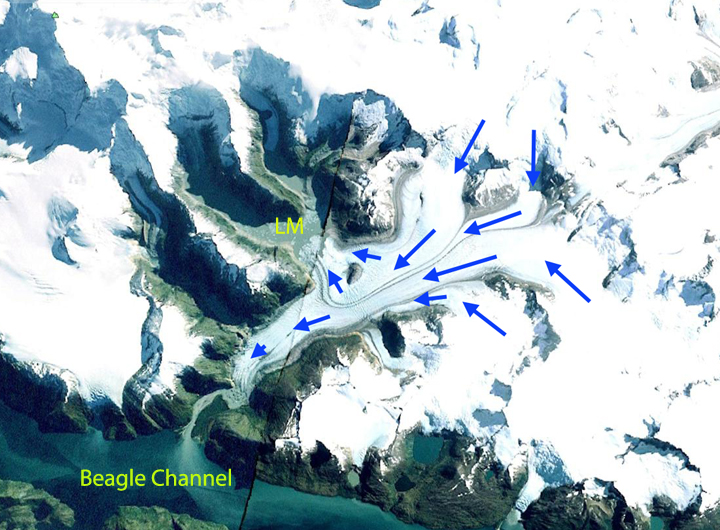
The Cordillera Darwin in Tierra Del Fuego, Chile is a remote area that is notorious for stormy, cloudy weather that makes for only a few good satellite images. Roncagli(Alemania) Glacier is the focus of this post and is an update to a previous post. The glacier has a terminus adjacent to the Beagle Channe(BC) and a secondary terminus in Lago Martinic (LM), 5 km upglacier. Velocity profiles by Melkonian et al (2013) indicate the highest velocities directed toward the LM terminus, making this the primary terminus. They also found that the glacier thinned by 5-10 m along most of its length from 2000-2011. Here we examine Landsat imagery from 1997 to 2014.

Roncagli ge
Googel Earth image
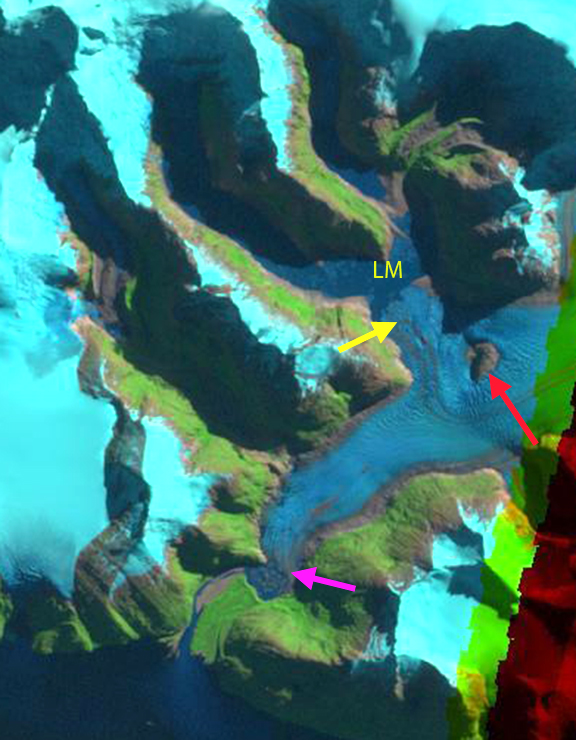
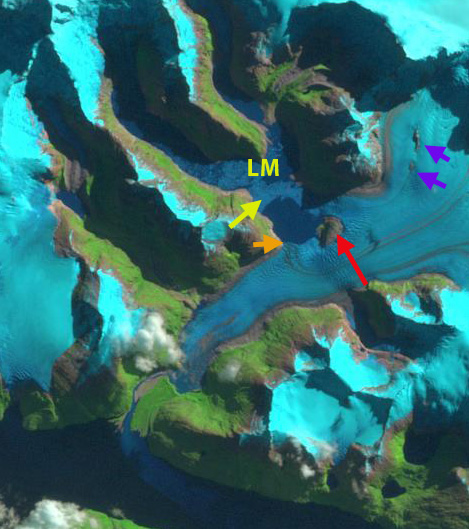
In 1997 the BC terminus at the pink arrow is at a narrowing of the valley. The LM terminus is at the yellow arrow with two primary glacier branches encircling the nunatak at the red arrow. In 2000 the terminus positions are relatively unchanged with the LM terminus actively releasing icebergs into Lago Martinic. Upglacier a single area of bedrock is emergent through the glacier, purple arrow. In 2001 the BC terminus remains unchanged, the water level in LM has declined exposing more bare rock surfaces around the LM terminus. By 2008 the LM terminus has separated, both still ending in the lake, the lake again is at a full stage on the date of the imagery. The lake experienced periodic filling and draining episodes during the 1997-2008 period. There are now two upglacier areas with exposed bedrock now. By 2014 the BC terminus has retreated 1 km along the southeastern margin and 200 m along the northwest side. This retreat from the pinning point that restricted calving at the pink arrow, suggests further retreat will occur in the near future. Lago Martinic has largely drained. The LM terminus has separated into two tongues and the former nunatak is no longer surrounded by glacier ice, red arrow. The retreat at LM terminus is 1500 m on the west side, orange arrow, and 800-1000 m on the east side. Upglacier both areas of bedrock that are emergent are expanding, purple arrows, indicating the thinning observed by Melkonian et al. (2013). The continued upglacier thinning indicates reduced flux to the terminus and continued retreat. The degree to which Lago Martinic can refill is uncertain, MODIS imagery from late 2014 shows the lake is still not filled. I have not seen imagery indicating even a nearly full lake in the 2011-2014 period. The rate of retreat is less than on Marinelli Glacier to the north or Glaciar Steffen.
racongli 1997
1997 Landsat image
racongli 2000
2000 Landsat image
racongli 2001
2001 Landsat image

roncagli 2008
2008 Landsat image
racongli 2014
2014 Landsat image

Marinelli Glacier Retreat, Chile

Marinelli Glacier, Chile is the largest glacier of the Cordillera Darwin Icefield. This ice cap is in Tierra del Fuego, a region famous for cloudy, stormy weather. Fernandez et al. (2011) indicate that rapid retreat particularly since 1945 has led to high erosion and sedimentation rates. They also provide an excellent diagram of the glacier from three time periods. The glacier extended to the Little Ice Age-Neoglacial moraine at the red arrow. Koppes et al (2009) indicate a retreat of  13 km from 1960 to 2005, 300 m/year.

marinelli ge
Marinelli Glacier in Google Earth

marinelli ela
Cross section of glacier from Fernandez et al (2011)
Melkonian et al (2013) note widespread thinning with a peak on Marinelli Glacier. They also note frontal velocities of 7.5 m/day to 10.5 m/day from 2000 to 2011. They note approximately a 4 km retreat during this period and an average accumulation area ratio (AAR) of 38 (Melkonian et al, 2013). A non-calving glacier needs an AAR over 50 and typically over 60, since calving is an additional loss, calving glaciers typically need an AAR above 70 (Pelto, 1987).

marinelli velocity
Change in thickness on Marinelli Glacier from Melkonian et al. (2013)

Here we examine Landsat imagery from 1998 to 2014. In 1998 Marinelli Glacier had a main calving tidewater terminus and a land based terminus, red arrow. The tidewater terminus extends beyond the land based terminus. The land based terminus is connected to a tributary at the pink arrow. A tributary from the east is connected to the main glacier at the purple arrow. The yellow arrow is the 2014 terminus position. By 2001 the tidewater terminus has retreated up fjord of the land terminating terminus. The tributary on the west is still connected with the land terminating section of the glacier. By 2008 the main terminus has retreated exposing a new island in the center of the calving front. The land terminating section is now separated from the main glacier and with no supply of new ice will melt away, orange arrow. The tributary from the west is separated from the land terminus now at the pink arrow. The east tributary sill has a connection at the purple arrow to the main glacier. By 2014 the island at the main terminus has expanded in size as the glacier has retreated. The east tributary at purple arrow is separated from the main glacier. The isolated stagnant former land based terminus section between the red and orange arrows continues to melt away. The tidewater terminus of the glacier has retreated about 3.75 km from 1998 to 2014.  This is a rate of less than 300 m/year the long term average. The glacier will not stop retreating until its AAR rises and the calving margin reaches a pinning point. In this case there is no lateral pinning point apparent, hence it will have to be a rise in the elevation of the base of the glacier. The velocity and thickness change profile indicate such a location may exist 3-4 km behind the current calving front.  This glacier is retreating faster than the other glaciers of this icefield and is more in line with glaciers in the Southern Patagonian Icefield such as, Onelli Glacier, Glaciar Steffen, Glaciar Chico and Jorge Montt Glacier.

marinelli 1998
Landsat image 1998

marinelli 2001
Landsat image 2001

marinelli 2008
Landsat image 2008

marinelli 2014
Landsat image 2014