Widespread Retreat Gilkey Glacier System, Alaska

Gilkey Glacier drains the west side of the Juneau Icefield and has experienced widespread significant changes since I first worked on the glacier in 1981.    Here we examine the changes from the August 17, 1984 Landsat 5 image to the August 21, 2014 image from newly launched Landsat 8.  Landsat 5 was launched in 1984, Landsat 8 launched in 2013. The Landsat images have become a key resource in the examination of the mass balance of these glaciers (Pelto, 2011). The August 17th 1984 image is the oldest Landsat image that I consider of top quality. I was on the Llewellyn Glacier with the Juneau Icefield Research Program (JIRP) on the east side of the icefield the day this image was taken. JIRP was directed by Maynard Miller at that time and by Jeff Kavanauagh now. The Gilkey Glacier is fed by the famous Vaughan Lewis Icefall at the top of which JIRP has its Camp 18 and has monitored this area for 60 years. Here I examine changes both in images and text below. The same analysis in a more depth is contained in the screen capture video of the same images.  Choose the format you prefer and let me know which works for you.

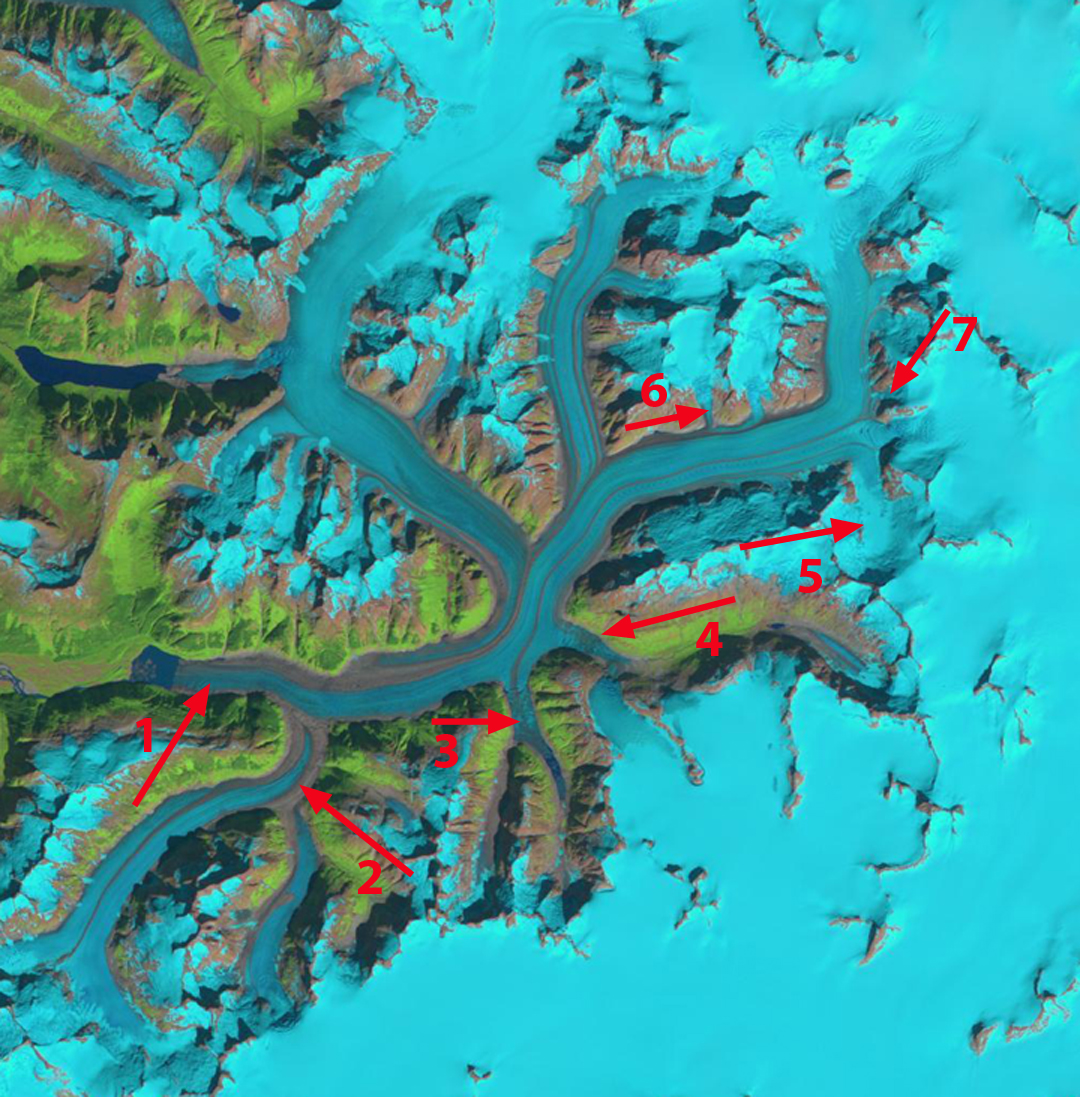
There are seven locations noted in the 1984 and 2014 image that are the focus of more discussion in a set of three more focused images

gILKEY gLACIER 1984 SOURCE

1984 Landsat Image

Gilkey Glacier 2014 source

2014 Landsat image

Arrow #1 indicates the Gilkey Glacier terminus  area.  Gilkey Glacier had begun to retreat into a proglacial lake by 1984, the lake was still just 1 km long. A short distance above the terminus the Gilkey was joined by the sizable tributaries of the Thiel and Battle Glacier. By 2014 the main glacier terminus has retreated 3200 m, the lake is now 4 km long.  A lake that did not exist in USGS maps from 1948. Thiel and Battle Glacier have separated from the Gilkey Glacier and from each other. Thiel Glacier retreated 2600 m from its junction with Gilkey Glacier from 1984-2014 and Battle Glacier 1400 m from its junction with Thiel Glacier and 3500 m from the Gilkey Glacier.  Melkonian et al (2013) note the fastest thinning in the Gilkey Glacier system from to is near the terminus and in the lower several kilometers of Thiel Glacier.

Gilkey terminus retreat

Above: 1984-2014 Comparison of Gilkey Glacier terminus area with Landsat imagery

Arrow #3 and #4 indicates valleys which tongues of the Gilkey Glacier flow into.  In 1984 at #3 the glacier extended 1.6 km upvalley ending where the valley split. The portion of the Gilkey flowing into the valley had a medial moraine in its center.  At arrow #4 the glacier extended 1.5 km up Avalanche Canyon.  In 2014 at  #3 the glacier tongue ends 1.2 km from the valley split, and the medial moraine does not enter the valley.  At #4 the glacier has retreated 1.3 km, leaving this valley nearly devoid of a glacier.
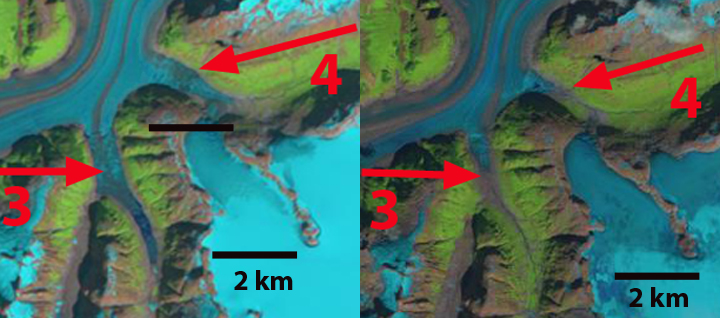
avalanche canyon retreat

Above: Comparison of the Avalanche Canyon area 1984-2014.

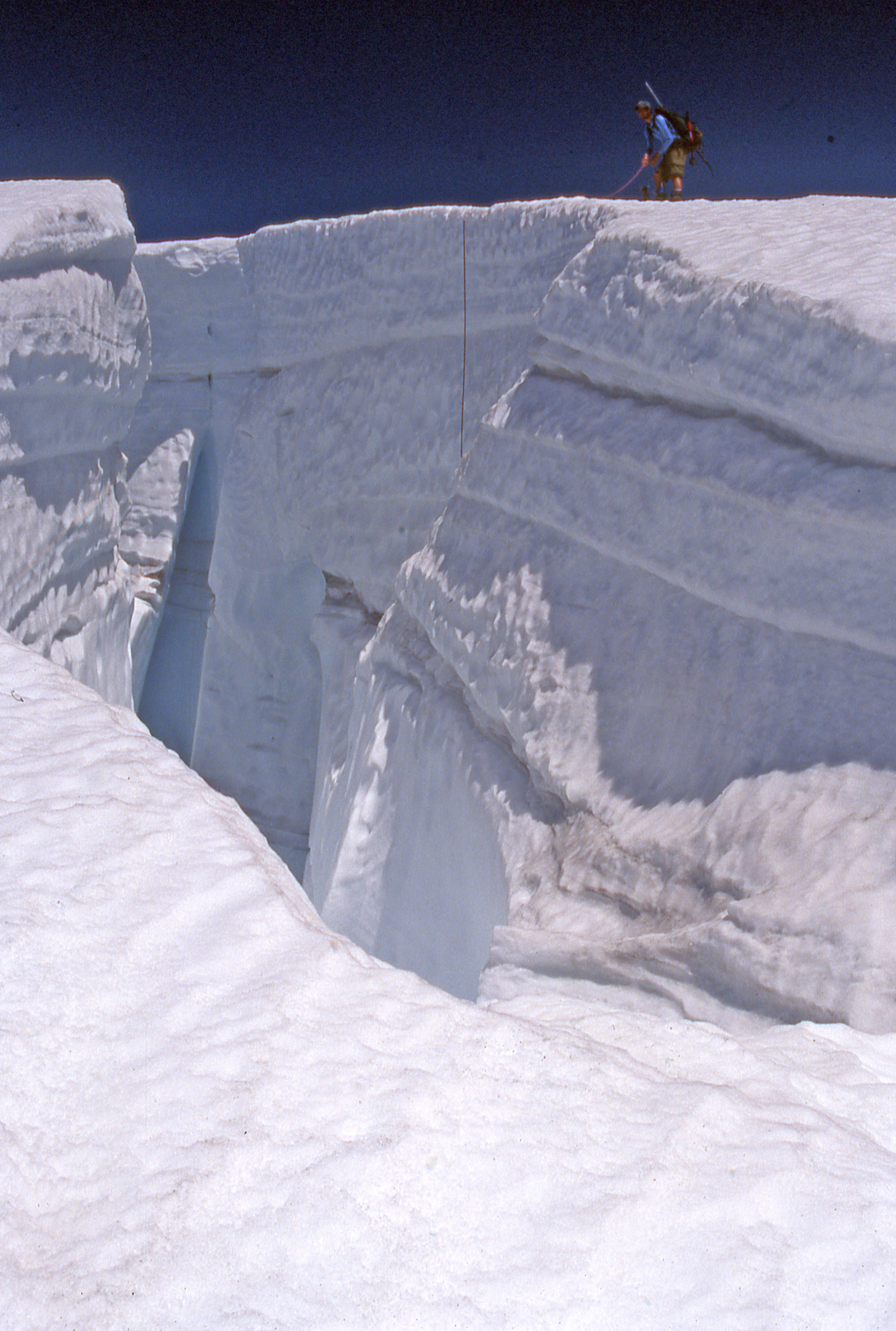
Further upglacier arrow #5 indicates a side glacier that in 1984 featured an unending system of glacier flowing down the steep mountain sides into the valley bottom.  By 2014 two rock ribs extend along most of the east and west valley walls separating the glaciers on mountain side from the main valley glacier, which has as a result been reduced in width and velocity. At arrow #6 a tributary glacier is seen merging with Gilkey Glacier in 1984.  By 2014 this tributary no longer reaches the Gilkey Glacier, ending 300 m up the valley wall.  At arrow #7 the Little Vaughan Lewis Icefall in 1984 is seen merging with the Gilkey Glacier across a 300 m wide front.  This I can attest from seeing the glacier that summer to be an accurate observation.  By 2014 at arrow #7 the Little Vaughan Lewis Icefall no longer feeds ice directly to the Gilkey Glacier.  There is still avalanching but not  a direct flow connection. JIRP has Camp 19 in this area, a spectacular area of ongoing research by JIRP.   The main Vaughan Glacier Icefall is still impressive, just south of the rib beyond arrow #7. Measurements of snowpack are made annually by JIRP above the icefall, and indicate a mean snow depth exceeding 3 m in early August, note image below of measuring annual snow layers in a crevasse at head of the icefall. Pelto et al (2013) summarize the results of this ongoing research that Chris McNeil (USGS) is working to enhance with newer technology.  The terminus change of all Juneau Icefield glaciers from 1984-2013 has been summarized in a previous post. The 2015 season will be of interest, since the area had a remarkably warm yet wet winter.  This will lead to high ablation at lower elevations, likely a higher snowline than usual, but above the Vaughan Lewis Icefall will those warm wet events dumped snow? The 2014 winters season was warm and the snowline seen in the 2014 satellite imagery was at 1500 m, yet snowpack at 1760 m on the Vaughan Lewis Glacier was 3.3 m deep in late July.  This has been the case in the past with warm wet winters featuring heavy snow above 1600 meters on the icefield. JIRP will be in the field answering this question in 2015.
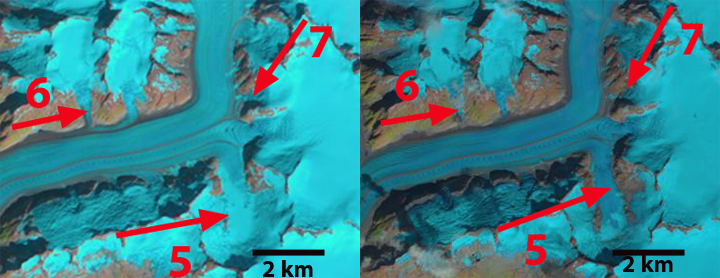
little vaughan

Above: Comparison 1984-2014 of the Vaughan Lewis Glacier area
Untitled-24

Crevasse stratigraphy Vaughan Lewis Glacier.
Downwasting Tributary-Glacier Dammed Lake Formation at HPN4 Glacier, Patagonia, Chile

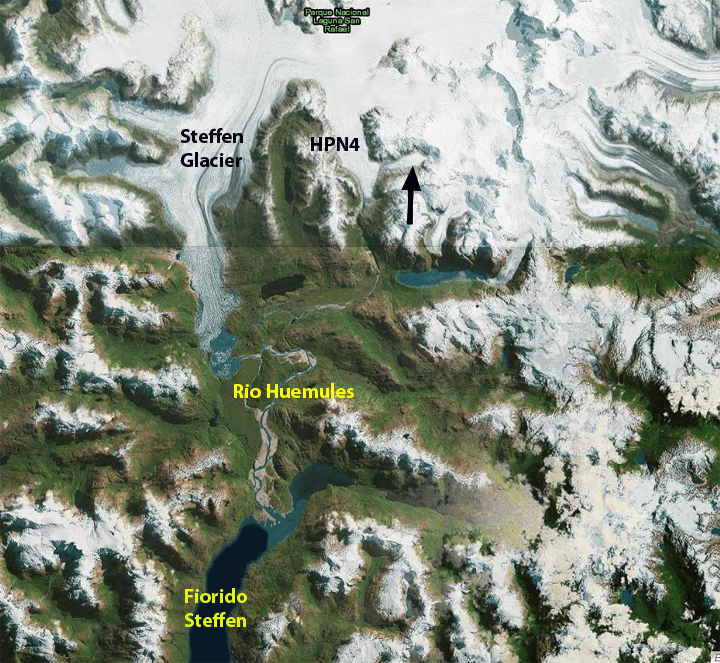
We often are more concerned with what is happening at the terminus of a glacier; however, often key changes are happening up glacier some distance. This is the case with the following example. The Northern Patagonia Icefield (Hielo Patagónico Norte, HPN) is one of the two main icefields in Patagonia.  The remoteness of the region is evidenced by the number of significant lakes and glaciers that remain unnamed.  This remoteness has led to several valuable detailed recent studies utilizing satellite imagery on glacier extent (Davies and Glasser, 2012), glacier thickness change (Willis et al, 2012) and glacier velocity (Mouginot and Rignot, 2015)  Here we focus on a downwasting tributary to an unnamed glacier listed as HPN4 Glacier  in the aforementioned studies. Davies and Glasser, (2012)  identify this region of the icefield as retreating faster from 2001-2011 than during any measured period since 1870.    Willis et al, (2012) in their Figure 2, seen below,  identify this an area of pronounced thinning, approximately 5 m/year from 2000 to 2011. Why such rapid thinning in an area without calving?   Mouginot and Rignot, (2015) indicate that this area is not an area of rapid flow, and given the thinning it should be an area of diminishing flow.  Here we examine changes from 1987 to 2014 using Landsat imagery.

HPN4-map

Digital Globe image of southern section of Northern Patagonia Icefield, with black arrow indicating downwasting tributary from the east flowing into HPN4 Glacier.

npi thinning

Figure 2 from Willis et al (2012) indicating thinning of NPI glaciers from 2000-2011, the blue arrow indicates the downwasting tributary of interest flowing into HPN4 Glacier from the east.

hpn4 flow

Ice Flow direction for HPN4 Glacier and the downwasting tributary (DT).   The flow diagram above indicates the converging flow of the downwasting tributary and HPN4, that meet at the medial moraine.

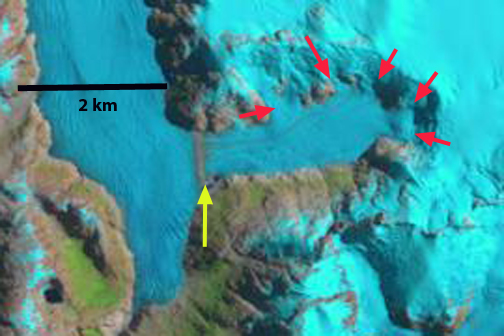
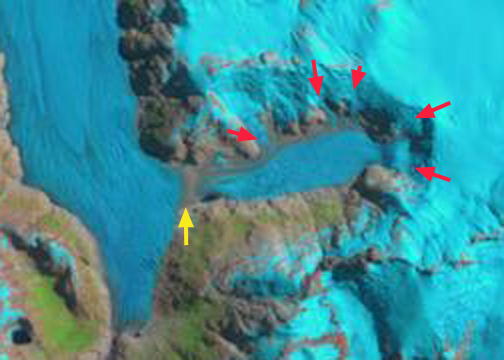
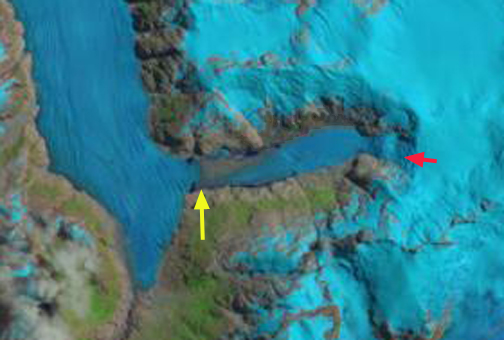
In 1987 there are five contributing glacier tongues to the downwasting tributary, each indicated with a red arrow.  It is like a bathtub being filled with five taps at once.  The yellow arrow indicates a medial moraine at the mouth of the valley, signalling the lack of current contribution of the downwasting tributary to HPN4 Glacier.  By 2004 only three of the contributing glacier tongues still merged with the downwasting tributary, and two of these are much more tentative.  The medial moraine has shifted east indicating that the main HPN4 Glacier is now flowing into the valley instead of the downwasting tributary being a contributing tributary to HPN4.  By 2014 there is only one contributing glacier tongue to the downwasting tributary, only one tap for this draining bathtub, the other four contributing tongues have retreated from contact with the downwasting tributary.  The medial moraine has spread eastward and some fringing proglacial/subglacial lakes are evident.  In 2015 the only change is that the rifting near the medial moraine is more pronounced.  A closeup 2013 Digital Globe image indicates both fringing ponds-blue arrows, rifts caused by varying flotation-green arrows and expanding supraglacial ponds, red arrows.  The rifts are a sign of instability and typically lead to break up of  this portion of the terminus. The downwasting tributary continues to demise faster than HPN4 Glacier, which crosses the valley mouth, hence it is likely that a glacier dammed lake will form and that HPN4 Glacier will continue to flow further east up this valley, which could offset some of the downwasting and lake development.  In either case this redirected flow of HPN4 into a high ablation valley, will help encourage a faster retreat of the main terminus. How large the lakes gets and how much of the time it is filled are difficult to speculate upon.  Analogs for this type of lake are seen at. Allemania Glacier (Lago Martinic) and Baird Glacier (Witches Cauldron) .  Schaefer et al (2013) discuss the HPN4 Glacier because the main terminus has changed little given its modelled mass balance, and the modelled mass balance to the east appears too negative, which they suggest indicates wind redistribution from the HPN4 to the Pared Sud Glacier just east.  That is a challenge to sort out without some ground truth.

hpn-4 1987

1987 Landsat image

hpn-4 2004

2004 Landsat image

hpn-4 2014

2014 Landsat image-not the fringing blue indicating trapped sub-glacial/proglacial lake.

hpn-4 2015

2015 Landsat image

hpn4-ge


Google Earth image 2013

Conway Glacier Separation and Retreat, Alberta

Conway Glacier drains east from the border with British Columbia into the Howse River. The Howse River joins the Saskatchewan River upstream of the Bighorn Hydropower project, which impounds Lake Abraham and produces 120 MW of power. The map of this area was updated based on 1990 images which indicate Conway Glacier is comprised of two lobes that join near the terminus.   An inventory of glaciers in the Canadian Rockies indicate area loss of 15% from 1985 to 2005 (Bolch et al, 2010).  The more famous Columbia Icefield, 50 km north, has lost 23 % of its area from 1919-2009 with ice loss at a minimum during the 1970′s (Tennant and Menounos, 2013)Here we examine Landsat imagery from 1986 to 2014 to see the impact of recent climate change.

conway glacier map

Map of Conway Glacier area from 1990 image.

In 1986 the two glaciers are still joined, with a surface lateral moraine at their junction, orange dots indicate this narrow surface rock band eroded from the ridge between the two lobes. The yellow arrow in each image indicates the 1986 terminus location of the northern lobe, the red arrow indicates a bedrock step near the southern lobe terminus, green arrow indicates an ice filled basin, and the purple arrow a small tributary joining the main glacier.  In 1986 the southern lobe extends 300 meters beyond the bedrock step.  By 1994 a small lake is developing at the basin indicated by the green arrow and the northern lobe is reduced in width.  Overall less than 40% of the glacier is snowcovered.  By 1998 the southern lobe has retreated to the bedrock step and the northern lobe has retreated from the end of the lateral moraine.  The glacier again is less than 40% snowcovered.  The 2013 image has better resolution thanks to the better Landsat 8 imagery, and has been sharpened using a higher resolution panchromatic image layer by Ben Pelto (Technique will be explained in a future post).  The glaciers are no longer joined.  The northern lobe has retreated 500-550 m since 1986 and a small lake has formed at the 1986 terminus location, another yellow arrow indicates 2013 terminus.  The northern lobe has retreated above the bedrock step, a total retreat of 500-600 m since 1986.  Two additional red arrows have been added to indicate 1986 and 2013 terminus location.  The small lake at the green arrow has expanded.  The tributary connection at the purple arrow is nearly severed.   Retained snowpack on the glacier is also limited in area with most of the glacier in 2013 being bare glacier ice. This indicates that snow was not retained in recent previous years either.  For a glacier to be in equilibrium it needs more than 50% of its area to be covered by snow at the end of the melt season, not  35% with a few weeks left in the melt season. as in 2013. This glaciers retreat and volume loss mirrors that of the region including Saskatchewan Glacier and Fraser Glacier.   Peyto Glacier is the nearest glacier, just 20 km southeast, with a long term mass balance record, which indicates a cumulative loss or over 28 m w.e or 30 m of glacier thickness.

conway glacier 1986a

1986 Landsat image

conway glacier 1994

1994 Landsat image

conway glacier 1998

1998 Landsat Image

Red Channel|Green Channel|Blue Channel 2013 Landsat image-Pan sharpened by Ben Pelto (Univ. Northern British Columbia)

Demise of Antler Glacier, Juneau Icefield, Alaska

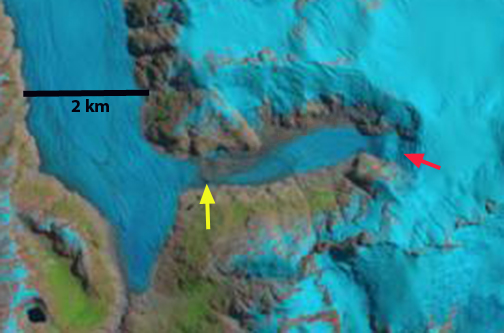
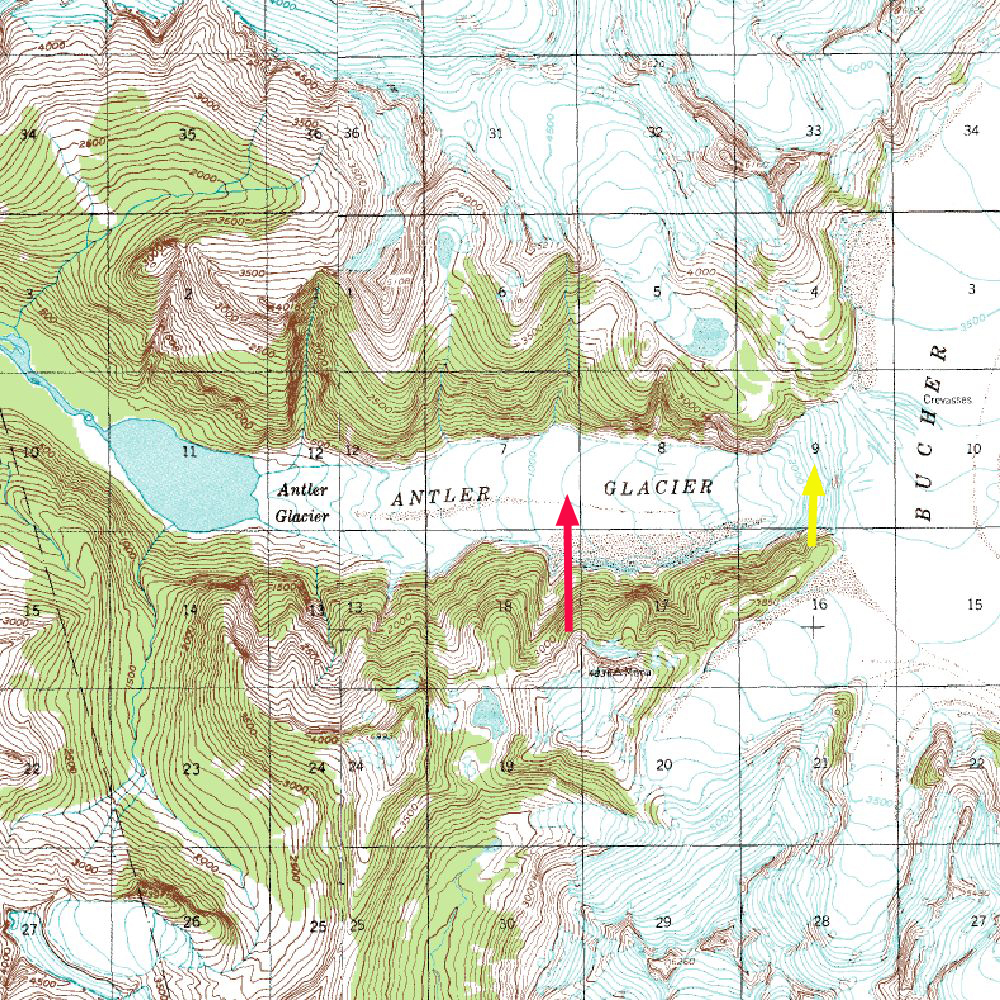
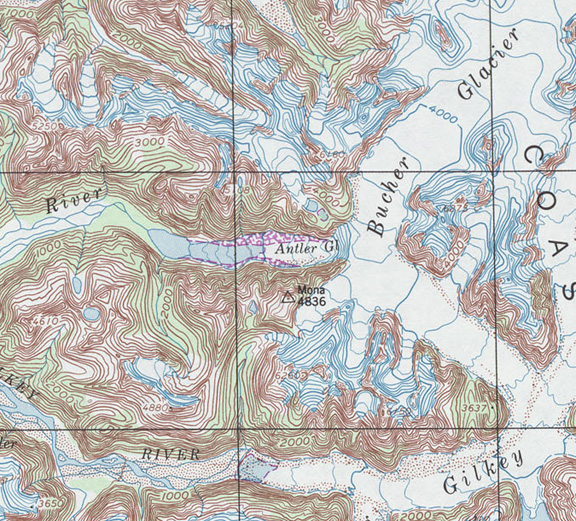
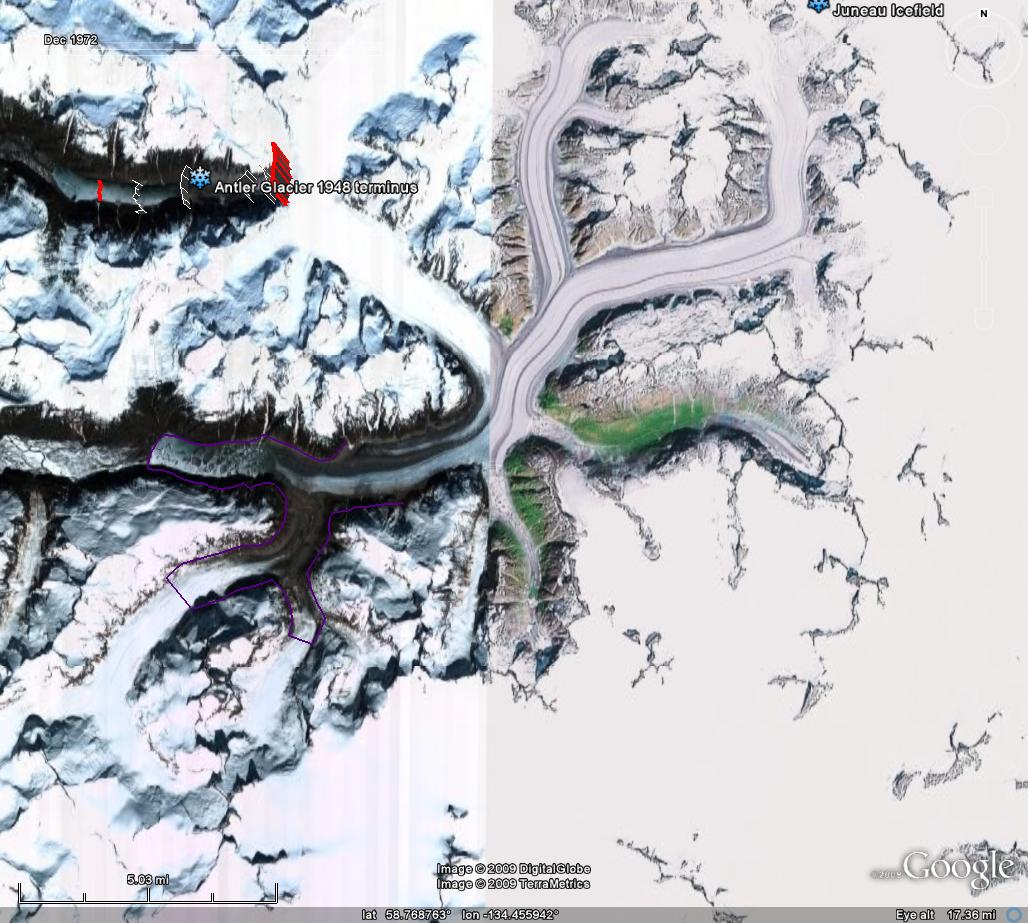
“What is wrong with this map?” . Was my first comment about the Antler Glacier in 1981, while surveying the geology in the region with the Juneau Icefield Research Program, during light snow flurries in August.  The map I had was the most up to date USGS topographic map based on 1948 images, indicating Antler Glacier terminating in a small lake.  By 1981 the lake was quite long and the glacier no longer reached it, though this was not perfectly evident  through the snow flurries. If I returned to the same location today, looking  at the updated USGS topographic map from 1979 my comment would be the same.  Climate is changing our glaciers and our maps of these regions. The Antler Glacier is an outlet glacier of the Juneau Icefield. It is actually a distributary glacier of the Bucher Glacier. It splits from the Bucher Glacier 8.5 km above where the Bucher Glacier joins the Gilkey Glacier as a tributary. In 1948 it spilled over the lip of the Antler River valley from the Bucher Glacier and flowed 6 kilometers downvalley to end in a proglacial lake. The glacier was 6200 m long in 1948, red arrow is 1984 terminus, yellow arrow indicates 2014 terminus.  Here we examine satellite imagery from 1984 to 2014 to identify changes in the Antler and other small glaciers in the area.

Antler_Glacier map

USGS map showing 1948 position of Antler Glacier.

antler 1985 map


Antler Glacier in 1979

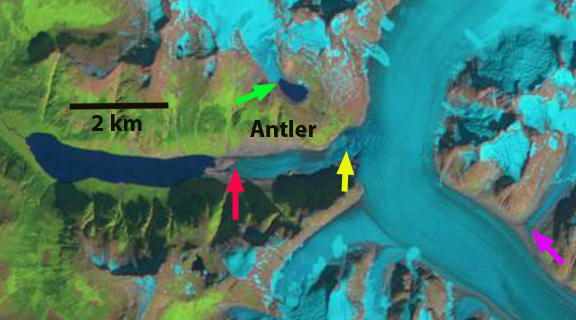
In each Landsat image the arrows indicate the same location, red arrow 1984 Antler Glacier terminus location, yellow arrow 2014 terminus of Antler Glacier, green arrow small glacier adjacent to Antler Glacier and purple arrow tributary glacier to Antler glacier.  In 1984 Antler Glacier no longer reached Antler Lake which had expanded from a length of 1.6 km  in 1948 to 4.2 km. The glacier was still 2.7 km long. Though I was in the area in 1984 I did not see Antler Glacier.  The small glacier at the green arrow terminated at the edge of a small lake.  The tributary at the purple arrow joined the Bucher Glacier.  By 1997 the lower 2 km of the Antler Glacier were gone and the glacier ended near the base of the steep eastern entrance to the valley. The glacier at the green arrow no longer reached the lake and at the purple arrow the tributary has separated from Bucher Glacier.  By 2013 Antler Glacier extended only 400-500 m over the lip of the valley entrance from Bucher Glacier.   The glacier at the purple arrow was separated by more than a kilometer from the Bucher Glacier.  There is little change of course from 2013 to 2014, Antler Glacier has retreated 2.2 km since 1984 and 5.8 km since 1948.  The small glacier at the green arrow has receded 300 m from the lake shore.  The former Bucher tributary at the purple arrow now terminates 1.4 km from Bucher Glacier. 

The lake is gorgeous, and the valley once filled by the glacier is now nearly devoid of glacier input. The retreat is largely a result of reduced flow from the thinning Bucher Glacier which no longer spills over the valley lip significantly. As the Bucher Glacier continues to thin, the Antler Glacier will cease to exist. This thinning is due to increased ablation of the glacier.  The mass balance loss at nearby Lemon Creek Glacier from 1953-2011 was -26.6 m  Pelto et al (2013), this equals a thinning of at least 29 m.  Gilkey Glacier which is fed by Bucher Glacier has retreated  3.2 km from 1984-2013 and  4 km from 1948-2013 (Pelto, 2013).  Continued losses and separation of tributaries from the Bucher Glacier could lead to formation of glacier dammed lakes such as on Tulsequah Glacier.   The Juneau Icefield Research Program directed by Jeff Kavanaugh will again be in the field in 2015., I will be interested to see their observations after the exceptionally warm but wet winter in the regioneantler glacier 1984


1984 Landsat image

antler glacier 1997

1997Landsat image


antler glacier 2013a

2013 Landsat image

antler glacier 2014


2014 Landsat image 

Cordillera Lago General Carrera Glacier Retreat, Chile

You know southern Chile has lots of glaciers when an icefield with an area of 132 square kilometers has no named glaciers.  Davies and Glasser (2012) referred to this icefield as Cordillera Lago General Carrera, since it drains into that lake, the icefield is just east of the Northern Patagonia Icefield.   Davies and Glasser (2012)  noted that the icefield has a mean elevation of 1670 m and has declined from an area of 190 square kilometers in 1870, to 139 square kilometers in 1986, and 132 square kilometers in 2011.  They further noted that the area loss of Patagonia glaciers has been most rapid from 2001 to 2011.  Paul and Molg (2014) observed a more rapid retreat of 25% total area lost from glaciers in northern Patagonia from 1985-2011, the study area was north of the Northern Patagonia Icefield. Lago General Carrera drains into the Baker River, which is fed by most glaciers on the east side of the Northern Patagonia Icefield.  This river had a series of proposed hydropower projects that have now been cancelled by the Chilean government.

clcg

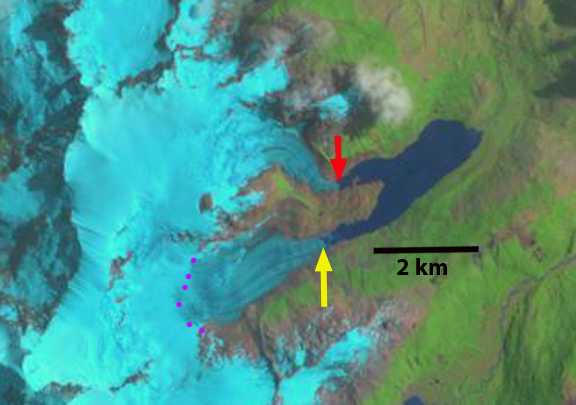
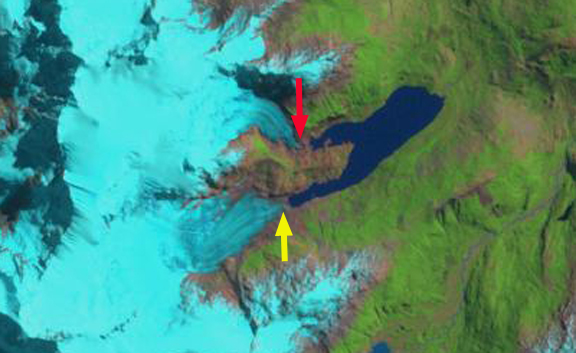
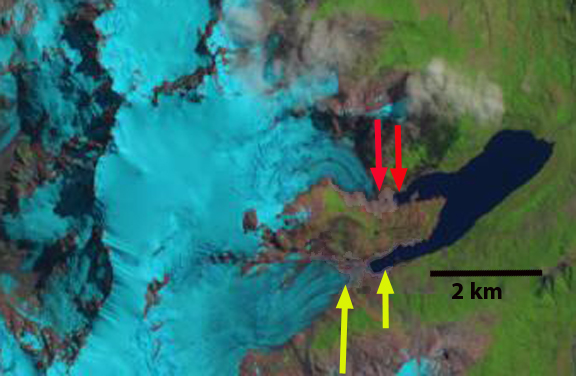
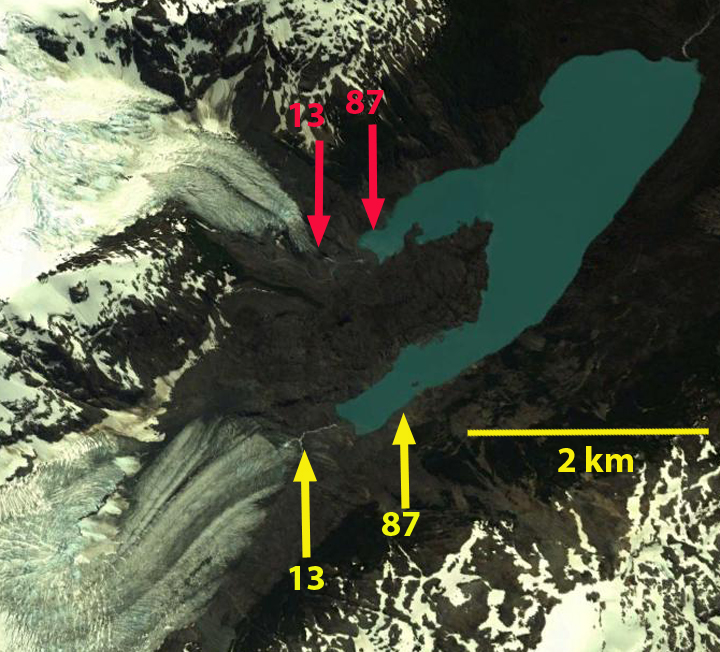
Here we examine Landsat imagery from 1987 to 2014 to identify the changes in a pair of outlet glaciers that drain the eastern side of the icefield, images below. In 1987 both outlet glaciers terminated in an unnamed lake that drains into the Leones River. The southern glacier is 5.5 km long beginning at 2400 m and terminates at the yellow arrow, with the snowline marked by purple dots, in the images below.  The northern glacier is 5.0 km long beginning at 2200 m with the terminus at the red arrow. In 1987 the glaciers were in shallow enough water  that calving was limited and no icebergs are evident. By 2001 both glaciers are no longer terminating in the lake.  The retreat can no longer be enhanced by calving into the lake.  By 2014 both glaciers have retreated several hundred meters from the lake.  It is easier to measure the retreat in the 2013 Google Earth image.  The retreat from the 1987 to 2013 position are indicated by the pair of arrows.  The northern glacier has retreated 400 m and the southern glacier 600 m from 1987 to 2013.  In both cases this is approximately 10% of the glacier length.  The beautiful green color of the lake is indicative of the contribution of glacier flour from actively moving and eroding glaciers.  This glaciers retreat is similar to that of the nearby Nef Glacier and Verde Glacier.

clgc 1987
1987 Landsat image
clgc icefield 2001

2001 Landsat image
clgc 2014

2014 Landsat image

clgc ge 2013
2013 Google Earth image.  With arrows indicating terminus change from 1987 to 2013.

Upernavik Glacier Retreat, NW Greenland

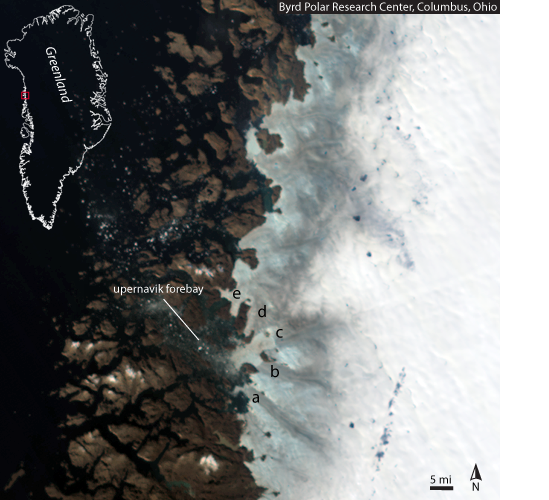
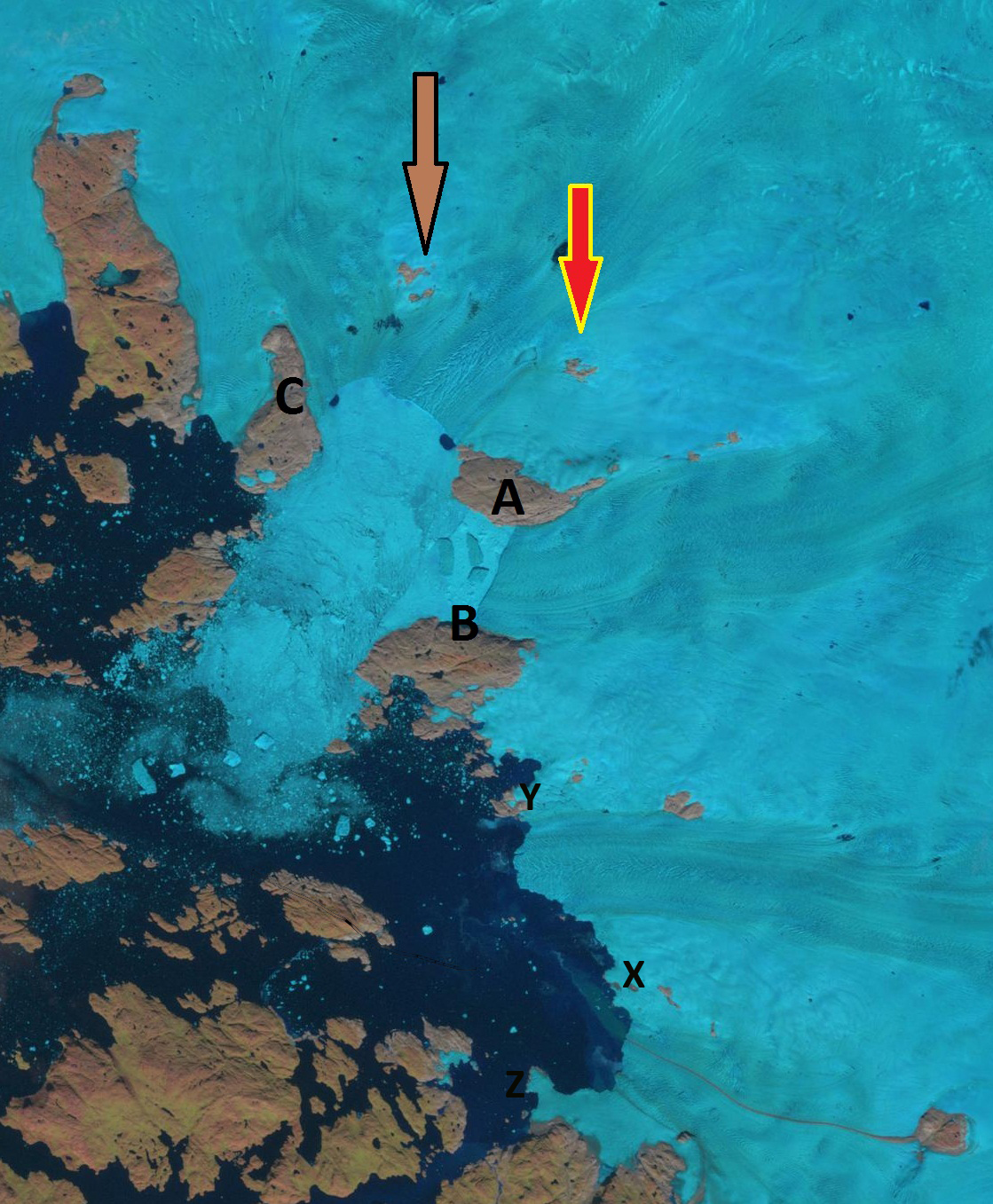
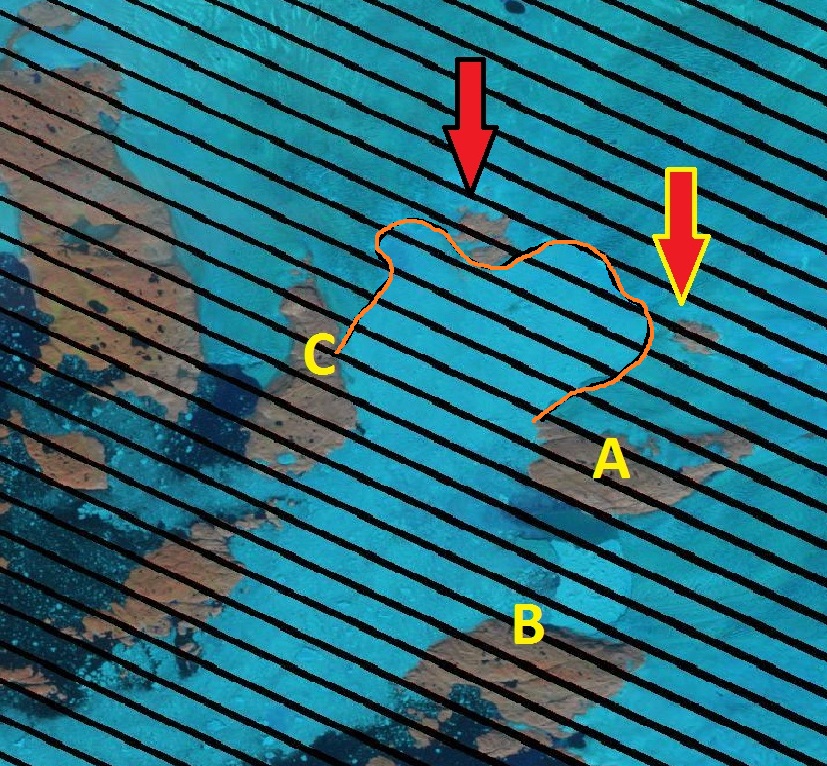
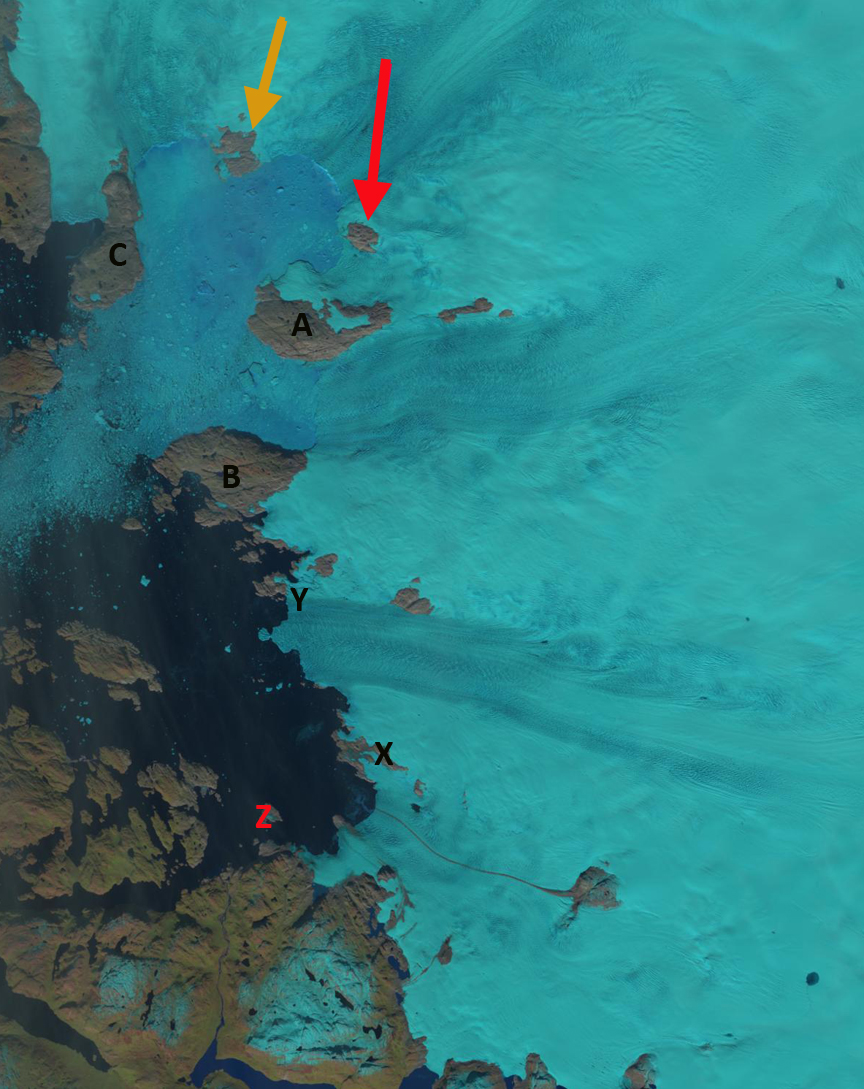
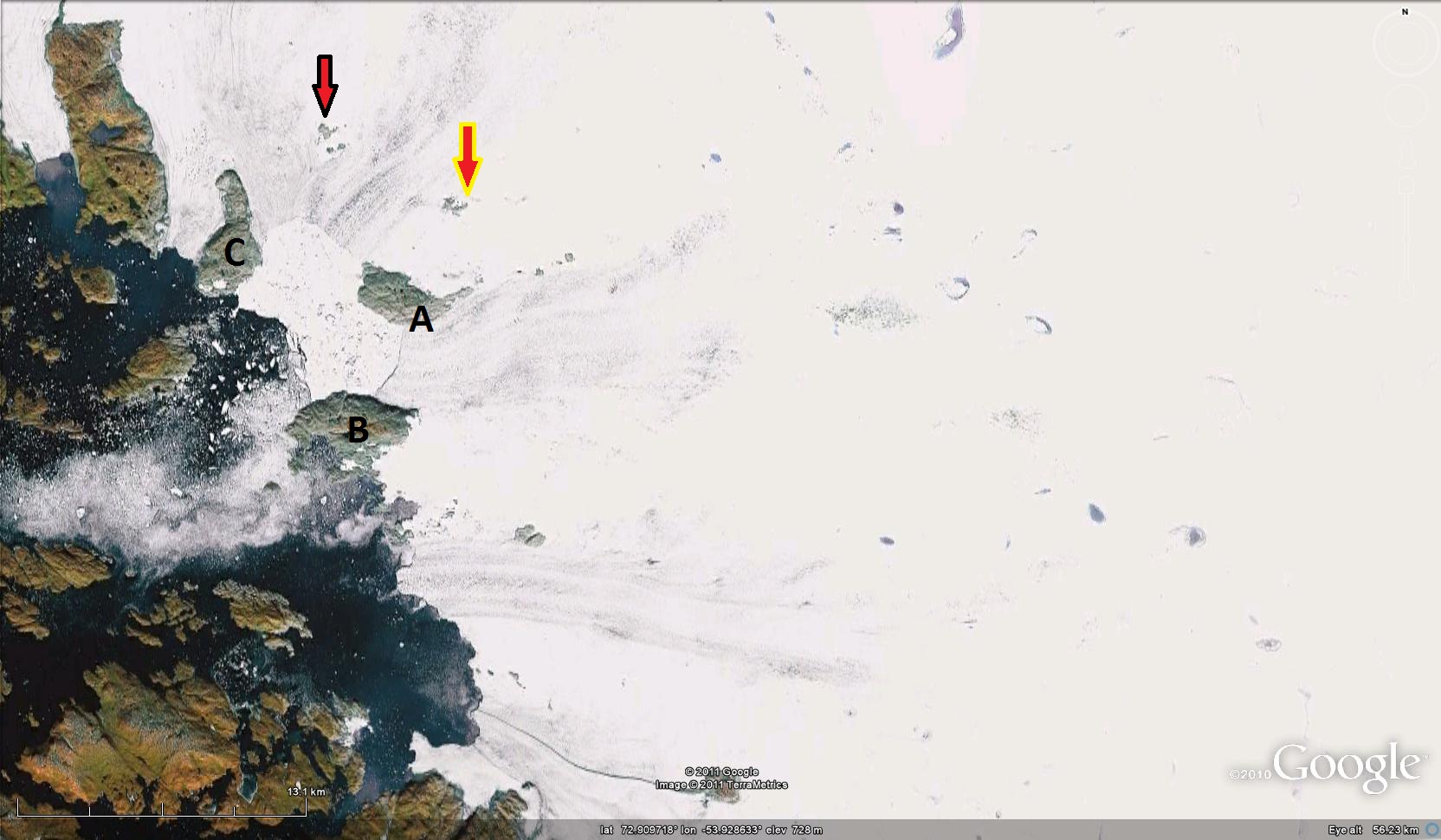
Box and Decker (2011) focused on the changes in the terminus of 39 Greenland Outlet glaciers from 2000-2010. Of these 35 had experienced net loss with the collective loss of 1593 km2 over the last decade. (Box and Decker, 2011). The retreat has occurred irrespective of the different characteristics of various glaciers (Bailey and Pelto, SkS) One of the glaciers in this group is Upernavik Glacier on the NW Greenland Coast. The Upernavik Glacier refers today refers to an increasing number of separate termini that were one termini up through 1950. Jason Box of Ohio State focused on the different termini in a 2008 post, commenting on the separation of termini A and B. Here we will focus on the development of two new islands between 2002 and 2010 due to the retreat of termini C as identified by Box and Benson in the image below. There are three marginal rock islands at the icecap periphery that are consistently labeled in the images below A, B and C. In addition the two arrows indicate two former nunataks, surrounded by ice in the 2002 Landsat image (top image below), and are now becoming rock islands at the glacier front in both Landsat 2010 (middle two images) and MODIS 2011 image (bottom). In the closeup Landsat image the glacier front is indicated in orange, beyond the terminus the fjord is still filled with considerable glacier debris that has calved. The black lines in the image are the uncorrected scan lines. A 2013 Landsat image indicates changes along outlet A as island at Point X, Y and Z emerge from the ice compared to 2002. upernavik2002 upernavik 2013
2013 Landsat image
Google Earth currently has an image that predates the development of the new island as well. This is not the only new island in Greenland by any means. Warming Island on the east coast has gained notoriety. It is seen below in a nice August 2010 Landsat image. Box and Decker (2011) note that ice loss for Upernavik Glacier’s combined termini was 7.9 square kilometers per year from 2000-2010, in Table 2. For the 2002 to 2010 period it is evident the Upernvavik terminus C lost at least 35 square kilometers as the two new islands begin to develop, mostly between 2002 and 2008. This glacier follows the pattern of Umiamako Glacier and Jakobshavn Glacier. It also is worth noting it has a deep bed that extends well under the ice sheet as observed by Morligheim et al (2014). upernavik base

Bridge Glacier Retreat Acceleration, BC, Canada

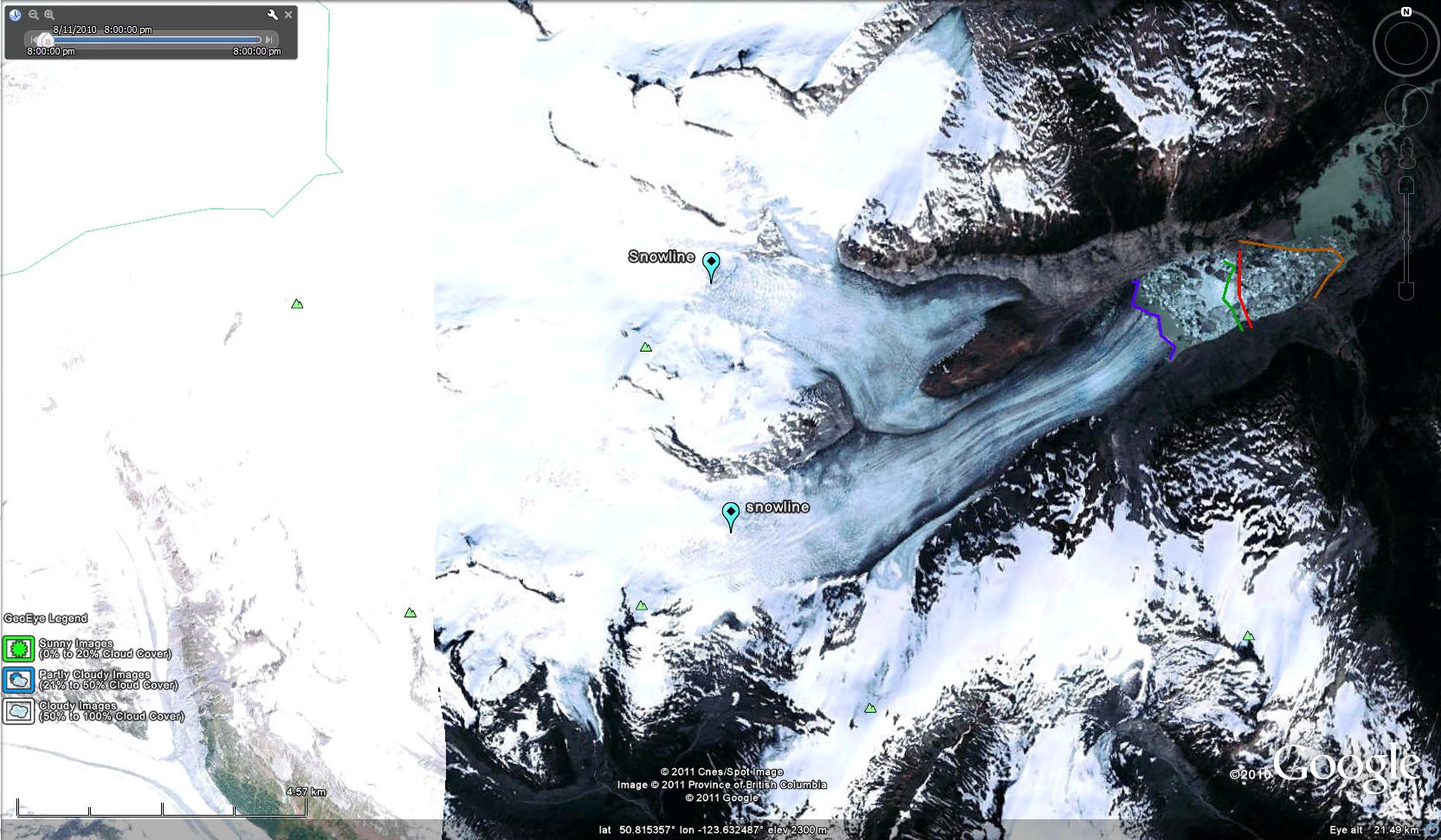
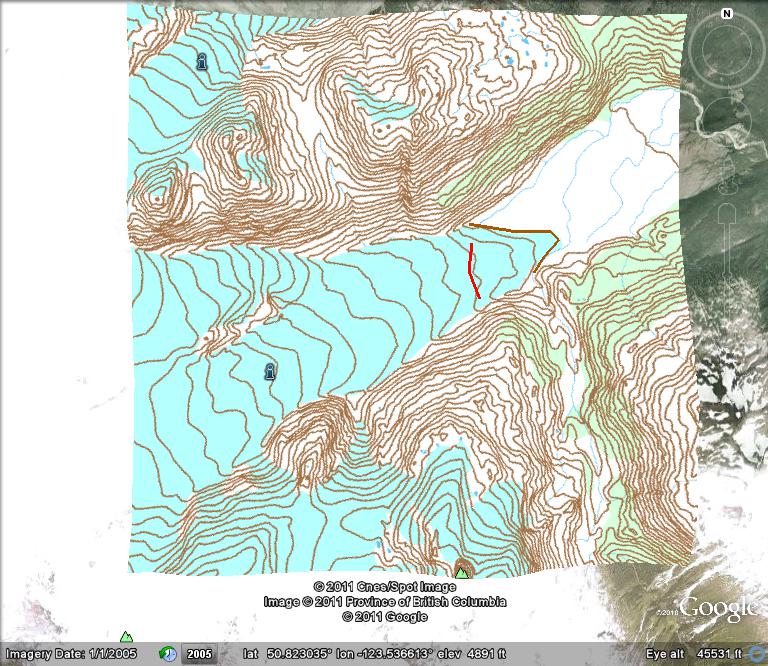
Bridge Glacier is an 17 km long outlet glacier of the Lilloet Icefield in British Columbia. The glacier ends in a rapidly expanding glacial lake with 1100 meters of retreat from 2005-2010. This 200+ m per year retreat is a substantial acceleration over the observed retreat rate of 30 m per year from 1981-2005 by Allen and Smith (2007). They examined the dendrolchronology of Holocene advances of the glacier and found up to 2005 a 3.3 kilometer advance from the primary terminal moraine band, with the most extensive advances being early in the Little Ice Age. The glacier currently ends at 1400 m and in 2010 had a late summer snowline of 2000 m. . The glacier terminus in 1970 is shown in map form, and is indicated by a brown line. The 2003 terminus position from a Landsat image, second image, is next with a red line marking the terminus. The normal Google Earth image, third image, is from 2005 and has a green line. An image from Geoeye from August 2010, last image, terminus purple line indicates the rapid acceleration of retreat. Retreat from 1970-2003 was 48 m per year. The retreat from 2003 to 2010 is 1400 meters, 200 m per year. This continued retreat and area loss will lead to glacier runoff decline in summer. This is crucial to the large Bridge River Hydro complex. This complex managed by BC Hydro can produce 490 MW of power. Stahl et al (2008) note in their modeling study of the glacier that ,”The model results revealed that Bridge Glacier is significantly out of equilibrium with the current climate, and even when a continuation of current climate is assumed, the glacier decreases in area by 20% over the next 50 to100 years. This retreat is accompanied by a similar decreasein summer streamflow.” This parallels our findings on the Skykomish River in the North Cascades, Washington Pelto (2008) and Pelto (2011).

Gilkey Glacier Ogive Spacing and Retreat

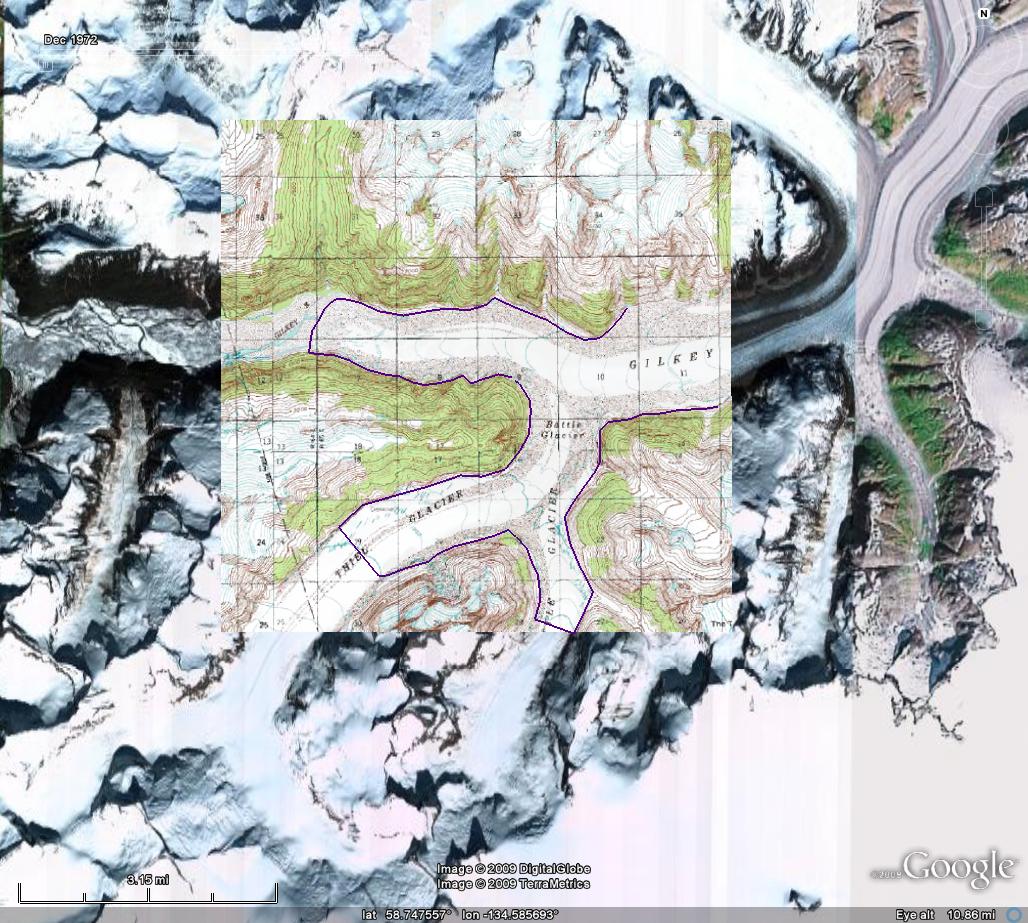
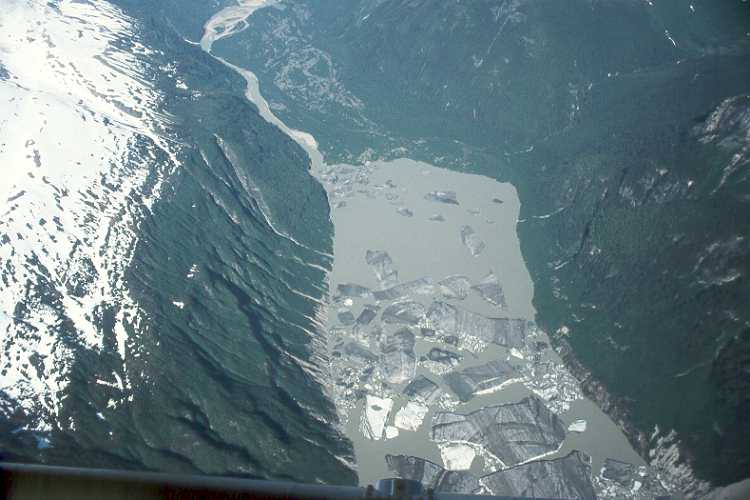
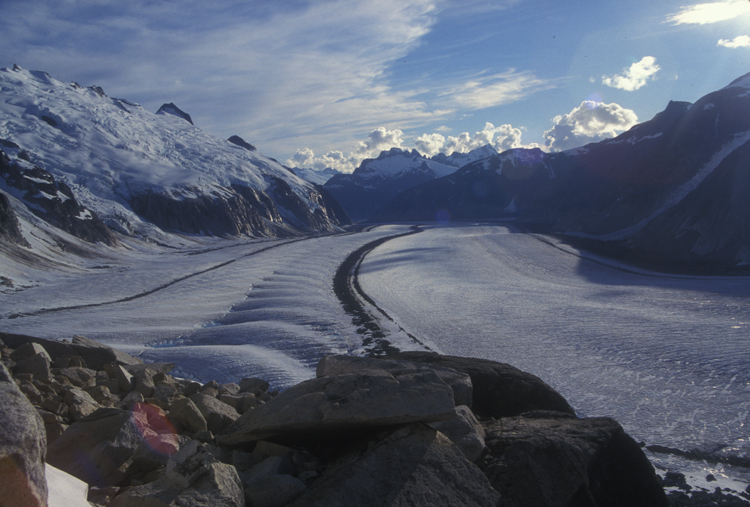
The Gilkey Glacier is a 32 km long outlet glacier flowing west from the Juneau Icefield. From 1948 to 1967 the Gilkey Glacier retreated 600 m and in 1961 a proglacial began to form. By 2005 Gilkey Glacier has retreated 3900 m from the 1948 terminus location. The glacier is currently terminating in this still growing lake, notice the new bergs and rifting at the glacier terminus. The retreat has been resulted from and in a thinning of in the lower reach of the glacier and the separation from Battle and Thiel Glacier. A major tributary to Gilkey Glacier, is Vaughan Lewis Glacier. At the base of the Vaughan Lewis Icefall where the Vaughan Lewis Glacier joins the larger Gilkey Glacier ogives form, as seen from above and below the icefall (Scott McGee). The ogives form annually and provide a means to assess annual velocity in this section of the glacier. Aerial photography of the ogives from the 1950’s combined with current satellite image provide the opportunity to assess ogive wavelength over a 50 year period, providing a long term velocity record for Gilkey Glacier. An ogive is a bulge-wave that forms annually due to a seasonal acceleration of the glacier through an icefall. The acceleration is enhanced in icefalls that are horizontally restricted. In most cases we do not have specific measurements of velocity through all season to ascertain the timing of the accelerated period, though typically spring would be the fastest. After formation the bulges move down glacier and a new bulge is formed the following year. The resulting train of ogives extending down glacier can be used to estimate the ice velocity by measuring the peak to peak separation between adjacent waves. Ogives can be visually identified as a series of arcuate wave crests and troughs pointing down glacier. Downglacier from this formation point the crests and troughs gradually flatten until the ogives are merely arcuate light and dark bands on the surface of the glacier. The dark bands are dense, blue and dusty ice that is compressed during summer, whereas the light bands are bubbly, white, air-filled ice that is compressed during winter.
In 1981 one of my tasks was to ski out through the top of the icefall inserting stakes in the crazily crevassed region to track summer velocity for the Juneau Icefield Research Program (JIRP). This has been completed often but not most years by JIRP. What we discovered was that velocity in 1981 had not changed from the 1960’s and 1970’s. Today we have frequent satellite imagery of the ogives to ascertain annual velocity that can be compared to the few aerial photographic records, in this case from 1056 and 1977. In several recent years Scott McGee of JIRP has specifically surveyed the distance between the first 11 ogive crest below the icefield. A comparison of the the ogives in 1956, 1977 and 2005 is possible by overlaying the images below. . The distance from the first to the 40th ogive has gone from 6.8 km in 1956 to 6.75 km in 1977 to 6.2 km in 2005. In 1956 and 1977 the first ten ogives spanned 1500 meters indicating an annual glacier velocity of 150 meters. From 2003-2007 the distance of the first ten ogives averaged 1440 m, or 144 meters per year. The change in velocity is quite small, compared to the large retreat of the glacier. One other key measure of the ogive surveying program is the surface elevation. A longitudinal profile containing 179 survey points was established at the base of the Icefall in 2001-2007. This profile begins in the trough immediately upglacier of the crest of the first wave ogive and continues downglacier nearly 1.8 kilometers to a point where the amplitude of the ogives becomes zero (Graphs and data from JIRP) During this six year time period, the surface has lowered an average of 17 meters – nearly 3 meters per year – along the longitudinal survey profile, with a maximum of 22 meters. This substantial thinning at the base of the icefall indicates reduced discharge through the icefall from the accumulation zone above. This will lead to further retreat and velocity reduction of Gilkey Glacier.