Snowcover Free Glaciers Generates Fragmenting in Central Andes, Chile

Snowcover free glaciers in the Central Andes in 2014 ad 2023 Landsat images. The ongoing fragmentation and retreat is evident at Point A-H, see closeup details below. The glacier as Point B has melted away, At Point G and H glacier tributaries have separated from the Norte Cipreses Glacier in the valley below. At Point D-F expanding bedrock areas amidst glacier driving further fragmentation. Glaciers at Point A and C rapidly melting away. 

Palomo Glacier and North Cipreses  are three comparatively large glaciers in the Central Andes of Chile. The three glaciers are adjacent to each other with the Palomo and Coton Glacier feeding  the Rio Cortaderal. Rio Cortaderal is part of the Cachapoal River watershed that supplies two Pacific Hydro projects; a 110 MW run of river project at Chacayes and a  78 MW Coya run of river project. Norte Cipreses Glacier feeds the Rio Cipreses. These glaciers are important water resource from December-March Bravo et al (2017) quantified this resource for adjacent Universidad Glacier, which supplied 10-13% of all melt season runoff to the Tinguirica Basin. La Quesne et al (2009) reported that Palomo Glacier retreated 1160 m from 1955-1978 and advanced ~50 m 1987-2007, due tot Palomo Glacier having an equilibrium balance durng the 1987-2000 period. Pelto (2022) reported a retreat of the glacier front of 1250 m from 2002-2022.  Here we examine the changes of this glacier from 2014-2023 using Landsat 8 and 9 images along with Sentinel images, that illustrate the impact of essentially snowcover free glaciers during the summer of  2022 and 2023 due largely to a January heat wave in 2022 (Washington Post, 2022) and February heat wave in 2023 (Pelto, 2023).

Point A is a small glacier in a south facing cirque below Alto de los Pejerreyes. From 2014 to 2023 area declined from 0.3 km² to 0.1 km². There is remanent glacier ice, but this is no longer active ice and will soon disappear. At Point B in 2014 the area of remanent glacier ice is 0.1 km², by 2023 it is gone. At Point C the glacier has declined from  0.35 km² to 0.15 km² and retreated 300 m from 2014-2023.  At Point D a bedrock area amidst the Maria Angeles Glacier, has expanded from 0.04 km² to 0.20 km², this reflects the lack of flow now reaching the terminus, which retreated 700 m from 2014-2023. At Point E the glacier has retreated 300 m and is separating into three fragments. At Point F the bedrock area amist Palomo Glacier has expanded from 1.1 km² to 1.7 km² between 2016 and 2023. This again reflects diminineshed flow to the terminus which has retreated 800 m during this period, ~100 m/year.  At Point G two glacier tongues connected to the Norte Cipreses Glacier in the valley below in 2014. By 2018 they had nealy separated and by 2023 they had completely separated from the glacier below, retreating 200-300 m to the top of this bedrock step. At Point H, the glacier disconnected from Norte Cipreses Glacier in the valley below after 2002 and retreated 300 m from 2014-2023. There is also a new expanding bedrock area high on the glacier, Point I below. The story is not unique with Sollipulli Glacier to the south and Rio Atuel glaciers in the next watershed to the east also having lost their snowcover in 2022 and 2023.

Retreat of Palomo Glacier from 2016 (red arrow) to 2023 (yellow arrow), 800 m. Separation of tributaries at G, yellow arrows that had fed Norte Cipreses Glacier. False color Sentinel images.


Glacier loss at Point B, Glacier retreat at Point C, yellow arrows marks 2016 location. Bedrock expansion at Point D, E and I. retreat from green arrow to yellow arrow of the Maria Angeles Glacier terminating near Point D. Glacier retreat at Point H, yellow arrows marks 2016 location. False color Sentinel images.
Chaba Glacier, Alberta Retreat and Icefall Separation

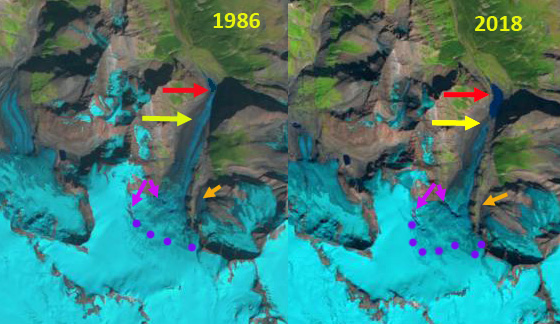
Chaba Glacier in 1986 and 2018 Landsat images.  Red arrow is 1986 terminus location, yellow arrow 2018 terminus location, pink arrows bedrock steps in icefall area, orange arrow, adjacent glacier and purple dots the snowline.

Chaba Glacier is a valley glacier descending from the Chaba-Clemenceau Icefield ending in the headwaters regions of the Athabasca River in Alberta.  Jiskoot et al (2009) examined the behavior of the Clemenceau Chaba Icefield and found that from the mid 1980’s to 2001 the Clemenceau Icefield glaciers had lost 42 square kilometers, or 14% of their area. During this same period terminus retreat averaged 21 meters per year on the glaciers. A short distance to the southeast is the better known Columbia Icefield. Tennant and Menounos (2013) examined changes in the Columbia Icefield 1919-2009 and found a mean retreat of 1150 m and mean thinning of 49 m for glaciers of the icefield, with the fastest rate of loss from  2000-2009. Here we examine the changes of Chaba Glacier from 1986-2018 using Landsat images.

Chaba Glacier has a substantial accumulation zone above 2600 m in the upper basin, the glacier then flows down an icefall from 2600 m to 2000m where it levels off in a lower slope valley tongue. In 1986 Chaba Glacier terminated in a 200 m wide proglacial lake at 1600 m, red arrow. The valley tongue below the icefall was 3.5 km long.  The icefall featured one exposure of rock at the pink arrow on the right. The snowline in 1986 is at ~2500 m.  The orange arrow indicates a separate glacier that flows down an icefall into the valley below and almost connects with Chaba Glacier.  In 1988 the snowline is lower at ~2450 m the proglacial lake.  In 1998 the glacier has retreated 200 m, leading to lake expansion. The snowline is at ~2550 m and only the upper bedrock rib is evident in the icefall, pink arrow. By 2016 the proglacial lake has doubled in size. The adjacent glacier that had terminated at the orange arrow, no longer descends below the icefall into the valley.  The lower bedrock rib in the icefall is now evident, right pink arrow.  The snowline is above ~2600 m, with a month left in the melt season. JuSt across the divide in the Columbia River Basin, measurements by  Ben Pelto of UNBC, indicated negative mass balance from 2014-2018 on glaciers in the northern portion of the basin closer to Chaba Glacier. In 2018 the proglacial lake is 900 m across and the glacier no longer terminates in the lake.  This Aug. 20 2018 image indicates the snowline is at ~2650 m.  The developing step in the icefall, right pink arrow at 2200 m, indicates a lack of strong flow through the icefall to the valley tongue, this will accelerate downwasting of the valley tongue. Retreat from 1986-2018 is ~900 m.  The valley tongue has narrowed at its 1986 halfway point, from the icefall to the terminus, from 700 m to 400 m. Chaba Glacier has experienced similar retreat to the adjacent Apex Glacier that experienced a retreat of 800 m from 1986-2010.  Cummins Glacier retreated 500 m  from 1986-2015, but also fragmented from adjacent glaciers.  A short distance southeast, Columbia Glacier an outlet of Columbia Icefield retreated 3000 m from 1986-2015> the rapid rate of retreat is more than three times as fast relative to the Chaba, due to mass loss through ice calving in the large proglacial lake at the terminus.

Chaba Glacier in 1998 and 2016 Landsat images.  Red arrow is 1986 terminus location, yellow arrow 2018 terminus location, pink arrows bedrock steps in icefall area, orange arrow, adjacent glacier and purple dots the snowline.

Canadian Topographic map of  the Chaba Glacier area, the accumulation zone=A, icefall=I and valley tongue=V, with flow arrows.  The map is from ~1990.

Shakes Glacier Retreat-Tributary Separation, Alaska

Shakes Glacier drains the southern portion of the Stikine Icefield and terminates in Shakes Lake. It is between the more famous LeConte Glacier to the west and Great Glacier to the east. Larsen et al (2007) indicate recent thinning of 2-4 meters per year on the glaciers along the southern margin of the Stikine Icefield. Here we utilize 1985-2013 Landsat imagery to examine changes in this glacier. shakes overall

The USGS map of Shakes Glacier indicates the glacier turning the corner south along Shakes Lake. In each image the red arrow marks the 1986 terminus, the yellow arrow the 2013 terminus, the pink arrow a tributary from the east and the purple arrow a tributary from the west. shakes mapIn 1985 and 1986 the glacier has retreated onto the southeast trending arm of the lake ending at a deep gully on the west side of the lake, red arrow. The tributaries are still well connected to the glacier. By 1993 the glacier has retreated 300 m, the east tributary is still well connected, the west tributary at the purple arrow has considerably diminished. By 2003 the terminus has retreated 1.2 km from the 1985 position, the west tributary is just separating from the main glacier. The snowline is nearly at the top of the west tributary with a month left in the melt season. By 2011 a Google Earth image indicates the loss of connection with the west tributary and the disconnection on the east side which ends in a steep icefall slope. There is also a lake, green arrow just behind the terminus indicating impending rapid retreat will continue. The 2013 Landsat image the terminus has retreated 2.2 km from 1985, that is 78 meters/year. The lake is still evident behind the terminus. The continued significant retreat of Shakes Glacier matches that of other glaciers in the area Great Glacier, Baird Glacier, Patterson Glacier and Sawyer Glacier. shakes 1985
1985 Landsat image

shakes 1986
1986 Landsat image

shakes 1993
1993 Landsat image

shakes 2003
2003 Landsat image

shakes ge
2011 Google Earth image

shakes 2013
2013 Landsat image

Lyell Glacier retreat and separation, New Zealand

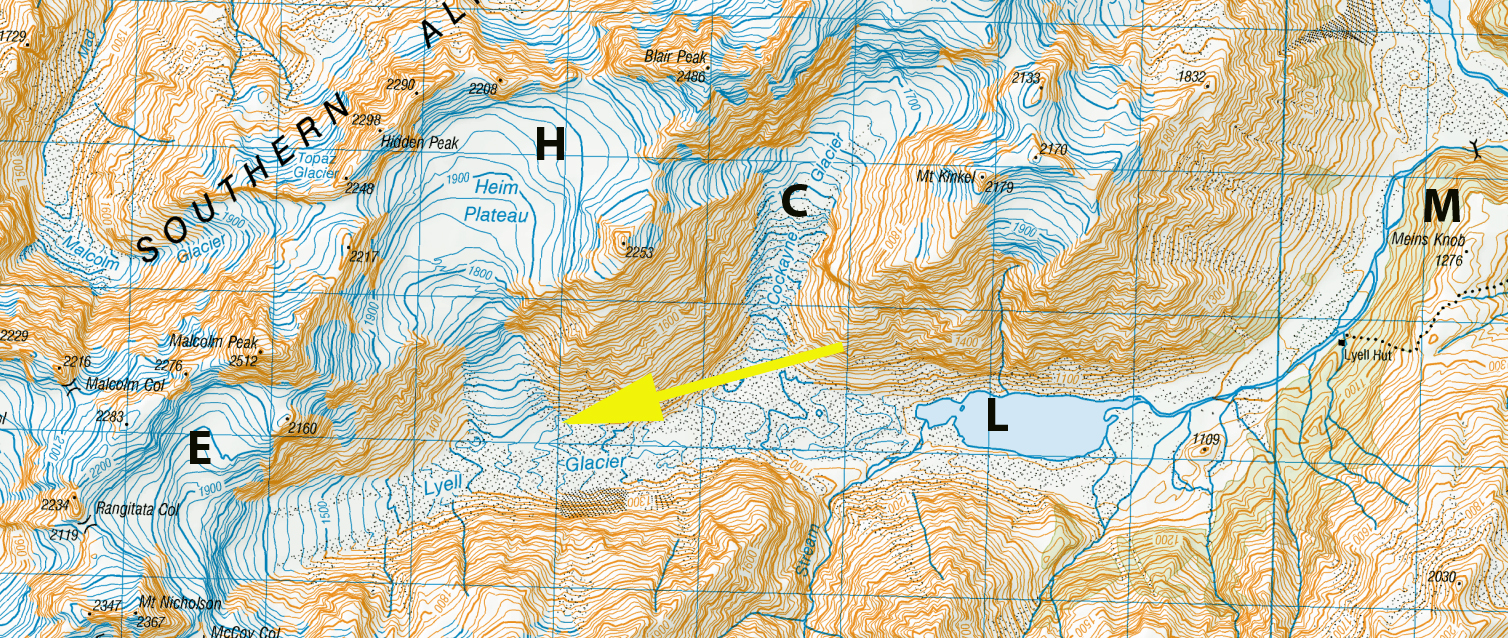
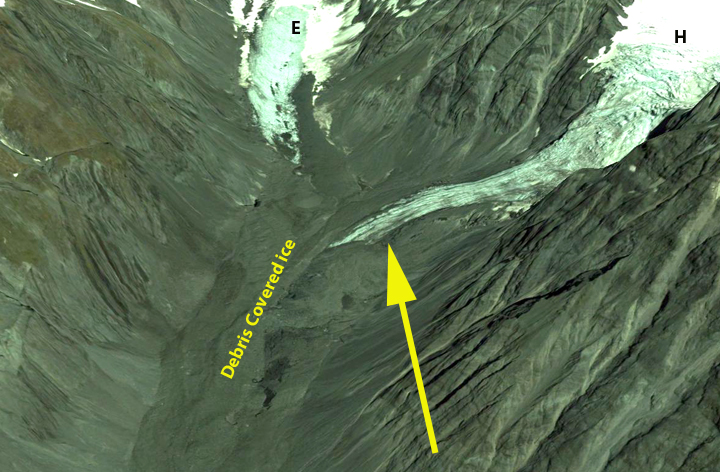
The Lyell and Ramsay Glaciers are the northernmost substantial valley glaciers in the Southern Alps of New Zealand. Their combined run-off is the chief source of the Rakaia River. The Lyell glacier was first observed by Dr.von Haast in 1862, from Mein’s Knob (M), at the time the glacier was 9 km long and ended close to Mein’s Knob. In 1949 Lyell glacier extended east from Rangiata Col some 7 km, and Lyell Lake (L) had not yet formed. (Gage, 1951). The Lyell Glacier has been the combined flow from the easterly tributary near Rangiata Col (E) and a northern tributary, Heim Plateau (H). Here we examine Google Earth Imagery and Landsat images from 2000-2013 to identify changes in the Lyell-Heim Glacier complex. lyell map

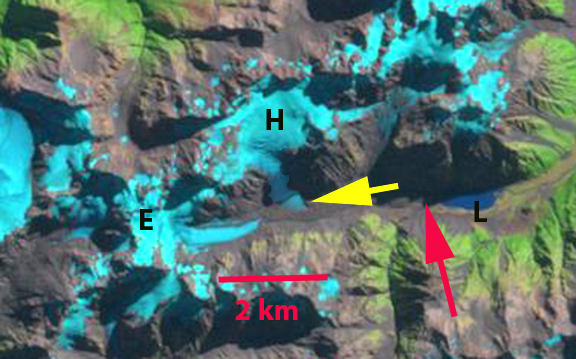
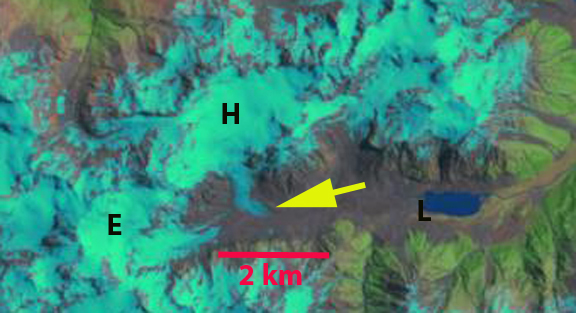
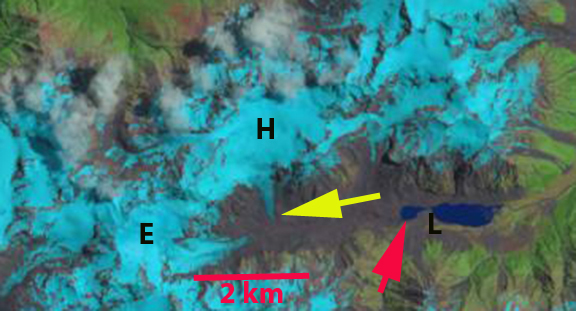
In 2000 the Heim Glacier (H) reached onto the Lyell Lake valley floor, yellow arrow. In 2001 this is evident along with the fact that Lyell Lake is a single lake. The terminus of the Lyell Glacier is obscured by thick glacier cover, and does end near Lyell Lake at the time, the end of the blue ice of the E tributary is not indicative of the terminus location. By 2013 Heim Glacier has retreated from the Lyell Valley and no longer is connected to the Lyell Glacier. A second small lake has formed as the terminus of Lyell Glacier has melted and retreated, red arrow. The terminus of Lyell Glacier does remain buried by debris, but it is stagnant and melting away. Both the Lyell Glacier and Heim Glacier have retreated 400 m from 2000-2013. The Lyell Glacier will likely experience a more rapid retreat in the near future as the debris covered tongue melts away. The 2013 austral winter featured record warmth, and the early melt season has also been warm in New Zealand, the impact on this glacier can be assessed in March or April as the melt season ends. The NIWA snowline surveys will document the impact on glaciers across New Zealand. The glaciers of New Zealand lost 15% of thier volume from 1976-2008 (Chinn et al, 2012). The retreat is like that of most all New Zealand glaciers today, Donne Glacier, Gunn Glacier, Tasman and Murchison Glacier

lyell glacier 2000
2000 Landsat image

lyell galcier 2001
2001 Landsat image

lyell glacier 2013a
2013 Landsat image

lyell glacier 2013
Landsat image 2013

lyell glacier ge
Google Earth image

lyell terminus
Google earth image of terminus