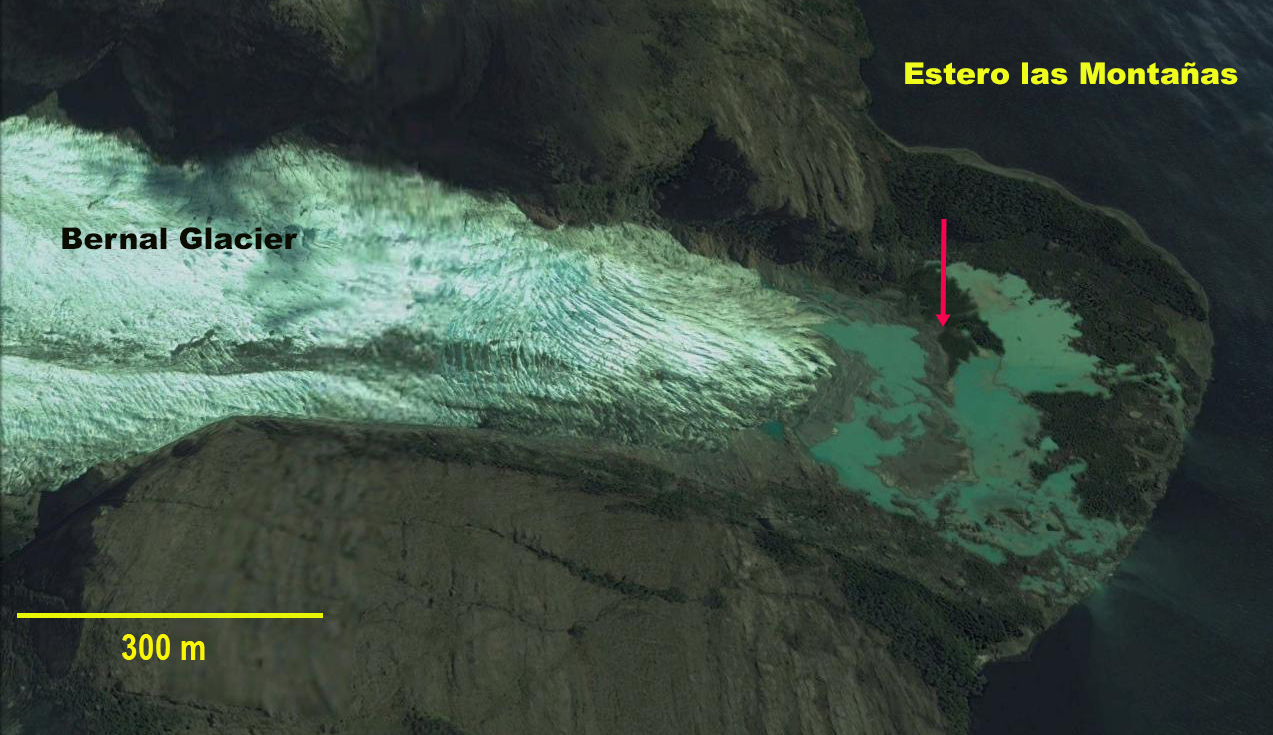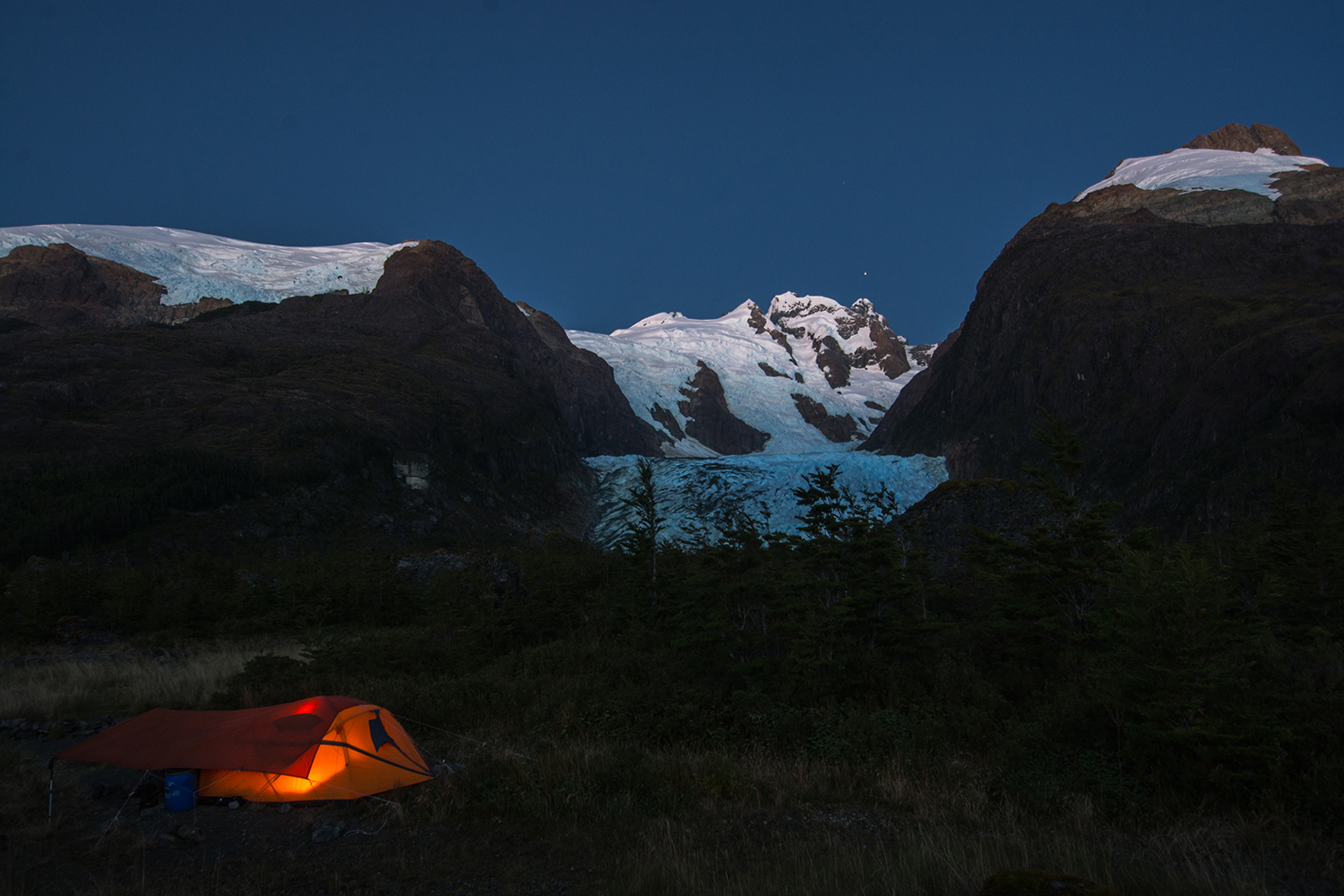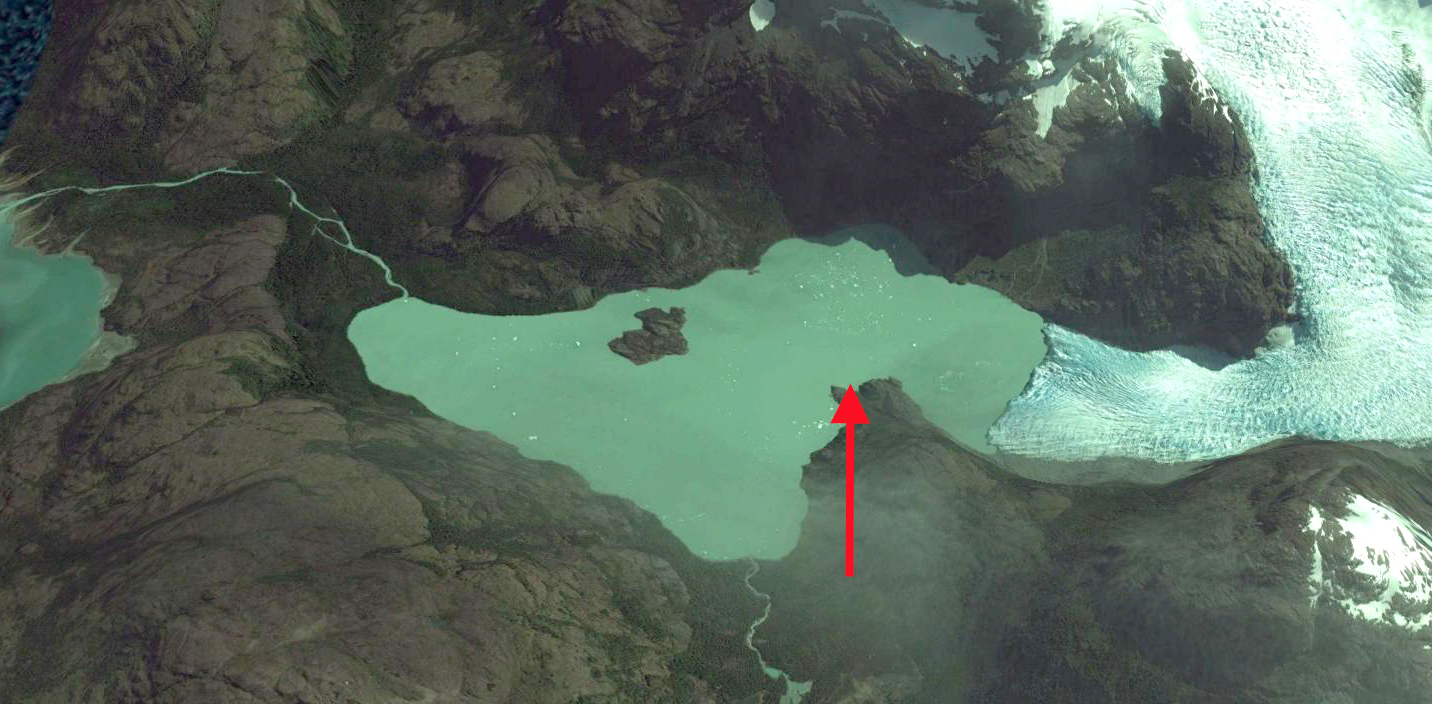
RG150-17.01019 Glacier Retreat, Southern Patagonia Forms Lake


peel-landsat-compare

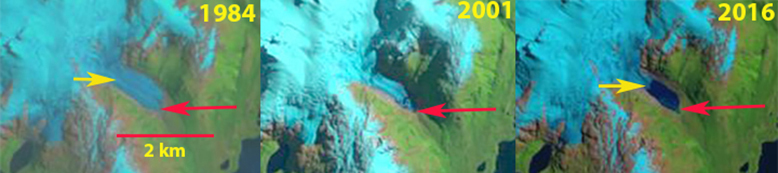
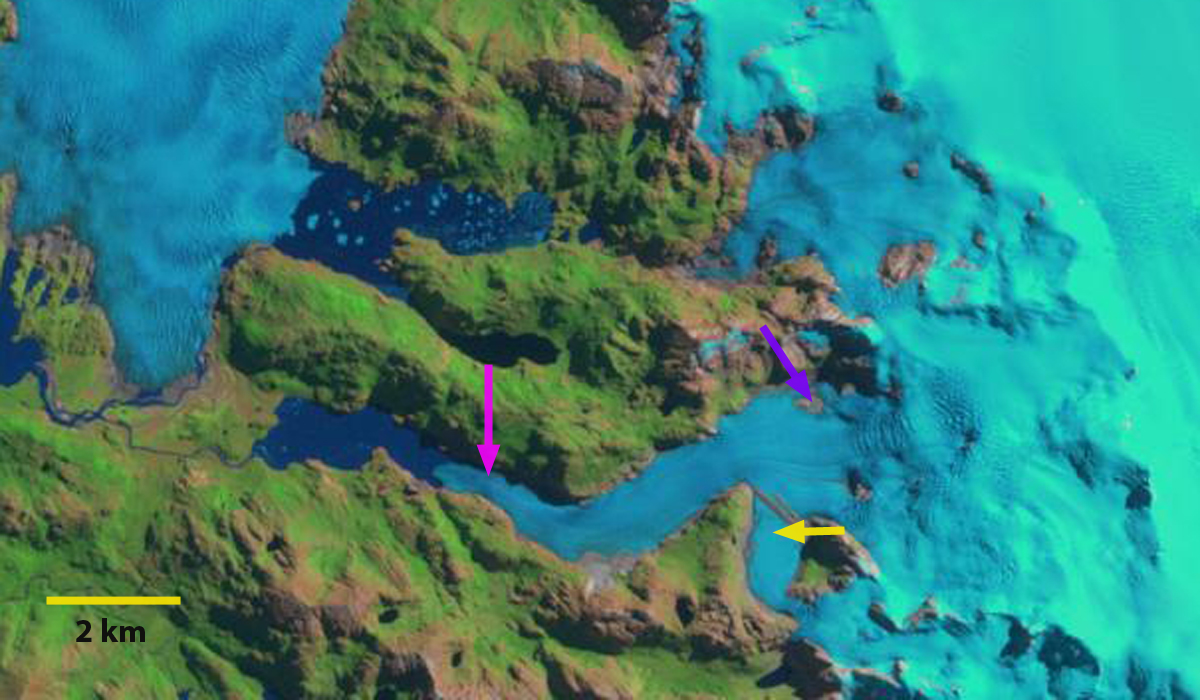
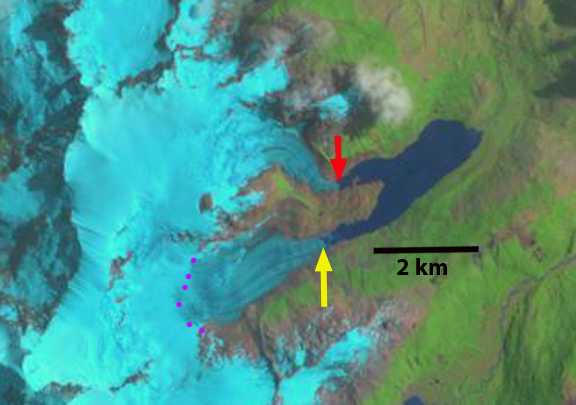
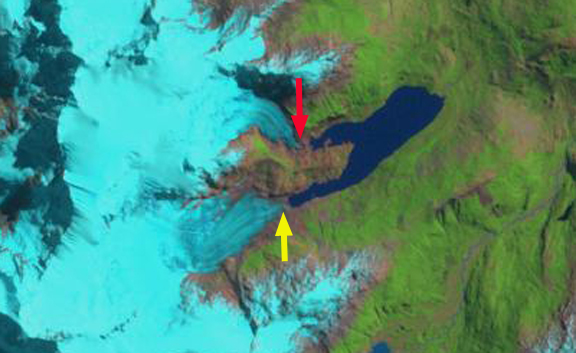
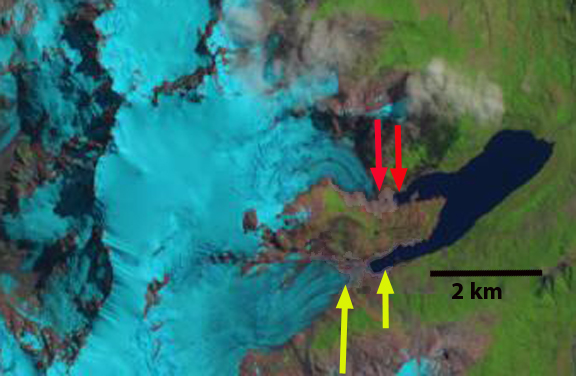
Retreat of RG150 indicated in Landsat images from 1984, 2001 and 2015.  Red arrow indicates 1984 terminus and yellow arrow 2015 terminus. 

RG150 is a 3.5 km long glacier in Bernardo O’Higgins National Park on the western edge of the Southern Patagonia Icefield, Chile.  RG150 is an unnamed glacier given this designation as part of the Randolph Glacier Inventory.  The glacier terminates in a lake that drains into Seno Andrew.  Willis et al (2012) observed that between February 2000 and March 2012 that the Southern Patagonia Icefield is rapidly losing volume and that thinning extends even to high elevations.  The mass balance loss is occurring at a rate of −20.0 ± Gt/year, which is +0.055 mm/year of sea level rise. The retreat has been driven by increasing calving rates from the 1975-2000 to the 2000-10 period (Schaefer et al, 2015). The pattern of retreat is consistent between these glaciers and the region as noted by Davies and Glasser (2012), annual rates of shrinkage in the Patagonian Andes increased in from 0.10% year from 1870-1986, 0.14% year from 1986-2001, and 0.22% year from 2001-2011. Davies and Glasser (2012), note the all the glaciers in the complex inclusive of RG150 had their fastest retreat period from 2001-2015. Glasser et al (2016) observed both an increase in glacier proximal lakes and in debris cover on glaciers with glacier retreat from 1987-2015. These losses have led to retreat such as at Balmaceda Glacier,  Glaciar Marconi and Glacier Onelli.  Here we examine Landsat imagery from 1984 to 2015 to identify glacier change and the formation of a new lake.

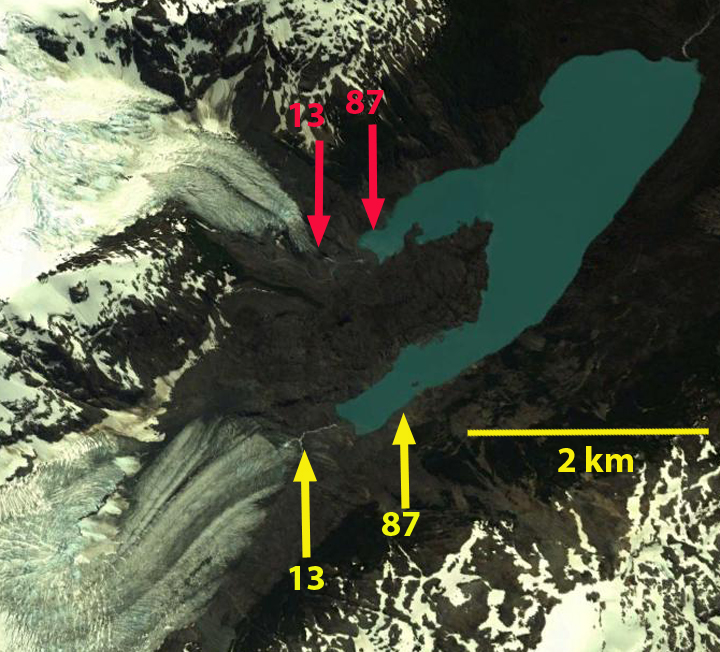
In 1984 there was no glacier lake at the terminus, with the lower 1 km of the glacier being a low sloped glacier tongue.  By 2001 a small proglacial lake had developed 250-300 m long.  In 2005 the glacier retreat had led to continued lake expansion.  The glacier had filled the lake with numerous small icebergs.  By 2015 the glacier still terminates in the proglacial lake that is not 850-900 m long.   The glacier retreat of 850 m since 1984 is 20-25% of the total glacier length.  The low slope region is minimal in length in 2015 indicating the lake basin is almost complete.  This will lead to a reduced rate of retreat.  This is a very cloudy region, and the images here are not at the end of the melt season.  Hence, the equilibrium line altitude can be ascertained.  At the crest of the glacier 1300 m, there are a number of wind sculpted features that are 400-600 m long, attesting to the strong westerly winds in the region. RG150 has significant retained accumulation each year and can survive the current climate.

peel-ge-compare

Retreat of RG150 indicated in Google Earth images from 2005 and 2015.  Red arrow indicates 1984 terminus and purple arrows indicate wind features at the top of the glacier.

peel-oblique

RG150  in Google Earth image looking upglacier in 2015.  Red arrow indicates 1984 terminus and yellow arrow 2015 terminus and purple arrows indicate wind features at the top of the glacier.

Bernardo Glacier, Patagonia, Chile Accelerated Retreat in Expanding Lake Complex

bernardo compare

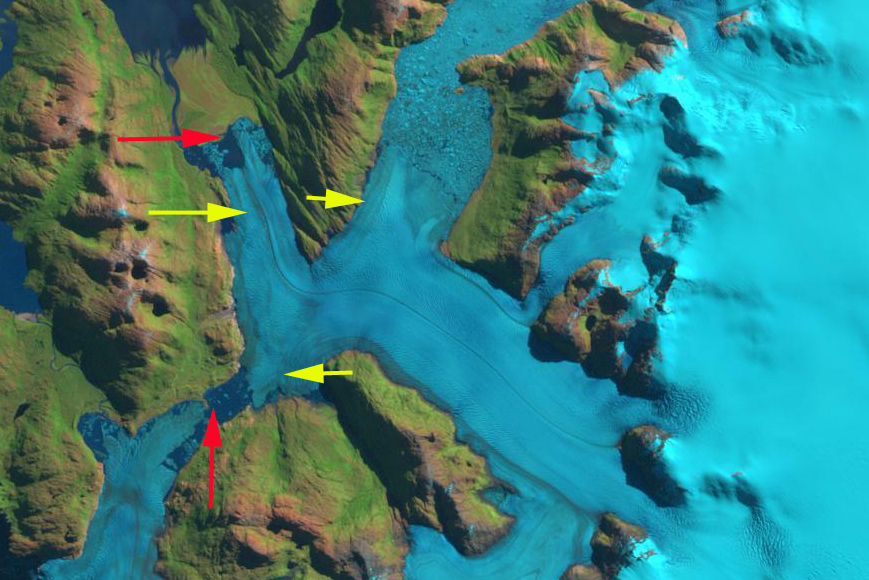
Comparison of 1986 and 2015 Landsat image of Bernardo Glaciers three termini, north, main and south. Red arrows indicate 1986 terminus location and yellow arrows the 2016 terminus location.  Indicating the substantial retreat of each terminus and lake expansion for the north and main terminus, while the lake drained at the southern terminus. 

Bernardo Glacier is a difficult to reach outlet glacier on the west side of the Southern Patagonia Icefield (SPI).  It The glacier currently ends in an expanding proglacial lake system, with three primary termini.  Here we examine changes from 1986 to 2016 using Landsat images. Willis et a (2012) quantify a rapid volume loss of the SPI from 2000-2012 of 20 giga tons per year mainly from rapid retreat of outlet glaciers. They note a thinning rate of 3.4 meters per year during this period of the Bernardo Glacier region. Mouginot and Rignot (2014) illustrate that velocity remains high from the terminus to the accumulation zone on Bernardo Glacier.  They also indicate the accumulation zone does not extend as far east toward the crest of the SPI as previously mapped. Davies and Glasser (2012) indicate that over the last century the most rapid retreat was from 2000 to 2011.

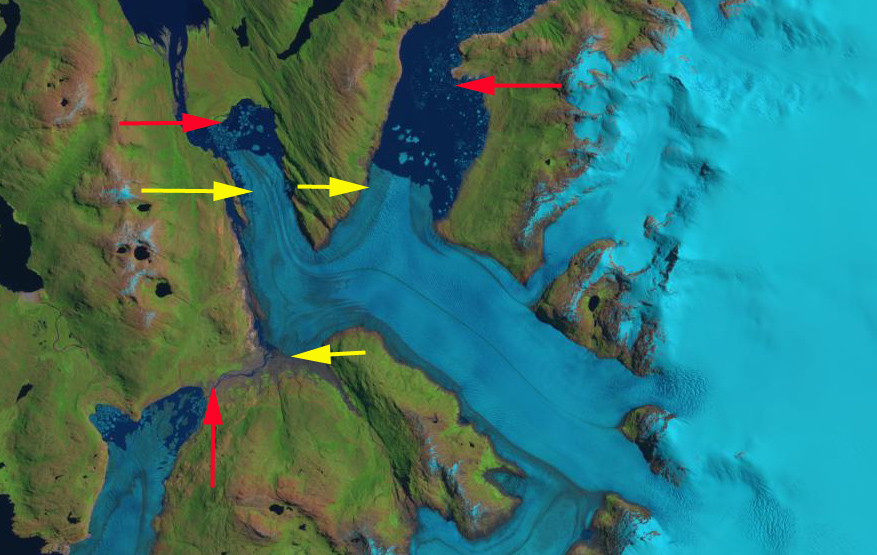
In 1986 Bernardo the southern terminus of the glacier was nearly in contact with Tempano Glacier.  The main terminus primarily ended on an outwash plain with a small proglacial lake developing.  The northern terminus had retreated a short distance south from a peninsula.  By 1998 the northern terminus had retreated into a wider, deeper lake basin, filled with icebergs. The main terminus is still mainly grounded on an outwash plain.  A small lake has developed between Bernardo Glacier and Tempano Glacier to the south. By 2003 the northern terminus had retreated 2 km from 1986, the main terminus 1.5 km and the southern terminus 1.2 km.  By 2015 the lake between Tempano and Bernardo Glacier had drained.  The main terminus had retreated 1.5 km since 1986.  In 2016 the northern terminus had retreated 3.5 km since 1986, the main terminus 2.5 km and the southern terminus 2.75 km.  The largest change is the loss of the lake between Tempano and Bernardo Glacier which slow the retreat of the southern terminus. If this terminus retreat into the another lake basin that shared with the main and north terminus, this would likely destabilize the entire confluence region.  The nearly 1 km retreat in a single year from 2015 to 2016 of the main terminus indicates the instability that will lead to further calving enhanced retreat. The retreat of this glacier fits the overall pattern of the SPI outlet glaciers, for example Chico Glacier and Lago Onelli Glaciers

.bernardo 1998

1998 Landsat image.  Red arrows indicate 1986 terminus location and yellow arrows the 2016 terminus location.

bernardo 2003

2003 Landsat image.  Red arrows indicate 1986 terminus location and yellow arrows the 2016 terminus location.  Main terminus beginning to retreat from outwash plain. 

bernardo 2015

2015 Landsat image.  Red arrows indicate 1986 terminus location and yellow arrows the 2016 terminus location.  Note the considerable difference in main terminus versus one year later in 2016.

Lago Onelli, Argentina trio of Glaciers Retreat and Separate

glacier onelli compare

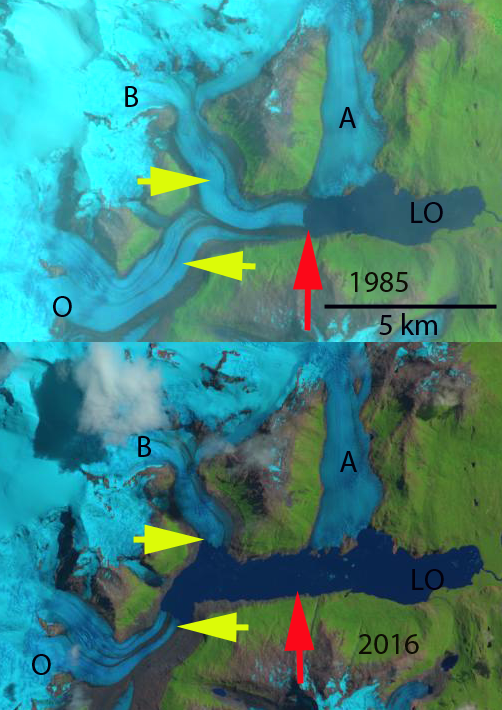
Onelli Glacier (O), Belados Glacier (B) and Agassiz Glacier (A) compared in Landsat images from 1985 to 2016.  The red arrow indicates the 1985 terminus location and yellow arrow is the 2016 terminus location. 

The Onelli Glacier drains eastward from the South Patagonia Icefield (SPI) into Lago Onelli (LO), which then connects to Lago Argentino. Lago Onelli has three main glaciers terminating in the lake Agassiz (A), Onelli(O) and Bolados Glacier (B). Onelli glacier is noted as 13 km long with an area of 84 square kilometers by the Labratorio de Glaciologia in Chile . Davies et al (2012) noted that the most rapid period of retreat since 1890 for Bolado and Onelli Glacier was from 1986-2001.  Warren and Sugden (1993) note an 1800 meter retreat from 1945-1992 for Onelli Glacier and 850 meters for Agassiz Glacier. Eric Shipton was the first to visit this glacier and did so in the company of Ohio State glaciologist John Mercer in 1958. They found Lago Onelli so filled with icebergs that little water could be seen (Shipton, Land of Tempest, 1963). Agassiz and Onelli Glacier were observed to have a shared terminus in 1958 much like Onelli Glacier and Belados Glacier in 1985.

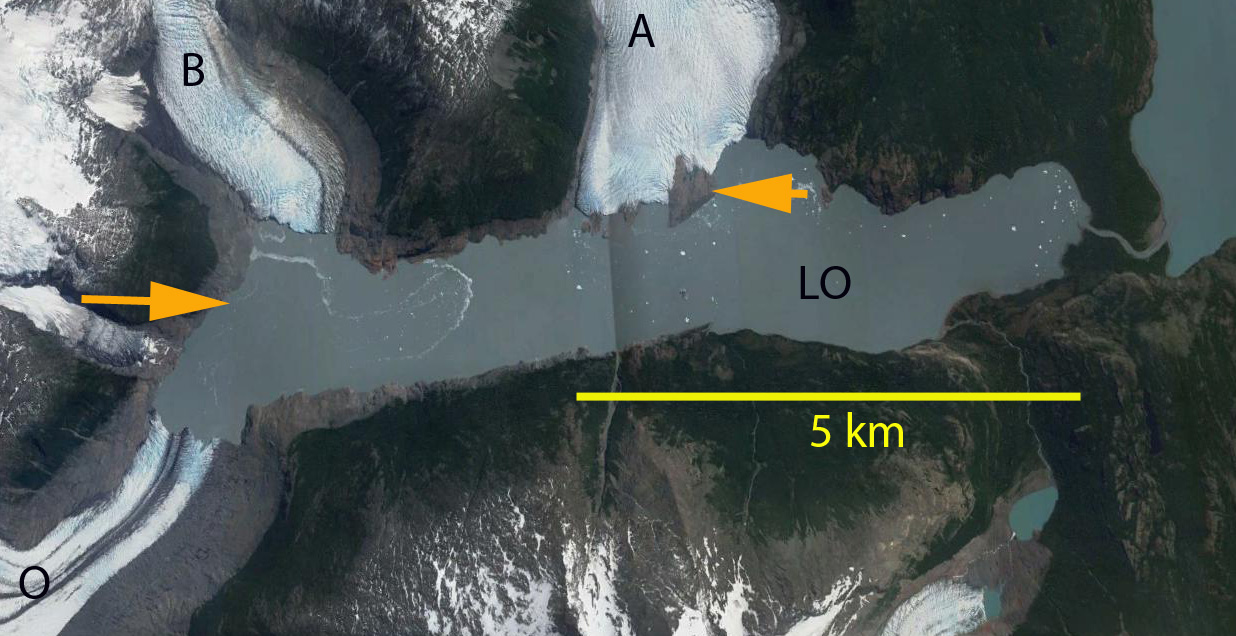
A comparison of Landsat satellite images indicate the separation and retreat of Bolados (B) and Onelli Glacier (O) from 1985-2016. In 1985 the joint terminus cuts directly across Lago Onelli as one reasonably straight 1.6 km wide calving front just short of connecting with Agassiz Glacier. By 2004 the glacier had retreated 3000 m and Belados and Onelli were  barely touching.The combined termini width was 1.8 km. By 2010 the glaciers were separated by 1300 meters. By 2016 Belados Glacier has retreated 3500 m from 1985-2016 and Onelli Glacier has retreated 3800 m. The glaciers in 2016 are separated from each other by 1800 m. The ELA in the satellite images from recent years has been 1300 meters. Agassiz Glacier has retreated 400 m during the 1985-2016 period.  The glacier is grounded on three islands that acts as pinning points, reducing calving losses and the retreat rate.

Willis et al (2012) examined the mass change of the 12,100 km2  SPI  from 2000-2012: in the accumulation zone the average thickness change of −1.1 ± 0.1 m/year, for the ablation zone the average thickness change is −3.5 ± 0.02 m/year.  This widespread loss even in the accumulation zone indicates that retreat will continue.  A comparison of Landsat images from 1998 to 2013 indicates upglacier thinning at the purple arrows. Schaefer et al (2015) noted that the mass loss of SPI has been largely from increased calving losses.  Mouginot and Rignot (2015) observed that Onelli Glacier does not have a high velocity reach extending beyond the immediate terminus zone, unlike major outlet glaciers of the SPI.

glacier onellis 2004 ge

Google Earth image of Onelli Glacier and Belados Glacier in 2004 above and 2015 below.  Orange arrow indicates the 2004 terminus location. 

glacier onelli 2015 ge

glacier onelli1998

Landsat images from 1998 and 2013 indicating specific areas of upglacier thinning at the purple arrows. 

glacier onelli 2013

Balmaceda Glacier Retreat, Chile Releases Island

balmaceda compare

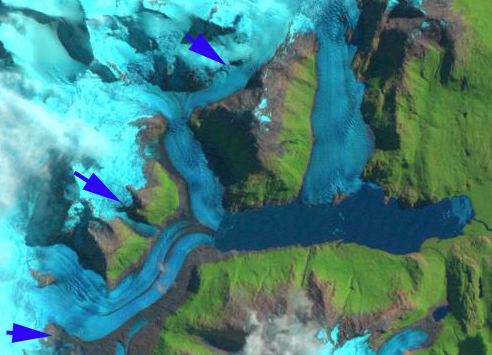
1986 and 2015 Landsat images of the Balmaceda Glacier, Chile region.  Red arrow indicates 1986 ice front, yellow arrow 2015 ice front and purple arrow a tributary that has detached.

Balmaceda Glacier (Felicia Glacier) is at the southeastern end of the Southern Patagonia Ice Cap (SPI) field and drains into the Serrano River.  There is another glacier referred to as Balmaceda  that descends steeply almost to the shores of Fiordo Ultima Esperanza, hence Felicia Glacier will be used here.  Willis et al (2012) observed that between February 2000 and March 2012, indicate that SPI is rapidly losing volume, that thinning extends to the highest elevations.  The mass balance loss is occurring at a rate of −20.0 ± Gt/year, which is +0.055 mm/year of sea level rise. The retreat is driven by increasing calving rates from the 1975-2000 to the 2000-10 period (Schaefer et al, 2015). The pattern of retreat is consistent between these glaciers and the region as noted by Davies and Glasser (2012),  annual rates of shrinkage in the Patagonian Andes increased in  from 0.10% year from 1870-1986, 0.14% year from 1986-2001, and 0.22% year from 2001-2011. These losses have led to retreat such as at Glaciar Marconi and Glacier Onelli

In 1986 the glacier terminated on an island in that acts as pinning point stabilizing the glacier front.  The calving front is over 2.5 km wide. By 2000 Landsat imagery indicates the glacier has retreated from the island with the greatest retreat on the north side.  By 2013 the glacier has receded into a narrow western arm of the lake, the snowline is at 600 m. By 2015 a southern tributary has separated from the main glacier at the purple arrow. The terminus at the yellow arrow is 1 km from an increase in surface slope indicating a rise in bedrock that may be the inland margin of the lake. The retreat from 1986 to 2015 is 2100 m and the current calving front is 1.2 km wide.  The snowline in 2015 is at 1000 m is quite high.  De Angelis (2014) notes the ELA for this glacier at 690 m.  Above the snowline the linear wind sculpted features oriented west to east indicate the ferocious winds of the region Schaefer et al (2015) note the exceptional accumulation rates in the region

The Balmaceda Glacier drains into the Serrano River, the headwaters being Del Toro Lake on the southern boundary of Torres del Paine National Park.  The river is home to numerous giant Chinook salmon which can weigh up to 35 kg with fishing season from June to December.  Chinook salmon have just recently started populating rivers in Chile and Argentina. Fish hatcheries in southern Chile release thousands of Chinook smolts. The introduced Chinook originate from tributaries of the Columbia River of Washington and Oregon.

balmaceda 2000

2000 Landsat Image

balmaceda 2013

2013 landsat image

balmaceda 2015

2015 Landsat image the purple dots are the snowline which at 1100 m is quite high.  Also note the long wind drift features extending west to east above the snowline.


Fraenkel Glacier Retreat, Patagonia, Chile

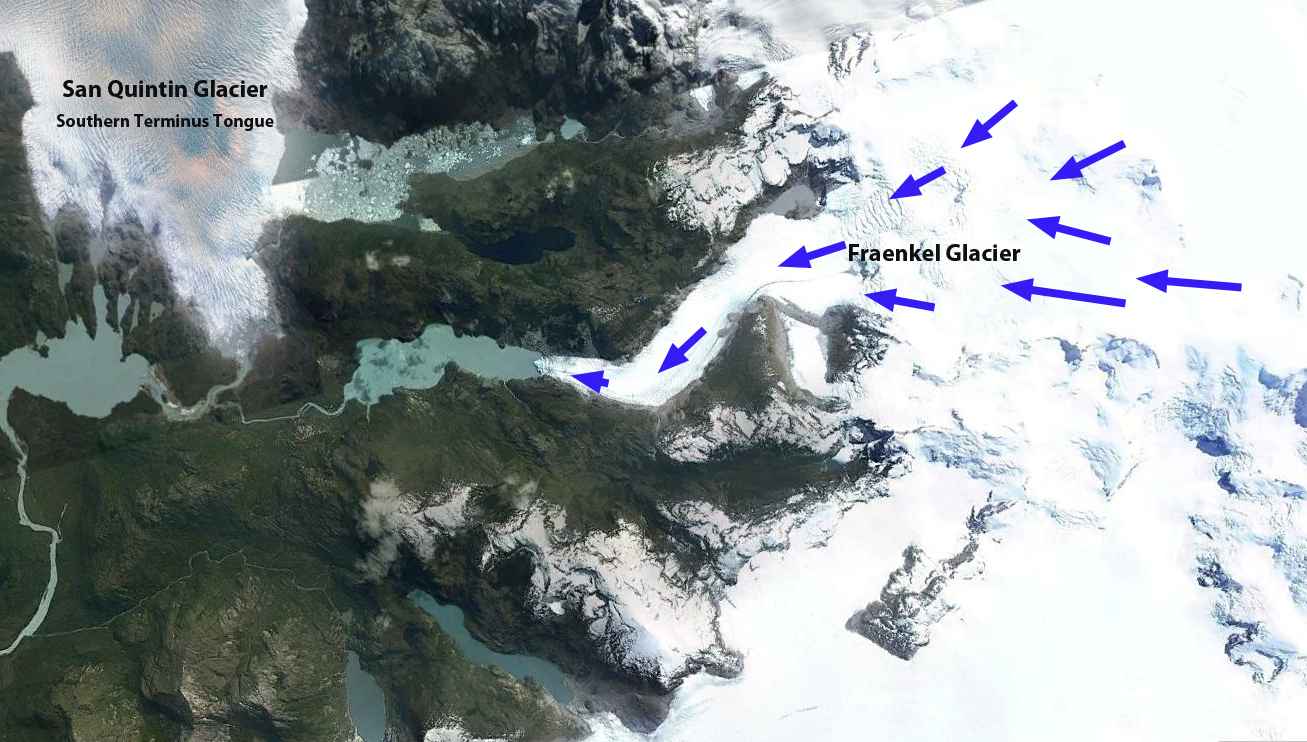
Fraenkel Glacier drains the west side of the Northern Patagonia Ice Cap (NPI) just south of Glaciar San Quintin. The retreat of this glacier in the last 30 years mirrors that of Gualas and Reichert Glacier, which also terminate in an expanding proglacial lake.   Davies and Glasser (2012) work, had an excellent Figure indicating two periods of fastest recession since 1870, are 1975-1986 and 2001-2011 for NPI glaciers.  They noted the loss was 0.07% from 1870-1986, 0.14% annually from 1986-2001 and 0.22% annually from 2001-2011. Willis et al (2011) observed that the thinning rate of NPI glaciers below the equilibrium line has increased substantially from 2000-2012. On Fraenkel Glacier they observed a 2.4 m per year thinning in the ablation zone. Here we examine the changes in this glacier from 1987 to 2015 using Landsat Image.

fraenkel ge

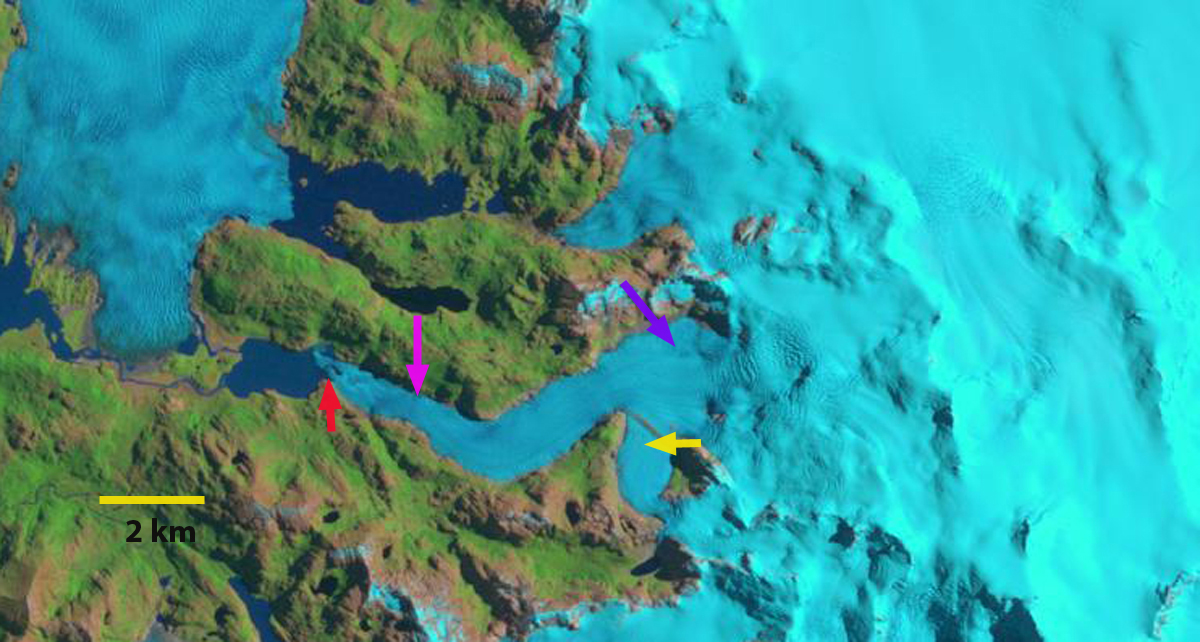
In 1987 the glacier terminus was at the end of a peninsula red arrow and the proglacial lake it terminates in is 2 km long. There is a medial moraine on the glacier at the yellow arrow and the glacier covers the terrain below an icefall at the purple arrow. By 2000 at the purple arrow bedrock is appearing from the base of the glacier. The medial moraine at yellow arrow is little changed. The terminus has retreated 800 m. By 2015 the area around the purple arrow has been deglaciated emphasizing the amount of thinning in the ablation zone even well upglacier of the terminus. At the yellow arrow the medial moraine has been replaced by a wide rock rib separating the glacier from a former tributary. The main terminus is at the pink arrow, indicating a retreat of 1.4 km since 1987. The retreat rate of 50 meters per years though large is less than on Reichert Glacier or Gualas Glacier.  Mouginot and Rignot (2014) observe that Fraenkel Glacier does not have the high velocity of the neighboring Benito and San Quintin Glacier or the Gualas and Reichert Glacier, this leads to the potential for greater mass loss of the ablation zone and even faster retreat.

fraenkel Glacier 1987
Fraenkel Glacier Landsat Image 1987
fraenkel glacier 2000
Fraenkel Glacier Landsat Image 2000

fraenkel glacier 2015
Fraenkel Glacier Landsat Image 2015

North Leones Glacier Retreat and new Landslide, Patagonia, Chile

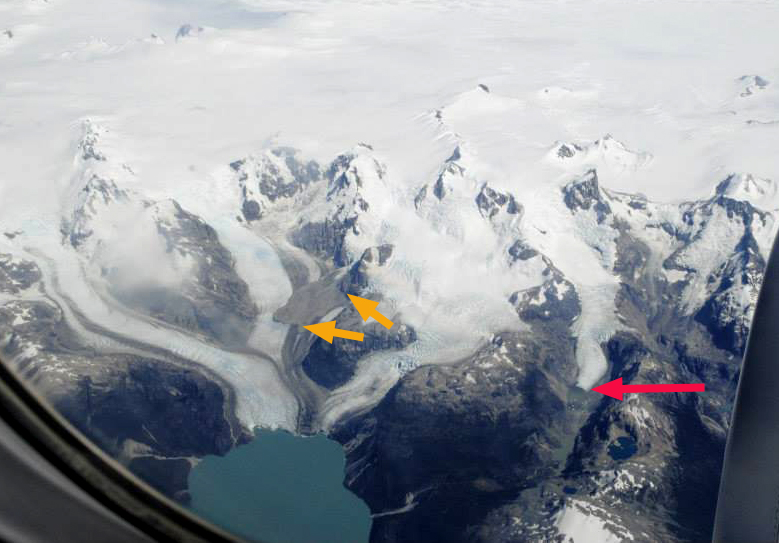
Jill Pelto, my daughter returning from fieldwork with UMaine in the Falkland Island took a picture last week out the plane window of Leones Glacier of the northern Patagonia Icefield. The picture illustrated two changes worth further examination, and the fact that if you have a glacier picture that you would like more information on let me know. The picture indicates outlet glaciers of the Northern Patagonia icefield fed by the snowcovered expanse.  Also evident is a large landslide that is both fresh and that I knew had not been there before, orange arrow,and it showed a new lake had formed due to retreat of the glacier north of Leones Glacier, red arrow, hereafter designated North Leones Glacier. The landslide extends 2 km across the glacier and is 3 km from the terminus. Here we use 1985 to 2014 Landsat imagery to identify changes in North Leones Glacier and the landslide appearance.

npi tri glacier
Jill Pelto took this picture on March 13th, 2015

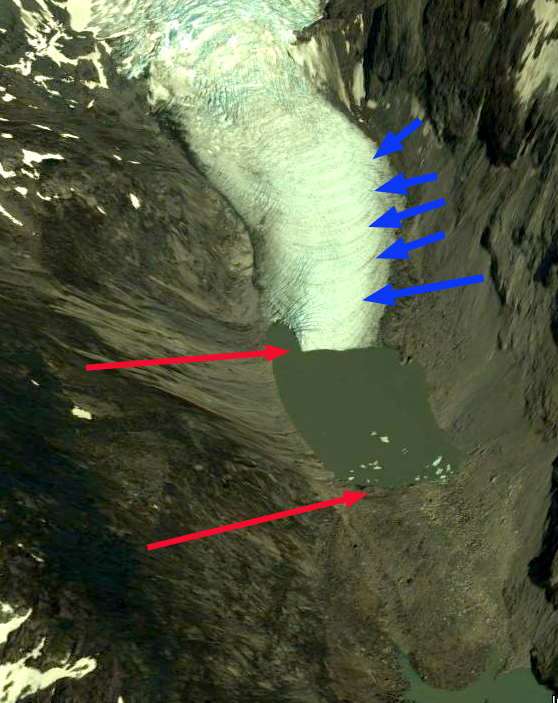
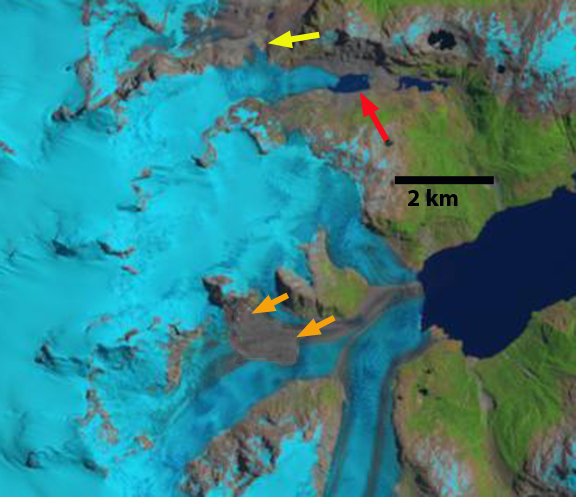
In 1985 there are medial moraines on the glacier surface, but no large landslide deposit. The Northern Leones Glacier terminates on land, red arrow. A distributary terminus almost connects with another glacier to the north at the yellow arrow. In 1987 there is little evident change from 1985. By 2002 a small lake is beginning to form at the terminus of Northern Leones Glacier. By Feb. 2014 a substantial lake has formed at the end of the North Leones Glacier. There is considerable separation between the distributary terminus at the yellow arrow and the next glacier. There is no landslide deposit either. Google Earth imagery indicates the lack of a landslide deposit as well. A closeup of the terminus of North Leones Glacier in 2013, with Google Earth imagery, indicates ogives (blue arrows), which are annually formed due to seasonal velocity changes through an icefall. In January 2015 the landslide deposit is evident, extending about 2 km across Leones Glacier and 3 km from the terminus. The North Leones Glacier has retreated 700 meters from 1985-2015. The retreat of the distributary terminus indicates thinning upglacier of the icefall on North Leones Glacier. The landslide adds mass to Leones Glacier, which will lead to a velocity increase. The debris is thick enough to reduce melting in this portion of the ablation zone. The velocity of this glacier is indicated by (Mouginot and Rignot, 2015) as 200-400 meters per year, indicating that for the next decade at least this landslide will impact the lower Leones Glacier. (Willis et al, 2012) identify thinning of the Leones Glacier area around 1 m per year, which will be reduced on the landslide arm of the glacier.
(Davies and Glasser, 2012), indicate that this region experienced increased area loss from 1986-2011.  Lago Leones feeds the Leones River which is also fed by the retreating General Lago Carerra Glacier.

leones glacier 1985
Landsat image 1985

leones glacier 1987
Landsat image 1987

leones galcier 2002
Landsat image 2002

leones glacier 2014
Landsat image 2014

leones north ge
Google Earth Image 2010

leones landslide
Google Earth image 2013

Leones Glacier 2015
Landsat image 2015

Cordillera Lago General Carrera Glacier Retreat, Chile

You know southern Chile has lots of glaciers when an icefield with an area of 132 square kilometers has no named glaciers.  Davies and Glasser (2012) referred to this icefield as Cordillera Lago General Carrera, since it drains into that lake, the icefield is just east of the Northern Patagonia Icefield.   Davies and Glasser (2012)  noted that the icefield has a mean elevation of 1670 m and has declined from an area of 190 square kilometers in 1870, to 139 square kilometers in 1986, and 132 square kilometers in 2011.  They further noted that the area loss of Patagonia glaciers has been most rapid from 2001 to 2011.  Paul and Molg (2014) observed a more rapid retreat of 25% total area lost from glaciers in northern Patagonia from 1985-2011, the study area was north of the Northern Patagonia Icefield. Lago General Carrera drains into the Baker River, which is fed by most glaciers on the east side of the Northern Patagonia Icefield.  This river had a series of proposed hydropower projects that have now been cancelled by the Chilean government.

clcg

Here we examine Landsat imagery from 1987 to 2014 to identify the changes in a pair of outlet glaciers that drain the eastern side of the icefield, images below. In 1987 both outlet glaciers terminated in an unnamed lake that drains into the Leones River. The southern glacier is 5.5 km long beginning at 2400 m and terminates at the yellow arrow, with the snowline marked by purple dots, in the images below.  The northern glacier is 5.0 km long beginning at 2200 m with the terminus at the red arrow. In 1987 the glaciers were in shallow enough water  that calving was limited and no icebergs are evident. By 2001 both glaciers are no longer terminating in the lake.  The retreat can no longer be enhanced by calving into the lake.  By 2014 both glaciers have retreated several hundred meters from the lake.  It is easier to measure the retreat in the 2013 Google Earth image.  The retreat from the 1987 to 2013 position are indicated by the pair of arrows.  The northern glacier has retreated 400 m and the southern glacier 600 m from 1987 to 2013.  In both cases this is approximately 10% of the glacier length.  The beautiful green color of the lake is indicative of the contribution of glacier flour from actively moving and eroding glaciers.  This glaciers retreat is similar to that of the nearby Nef Glacier and Verde Glacier.

clgc 1987
1987 Landsat image
clgc icefield 2001

2001 Landsat image
clgc 2014

2014 Landsat image

clgc ge 2013
2013 Google Earth image.  With arrows indicating terminus change from 1987 to 2013.

Verde Glacier Retreat, Chile

Verde Glacier is adjacent to Reichert Glacier and drains the north side of the Northern Patagonia Icefield. It is a small glacier compare to many outlet glaciers of the icefield that have been examined in previous posts, Reichert Glacier, Steffen Glacier, Nef Glacier, and Colonia Glacier. Here we examine Landsat imagery during the 1998-2014 period to identify the response of the glacier. The glacier flows from a pair of peaks at 1800 m to terminate at the edge of a proglacial lake. There is a significant icefall at 800-1250 m and a significant avalanche fan at the base of this icefall that is spills from a disconnected portion of the glacier west of the terminus and just northwest of the icefall. Davies and Glasser (2012) Figure 2d indicates the glacier nearly filling the entire lake in 1975. In Figure 8a they indicate the fastest retreat for the glacier being from 1998-2014. Rivera et al (2007) indicate the ELA for the glacier at the top of the icefall 1250 m. npi north ge
The yellow arrow in each image is the 2014 terminus and the red arrow the 1998 terminus. In 1998 the glacier terminates at the red arrow just beyond the northeast bend in the lake. The lake is 1.6 km long. By 2001 the glacier has retreated 300 m and is at this bend. Notice that the lowest lone kilometer of the glacier is quite debris covered. By 2014 the glacier has retreated to the yellow arrow, this is a further 600 m retreat since 2011. The lake is 2.5 km long measured along its center line. The 900 meter retreat in 16 years is substantial for a glacier that is only 5 km long. A cloe up view of the terminus in a Goggle Earth image indicates that the lowest 300 m is debris coverered ice, notice the wetness of some of the debris, pink arrow. This looks more like ice cored moraine than active glacier ice covered by debris. If this is the case the active terminus is 300 m from the shore of the lake, at the yellow terminus where calving begins. It is certain the lake will expand further as the buried ice melts, but it is nearing its southwestern limit. The steep slope of the icefall and the rock slope to the right of the icefall is evident. This will lead to continued avalanching onto the terminus area, that will make that lowest region above the yellow arrow more difficult to melt out. One observation that is striking is the number of narrow alpine lakes that have formed and expanded as the Northern Patagonia Icefield outlet glaciers have receded. npi n 1998
1998 Landsat image

npi n2001
2001 Landsat image

npi n 2014
2014 Landsat image

verde icefall
Google Earth image

Glaciar Chico Retreat, Patagonia, Chile

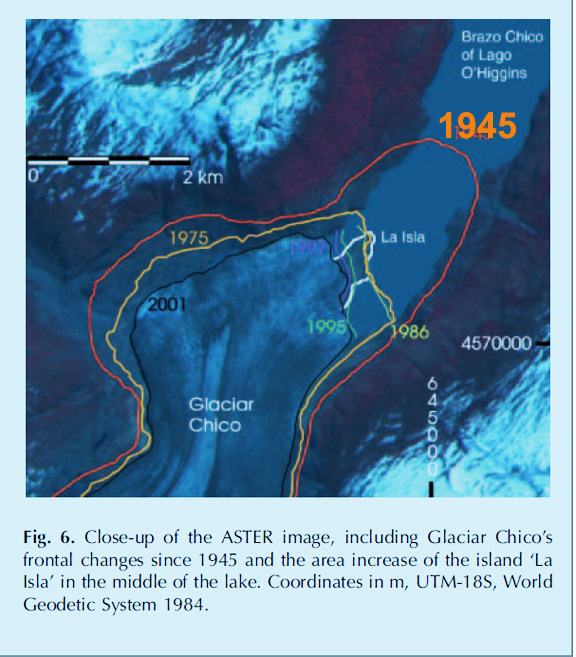
Glaciar Chico drains the east side of the Southern Patagonia Icecap (SPI). Rivera et al (2005) noted that Glaciar Chico had retreated significantly from 1945 to 1976, calving into Brazo Chico, but then retreated slower than most SPI glacier from 1975 to 2001, second image from Rivera et al (2005).

glaciar chico  ge
glaciar chico retreat
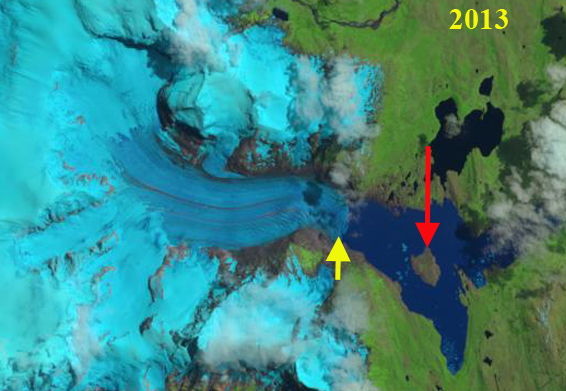
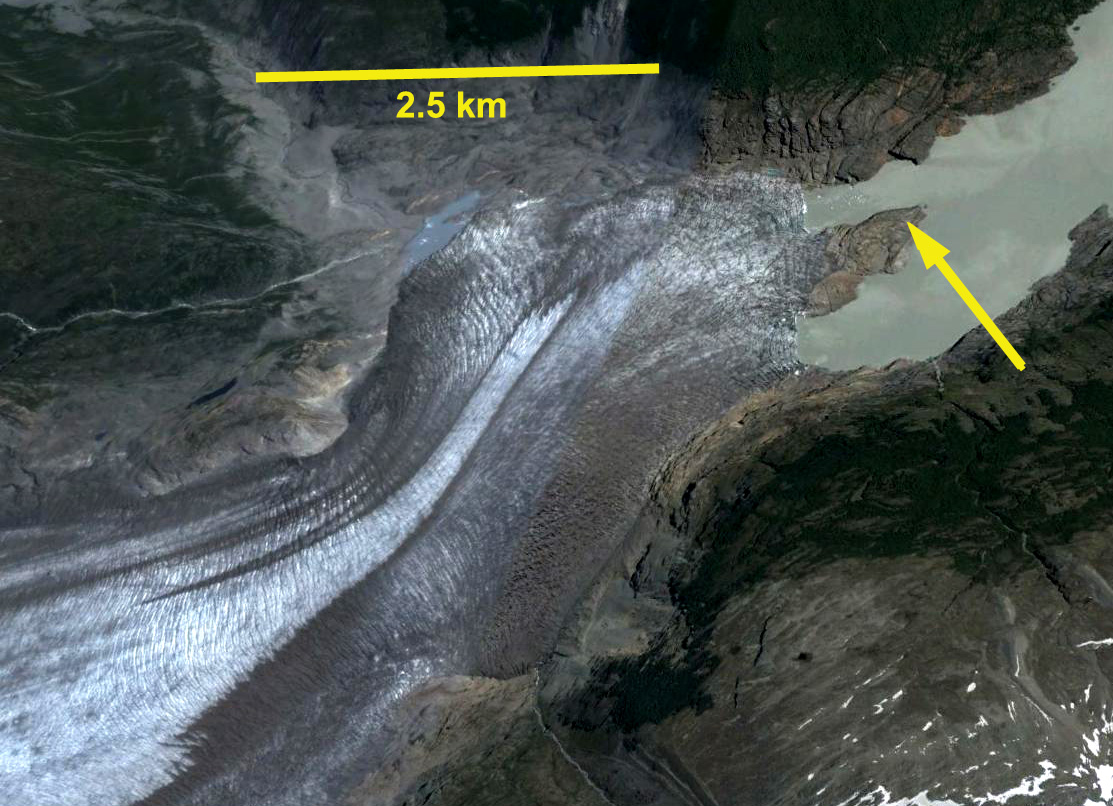
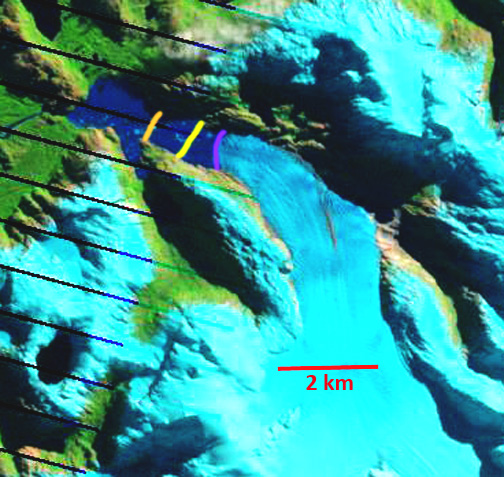
Davies and Glasser (2012). noted that Glaciar Chico’s thinning rates are comparable to other glaciers of the SPI, and the rate of area SPI now shrinking at 20.5 km2 per year. Here we examine Landsat imagery of the glacier from 1986, 1999, 2011 and 2013. In 1986 the glacier terminates near the northern end of a small island in Brazos(Lago) Chico, yellow arrow. A portion of the terminus extends due north to Glacier O’Higgins forming two proglacial lakes, red arrow. The red dot and pink dot indicate the 2013 terminus positions. By 1999 the island is half exposed, a retreat of 600 m. By 2011 the glacier has exposed nearly the full island a retreat of 900 m. The northern margin at the red arrow has also retreated 300 m and the proglacial lakes have now drained. By 2013 at the beginning of the melt season, Glaciar Chico has retreated from the island, and is ending in the lake, though the lake is not likely very deep. The glacier has retreated 1100-1200 meters from its 1986 position. The northern margin has retreated 400-500 meters from its 1986 position. This indicates widespread thinning has continued as Rivera et al (2005) and Davies and Glasser (2012) have indicated would be the case. At the orange arrow 5 km above the terminus the glacier width has decreased by 15-20% from 1986-2013, indicating a continued reduction of flow of ice into the terminus region. The closeup of the terminus from Google Earth indicates a glacier with active crevassing and flow into the terminus region, suggesting that rapid retreat will not ensue. The retreat of this glacier is typical of the other Patagonian glaciers as Davies and Glasser (2012) have so well documented. Examples of the retreat include Onelli Glacier, Jorge Montt Glacier, and Glaciar Steffenchico 1986
1986 Landsat image

glaciar chico 1999
1999 Landsat image

glaciar chico 2011
2011 Landsat image

glaciar chico 2013
2013 Landsat image

glaciar chico terminus
Google Earth terminus closeup

Glacier Noroeste Retreat, Gran Campo Nevado, Chile

The Gran Campo Nevado (GCN) is the smallest of the four primary Patagonian Icefields. It is on the Península Muñoz Gamero 200 km to the south of the Southern Patagonia Icefield. The major outlet of this icefield is the Noroeste Glacier. In a recent paper examining the changes in Patagonia glacier from 1870-2010 (Davies and Glasser, 2012), observed that the Gran Campo Nevado icefield lost of its area from 1870-2010, and 14% of its area from 1986-2011. Davies and Glasser (2012), Aberystwyth University, also documented that 21 of the 31 glaciers of the icefield experienced their most rapid retreat of the last 140 years during the 1986-2010 period. Nororeste Glacier has been a focus in two papers Scheider et al,(2007) and Moller and Schenider (2010). These papers document a retreat of 1100 m from 1986-2002 first image below, they further identify that the glacier area has declined by 4 square kilometer from 1986-2007, and in 2007 was just under 50 square kilometers. Moller and Schenider (2010) develop an areal extent model for the glacier that indicates the glacier will lose a further 15 square kilometers by 2100. The second image is showing the areal extent change from Davies and Glasser (2012), with the red arrow indicating Nororeste Glacier and the yellow the deglaciated area since 1870. Here we examine Landsat imagery from 1999, 2007 and 2012. The 1986 terminus is noted by the orange line, the 2002 margin is a yellow line, the 2007 terminus a purple line and the the 2012 terminus indicated by pink arrows. The retreat from 1986-1999 was 600 meters, from 1999-2007 1050 meters and 2007-2012 250 meters. The overall retreat of 1900 meters from 1986-2012, is 73 meters/year and from 1999-2012 the 1300 meter retreat is 100 meters/year. One other noteworthy change is the thinning and retreat at the northern margin that has led to the drainage of an. ice dammed lake that is present in 1999, red arrow and gone in 2012. The lake had drained by 2007 but that is not evident in the deep shadows of the Landsat image. This glaciers retreat fits the regional patter of glaciers to the north, Joerg Montt Glacier, Colonia Glacier, Glacier Gualas and Alemania Glacier to the south. This also fits the overall pattern of area loss that increased after 1986 and has remained high (Davies and Glasser, 2012) and the ongoing detailed studies of the Chilean Laboratorio de Glaciologia

The retreat is partly due to calving of icebergs into the lake the glacier terminates in, as evident by the icebergs visible in each satellite image above and in the Google Earth image below of icebergs in the lake in 2004.

Jorge Montt Glacier Retreat

The Jorge Montt Glacier is one of the main tidewater glaciers of the Southern Patagonia Icefield. The glacier has been the focus of ongoing annual observations by the Laboratorio de Glaciologia at the Center for Scientific Studies, University of Chile. Two recent papers highlight the dramatic changes this glacier is undergoing. The glacier has retreated 19.5 km from 1898-2011 (Rivera et al, 2012a). A recent photograph of the terminus from Andrés Rivera indicates the extensive crevassing and calving of icebergs indicating the high very high velocities.. The velocities were determined from tracking of salient features for an 11 month period using time lapse photography and indicated a mean velocity of 13 meters/day, with maximum velocities of up to 33 meters/day, in the center of the glacier (Rivera et al, 2012b). These velocities rival the high velocities on the faster Greenland outlet glaciers and San Rafael Glacier, Chile. They did not observed seasonal velocity changes. This paper provides a nice visual of the velocity, top image. The velocity and retreat tend to increase when water depth increases. The mean water depth at the calving front has declined from over 260 m 1997-2003 to closer to 220 m 2003-2011, bottom image indicates the water depths from Rivera et al (2012a). . . A map of the long term retreat of the glacier is provided in both papers, here we examine a closeup view of the lower glacier from Landsat imagery in 1997, 2003 and 2011. The glacier retreat peaked during the 1990-2000 period with 8.5 km of retreat. The lake widened and deepened at the calving front for that period. The yellow arrow indicates the 1997 terminus, burgundy arrow 2003 and orange arrow 2011. The green arrows point the expansion of exposed bedrock areas on the east margin of the glacier from 1997-2011. Retreat from 1997-2003 was 2250 m, 375 m/year. Retreat from 2003-2011 was 2000 meters, 250 m/year. In 2011 an additional nunatak has emerged as the glacier has thinned. The 2011 terminus is near a point where the lake appears it will widen again, the potential depth is hard to assess. The map from Rivera et al (2012a) indicates at least a short term deepening at the ice front, this is at the same point as a modest lake width reduction. . Below is a closeup of the changes 12-14 km upglacier of the terminus indicating the rapid thinning from 2003 to 2011 expanding the bedrock exposed at point B and exposing the new nunatak at Point C. The retreat of this glacier follows the regional pattern observed by the Laboratorio de Glaciologia on other glaciers such as Gualas Glacier, Nef Glacier, Alemania Glacier, Tyndall Glacier and Colonia Glacier.

Onelli Glacier retreat separation, Argentina

The Onelli Glacier drains eastward from the South Patagonia Icefield into Lago Onelli (LO), which then connects to Lago Argentino (LA). Lago Onelli has three main glaciers termininating in the lake Aggassiz (A), Onelli(O)and Bolados Glacier (B). The glacier is noted as 13 km long with an area of 84 square kilometers by the Labratorio de Glaciologia in Chile . Warren and Sugden (1993) note an 1800 meter retreat from 1945-1992 for Onelli Glacier and 850 meters for Agassiz Glacier. Eric Shipton was the first to visit this glacier and did so in the company of Ohio State glaciologist John Mercer in 1958. They found Lago Onelli so filled with icebergs that little water could be seen (Shipton, Land of Tempest, 1963). Agassiz and Onelli Glacier were observed to have a shared terminus much like Onelli Glacier and Belados Glacier in 2003, ion contact but one flowing into the fjord from the north with a steep calving face, and one from the northwest (Onelli) with a gentler slope. The focus for Mercer was the age of the moraines beyond the glacier terminus, for Shipton hiking up onto the icefield to explore potential avenues to the crest of the icefield. The glacier is located on the icefield base map image from the Glaciares of Argenina website. . A comparsion of Landsat satellite images indicate the separation and retreat of Bolados (B) and Onelli Glacier(O) from 2000-2010. In 2000 the joint terminus cuts directly across Lago Onelli as one reasonably straight 1.6 km long. By 2003 the glaciers are barely touching and the combined termini are now long 1.8 km long. BY 2008 the glaciers are separated by 1300 meters. The retreat from the 2000 terminus of Onelli Glacier has been 1500-1800 meters depending where on the ice front the retreat is assessed. Theretreat of the last decade of 160 meter/year is a considerable acceleration over the period from 1945-1990. Belados Glacier has retreated 800 meters. The ELA in the satellite images from recent years has been 1300 meters.