Erasmo Glacier, Chile Terminus Collapse

eerasmo-compare

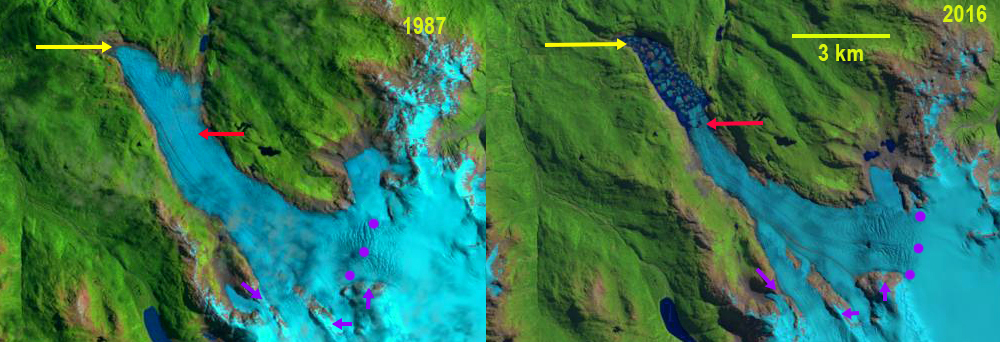
Erasmo Glacier, Chile, comparison in 1987 and 2016 Landsat images.  The red arrow indicates the 2016 terminus and the yellow arrow the 1987 terminus location.  Purple dots indicate the snowline and purple arrows locations of upglacier thinning.

Cerro Erasmo at 46 degrees South latitude is a short distance north of the Northern Patagonia Icefield and is host to a number of glaciers the largest of which flow northwest from the mountain. This is referred to as Erasmo Glacier with an area of ~40 square kilometers.   Meltwater from this glacier enters Cupquelan Fjord, which is host to farmed salmon. This remote location allows Cooke Aquaculture to protect its farm from environmental contamination. Runoff from Erasmo Glacier is a key input to the fjord, while Rio Exploradores large inflow near the fjord mouth limits inflow from the south.  Davies and Glasser (2012) mapped the area of these glaciers and noted a 7% decline in glacier area from 1986-2011 of Cerro Erasmo. The recent retreat of the largest glacier in the Cerro Erasmo massif indicates this area retreat rate has increased since 2011.   Paul and Molg (2014) observed a more rapid retreat in general of 25% total area lost from glaciers in the Palena district of northern Patagonia from 1985-2011, a region at 43-44 south, north of Cerro Erasmo.

In 1987 Erasmo Glacier had a land based terminus at the end of a 6 km long low sloped valley tongue.  The snowline was at 1100 m.  In 1998 there is thinning, but limited retreat and the snowline is at 1250 m.  In 2001 a lake has still not formed and retreat is less than 500 m since 1987. By 2013 a proglacial lake has formed and there are numerous icebergs visible in the lake.  The snowline is at 1200-1250 m in 2013 at the top of the main icefall. In 2015 a large lake has formed and the snowline is at 1200 m again at the top of the icefall.  By 2016 the terminus has retreated 2.9 km since 1987 generating a lake of the same length.  The collapse is ongoing as indicated by large icebergs in the lake.  The snowline in 2016 is at 1200 m at the top of the icefall  The purple arrows indicate locations of expanded bedrock amidst the glacier since 1987.  Each location is above 1000 m indicating upglacier thinning and reduced retained snow accumulation is driving the retreat.  The west most purple arrow indicates where a glacier formerly was joined to the Erasmo Glacier and is now separated. The retreat is consistent with retreat documented at Reichert GlacierHornopirén Glacier and Cord.illera Lago General Carrera Glacier. The rapid retreat will continue until the head of the developing lake basin is reached.

[ngg_images source=”galleries” container_ids=”12″ display_type=”photocrati-nextgen_basic_imagebrowser” ajax_pagination=”1″ template=”/nas/wp/www/sites/blogsorg/wp-content/plugins/nextgen-gallery/products/photocrati_nextgen/modules/ngglegacy/view/imagebrowser-caption.php” order_by=”sortorder” order_direction=”ASC” returns=”included” maximum_entity_count=”500″]

Harris Glacier Retreat, Kenai Fjords, Alaska

harris compare

Landsat images of Harris Glacier from 1986 and 2015.  The red arrow indicates 1986 terminus location, yellow arrow the 2015 terminus position.  The orange arrow indicates a key eastern tributary and the pink arrow a smaller eastern tributary. 

Harris Glacier flows from the northwest corner of the Harding Icefield, Alaska and it drains into Skilak Lake.  The glaciers that drain east toward are in the Kenai Fjords National Park, which has a monitoring program.  Giffen et al (2014) observed the retreat of glaciers in the region. From 1950-2005 all 27 glaciers in the Kenai Icefield region examined  are retreating. Giffen et al (2014) observed that Harris Glacier (A Glacier) retreated 469 m from from 1986-2005.  Here we examine Landsat imagery from 1986-2015 to illustrate the retreat of this glacier and other upglacier changes. The glacier supplies meltwater to Skilak Lake which is a critical salmon habitat for the Kenai. Chinook Salmon spawn on a section of the Kenai River between Kenai Lake and Skilak Lake. With Skilak Lake being the resulting home for ninety percent of the salmon fry for the Kenai River, and with the most of any nursery in the Cook Inlet area. Escapements of chinook in the Kenai River exceed 50,000 annually in two runs (Heard et al 2007).

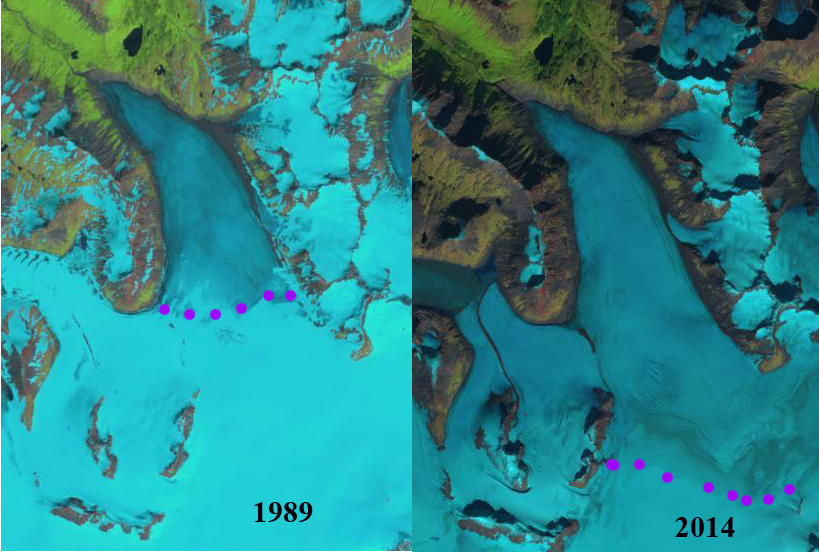
In 1986 the glacier extended to an elevation of 590 m, on the east side of the glacier there were two smaller tributaries reaching the glacier at the orange and pink arrow.  By 2015 the terminus had retreated 600 m from 1986.  The eastern tributary at the pink arrow had detached from the main glacier.  The tributary at the orange arrow still reaches the main glacier, but the blue ice extent after joining the glacier has diminished significantly. Below is a closeup of the terminus from 1996 and 2015 illustrating a 225 m retreat and associated thinning.  It is also interesting to note the prominent ash layer has shifted little.  This suggests the terminus area is relatively stagnant. There is no active crevassing in the lower 1 km suggesting retreat will be ongoing.   In 1989 the snowline is at 975 m whereas in 2014 the snowline is at 1125 m.  This higher snowline is too high to maintain the glacier. The snowline in 2015 was again above 1100 m, though it is lower in the mid-August image at 1050 m. The retreat of this glacier is less than neighboring glaciers such as Grewingk, Pederson and Bear Glacier that have calving termini.

harris snowline

Landsat images from 1989 and 2014, with the snowline indicated by purple dots. 

harris terminus

Terminus of Harris Glacier in Google Earth images from 1996 and 2015.  Margin with purple dot, purple arrow indicates 1996 terminus lcoation, with a 225 m retreat by 2015. Note the prominent ash layer

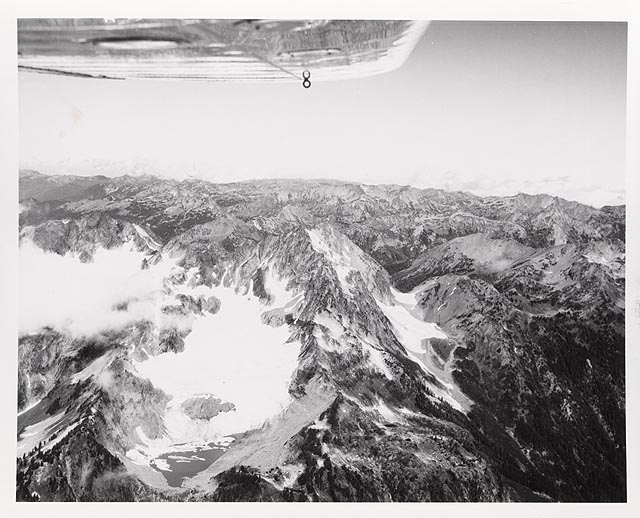
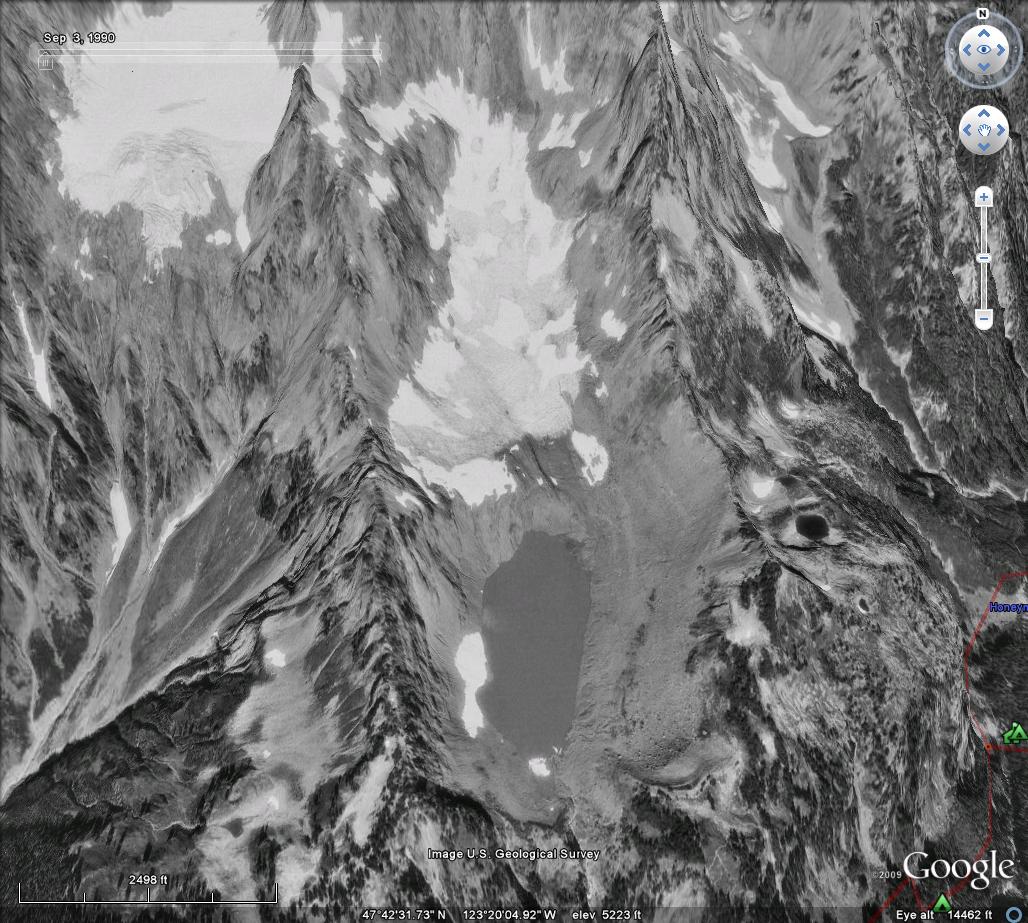
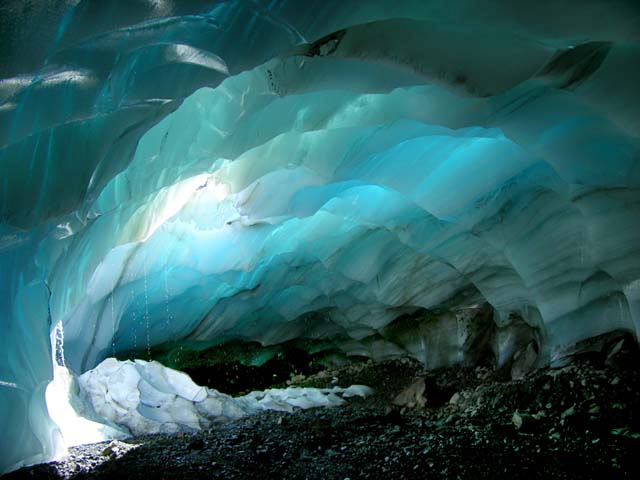
Anderson Glacier Retreat, Middle section exposed

Anderson Glacier is the headwaters of the Quinault River in the Olympic Mountains of Washington. A century ago the glacier was 2 km long, and a half kilometer wide. Retreat of this glacier in the first half of the 20th century exposed a new alpine lake, as the glacier retreated 1 kilometer. From 1950-1980 the glacier diminished slowly. From 1959 to 1990 the glacier thinned and retreated from the lake trapped behind the Little Ice Age moraine. The picture below was given to me by Austin Post. Since 1990 the glacier has begun to shrink rapidly. The USGS aerial photograph of the glacier is from 1990, Anderson Glacier is on the right, West Glacier is to the left. Investigating this glacier in 1992 we measured its area at 0.38 square kilometers, down from 1.15 square kilometers a century before. Ten years later the glacier had diminished to 0.30 square kilometers, but had thinned even more, leaving it poised for a spectacular change, over the next five years. Large outcrops of rock have appeared beginning in 2003 and further exposed in 2005 and 2009 in the middle of the glacier. Note the outcrops in this 2007 image from Kathy Chrestensen The end of the glacier is an avalanche runout area and is thinning slower than most of the lower reach of the glacier. This glacier has become a series of small disconnected relict glacier ice patches. There are some large ice caves that have developed under the glacier. This is an indication of limited flow, and stagnant melting ice. Anderson Glacier is not the only glacier feeding the Quinault River, all the others are retreating as well. The result of glacier retreat is reduced late summer and early fall streamflow, impacting salmon runs at that time of the year. This is primarily the fall Coho, Chum and Chinook salmon and Steelhead summer run. During the spring and early summer runoff increases as snowmelt still occurs, but is not retained in the glacier system.