Hornopirén Glaciers, Chile continue a Spectacular Retreat 1985-2022

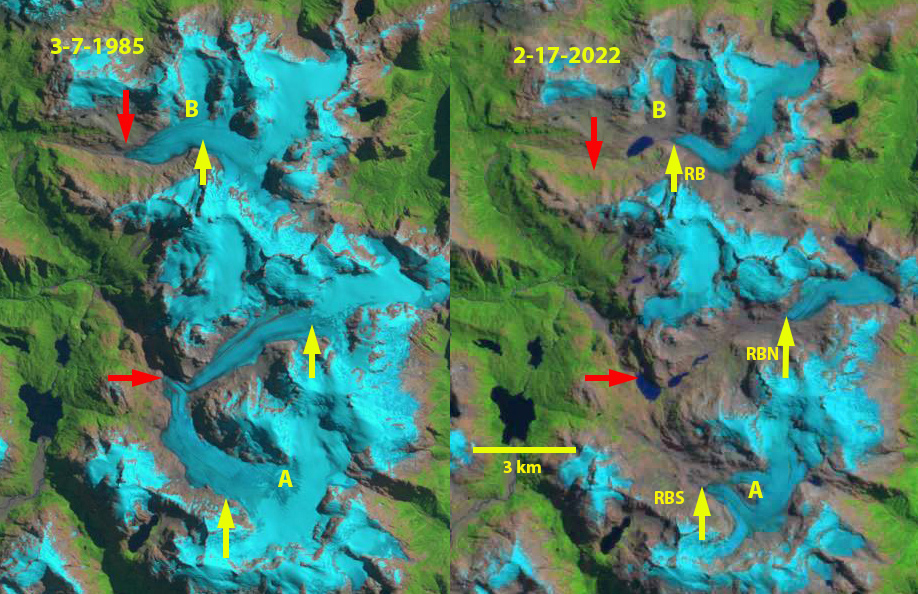
Rio Blanco Glaciers in Hornopirén Naitonal Park, Chile in Landsat 5 and 9 images from 1985 and 2022. Red arrows indicate 1985 terminus position, yellow arrows 2022 terminus position. Point A is an emerging bedrock nunatak and Point B is where tributary separation has occurred.

Hornopirén National Park is in the Los Lagos region of Chile.  The park is host to a number of glaciers that are in rapid retreat.  Davies and Glasser (2012) mapped the area of these glaciers with 113 km2 in 1986 and 96  km2 in 2011.  The retreat of the largest glaciers in the park is spectacular in recent years.Barcaza et al (2017) indicate that Inexplorado glaciers have lost 0.46-0,48 km2 from 2003-2015. Here we examine Landsat imagery to identify changes in three of the larger valley glaciers from 1985-2022.  These glaciers from the headwaters of the Rio Blanco and are designated Inexplorado (RB), Rio Blanco North (RBN), Rio Blanco South (RBS).  Rio Blanco enters the ocean just east of the community of Hornopirén.

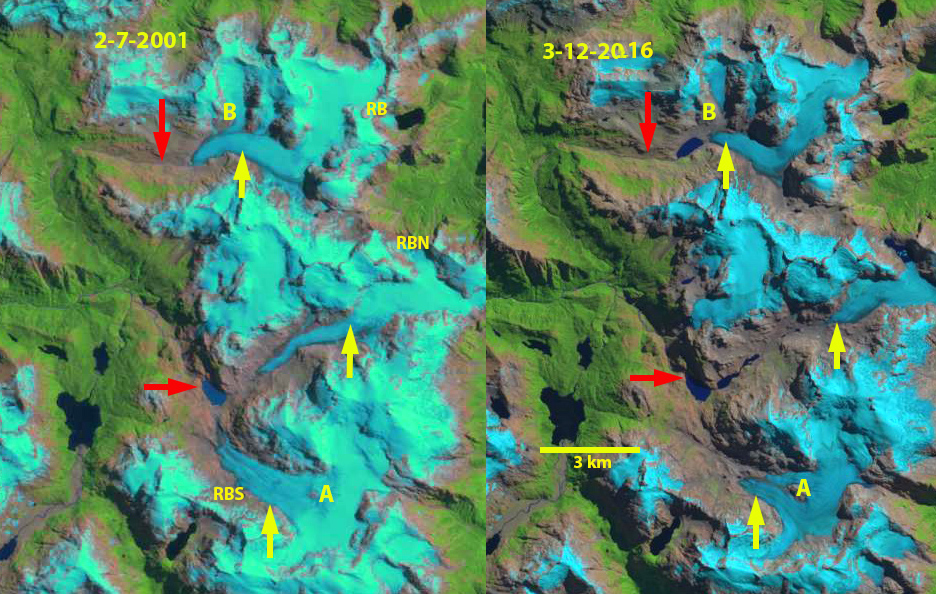
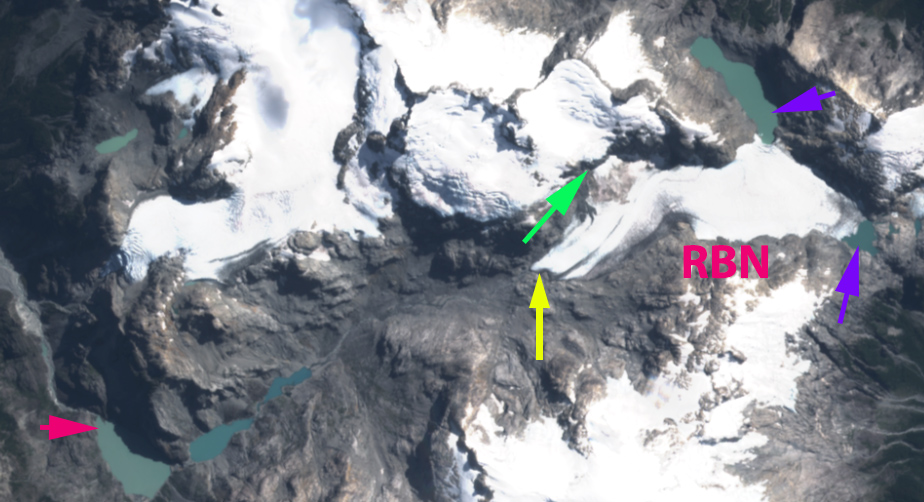
In 1985 the 8 km long RBN and RBS glaciers merged just above the terminus at 820 m, red arrow. In 1985 Inexplorado  (RB) was a 7.5 km long glacier terminating at The snowline was at 1300 m.  By 2001 RBN and RBS had separated by ~1 km with the formation of a new lake at the former terminus. RBS is developing a nunatak at Point A. Inexplorado had retreated 1 km with a proglacial lake just beginning to develop at the terminus, while the northern tributary at Point B is still feeding the main glacier. By 2016 the retreat of RBN has led to the development of  three new alpine lakes in the deglaciated valley.  By 2016 RBS thinning and retreat has led to the Point A nunatak in the lower section of RBS becoming a significant bedrock exposure.  In 2016 The retreat of Inexplorado has led to the formation of a nearly 0.9 km long proglacial lake and the former northern tributary at Point B has separated.  By 2022 RBN has retreated 4.8 km losing 60% of its length since 1985, it has detached from the accumulation and the eastern margin has two lobes now terminating in proglacaial lakes.  RBS has retreated 4 km, losing 45% of its length since 1985. Point A is beginning to merge with terminus and the main terminus is likely retreating into a new lake basin. Both RBS and RBN terminate at ~1200 m. Inexplorado has retreated 2.3 km since 1985, 30% of its length, and is still 5.3 km long, terminating at ~1300 m,  A new lake basin will likely form between the current terminus and the base of the cefall 1.5 km upglacier of the terminus. The snowline in 2015, 2016 and 2022 was at 1600-1700 m.  This leaves only a small percentage of the glacier area above the snowline. The large valley glaciers that just 30 years dominated the headwaters of Rio Blanco have lost ~50% of their length and area and will soon be small slope glaciers clinging to the highest peaks.  Retreat here is more extensive than seen 100 km to the northwest at Calbuco Volcano or to the south at the Quelat Glacier Complex.

Rio Blanco Glaciers in Hornopirén Naitonal Park, Chile in Landsat 7 and 8 images from 2001 and 2016. Red arrows indicate 1985 terminus position, yellow arrows 2022 terminus position. Point A is an emerging bedrock nunatak and Point B is where tributary separation has occurred.

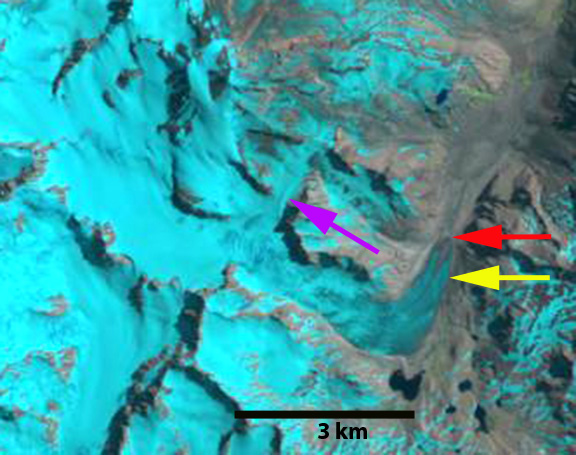
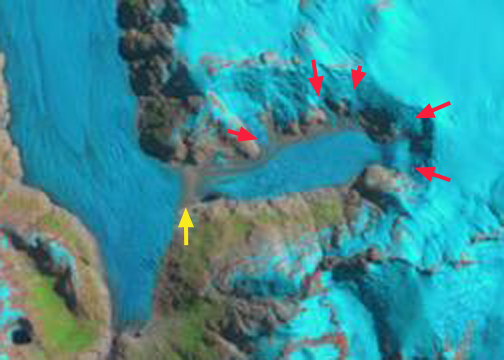
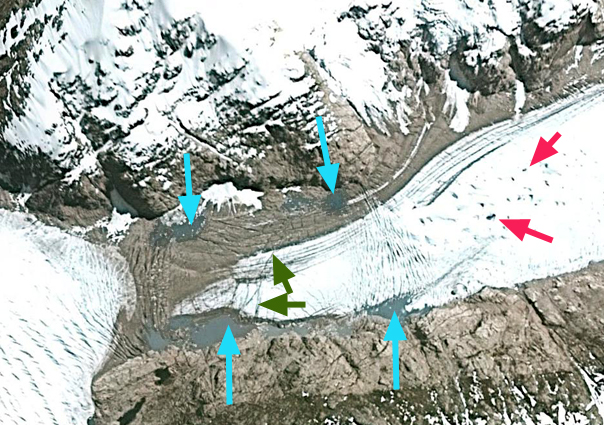
The Rio Blanco North Glacier in March 2022 Sentinel image indicating the two proglacial lakes on eastern margin, purple arrows, the detachment at the green arrow, 1985 terminus locaiton red arrow and 2022 terminus location yellow arrow.

Palomo Glacier, Chile Snow Cover Loss in 2022 and Accelerating Retreat

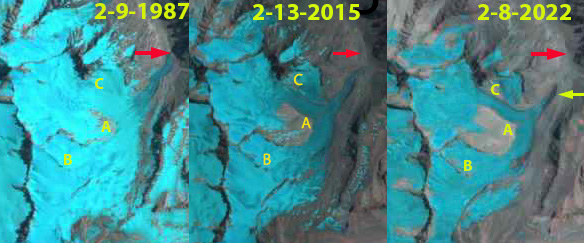
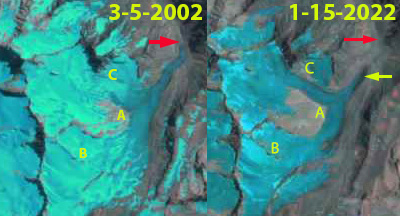
Palomo Glacier, Chile in Landsat 5, 8 and 9 images illustrating retreat from 1987 position, red arrow, and expansion of bare rock areas amidst the glacier at Point A,B and C. Note lack of retained snowcover in 2022.

Palomo Glacier is a large valley glacier in Central Andes of Chile. Adjacent to the Cortaderal Glacier and Universidad Glacier, it flows east from Volcan Paloma (4860 m)  and drains into the Rio Cortaderal. Rio Cortaderal is in the Cachapoal River watershed that supplies two Pacific Hydro projects; a 110 MW run of river project at Chacayes and the 78 MW Coya run of river project a short distance downstream. The glacier is an important water resource from December-March. Bravo et al (2017) quantified this resource for nearby Universidad Glacier that supplied 10-13% of all runoff to the Tinguirica Basin during the melt season. La Quesne et al (2009) reported that Palomo Glacier retreated 1160 m from 1955-1978 and advaned ~50 m from 450 m 1987-2007. They reported that Palomo Glacier had an equilibrium balance durng the 1987-2000 period, which drove the lack of retreat. Here we examine the changes of this glacier from 1987-2022 using Landsat 5, 7, 8 and 9 images, and the unusually high snow lines during the winter of  2022 due largely to a January heat wave (Washington Post, 2022). This is the first post using Landsat 9, that extends this invaluable data record.


In 1987 Palomo Glacier terminus had been in slight advance over the previous decade. The area of bare rock at Point A was 0.25 km2. At Point B and C limited exposed rock was evident on two rock ribs.  The snowline is below Point A at 3300 m. By 2002 there is minor retreat and the area of exposed rock at Point A has expanded, with the snowline at 3600 m. By 2015 the terminus has retreated 700 m to the north end of steep slope on the east margin of the glacier. The exposed bedrock area at Point A is now 1 km2. the snowline is at 3800 m.  By mid-January 2022 the glacier has only ~10% snowcover remaining, mostly above 4000 m. Retreat since 1987 is now ~1200 m. The bedrock area at Point A is 1.5 km2. Point B is expanding ridge of bedrock and the rib or rock at Point C now separates the glacier from flow on the south facing slope east of Point C.

By February 8, 2022 with six weeks left in the melt season there is no evident retained snowpack. This will accelerate both retreat, thinning and area loss of this glacier.  This story is playing out at glaciers across the region such at Olivares Glacier, Chile,  Cortaderal Glacier, Chile and Volcan Overo, Argentina

Palomo Glacier, Chile in Landsat 7 and 9 images illustrating retreat from 1987 position, red arrow, and expansion of bare rock areas amidst the glacier at Point A,B and C.

Olivares Beta and Gamma Glaciers, Chile Bare of Snowcover in 2022

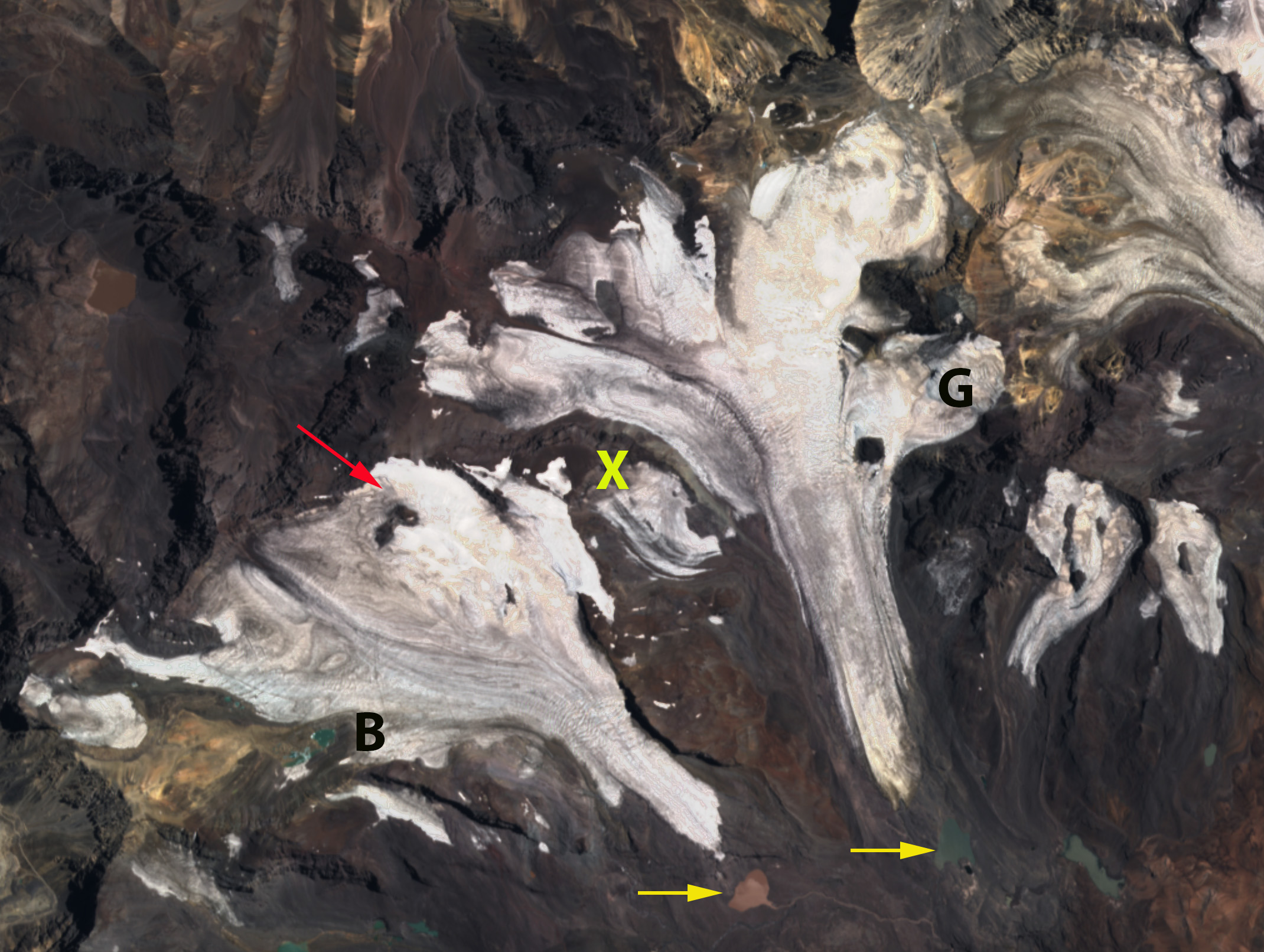
Olivares Beta (B) and Olivares Gamma (G) Glacier in Sentinel image from 1-23-2022, illustrating the lack of retained snowcover with 8 weeks left in the melt season. The yellow arrow marks proglacial lakes below each glacier. The red arrow an area of emerging bedrock on the upper Beta, X marks a location where the glaciers were joined in 1986 and now have separated. 

Olivares Beta and Olivares Gamma Glacier are adjacent glaciers 50 km NE of Santiago Chile in the central Andes of Chile. The glaciers are at the headwaters of the Olivares River, which drains into the Coloardo River. The Alfalfal Hydropower Planton the Colorado River is a 178 MW run of river plant completed in 1991 and owned by AES Andes. Malmros et al (2016) identified the retreat and area change of te Olivares glaciers for the 1955-2013 period. They noted a retreat of 979 m from 1955-1994 on Olivares Beta and 753 m on Olivares Gamma Glacier. The identified area loss from 1955-2013 was 21% on Olivares Beta and 34% Olivares Gamma.  Dussaillant et al (2019) identified a slower mass loss  -0.28 m/year in this region from 2000-2018, than further south in the Patagonia Andes or north in the Tropical Andes. Here we examine Landsat imagery from 1986-2020 and Sentinel Imagery from 2020-2022 to identify changes in area and snowcover.  The lack of retained snowcover indicates mass balance losses which will drive further retreat.

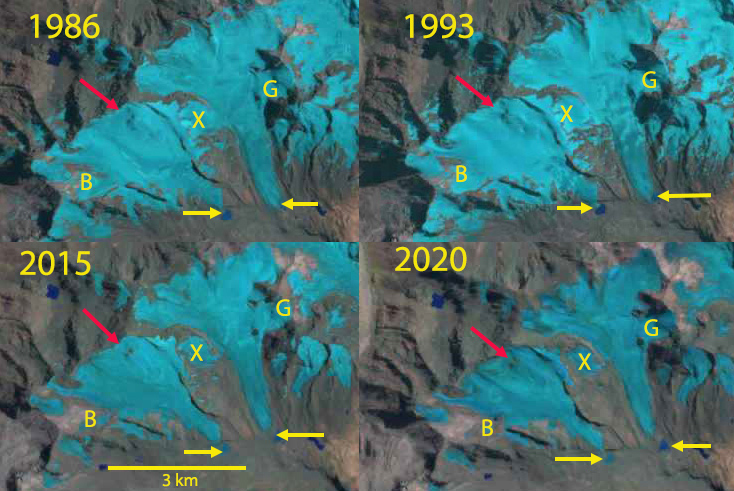
Olivares Beta (B) and Olivares Gamma (G) Glacier in Landsat images from 1986, 1993, 2015 and 2020. The yellow arrow marks the terminus location in 1993 of both glaciers, the red arrow an area of emerging bedrock on the upper Beta, X marks a location where the glaciers were joined in 1986 and now have separated. 

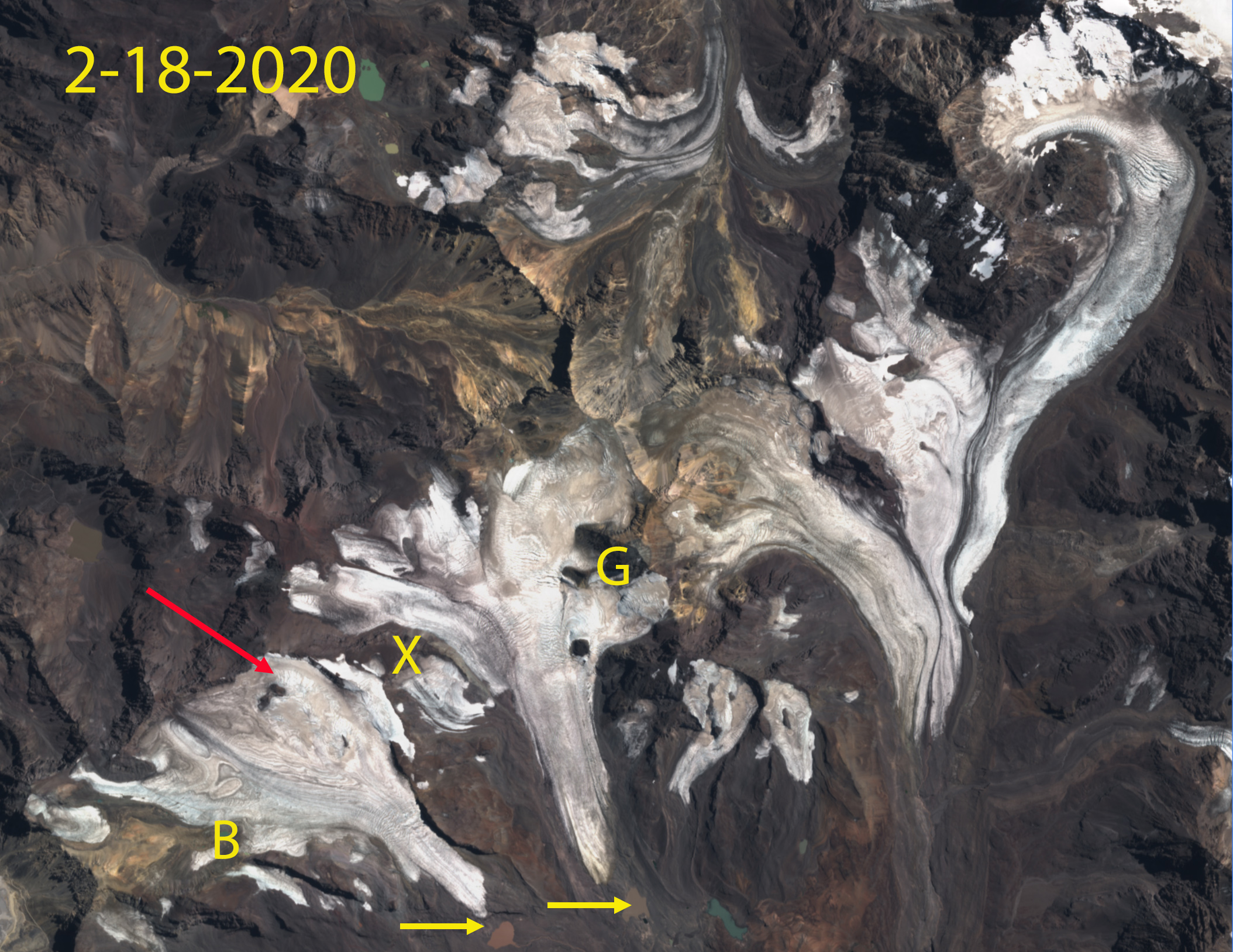
In  1986 and 1993 both glaciers terminated in small proglacial lakes, yellow arrows, and were connected adjacent to Point X.  There is no evident bedrock emerging on the upper Beta. In 1986 there is limited retained snowcover, ~10% of total area by early March. In 1993 there is 30% snowcover on the glaciers in March. By 2015 the glacier had receded from the proglacial lakes, bedrock is emerging at the red arrow on the upper Beta, and the glaciers are barely connected at Point X. Snowcover is ~10% of total area in mid-February.  In 2020 the glaciers have disconnected at Point X and there is less than ~10% retained snowcover by mid-February. The proglacial lakes are also quite brown suggesting high runoff from the dirtier/darker glacier. By January 23, 2022 both glaciers have again lost almost all snowcover with 8 weeks left in the melt season. The dirtier firn and ice at the surface melts at a faster rate than snow for the same weather conditions.  The result will be large mass balance losses in 2022 that will further lead to glacier thinning and recession. Both glaciers currently extend from ~3800 m to ~4800 m, with areas below 4600 m consistently being in the ablation zone.

The early loss of snowcover has been seen on other nearby glaciers Cortaderal Glacier, Chile and Volcan Overo, Argentina due to the unsually warm conditions in the region, particularly in the first half of January.

Olivares Beta (B) and Olivares Gamma (G) Glacier in Sentinel image from 2-18-2020 illustrating the lack of retained snowcover with 4 weeks left in the melt season. The yellow arrow marks proglacial lakes below each glacier. The red arrow an area of emerging bedrock on the upper Beta, X marks a location where the glaciers were joined in 1986 and now have separated. 

Olivares Beta and Olivares Gamm


Cortaderal Glacier, Chile 2022 Heat Wave Reduces Snow Cover, Retreat Continues

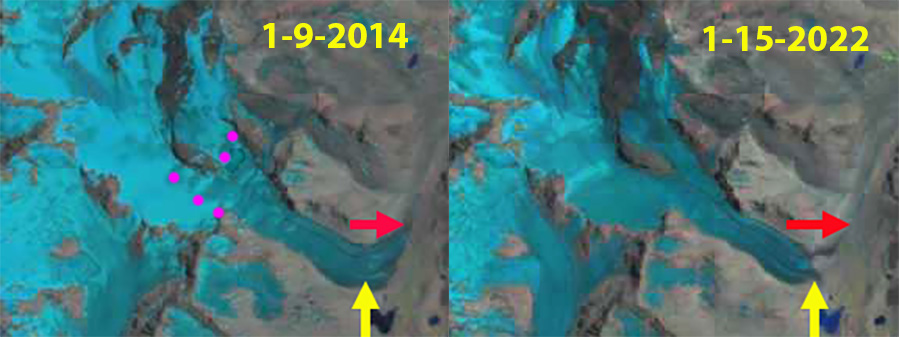
Cortaderal Glacier in Landsat images from 2014 and 2022. The glacier retreated 1400 m during this interval. The snowline in January 2014 is at 3750 m. On January 15, 2022 the snowline averages 4100 m with less than 15% snowcovered with 2.5 months left in the melt season. Red arrow is 2014 terminus and yellow arrow is 2022 terminus.

Cortaderal Glacier is a large valley glacier in Central Andes of Chile. Adjacent to the Universidad Glacier, it flows from Volcan Paloma (4860 m) and Nevado Penitente (4350 m) and drains into the Rio Cortaderal. Rio Cortaderal joins the Cachapoal River, that supplies two Pacific Hydro projects; a 110 MW run of river project at Chacayes and the 78 MW Coya run of river project a short distance downstream. The glacier is an important water resource from December-March. Bravo et al (2017) noted for Universidad Glacier that it supplied 10-13% of all runoff to the Tinguirica Basin during the melt season. La Quesne et al (2009) reported that Cortaderal Glacier retreated 110 m from 1970-2000 and 450 m from 2000-2007. Here we examine the retreat of this glacier from 2014-2022 and the unusually high snow lines in mid-January of 2022 due to the recent January heat wave (Washington Post, 2022).

Cortaderal Glacier in Sentinel images from 2016 and 2022. Point A is the bedrock area that emerged in 2016 and was at the glacier front by 2022. Point T marks the 2016 terminus position, Point B is at 3750 m and Point C is at 4200 m. Snowline on January 22, 2016 is at 3200 m and averages 4100 m on January 13, 2022.

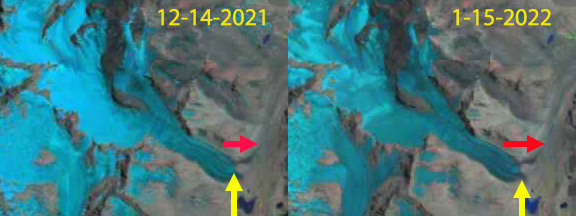
In February of 2014 the glacier terminated on the outwash plain at 2800 m. The snowline in mid January was at 3750 m. On January 9, 2016 the snowline was at 3200 m.  At Point A a small bedrock area has emerged from beneath the ice  1 km upglacier of the terminus. On January 16, 2017 the snowline is at 3750 m. On January 19, 2019 the snowline is at 3700 m. The bedrock exposed at Point A is no longer surrounded by ice due to expansion and glacier retreat. On December 14th the snowline is at 3700 m and the glacier is 50% snowcovered. By January 15 there is less than 15 % snowcover, and the snowline averages 4100 m, nearly at the top of the glacier. With 10 weeks left in the melt season snowcover will decline further. This is reminiscent of reduced snowcover on glaciers in the Pacific Northwest due to the summer 2021 heat wave (Pelto, 2021).

The glacier has retreated to Point A, with an average frontal recession of 1300 m from 2014-2022. This is greater than the retreat from 1990-2014 of ~800-900 m (Pelto, 2014).  The glacier now terminates at 3050 m in a region of much steeper slope that will reduce the retreat rate in the near future.

Cortaderal Glacier snow covered area change in two Landsat images one month apart. Snowcover declined from ~50% to 15%.

Cortaderal Glacier in Sentinel images from 2017 and 2019. Point A is the bedrock area that emerged in 2016 and was at the glacier front by 2022. Point T marks the 2016 terminus position, Point B is at 3750 m and Point C is at 4200 m. Snowline on January 16, 2017 is at 3750 m and averages 3700 m on January 19, 2019.

Landsat image indicating retreat from 1990-2014 of Cortaderal Glacier, red arrow 1990 position, yellow arrow 2014 position.

Steffen Glacier, Chile Drainage of Laguna de Los Tempanos

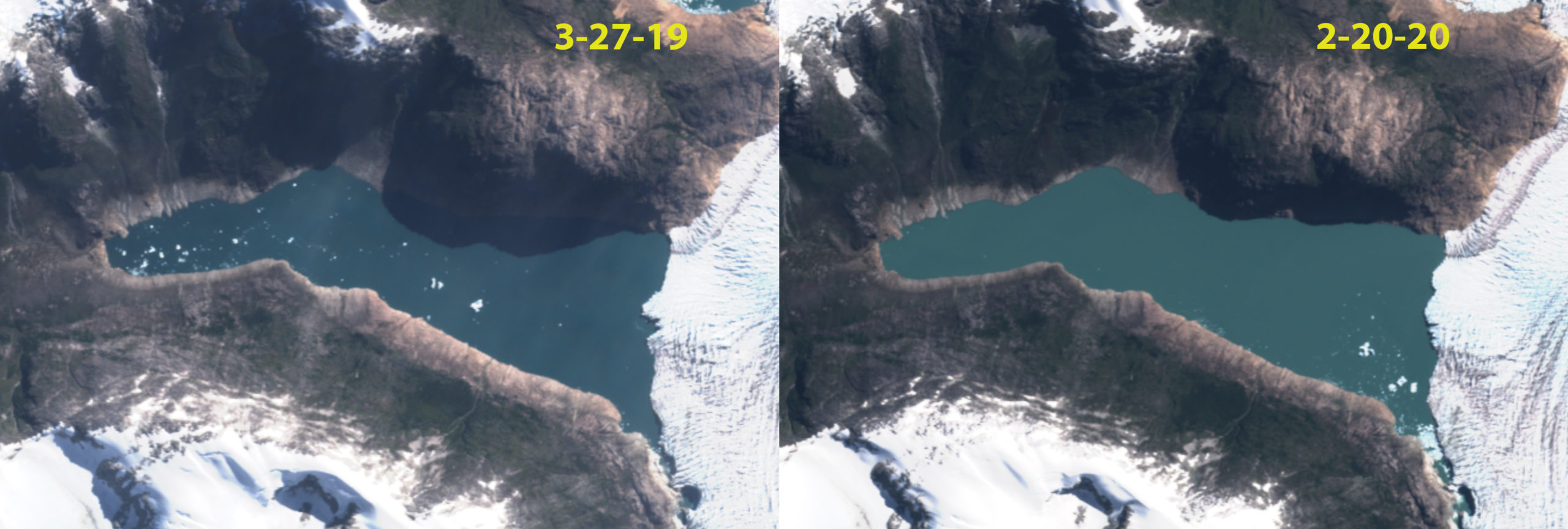
Laguna de los Tempanos full on February 9, 2021 and drained on December 6, 2021 in Sentinel 2 images. Point A marks the western margin when full. Point C marks the western margin when drained. 

Steffen Glacier is the south flowing glacier from the 4000 km2 Northern Patagonia Icefield (NPI). Several key research papers have reported on the spectacular retreat of this glacier in recent years.  Glasser et al (2016) reported that Steffen Glacier proglacial lake area expanded from  12.1 km2 to 20.6 km2 from 1987 to 2015, due tin part to a 100 m snowline rise. noted to have risen ~100 m.  Dussaillant et al (2018) determined the annual mass loss of NPI at ~-1 m/year for the 2000-2012 period, with Steffen Glacier at -1.2-1.6 m/year. Millan et al (2019) indicate the area of tributary glacier convergence near the northwest terminus and above the glacier is 700 m thick, and that the glacier has been retreating along an area where the glacier bed is below sea level, though the terminus now is close to sea level. Steffen Glacier retreat from 1987-2019 was 4.4 km, ~137 m/year (Pelto, 2019). Aniya et al (2020) reported on 19 glacier drainage events from 1974-2020, with most occurring in late summer or early Fall. They noted the largest in 2016 and 2017 were the first to expose much of the lake bottom.

There are two large ice dammed proglacial lakes on the west side of the glacier.  Laguna de Los Tempanos is the southern one 6 km upglacier of the current terminus and 11 km upglacier of the 1987 terminus position. Here we utilize Landsat and Sentinel imagery to examine the evolution of the lake from 1987-2021, Including the 2021 drainage event.

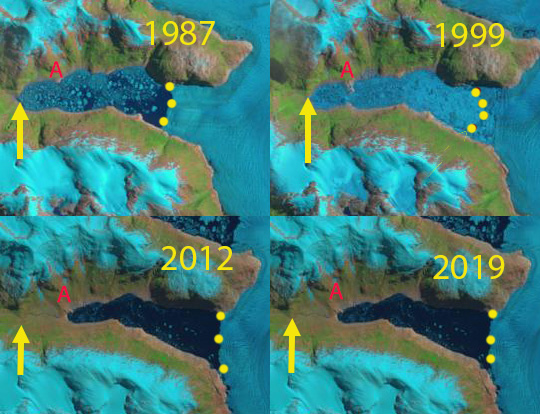
Laguna de los Tempanos in Landsat images from 1987, 1999, 2012 and 2019. Yellow arrow is western extent of the lake in 1987 and 1999, while Point A is the western extent in 2012 and 2019.

In 1987 the area of the lake is 5.2 km2 extending west past point A to the yellow arrow. In 1999 the water level is lower leading to a peninsula developing at Point A, with a lake area of 5.0 km2.  By 2012 the water level had dropped further and the west margin of the lake was now at Point A and the lake area was 4.8 km2.  The filled size remained unchanged for most of the 2012-2021 period, though there was large drainage events in 2016 and 2017 the lake rapidly refilled.

I

On November 17, 2016 the lake is full, but it is drained on April 16, 2017 with evident icebergs on the bottom, the drainage event occurred on March 30/31 2017 (Aniya et al 2020)

By January 21, 2018 the lake is again full and is full again on December 7, 2018 in Sentinel 2 images.

The lake is full on March 27, 2019 and on Feb. 20, 2020 in Sentinel 2 images.


On March 31, 2021 the lake is still full, by November 16, the lake area had declined from 4.5 km2 to 1.9 km2, in Sentinel 2 images.

The drainage event appears to have been in the early spring as the lake is full on May 20, 2021 at the start of the winter season and at the end of the winter season on August 8, 2021 in Sentinel 2 images. The lake remained largely filled on Sept. 7, 2021, but had drained by Oct. 7, 2021.

By October 7, 2021 the  lake had drained and two months later the lake is still not filling.  As Steffen Glacier thins, its ability to impound this lake has diminished from 1987 to 1999, from 1999 to 2012 it diminished again.   Now we may have another evolution in this process, with the more complete drainage starting in 2016 and now in 2021 the first event where refilling is not progressing.

Bernardo Glacier, Chile Retreat Yields 15 km2 Lake Expansion 1986-2021

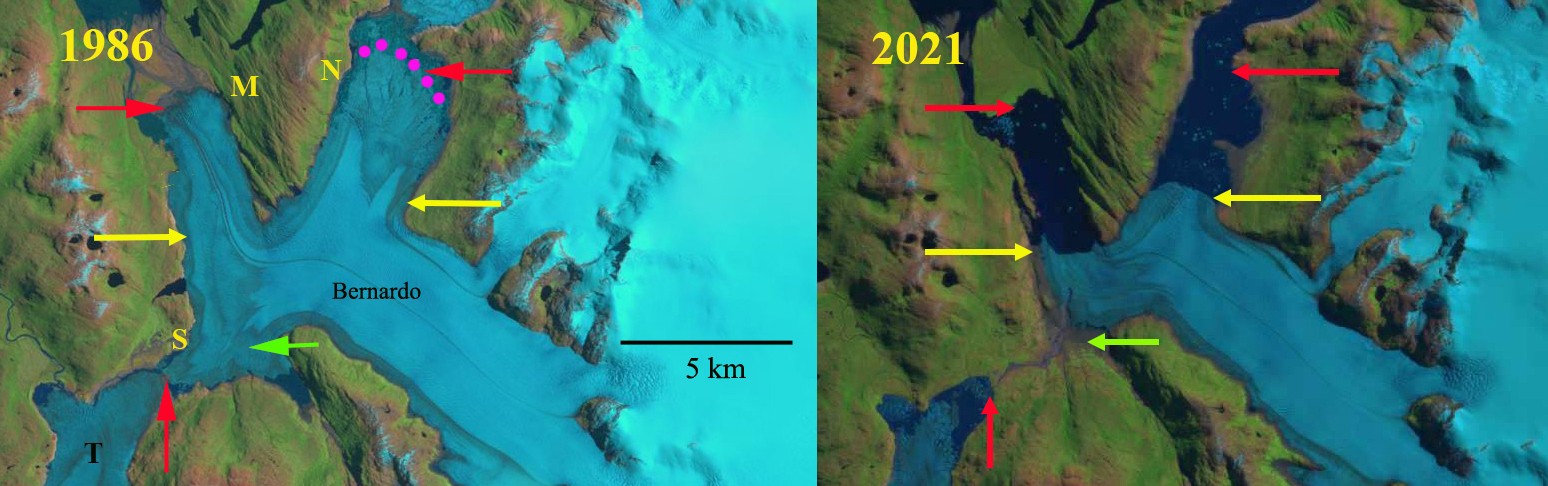
Bernardo Glacier in Landsat images from 1986 and 2021 illustrating retreat at the southern (S), middle (M) and northern (N) terminus respectively. Red arrows are 1986 terminus locations, yellow arrows are 2021 terminus locations. Separation from Tempano occurs at S, while lake expansion occurs at M and N.

Bernardo Glacier is an outlet glacier on the west side of the Southern Patagonia Icefield (SPI) that  currently ends in an expanding proglacial lake system, with three primary termini.  Here we examine changes from 1986 to 2021 using Landsat images. Davies and Glasser (2012) indicate that over the last century the most rapid retreat was from 2000 to 2011. Willis et a (2012)  note a thinning rate of 3.4 meters per year during this period of the Bernardo Glacier region, which drives the retreat. Mouginot and Rignot (2014) illustrate that velocity remains above 200 m/year from the terminus to the accumulation zone on Bernardo Glacier. Eñaut Izagirre visited the glacier in 2019 and provided images of the middle terminus of Bernardo Glacier, below.

Bernardo Glacier in Landsat images from 1998 and 2020 illustrating retreat at the southern (S), middle (M) and northern (N) terminus respectively. Red arrows are 1986 terminus locations, yellow arrows are 2021 terminus locations. Separation from Tempano occurs at S, while lake expansion occurs at M and N.

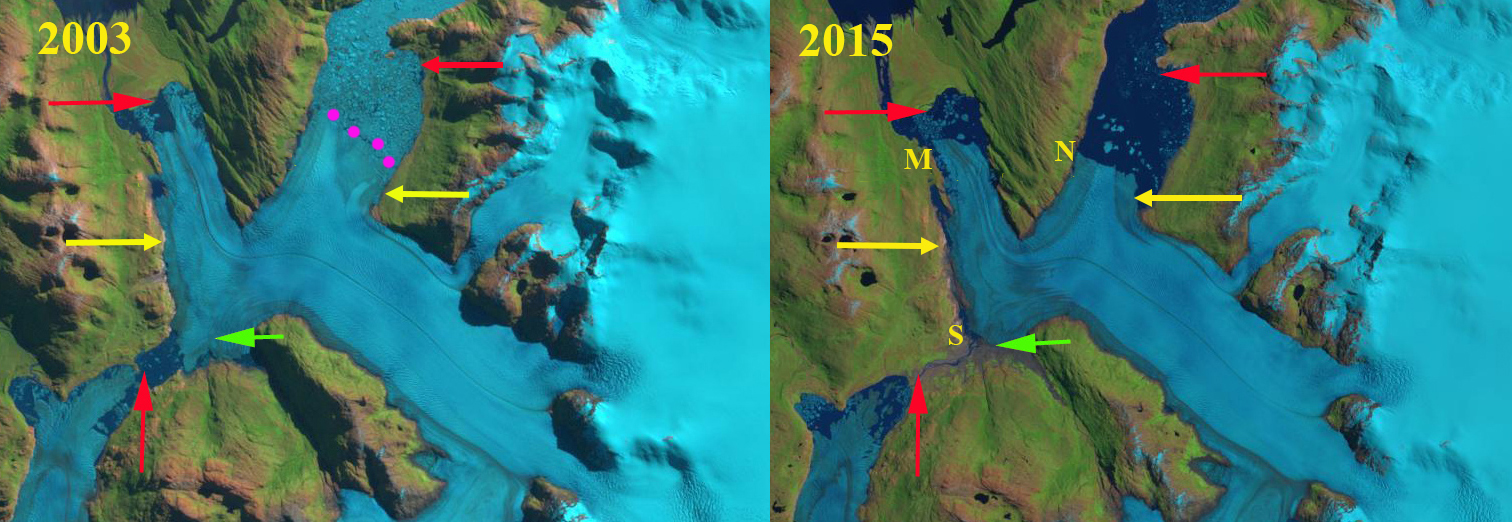
In 1986 Bernardo the southern terminus of the glacier was in tenuous contact with Tempano Glacier.  The middle terminus primarily ended on an outwash plain with a fringing proglacial lake developing.  The northern terminus had retreated a short distance south from a peninsula that had acted as a pinning point.  By 1998 the northern terminus had retreated into the wider,deeper portion of the lake basin that was now filled with icebergs. The middle terminus remained grounded on an outwash plain, with proglacial lake expansion at the NW corner of the terminus.  A small lake has developed completely separating Bernardo Glacier and Tempano Glacier. By 2003 the northern terminus had retreated 2 km from 1986, the middle terminus 1.5 km and the southern terminus 1.2 km in an expanding proglacial lake.  By 2015 the lake between Tempano and Bernardo Glacier had drained, but a fringing proglacial lake at the margin of Bernardo Glacier was forming.  In 2015 the northern terminus had retreated 3.5 km since 1986, the middle terminus 2.5 km and the southern terminus 2.75 km.   From 2015 to 2020 the change of the southern terminus was limited to a limited expansion of the fringing proglacial lake, a limited retreat of the the northern terminus, while the middle terminus had retreated significantly into a wider portion of the lake basin.  By 2021 the southern terminus had retreated 3 km since 1986, the middle terminus 4.6 km and the norther terminus 4.1 km.  This led to a 8.7 km2 lake expansion at the middle terminus and a 7.8 km2 lake expansion at the northern terminus. Gourlet et al (2016) identify Bernardo Glacier as having thinner ice than other large outlet glaciers such Jorge Montt or O’Higgins, which helps lead to rapid terminus change. The retreat is similar to the extensive retreat observed at Dickson Glacier and Upsala Glacier.

Southern Andean huemel an endemic deer on the foreland beyond Bernardo Glacier (photograph from Eñaut Izagirre).

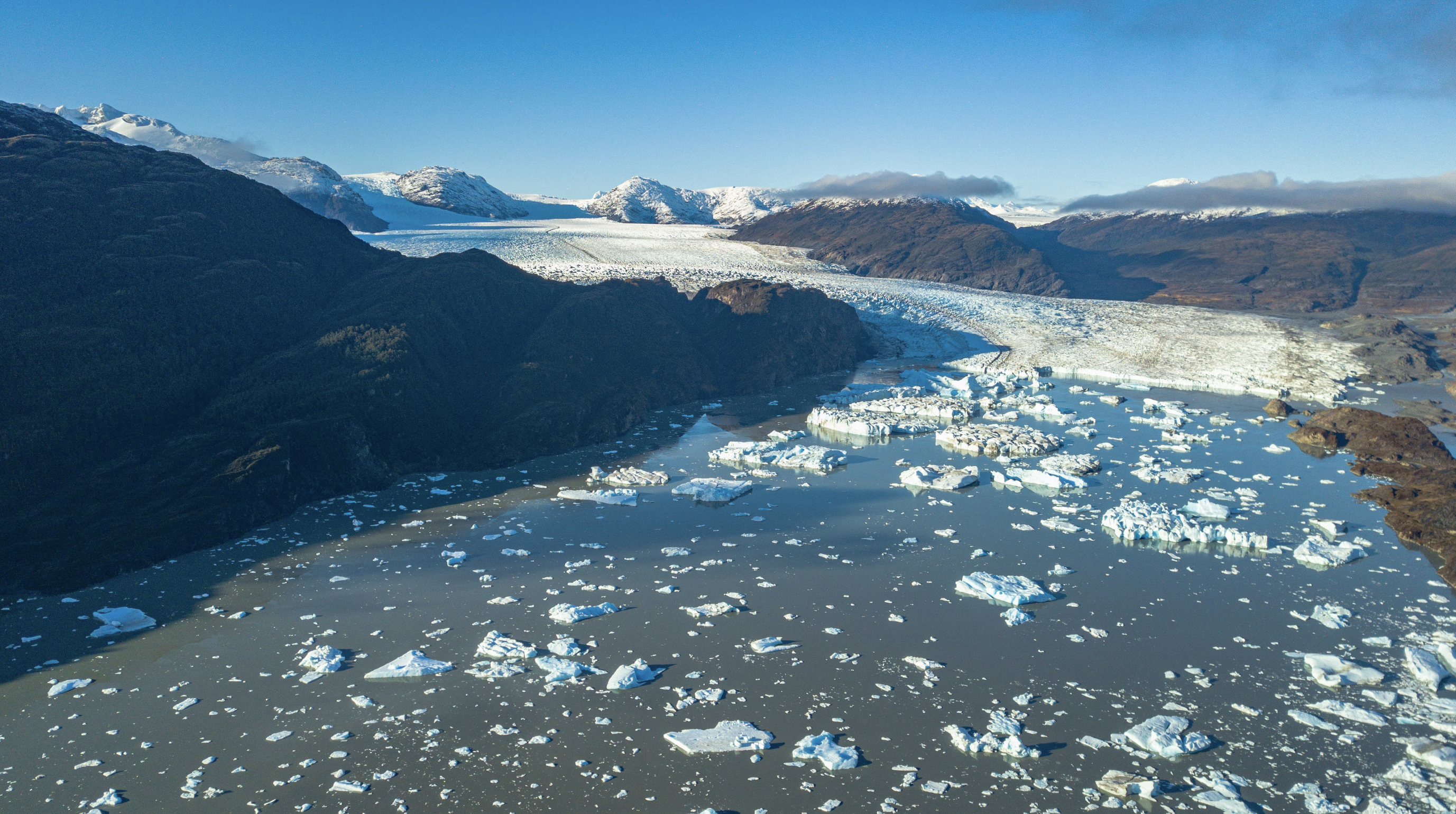
Middle terminus of Bernardo Glacier in 2019 taken by Eñaut Izagirre who considers this a condor-view.

Bernardo Glacier in Landsat images from 2003 and 2015 illustrating retreat at the southern (S), middle (M) and northern (N) terminus respectively. Lake expansion and then drainage occurs at S. Red arrows are 1986 terminus locations, yellow arrows are 2021 terminus locations.

Melt Severs Northern Patagonia Icefield Glacier Connections

Loss of glacier connection between HPN1 and HPN2 in Landsat images from 2000 and 202o at Point A and B. Glacier tongue retreat at Point A from HPN1 and at Point C from HPN2. Formation of 1.4 km2 lake at HPN1.

HPN1, HPN2 and HPN3 drain adjacent sections of the the Northern Patagonia Icefield (NPI).  HPN2 and HPN3 comprise the Acodado Glacier, with HPN1 being the next glacier to the north is. The lakes at the terminus of HPN2 and HPN3 were first observed in 1976 and had an area of 2.4 and 5.0 km2 in 2011, while HPN1 had no lake in 2000 (Loriaux and Casassa, 2013).   Davies and Glasser (2012) noted that the Acodado Glacier termini, HPN2 and HPN3, had retreated at a steadily increasing rate from 1870 to 2011. Pelto, 2017 reported a retreat from 1987-2015 of 2100 m for HPN2 and 3200 m for HPN3. From 1987-2020 Acodado Glacier terminus HPN2 has retreated 2700 m and HPN3 has retreated 4100 m.  The result of this retreat is an increase in lake area at HPN2 from 2.1 km2 in 1987 to 7.1 km2 in 2020 (Pelto, 2020). Glasser et al (2016) identified a 40% increase in lake area for the NPI from 1987-2015,  and a 100 m rise in the snowline.  Dussailant et al (2018) identified a mass loss rate of -2–2.4 m/year for HPN1, with thinning of over 4 m/year in the lower reaches in the vicinity of Point A and B. Here we examine the impact of the rising snowline, increased melt and resultant thinning on two glacier tongues that connected HPN1 to the accumulation zone region of HPN2 in 2000 and are now disconnected.

In the 2000 Landsat image glacier tongues extending from the accumulation zone region of HPN2 connect with HPN1 at Point A and Point B. At Point C an ice tongue extends 2.7 km upvalley from HPN2. By 2016 there is a disconnection at Point A with ice flowing south from HPN1 no longer joining the north flowing tongue.  Point B is still connected. At Point C the ice tongue extends 1.8 km upvalley.  By 2020 the connection at Point B has also been severed. At Point A ice no longer flows south into the valley from HPN1 and there is a 3.25 km long deglaciated valley between the two formerly connected ice tongues. At Point C the ice tongue from HPN2 has also been lost, a 2.7 km retreat.  From 2000-2021 HPN1 has retreated 1.8 km leading to the formation of a 1.4 km2 lake. We can anticipate the rapid retreat of the glacier tongue from HPN1 at Point B during this decade.  There is potential of short term formation of glacier dammed lakes at Point A and C now, and Point B in the future.  There is not a hazard from drainage of these lakes that both reach tidewater via Rio Acodado within 15 km.

Loss of glacier connection between HPN1 and HPN2 in Landsat images from 2016 and 2021 at Point B. Glacier tongue retreat at Point A from HPN1 and at Point C from HPN2. Expansion of 1.4 km2 lake at HPN1.

HPN1 in Sentinel 2 image from Nov. 9, 2021 illustrating the 1.4 km2 lake at HPN1 that has formed this century and the deglaciated valley at Point A.

Queulat Glacer Complex, Chile Recession 1987-2021

Seven outlet glaciers of the Queulat glacier complex, Chile in 1987 and 2020 Landsat images. A=Rosselot Glacier and D=Colgante Hanging Glacier are the only ones in 1987 not terminating in a proglacial lake. The other five retreated from a proglacial lake since 1987 and Rosselot Glacier retreat has led to formation of two lakes. 

Nevado Queulat, Chile is the centerpiece of the Queulat National Park in the Aysen Region.  This massif is host to the Queulat glacier complex, which has a number of outlet glaciers. Rosselot Glacier is the largest glacier and it flows north draining into Lago Rosselot and then the Rio Palena. Colgante Hanging Glacier flows south and is the second largest terminating at the top of a cliff  as a hanging terminus creating a spectacular waterfall.  Paul and Molg (2014) observed a rapid retreat in general of 25% total area lost from glaciers in the Palena district of northern Patagonia from 1985-2011. Meier et al (2018) note a 48% reduction in glacier area in the Cerro Erasmo and Cerro Hudson region, since 1870 with half of that occurring since 1986. The 3.8 km retreat of Erasmo Glacier from 1998 to 2018 is a rate of ~200 m/year.   Here we examined the changes from 1987 to 2021 of seven outlet glacier locations around the ice cap.

Seven outlet glaciers of the Queulat glacier complex in Queulat National Park in Chile in 2021 Sentinel 2 image. A=Rosselot Glacier and D=Colgante Hanging Glacier are the only ones in 1987 not terminating in a proglacial lake. The other five retreated from the proglacial lake since 1987 and Rosselot Glacier retreat has led to formation of two lakes. 

In 1987 Rosselot (A) terminates against the valley where the valley turns to the east,and there is no lake at the terminus.  In 1999 glacier retreat has exposed a new lake that is 900 m across.  By 2015 the glacier has retreated south of a second lake that is 700 m across.  In 2021 the glacier has retreated 250 m from the edge of the lake terminating at an elevation of 650 m. The total retreat from 1987-2021 has been 2100 m, ~60 m per year.  This is the loss of  15% of the entire glacier length.

Seven outlet glaciers of the Queulat glacier complex, Chile in 1999 and 2015 Landsat images.

Outlet Glacier B terminates in a lake at 750 m.  In 1999 the glacier has retreated to the top of a steep slope above the lake terminating at 850 m.  In 2015 the glacier is terminating at 925 m and is receding up a north-south oriented valley. By 2021 the glacier has retreated 1100 m from the shore of the lake.

Outlet Glacier C terminates in a small fringing proglacial lake.  By 1999 the glacier has retreated ~400 m to the base of a steeper slope, there is still ice cored moraine beyond the terminus. By 2015 a 500 m lake has formed beyond the terminus.  In 2021 the glacier has retreated ~1000 m since 1987.

Colgante Hanging Glacier (D) terminates at the top of a steep cliff in 1987.  The glacier reamins at the top of this cliff up to 2021, with considerable avalanching off the front into the valley below.  A reconstituted glacier at the bottom of the cliff is thinning.

Outlet Glacier (E) terminated in a proglacial lake  at 700 m elevation in 1987.  By 1999 the glacier had a tenuous connection to the lake with a reconstituted stagnant area in contact with the lake. In 2015 the glacier no longer reaches the lake. In 2021 the terminus of the glacier is 400 m from the lake.

Outlet Glacier (F) terminated in a proglacial lake at 750 m elevation in 1987.  In 1999 the glacier still connected to the lake. By 2015 the glacier had receded from this lake. In 2021 the glacier has retreated 350 m from the lake and terminates at  1000 m.

Outlet Glacier G is a stagnant debris covered glacier tongue that is in contact with a proglacial lake in 1987 and 1999.  By 2015 the glacier has retreated from contact with the lake.  In 2021 the glacier has retreated 600 m across an outwash plain from the lake.

Barcaza et al (2017) indicate that Colgante Hanging Glacier did not retreat from 2000-2015, while Rosselot Glacier lost 0.9 km2.

Benito Glacier, Chile 2021 Calving Event Drives Further Retreat


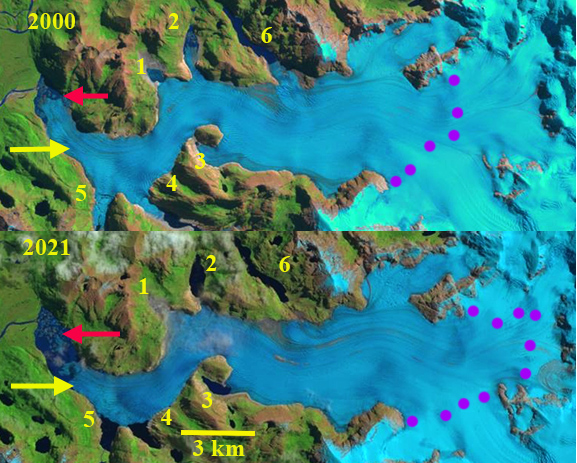
Benito Glacier in 2000 and 2021 Landsat images. Locations 1-6 are current or former distributary terminus locations. Red arrow is the 2000 terminus location and yellow arrow the 2021 terminus location.  A small cloud is obscuring an iceberg near terminus.  Purple dots are the snowline.

Benito Glacier is a temperate outlet glacier on the west side of the North Patagonian Icefield terminating in an expanding lake. The glacier is south of  San Quintin Glacier and north of Acodado GlacierLoriaux and Casassa (2013) examined the expansion of lakes of the Northern Patagonia Ice Cap. From 1945 to 2011 lake area expanded 65%, 66 square kilometers. Ryan et al (2018) identified thinning of 2.8 m/year in the ablation zone from 2000-2013, and that thinning of over 120 m extended from the terminus to ~750 m from 1973-2017. Mouginot and Rignot (2015)  indicate that the velocity of Benito Glacier is between 200-500 m per year along the center line below the snowline. Glasser et al (2016) note the glacier has limited debris cover and that the average transient snowline in 2013-2016 is at 1000 m, substantially above the ~900 m average from earlier.

Benito Glacier in 1987 main terminus was on an outwash plain.  The glacier has five distributary termini (1,2,34,5,6) two of which had open proglacial lakes in 1987.  At Point 3 the glacier flows around a nunatak and reconnects. In 2000 a 1 km long proglacial has formed at the main terminus.  Distributary termini 1,2 and 4 all have proglacial lakes.  The snowline in 1987 and 2000 is 800-825 m. By 2015 there are  five ending in lakes, with Lake 6 having retreated out of a lake basin. A lake has formed at the new distributary terminus at Lake 3. The two tributaries to the north indicated with arrows each retreat approximately 1 km from 1987 to 2015 and in both cases are no longer calving termini.  The main glacier terminus has retreated into a proglacial lake, with a retreat of 2 km from 1987 to 2015. The lowest 1.5 km  has a low slope and peripheral lakes suggesting the lake will expand substantially as Benito Glacier retreat continues. The transient snowline in 2015 is at  900 m. In 2021 a significant iceberg 0.4 km2 has calved off the terminus.  The terminus has retreated 2900 m from 1987-2021 with the lake area expanding to 2.8 km2.  The lower 1.5 km of the glacier remains low sloped suggesting significant lake expansion is ongoing. The glacier no longer reaches the former proglacial lake 2 or 6. Proglacial lake 1 has drained. Proglacial lake 2,3, and 4 continue to expand. The snowline on Feb. 6 2021 is at 875-900 m, rising to 925-950 m by March 16, 2021.

March 17, 2021 Landsat image indicating iceberg located off front of Benito Glacier


Benito Glacier comparison in Landsat images from 1987 and 2015 indicating the terminus position in 1987 red arrows, yellow arrows the 2015 terminus positions. Locations 1-6 are current or former distributary terminus locations. purple arrows where glacier thinning is expanding bedrock areas. The snowline is indicated by purple dots

Gorra de Nieve East Glacier, Chile Retreat-Lake Expansion

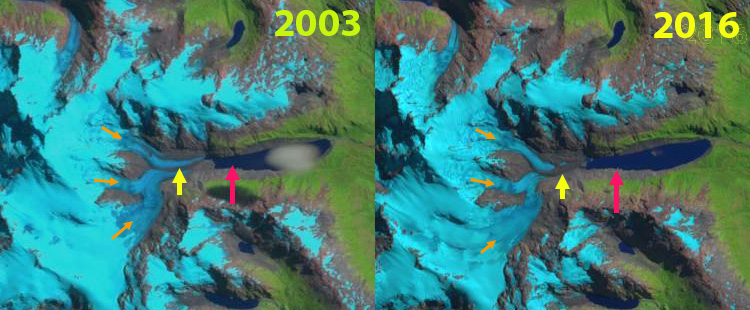
Gorra de Nieve East Glacier in 1986 and 2021 Landsat images. Red arrow is the 1986 terminus location, yellow arrow is the 2021 terminus location, orange arrows the three main tributaries.

The Gorra de Nieve massif is 50 km southwest of Monte San Lorenzo, draining its eastern flank the largest glacier of this massif is unnamed and referred to here as Gorra de Nieve East Glacier. The glacier consists of three main tributaries that join shortly above the proglacial lake the glacier has terminated in, which drains into the Rio Bravo. In this region glaciers thinned by ~0.5 m/year from 2000-2012 with most of the thinning on  Gorra de Nieve East Glacier occurring on the lower sloped valley section below 1100 m (Falaschi et al 2017). The glacial history of the region is detailed in a visual map that includes moraines and trimlines including around the expanding proglacial lake discussed here Davies et al (2020).  Here we examine the changes of the glacier and the expanding proglacial lake from 1986 to 2020.

In 1986 the glacier terminated in a 3 km long proglacial lake, red arrow.  Three primary tributaries joined ~2 km above the terminus at 900 m, orange arrows. By 2003 the glacier has retreated ~500 m and the lateral moraines have become more prominent covering a majority of the glacier width.  By 2016 the glacier has retreated ~900 m from the 1986 position and lateral moraine debris covers nearly the entire lower 1 km of the glacier.  In 2021 the tributaries are separating with the northern tributary the only one feeding the terminus. The glacier has retreated 1500 m since 1986 and the proglacial lake is 4.5 km long.  The two southern tributaries will separate soon and the northern tributary will also retreat from the lake.

The retreat is similar to that  at San Lorenzo Sur Glacier or Calluqeuo Glacier.

Gorra de Nieve East Glacier in 2003 and 2016 Landsat images. Red arrow is the 1986 terminus location, yellow arrow is the 2021 terminus location, orange arrows the three main tributaries.

HPN4 Glacier, Chile New Lake Forms and Drains in 2021

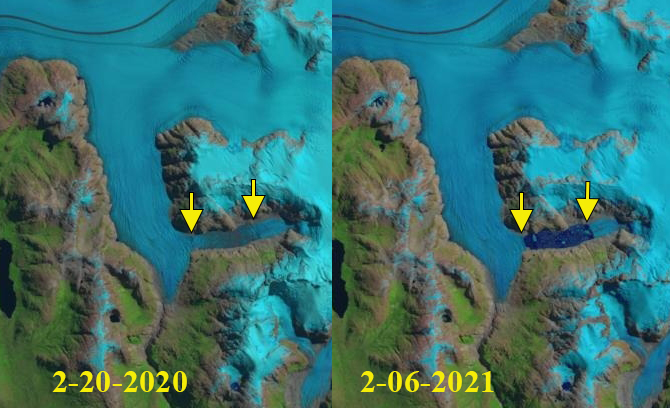
Glacier dammed lake formation at HPN4 Glacier, Chile between Landsat images of Feb. 2020 and Feb. 2021, yellow arrows indicating new calving fronts on either end of lake. 

HPN4 Glacier drains the southern side of NPI just east of Steffen Glacier. The terminus retreated little from 1987-2015, see below (Pelto, 2015 and 2017). The main change is in the eastern tributary 1-2 km north of the terminus. In 1987 there were five separate feeder ice tongues descending from the ice cap into this valley.  By 2015 there was just one.  Further this tongue has narrow and downwasted and a new lake is developing.

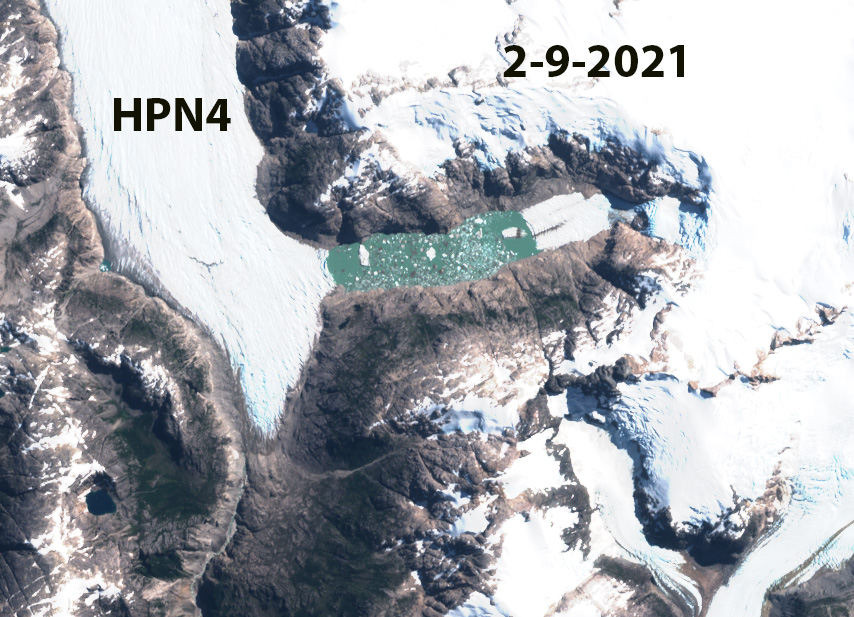
In February 2020 the lake has still not formed, note yellow arrows. In February 2021 the lake has formed between the yellow arrows and is 2 km long and has an area of 1.1 km2. The drainage of this lake was reported by on Claudio Bravo Lechuga comparing PlanetLab images from 2-15-2021 and 2-23-2021.

HPN4 and glacier dammed lake in Sentinel2 Image from 2-9-2021.

HPN4 Glacier in 1987 and 2015 Landsat imagery.  Red arrow indicates 1987 terminus, yellow arrow 2015 terminus, purple arrows indicate medial moraines

The below is from Pelto (2015 and 2017). In 1987  and 2004 there were five contributing glacier tongues to the downwasting tributary, see below. It is like a bathtub being filled with five taps at once. The purple arrow indicates a medial moraine at the mouth of the valley, signaling the lack of current contribution of the downwasting tributary to HPN4 Glacier.  The medial moraine has shifted east indicating that the main HPN4 Glacier is now flowing into the valley instead of the downwasting tributary being a contributing tributary to HPN4.  By 2015 there is only one contributing glacier tongue to the downwasting tributary, only one tap for this draining bathtub, the other four contributing tongues have retreated from contact with the downwasting tributary.  The medial moraine has spread eastward and some fringing proglacial/subglacial lakes are evident  A closeup 2013 Digital Globe image indicates both fringing ponds-blue arrows, rifts caused by varying flotation-green arrows and expanding supraglacial ponds, red arrows.  The rifts are a sign of instability and typically lead to break up of this portion of the terminus. The downwasting tributary continues to demise faster than HPN4 Glacier, which crosses the valley mouth, hence it is likely that a glacier dammed lake will form and that HPN4 Glacier will continue to flow further east up this valley.

Schaefer et al (2013) discuss the HPN4 Glacier because the main terminus has changed little given its modeled mass balance, and the modeled mass balance to the east appears too negative, which they suggest indicates wind redistribution from the HPN4 to the Pared Sud Glacier just east. Davies and Glasser, (2012)  identify this region of the icefield as retreating faster from 2001-2011 than during any measured period since 1870.  This has led to the formation and expansion of many lakes in the basin Loriaux and Cassasa (2013)Glasser et al (2016) observed that proglacial and ice-proximal lakes of NPI increased from 112 to 198 km2. The largest expansion this century being at San Quintin Glacier at ~24 square kilometers.

hpn-4 2004

2004 Landsat image showing five contributing tributaries

hpn4-ge

Google Earth image 2013

Tres Puntas Glacier, Chile Loses 50% of its Length this Century

Tres Puntas Glacier, Chile in 1999 and 2021 Landsat imagery. Red arrow is 1999 terminus location, yellow arrow the 2021 location, Point A is where tributaries joined in 1999 and Point B is where an adjacent glacier drains west.

Tres Puntas Glacier flow south from Cerro Tres Puntas draining south into Lago O’Higgins in Patagonia. The icefield is east of the Patagonia icefields where Davies and Glasser (2012) noted the nearby (50 km se) Lago Del Desierto glaciers lost 0.6% of its glacier area from 2001-2011, a much higher rate than from 1986-2000.

In 1999 the glacier is 5.6 km long with two significant tributaries joining at 850 m (Point A) before terminating in a proglacial lake at 600 m. The glacier shares a broad divide near Point B with glacier flowing west. In 2002 the snowline is at 1100 m, the terminus is still terminating in the proglacial lake. By 2020 the glacier tributaries have separated and now terminates at 900 m, above Point A. At Point B there is a separation between this glacier and the glacier draining west. By mid-February of 2021 the west tributary has retreated 2.8 km, 50% of its 1999 length, while the eastern tributary has retreated 2.4 km of its 5.0 km length. The snowline in mid-February of 2020 and 2021 has been at 1200 m, above the median glacier elevation. Further retreat of the eastern arm should lead to an additional alpine lake forming.

The retreat of this glacier is more extensive than that of the nearby Sierra Sangra glaciers,  Argentina.  The retreat from an expanding proglacial lake also has played out at Cordillera Lago General Carrera Icefield, Chile

Tres Puntas Glacier, Chile in 2002 and 2020 Landsat imagery. Red arrow is 1999 terminus location, yellow arrow the 2021 location, Point A is where tributaries joined in 1999 and Point B is where an adjacent glacier drains west.