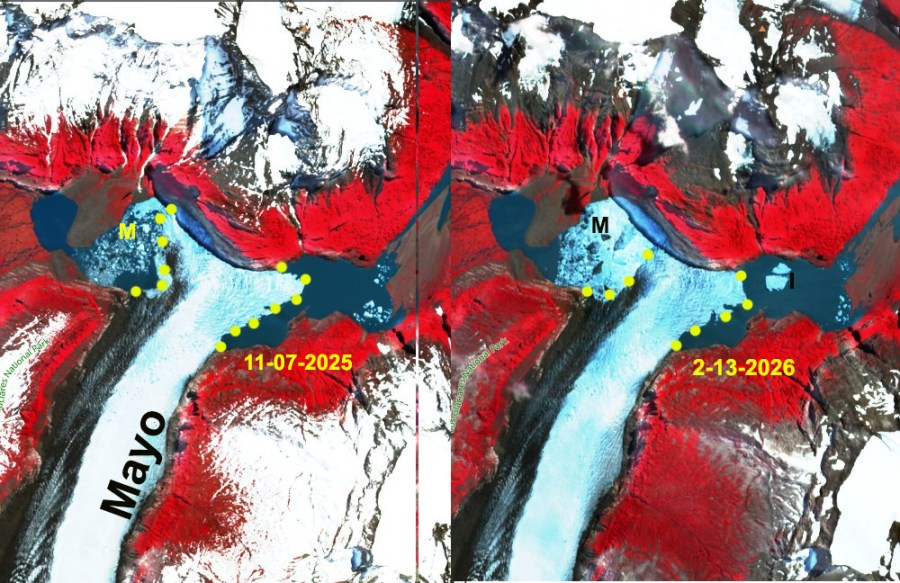
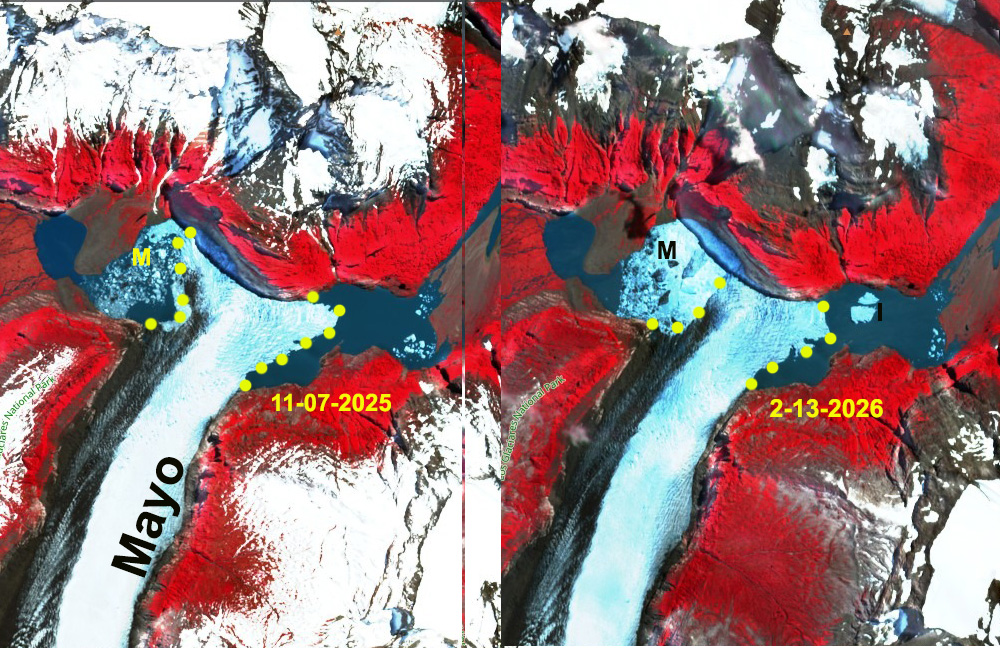
Glaciar Mayo terminus change from November 2025 to February 2026 illustrated in Sentinel images. The yellow dots indicate the margin, which has retreated on both sides forming a melange (M) and new icebergs (I).
Glaciar Mayo, Argentna in Los Glaciares National Park is an eastern outlet of the Southern Patagonia Ice Cap. The glacier has terminated on the northern shore of a glacial lake for the last ss years. The mass balance from 1975-2011 was identified as slightly positive by Schaefer et al (2015). This enabled the glacier to terminate on the northern shore of a glacial lake, an arm of Lago Argentino from 1984-2020. From 2000-2019 Minowa et al (2021) noted that Glaciar Mayo had transitioned to a negative balance and overall thinning. This thinning is what has led to the terminus beginning to collapse into the lake.
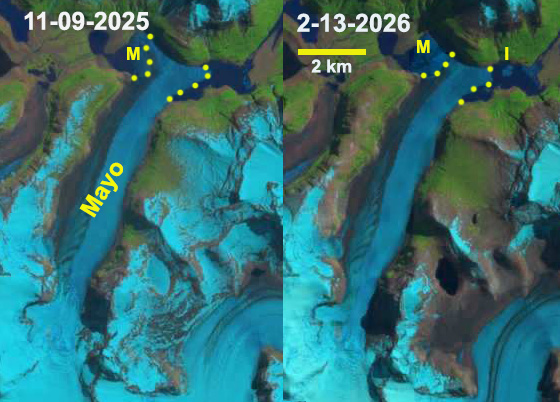
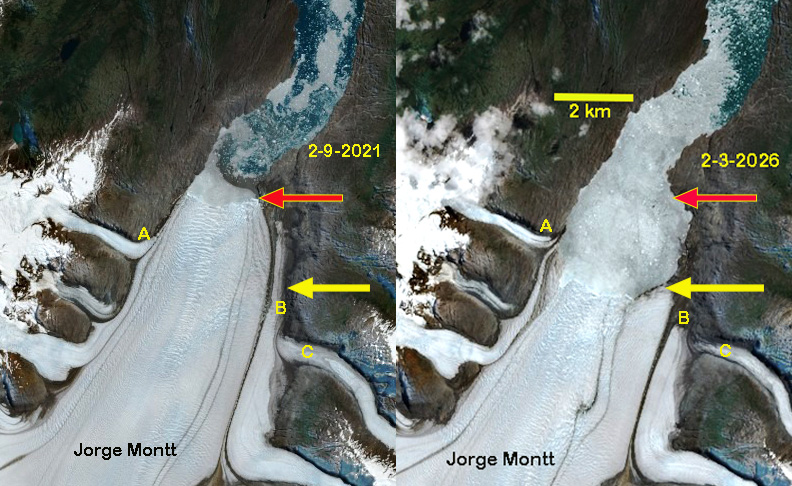
The terminus tongue projecting into the lake had been 2.5 km2, had now declined to 1.4 km2. The terminus along the northern shore had been 2000 m wide and is now 1150 m wide. There is further crevassing/rifting that suggests the glacier tongue is not done thinning in 2026. This continues to be an active year for calving retreat in Patagonia as seen at Upsala and Jorge Montt Glacier, see below.
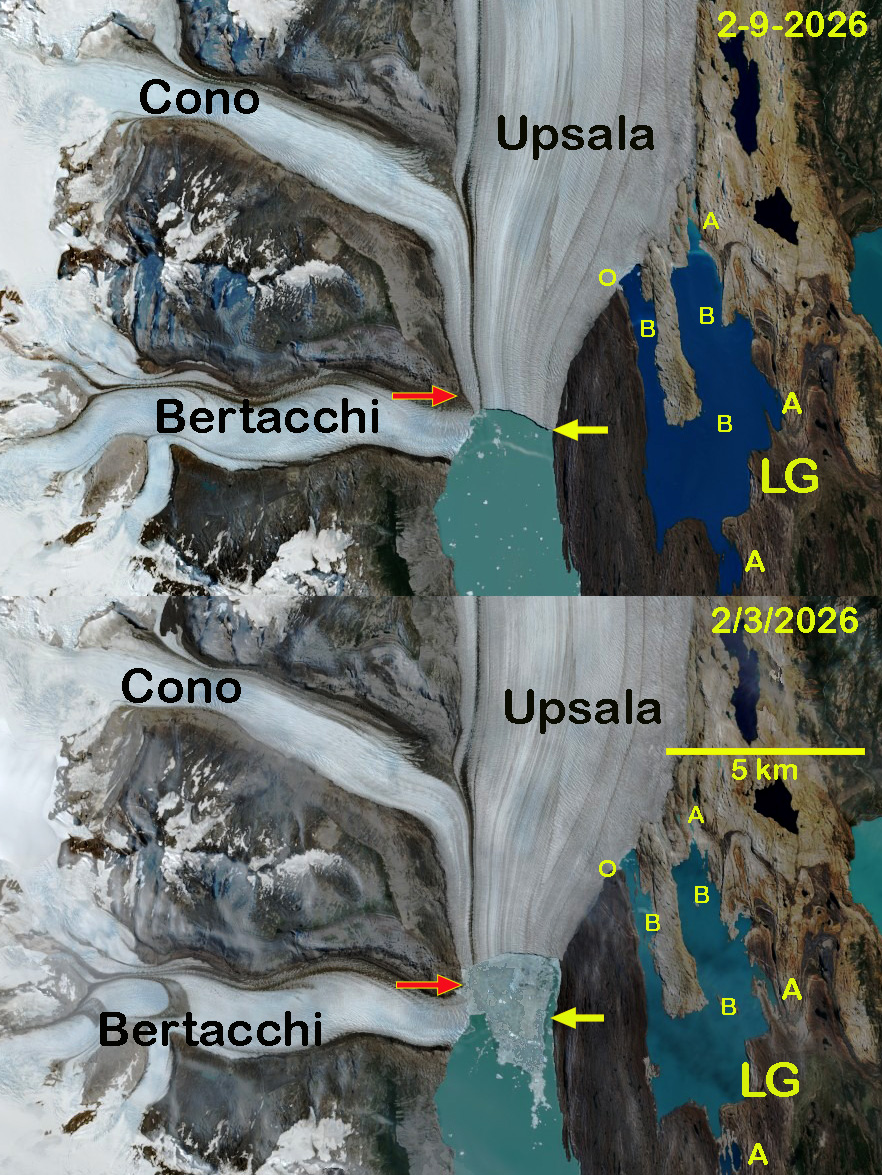
Glaciar Mayo terminus change from November 2025 to February 2026 illustrated in Landsat images. The yellow dots indicate the margin, which has retreated on both sides forming a melange (M) and new icebergs (I).Jorge Montt Glacier retreat from 2021-2026 with a particularly extensive and packed melanage in 2026, observed in Sentinel images.Upsala Glacier had a burst of calving in Feb. 2026. The comparison to 2021 highlights both the retreat, separation from Bertachhi Glacier and substantial drainage of Lago Guillermo.
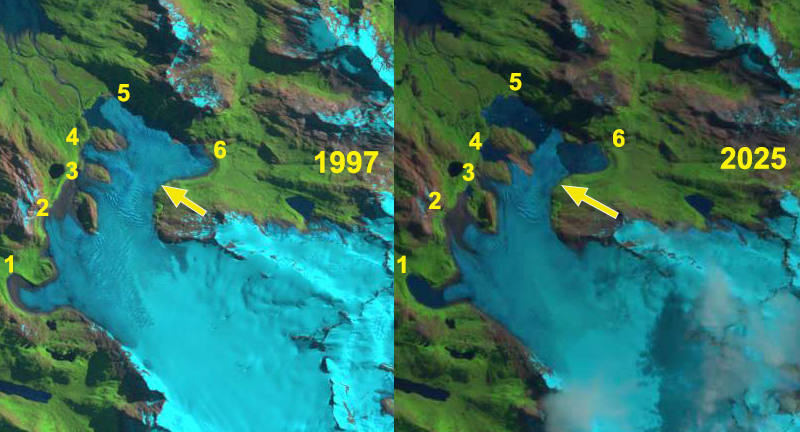
Videla Glacier, Chile is an outlet glacier of the Cordillera Darwin Icefield. The glacier has a number (Point 1-6) of terminus lobes where retreat has led to proglacial lake development between 1997 and 2025, as seen in these annotated Landsat images.
Videla Glacier is a land terminating glacier in the northwest portion of the Cordillera Darwin Icefield (CDI) in Tierra del Fuego, Chile. The glacier has terminates in several expanding proglacial lakes each in front of a different tongue of the glacier. The glacier flows northwest from Cerro Ambience towards Fiordo Profundo. Meier et al (2018) identified area change of Patagonia glaciers from 1870-2016 with a ~16% area loss of CDI, with more than half of the loss occurring since 1985. They also noted that CDI glaciers were retreating fastest between 1986 and 2005. Izagirre et al (2025) identified a 124% increase in glacier lake area from retreat between 1945 and 2024. The retreat has been largest on tidewater glaciers such as Marinelli Glacier and Ventisquero Grande Glacier.
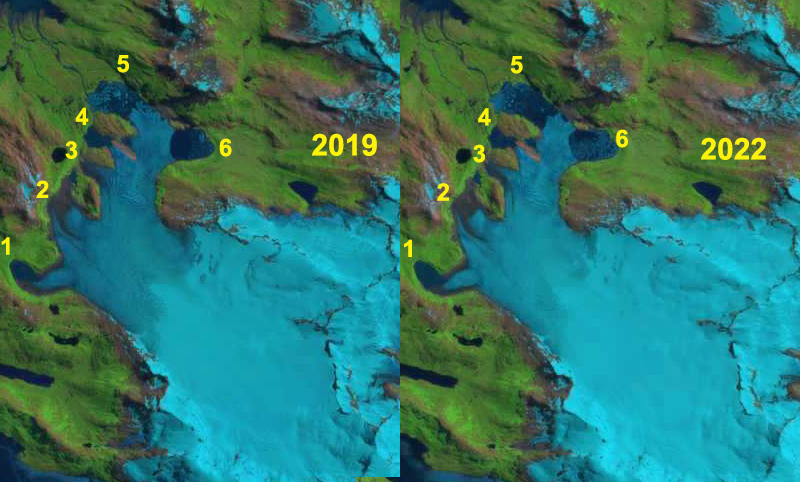
In 1997 of Videla Glacier’s six main terminus lobes, five did not exhibit a proglacial lake, only the two northern most lobes (Point 4, 5, and 6) ending in a fringing yet to develop proglacial lake. The terminus lobes at Point 2 and 3 were joined. By 2019 lobes 1 and 4 had developed significant proglacial lakes, while the main terminus at Point 5 and 6 had opened up two halves of the same proglacial lake. The terminus lobes at Point 2 and 3 had separated. A rib (yellow arrow) was developing upglacier of the main terminus indicating thinning and reduced flow. A new lake had developed just downstream of this rib.
In 2025 the terminus at Point 1 had receded 950 m creating a 0.75 km2 proglacial lake. Terminus Lobe 2 and 3 had separated by 400 m. At Point 4 a 0.5 km2 proglacial lake had formed with the 1050 m retreat. The main terminus at Point 5 and 6 extends across the lake basin in a narrow 350 m wide tongue. The lake has grown to 3 km2, with 1.5 km of recession from Point 6 and 1.8 km from Point 5. This narrow tongue may well break off this coming summer.
Videla Glacier, Chile ongoing retreat and proglacial lake growth at terminus lobes (1-6) illustrated by Landsat images from 2019 and 2022.
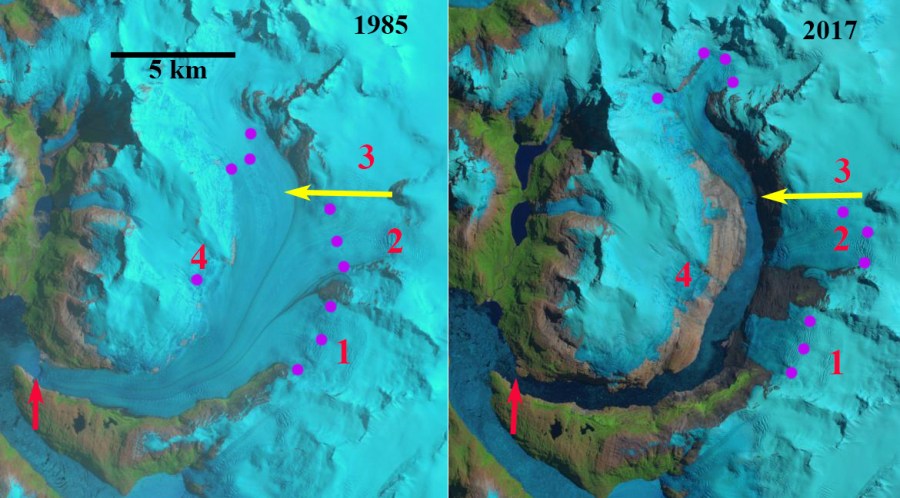
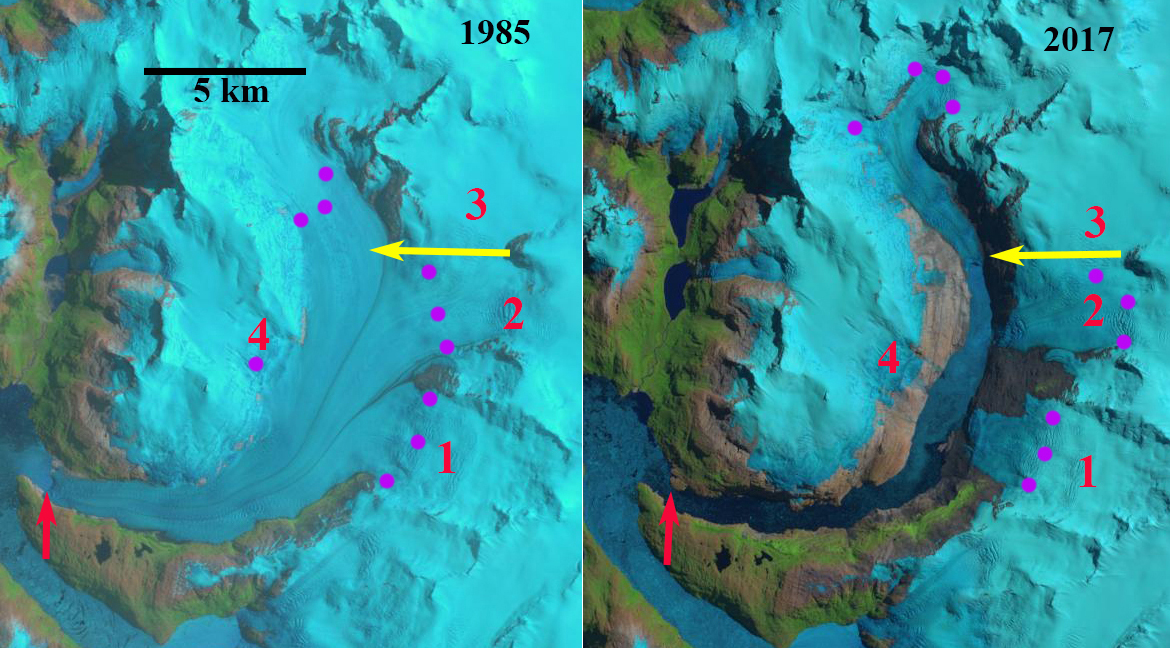
HPS-12 Glacier in 1985 and 2017 Landsat images. The red arrow indicates 1985 terminus, yellow arrows the 2017 terminus, purple dots the snowline and 1-4 are tributaries. By 2017 all tributaries have detached and the glacier has retreated 13 km.
HPS-12 is an unnamed glacier draining the west side of the Southern Patagonia Ice Cap (SPI). The glacier terminates in a fjord and is adjacent to Upsala Glacier to the east and Pio IX Glacier to the north. This developing fjord is also unnamed but feeds into Estero Falcon. Here we update the 2017 NASA Earth Observatory project I completed in 2017, that identified this as the fastest retreating glacier in Chile in the 1985-2017 period, using Landsat imagery from 1985-2025.
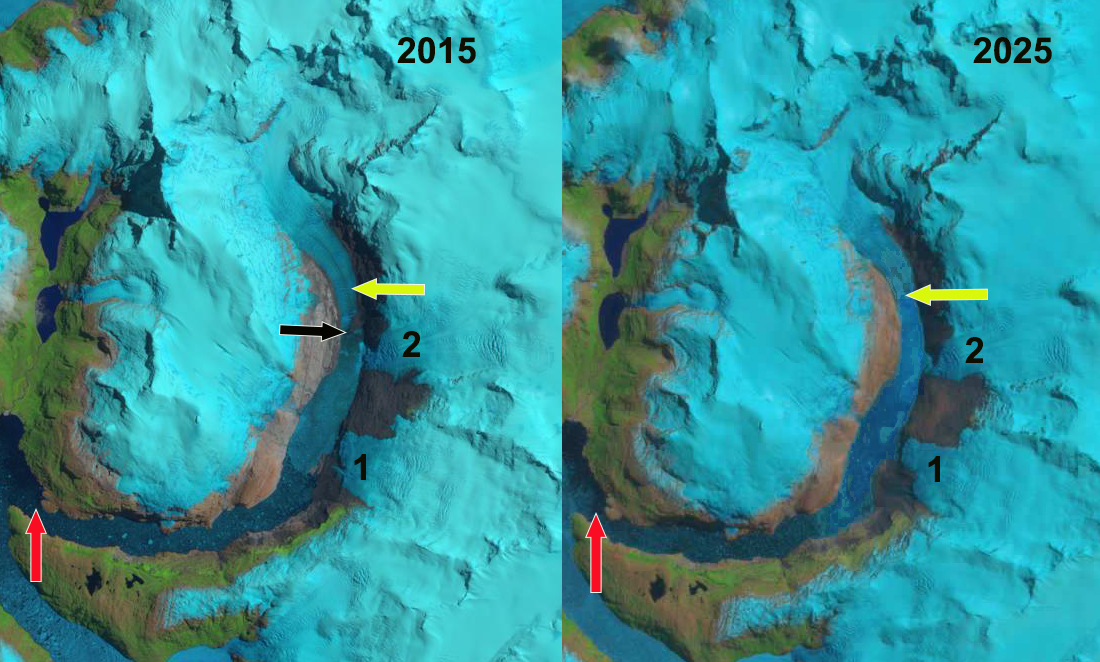
HPS-12 Glacier in 2015 and 2025 Landsat images. The red arrow indicates 1985 terminus, yellow arrows the 2025 terminus, black arrow the 2015 terminus. Former tributary 1 and 2 have declined in width .
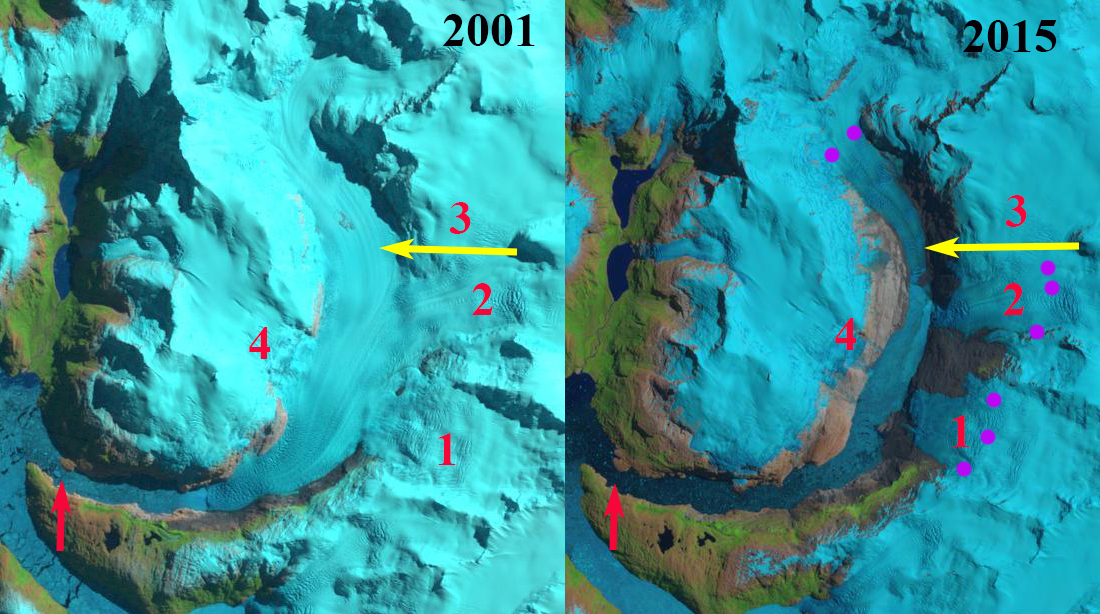
In 1985 the HPS-12 terminates 1.5 km from the junction of two fjords that are occupied by HPS-12 and HPS-13. These are separated by a peninsula. The glacier is fed by four tributaries labelled 1-4. The snowline in 1985 is at 900 m. In 2001 the four tributaries still join the main glacier, but the terminus has retreated 3.5 km. In 2015 glacier retreat has led to separation of tributary 1, 2 and 4 from the main glacier, tributary 3 only feeds tributary 2 and not the main glacier. The glacier retreat has continued to 2017, the current terminus is 800 m wide vesus 2800 m wide in 1985 . Total retreat from 1985 to 2017 was 13 km. By 2025 the glacier has retreated 14.75 km and has lost more than 50% of its total length. Tributary 1 and 2 continue to narrow from 2015 to 2025 illustrating that flow from the icefield accumulation zone is being reduced. This suggests less discharge into the terminus reach of HPS-12.
This glacier follows the pattern of retreat we have reported from Bernardo Glacier, O’Higgins Glacier, Tyndall Glacier and Upsala Glacier. The retreat is driven by the SPI have been experienced significant mass loss a. Malz et al (2018) noted a ~1 m/year mass loss from 2000-2016 with HPS-12 and Jorg Montt Glacier losing the most. Minowa et al (2021) found that 35% of all ablation of the Patagonia Icefields stemmed from frontal ablation.
HPS-12 Glacier in 2001 and 2015 Landsat images. The red arrow indicates 1985 terminus, yellow arrows the 2017 terminus, purple dots the snowline and 1-4 are tributaries. By 2015 tributaries 1, 2 and 4 have detached.
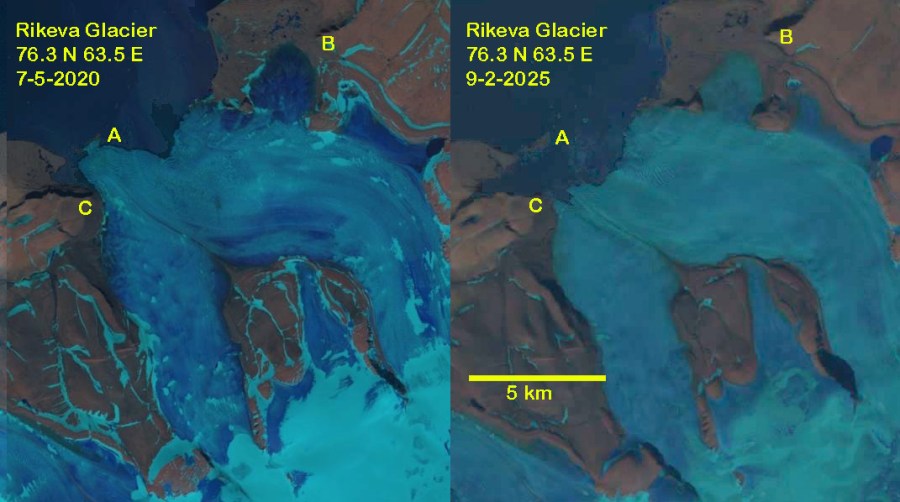
Rikeva Glacier retreat in Landsat images from 2020 and 2025. Illustrates new island at Point A and retreat of land terminus at Point B and from headland at Point C.
Rikeva (Rykacheva) Glacier flows from the Northern Novaya Zemlya Ice Cap to the west coast and the Barents Sea. The glacier has been retreating rapidly like all tidewater glaciers in northern Novaya Zemlya (Pelto, 2016) (Carr et al 2014) identified an average retreat rate of 52 m/year for tidewater glaciers on Novaya Zemlya from 1992 to 2010. Maraldo and Choi (2025) identified frontal retreat rate of Novaya Zemlya glaciers from 1931-2021 and found an increased each decade since the early 1970s, reaching a peak retreat rate of 65 m/year between 2011 and 2021. We have observed the impact at Vilkitskogo Glacier and Krayniy Glacier,
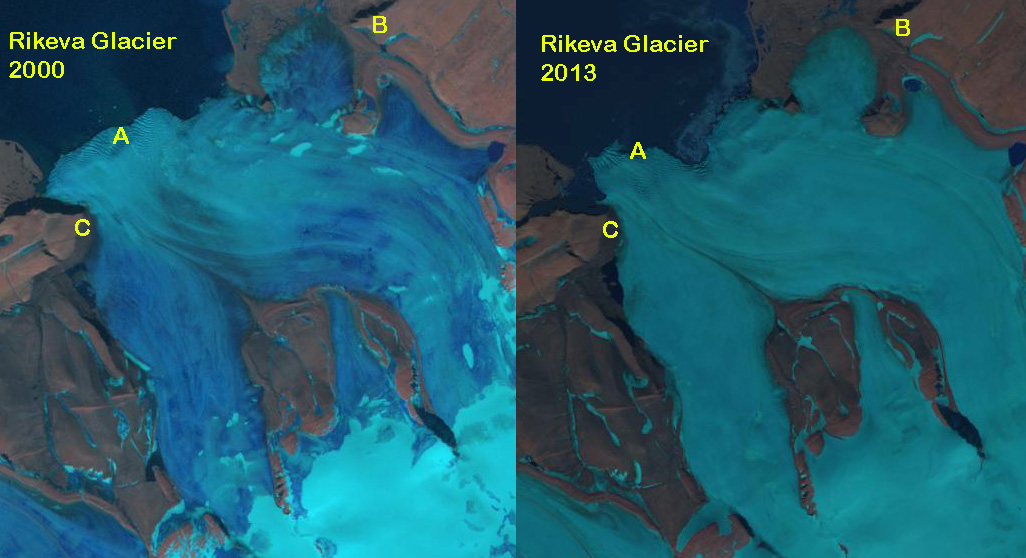
In 2000 Rikeva Glacier extended beyond the island that would emerge at Point A. The landbased terminus lobe extended just beyond Point B. By 2013 the glacier had retreated adjacent to the island, with the island acting as a stabilizing point for the terminus. The terminus lobe had retreated just south and east of Point B.
Rikeva Glacier in Landsat images from 2000 and 2013 illustrating retreat to island at Point A and retreat of land terminus at Point B.
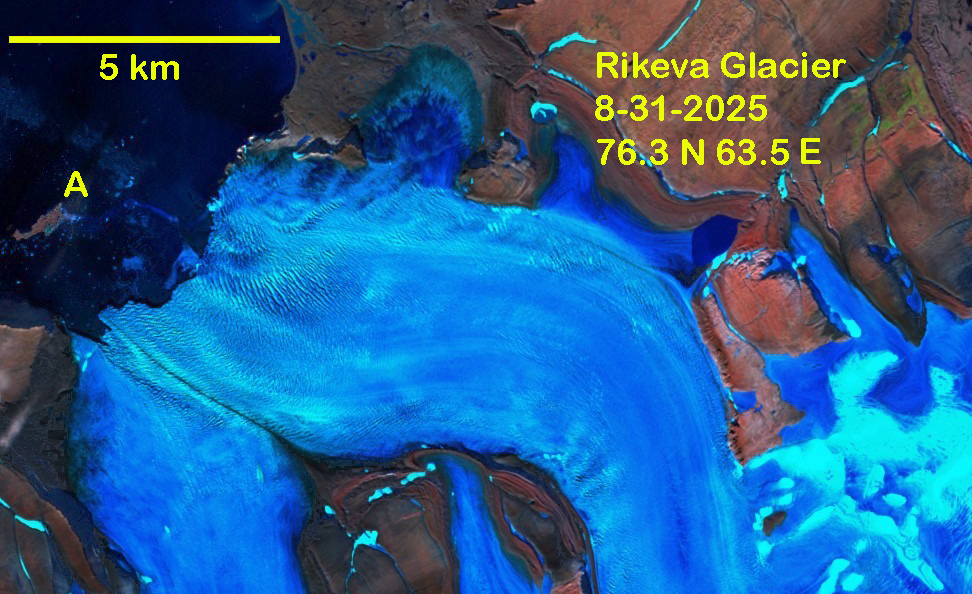
In 2018 Rikeva Glacier terminus rested on an island at Point A that acted as a buttress for the glacier terminus. By 2025 the glacier had retreated from the island with 4.5 km2 of glacier retreat since 2018 and 8 km2 of retreat since 2000.
Rikeva Glacier in Sentinel images from 2018 and 2025 illustrates retreat from Island at Point A.
Core field team in 2025 Emmett Elsom, Mauri Pelto, Jill Pelto and Caitlin Quirk.
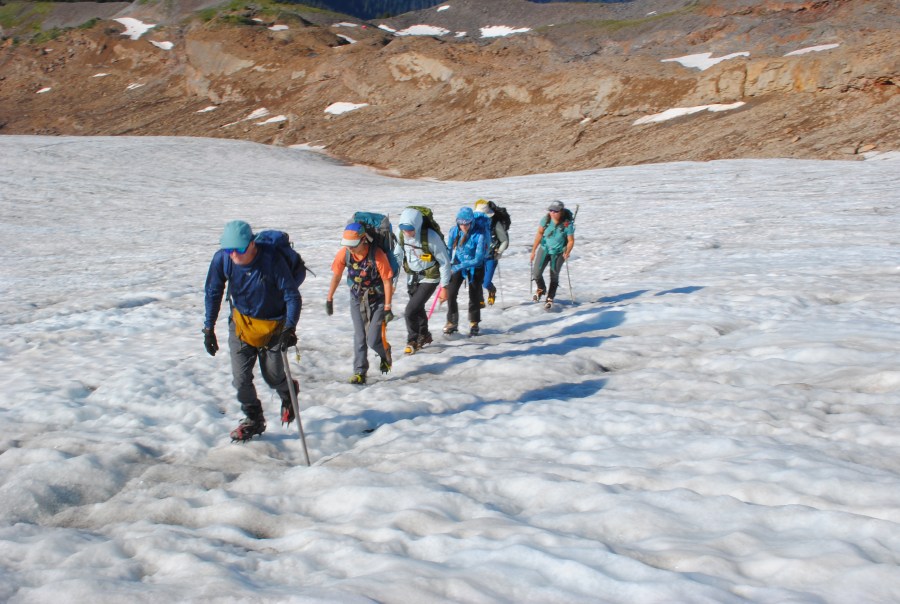
We hiked into North Cascade glacier to complete detailed observations for our 42nd consecutive year. These annual observations provide a detailed assessment of their response to climate change. For the third consecutive year North Cascade glacier on on average lost more than 2 m of glacier thickness. This cumulative loss of 7-8 m on most of the ranges glaciers that average 25-40 m in thickness represents 20% of their volume lost in just three years. On a few of the largest glaciers, such as those on Mount Baker that average 40-60 m in thickness the loss represents 12% of their volume lost.
The consequence is an acceleration of the collapse of the North Cascade glacier system. This landscape that has for long been shaped by ice is rapidly losing that glacier element. The rate of retreat for the glaciers we work on has accelerated so quickly that we are faced each year with changing terrain and new challenges. Beyond that, we are starting to really see the effect this retreat and the decrease in water has on the ecosystems both near the glaciers and further downstream. During the field season we love seeing the wildflowers, eating blueberries, and counting mountain goats. These are all parts of a habitat that is built around glaciers and snowpack. Seeing these shifts has been really difficult, but it helps to still return to these landscapes and continue to tell their stories through science and art. Below the story is told in images with captions by each of us who participated.
Two things that stood out during the 2025 field season were the strength of our collaborations, and the changing resources the glaciers are able to provide to the surrounding ecosystem. This visible change attracted the attention of KING5-Seattle NBC affiliate and CBS Morning News. At the bottom of this post the resulting footage is embedded. The film “Shaped By Ice” Jill and I worked on with Dan McComb has been a finalist in two recent film festivals, this footage also at bottom of this long read post.
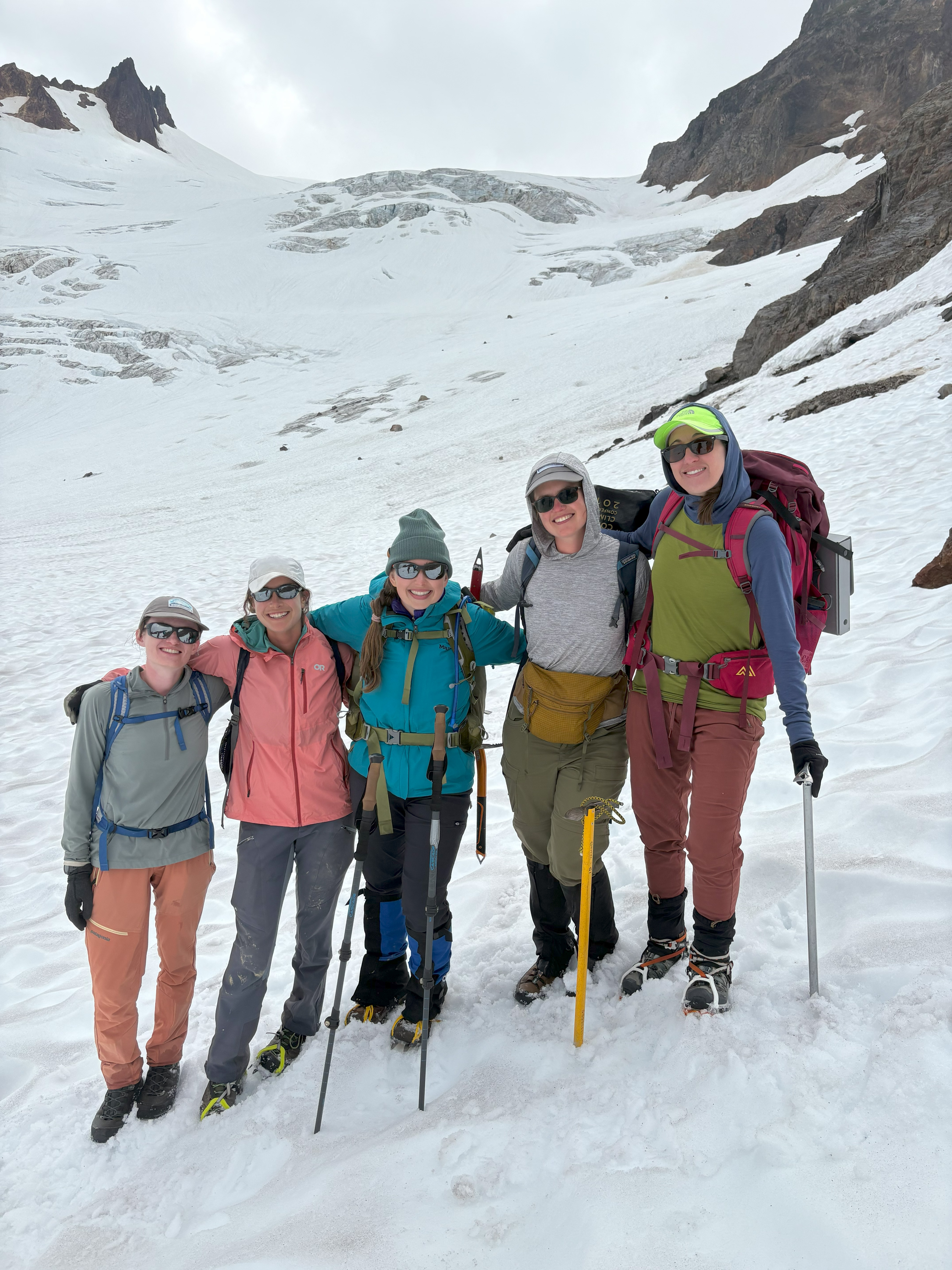
Working on Rainbow Glacier from left-Katie Hovind, Caitlin Quirk, Claire Seaman, Jill Pelto and Margaret Kingston
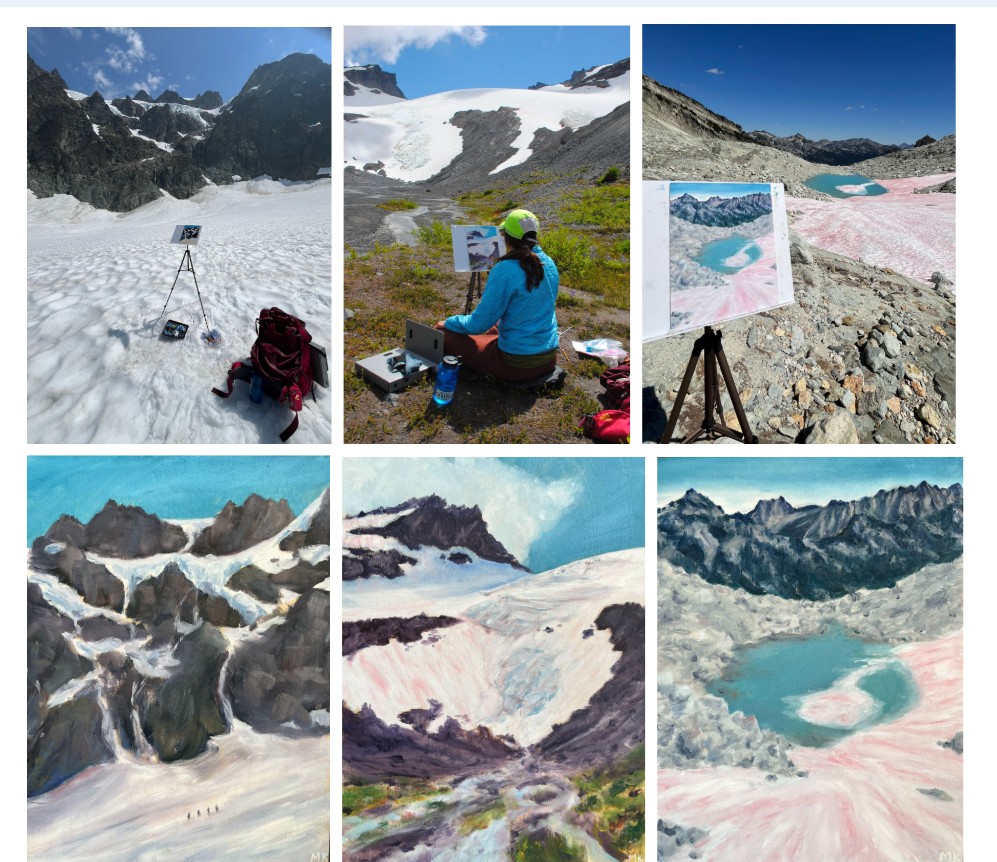
We worked with two oil painters, one watercolor painter, one printmaker, two news film crews, a team of botanists, and more. The result of all these collaborations has led to so many great stories being created and shared about our collective work. It also meant our core group of field assistants had to be flexible to a changing group and the sometimes difficult and imperfect logistics that accompany that. -Jill Pelto
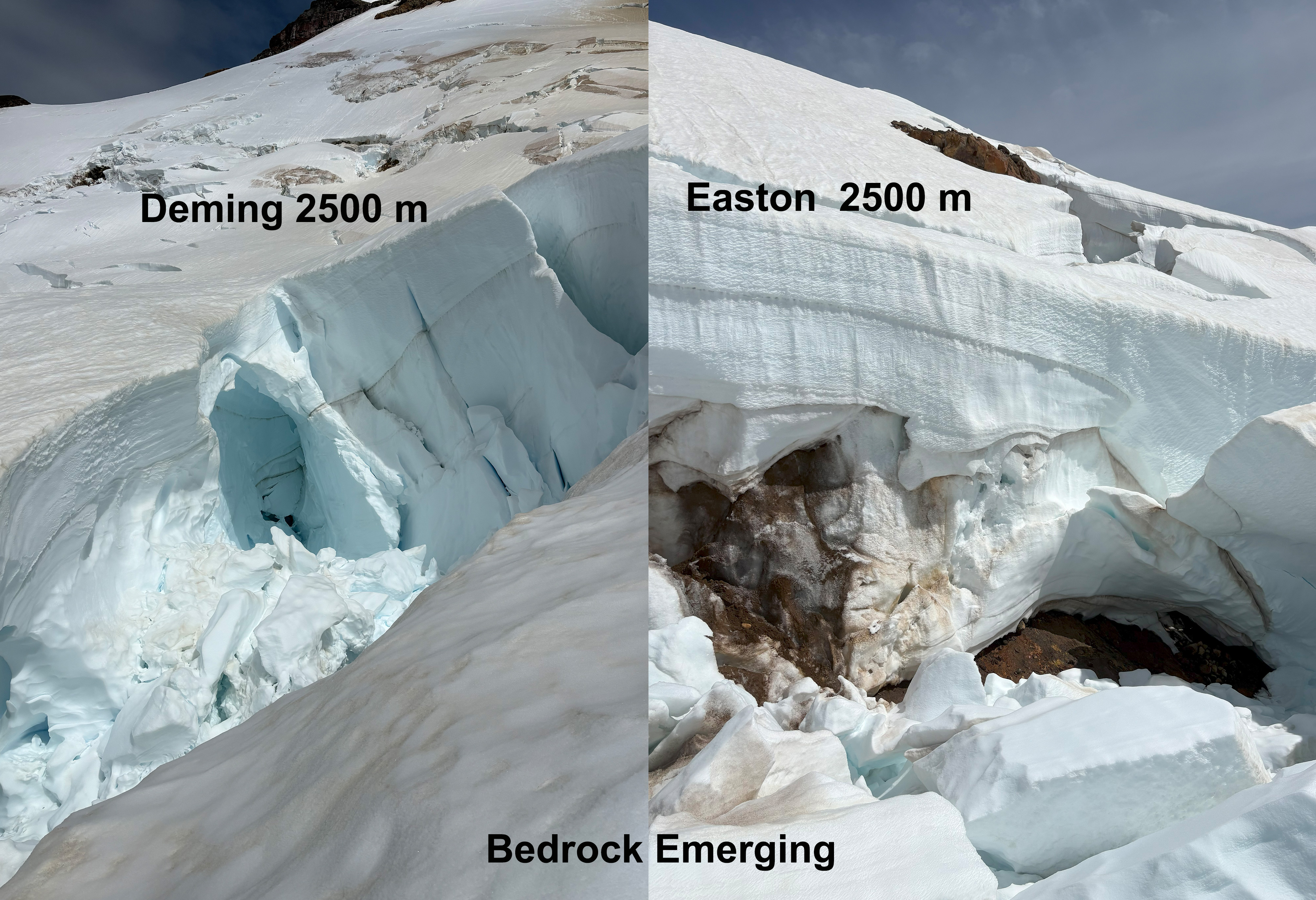
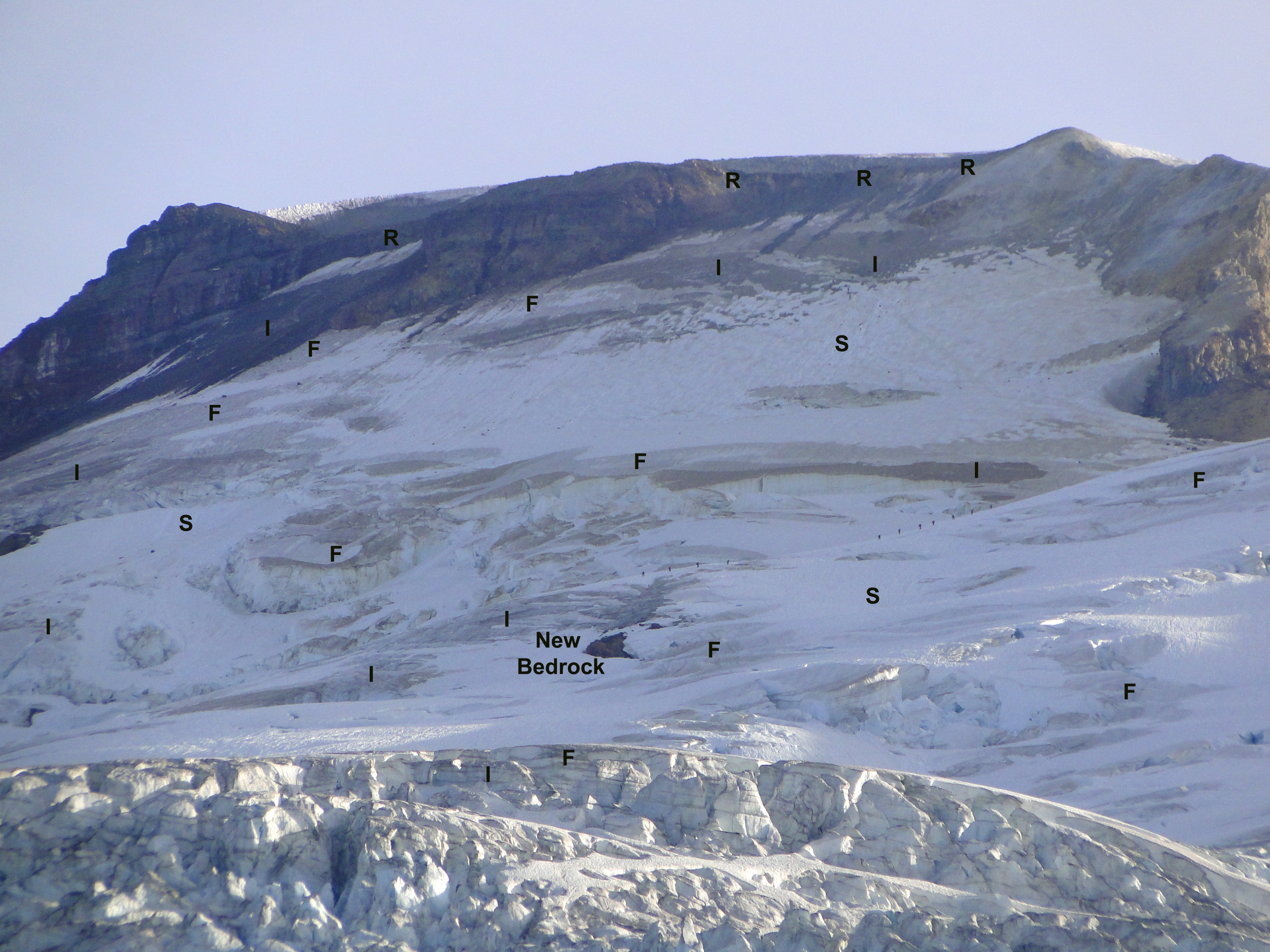
This photograph of an icefall at 2000 m (6700 ft) on the Easton glacier encompasses the wide range of emotions that I felt working on these glaciers this summer. The focal point of the picture is the wound inflicted upon the glacier by our changing climate. Bedrock and sediment creep through the gaping wound in the lowest icefall of the Easton, the opening visible for the first time in the project’s 42-year history. The place also holds a beauty, a sense of majesty that cannot be diminished by the tragic context of our work. The seracs at the top of the scene lean at impossible angles, destined to crash down onto the slope below, piercing the quiet of the snowy expanse in dramatic fashion. The dark annual layers in the glacier speak to the age of the ice, flowing down the flank of Mt. Baker over decades. The landscape has been a facet of my life for the past few years, as it falls upon the Easton Glacier route to the mountain’s summit. The icefall has always drawn me in as I pass, sparking a profound sense of wonder. It makes me deeply sad to see the beauty of such special places diminished, sad in a way that little else does. Over the past few years, I’ve come to like visiting these places to visiting an elderly loved one. While time may change them and even take them away from us, their beauty and meaning to me will hold true.-Emmett Elsom
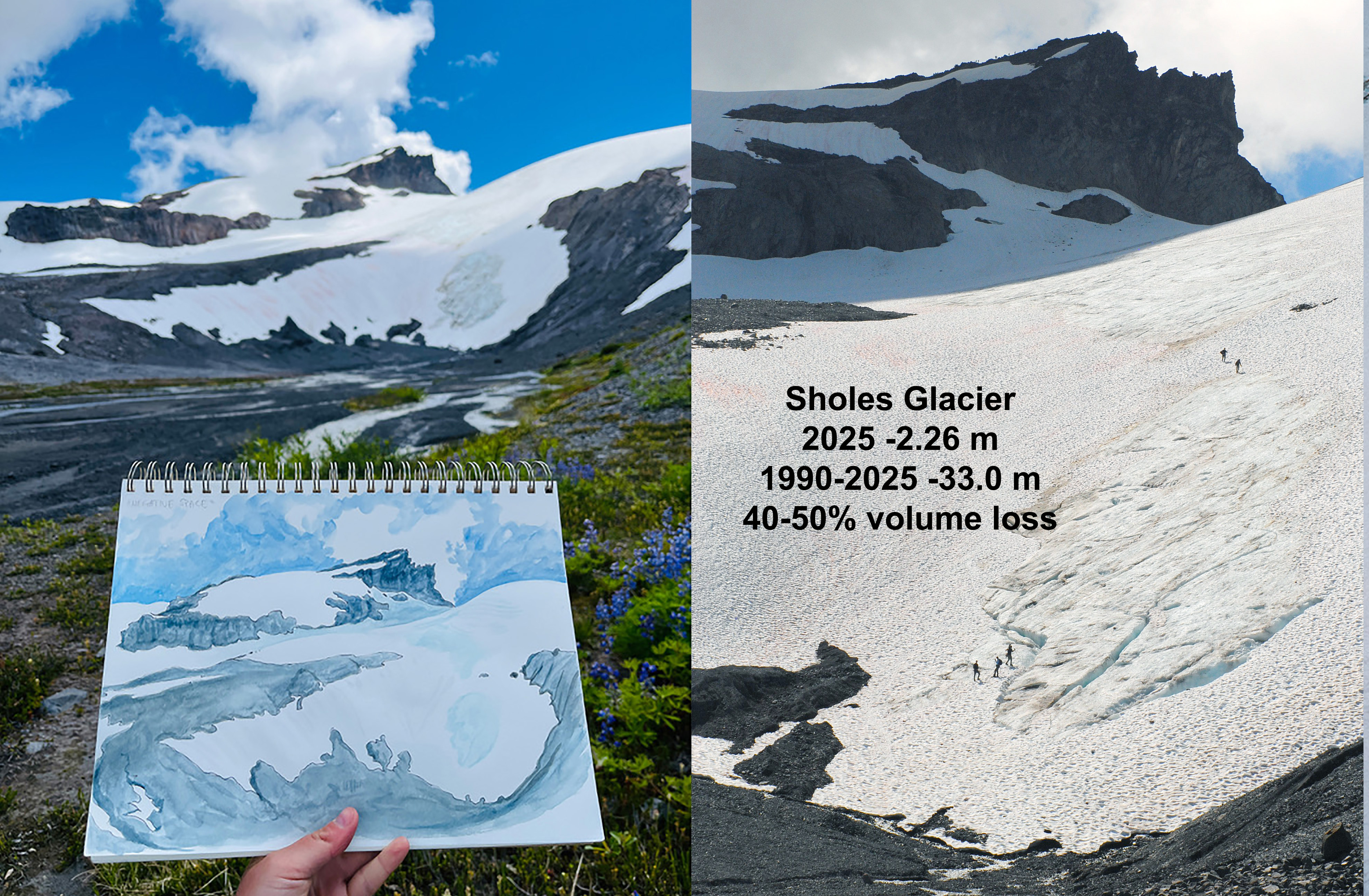
How does being present in a place shape our understanding? To the left is a view of Sholes Glacier, complete with my on-site rendition. I can’t express how lucky I feel to have had the chance to experience these places first hand. To interact with a place by attempting to capture its likeness — paying attention to the negative space not only between the white snowpack and black exposed rock, but in the empty, carved-out area that used to be filled with ice. Experiencing the texture of the glacier under your feet, the cool air drifting off the snow, the good tired feeling of your body after physically traversing top to bottom. This is what you don’t get from a photo. To know places such as these is to love them and see their role in the world, and want to protect them. But so many never get the chance to understand them this way.-Claire Seaman
This field season I focused on exploring the once-barren foreland a glacier leaves behind. Studying the plants growing in the wake of the Easton Glacier made me reflect on the way life responds to these major changes. This photo of a bright monkeyflower cluster in the streambed of the nearby Sholes Glacier exemplifies this resilience and optimism to me. The Sholes, in the background, drains a lifeblood that will feed the watershed downstream into the Nooksack, supporting people, fisheries, and a whole riparian ecosystem. The eventual loss of glacial ice feeding the river will be catastrophic, yet the scarred space left behind will blossom with vegetation. Witnessing firsthand how staggering the extent of glacial retreat is can be overwhelming, but that bright patch of flowers stands as encouragement. Alone in an altered landscape, those flowers will pave the way for more to follow. Change is nuanced, and as we watch it occur we can change, sharing stories of the beauty of this environment supported by ice, and adapting our lives and policies in a way that can be the difference which keeps glaciers flowing.-Katie Hovind
As a backcountry skier and oil painter focused on winter landscapes of the North Cascades, the idea of painting glaciers in the field was a dream come true! I knew what we would see and learn about the health of our glaciers from the scientists would be highly emotional, but the power of these environments disappearing in our lifetimes is something my words fail to communicate how devastating that feels. During the study on Rainbow glacier I caught on film the moment a serac collapsed, loudly crashing, crumbling from a newly melted out rock knob down the mountain splitting into smaller and smaller pieces. It looked sickly as it broke before our eyes. Another unique experience was going into a teal, translucent, otherworldly ice cave. I have started 2 paintings to capture this vanishing environment. My goal is to assist the project in translating the study’s findings through landscape paintings that communicate the beauty of these places with titles that call attention to the retreating glaciers in the North Cascades. We all have a responsibility as humans to make individual changes to combat climate change and vote like fresh water and air depends on it, because it does. -Margaret Kingston
The pace of glacier change struck me hard this summer. Never before have humans lived with such a deglaciated Cascades mountain range. Not the settlers, not the fur trappers, not the first people who have been here for 13,000 years or more. Cultures and ecosystems spawned from the retreating edge of the Cordilleran Ice sheet into the Puget Sound area. Alpine glaciers fed streams, rivers, salmon, all kinds of human projects in Washington State. Our societies are shaped by the ice and now we are experiencing glaciers disappear.
I write this at the end of the 2025 hydrological year, waiting for winter snow to shelter the land I love in a cool white blanket. The devastation of the alpine glaciers has surfaced so frequently in conversation these last couple months. Those who have seen the mountains are alarmed as beds of ice they once knew to be hundreds of feet thick look shallow and frail, ice pitches that were once climbed are now grey gullies of rock, and volcanoes which have always been white are unnervingly gray and shrouded in smoke. The realities of climate change in the Northwest are clear.
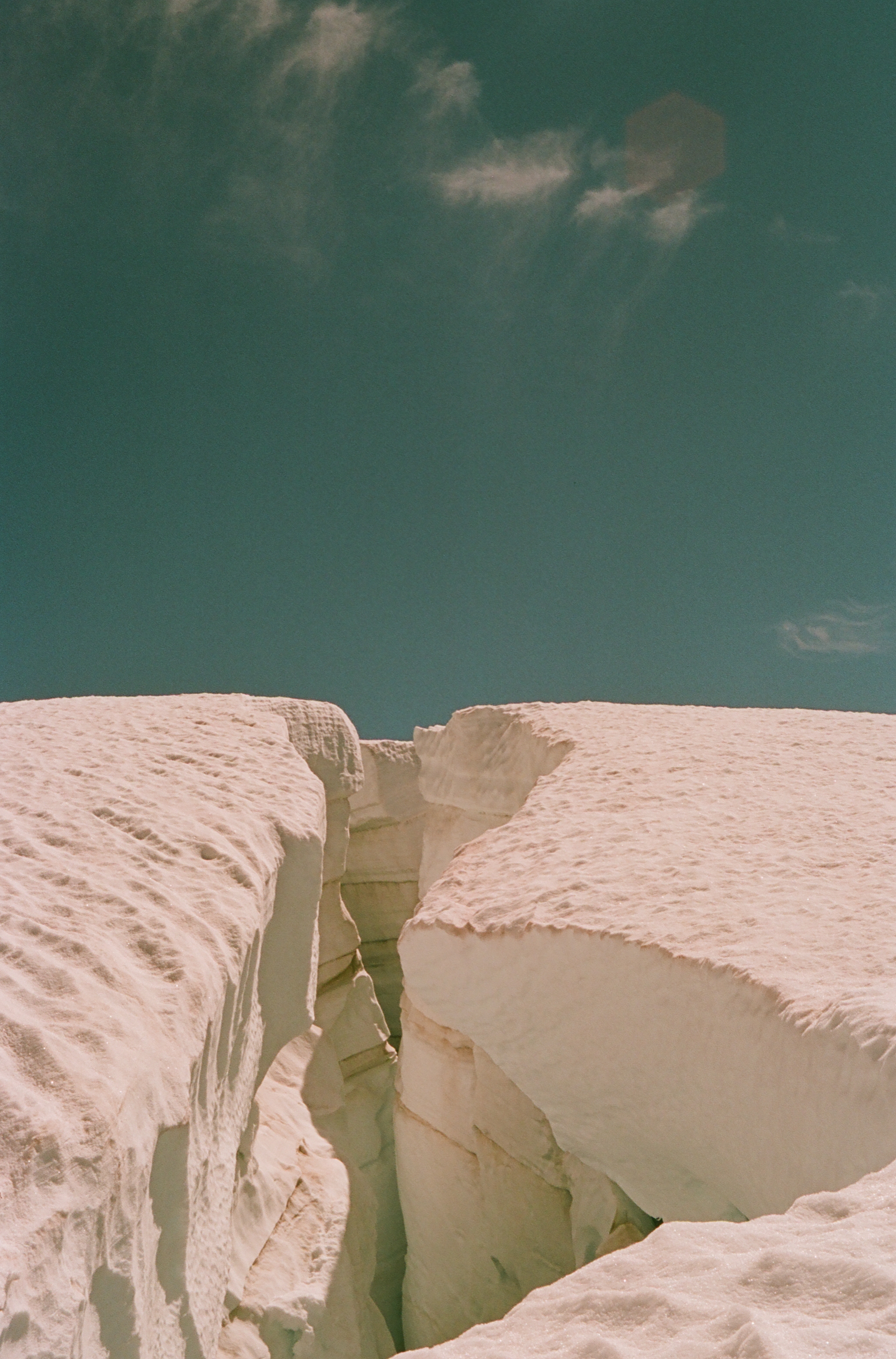
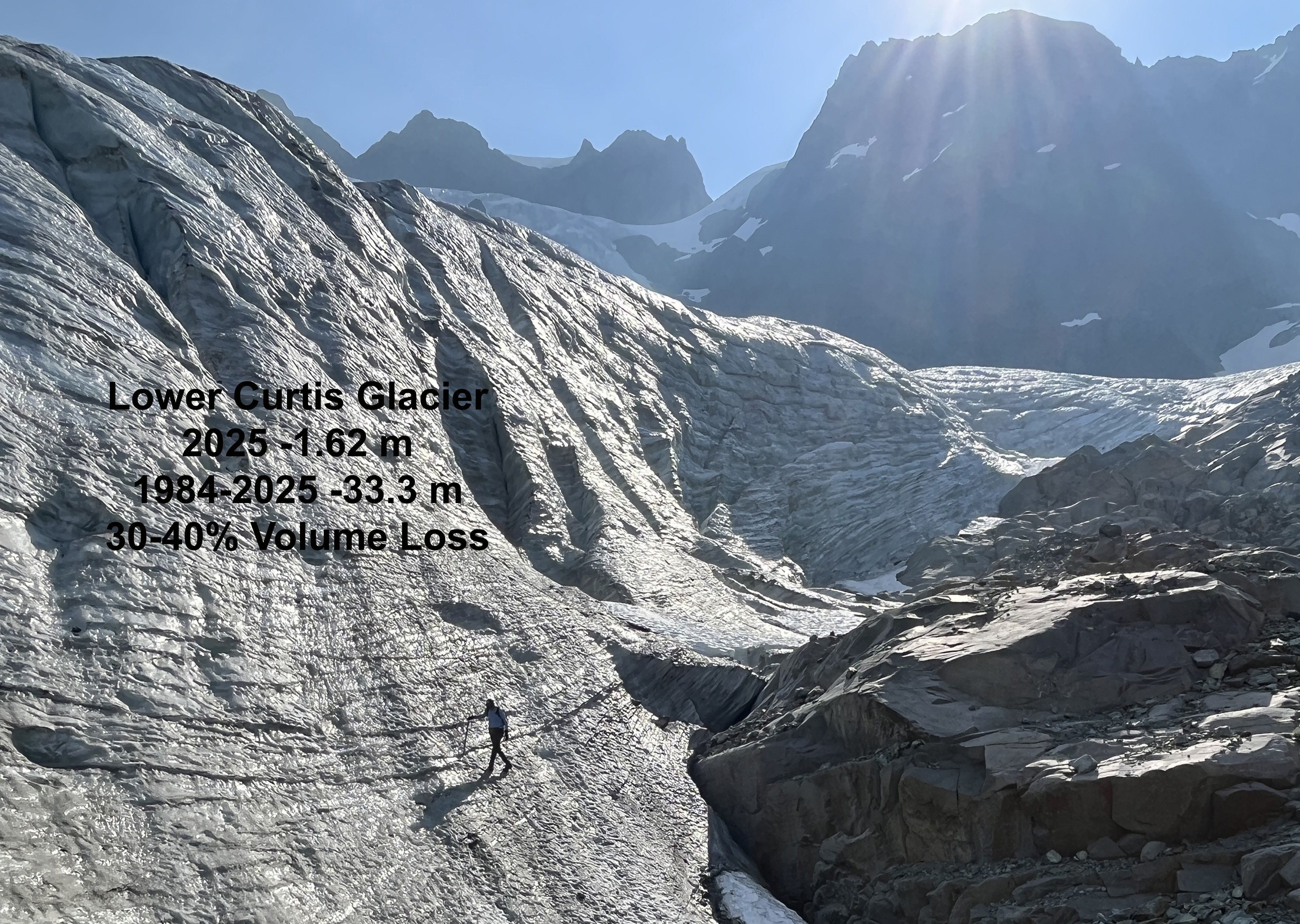
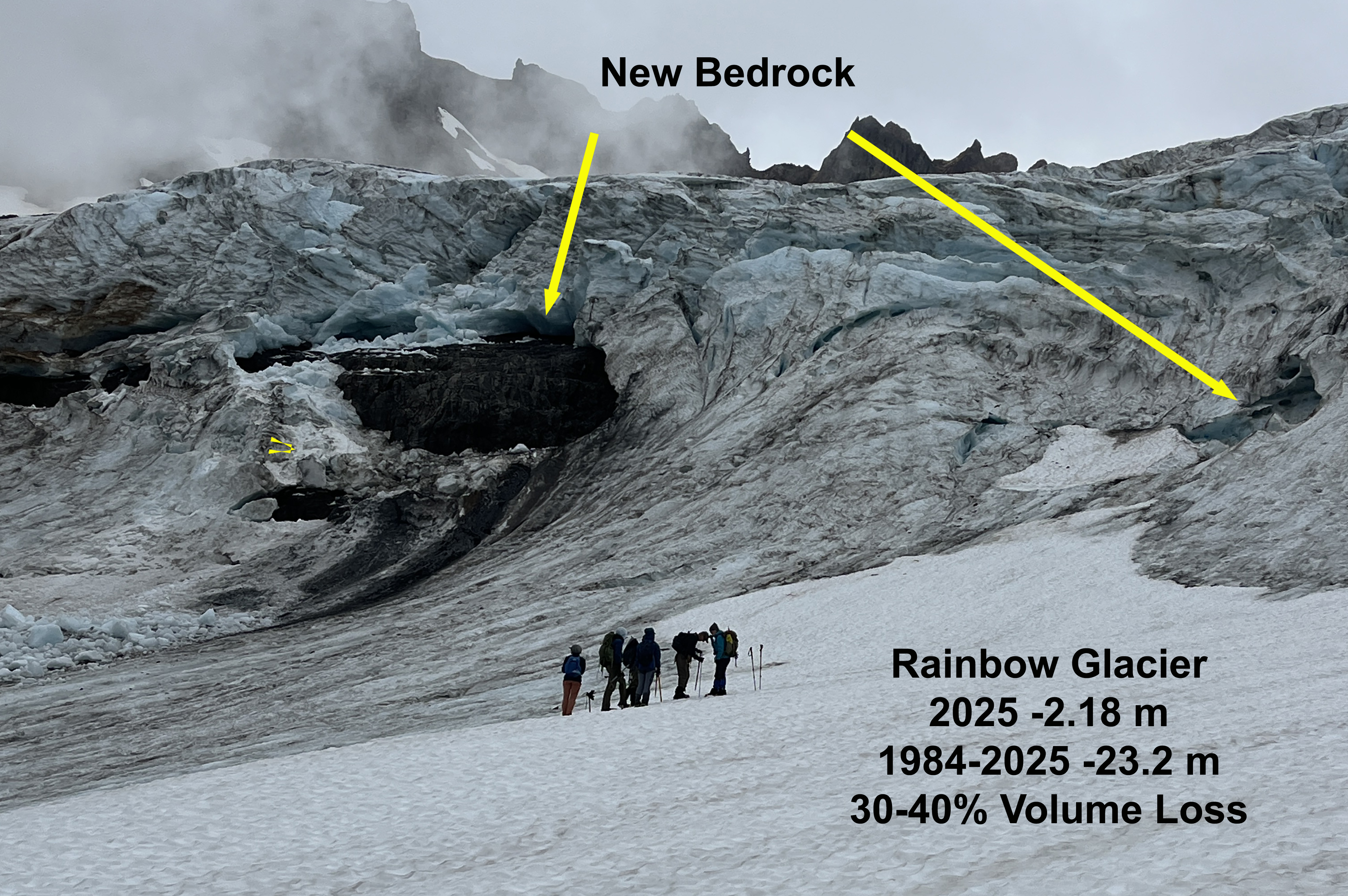
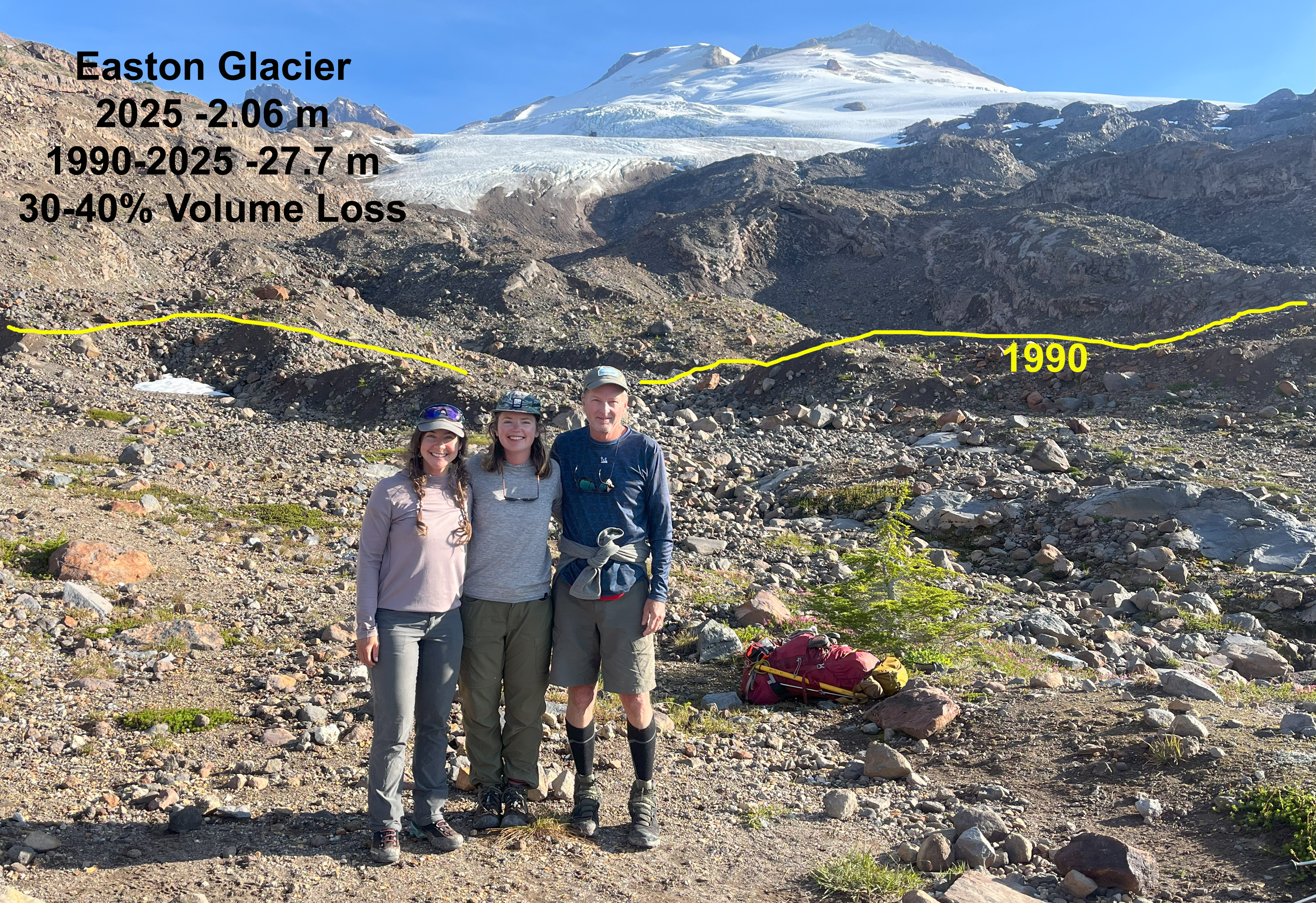
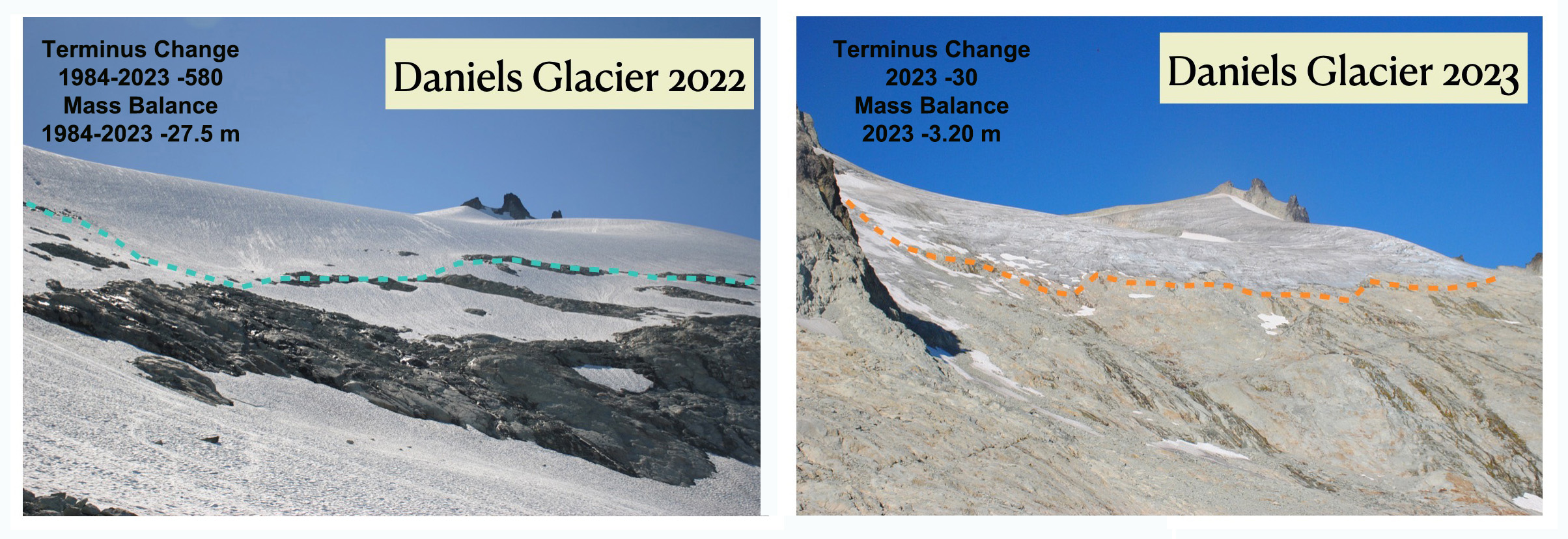
It is a painful time to care about the glaciers of the Cascades. Witnessing the erosion of something so much older and bigger and impactful than myself is staggering. There is much action to be done in this new terrain but for now, I come back to this: I sit in the dying glaciers warm light as the sun rises, summon the deepest snowfall in years and tell the glacier that we care, that we were grateful for all the help watering our food and feeding our oceans and making sure our salmon had somewhere to live. We are here because of you. -Cal WaichlerImage description: This image shows a crevasse on the Easton Glacier of Mount Baker. The saturation is distorted because I shot this photo on 35mm and pre-exposed the film to light and heat to parallel the material effects of global warming on our glacier systems. The Easton glacier is a source of water for Baker Lake, which provides recreation and hydropower to the region. When I see this photo, I think of the impacts of glacial melt to water, energy, cultural, and economic resources in Washington. -Caitlin QuirkColumbia Glacier is one of sixty global reference glaciers. This summer it lost 5% of its volume.Lower Curtis Glacier continues to rapidly thin at the top of the glacier as well as at the terminus. The glacier retained additional avalanche accumulation, leading to a less negative balance than other glaciers.Rainbow Glacier is one of the sixty global reference glaciers. This year new bedrock began to emerge and expand in several icefalls, leading to serac fall.Easton Glacier has retreated 700 m since 1990 and has a number of bedrock areas emerging in icefall up to 2500 m.Lynch Glacier east and west side are separating. The upper basin did retain some snow in 2025.Daniels Glacier lost all snowpack by the end of the summer and bedrock is quickly expanding amongst the glacier.
The trajectory for most North Cascade glaciers is one of fragmentation. This is illustrated by Foss Glacier on the east flank of Mount Hinman, that we began observing annually in 1984 but stopped measuring as it fragmented.Foss Glacier from the top was a 1 km long and nearly 600 m wide glacier. In Sept. 2025 Cal Waichler captured view from the top with the two main fragments now less than 50 m wide and 300 m long.-Mauri Pelto
Leah Pezzetti KING5 meterologist hiked in with us to Lower Curtis Glacier.
The CBS team hiked into Sholes Glacier with usspending the night, and we had three generations of Pelto’s.
Hofsjokull East is snow free on 8-17-2025 in this false color Sentinel image. This leads to ice melt, thinning and bedrock expansion at Point A-D.
Hofsjokull East, Iceland is a small ice cap east of Vatnajokull with a summit elevation of 1100 m. In the last decade the snow line has often been above the ice cap. The ice cap had an area or 4.97 km2 in 2003 declining to 2.51 km2 in 2023 (Iceland Glacier Viewer). In 2024 all 10 glaciers in Iceland had significant mass loss (Pelto, 2025).
In August 2020 the ice cap has lost nearly all of its snow cover, this occurred again in 2023 and 2024. The result in 2025 when the ice cap again lost all its snowcover, is significant glacier surface melt and thinning. This leads to expansion of bedrock. At Point A there has been rapid expansion of the bedrock knob. At Point B and C new bedrock has been exposed and rapidly expanded. At Point D a bedrock rib at the edge of the ice cap has spread into the ice cap.
The lack of snow cover indicates the ice cap no longer has an accumulation zone and cannot survive. In 2025 the ice cap area is 2.10 km2 . Ice cap area has declined by ~60 % in the last 22 years. The story here is similar to that at the larger Prándarjökull 10 km to the northeast. The summer of 2025 in Iceland was exceptional beginning with a May heatwave, followed by a July heatwave. The May heat wave led to high snow lines as summer began on Vatnajokull.
Hofsjokull East is nearly snow free on 8-14-2020 in this false color Sentinel image. Contrast the area of bedrock at Point A-Dto the 2023 and 2025 images.
Hofsjokull East is nearly snow free on 9-3-2023 in this false color Sentinel image. Point B and C now have evident bedrock areas.
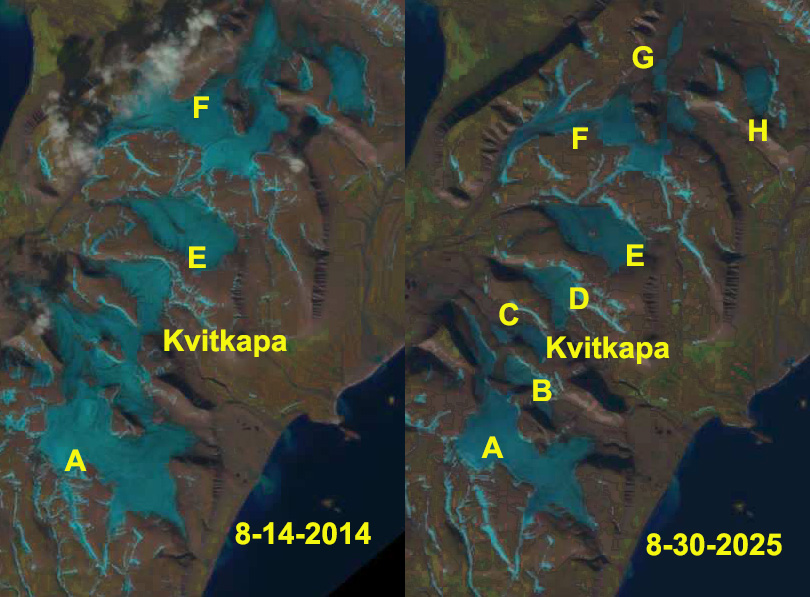
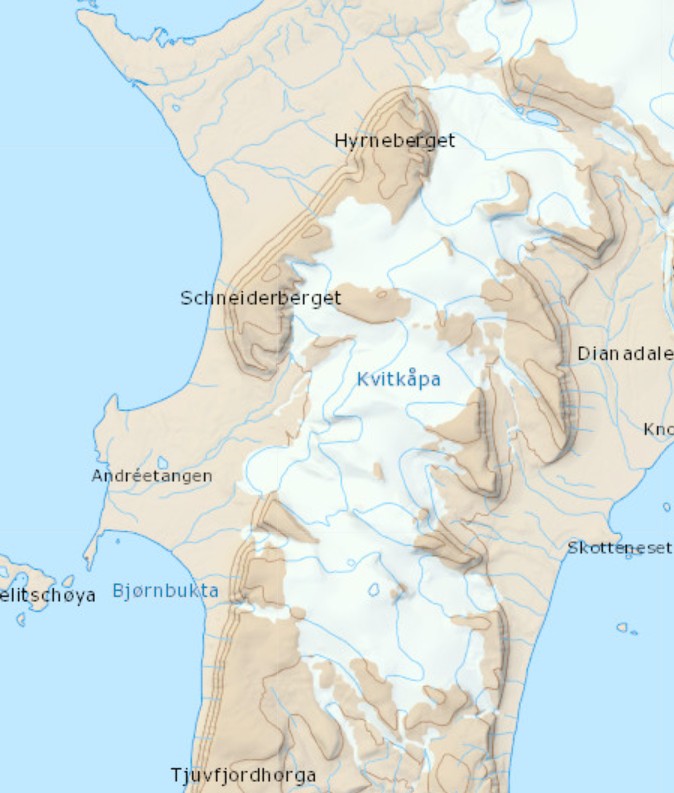
Kvitkapa in Landsat images from 2014 and 2025 indicating the fragmentation from 3 to 8 different glacier parts.
In 2022, 2023 and 2024 a number of ice caps and glaciers across Svalbard lost all snow cover, ie. Edgeøya 2022. The result by 2024 was that all firn cover had been lost as well on many of the ice caps of Edgeoya, such as on Digerfonna. This largely removes the ability of meltwater to refreeze. In 2025 we again see this playing out on the ice caps of Edgeøya. This all too familiar story indicates these glaciers lack a consistent accumulation zone that is essential for their survival
Map of Kvitkapa from TopoSvalbard indicating one interconnected ice cap in 2000.
Kvitkapa is an ice cap on a peninsula on the south coast of Edgeøya Island. In a map of this region from TopoSvalbard this is a single interconnected system of glaciers. By 2014 Landsat imagery indicates the ice cap has separated into three sections. By 2025 the ice cap has fragmented into eight different parts.
On the next peninsula to the east Kvalpyntfonna has also lost all snow cover again 2025.
Kvalpyntfonna in Landsat image from 2025 having lost all its snow coverand has no residual firn from previous winters either.
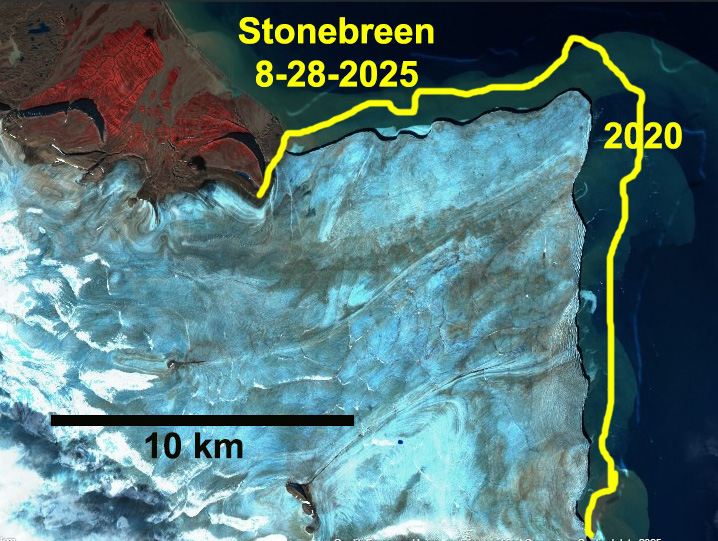
Further north and east on Edgeøya the Stonebreen ice cap has also losts its snow cover and firn cover driving thinning and retreat. The consistes loss of snow cover and resultant loss of firn cover, indicates that most ice caps Edgeøya cannot be sustained.
Stonebreen in false color Sentinel image illustrating retreat from 2020-2025. The lack of retained snow cover and residual firn will lead to continued rapid thinning and retreat.
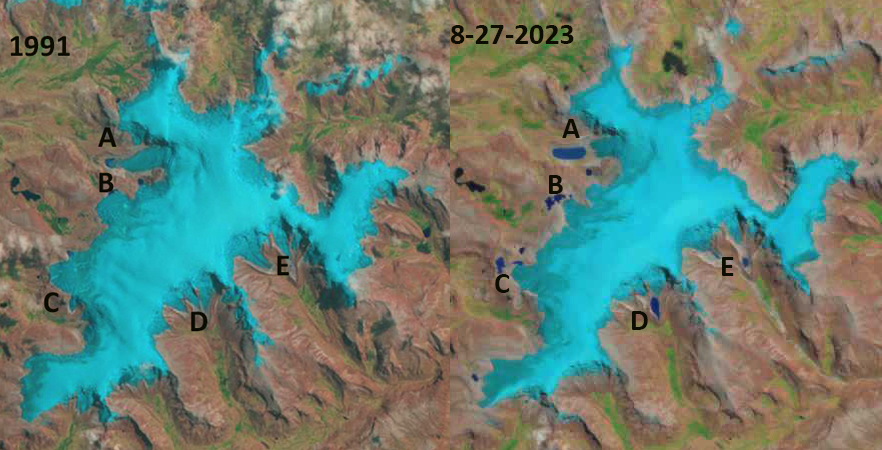
Quelccaya Ice Cap in 2013 and 2024 Landsat images illustrating snow line at 5600 m in 2024 and retreat leading to lake expansion at Point A-E from 2013 to 2024.
Quelccaya Ice Cap (QIC) is located in the tropical Andes of southeast Peru. Along with Coropuna Ice Cap it is one of two large ice caps in the area. Lamantia et al (2024) observed a 37% decline overall QIC area from 1985-2022, and a 57% decline in snow covered area. They observe snow cover is particularly limited during El Nino events. Here we examine the particularly high snowline and resulting minimum snow cover on QIC in 2024.
Quelccaya Ice Cap in 2024 August false colar and October natural color Sentinel 2 images. Snow line is at 5600 m in October with 25% snowcover.
The 2023-24 winter season featured El Nino conditions. During spring 2024 El Nino ended and neutral conditions persisted through summer. By late August 2024 the snowline on QIC averaged 5500 m (false color Sentinel Image). By late September 2024 the snowline had risen to ~5600 m, leaving the southern 1/3 and eastern arm of QIC with no snow cover, Landsat image. Overall snowcovered area dropped to ~25%, much below the 75% needed to maintain the ice cap (Lamantia et al. 2024). Despite a few minor snow events that briefly covered the ice cap, in late October the snowline had returned to 5600 m with ~25% snow cover. This is the least extensive snow cover since satellite images allow for mapping in 1984, falling below 10km2 . This is lower than the mininmum of ~15 km2 observed in 2023, which along with 1986 and 2016 had featured the lowest snow covered area on QIC (Lamantia et al. 2024). During this late summer period much of ablation is from sublimation (Fyffe et al 2021).
The high snow line elevation of 2024 exposing the majority of the ice caps glacier ice surface, which melts more rapidly than snow cover, leads to rapid thinning and volume loss.
The series of lakes that began to develop after 1991 at the margin of the QIC have expanded, and now are separating from the retreating ice margin.
Quelccaya Ice Cap in 1991 and 2023 Landsat images illustrating snow line at 5500 m in 2023 and retreat leading to lake development at Point A-E from 1991 to 2024.
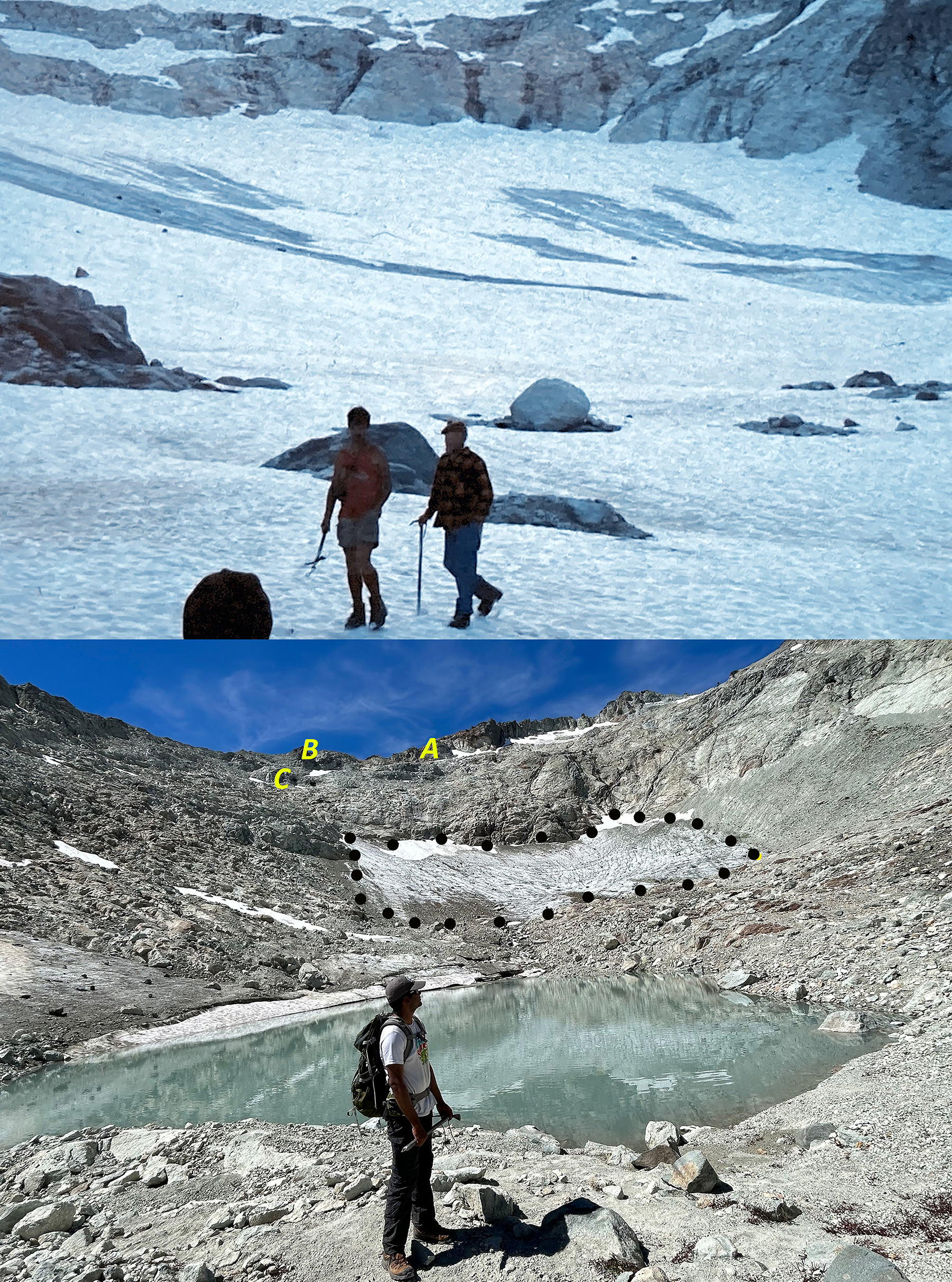
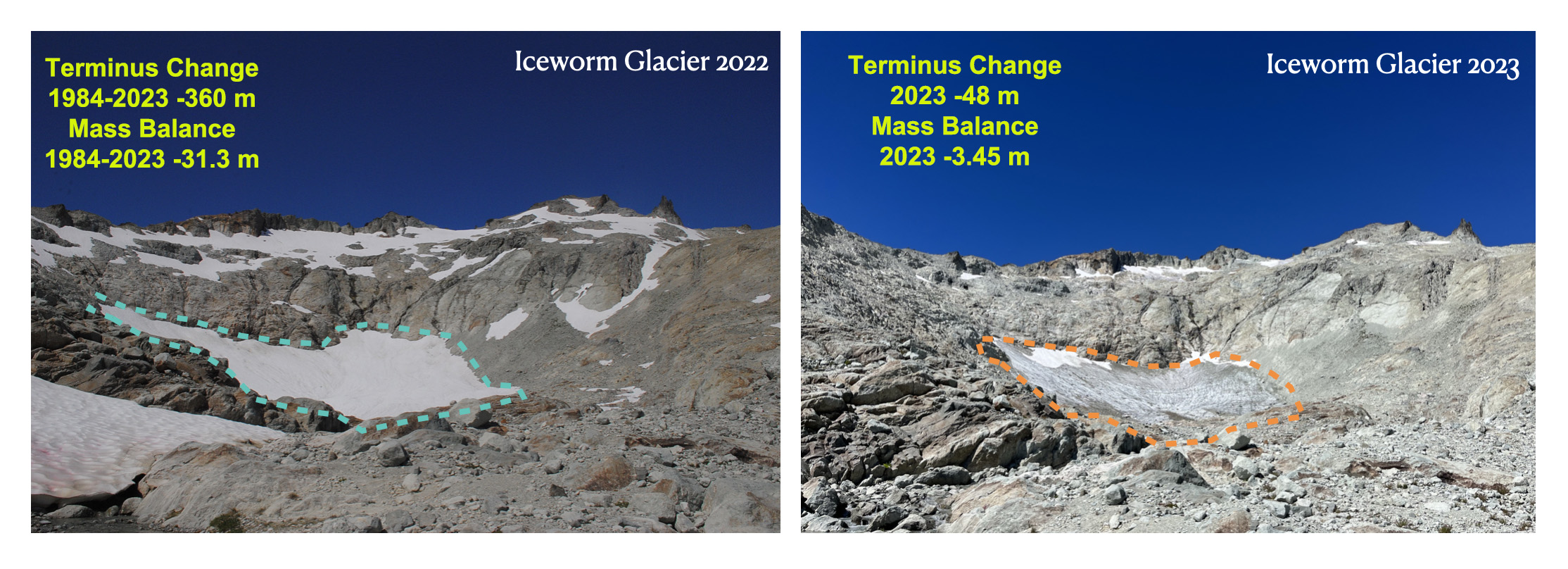
Ice Worm Glacier from the same location in 1986 and 2023, Bill Prater in 1986 image.
Ice Worm Glacier is an east-facing cirque glacier on the east flank of Mount Daniel, WA. Mount Daniel is on the crest of the North Cascade Range of Washington, the crest separates the dry east side that drains to the Columbia River and the wet west side that drains to Puget Sound. The glacier is at the headwaters of Hyas Creek, which drains into the Cle Elum River and the Cle Elum Reservoir. The Cle Elum Reservoir has a storage volume of 538,900,000 m3 and is primarily used for flood control in spring, and agricultural irrigation in summer. This reservoir is the largest in the Yakima River Basin and provides irrigation to 180,000 hectares of agricultural land. The glacier is located in the Alpine Lakes Wilderness area which prohibits the use of mechanized equipment. The Ice Worm Glacier cirque floor is at 1940 m and the headwall at 2050 m. There is a bench at 2150–2300 m that held a glacier/perennial icefield prior to 2015. The glacier is accessed by backpacking 8 km from the Cathedral Rock trailhead with the same base camp used each year at 1700 m on the bank of Hyas Creek. Detailed publication by Mauri and Jill Pelto at: Loss of Ice Worm Glacier, North Cascade Range, WA USA, 2025.
The glacier is fed by wind drift accumulation along the ridge that was just above the top of the glacier during the 1944-2000 period. Avalanching from the slopes below the East Peak of Mount Daniel and from the ridges extending along the north and south flank of the glacier have also been significant. The glacier is part of the Mount Daniel-Mount Hinman Glacier Complex just south of Highway 2 and sits astride the Cascade Divide. This complexcomprised of 9 glaciers covering 3.8 km2 in 1984. This was the biggest cocentration of glaciers between Mount Rainer and Glacier Peak. At the end of the summer 2023 melt season only three of these remain as glaciers, Daniels, Foss and Lynch Glacier. We began monitoring these glaciers along with Ice Worm Glacier in 1984.
Ice Worm Glacier Evolution
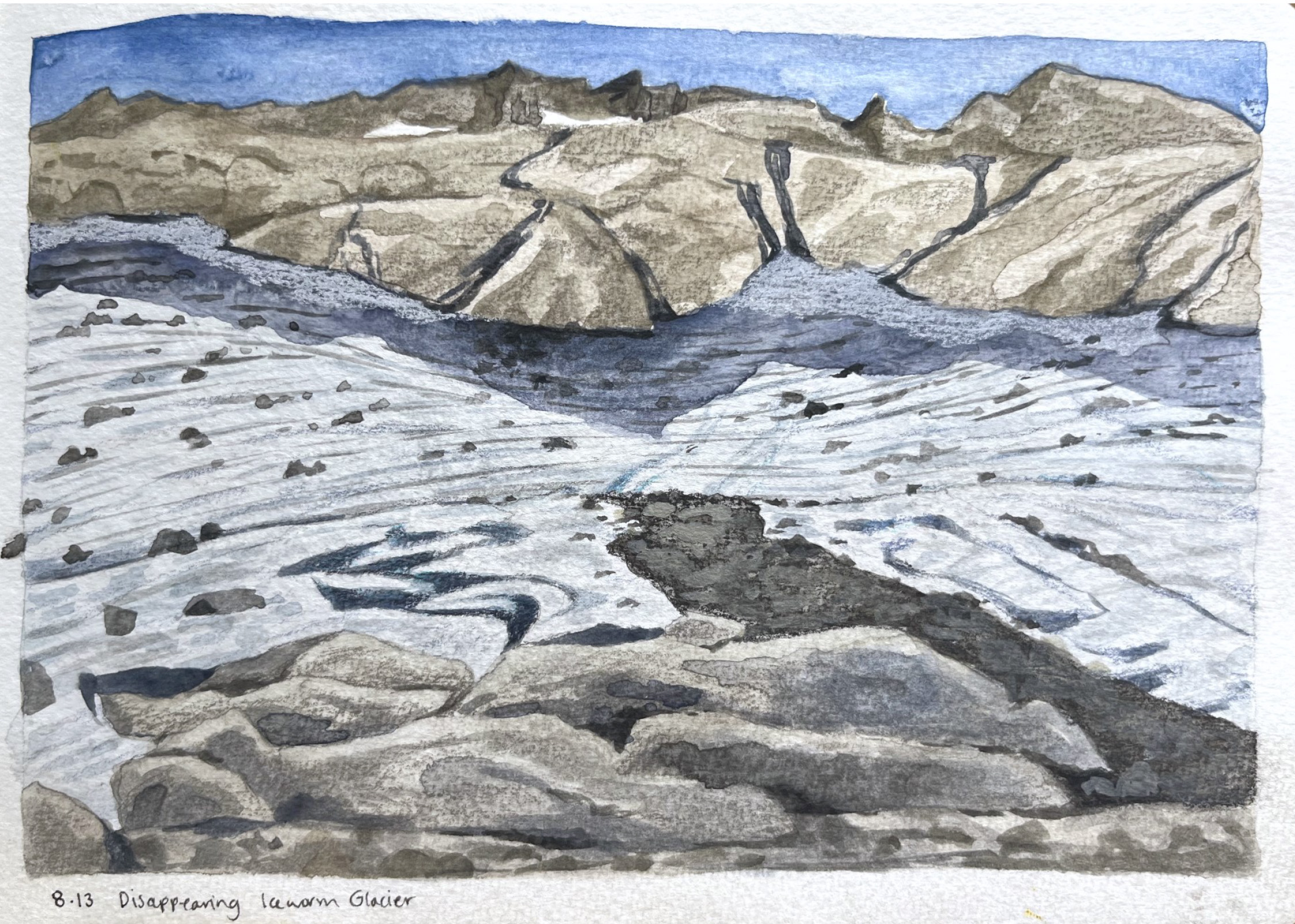
Ice Worm Glacier field sketch by Jill Pelto in 2023.
In 1986 William (Bill) Prater, who had made many first ascents in the area between 1944 and 1960, joined us in the field. Bill also had invented and patented (1973) the first snowshoe with a claw attached to its binding, the Sherpa Snowshoe. Comparing images from these early visits with the current margin of Ice Worm Glacier indicated that there had little change in this glacier from 1944-1986. The mapped area in 1958 was 0.19 km2 (GLIMS, 2023), in 1986 we mapped the area at 0.18 km2.
Each summer during the third week in August we measure the mass balance of this glacier. Because the glacier lacks crevasses we simply grid the glaciers with measurements made 50 m apart along transects running up the glacier and across the glacier along the margins. We also completed a longitudinal profile running up the glacier from a fixed location on the bedrock at the below and at the top of the glacier. The surface elevation was determined at the specific 50 m points to identify thinning of the glacier. During the first decade the glacier extended to within 10 m of the ridge on the south side of the glacier, allowing us to ski off of the ridge, see 1990 image below.
Glacier Area Change
View of the south ridge across Ice Worm Glacier in 1990 above and 2006 below, note recession of the top of the glacier from this ridge.
From 1984 to 1992, the glacier extended to within 15 m of the ridge on the south side of the basin. By 1995 this was no longer possible as the top of the glacier was retreating as fast as the bottom of the glacier. In 2006, the recession from this ridge was greater than the recession at the terminus. The glacier perimeter was surveyed in the low snow years of 2005 and 2015, identifying the glacier area to be 0.15 km2 and 0.110 km2, respectively. In 2015, the inventory for RGI noted an area of 0.106 km2. Annually, from 2021 to 2024, low snow cover allowed for mapping of the glacier perimeter during a rapid decline from 0.09 km2 to 0.03 km2. The area loss from 1986 to 2015 was 0.07 km2, which is less than the area loss from 2015 to 2023 of 0.08 km2. provides a photo comparison of the change from 1986 to 2023, with the people standing in the same location in each case. The observed area determined in the field from the GPS position locations closely matches the RGI inventory area in 2015 and the area derived from overlaying the points on Sentinel 2 imagery from August 2021 to 2024, which have a 10–30 m resolutionThis summer we observed a dozen holes that reached the bottom of the glacier 4-6 m below, indicating how thin the ice is. There is no movement, the size and thickness are too low to generate future movement, hence this is no longer a glacier. A glacier is a body of snow and ice that is moving, this requires a persistent thickness of 20-30 m, which is typically associated with snow/ice areas of ~50,000 m² or larger. As a glacier becomes thinner or smaller than this movement will not be sustained.
Table 1. The observed area of Ice Worm Glacier from field measurements. The area of Ice Worm Glacier from previous inventories and Sentinel 2 imagery.
Year
Field Mapped Area (m2)
Validating Aerial/Satellite Image Area (m2)
1958
190,000 (GLIMS)
1986
180,000 (±10,000)
Field Observation only
1992
170,000 (±10,000)
Field Observation only
2005
150,000 (±5000)
Field Observation only
2015
110,000 (±5000)
106,000 (RGI)
2021
88,000 (±2000)
90,000 (Sentinel)
2022
68,000 (±2000)
Field Observation only
2023
41,000 (±2000)
40,000 (Sentinel)
2024
32,000 (±2000)
30,000 (Sentinel)
We have measured discharge at a natrual weir below Ice Worm Glacier since 1986. Average August daily runoff has declined 60% by 2022.
Glacier Base Observations
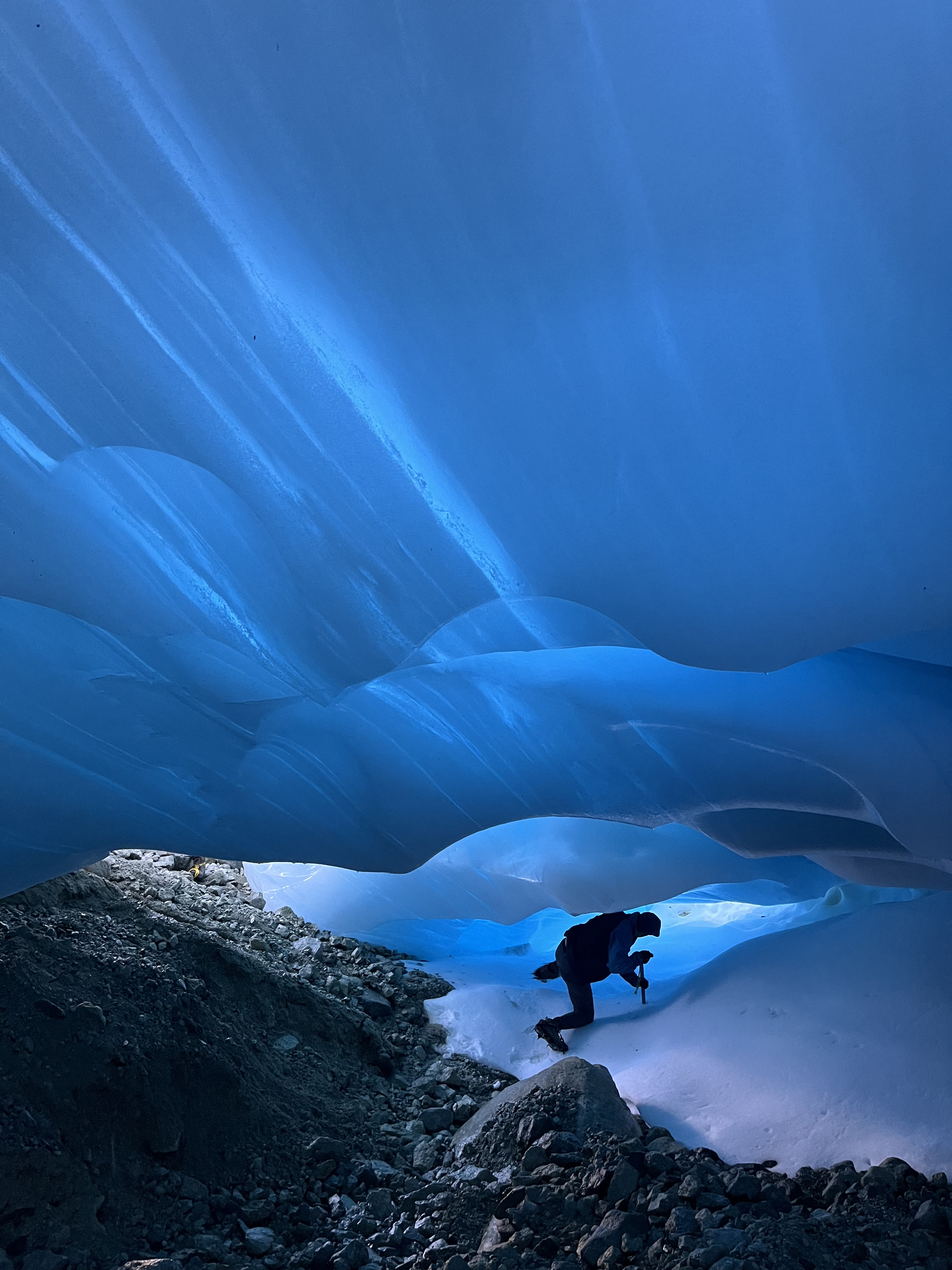
Ice Cave in 2024 that extended from top to the end of the glacier.
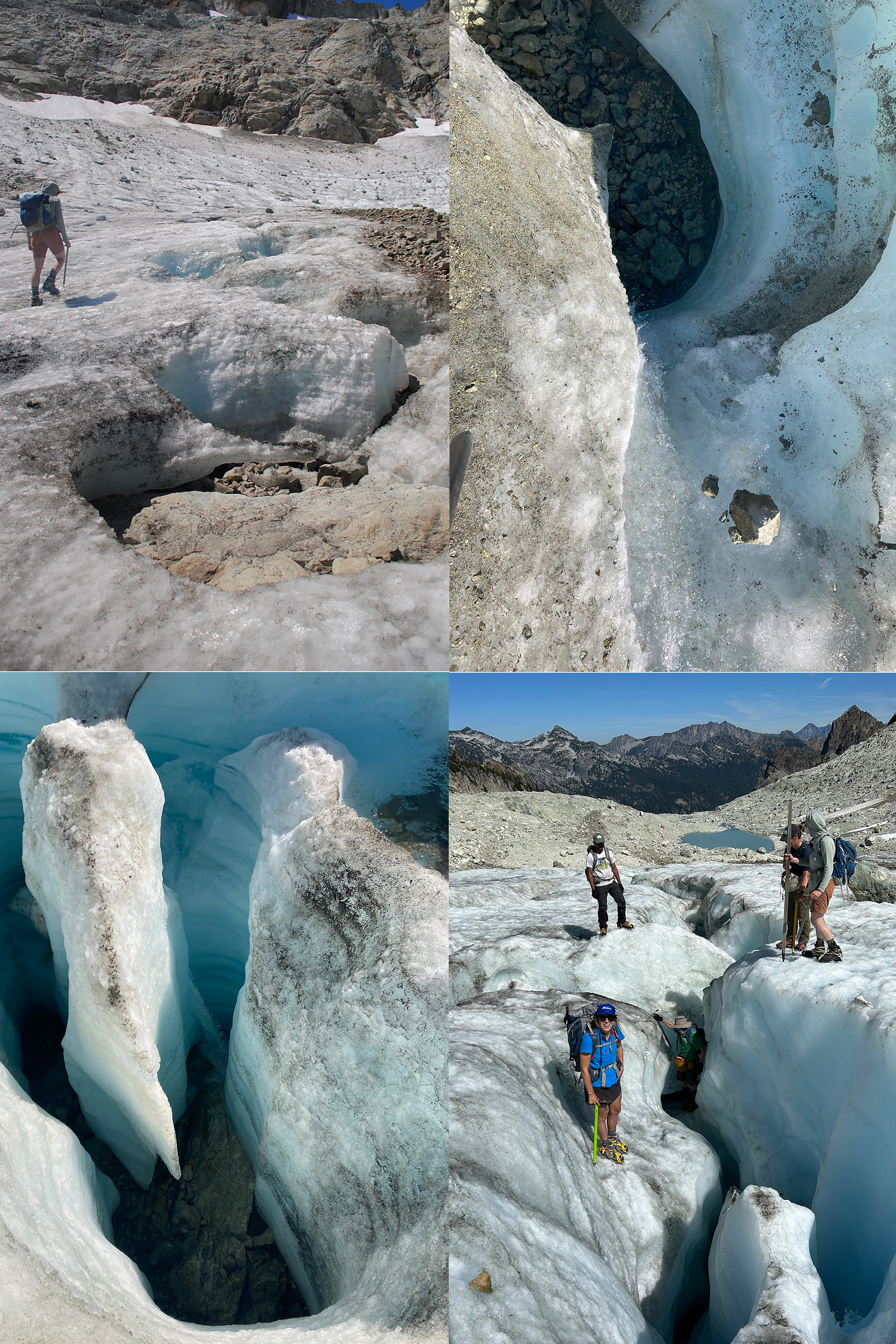
Beginning in 2015, we routinely assessed how deep each moulin, crevasse or supraglacial stream channel was on the glacier. One measure of a glacier no longer being a glacier is when crevasse features and stream channels consistently reach the bedrock below the glacier. In 2023, we examined 24 of these features and each reached bedrock at depths of 2–10 m. These features were distributed widely across the glacier. There are undoubtedly limited areas of thicker ice. In 2024, we explored an ice cave that extended 250 m from the top of the glacier to the end of the glacier. The cave roof was 1–4 m above bedrock, and the roof was consistently less than 2 m thick allowing light to penetrate from the glacier surface into the cave. An extensive ice cave transecting the entire glacier such as this cannot exist in a current glacier because ice movement would lead to ice cave closure.
Streams channel reaching bedrock at base of Ice Worm Glacier.
Each year in mid-August, stream discharge has been observed immediately below the 1986 terminus position of Ice Worm Glacier at 11 a.m., 2 p.m. and 5 p.m. during the field visit. This stream is also fed by perennial snowfields and, before 2015, a small glacier. These observations are insufficient to quantify daily runoff, but because of the consistent timing and methods, do allow for comparison. The glacier is located on the dry side of the range and has not experienced rainfall during any of our field observation periods, which would contribute to stream discharge. From 1985 to 2002, streamflow was observed on 36 days, with the average discharge being 0.12 m3 s−1. From 2021 to 2024, discharge was observed on 6 days with the average discharge being 0.03 m3 s−1. This roughly 75% decline in August runoff is similar to the 60% loss in runoff modeled for the loss of small glaciers in basins in the Alps and observed when the Lewis Glacier, North Cascade Range was lost. The change in summer streamflow in Hyas Creek near our base camp is apparent, as it had been a challenging stream crossing to keep your feet dry until 2013, and now is a simple step across. There has also been a marked increase in algae coating the substrate of the stream with the lower flow, clearer and warmer water, which is expected.
Climate Drivers
Trends in summer temperature at Western Cascade weather stations for the 1896 to 2024 period indicate that seven of the ten warmest melt seasons (June–September) have occurred since 2013. Melt season temperatures from 2014 to 2024 were 1.3 °C above the 1896 to 2022 mean. The long-term winter temperature trend from 1896 to 2024 has been 1.2 °C. From 2014 to 2024 winter temperatures were 0.9 °C above the long-term average, the warmest decadal period of the record.
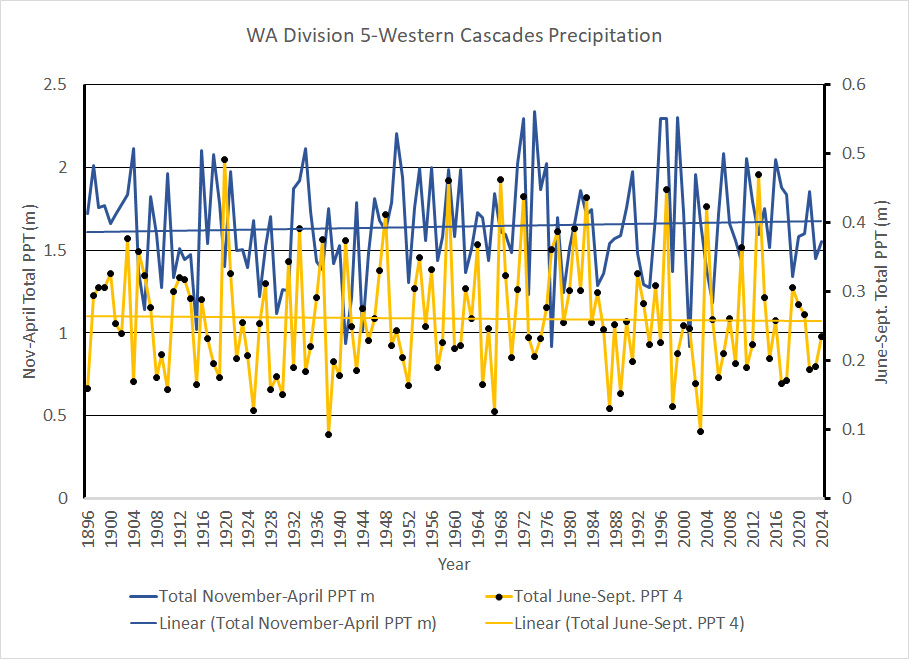
During the 1896 to 2024 period from June to September, precipitation exhibited no significant trend. For the November–April (winter season) there was a 3% increase in precipitation from 1896 to 2024. From 2014 to 2024 winter precipitation averaged 1.68 m vs. the long-term average of 1.65 m. April 1 SWE from six long-term SNOTEL stations where April 1 SWE has a declining trend of 30% from 1946 to 2023, with a 10% decline since 1984. The April 1 SWE loss reflects increased melting of the snowpack or rain events during the winter season.This indicates that it is temperature rise that is driving the glacier mass balance loss, retreat and eventual disappearance of Ice Worm Glacier.
Washington State Division 5 -Cascade West-Temperature trends.Washington State Division 5 -Cascade West-Precipitation trends.
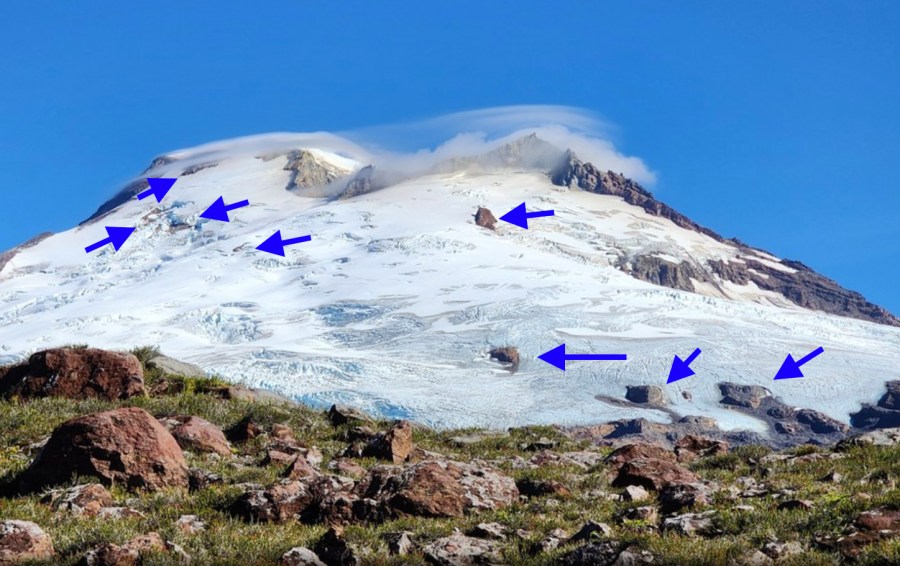
Recent glacier thinning due primarily to warm summers has exposed new bedrock knobs on upper portions of Deming, Easton and Squak Glacier on Mounty Baker, Washington
Find a location where temperatures are cold for at least 7 months of the year. This location also needs to have substantial snowfall and ideally where addtiional snow is added via avalanches or wind depostion. With these ingredients on hand, let stand for a few decades, while the snow accumulates to a thickness of at least 20 m. A key step in the recipe is the transformation of snow to ice under its own weight and with some meltwater percoloation and refreezing. Unlike bread dough you do not need stir or kneed during this period. Once there is a volume . For the glacier to persist the glacier must retain accumulation across a significant portion of its surface by the end of summer. To maintain its size we have observed this percentage to vary from 50-70% on North Cascade glaciers. The lack of a persistent accumulation zone will lead to loss of that glacier. of 500,000 m3 you are either a glacier or at the threshold of being a glacier depending on how steep the underlying slope is. Unlike rolling out a pie crust, this does not need to be an even thickness, or made on a flat surface. As the glacier matures it will develop crevasses indicating movement, which is an essential characteristic of a glacier. It is not a passive feature, its movement allows it to begin to sculpt its landscape.
Current Glacier Loss in North Cascade Range, Washington
Many centuries or millenia later, the glacier has become a critical part of the landscape. Yet, changing climate is leading to the loss of many. In the North Cascades glaciers have been losing close to 1% of their volume annually over the last 40 years, with the rate rising to over 2% in the last decade. The glaciers cover 200 km2 almost all of which are in steep high elevation Wilderness areas not proximate to roads. In 2010 we noted that 2/3 of North Cascade glaciers could not survive current climate. Today this percentage has increased to more than 90%. There are 31 glaciers in the range that I completed observations on in the 1980s that are now gone. Our annual field expedition has noted the glaciers losing ~1.5 m of thickness annually in the last decade.
Deglaciated area below Easton Glacier, Mount Baker, WA in 2023.
Are there any Preservatives we can add to the Recipe?
What would it take to preserve the Easton Glacier in the North Cascades?
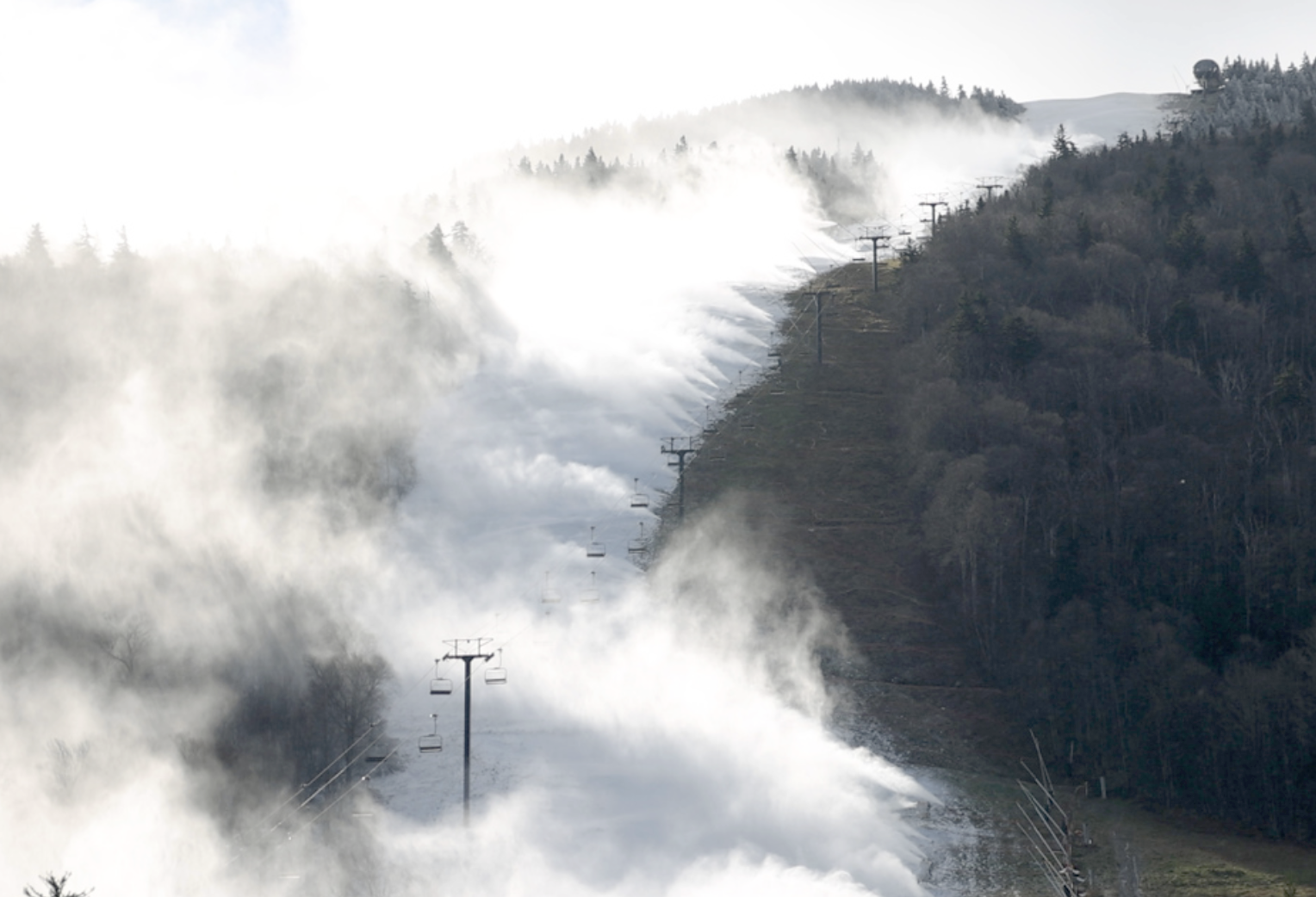
The largest snowmaking operation in North America is at Killington Ski Area, VT. At maximum capacity they can convert 35,000 m3 of water into snow per day. Given that Easton Glacier has an area of 2.5 km2 and has been losing 1.5 m water equivalent thickness per year, 3.75 million m3 of water equivalent snow has to be produced.This would take 108 days at maximum capacity of the more than 2000 snow guns. This ignores enviornmental laws and the logistics of water supply, piping, snow gun placement and electricity. This all in an environment of harsh weather with avalanches and crevasses.
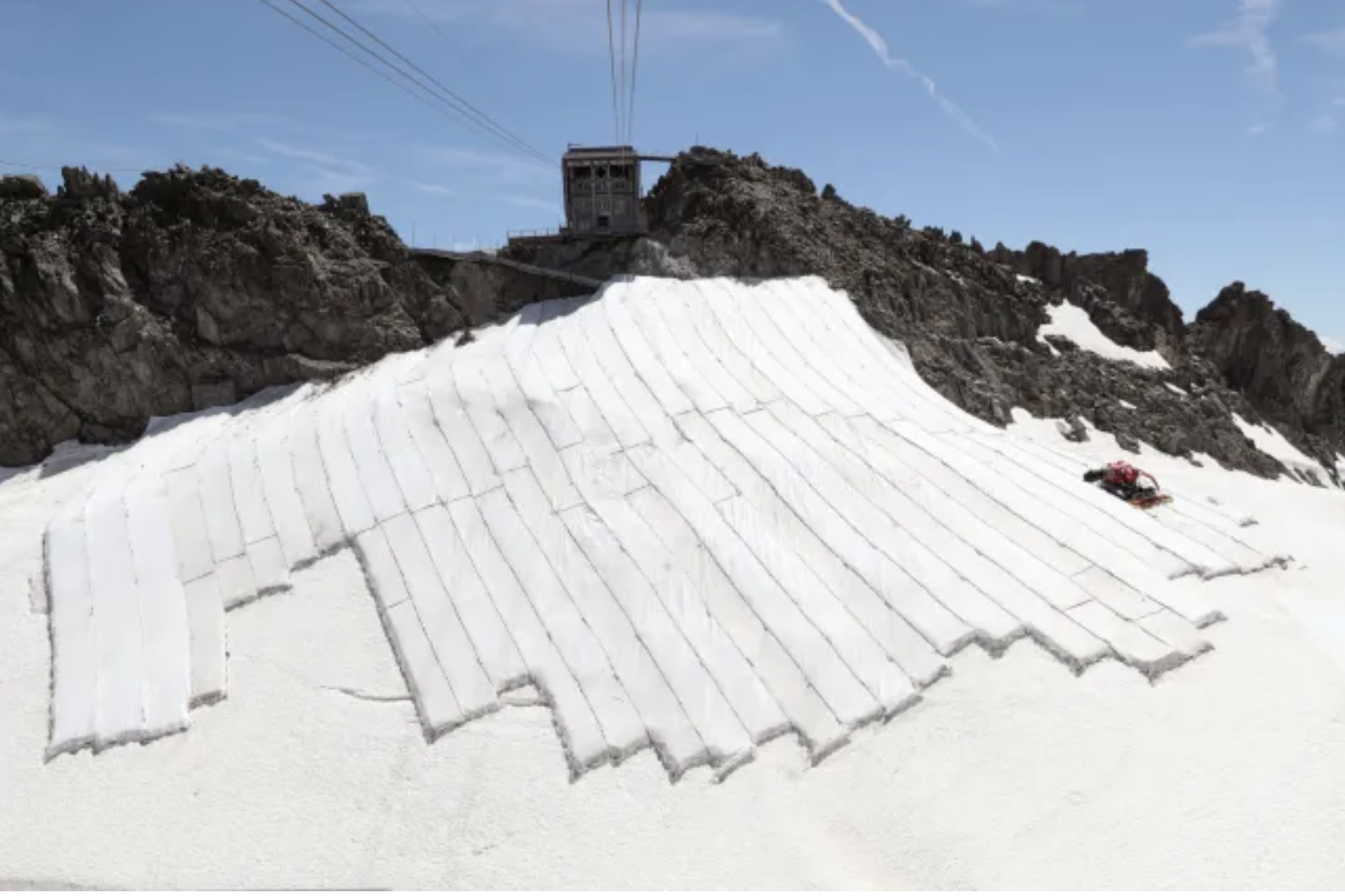
To cover the glacier with geotextiles during the summer, requires 2.5 million square meter of material that would be to installed each summer and removed each winter to allow accumulation, of course summer recreation would not be practical on the glacier. The geotextiles do not last long in these conditions and cost ~$2 per square meter. How to anchor these in place and connect on a crevasse glacier would be very difficult, which is why usually only a portion of the glacier near the terminus is covered, which does not help the overall situation of glacier loss.
There are many more glaciers in this range and around the world where this same confounding logistical challenges make any artificial attempts at preservation ridiculous beyond a few isolated glaciers that are already close to existing infrastructure.
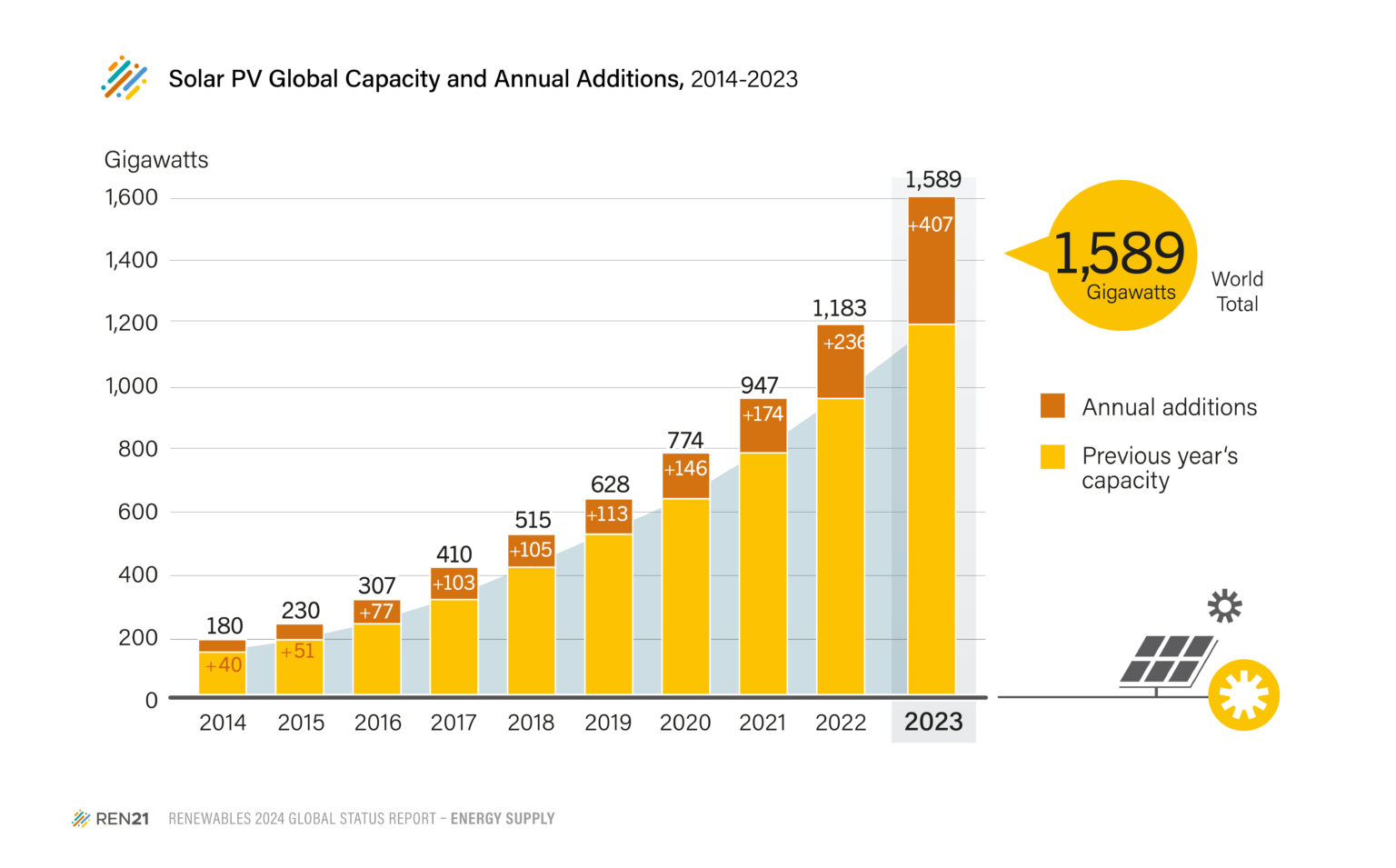
When I began this work in 1984 solar power and wind power did not exist, these are not the only renewable sources of power, and just one of many approaches to reducing CO2 emissions, but they are illustrative of rapid growth from insignificance. The Renewalbes 2014 Global Status Report and the Renewables 2024 Global Status Reports provides measures of renewaable energy production over the last decade. Global capacity for Solar Photovoltaic energy production has risen from 4 GW in 2004 to 190 GW in 2014 and then to 1600 GW in 2023. Global Capacity for Windpower has risen from 48 GW in 2004 to 370 GW in 2014 and in 2023 was 1020 GW. In 2023 alone over 500 GW was added to these two sources combined. See below for charts from this report on increased capacity. This is a preservative under development that can work with continued emphasis and in concert with other items such power grid infrastructure improvement and electric/hybrid automobile manufacturing expansion.
Field Sketch of Ice Worm Glacier from Aug. 13, 2023 on photograph of glacier. (Jill Pelto)
It was July 5, 1981 and Juneau meteorologist Brad Coleman had just informed us that Juneau had experienced one of its warmest least snowy winter ever. I was with the Juneau Icefield Research Program and we were headed up to the icefield the next day, it would be my first visit to a glacier. I was looking forward to plentiful summer skiing and now was concerned there would be limited snow. This worry proved unfounded, as once on the icefield, we stayed above 1000 m, and it was all snow, allowing me to ski 500 km in the next several weeks. From that summer through 2000, I continued to spend the majority of my time working on glaciers every August skiing whether in Alaska or in the North Cascade Range, Washington. Alpine glaciers need to maintain at 55%+ snowcover right to the end of the summer to maintain equilibrium. Hence, skiing should be plentiful. However, in 2003 I gave up skiing on glaciers during our August North Cascade field seasons, the snow had become too limited and patchy. During the last decade the percentage of snowcover has been consistently low, with the 2021-2023 period setting the record for persistent snowcover deficits in the North Cascacdes, but also throughout the Pacific Northwest from Mount Robson, BC to Mount Shasta CA. This sequence of difficult years for glaciers had led to the end for quite a few. -Mauri Pelto
I have spent 15 years with the NCGCP most years snow remains only at higher elevations or in large avalanche fans, with a couple of years having deep snowpack and lack of heat waves has led to a good year for the glaciers. And now years like 2015, 2021 and 2023 where there is so little snow that walking on the glaciers is almost a different landscape. Every feature is exposed, debris cover is piled up, and new or changed water features like melt channels or ponds emerge. In August 2023 it was most starkly seen on Mt. Daniel, on the eastern, drier side of the North Cascades. It was my first year seeing the loss of a glacier: the Iceworm Glacier. A remnant ice patch remains, but there are no longer any active features such as crevasses. It was also my first time seeing the very steep Daniel Glacier with essentially no snow. Navigating across bare ice on a 35+ degree slope for very few measurements had our whole team questioning how long it would be worth our effort. Some of my favorite moments of my 14 other seasons are glissading (or skiing with your hiking boots) down the steep slopes of Daniels. You can carve turns and do quick stops, and you can get down the glacier in about a quarter of the time you climb up. It’s always an exhilarating and rewarding way to end the season. This year the descent was difficult one firm crampon step at a time. I clung onto one fun glissade on the adjacent Lynch Glacier. In that moment I needed to enjoy what I could, and after the season I needed to feel the loss of a place that has defined a piece of my life.
Here we focus on this lack of snowcover we observed in the field and in satellite images from Mount Hood, OR to Mount Robson BC in August and Septemeber 2023. This combined with 2021-2023 has redefined many glaciers, making it clear how many cannot survive even current climate. We developed a forecast model of alpine glacier survival, published in 2010 that indicated significant accumulation zone thinning and/or lack of consistent accumulation zone are indicators of a glacier that cannot survive. The glaciers below on some of the highest peaks in OR, WA and BC are failing this metric in 2023.
Screenshot
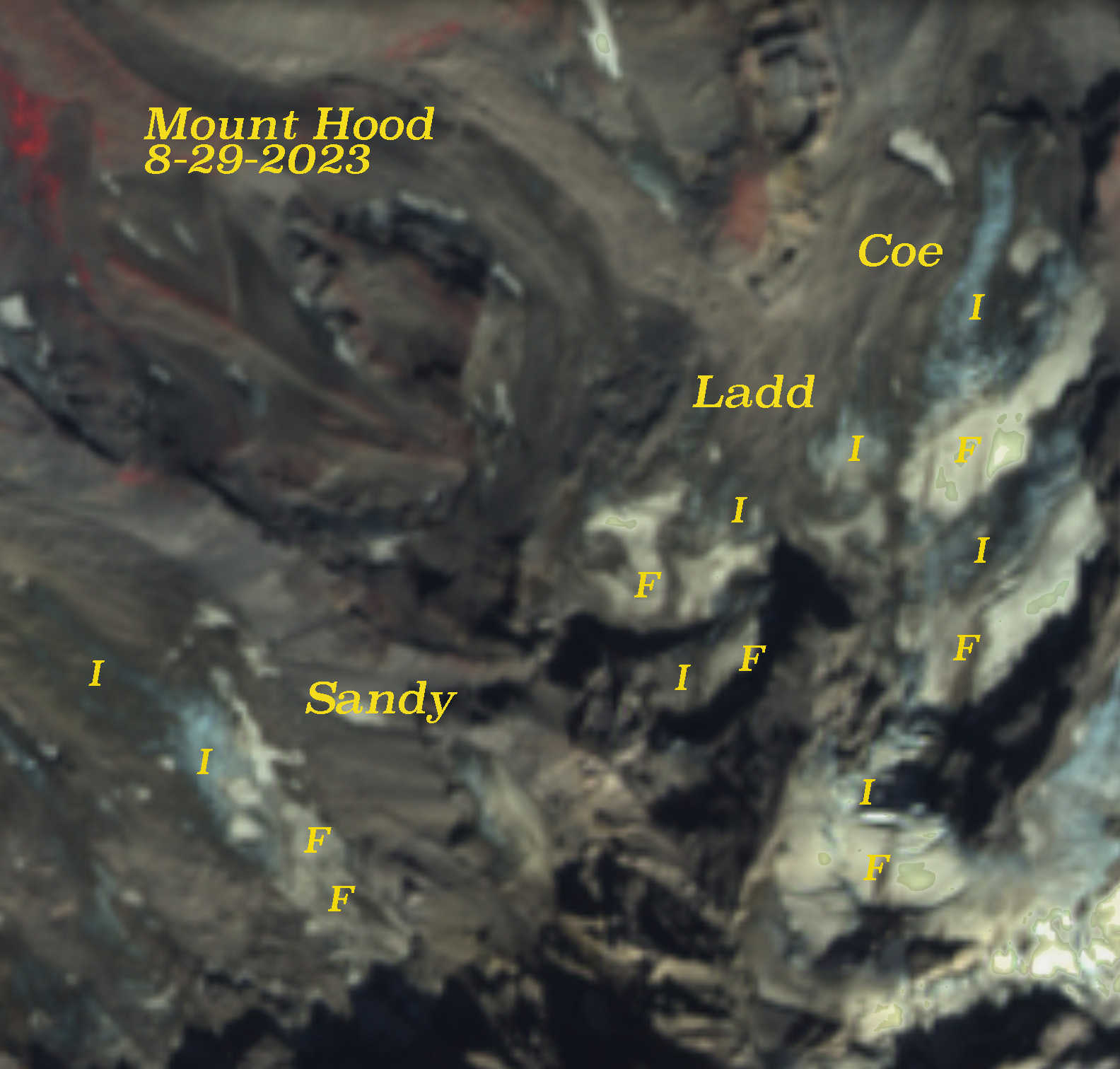
At the end of August 2023 on the north side of Mount Hood, OR; Sandy Glacier and Ladd Glacier are so dirty looking in this Sentinel image that it is hard to discern that they are glaciers, both have limited patches of retained snow from the winter of 2023. Coe Glacier has three pockets of snow remaining from last winter covering close to 30% of the glacier.
Screenshot
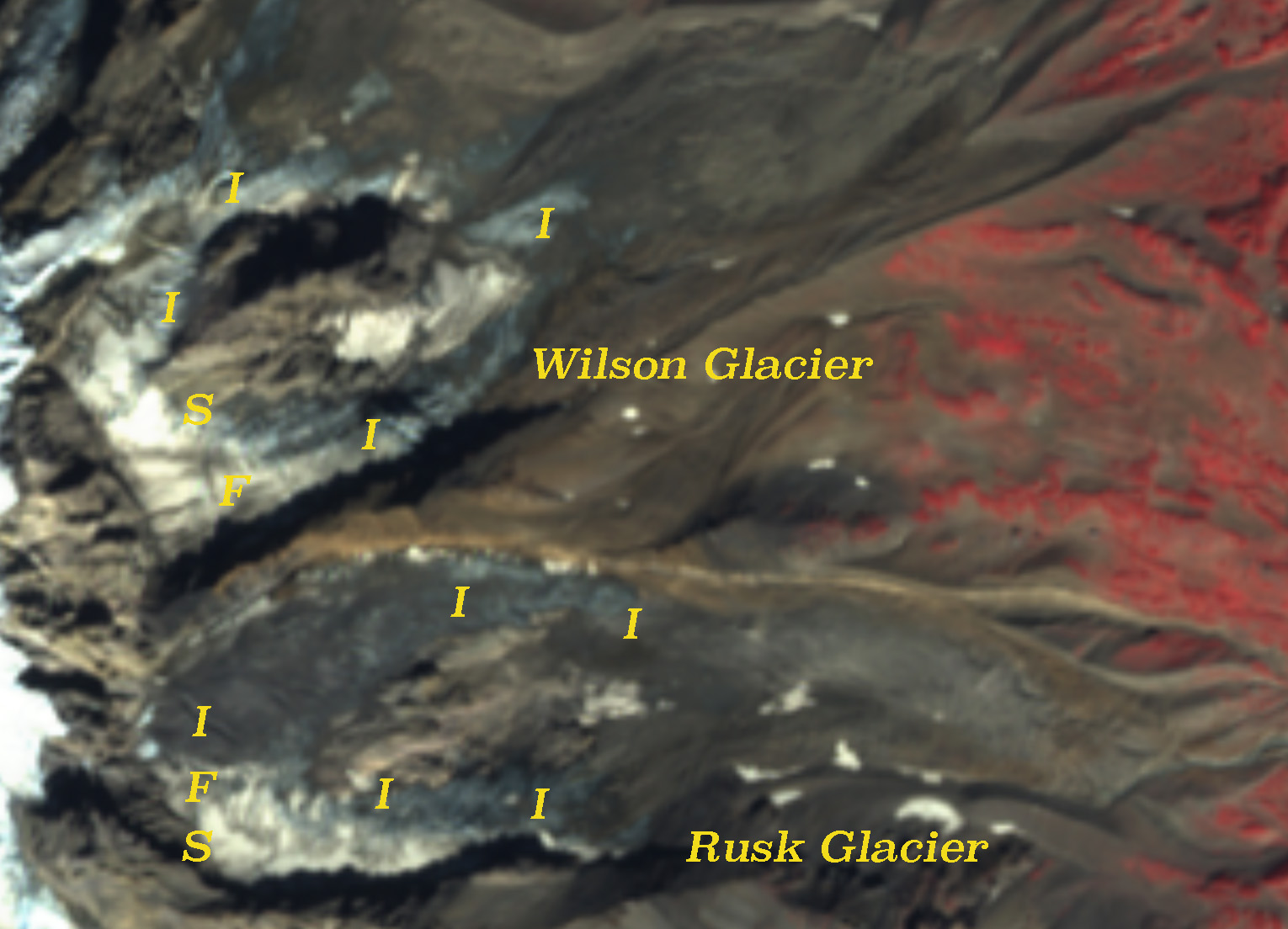
Across the Columbia River on Mount Adams, WA Wilson and Rusk Glacier are both over 90% bare firn and ice, with some snow on the upper margin above 2800 m where avalanche deposits endured.
Screenshot
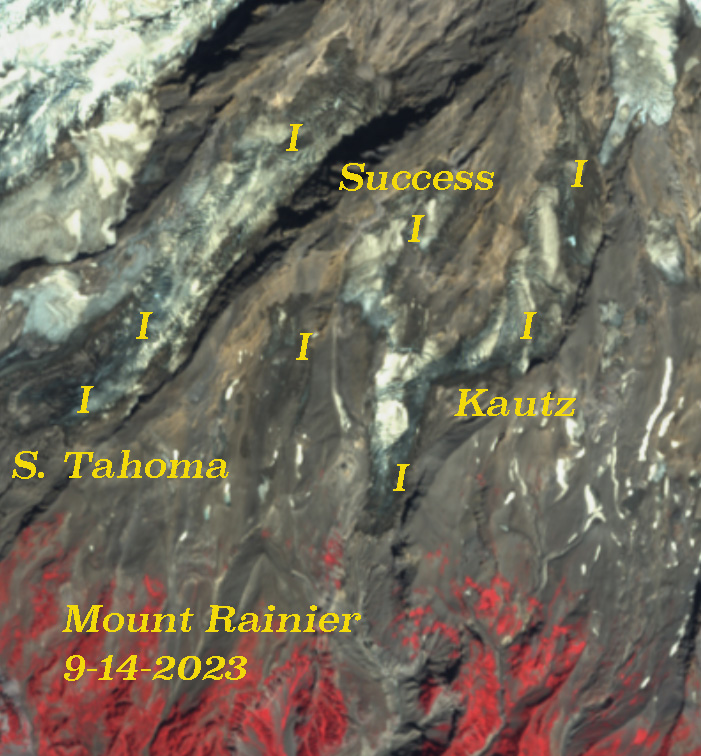
On the south slope of Mount Rainier, WA South Tahoma Glacier and Success Glacier lost all of their snowcover. There are a few patches of snow left on Kautz Glacier. The snowcover becomes more consistent at 3500 m, higher than can sustain most of the glaciers.
Halfway between Mount Rainier and Glacier Peak is the Mount Daniel/Hinman area where glaciers are in rapid collapse. This includes Ice Worm Glacier on the east slope of Mount Daniel, which lost all of its snowcover in 203 (above) and Daniels Glacier that only has 5% snowcover in mid-August 2023 (below)
Foss Glacier on the northeast slope of Mount Hinman looks like a bug that splats on your windishield with wings/limbs in all directions, this will lead to rapid fragmentation.
Closer to Glacier Peak is Columbia Glacier, below Kyes, Monte Cristo and Columbia Peak. The view down the accumulation zone indicates a lack of snow or firn where there should be 2+ m of snowpack in early August.
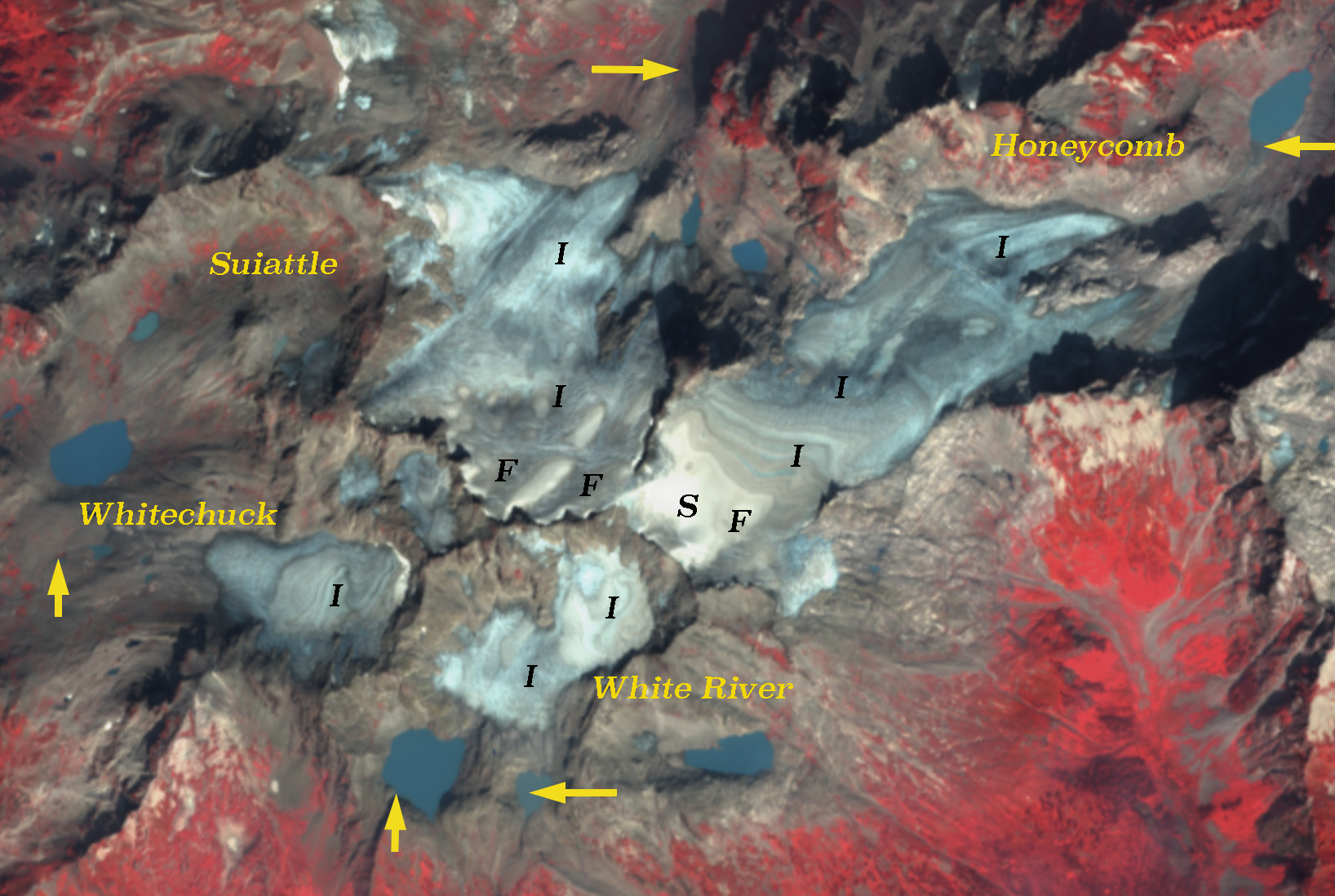
Kololo Peak is on a ridge extending south from Glacier Peak and is host to several large glaciers. In September 2023 Whitechuck, Suiattle and White River Glacier lost all their snowpack, while the top of Honeycomb Glacier has a small area of snow left. Yellow arrows indicate where we observed the terminus of these glaciers 40 years ago.
Screenshot
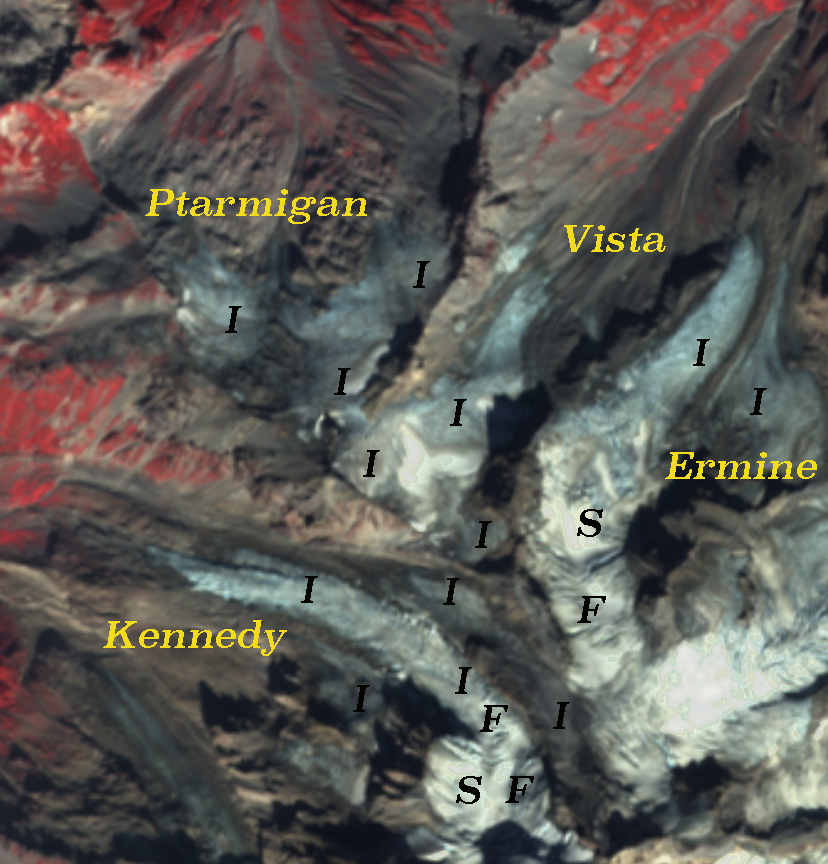
On Glacier Peak Ptarmigan Glacier has separated into and east and west part and had no retained snow. Kennedy, Vista and Ermine Glacier had 10-20% retained snowcover on 9-15-2023 mostly in a band at 2500 m. Yellow arrows indicate terminus locations when I first visited these glaciers 40 years ago.
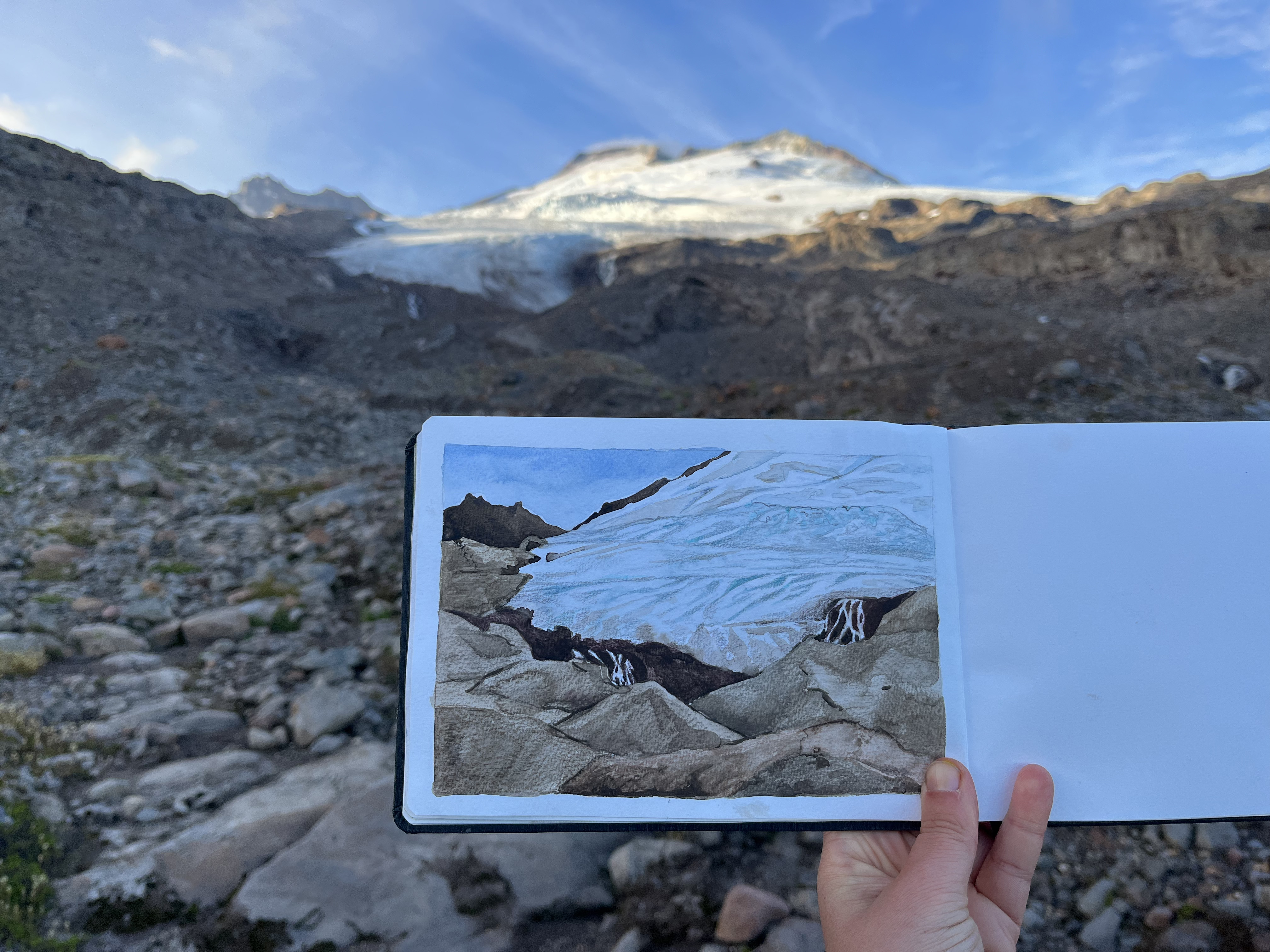
Easton Glacier is on the south/southwest side of Mt. Baker. The upper part of the glacier is a patchwork of ice, firn and snow, with new rock areas emerging even high on the glacier in August 2023. The difference with 2022 is evident. Two new waterfalls appeared in 2023 due to the extensive thinning and retreat at the terminus., yellow arrows. These are also depicted in the field sketch by Jill Pelto below.
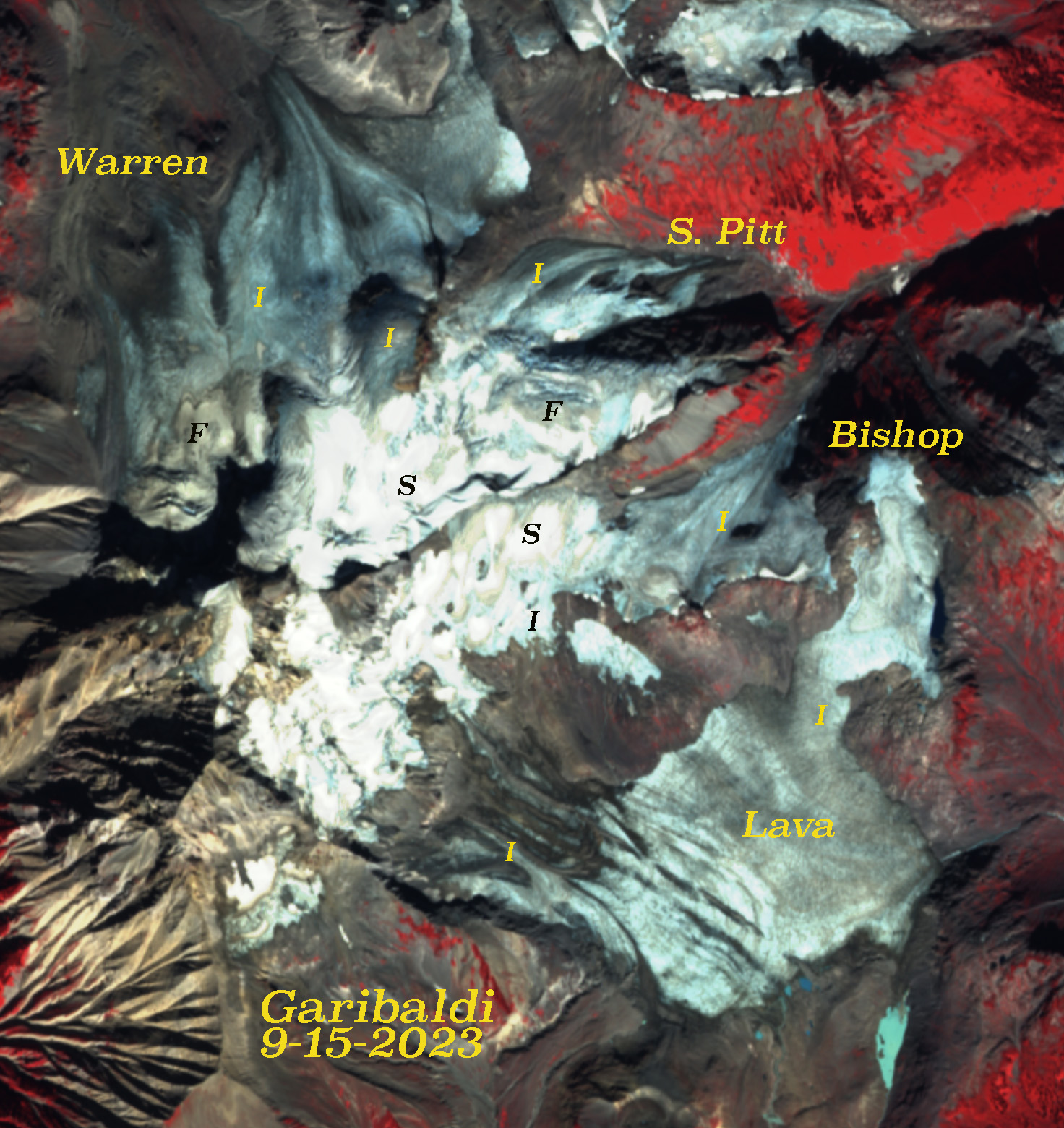
Near Whistler, BC, the Garibaldi Neve (Icefield) showed little remaining snow in mid-September. Snow only clings high on Mount Garibaldi above 2200 m or 7200 ft.
Small glaciers across the region are losing all traces of seasonal and multi-year snow and are transitioning from active glaciers to remnant ice patches. The Stadium Glacier near Squamish British Columbia is one example of this. Photo by Ben Pelto.
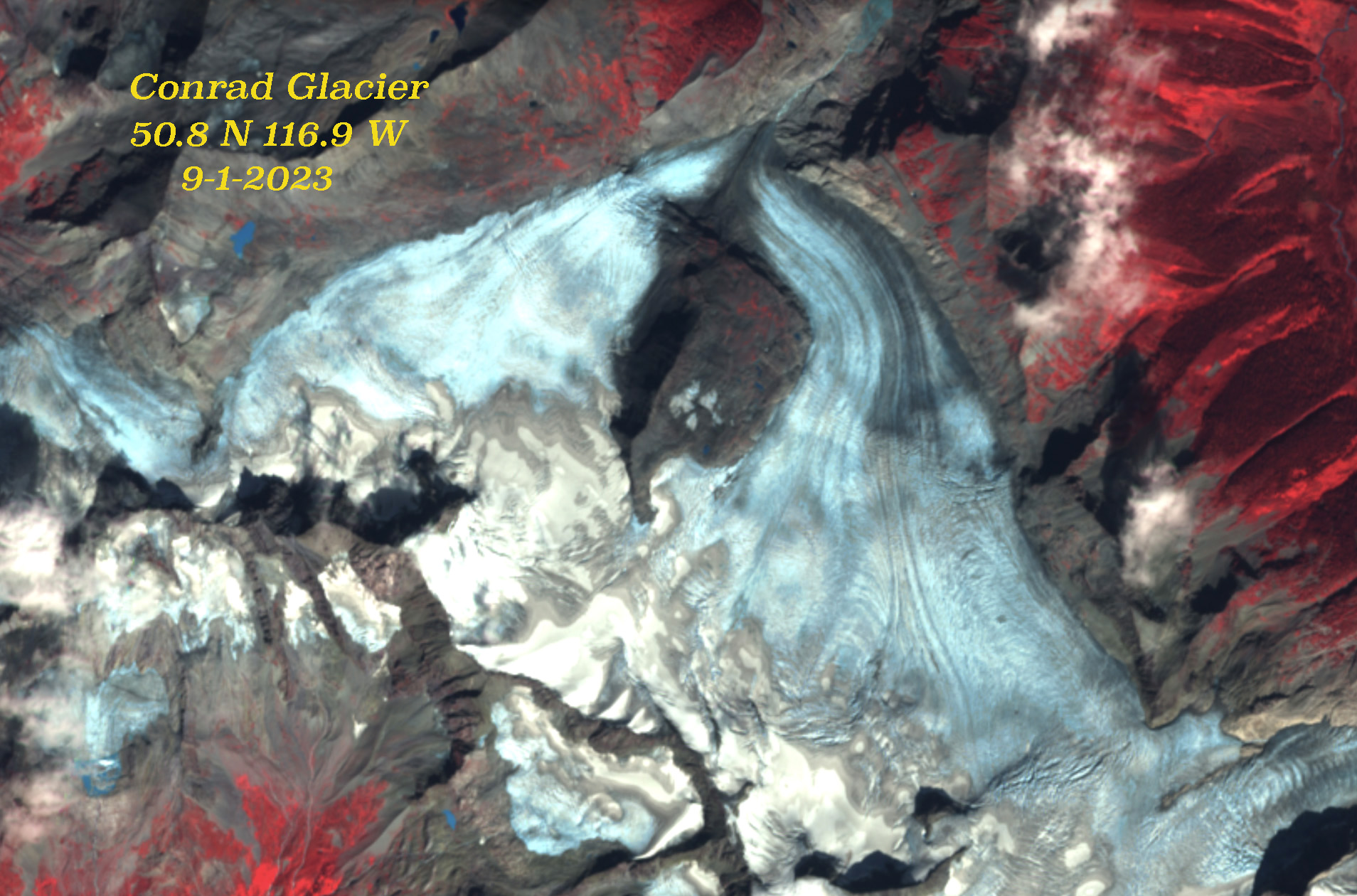
The Conrad Glacier on the boundary of Bugaboo Provincial Park in British Columbia showing extensive bare ice and limited snow cover. The dark grey areas surrounding the white snow is firn, or multi-year snow, now exposed. The area covered by firn is important to glacier health. Firn that remains on a glacier becomes glacier ice and can retain meltwater. Areas of bare ice behave like a parking lot, nearly all water that reaches glacier ice leaves the glacier as runoff. The area of glaciers covered by firn is dramatically decreasing in the region. Pelto et al. (2019) found that 58% of the Conrad Glacier was covered by multi-year firn, a quick visual scan here shows that that number has declined to roughly 30-40%.
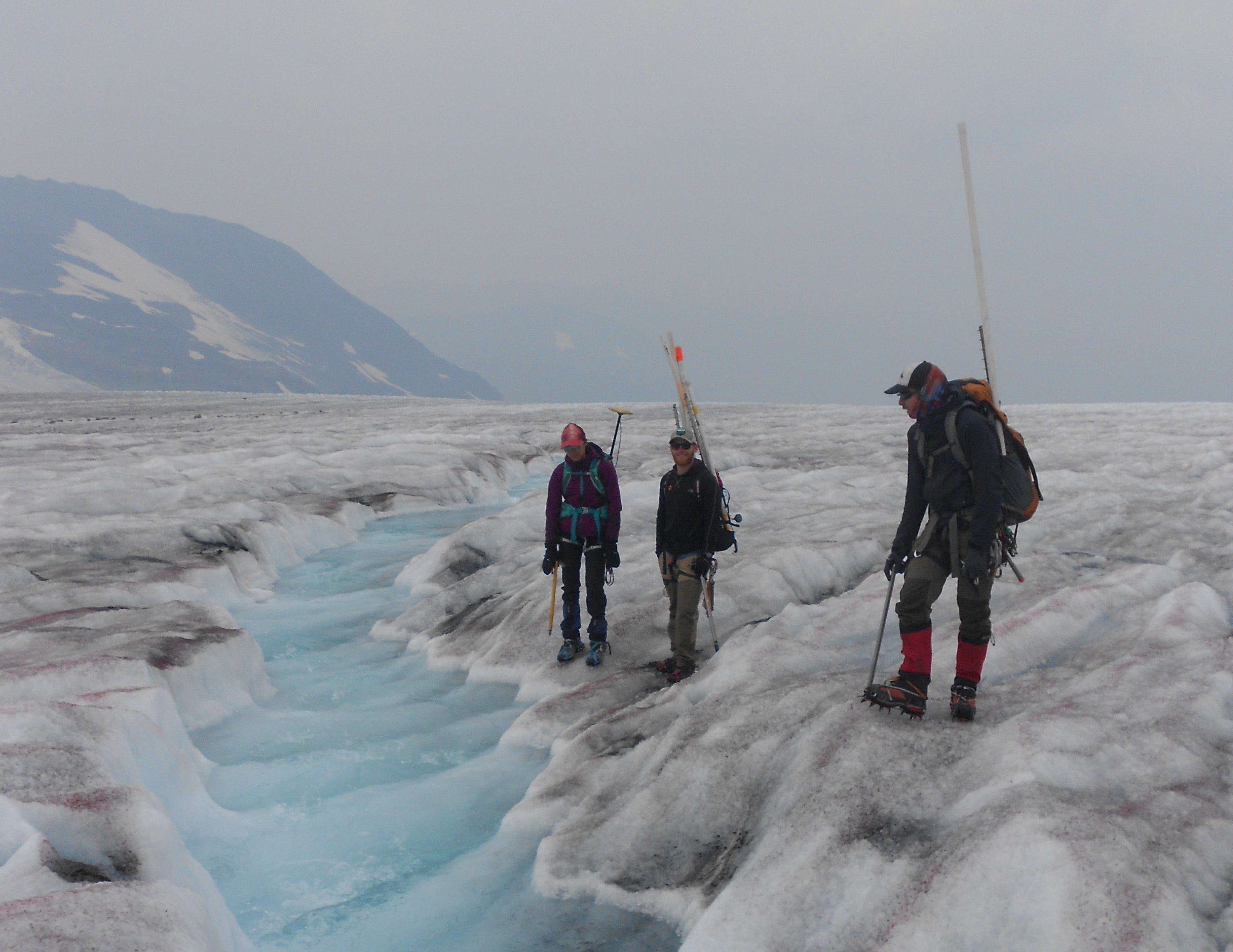
Wildfire smoke darkens the sky and ice as Alexandre Bevington, Jacob Bailey and Margot Pelto stand on the Conrad Glacier in August 2018. Photo by Ben Pelto.
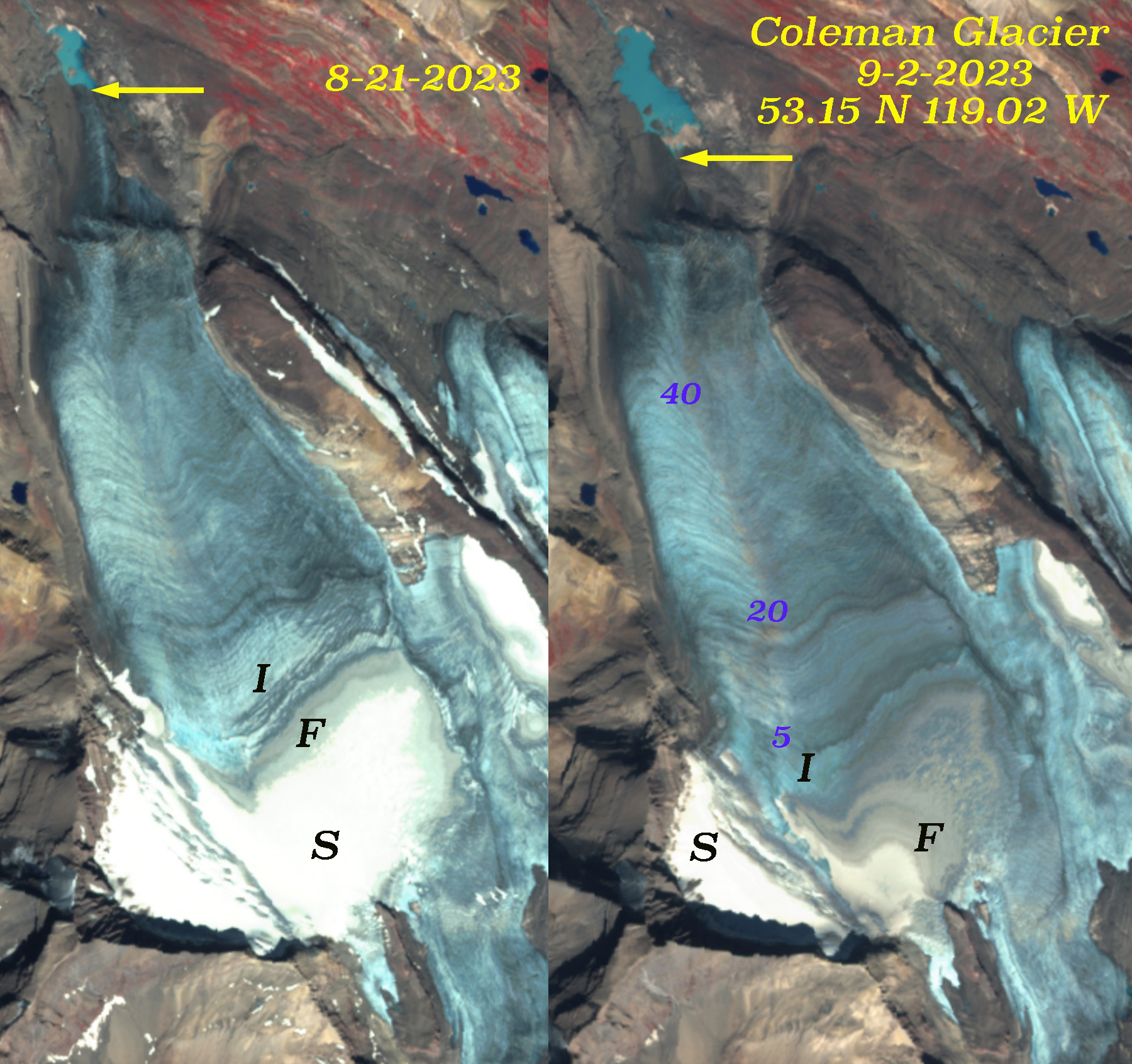
Coleman Glacier is on the east flank of Mount Robson. In 2018 the terminus is in a small lake with the snow covering 25% of the glacier. By 2023 the glacier has retreated 400 increasing the lake size. The snowcovered area is less than 10% of the entire glacier and is restricted to regions above 2500 m.
The above images of snow free and nearly snow free glaciers is a sight that has until the last decade been very rare. It is now becoming a typical event. The glacier response has been rapid, profoundly changing most and leading to the end of some.
For the 14th year I had the opportunity to author the Alpine Glacier section of the State of the Climate 2022 report published in the Bulletin of the American Meteorolocial Society. Below is this report with additional images.
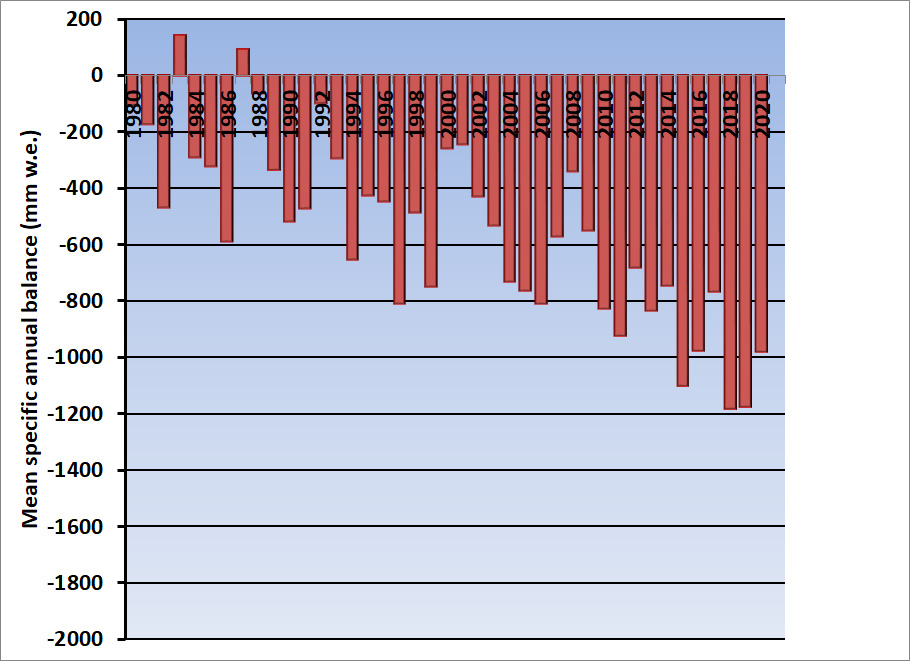
An increasing frequency of heat waves impacting glaciated mountain ranges continues to lead to large mass balance losses. In 2022 heat events in the European Alps, Svalbard, High Mountain Asia and the Central Andes of Argentina and Chile resulted in a mean annual mass balance of -1433 mm w.e., for all 108 reporting alpine glaciers, with data reported from 20 nations on five continents. In the hydrological year 2021/22 the preliminary regionally averaged annual mass balance based on the World Glacier Monitoring Service (WGMS, 2021) reference glaciers was -1179 mm w.e. compared to the 1970-2020 average -490 mm w.e.
In 2022, a negative annual mass balance was reported from 34 of the 37 reference glaciers reported to WGMS. The mean annual mass balance of thereference glaciers reporting was -1547 mm w.e.. Reference glaciers each years of observation are used to generate regional averages. Global values are calculated using a single value (averaged) for each of 19 mountain regions in order to avoid a bias to well observed regions. The regionally averaged annual mass balance was -1179 mm w.e., less negative than the general mean. This makes 2022 the 35th consecutive year with a global alpine mass balance loss, and the 14th consecutive year with a mean global mass balance below -500 mm w.e. This acceleration in mass loss from global alpine glaciers in the 21st century matches the findings of Huggenet et al (2021).
The lack of retained snowpack is evident at glaciers around the world in 2022.
More frequent and intense heat waves impacting glaciated ranges continued to take a toll on alpine glaciers in 2022. Heat waves reduce snow cover extent earlier in the melt season, exposing ice surfaces earlier and enhancing surface darkening, both causing higher melt rates on alpine glaciers (Shaw et al. 2021; Pelto et al. 2022; Cremona et al., 2023).
All 32 reporting glaciers in the Alps, Pyrenees and Caucasus Mountains had a negative mass balance averaging –3100 mm w.e. in 2022. In the European Alps the combination of low winter snowpack and several summer heat waves generated unprecedented mass loss (BAMS, 2023?). In Switzerland the 25 days of heat waves in 2022 are estimated to have melted 1.27±0.10 km3 w.e., equivalent to 35 % of the overall glacier mass loss during the summer (Cremona et al, 2023).
In Norway and Sweden, the average balance of 11 reporting glaciers was -443 mm w.e., with three glaciers in Norway having a positive balance. Iceland completed surveys of nine glaciers, five had a positive balance and four a negative balance with a mean mass balance of -7 mm w.e., e.g. equilibrium.
Langjokulen (La), Kvitisen (Kv), Bergfonna (Be) and Blaisen (Bl) ice caps on Edgeøya in Sentinel image from 8-20-2022 illustrating the lack of snowcover, limited firn areas and numerous annual layers.
On Svalbard the mean loss of the four reporting glaciers was -1102 mm w.e.. The negative mass balances were due to several summer heat events (BAMS, 2023?), which led to many glaciers and ice caps losing all or most of their snow cover, further accelerating mass loss (Figure 2.c.3.1).
Screenshot
Helm Glacier BC with limited retained snowpack.
In Alberta and British Columbia, Canada and in Alaska and Washington, United States,19 glaciers had a negative mass balance, averaging -965 mm w.e.. The Alberta, British Columbia and Washington region again experienced several prolonged heat waves. Daily glacier ablation in this region was noted as increasing by 30-40% during heat wave periods (Pelto et al 2022).
Screenshot
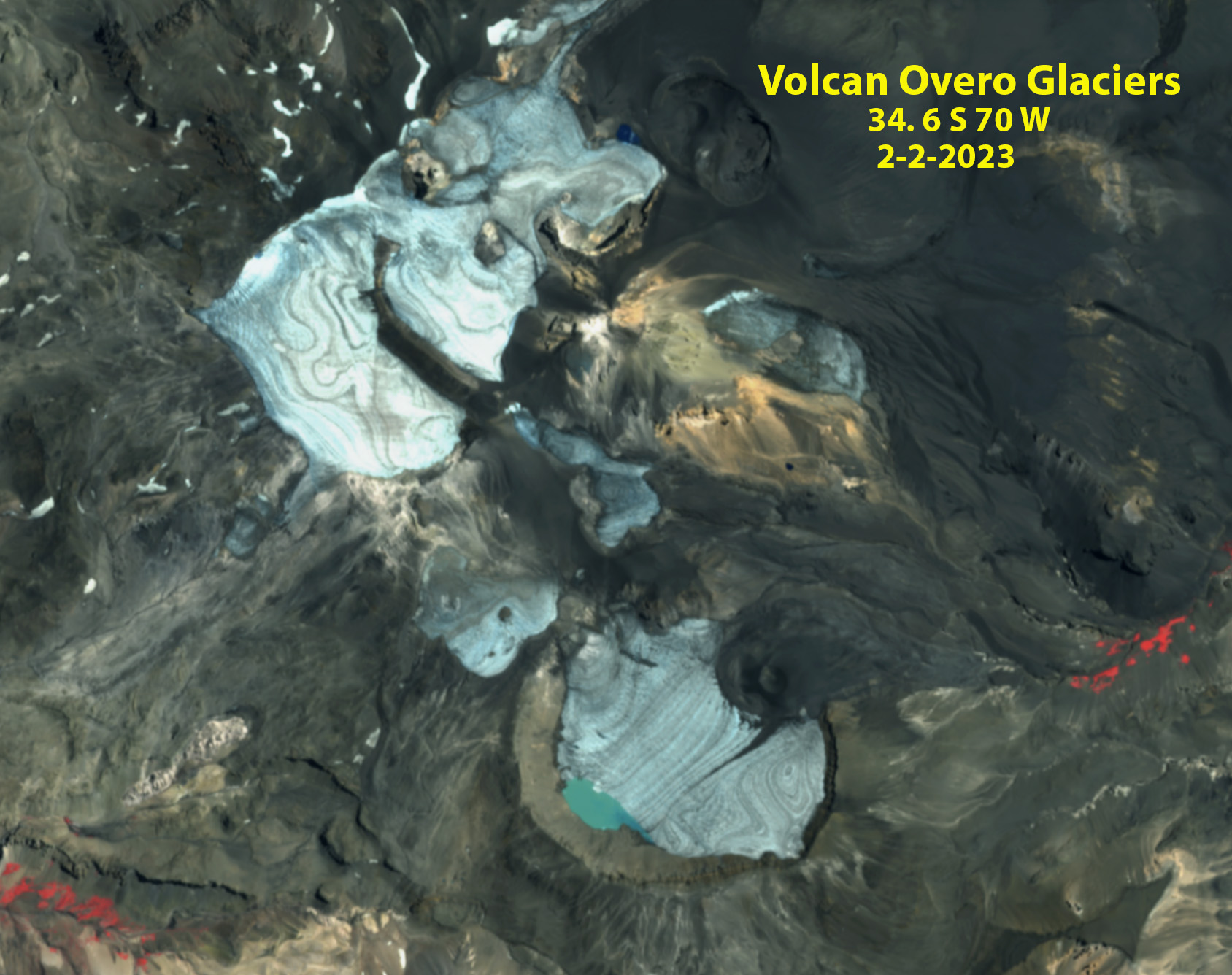
Volcan Overo, Argentina with no retained snowpack
In South America, mass balance data, reported from five Andean glaciers in Ecuador, Argentina, and Chile, were negative with a mean of -1465 mm w.e.. The combination of drought and heat events left many central Andean glaciers snow free by mid-summer in 2022. Shaw et al. (2021) noted a significant decline in surface albedo (Section 2.h.1) due to decrease fractional snow cover that further enhances melt.
In the High Mountain Asia mass balance measurements were completed on glaciers in China, Kazakhstan, Kyrgyzstan, Russia, and Tajikistan. All twenty glaciers reported negative balances. The average mass balance was -1040 mm w.e.. The negative balances were driven by above average melting during the May-July period (BAMS, 2023?).
In New Zealand the mass balance assessed on Brewster and Rolleston Glacier was strongly negative at -1125 and -1065 mm w.e. respectively. This matched the end of year snowline observations on 50 glaciers that was one of the five highest of the last 45 years.
Annual mass balance is reported in mm water equivalent (w.e.). A value of -1000 m w.e. per year is representing a mass loss of 1,000 kg m-2 of ice, or an annual glacier-wide thickness loss of about 1100 mm yr-1




















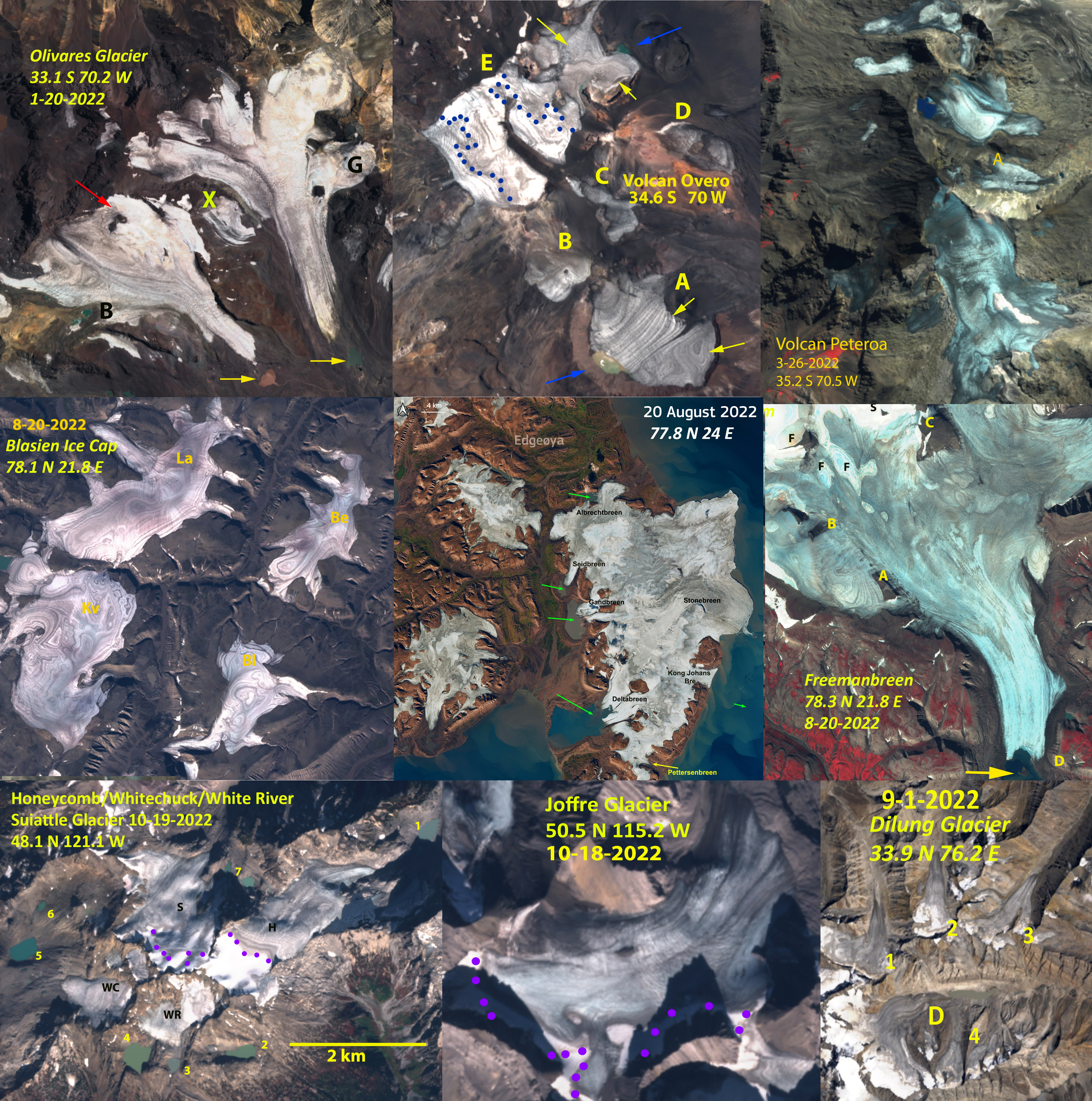 The lack of retained snowpack is evident at glaciers around the world in 2022.
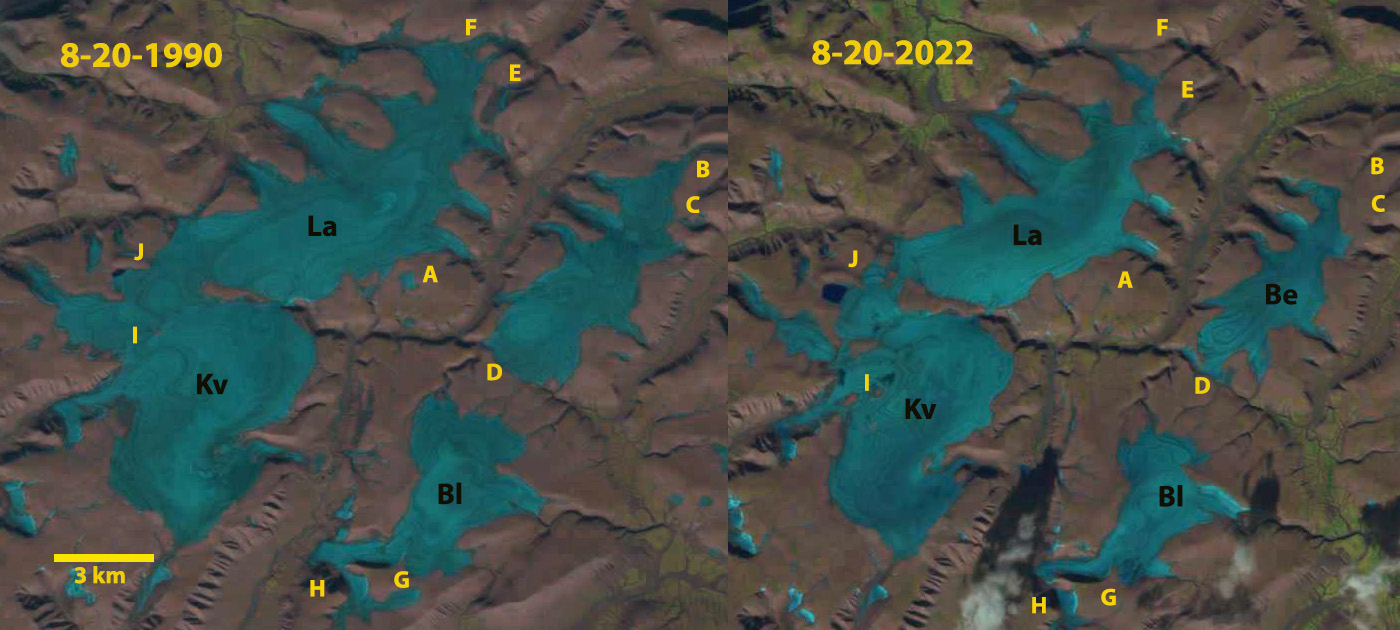 Langjokulen (La), Kvitisen (Kv), Bergfonna (Be) and Blaisen (Bl) ice caps on Edgeøya in Sentinel image from 8-20-2022 illustrating the lack of snowcover, limited firn areas and numerous annual layers.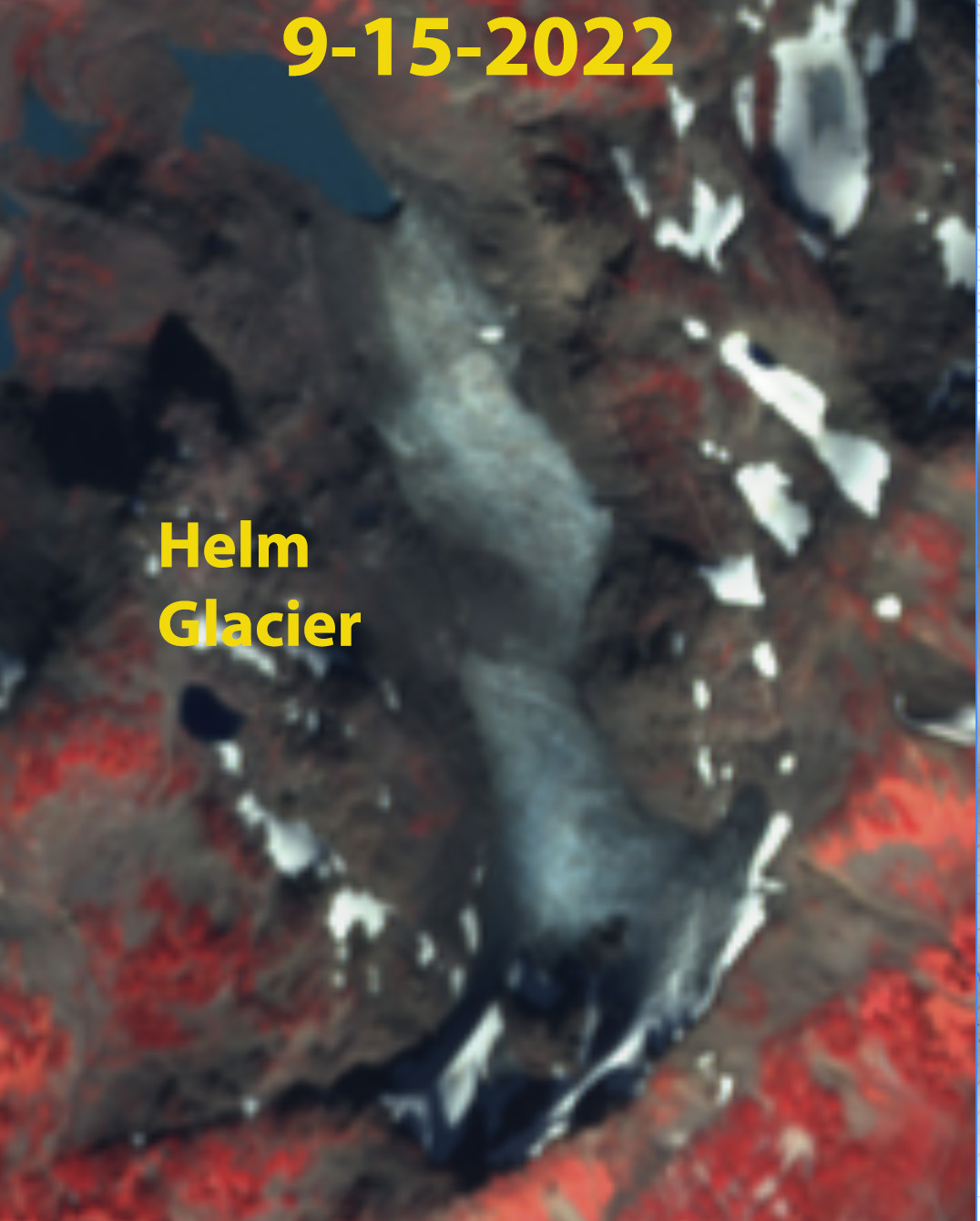
 From a Glaciers Perspective