Lyman Glacier Lost Half its area from 1979-2022

Map illustrating changes in Lyman Glacier 1890-2017- losing 87% of its area.

Lyman Glacier which feeds into Lyman Lake and then Railroad Creek in the Lake Chelan drainage of the North Cascade Range, Washington has retreated a total of 1330 m from the 1890 moraine. In 1929 year the terminus position was mapped by the Washington Water Power Company. The Washington Water Power Company emplaced a benchmark from which to measure retreat of the glacier which they monitored from 1929-1940. They found the glacier retreated 195 m from 1929-1940, and 530 m from the Little Ice Age Maximum to the 1940 position. William Long  (Bill) visited the glacier with this party in 1940 and again in 1944 on leave from the 10th Mountain Division. In 1988 and 1990 Bill retured for the first times since 1944, with us, pointing out the benchmark. From 1986-2022 we have surveyd the terminus of this glacier in the field during 15 different summers. Lyman Glacier retreated 11 m/year 1940-1986, 11 m/year from 1986 to 2008, and 5.5 m/year retreat from 2008-2022. Retreat since our first field observations in 1986 has been 298 meters, 800 meters since 1940.
The area of the glacier in 2022 is 0.22 km², which is less than 13% of the 1890 area of 1.72 km².  The glacier has been losing ~1% of its area per year since 1979. The glacier was noted to be in disequilibrium with climate and would melt away with current climate by Pelto (2010). From 1986-2008 the glacier reamined  thick in the middle, over 40 m, as evidenced by a significant ice cliff into the lake. In 1986 this ice cliff maximum height was 15 m. The height increased to more than 20 m by 2003 and reached a maximum of 24 m high in 2008.. By 2011 the ice cliff had diminished to 15 m, and by 2022 to 2.5 m. The current glacier length is 360 m on the eastern portion and 400 m on the western portion. With retreat the slope in the glacier center has increased from 16 to 25 degrees from 1986-2022. The continued retreat at the 50 year retreat rate would eliminate the glacier in 35-50 years, but a simple extrapolation is typically not a good approach to determine when a glacier disappears. In 2008 we noted that the “glacier was still quite thick and should slow its retreat once the bedrock slope begins to increase, and the minor lake calving ceases.” Without a terminus ice cliff crevassing near the front has greatly diminished indicating that the terminus acceleration due to the ice cliff no longer exists. This retreat rate has slowed, while the rate of thinning due to mass balance loss has remained high ~1 m/year. The headwall also is the location of greatest avalanche accumulation, which also will slow retreat.

Additional details and images on Lyman Glacier.

1921 Mountaineers Expedition view of Lyman from the first upper Lyman Lakes shoreline (University of Washington Library), near the 1890 terminus position. Note the glacier is connected to the arm leading to Spider Gap top center. 


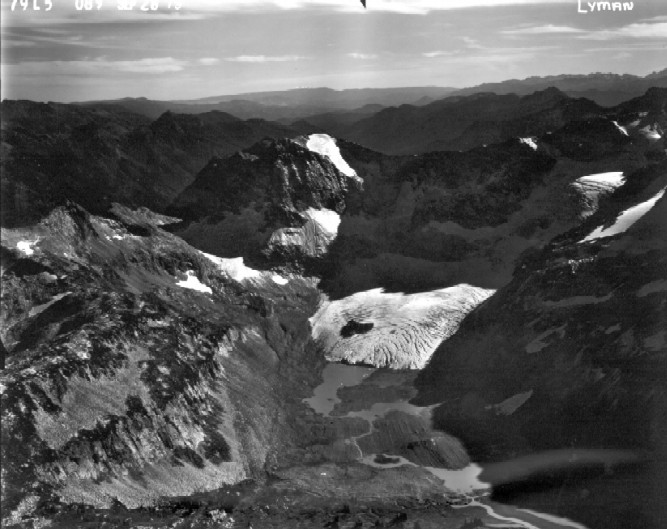
Lyman Glacier in 1979 (USGS) no longer connected to spider gap section. A second upper Lyman lake has formed and the glacier terminates in this lake. The glacier is connected to upper Lyman Glacier extending top right.

Lyman Glacier in 1986. Debris pile from 1930’s avalanche just reaching front, calving front at terminus narrow and only 5-8 meters high, Mauri Pelto in foreground.

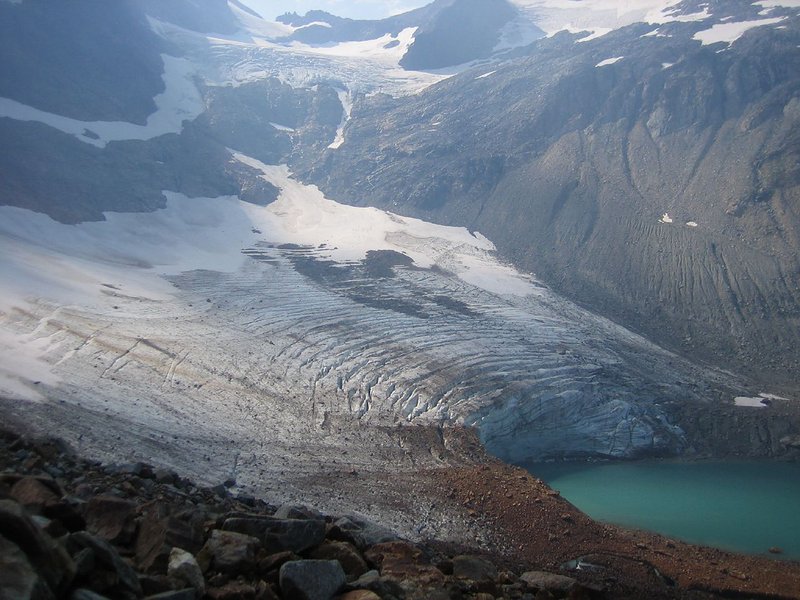
Lyman Glacier 2006 with very active crevassing behind 15-20 m high calving front. Glacier is disconnected from upper Lyman Glacier, top center.

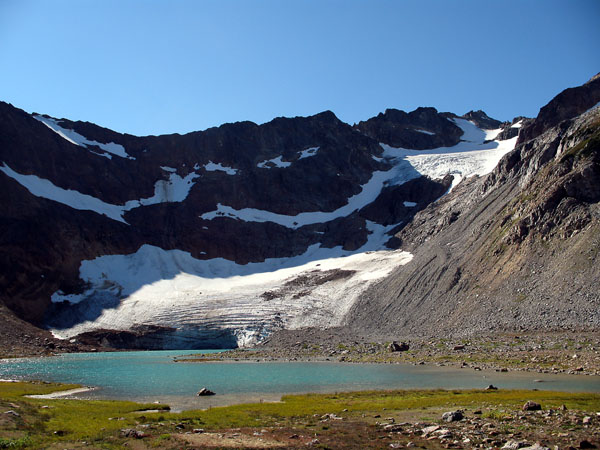
Lyman Glacier in 2007 from far end of newest upper Lyman Lake near the 1940 terminus position.

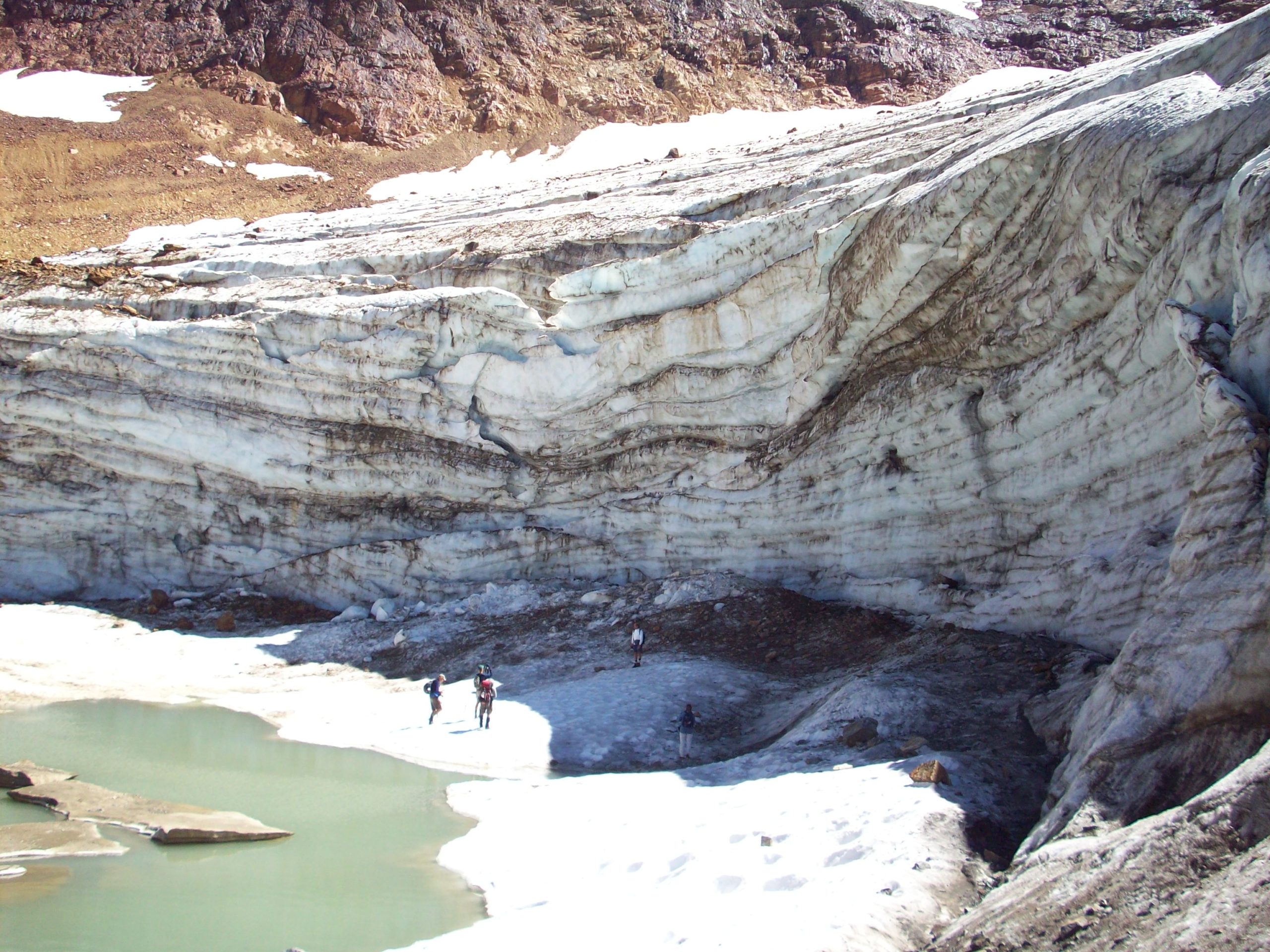
2008 Terminus ice cliff that is 18-24 m high above and below.

Lyman Glacier 2011 most extensive snowpack in the 2000’s, ice cliff 10-15 m.

Lyman Glacier in 2022 from east margin reduced slope and size compared to similar viewpoint in 1988, Jill Pelto in foreground (Kevin Duffy-image)

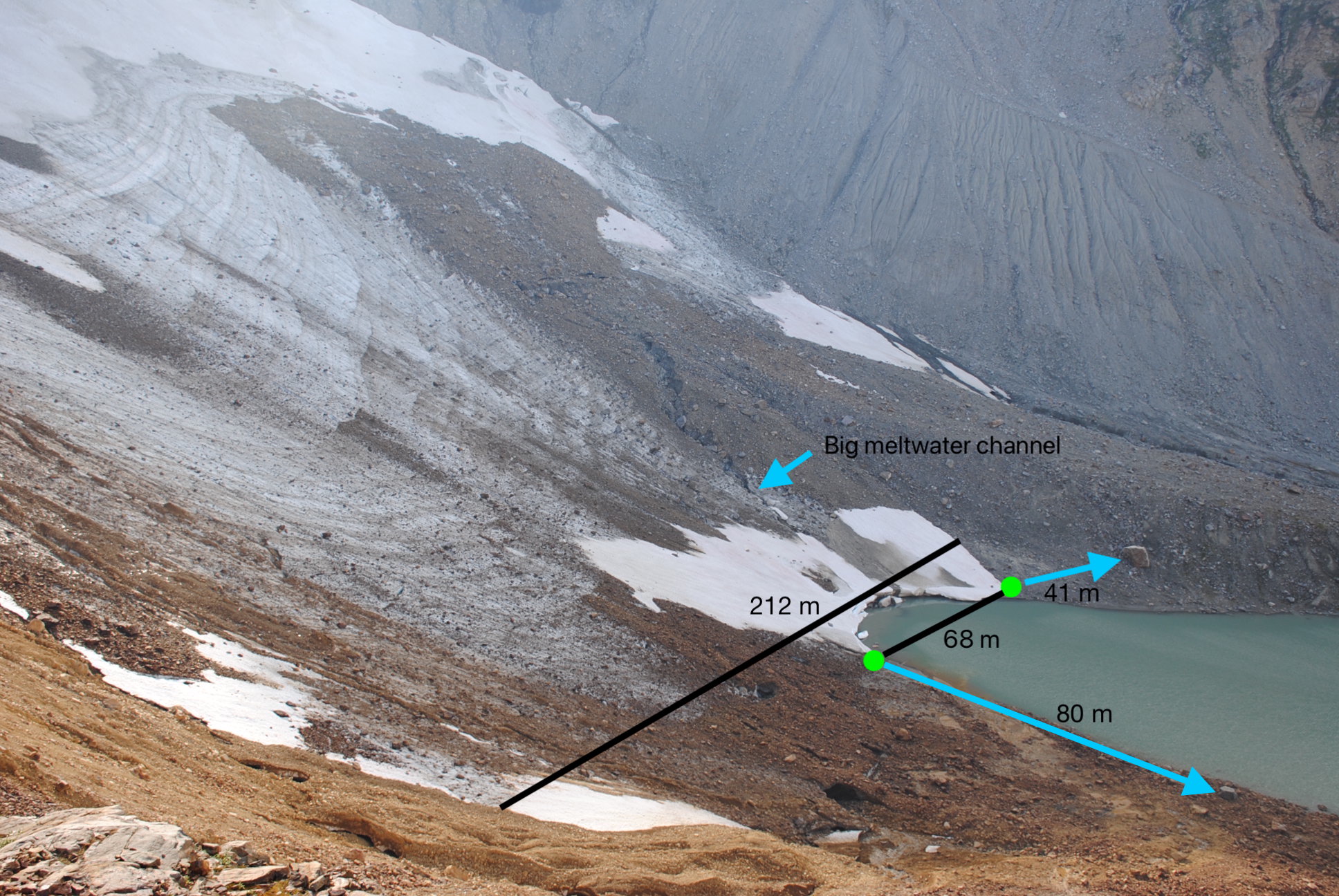
Lyman Glacier 2022 with annotated measurements from the 2008 terminus locations and of terminus condition. Kevin Duffy on the terminus rock. (Jill Pelto-Image)

Glacier Landslides and Collapses Preconditioned by Warming

Lamplugh Glacier, Alaska in 2015 (before) and 2016 (after) landslide in Landsat images. The Landslide covered 17 km2 of the glacier, yellow dots. B=Brady, L=Lamplugh, R=Reid Glacier.

Ice whether as permafrost, in a glacier, filling cracks or coating surfaces literally helps stabilize materials on mountain slopes. Climbers who ascend glaciated peaks have long practiced early starts to avoid the heat of the day. The goal to avoid falling, rock, ice and snow all made more prevalent by the rising temperatures of the day, which leads to thawing/weakening the ice and snow binding materials together and to the mountain. Working on steep alpine glaciers each summer for 40 years, we do not go below a steep convex icefall or terminus after the sun is on it. These approaches are a risk accommodation to short term diurnal changes. This combination of hazards has been playing itself out on the small scale altering the climbing routes from Mont Blanc to Mount Kenya and Mount Rainier generating more frequent large-scale avalanches/landslides/glacier collapses in glaciated mountain ranges.  On Mont Blanc massif Maurey et al (2019) found that 93 of 95 climbing routes had been affected by climate change, 26 greatly and 3 no longer existed.

Long term climate change also leads to preconditioning that increases opportunities for thawing/melting and weakening of the bonds between mountains and the rocks, snow and ice perched on and within their slopes. Atmosphere and ocean warming over the past century are driving rapid glacier thinning and retreat of the majority of alpine glaciers destabilizing hillslopes and increasing the frequency of landslides from unconsolidated, unstable sediments often perched on slopes. Jacquemart et al (2020) conclude that as “meltwater production increases with rising temperatures, the possible increase in frequency of glacier detachments has direct implications for risk management in glaciated regions.”

The long term preconditioning has led to a number of  large avalanches/landslides/glacier collapses from 2015-2021.  Each has a unique story, but each is connected to warming.

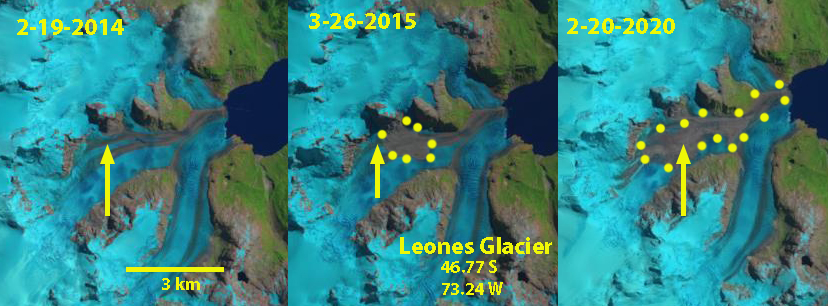
Leones Glacier, Chile sequence of Landsat images illustrating the landslide and its evolution.

Flat Creek, AK

Flat Creek, Alaska is in the Wrangell Saint Elias National park. Jacquemart and Loso (2018) detailed a series of events from 2013-2016 generating debris flows. They identified in satellite images, that large parts of the glacier that occupied the head of Flat Creek disappeared during the August 2013 and August 2015 events. In 2013 shows that the front third of the glacier tongue went missing and in 2015, the ice in the central trough of the glacier disappeared altogether.   The combined events transported 24.4–31.3 × 10⁶ m3 of ice and lithic material from Flat Creek Glacier (Jacquemart et al 2020), who concluded this event was triggered by unusably high meltwater input. In 2016 the event was smaller, but the resulting debris flow/slushalanche was caught on video .

Taan Fjord, AK

Taan Fjord is a newly developed fjord in Icy Bay, Alaska resulting from glacial retreat in recent decades that has exposed unstable slopes and allowed deep water to extend beneath some of those slope. The Tyndall Glacier had retreated 17 km from 1961 to 2015, stranding lose deposits of glacial sediments on the slopes (Williams and Koppes, 2020). Slope failure at the terminus of Tyndall Glacier on 17 October 2015 sent 180 million tons of rock, 60 × 106 m3  into Taan Fiord,  (Dufresne et al 2017) . The resulting tsunami reached elevations as high as 193 m.

Lamplugh Glacier, AK

Lamplugh Glacier terminates in Glacier Bay, Alaska. In 2016 Southeast Alaska had its warmest spring ever. On June 28, 2016 a landslide triggered by the collapse of a rock face occurred. After accelerating downslope the debris hit the ice on the glacier and kept sliding bulldozing snow and ice as it went. Seismic analysis, indicated a landslide of about 120 million metric tons (Morford, 2016). The Landslide covers an area of 17 km2 and is 7.5 km long on the Lamplugh Glacier (Pelto, 2016)

Eliot Creek, BC

Rapid glacier retreat set the stage for a slope failure to occur in  Eliot Creek, a steep mountain valley in the Coast Range of British Columbia on November 28, 2020, about 18 million m3 of rock descended 1000 m down the steep slop, then across the toe of a glacier before entering a 0.6 km2 glacier lake displacing water that produced a >100-m high run-up (Geertsema et al 2022). A water saturated debris flow overtopped the lake outlet and scoured a 10-km long channel before depositing a 2 km2 fan below the lake outlet. Floodwater and associated debris entered the fjord where it produced a 60+km long sediment plume and altered turbidity, water temperature, and water chemistry for weeks. The outburst flood destroyed forest and salmon spawning habitat throughout the valley (Geertsema et al 2022).

Joffre Peak, BC

Two catastrophic landslides occurred in quick succession on May 13 and 16, 2019 from the north face of Joffre Peak in the Southern Coast Mountains, British Columbia. Beginning at 2560 m and 2690 m elevation as rock avalanches each rapidly transformed into debris flows along Cerise Creek. The toe of the main debris flow deposit travelled 4 km from the origin, with debris flood materials reaching 5.9 km downstream. Photogrammetry indicates the source volume of each event is 2–3 Mm3, with combined volume of ~5 Mm3 (Freile et al 2020). The slope was pre-conditioned by progressive glacier retreat and permafrost degradation, with precursor rockfall activity noted at least ~6 months previous. The 13 May landslide followed a  rapid snowmelt, with debuttressing from the first slide triggering the 16 May event (Freile et al 2020).

Chamoli, India

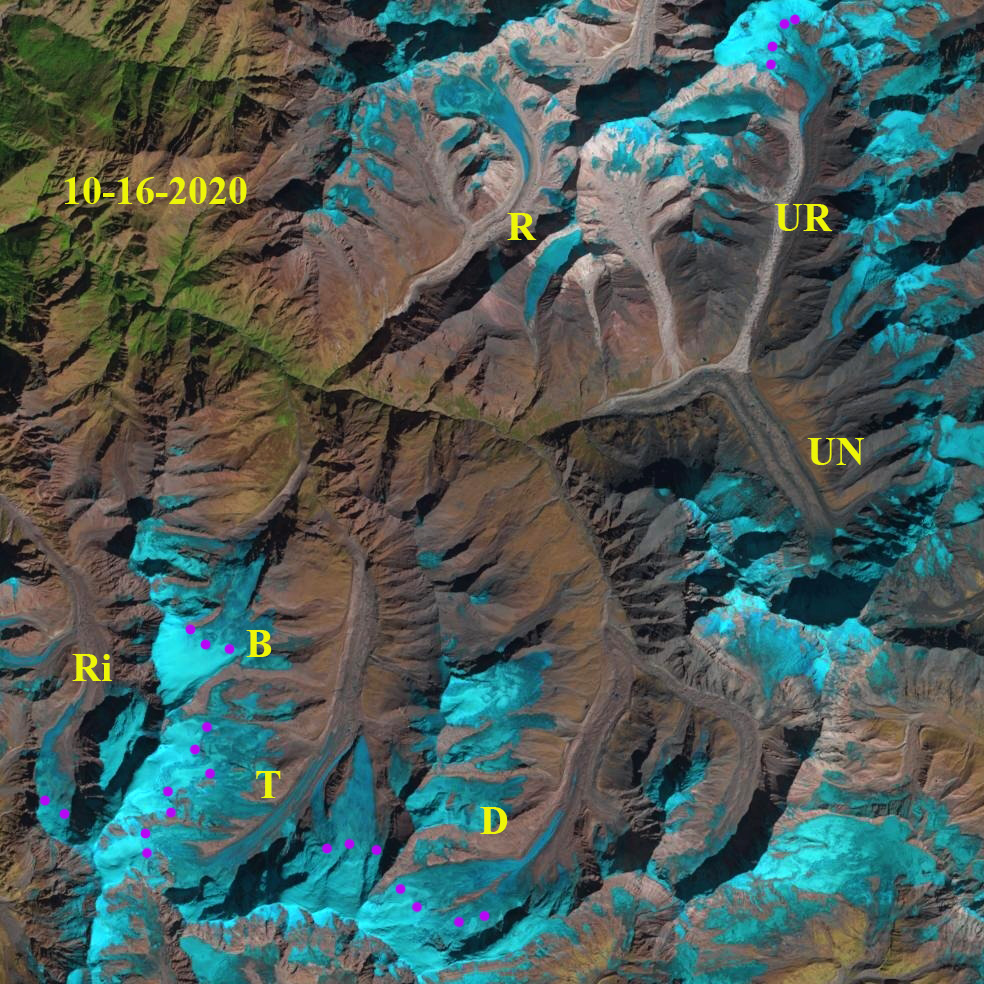
Nanda Devi region glaciers in 10-16-2020 image indicating the snowline at between 5800 and 6000 m on all the glaciers in the upper Rishi Ganga: Bethartoli (B), Dakshini (D), Ramani (R), Rinti (Ri), Trisul (T), Uttar Nanda Devi (UN), Uttar Rishi (UR).

On 7 February 2021, a catastrophic mass flow descended from the steep north face of Ronti Peak and then descended the Rishiganga, and Dhauliganga valleys in Chamoli, Uttarakhand, India, causing widespread devastation and severely damaging two hydropower projects (Shugar et al 2021). This event occurred after a post-monsoon season featuring high snowlines on adjacent glaciers and the warmest January in the last six decades  in Uttarakhand, India. and warmth across the region (Pelto et al, 2021; Matthews et al, 2021). By mid October the snowline on the glaciers had risen to ~5800-6000 m on glaciers in the region which is above the landslide initiation location,  see above.  More than 200 people were killed or are missing. The~27 × 106 cubic meters of rock and glacier ice collapsed and rapidly transformed into an extraordinarily large and rapidly moving debris flow that scoured the valley walls up to 220 meters above the valley floor (Shugar et al 2021).

Aru Glacier, Tibet

A 3 km long glacier collapsed in an ice avalanche on July 17, 2016, killing nine herders living in their summer pasture at Aru Village, Xizang Autonomous Region, China (Tian et al 2016). The Aru Glacier, ranged in elevation from 5250 to 6150 m. The collapsed ice flowed/slid downslope within 4–5 min over the narrow terminus tongue and swept across the gently-sloping alluvial fan, reaching Aruco Lake. The average depth of the deposits was estimated to be 7.5 m indicating a total volume of fallen ice of at least 70 million m3, or equivalent to an average glacier thickness loss of ~21 m (Tian et al 2016). Both glaciers had a mass balance gain in years prior to the collapse.

Air temperature at the nearest state-run meteorological station had increased by ~1.5°C over the past five decades. The total precipitation in the area prior to the accident had been the highest in the 2010–16 period exceeding the average value by 88% (Tian et al 2016).The event occurred in the midst of the summer monsoon during a period of wet weather. The warm wet weather likely pre-conditioned the event. There is no evidence of a previous event at this site.(Jacquemart et al 2020) concluded this event was triggered by unusably high meltwater input.

Leones Glacier, Chile


Leones Glacier in March 2015, Jill Pelto Photograph

Leones Glacier is a lake terminating outlet glacier on the east side of the Northern Patagonia Icefield. In late 2014 or early 2015 a landslide spread onto the Leones Glacier from an adjacent mountain slope. My daughter Jill took this image out a plane window returning from field work in the Falkland Islands, illustrating the landslide.  Landsat images from 2014 (before) and 2015 (after) indicate the 1.5 km2 size of the landslide debris cover on the glacier. By 2020 the landslide had migrated downglacier, but there is also debris cover further upglacier suggesting an additional smaller landslide, from a bedrock ridge in an icefall area. The glacier had been thinning 1 m/year and had a high snowline averaging above 1300 m in 2013, 2014 and 2015, which would further debuttress the mountain slope (Glasser et al 2016: Pelto, 2017).

Amalia Glacier, Chile

Amalia Glacier is a rapidly thinning outlet glacier of the Southern Patagonia Icefield. A 2019 landslide from the northeast slopes of Reclus Volcano with a volume of 262 ± 77 × 106 m3  disrupted 3.5 km2 of Amalia Glacier’s surface (Van Wyck de Vries et al 2022). Retreat had debuttressed the ice marginal mountain side that failed. The glacier briefly accelerated and then decelerated after the landslide.

Santa Lucia, Chile

On December 16, 2017 a rock landslide was triggered that transitioned into a debris flow incorporating much of a glacier before destroying most of Santa Lucia killing 18 people (Duhart et al 2019). The landslide occurred following an intense rainfall event with 122 mm of rain in 24 hours and a two week period of high temperatures. The flow had a volume of 7.2 million m3 with a flow velocity of 72 km/hour.


Drogpa Nagtsang Glacier, China 2021 Snow Line Positions Lake Expansion

Drogpa Nagtsang Glacier, China retreat and proglacial expansion in 1993 and 2021 Landsat images. Red arrow is the 1993 terminus, yellow arrow the 2021 terminus and yellow dots are the snowline.

Drogpa Nagtsang Glacier, China is 30 km west of Mount Everest terminating in an expanding proglacial lake. The glacier begins on the Nepal border at 6400 m, and its meltwater enters the Tamakoshi River that supplies the Upper Tamakoshi Hydropower project a 456 MW run of river  project that began operation in September 2021.  King et al (2017) observed the mass balance of 32 glaciers in the Mount Everest area including Drogpa Nagtsang and found a mean mass balance  was  -0.7 m/year for lake terminating glaciers. In this basin from 2000–2016, mass balance loss resulted in surface elevation to decline at a rate of −0.63 m a−1, which drove a velocity decline of ~25% (Zhong et al 2021). They also noted that the area of  proglacial lakes in glacier contact increased by ~204% . Pelto et al (2021) documented the exceptionally high winter snowline in the Mount Everest region from October 2020-January of 2021.  Here we examine changes in Drogpa Nagtsang Glacier since 1993 and the snowline variation from October 2020-November 2021.

In 1993 Drogpa Nagtsang Glacier had a substantial number of coalescing supraglacial ponds on its relatively flat stagnant debris covered terminus.  The snowline in 1993 was at ~5450 m.  At Point A there is extensive crevassing indicating vigourous flow. At Point B a tributary glacier joins the main glacier. At Point C the glacier is a 1.2 km wide glacier tongue.  Quincey et al (2009) observed flow of less than 10 m/a in lower 5 km of glacier in 1996 and peaking at 20-30 m/a 8 km from terminus. By 2015 a 2.7 km long lake has developed (Pelto, 2019).  In 2021 the lake has expanded to 3 km long. At Point A there is no longer significant crevassing indicating reduced flow. At Point B the tributary no longer connects to main glacier. At Point C the glacier tongue has lost 30% of its width and debris cover width has expanded.  The terminus area remains stagnant and the lake is poised to continue expansion.

Snowline variation from October 2020-November 2021, yellow dots. These are Landsat images except May 2021 is from Sentinel.

In October 2020 the snowline on Drogpa was at 5650-5700 m. By mid-January after the record winter heat wave of 2021 the snowline had risen to 5750-5800 m.  In May of 2021 as the summer monsoon began the snowline was below the terminus of the glacier (5000 m).  In June the snowline had risen to 5450 m. This is a summer acccumulation type of glacier, which means most of the accumulation snowfall occurs during the summer monsoon above the snowline simultaneous with high melt rates below the snowline.  The snowline is close to mean freezing level, which has risen to 5400 m in recent years for the summer monsoon period (Perry et al 2020)The snowline than rises in the post-monsoon period. By October 2020 in the post-monsoon period the snowline had rise to 5600 m.  A significant storm in late October lowered the snowline to 5250 m for November 2021. This suggests the snow free start to winter we saw last year will not occur this year.

From Shasta, CA to Adams to Baker, WA to Kokanee, BC to Banff, AB High Glacier Mass Loss in 2021

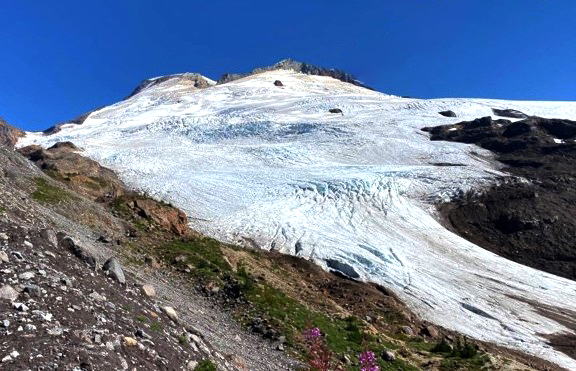
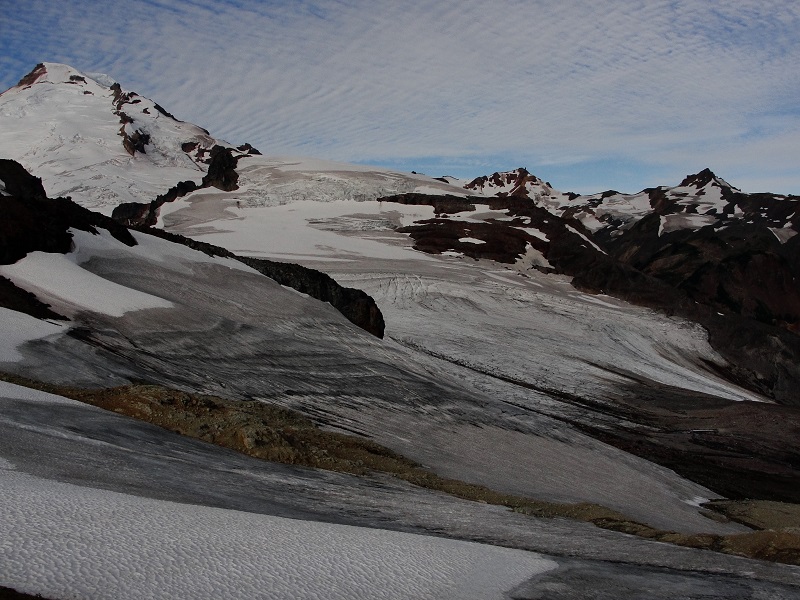
Easton Glacier on Mount Baker in late August 2021, with less than 20% of the glacier retaining snowpack.

The exceptional heat of the summer of 2021 across glaciated mountain ranges of the Pacific Northwest, reduced snowcover extent from Mount Shasta, CA north to Mount Adams and Mount Baker, WA and east to Glacier National Park, MTKokanee Glacier, BC and Bonnet Glacier, Alberta.  Here we examine late summer images to illustrate the extent of exposed bare ice and firn across glaciers in the region. For a glacier to be in equilibrium requires at least 50% to be in the accumulation zone, snow covered at the end of the summer. At the end of the summer the snowcovered area varied from 0-20% on all of the glaciers reviewed here, the snowcovered area is the accumulation area ratio. Low accumulation area ratios such as this indicate mass loss of at least 2 m w.e. in 2021 on these glaciers. That is the equivalent of losing a 2 m thick slide of ice off the surface of the entire glacier.

When there is a persistent pattern of snowcover loss on the upper part of the glacier this indicates the lack of a consistent accumulation zone indicating the glacier cannot survive (Pelto, 2010). One indicator of this is new bedrock being exposed on the upper glacier as seen on both Easton and Bonnet Glacier here.

As the winter season begins hopefully a La Nina pattern will deliver much needed deep snowpacks.

Sentinel 2 False and True Color images from 8-25-2021.  Yellow arrows indicate where glacier is separating and blue arrows the small remanent of 2021 snowpack remaining. This remanent will not last to the end of the melt season. 

Jackson and Blackfoot Glacier in early September Sentinel 2 false color images. Point A indicates exposed ice showing annual layers. Point B indicates exposed firn that had been retained through previous summers. The gray color of the firn indicates how dirty it is and that its albedo would enhance melting.  

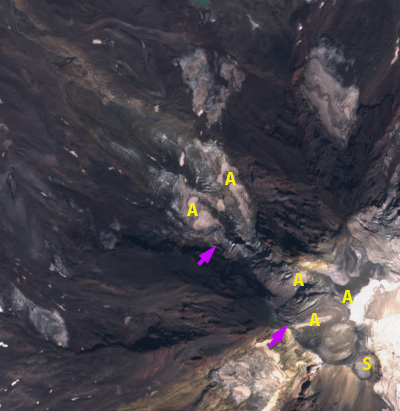
Adams Glacier on Mount Adams in Sentinel 2 True Color image from 8-30-2021. Pink arrows indicate icefall top and bottom. S=summit area, A=Areas where limited pockets of 2021 snowpack has been retained through August.

The upper reaches of Kokanee Glacier to Cond Peak (2800 m) with no retained snow in 2021. Bare ice is exposed on the lower half of the image, and firn, or multi-year snow above.  Picture taken during fieldwork by Ben Pelto.

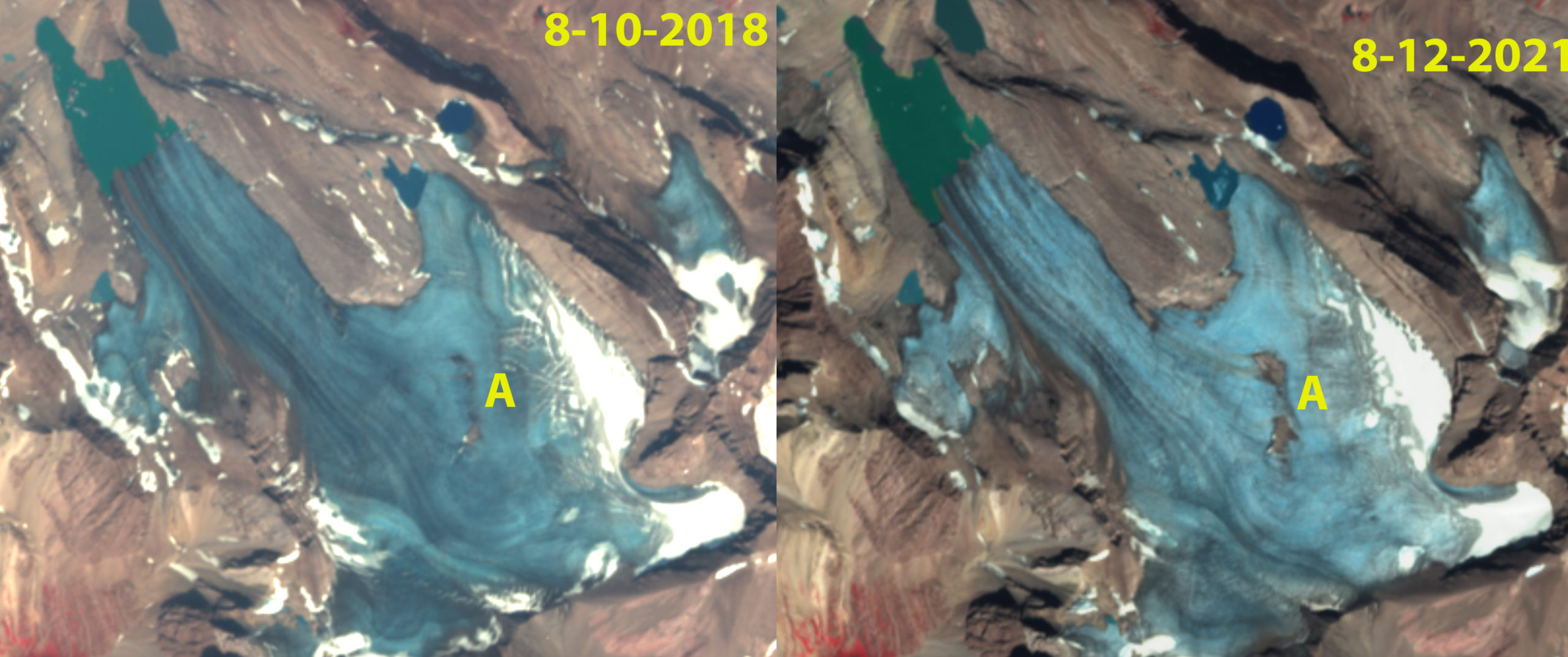
Bonnet Glacier in Sentinel 2 images indicating the emergence of bedrock due to thinning in the former accumulation zone, Point A. Note the lack of retained snowcover in both years with at least a month left in the melt season.


Sholes Glacier, WA and a Cascade of Ologies

Watercolor painting of Sholes Glacier. The small figure is at the current terminus of the glacier, and the photo that inspired this painting was taken from where the glacier used to end about 35 years prior. By Jill Pelto

Sholes Glacier is on the northeast flank of Mount Baker, WA.  We have spent the last 32 years completing detailed measurments on this glacier that has revealed a story of glacier mass balance loss, thinning, retreat, declining area, and a cascade of other consequences impacting other “ologies” beyond the glacier.  If you are intrigued by many ologies, the Podcast by Allie Ward will be inspiring as it was to this title.

Sholes Glacier and stream gage station.  We have constructed a rating curve for this station, that the Nooksack Indian Tribe maintains (Grah and Beaulieu, 2013).

The climatology of the region has shifted, with one key change being more frequent and intense heat waves.  Glaciers and heat waves just are not compatible. Using daily maximum temperatures for the 1981-2021 period for Mount Baker from ERA5 temperature reanalysis, completed by Tom Matthews at Loughborough University, indicates that there have been 83 days where the maximum temperature exceeded 12°C, an average of 2 days/year.  In the last five years there have been 22 days exceeding 12°C,  over 4 days/year. There have been 16 days during 1981-2021 period when the maximum temperature exceeded 14°C, 75% (12) of these have been in the last five years.

Probing snow depth on Sholes Glacier in 2014, this is completed annually at a fixed network of over 100 locations.

In terms of glaciology the result of the climate shift is that the glacier has lost 25-30% of its volume from 1990-2021. The terminus has retreated 155 m while the area has decreased by 25%.  The changes have been most rapid in the last 8 years. The two years of largest mass loss were 2015 and 2021. We measure both melting (ablation) on the glacier and runoff from the glacier. This combination allows determination of the amount of glacier runoff. During 24 heat waves in the region from 2009-2021 mean daily ablation during the heat waves has ranged from 4.5-7.2 cm w.e./day (w.e.=water equivalent).  The highest rate of 7.2 cm was during the June 26-July 1, 2021 period.

Sholes Glacier in 2015 exhibiting the darkening of the surface that occurs in high melt years, increasing melt rates. How much black carbon and algae is part of this darkening is the research of Alia Khan (WWU).

For a glacier to be in equilibrium or have a positive mass balance the majority of the glacier must be in the accumulation zone, snow covered at the end of the summer, that is an accumulation are ratio (AAR) greater than 50%.  Pelto and Brown (2012) noted that for Mount Baker an AAR of 60% is required for a break even balance for the year.  From 2013-2021 the average accumulation area ratio has been 35%.  For Sholes Glacier if 50% of the glacier is exposed ice and firn in early August that increases mass loss.  The ice and firn for the same weather conditions have a 30-40% higher melt rate than the snowpack.  An early season heat wave strips the snow off earlier exposing the darker faster melting glacier surfaces for longer further increasing mass loss, note image above.

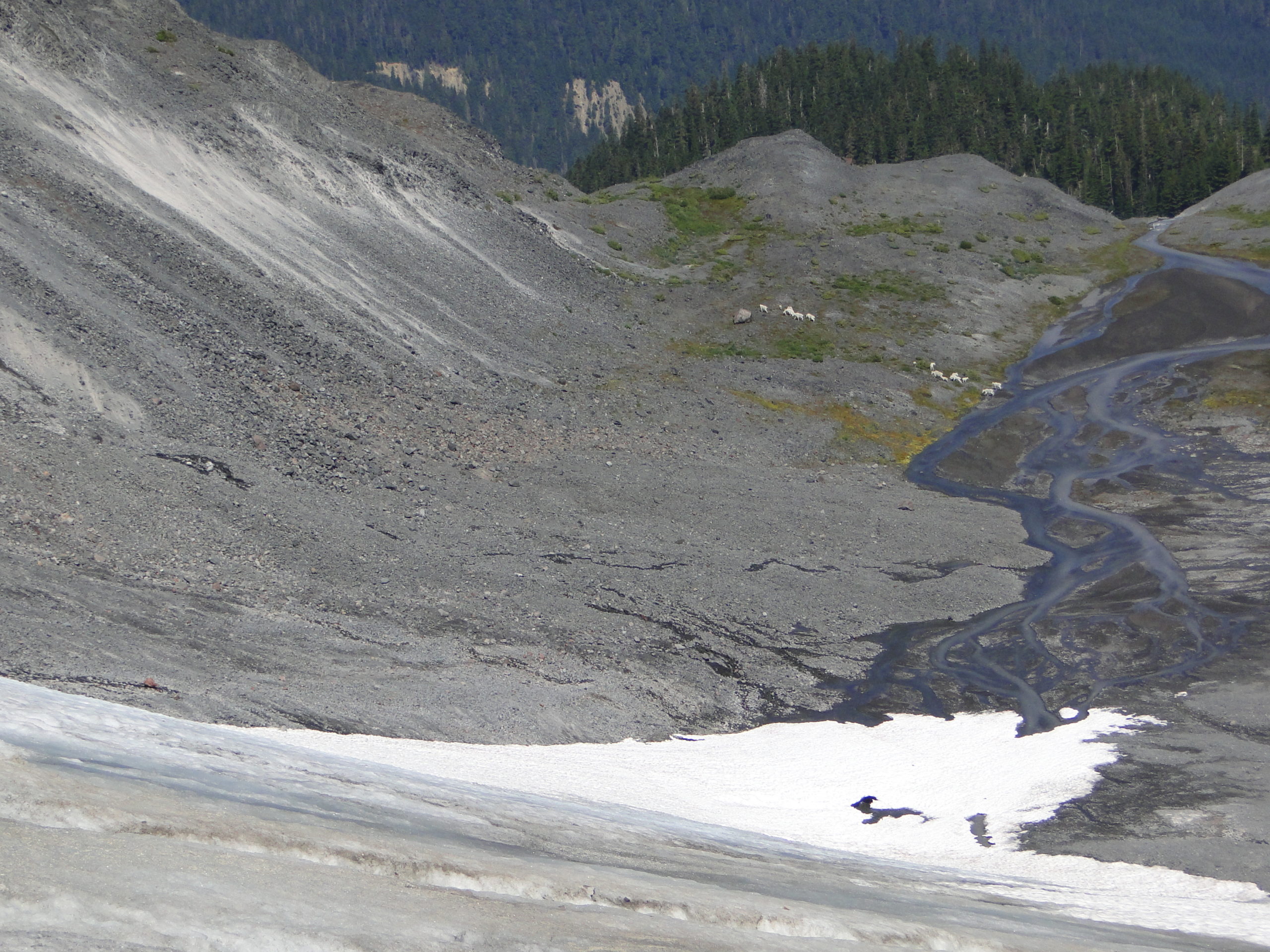
Sholes Glacier in 2021. The glacier has retreated 170 m from 1990-2021, the terminus in 1990 is approximately whre the goats are crossing the stream.

Hydrology downstream in Wells Creek and the North Fork Nooksack River is changing in part because of the changes in glacier runoff. Glacier runoff is a major source of streamflow during the summer low-flow season and mitigates both low flow and high water temperatures (Pelto, 2015). This is particularly true during summer heat wavesbut this ability has been diminishing in the region (Moore et al 2020)  For the last 37 summers we have been in the field monitoring North Cascade glaciers response to climate change including during heat waves (Pelto, 2018). In the last decade we have made synchronous observations of glacier ablation and stream discharge immediately below Sholes Glacier, Mount Baker (Pelto, 2015). This in conjunction with observed daily discharge and temperature data from the USGS stations on the ~6% glaciated North Fork Nooksack River (NFN) and the unglaciated South Fork Nooksack River (SFN), contrasts and quantifies the ameliorating role of glacier runoff on discharge and water temperature during 24 late summer heat wave events.

Measuring discharge below Sholes Glacier in 2016.

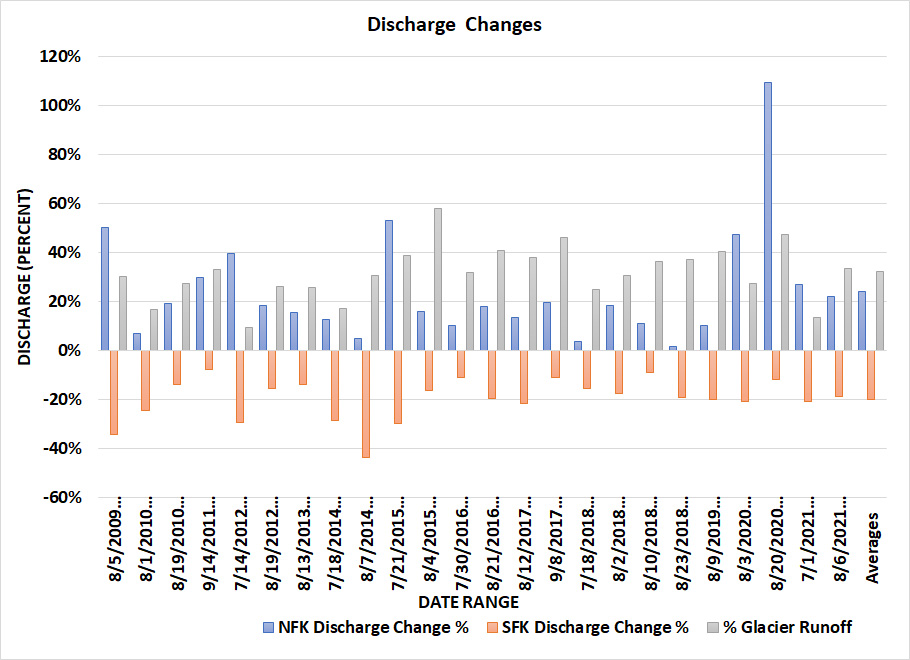
Sholes Glacier and ablation measurements on Sholes Glacier indicate daily ablation ranging from 5-6 cm/day, which for the NFN currently yields 9-11 cubic meters/second. This is 40-50% of the August mean discharge of 24 cubic meters/second, despite glaciers only covering 6% of the watershed. In the unglaciated SFN warm weather events generated a mean stream temperature change of +2°C, only 1 event in the NFN generated this rise and the mean was +0.7°C. Durng the June 2021 heatwave from June 21-29 maxium daily stream temperature in SFN warmed 3°C, vs 0.8°C for NFN.  This illustrates that a greater proportion of snowmelt, which NFN recieves, has limited the temperature rise.  Discharge rose at least 10% in 20 of the 24 events in the NFN with an average increase of 24%.  In the SFN all 24 events led to a decreased discharge with an average decrease of 20%. The primary response to these summer heat waes is increased discharge in the heavily glaciated NFN, and increased stream temperature in the unglaciated SFN.

Discharge change during heat waves in South Fork (decreases) and North Fork Nooksack River  (increases) above.  Below temperature change during heat waves in South Fork (significant rise) and North Fork Nooksack River (small rise).

Glacier runoff is a product of glacier area and melt rate.  Overall glacier runoff declines when area reductions exceed, ablation rate increases.  This has already occurred in the NFN and now glacier runoff is declining (Pelto, 2015). The measured ablation rate is applied to glaciers across the NFN watershed, providing daily glacier runoff discharge to the North Fork Nooksack River.  For the NFN glacier runoff production was equivalent to 34% of the total discharge during the 24 later summer heat wave events. As the glaciers continue to retreat the NFN will have a declining mitigation of heat waves for discharge and temperature and trend towards the the highly sensitive SFN where warm weather leads to declining streamflow and warming temperatures.

Nooksack Falls heavily glacier fed.

Aquatic ecology in glaciated watershed in turn is impacted. Glaciers are important in maintaining sufficient discharge and stream temperature that are critical for salmon in the North Fork Nooksack. Some cold-water trout and salmon species are already constrained by warm water temperatures and additional warming will result in net habitat loss (Isaak et al 2012). In the Fraser River and Thompson River, BC fish community thresholds were obsrved for mean weekly average temperatures of about 12°C and again above 19°C (Parkinson et al 2015). Below 12°C the community were characterized by bull trout and some cold water species, between 12°C and 19°C by salmonids and sculpins and above 19°C by minnows and some cold water salmonids (Parkinson et al 2015). These thresholds indicated small temperature changes can be expected to drive substantial changes in fish communities. During the 24 warm weather events noted in the North Fork only two events exceeded 12°C, while in the South Fork 15 of the events exceeded 19°C.  This suggest that both rivers are near a threshold that could alter the fish community.

In the North Fork Nooksack the number of returning chinook is divided into natural and hatchery spawned salmon. The Chum and Coho salmon data for the Nooksack River during the 1999-2013 interval indicate there are two salmon population peaks for each species. The early peak is in 2002 and the second peak occurs in 2010 (Washington Dept. Fish & Wildlife, 2020). Overall numbers have not sustained an increase and remain endangered.

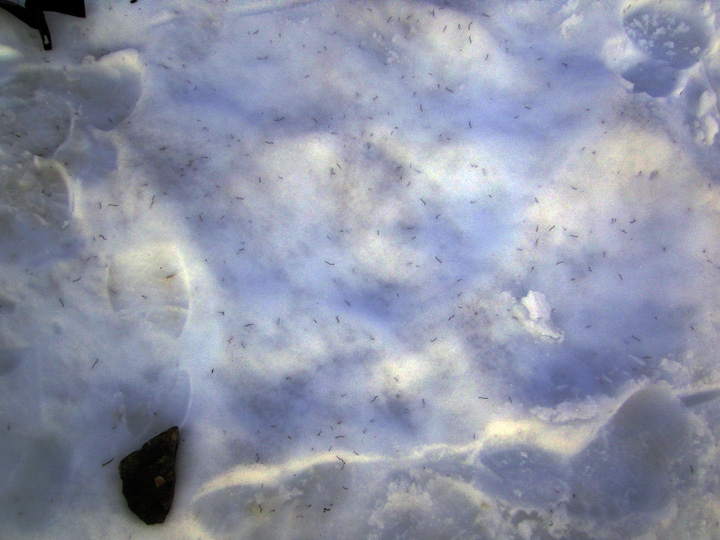
Ice Worm counts as the sunsets, 110 worms per square meter.

The climatology and glaciology has been difficult for ice wormology  On the glacier itself ice worm population density surveys conducted annually indicate the density of ice worms has decreased since 2000 and that even 10 m beyond the edge of the glacier on snowpack they do not exist.  This combined with the reduction in glacier area indicate population decline of ice worms.

In 2009 we observed the largest goat herd 62 goats (13 kids), some of them seen here below Sholes Glacier.

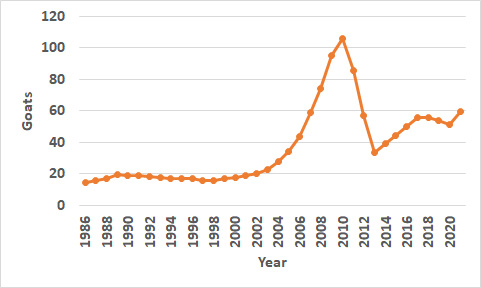
The climatology has been more favorable in terms of Goatology.We have conducted annual mountain goat surveys in the Ptarmigan Ridge-Sholes Glacier region each years since 1984.  Populations stayed steady from 1984-2000, before rising dramatically through 2010. The difficult winters of 2011 and 2012 reduced the population, followed by a recovery up to 2021.

Three year running mean of mountain goat census conducted each summer while we are working on Ptarmigan Ridge, Sholes Glacier and Rainbow Glacier.


Kokanee Glacier 2021: slash and burn

The southwest side of Kokanee Glacier from the ridge with Cond Peak at the Right and Sawtooth Ridge at center.

By Ben Pelto, PhD, UBC Mitacs Elevate Postdoctoral Research Fellow

Since 2013 I have been working on the Kokanee Glacier. Located just outside of Nelson in southeastern British Columbia (BC), the Kokanee Glacier is due north of the Washington-Idaho border. This work began as part of a five-year study of the cryosphere in the Canadian portion of the Columbia River. This project was carried out by the Canadian Columbia River Snow and Glacier Research Network — spearheaded by the Columbia Basin Trust. The glacier research, which included the Kokanee Glacier, was led by my former PhD supervisor at the University of Northern British Columbia Dr. Brian Menounos and myself. At the culmination of the project, we published a technical report, and a plain language summary of that report. When the five-year project officially ended in 2018, I learned of a BC Parks program called Living Labs, which offers funding for climate change research in BC Parks, particularly research which documents change and guides protected area management. With Living Labs funding in 2019-2021, I have kept the annual mass balance trips going — now a continuous nine-year record — and a winter mass balance trip in 2021. In conjunction with this, Brian Menounos has secured continued funding (continued from our 5-year project) from BC Hydro for LiDAR surveys of the glacier every spring and fall. These surveys are carried out by the Airborne Coastal Observatory team from the Hakai Institute.

During the 2021 spring trip, we found that the Kokanee Glacier had an average snow depth of 4.4 meters. Using snow density measurements collected with a snow-corer, we found that the winter balance for 2021 was 1.91 meters water equivalent (m w.e.). This value was lower than the 2013-2020 average of 2.18 m w.e. (Pelto et al. 2019).

With a below average winter balance, 2021 would need to feature a cool summer. Instead, multiple heat waves occured, with temperature records being broken across the province. Wildfires burned all over BC and the neighboring US states of Washington and Idaho, swamping the region in smoke for weeks on end. Rather than mitigate for a slightly-below-normal snowpack on the Kokanee, summer 2021 took a blow-torch to glaciers across the region.

We hiked into the Kokanee Glacier on September 12, stopping under a boulder to wait out proximal booms of thunder and flashes in the clouds. We got pelted with bursts of both hail and graupel, and soaked in the rain, before gingerly working our way up boulder field and talus that is climbers route up the Keyhole to the Kokanee Glacier. Like the satellite imagery had shown, there was no snow in sight on the glacier — bare ice only. Instead of my usual camp on the snow, we chose a climbers bivy site to set our tent.

Stepping out onto the glacier, we immediately ran into difficult terrain, crevasse bridges of snow or firn had collapsed, leaving bedroom-width crevasses gaping open, necessitating an exercise in maze navigation. Our first stop was a stake at 2600 m which typically retains snow (50 to 100 cms), but this year had lost 1.6 meters. In fact, two stakes drilled at the site in 2015 and subsequently buried by snow had melted out, demonstrating that all snow/firn from the intervening years had been lost. This observation clued me in to the magnitude of melt to expect this year.

Travel on the glacier was more challenging in spots, but overall faster, as the total lack of snow meant that most crevasse bridges were gone, requiring less probing of crevasse bridges and roped-travel. Later, using a satellite image from the dates of our visit, I mapped the retained snow cover, limited to two tiny patches high on the glacier’s east side. The accumulation area ratio (AAR), or the ratio of snow cover to bare ice/firn was <0.01, meaning that under 1% of the glacier was covered in snow.

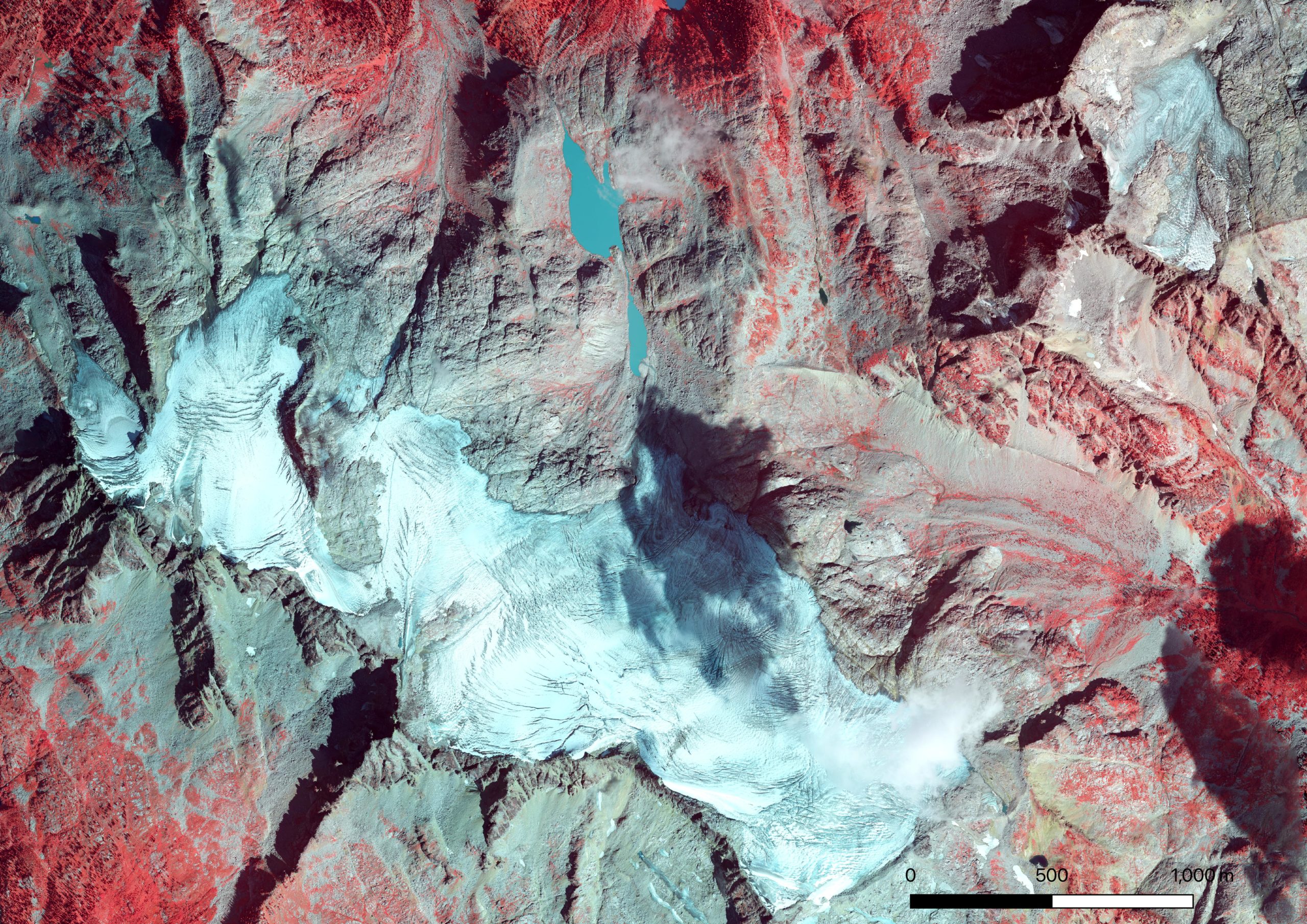
Near infrared-Red-Green 30 cm resolution ortho image of Kokanee Glacier from the Hakai Geospatial/ACO team on Sept. 2, 2021. Note how badly crevassed the glacier is, most crevasses are exposed with no retained snow. The white color and mottled appearance over the upper glacier is a skiff of overnight snow just a few centimeters thick that melted off the next day. Also note bare ice patches exposed under formerly perennial snow patches that have shrunk in recent years and now are disappearing.

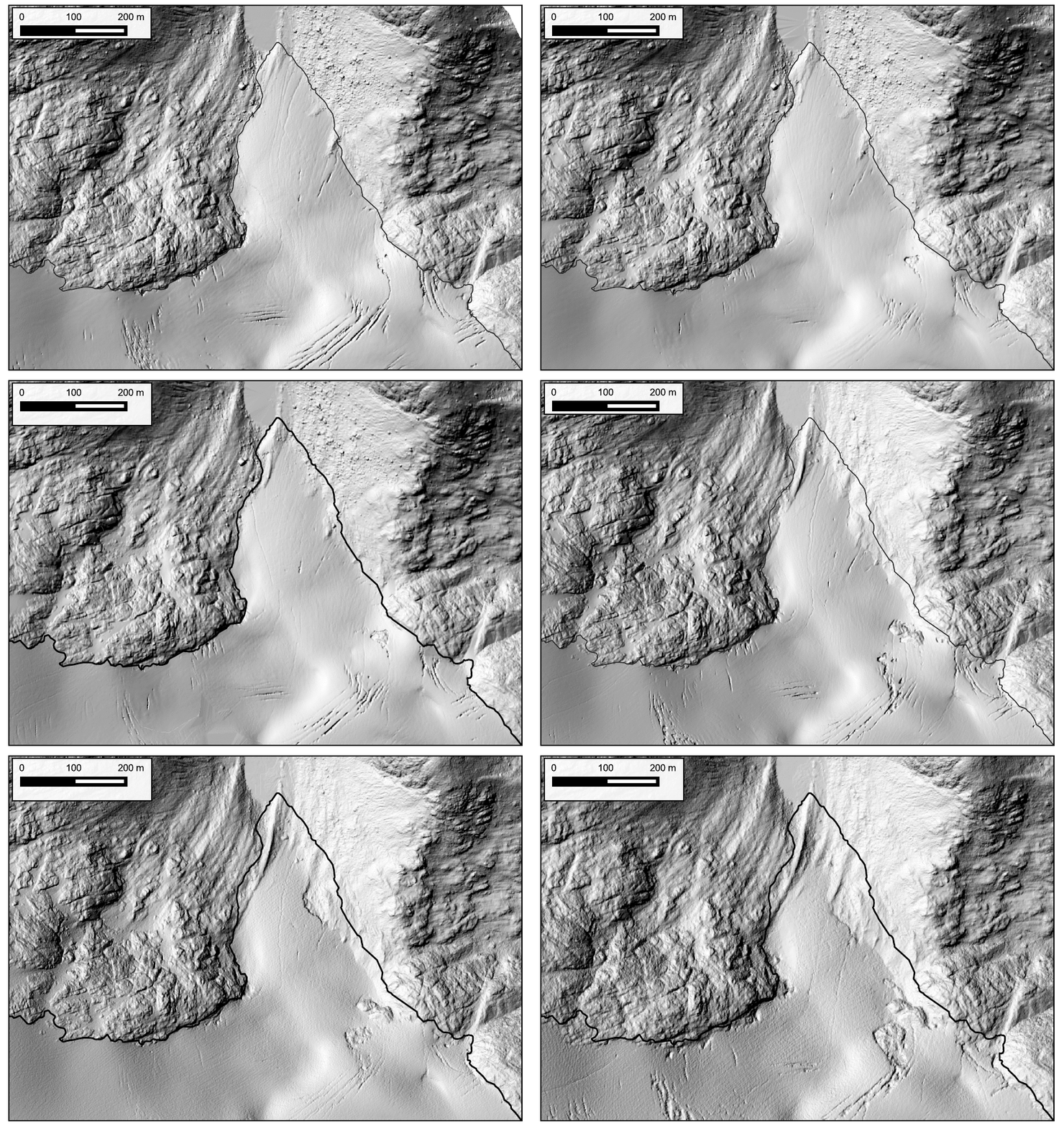
Visiting the toe of the glacier, our lowest stake indicated just under 5 m of ice melt, double that of 2020. In May, this location had 3 m of snow; the combined melt of snow and ice (loss of winter snow and glacier ice) is termed the summer mass balance, and at this site was -6.2 m w.e., far higher than the usual -4 m w.e. I also noticed that much of the thin ice along the margin of the toe was gone, and a little rock nunatak (rock island) that appeared in 2015 (images below) became a bite out of the glacier rather than a island. We estimated that the toe experienced 60 m of retreat. Over the past 5 years, the Kokanee has lost an average of 16 m in length annually. Expecting to see above average thinning and retreat, I was still startled to see how diminished and thin the toe looked.

A week prior to my field visit, the Hakai Institute ACO team flew a LiDAR survey of the Kokanee Glacier as part of their work with Brian Menounos at UNBC. Comparing this year’s glacier surface with that from last year’s survey, Brian found a whopping 2.55 m of thinning. After mapping the glacier facies (ice/firn/snow) to represent on the density of the observed thinning, this equates to a glacier mass balance of -2.16 m w.e., higher than the previous record loss of -1.20 m w.e. in 2015.

LiDAR-derived height change 2020 to 2021 from 1 m resolution DEMs from Brian Menounos and the Hakai Institue ACO team. The black line is the 2021 glacier outline, note the bite out of the glacier above the toe to the NE corner of the glacier. Small red patches off-ice are seasonal snow patches losing mass. Points represent mass balance observation locations.
Kokanee Glacier terminus from 2015 to 2021. 140 meters of retreat for 23 m/yr. Data in the GIF are from Hakai Institute and Brian Menounos of UNBC ACO glacier surveys.

Back home, I crunched the numbers from our glaciological observations of mass balance (consisting of 14 ablation stakes this year) and calculated a mass balance of -1.97 m w.e. With Brian, I published a paper in 2019 (Pelto et al. 2019) comparing glaciological (field) and geodetic (LiDAR) mass balance estimates and found them to be similar — if some factors like snow and firn density were carefully considered. The small difference between estimates is likely due to timing (the LiDAR mass balance is from 8/26/2020 to 9/3/2021, while the field mass balance is 9/12/2020 to 9/13/2021), and that there was a skiff of fresh snow (likely 5-10 cms) on the glacier during the 2020 LiDAR survey.

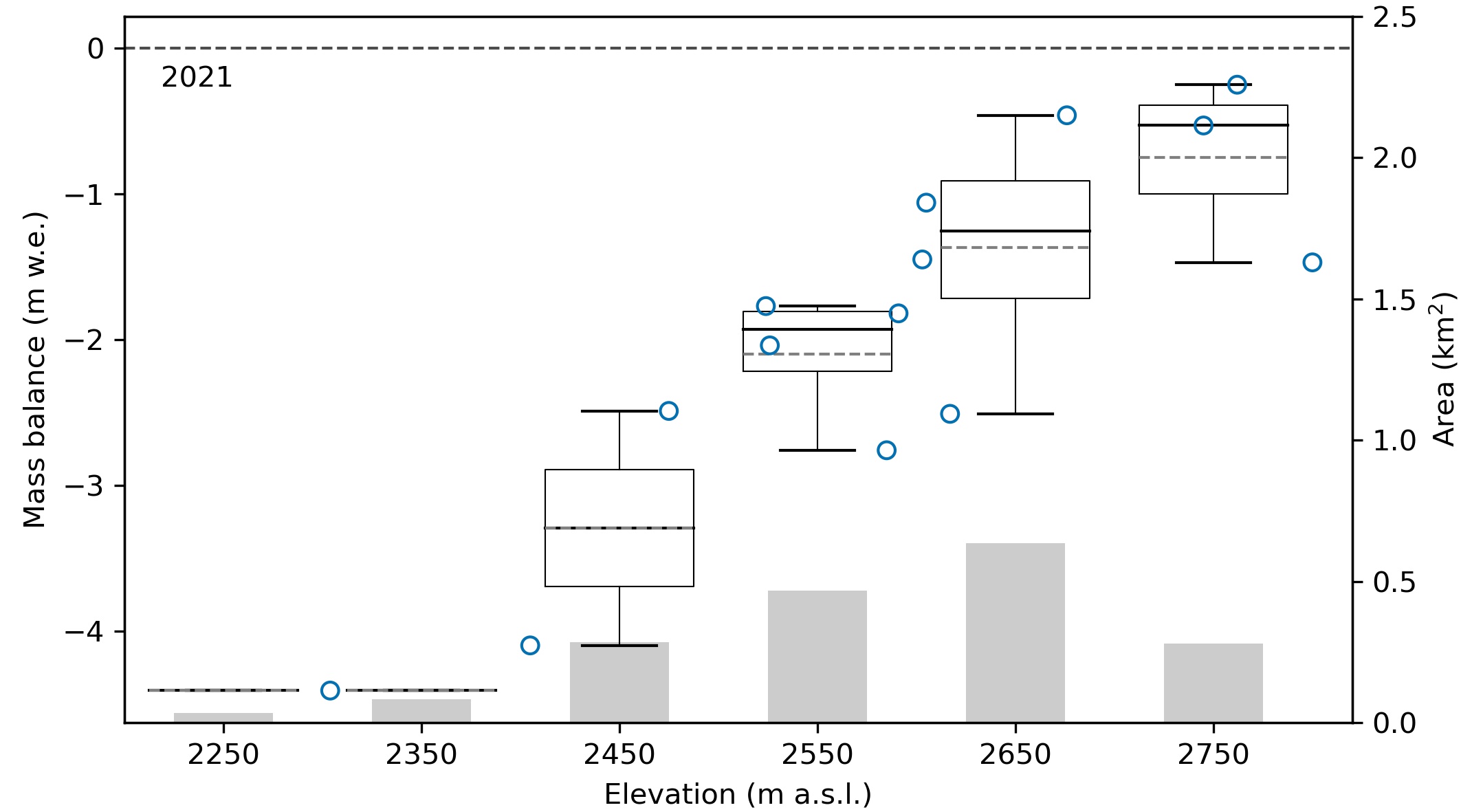
Kokanee 2021 glacier mass balance. Blue dots are observations. The boxplots show the 100 m bins used to estimate glacier-wide mass balance (median line in black, mean dashed grey line). The grey bars depict the area of the glacier for each 100 m elevation-band
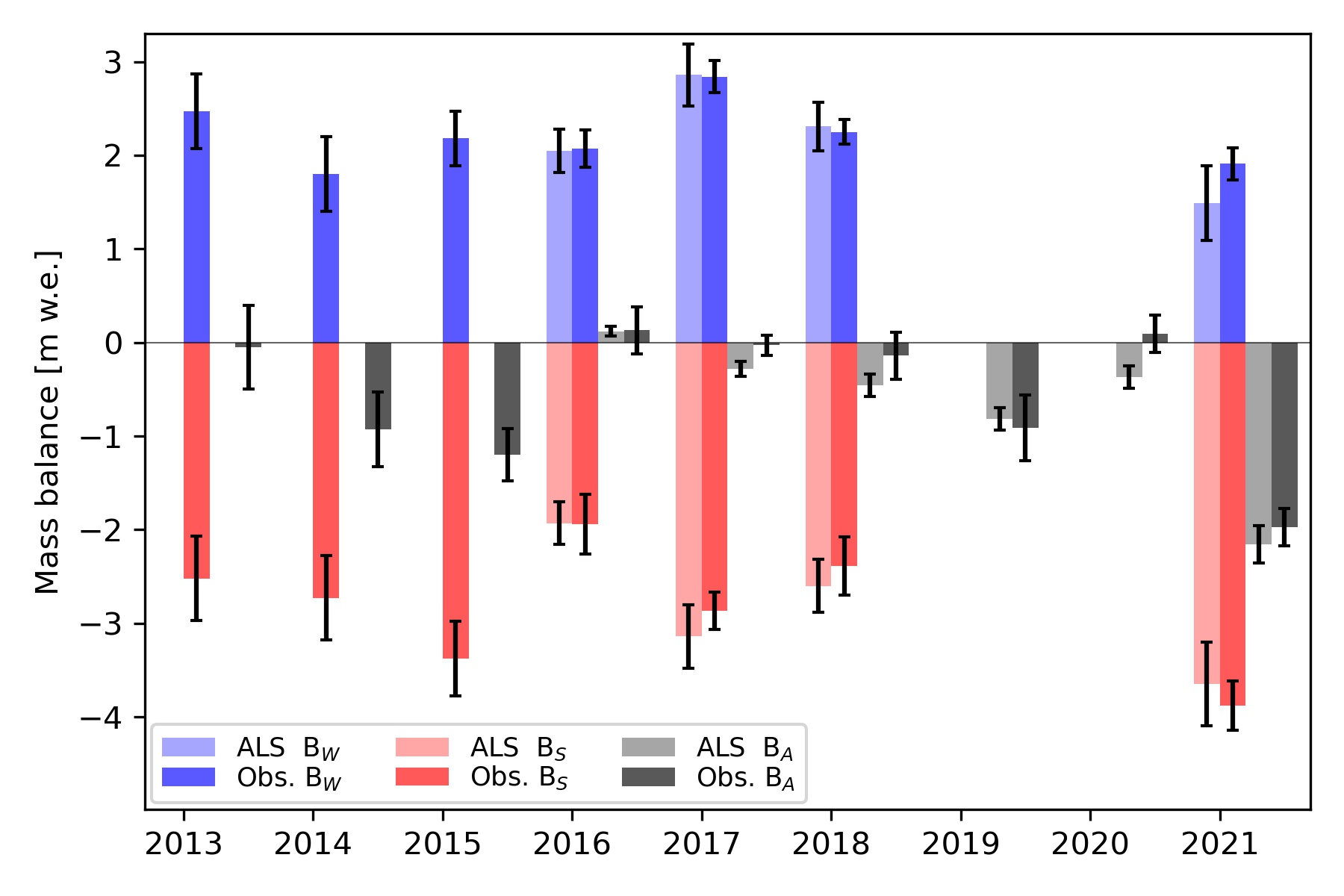
Seasonal and annual mass balance for Kokanee Glacier from LiDAR and glaciological measurements for each balance year from 2013 to 2021 with 2σ uncertainties.

In 2017, I visited the Kokanee Glacier to measure it’s ice thickness using ice-penetrating radar. I found that the glacier on average was 43 m thick using my measurements to tune a glacier model. I published these results in the Journal of Glaciology (Pelto et al. 2020). In the five years since that work, the glacier has lost over 4.8 m of total thickness. That equates to a loss of over 11% of its total volume. 2021 alone wasted away 6% of the glacier’s total volume — an eye-watering number for a single year.

Cumulative mass balance for Kokanee Glacier 2013-2021 from both field and LiDAR measurments. LiDAR-derived mass balance began in 2016.

The heat of 2021 was an outlier, but years like 2021 and 2015 take a toll on the glaciers. Currently, glaciers in western North America are losing around 0.75 m of thickness per year (according to my work in the Columbia Basin (Pelto et al. 2019) and work by Brian Menounos for all of western North America (Menounos et al. 2018)). The better years for Kokanee Glacier (2016 mass balance: +0.12 m w.e.) pale in comparison. That meager surplus was lost the very next year (2017).

Herein lies the issue, positive mass balance years in recent decades are not large enough to offset even average years; hot dry summers take years off the lifespan of glaciers across western North America.

Losing 6% of it’s total volume in 2021, the best we can hope for Kokanee Glacier is a few near-neutral or positive mass balance years to cover back up the exposed firn, to keep the glacier albedo from becoming too dark and increasing the rate at which ice can melt.


Benito Glacier, Chile 2021 Calving Event Drives Further Retreat


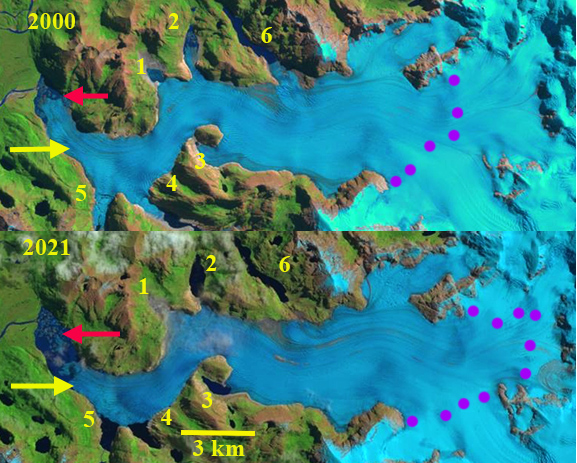
Benito Glacier in 2000 and 2021 Landsat images. Locations 1-6 are current or former distributary terminus locations. Red arrow is the 2000 terminus location and yellow arrow the 2021 terminus location.  A small cloud is obscuring an iceberg near terminus.  Purple dots are the snowline.

Benito Glacier is a temperate outlet glacier on the west side of the North Patagonian Icefield terminating in an expanding lake. The glacier is south of  San Quintin Glacier and north of Acodado GlacierLoriaux and Casassa (2013) examined the expansion of lakes of the Northern Patagonia Ice Cap. From 1945 to 2011 lake area expanded 65%, 66 square kilometers. Ryan et al (2018) identified thinning of 2.8 m/year in the ablation zone from 2000-2013, and that thinning of over 120 m extended from the terminus to ~750 m from 1973-2017. Mouginot and Rignot (2015)  indicate that the velocity of Benito Glacier is between 200-500 m per year along the center line below the snowline. Glasser et al (2016) note the glacier has limited debris cover and that the average transient snowline in 2013-2016 is at 1000 m, substantially above the ~900 m average from earlier.

Benito Glacier in 1987 main terminus was on an outwash plain.  The glacier has five distributary termini (1,2,34,5,6) two of which had open proglacial lakes in 1987.  At Point 3 the glacier flows around a nunatak and reconnects. In 2000 a 1 km long proglacial has formed at the main terminus.  Distributary termini 1,2 and 4 all have proglacial lakes.  The snowline in 1987 and 2000 is 800-825 m. By 2015 there are  five ending in lakes, with Lake 6 having retreated out of a lake basin. A lake has formed at the new distributary terminus at Lake 3. The two tributaries to the north indicated with arrows each retreat approximately 1 km from 1987 to 2015 and in both cases are no longer calving termini.  The main glacier terminus has retreated into a proglacial lake, with a retreat of 2 km from 1987 to 2015. The lowest 1.5 km  has a low slope and peripheral lakes suggesting the lake will expand substantially as Benito Glacier retreat continues. The transient snowline in 2015 is at  900 m. In 2021 a significant iceberg 0.4 km2 has calved off the terminus.  The terminus has retreated 2900 m from 1987-2021 with the lake area expanding to 2.8 km2.  The lower 1.5 km of the glacier remains low sloped suggesting significant lake expansion is ongoing. The glacier no longer reaches the former proglacial lake 2 or 6. Proglacial lake 1 has drained. Proglacial lake 2,3, and 4 continue to expand. The snowline on Feb. 6 2021 is at 875-900 m, rising to 925-950 m by March 16, 2021.

March 17, 2021 Landsat image indicating iceberg located off front of Benito Glacier


Benito Glacier comparison in Landsat images from 1987 and 2015 indicating the terminus position in 1987 red arrows, yellow arrows the 2015 terminus positions. Locations 1-6 are current or former distributary terminus locations. purple arrows where glacier thinning is expanding bedrock areas. The snowline is indicated by purple dots

Hochstetter Ice Cap Loses All Snowcover in 2020, Franz Josef Land

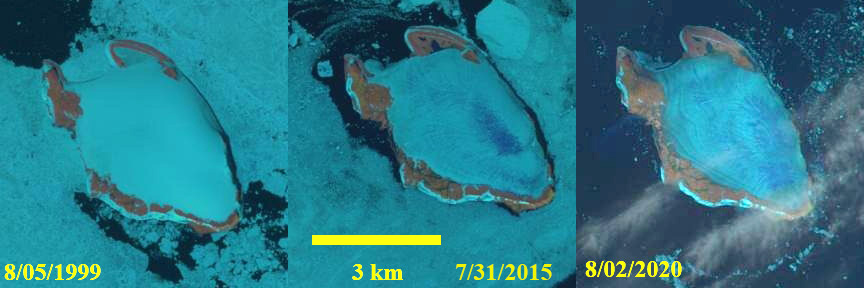
Landsat images from 1999, 2015 and 2020 of Hochstetter ice Cap.  Snowcover=100% in 1999, 80% in 2015 and 0% in 2020.

Hochstetter Ice Cap covers most of Hocstetter Island (Ostrov Khokhshtettera) in the the southern part of the Franz Josef Land archipelago.  Situated ~1000 km from the North Pole this area is known for its white ice caps and cold summer temperature averaging 2 C.  The lack of sea ice in the region is exposing the marine margins of the ice caps in Franz Josef Land to enhanced melting.  This has and will lead to more coastal changes and island separations (Ziaja and Ostafin, 2019), such as occurred on Hall and Littow Island. Here we examine Landsat imagery from 1999-2020 to reveal changing snowcover. The summer of 2020 featured record low sea ice in the Barents Sea by mid July (NSIDC, 2020),  due to the Siberian heat wave this past spring which led to early ice retreat along the Russian coast.

In early August 1999 the island is mostly surrounded by sea ice and the ice cap is fully snowcovered. In July 2000 and 2002 the situation is similar with insignificant exposed ice. At the end of July 2015 the island is mostly surrounded by sea ice, while the island is largely snowcovered there are meltwater saturated blue areas on the ice cap.  On August 2, 2020 there is no snowcover on the ice cap and very limited sea ice around the island.  Three weeks later on August 22, 2020 the ice cap remains bare of snowcover and is hardly the bright white that the area is known for.  This period of extensive ice exposure leads to significant ablation of the exposed darker and older glacier ice leading to a large mass balance loss and glacier thinning.

Hochstetter Ice Cap in  early August 2020 has lost all of its snowcover and has little sea ice in the vicinity. The blue coloration to the ice cap indicates meltwater is present.

Landsat images from 2002 and 2020 of Hochstetter ice Cap.  Snowcover=100% in 2000 and 0% in 2020.

Alpine Glaciers-BAMS State of Climate 2018

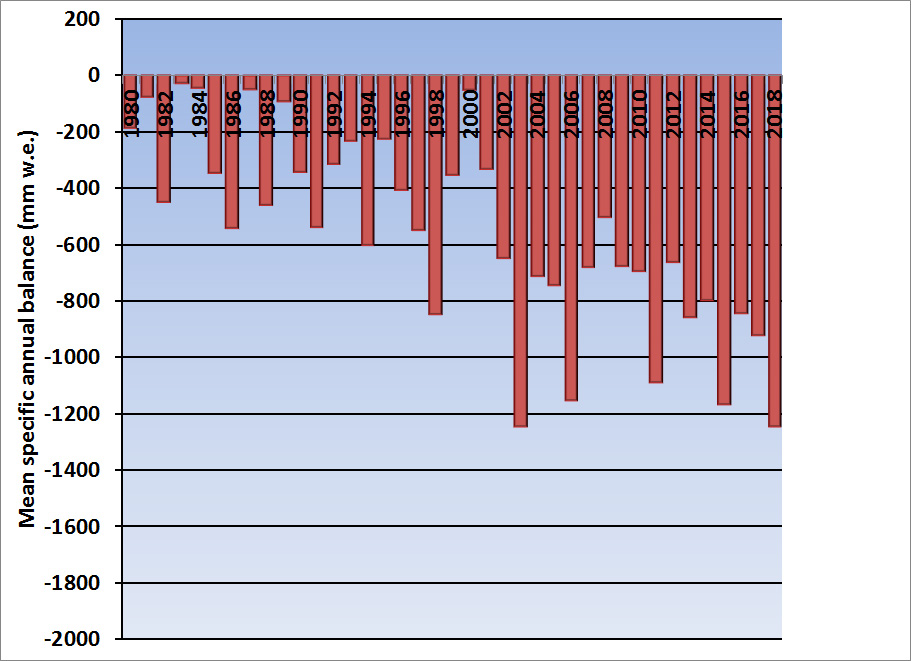
Figure 1. Global Alpine glacier annual mass balance record of reference glaciers submitted to the World Glacier Monitoring Service, with a minimum of 30 reporting glaciers.

For the last decade I have written the section on Alpine Glaciers for the BAMS State of the Climate report, the 2018 report was published this week, below is the section on alpine glaciers.  The key data resources is  the World Glacier Monitoring Service (WGMS) record of mass balance and terminus behavior (WGMS, 2017), which provides a global index for alpine glacier behavior.  Glacier mass balance is the difference between accumulation and ablation, reported here in mm of water equivalence (mm).  Mean annual regionalized glacier mass balance in 2017 was -921 mm for the 42 long term reference glaciers , with an overall mean of -951 mm for all 142 monitored glaciers.  Preliminary data reported from reference glaciers to the WGMS in 2018 from Argentina, Austria, China, France, Italy, Kazakhstan, Kyrgyzstan, Nepal, Norway, Russia, Sweden, Switzerland and United States indicate that 2018 will be the 30th consecutive year of significant negative annual balance (.-200mm); with a mean balance of -1247 mm for the 25 reporting reference glaciers, with one glacier reporting a positive mass balance (WGMS, 2018).  This rate of mass loss may result in 2018 exceeding 2003 (-1246 mm) as the year of maximum observed loss. as a mean. This WGMS mass balance record has now been regionally averaged before determining the global mean, this has not been done yet for 2018, which will reduce the magnitude of the negative balance.

Ongoing global glacier retreat is currently affecting human society by increasing the rate of sea-level rise, changing seasonal stream runoff, and increasing geo-hazard potential (Huss et al, 2017).  The recent mass losses 1991-2010 are due to anthropogenic forcing (Marzeion et al. 2014).

The cumulative mass balance from 1980-2018 is -21.7 m, the equivalent of cutting a 24 m thick slice off the top of the average glacier (Figure 1).  The trend is remarkably consistent across regions (WGMS, 2017).  WGMS mass balance from 42 reference glaciers, which have a minimum 30 years of record, is not appreciably different from that of all glaciers at -21.5 m.  Marzeion et al (2017) compared WGMS direct observations of mass balance to remote sensing mass balance calculations, and climate driven mass balance model results and found that each method yields reconcilable estimates relative to each other and fall within their respective uncertainty margins. The decadal mean annual mass balance was -228 mm in the 1980’s, -443 mm in the 1990’s, 676 mm for 2000’s and – 921 mm for 2010-2018.  Glacier retreat reflects sustained negative mass balances over the last 30 years (Zemp et al., 2015).  The increasing rate of glacier mass loss  during a period of retreat indicates alpine glaciers are not approaching equilibrium and retreat will continue to be the dominant terminus response (Pelto, 2018).

Exceptional glacier melt was noted across the European Alps, leading to high snowlines and contributing to large negative mass balance of glaciers.  In the European Alps, annual mass balance has been reported from 17 glaciers in Austria, France, Italy and Switzerland.  All 17 had negative annual balances, with 15 exceeding -1000 mm with a mean of -1640 mm.  This continues the pattern of substantial negative balances in the Alps, which will equate to further terminus retreat.  Of 81 observed glaciers in 2017 in Switzerland, 80 retreated, and 1 was stable (Huss et al, 2018).  In 2017, 83 glaciers were observed in Austria,; 82 retreated, and 1 was stable.  Mean terminus retreat was 25 m, the highest observed since 1960, when mean length change reporting began (Lieb and Kellerer-Pirklbauer, 2018).

In Norway and Sweden, mass balance surveys with completed results are available for eight glaciers; all had negative mass balances with an average loss of -1420 mm w.e.  All 25 glaciers with terminus observations during the 2007-2017 period have retreated  (Kjøllmoen et al, 2018).

In western North America data has been submitted from 11 glaciers in Alaska and Washington in the United States.  All eleven glaciers reported negative mass balances with a mean loss of -870 mm.  The longest mass balance record in North America is from Taku Glacier in Alaska.  In 2018 the glacier had its most negative mass balance since the beginning of the record in 1946 and the highest end of summer snowline elevation at 1400 m. The North Cascade Range, Washington from 2014-2018 had the most negative five-year period for the region of the 1980-2018 WGMS record.

In the High Mountains of Asia (HMA) data was reported from ten glaciers including from China, Kazakhstan, Kyrgyzstan and Nepal.  Nine of the ten had negative balances with a mean of -710 mm.  This is a continuation of regional mass loss that has driven thinning and a slowdown in glacier movement in 9 of 11 regions in HMA from 2000-2017 (Dehecq et al 2018).


Figure 2. Taku Glacier transient snowline in Landsat 8 images from July 21, 2018  and September 16, 2018.  The July 21 snowline is at 975 m and the September 16 snowline is at 1400 m.  The average end of summer snowline from is m with the 2018 snowline being the highest observed since observations began in 1946.

References

Huss, M., B. Bookhagen, C. Huggel, D. Jacobsen, R. Bradley, J. Clague, M. Vuille,  W. Buytaert, D. Cayan, G. Greenwood, B. Mark, A. Milner, R. Weingartner and M. Winder, 2017a: Toward mountains without permanent snow and ice. Earth’s Future, 5: 418–435. doi:10.1002/2016EF000514

Huss, M., A. Bauder, C. Marty and J. Nötzli, 2018: Neige, glace et pergélisol 2016/17.  Les Alpes94(8), 40-45. (http://swiss-glaciers.glaciology.ethz.ch/downloadPubs/alpen_15-16_f.pdf).

Dehecq, A., N. Gorumelon, A. Gardner, F. Brun, D. Goldberg, P. Nienow, E. Berthier, C. Vincent, P. Wagnon, and E. Trouve, 2019: Twenty-first century glacier slowdown driven by mass loss in High Mountain Asia. Nature Geoscience 12, 22–27.

Kjøllmoen B., L. Andreassen, H. Elvehøy, and M. Jackson, 2018: Glaciological investigations in Norway in 2017. NVE Report 82 2018.

Lieb, G.K. and A. Kellerer-Pirklbauer ,2018: Gletscherbericht 2016/17 Sammelbericht über die Gletschermessungen des Österreichischen Alpenvereins im Jahre 2017. Letzter Bericht: Bergauf 2/2017, Jg. 72 (142), S. 18–25. (http://www.alpenverein.at/).

Marzeion, B., J. Cogley, K. Richter and D. Parkes, 2014: Attribution of global glacier mass loss to anthropogenic and natural causes. Science, 345(6199), 919–921, doi: 10.1126/science.1254702)

Marzeion, B., Champollion, N., Haeberli, W. et al.: Observation-Based Estimates of Global Glacier Mass Change and Its Contribution to Sea-Level Change. Survey of Geophys, 38: 105, doi: 10.1007/s10712-016-9394-y.

Pelto, M., 2018: How Unusual Was 2015 in the 1984–2015 Period of the North Cascade Glacier Annual Mass Balance? Water 10, 543, doi: 10.3390/w10050543.

WGMS 2017: Global Glacier Change Bulletin No. 2(2017). Zemp, M., and others(eds.), ICSU(WDS)/IUGG(IACS)/UNEP/UNESCO/WMO, World Glacier Monitoring Service, Zurich, Switzerland, 244 pp.: doi:10.5904/wgms-fog-2017-10.

WGMS 2018: Fluctuations of Glaciers Database. World Glacier Monitoring Service, Zurich, Switzerland. doi: 10.5904/wgms-fog-2018-11. http://dx.doi.org/10.5904/wgms-fog-2018-11

Zemp and others 2015: Historically unprecedented global glacier decline in the early 21st century. J. Glaciology, 61(228), 745-763, doi: 10.3189/2015JoG15J017.


Asejiaguo Glacier, China Retreat and Lake Expansion

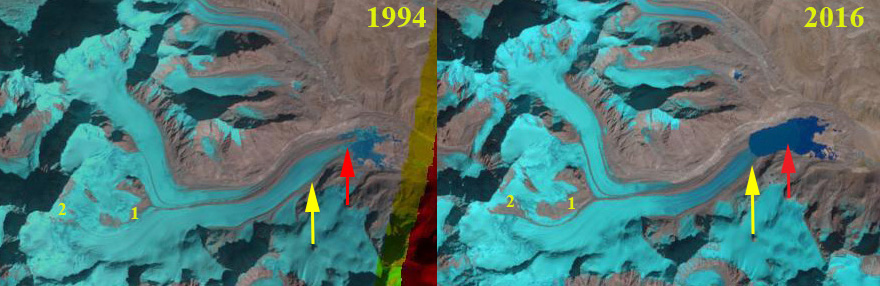
Asejiaguo Glacier in Landsat images from 1993 and 2018.  The yellow arrow indicates the 2018 terminus and the red arrow the 1993 terminus location.  Point 1 and 2 are areas of expanding bedrock in the 5400-5600 m.

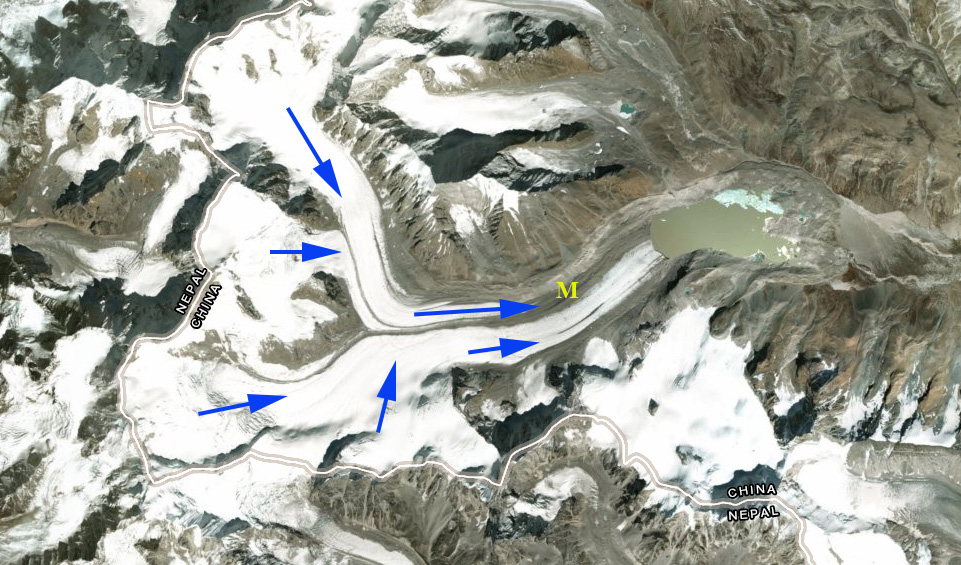
Asejiaguo Glacier drains east from the China-Nepal Border and is at the headwaters of the Yarlung Tsangpo, which becomes the Brahmaputra River.  The Yarlung Tsangpo powers the 510 MW Zangmu Hydropower Station.  Gardelle et al, (2013) identified this glacier as part of the West Nepal region, which experienced mass loss averaging -0.32 m/year from 1999-2011. The changes of the Asejaguo Glacier are examined for the 1993 to 2018 period using Landsat imagery. Neckel et al (2014) examined changes in surface elevation of the glaciers and found this region lost 0.37 m/year from 2003 to 2009.

In 1993 the glacier terminated in a small proglacial lake that is ~1 km long at 4900 m. At Point 1-2 there is limited exposed bedrock at 5400-5600 m, which is near the snowline,  the head of the glacier is at 6000 m.  There is a prominent medial moraine that begins at 5300 where the north and south tributaries join.  The greater width of the southern tributary indicates this is the large contributor.  In 1994 the snowline is higher at 5500 m, but there is still only a small outcrop of bedrock at Point 2.  By 2016 the proglacial lake has expanded to a length of over 2 km.  At Point 1 and 2 there is a greatly expanded area of bedrock, and the separation of a former tributary near Point 1 from the main glacier. In November 2018 there is fresh snowfall obscuring the exposed bedrock at Point 1 and 2. The retreat from 1993-2018 is 1.5 km, and the expanding proglacial lake is over 2.5 km long. The expanding bedrock areas in the 5400-5600 m range indicate the reason rise in snowline that has generated mass loss and ongoing retreat.

The behavior of this glacier matches that of other glaciers in the regions such as Chako Glacier and Ribuktse Glacier

Asejiaguo Glacier in Landsat images from 1994 and 2016.  The yellow arrow indicates the 2018 terminus and the red arrow the 1993 terminus location.  Point 1 and 2 are areas of expanding bedrock in the 5400-5600 m.

Asejiaguo Glacier, blue arrow indicate flow direction, M indicates the medial moraine, the China-Nepal border is also noted.

Soranano Glacier, Peru Separation and Retreat 1995-2018

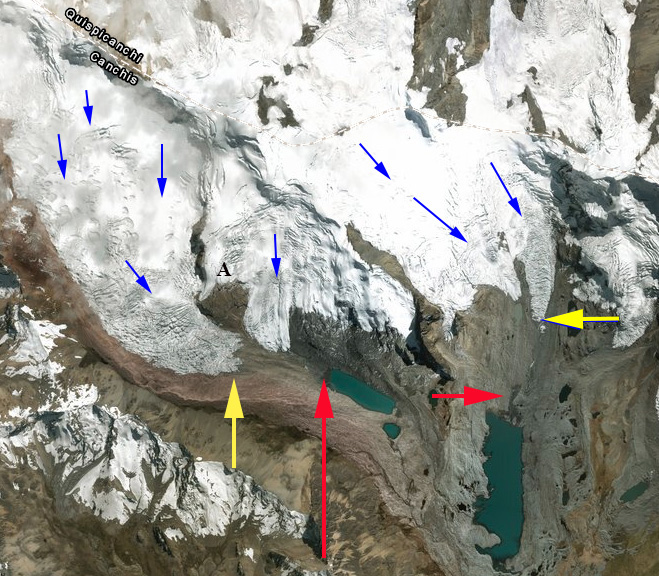
Western Soranano (WS) and Eastern Soranano Glacier (ES) in 1995 and 2000 Landsat images and 2018 Sentinel image, with red arrows indicating the terminus in 1995, and yellow arrows the 2018 terminus. 

Here we examine the west and east Soranano Glacier glacier descending south from the 5800 m summit of Jatunnano (Hatun Nana Punta). The glaciers are just east of Laguna Sibinacocha, which drains into the Rio Vilcanota.  Retreat of glaciers in the Cordillera Vilcanota, Peru has been rapid since 1975, Veettil et al (2017) noted that ~80% of glaciated area below 5000 m was lost from 1975-2015 and glacier area overall declined 48%.  Henshaw and Bookhagen (2014) observed that from 1988-2010 glacial areas in the Cordillera Vilcanota had been declining annually by ~4 km2, which is just over 1% per year for this region that had a glacial area of 361 km2 in 1988.

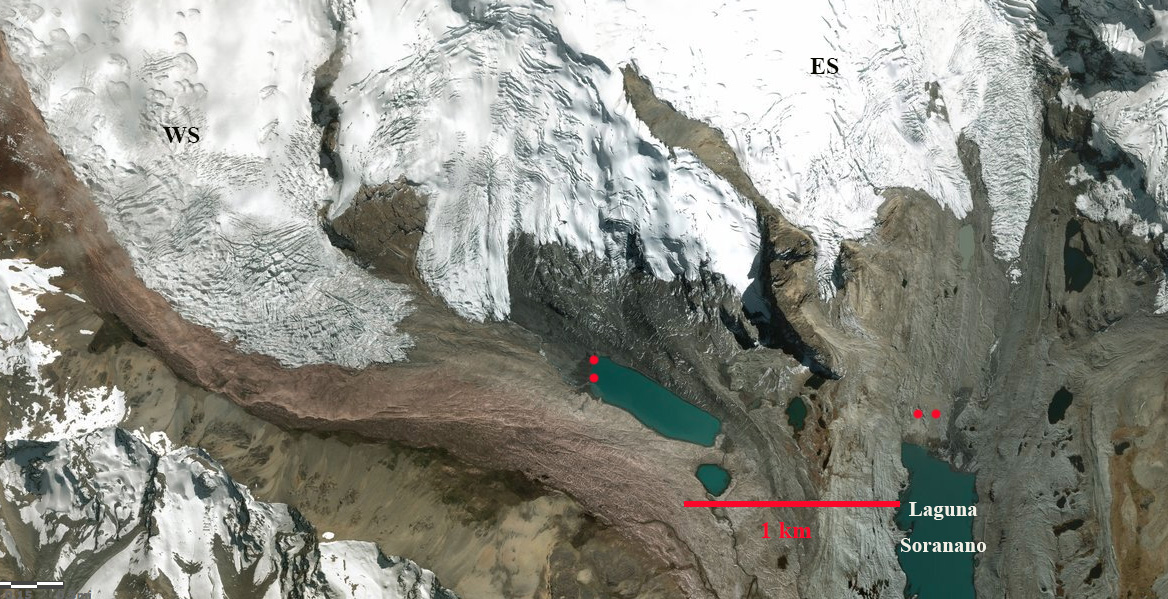
In 1995 the western Soranano Glacier terminates in a proglacial lake at 5000 m the eastern glacier terminates just north of Laguna Soranano also at ~5000 m.  Point A is encircled by the two lobes of the western Soranano Glacier. By 2000 there is minor retreat of both glaciers. By 2018 the western Soranano Glacier has separated into two lobes, with the former rock knob at Point A now the separating rib. The glacier has retreated 800 m since 1995, which is 20% of its 4 km length in 1995. The eastern Soranano Glacier has retreated 700 m and has also separated into two lobes. A new small lake has formed in front of the western lobe.

The formation of new lakes and the retreat from proglacial lakes has been a common occurrence in recent decades for Andean glaciers in Peru such as Manon Glacier , Safuna and Arhuey Glacier. The key role of glaciers to runoff is illustrated by the fact that 77% of lakes connected to a glacier watershed have maintained the same area or expanded, while 42% of lakes not connected to a glacier watershed have declined in area Henshaw and Bookhagen (2014).  Laguna Sibinacocha water level is raised by the Sibinacocha Dam, to maintain the flow of the Vilcanota River in dry season and support the normal operation  of the Machupicchu Hydroelectric Power Plant managed by EGEMSA, which has an operating capacity of 90 MW.  The Vilcanota River becomes the Urubamba River further downstream.

Western Soranano (WS) and Eastern Soranano Glacier (ES), with red dots indicating the terminus in 1995, this is a 2018 Digital Globe image.

Western Soranano and Eastern Soranano Glacier, with red arrows indicating the terminus in 1995, and yellow arrows the 2018 terminus in this 2018 Digital Globe image.

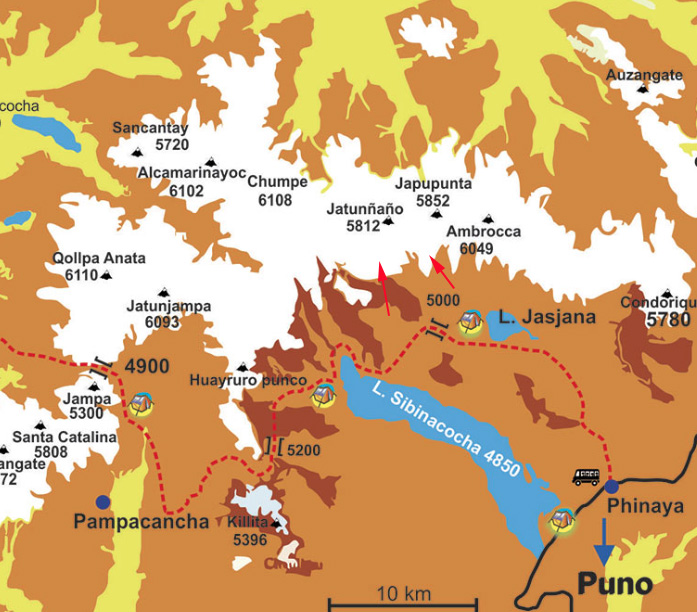
Trekking map of the region, red arrows indicate the Soranano Glaciers

Suhai Hu Ice Cap, China Outlet Glacier Retreat

Suhai Hu, Quilian Mountains Ice Cap in 1999 and 2016 Landsat image indicating five different outlet glacier termini that all ended in proglacial lakes in 1999 and all retreated significantly by 2016. 

Here we examine an unnamed icecap that I refer to as the “Suhai Hu” Ice Cap and five of its largest outlet glaciers in the Qilian Mountains in northwest China, with Landsat imagery from 1999-2016.  The northern outlet glaciers drain into the Suhai Hu and the southern outlet glaciers into Quidam Hu. Glaciers in the Gansu Province have shrunk by 36 square kilometers, a 4.2 percent loss, during the past decade Quiang (2016).  Tian et al (2014) report Qilian Mountain glacier area shrank by 30% from 1956 to 2010 and the shrinkage accelerated remarkably in the past two decades.  Yang et al (2015)  Results show that mountain glaciers in China are very vulnerable to climate change with 41% of glaciers having had a high vulnerability in the period 1961–2007.

In 1999 all five outlets, indicated by arrows terminate in proglacial lakes, with the northwest outlet comprise of two tributaries that join just above the terminus.  In 2001 the outlets still terminate in glacier lakes.  By 2015 two of the outlet glaciers at the orange and red arrow have retreated from the proglacial lakes they had terminated in.  The northwest outlet glacier, green arrow, the tributaries had separated.  From 1999 to 2016 the proglacial lake at the purple arrow has expanded from 600 m in length to 850 m.  The lake at the yellow arrow expanded from 450 m in length to 850 m in length from 1999-2016. each of the five outlet glaciers has retreated significantly from 1999-2016.  All 8 summer Landsat images examined indicate the ice cap always has substantial retained snowcover, and will not disappear with current climate. In a close up view of the terminus of the yellow outlet glacier there are prominent crevasses near the calving ice front, green arrow and supraglacial streams , blue arrows. The retreat here is similar to but less than that observed at Gangg’er Glacier in the Shule River Basin, Qilian Mountains. 

Suhai Hu, Quilian Mountains Ice Cap in 2001 and 2015 Landsat image indicating five different outlet glacier termini that all ended in proglacial lakes in 2001 and all retreated significantly by 2015.


Google Earth image at the yellow outlet glacier. Green arrow indicates crevassing near front and blue arrows supraglacial streams.