Asejiaguo Glacier, China Retreat and Lake Expansion

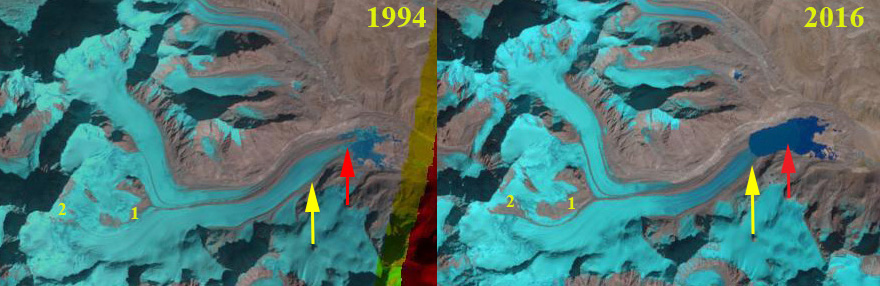
Asejiaguo Glacier in Landsat images from 1993 and 2018.  The yellow arrow indicates the 2018 terminus and the red arrow the 1993 terminus location.  Point 1 and 2 are areas of expanding bedrock in the 5400-5600 m.

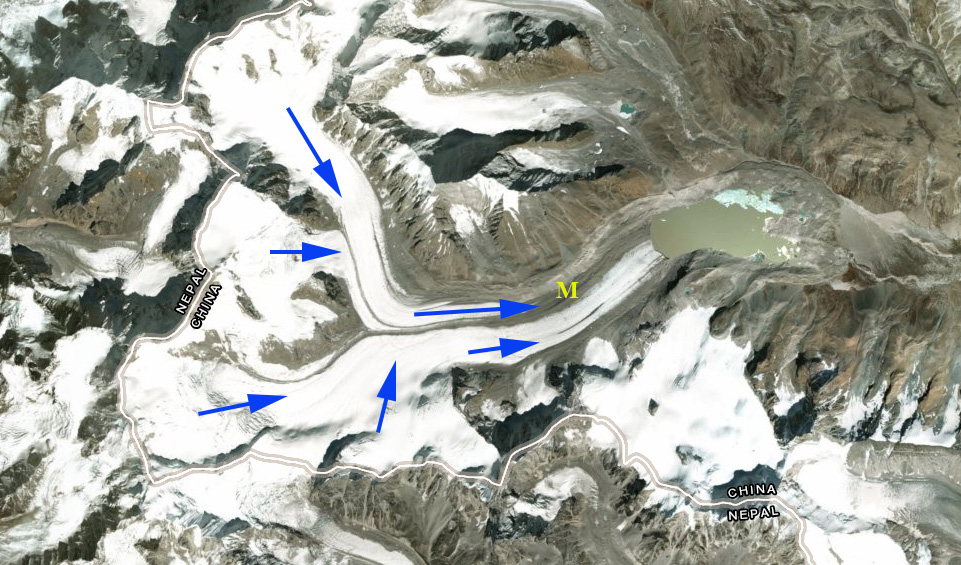
Asejiaguo Glacier drains east from the China-Nepal Border and is at the headwaters of the Yarlung Tsangpo, which becomes the Brahmaputra River.  The Yarlung Tsangpo powers the 510 MW Zangmu Hydropower Station.  Gardelle et al, (2013) identified this glacier as part of the West Nepal region, which experienced mass loss averaging -0.32 m/year from 1999-2011. The changes of the Asejaguo Glacier are examined for the 1993 to 2018 period using Landsat imagery. Neckel et al (2014) examined changes in surface elevation of the glaciers and found this region lost 0.37 m/year from 2003 to 2009.

In 1993 the glacier terminated in a small proglacial lake that is ~1 km long at 4900 m. At Point 1-2 there is limited exposed bedrock at 5400-5600 m, which is near the snowline,  the head of the glacier is at 6000 m.  There is a prominent medial moraine that begins at 5300 where the north and south tributaries join.  The greater width of the southern tributary indicates this is the large contributor.  In 1994 the snowline is higher at 5500 m, but there is still only a small outcrop of bedrock at Point 2.  By 2016 the proglacial lake has expanded to a length of over 2 km.  At Point 1 and 2 there is a greatly expanded area of bedrock, and the separation of a former tributary near Point 1 from the main glacier. In November 2018 there is fresh snowfall obscuring the exposed bedrock at Point 1 and 2. The retreat from 1993-2018 is 1.5 km, and the expanding proglacial lake is over 2.5 km long. The expanding bedrock areas in the 5400-5600 m range indicate the reason rise in snowline that has generated mass loss and ongoing retreat.

The behavior of this glacier matches that of other glaciers in the regions such as Chako Glacier and Ribuktse Glacier

Asejiaguo Glacier in Landsat images from 1994 and 2016.  The yellow arrow indicates the 2018 terminus and the red arrow the 1993 terminus location.  Point 1 and 2 are areas of expanding bedrock in the 5400-5600 m.

Asejiaguo Glacier, blue arrow indicate flow direction, M indicates the medial moraine, the China-Nepal border is also noted.

Soranano Glacier, Peru Separation and Retreat 1995-2018

Western Soranano (WS) and Eastern Soranano Glacier (ES) in 1995 and 2000 Landsat images and 2018 Sentinel image, with red arrows indicating the terminus in 1995, and yellow arrows the 2018 terminus. 

Here we examine the west and east Soranano Glacier glacier descending south from the 5800 m summit of Jatunnano (Hatun Nana Punta). The glaciers are just east of Laguna Sibinacocha, which drains into the Rio Vilcanota.  Retreat of glaciers in the Cordillera Vilcanota, Peru has been rapid since 1975, Veettil et al (2017) noted that ~80% of glaciated area below 5000 m was lost from 1975-2015 and glacier area overall declined 48%.  Henshaw and Bookhagen (2014) observed that from 1988-2010 glacial areas in the Cordillera Vilcanota had been declining annually by ~4 km2, which is just over 1% per year for this region that had a glacial area of 361 km2 in 1988.

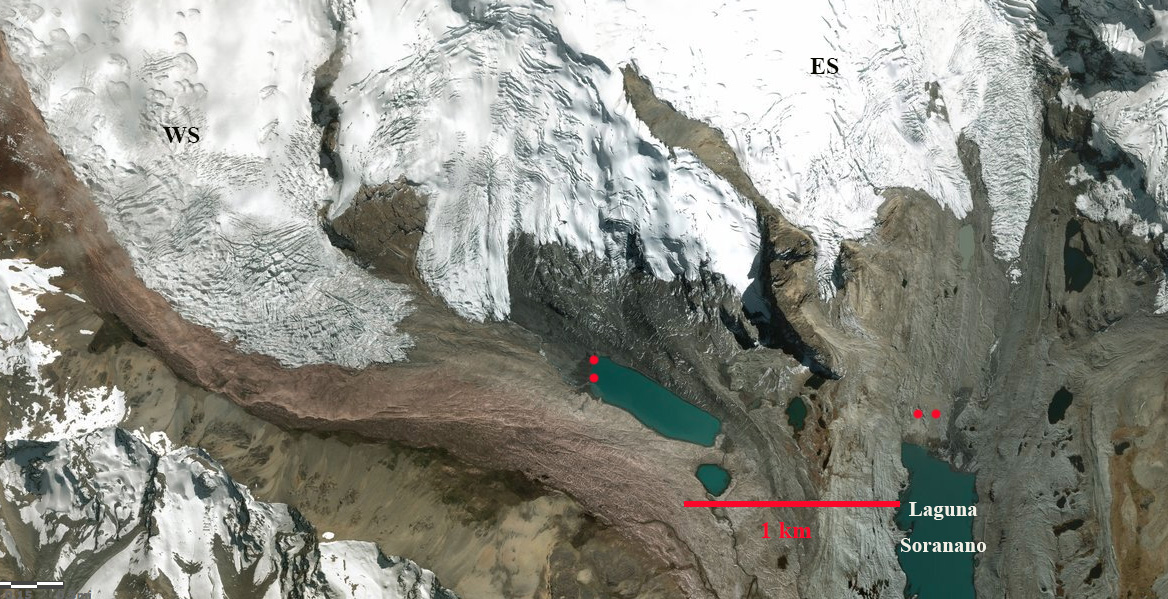
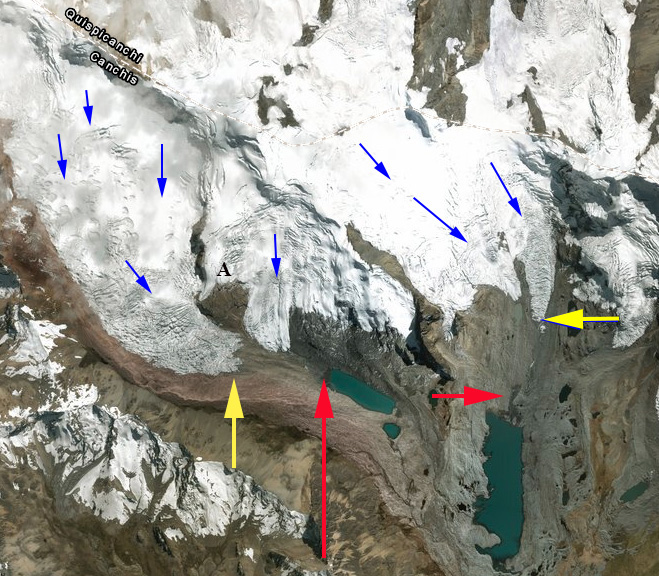
In 1995 the western Soranano Glacier terminates in a proglacial lake at 5000 m the eastern glacier terminates just north of Laguna Soranano also at ~5000 m.  Point A is encircled by the two lobes of the western Soranano Glacier. By 2000 there is minor retreat of both glaciers. By 2018 the western Soranano Glacier has separated into two lobes, with the former rock knob at Point A now the separating rib. The glacier has retreated 800 m since 1995, which is 20% of its 4 km length in 1995. The eastern Soranano Glacier has retreated 700 m and has also separated into two lobes. A new small lake has formed in front of the western lobe.

The formation of new lakes and the retreat from proglacial lakes has been a common occurrence in recent decades for Andean glaciers in Peru such as Manon Glacier , Safuna and Arhuey Glacier. The key role of glaciers to runoff is illustrated by the fact that 77% of lakes connected to a glacier watershed have maintained the same area or expanded, while 42% of lakes not connected to a glacier watershed have declined in area Henshaw and Bookhagen (2014).  Laguna Sibinacocha water level is raised by the Sibinacocha Dam, to maintain the flow of the Vilcanota River in dry season and support the normal operation  of the Machupicchu Hydroelectric Power Plant managed by EGEMSA, which has an operating capacity of 90 MW.  The Vilcanota River becomes the Urubamba River further downstream.

Western Soranano (WS) and Eastern Soranano Glacier (ES), with red dots indicating the terminus in 1995, this is a 2018 Digital Globe image.

Western Soranano and Eastern Soranano Glacier, with red arrows indicating the terminus in 1995, and yellow arrows the 2018 terminus in this 2018 Digital Globe image.

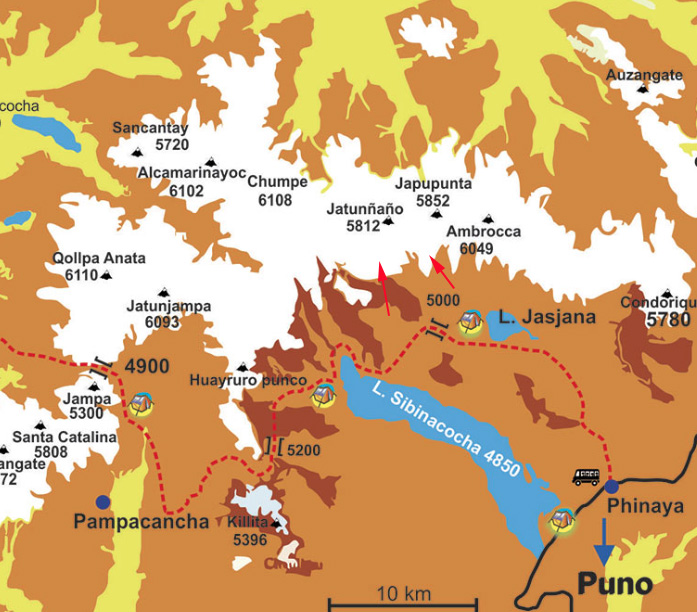
Trekking map of the region, red arrows indicate the Soranano Glaciers

Suhai Hu Ice Cap, China Outlet Glacier Retreat

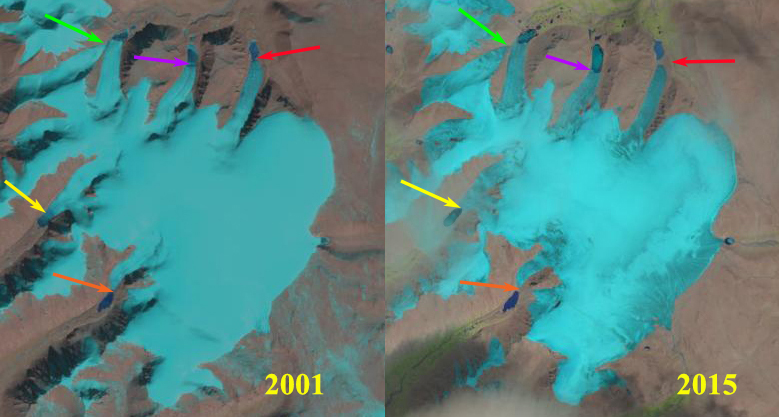
Suhai Hu, Quilian Mountains Ice Cap in 1999 and 2016 Landsat image indicating five different outlet glacier termini that all ended in proglacial lakes in 1999 and all retreated significantly by 2016. 

Here we examine an unnamed icecap that I refer to as the “Suhai Hu” Ice Cap and five of its largest outlet glaciers in the Qilian Mountains in northwest China, with Landsat imagery from 1999-2016.  The northern outlet glaciers drain into the Suhai Hu and the southern outlet glaciers into Quidam Hu. Glaciers in the Gansu Province have shrunk by 36 square kilometers, a 4.2 percent loss, during the past decade Quiang (2016).  Tian et al (2014) report Qilian Mountain glacier area shrank by 30% from 1956 to 2010 and the shrinkage accelerated remarkably in the past two decades.  Yang et al (2015)  Results show that mountain glaciers in China are very vulnerable to climate change with 41% of glaciers having had a high vulnerability in the period 1961–2007.

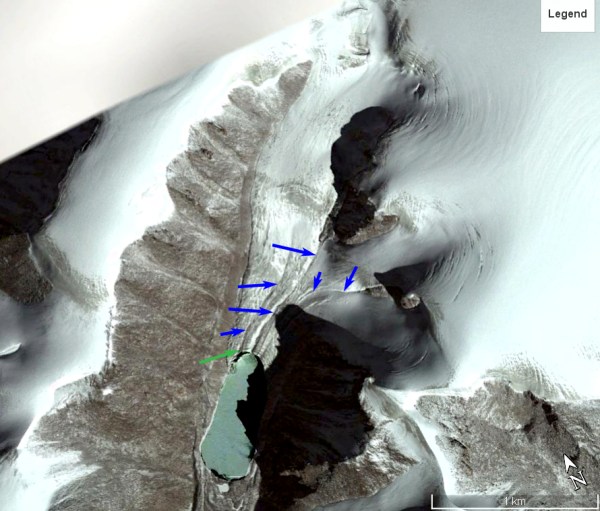
In 1999 all five outlets, indicated by arrows terminate in proglacial lakes, with the northwest outlet comprise of two tributaries that join just above the terminus.  In 2001 the outlets still terminate in glacier lakes.  By 2015 two of the outlet glaciers at the orange and red arrow have retreated from the proglacial lakes they had terminated in.  The northwest outlet glacier, green arrow, the tributaries had separated.  From 1999 to 2016 the proglacial lake at the purple arrow has expanded from 600 m in length to 850 m.  The lake at the yellow arrow expanded from 450 m in length to 850 m in length from 1999-2016. each of the five outlet glaciers has retreated significantly from 1999-2016.  All 8 summer Landsat images examined indicate the ice cap always has substantial retained snowcover, and will not disappear with current climate. In a close up view of the terminus of the yellow outlet glacier there are prominent crevasses near the calving ice front, green arrow and supraglacial streams , blue arrows. The retreat here is similar to but less than that observed at Gangg’er Glacier in the Shule River Basin, Qilian Mountains. 

Suhai Hu, Quilian Mountains Ice Cap in 2001 and 2015 Landsat image indicating five different outlet glacier termini that all ended in proglacial lakes in 2001 and all retreated significantly by 2015.


Google Earth image at the yellow outlet glacier. Green arrow indicates crevassing near front and blue arrows supraglacial streams. 

Tajuco Glacier Lake, China Expands with Glacier Retreat

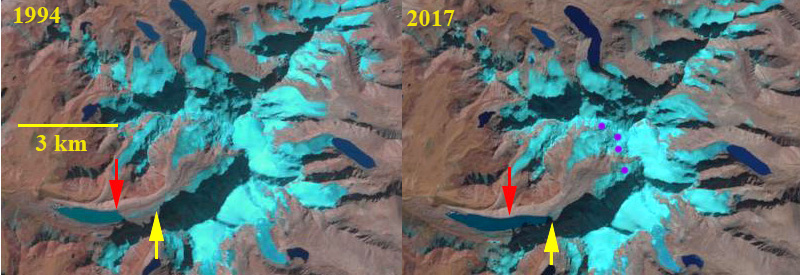
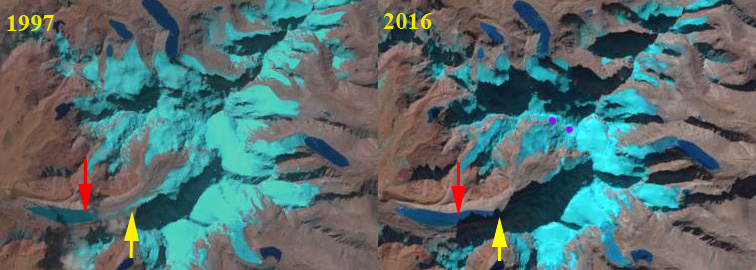
Tajuco Glacier terminating in Tajuco Lake retreat in 1994 and 2017 Landsat comparison. Red arrow is 1997 terminus location, yellow arrow is the 2017 terminus location and the purple dots are the snowline in 2017. 

Tajuco Glacier Lake is a moraine dammed glacier lake in the Tingri district of China.  It drains into the Amur River which flows south into Nepal. Shijin et al (2015) reported on the expansion of the lake from 1990 to 2010 expanding from 0.65 square kilometers to 1.14 square kilometers.  They further reported that the Chinese Himalaya had 329 moraine dammed glacier lakes greater than 0.02 square kilometers in area, 116 of these posing a potential hazard, average size of 0.4 square kilometers. The number of lakes across the region is increasing (Kathmandu Post, 2017), though the number of GLOF’s has not.  The greater volume of expanding lakes puts more pressure on the moraine, the moraines if they have any ice core or permafrost can also weaken,  The moraines with time and distance from the glacier also can consolidate and become more stable.

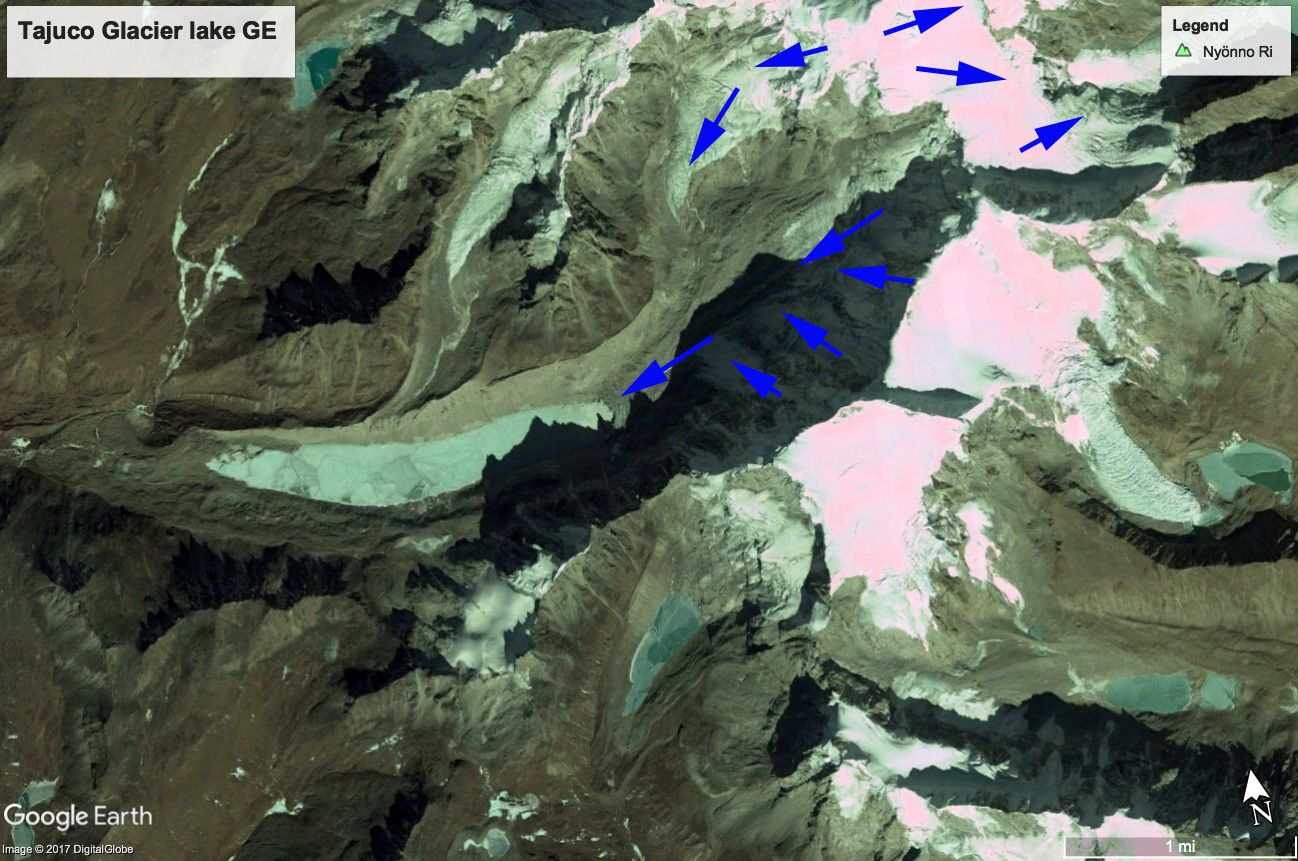
In 1994 Tajuco Lake was 1.85 km long and had an area of about 0.7 square kilometers.  The snowline was at 6400 m.  In 1997 glacier retreat had led to an expansion of the lake to 2.05 km.  By 2016 the glacier retreat had led to expansion of the lake to a length of 3 km.  The snowline is at 6500 m near the crest of the glacier.  By 2017 the glacier had retreated 1200 m from 1994 to 2017, a rate of 24 m/year. The snowline was again at 6500 m near the crest of the glacier.  The high snowline indicates a glacier that will not survive. retreat will continue to expand the lake.  It is likely based on the Google Earth imagery below that the lake will not increase by more than 500 m in length, area in 2017 is 1.20 square kilometers. The retreat and lake expansion is similar to that of other glaciers on the north side of the Himalaya Range in China; Chaxiqudong Glacier, Chutanjima Glacier and Yanong Glacier. The high snowlines have been observed on nearby Rongbuk Glacier at Nup La and on Gangotri Glacier.

Tajuco Glacier terminating in Tajuco Lake retreat in 1997 and 2016 Landsat comparison. Red arrow is 1994 terminus location, yellow arrow is the 2017 terminus location and the purple dots are the snowline in 2016. 

Google Earth image of Tajuco Glacier illustrating flow. 

Global Glacier Change Bulletin-Many Glaciers Same Story


Cumulative glacier mass balance losses reported by WGMS by region, all glacier, reference glaciers and geodetic mass balance (Sholes Glacier, WA in background).  The data set size, location and type changes but the story remains the same, mass loss resulting from global temperature increase.

The World Glacier Monitoring Service has released the second bulletin of Global Glacier Change.  The bulletin provides detailed global and regional information on alpine glaciers particularly for 2014 and 2015.  There is data reported from 621 glaciers.  The glaciers vary in type and location, yet their response is the same retreat and mass balance loss as a result of the global temperature increases.  There are currently 41 reference glaciers with at least 30 consecutive years of detailed field measurement of mass balance.  Additionally mass balance is typically reported from 60-80 other glaciers.  The graph below indicates that the reference glacier network mass balance losses parallels the losses of all glaciers and that of geodetic assessment of mass loss from remapping.  The report indicates that alpine glaciers have lost 0.9 m w.e. per year.  This continues the unprecedented trend of mass loss that is driving glacier retreat as well. In 2014 and 2015 316 mass balance observations are reported from 166 glaciers.  There are 889 terminus change observations reported from 528 glaciers. The results in graph after graph illustrate that glaciers in all regions of the globe are experiencing mass loss and retreat.  As the United States representative to the WGMS, helping pull together each strand of data, is a key task.  The result unfortunately is a very strong line of data built of all these strands of glaciers losing mass.  The report also contains preliminary data from 2016, which was the 37th consecutive year of mass loss as reported in BAMS State of the Climate 2016 (Pelto, 2017).  The deadline for posting initial results on mass balance for reference glaciers in 2017 was Dec. 1 2017.  Reporting on the US glaciers it is clear that 2017 will be another year of substantial losses in this region. 


Annual glacier mass balance reported for each region.  The coloration indicates the increase in mass balance loss in each region with global temperature increase. 

There is a section of the bulletin on each region including graphs of terminus change and mass balance on selected glaciers. Below are examples from Western North America and Central Europe.  For reference glaciers data is submitted that includes maps of the mass balance, and then charts are derived from WGMS illustrating mass balance changes and the relationships between mass balance and the equilibrium line altitude, and between mass balance and the accumulation area ratio.  


Gangge’er Glacier, Retreat & Tributary Separation Qilian Mt. China

Gangge’er Glacier, Qilian Mt., China comparison in 1997 and 2017 Landsat Images.  Yellow arrows indicates 2017 terminus, red arrows the 1990 terminus, and purple arrows tributaries that have detached.  The snowline is  purple dots and Points 1-3 indicate bare rock areas amidst the glacier.

The largest glacier in the Gangge’er Xiaoheli Shan range of the the Qilian Mountains in China, here referred to as Gangge’er Glacier, drains northwest into the Shule River.   Glaciers in the Qilian Mountains in northwest China’s Gansu Province have shrunk by 36 square kilometers, a 4.2 percent loss, during the past decade Quiang (2016).  Tian et al (2014) report Qilian Mountain glacier area shrank by 30% from 1956 to 2010 and the shrinkage accelerated remarkably in the past two decades.  Yang et al (2015)  Results show that mountain glaciers in China are very vulnerable to climate change with 41% of glaciers having had a high vulnerability in the period 1961–2007. For the Upper Shule Basin the impact of glaciers on the overall water resource is not known as Li  and Yang (2017) observe that  that the basic features of precipitation in the upper reaches of the Shule River were unexplored prior to their study and there is no national weather station in the basin.  They found that most of the precipitation occurred during the summer. 

What is apparent in a comparison of Landsat images from 1997-2017 is the changes in the glacier.  In 1997 the glacier is joined by three main tributaries from the south and four from the north.  The western most from the north and south are noted by the purple arrow.  The glacier terminates at the red arrow and the snowline is low on the glacier at 4600 m, likely after a summer snowstorm. The areas of bedrock amidst the glacier at Points 1-3 are limited.  In 1999 the snowline is above the main stem of the glacier at 4800 m.  There has been limited change since 1997, there is a small cloud causing a ground shadow right at the terminus.  By 2016 and 2017 the westernmost tributary from the north and south have detached from the glacier , purple arrows.  The areas of bedrock amidst the glacier at Point 1-3 have all expanded indicating upglacier thinning.  The terminus has retreated to the yellow arrow a distance of 900 m in 20 years.  In the digital globe image below extensive surface streams indicate significant meltwater drainage up to 4900 m, above the snowline in both images. The surface streams indicate a cold layer of ice preventing surface meltwater infiltration.  


Gangge’er Glacier, Qilian Mt., China comparison in 1999 and 2016 Landsat Images.  Yellow arrows indicates 2017 terminus, red arrows the 1990 terminus, and purple arrow tributary that has detached.   Points 1-3 indicate bare rock areas amidst the glacier.


Google Earth image of the glacier indicating flow directions dark blue arrows, surface streams light blue arrows and separated tributaries purple arrows.

Mensu Glacier, Siberia Russia Retreat 1994-2016

Mensu Glacier, Russia in comparison of 1994 and 2016 Landsat images.  Red arrow is the 1994 terminus, yellow arrow 2016 terminus, purple arrow a tributary and purple dots the snowline. 

Mensu Glacier (Lednik Mensu) drains northeast from Gora Belukha in the Russian Altai.  The glacier drains into the Ob River and then the Arctic Ocean.  This glacier has not been the focus of detailed research to date. Khromova et al (2014) report that at the end of the century the glacier degradation in Russian mountain ranges strengthened including glacier area loss of 13% in the Tien Shan, 19% in the Altai and 22.3% in the Polar Urals.  The icecap draining west from Gora Belukha was cored to look at longer term climate records (Fujita et al 2004).  The core at 4500 m is high enough so that significant melt events affecting the record were rare. Shahgedanova et al (2010) noted that the retreat has largely been driven by summer warming. 

In 1994 the glacier terminates at the red arrow at 2150 m.  The glacier has an icefall from 3200 m to 2700 m that generates annual ogives, note Google Earth image below. The snowline in the 1994 Landsat  image averages 3000 m.  There is a tributary joining the main glacier at the purple arrow.  A neighboring glacier terminates in a proglacial lake at the orange arrow.  By 2001 the glacier has retreated and the snowline is at 3100 m. By 2016 the glacier terminates at 2200 m and has retreated 600  m to the yellow arrow.  The tributary at the purple arrow has separated from the main glacier.  This illustrates substantial glacier thinning  6 km above the terminus. The glacier at the orange arrow  no longer reaches the proglacial lake. In August 2016 below the snowline is at 3100 m in September 2016 the snowline has descended to 2800 m.  The lowest 800 m of the glacier has few crevasses, appears stagnant and will be lost to retreat.

Retreat is similar to the nearby Potanin Glacier, Mongolia. 

Mensu Glacier, Russia in comparison of 2001 and 2016 Landsat images.  Red arrow is the 1994 terminus, yellow arrow 2016 terminus, purple arrow a tributary and purple dots the snowline. 

Google Earth image indicating the snowline at the top of the icefall and the ogives beginning at the bottom near the orange arrow.


Terminus of Mensu Glacier in 2013 note lack of crevassing.

Nuusuaq Peninsula West Greenland Glacier Disintegration

Comparison of alpine glaciers on Nuussuaq Peninsula in 1990 and 2016 Landsat images.  Each arrow is at a specific location in both images exhibiting glacier separation/disintegration. 

The Nuussuaq Peninsula is just north of Disko Island in West Greenland and is home to many alpine glaciers and small ice caps.  Here we examine the furthest west group of alpine glaciers on the peninsula.  This group is 125 km west of the ice sheet and is not influenced directly by the ice sheet, but instead is most sensitive to the conditions over the Davis Strait and Baffin Bay just 25 km away.  The glaciers are near Snokpulen Peak, 1928 m.  Smaller ice caps around the Greenland Ice Sheet have been losing mass. Citterio et al (2011) documented the existence of 1172 glacier in 2001 on Disko Island,  Nuussuaq Peninsula and Svartenhuk Peninsula. West Greenland.  Bolch et al (2013) using Landsat imagery and  ICESat altimetry data noted that peripheral ice caps and glacier provided a significant fraction,~14 or 20% of the reported overall mass loss of Greenland to sea level.  This is equivalent to 10% of the estimated contribution from the world’s alpine glaciers and ice caps to sea level rise.  Noël et al, (2017) observed that  in ~1997 a tipping point for the peripheral ice caps/alpine glaciers of Greenland occurred in terms of  mass balance. The onset of a rapid deterioration in the capacity of the glaciers firn to refreeze meltwater led to mass losses and consequent glacier runoff increased 65% faster than meltwater production. Mittivakkat Glacier is an example of this trend. 

Here we compare 1990-2016 Landsat images indicating the changes in the alpine glaciers near Snokpulen Peak.  At Point A,B,D and F there is a glacier connection between tributaries or adjacent glaciers. At Point C and E there is an area of limited bare ground amidst the glacier.  Also notice in 1990 there is retained snowpack on the glaciers.  In the 2002 image below there is also retained snowpack.  In 2016 there is not retained snowpack on the glaciers, indicating the lack of an accumulation zone.  Without an accumulation zone there is not firn for meltwater to percolate into and refreeze. Meltwater is then not recaptured and is lost as noted by Noël et al, (2017), to be a widespread occurrence. The adjacent glaciers at Point A, B, D and F are now separated.  The extent of bare ground near point C and E has expanded significantly.  The area loss here underscores the volume loss of the peripheral ice caps that Bolch et al (2013) observed. 

2002 Landsat image indicating some retained snowpack on the glaciers.

Topographic Map of the region on Nuussuaq Peninsula.

Google Earth image of region, indicating the separation/disintegration that is occurring. 

Dama Blanca Glacier Retreat, Southern Chile

Dama Blanca Glacier in Landsat images from 1986 and 2017.  Red arrow is the 1986 terminus, yellow arrow the 2017 terminus, purple dots the snowline and purple arrows a bedrock ridge.

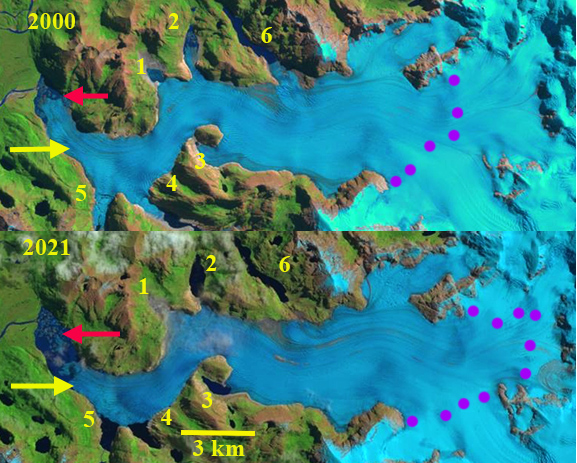
Dama Blanca Glacier drains west from Chile’s Sarmiento de Gamboa Range in Southern Patagonia. terminating in Lago Verde in the Alacalufes National Reserve. Alacalufes NR features kelp rich fjords, Northofagus coastal forests and glacier clad alpine zones. Davies and Glasser, (2012) indicated extensive recession of almost all glaciers in the range from 1870-2011. They indicate the fastest recession rate of  Dama Blanca is from 1986-2001. This range is between the Southern Patagonia Icefield to the north and the Cordillera Darwin Icefield to the south. Incognita Patagonia has been exploring and mapping glaciers in the region since 2015, and have provided a map shown below in coordination with Camilo Rada and Natalia Martinez of the UNCHARTED project . On Marinelli Glacier, in the Cordillera Darwin Icefield, Koppes et al (2009) indicated a retreat of 13 km from 1960 to 2005. More recently Marinellli Glacieri retreated ~3.75 km from 1998 to 2014. Melkonian et al (2013) observed that the Cordillera Darwin Icefield had an average thinning rate of −1.5 m w.e/year with more rapid losses north and west. This is a continuation of the trend noted by Holmund and Fuenzelida (1995) that glaciers on the northern side have a trend of receding fronts. On the southern side the present extent of some glaciers are similar to their 20th century maximum extents. The region is characterized by strong climatic gradients, with high rates of precipitation on the southwestern side of the range where glaciers are faring better and drier conditions on the northern side. Given that the Sarmiento de Gamboa Range is north of Cordillera Darwin it would be expected this area would have substantial recession.

Here we compare satellite images from 1986-2017 to determine the changes of Dama Blanca Glacier. In 1986, the glacier terminated at the end of a peninsula on the south side of Lago Verde, red arrow. The snowline was at 500m. In 2013 the terminus has retreated significantly from the peninsula and the snowline is at 650 m. By 2017 the terminus has retreated 700 m since 1986. The snowline is obscured by clouds in the Landsat image. In February 2017 the snowline is at 700 m. There is also expansion of a bedrock rib on the west side of the glacier that extends to 800 m, purple arrow. The glacier remains actively crevassed to the glacier front as illustrated by the Google Earth image. The glacier will continue to retreat as long as calving continues; however, there is an increase in slope 200-300 m from the current glacier front suggesting the limit for lake development. Izagirre (2017) and the UNCHARTED project explored a number of glaciers in the Sarmiento de Gamboa Range this spring, that will lead to a detailed current map. The retreat here is similar to that of Balmaceda Glacier.

Dama Blanca Glacier in Landsat imags from 2013 and Sentinel image from Dec. 2016  Red arrow is the 1986 terminus, yellow arrow the 2017 terminus, purple dots the snowline and purple arrows a bedrock ridge.

Map from the UNCHARTED Project indicating glaciers of the Sarmiento de Gamboa Range and exploration routes.

Google Earth image of Dama Blanca Glacier in 2013, with the 1986 terminus position at the red arrow.

Shoup Glacier, Alaska Retreat, Thinning, Velocity Decline

Shoup Glacier comparison in 1986 and 2016 Landsat images.  The glacier retreated 1900 m in this interval.  Red arrow is 1986 terminus, yellow arrow the 2016 terminus, green arrow rock rib emerging from beneath glacier, purple dots a landslide deposit, and purple arrow the snowline.

Shoup Glacier is between the Columbia Glacier and Valdez draining from the Chugach Mountains in southern Alaska.  The glacier was a tidewater terminating glacier until 1953 (McNabb et al, 2014).  From 1985 to 2011 McNabb et al (2014) noted a 1.7 km retreat.  The retreat was enhanced by significant lacustrine calving in an expanding tidal lagoon.  Here we examine Landsat and Sentinel images from 1986-2016 to identify recent and potential future changes.

In 1986 the glacier extends to the red arrow in the midst of a tidal lagoo. The glacier is 2.5 km wide at the sharp bend in the glacier 2.5 to 3 km from the terminus, green arrow.  There is significant crevassing at this bend indicating an increase in slope.  There is an landslide/avalanche deposit near the junction with a tributary, purple dots.  By 2002 the glacier has retreated 1.5 km since 1986, the minor ice cliff at the terminus indicates the glacier ends in shallow water near the end of the tidal lagoon.  The glacier is now 2 km wide at the sharp bend.  The landslide deposit, purple dots,  has shifted little since 1986. The snowline is at 1200 m in 2002.  By 2016 the glacier has retreated an additional 400 m since 2002, 1900 m since 1986.  The glacier no longer terminates in the lagoon.  A bedrock rib at the sharp bend has been exposed and the glacier is only 500 m wide now and this bend is just 500 m from the terminus, green arrow.  A closeup of this rib in a 2016 Sentinel image indicates why the crevassing had occurred, it is also clear this is an extension of the ridge that runs east from the glacier.  This is a band of erosion resistant rock.  This suggests that a basin exists above the this bedrock rib/ridge and a new lake will form.  The glacier slope from the green arrow for the next 2 km upglacier is quite low 1/40, again indicative of a basin beneath the lower glacier.  There is an increase in crevassing 2 km above the current terminus,  suggesting another increase in surface slope and the probable limit of the basin.  In 2016 the snowline is at 1250 m.  The landslide deposit remains little changed since 2002, indicating a low velocity in this region.  Burgess et al (2013) indicates the velocity of the Shoup Glacier near the terminus is in the range of 100 m annually.  The tributary is clearly significantly less. The low velocity, thinning and retreat indicates the glacier is continuing to lose volume via surface melting, despite no longer calving as Larsen et al (2015) have indicated is the prime mechanism for ice loss.  The retreat of this glacier is similar to that of nearby Valdez Glacier.

Shoup Glacier comparison in 2002 Landsat image.  Red arrow is 1986 terminus, yellow arrow the 2016 terminus, green arrow rock rib emerging from beneath glacier, purple dots a landslide deposit, and purple arrow the snowline.

Shoup Glacier terminus in 2016 Sentinel 2 image.  Green arrows indicate rock rib. 

State of Alpine Glaciers in 2016-Negative for 37th Consecutive Year

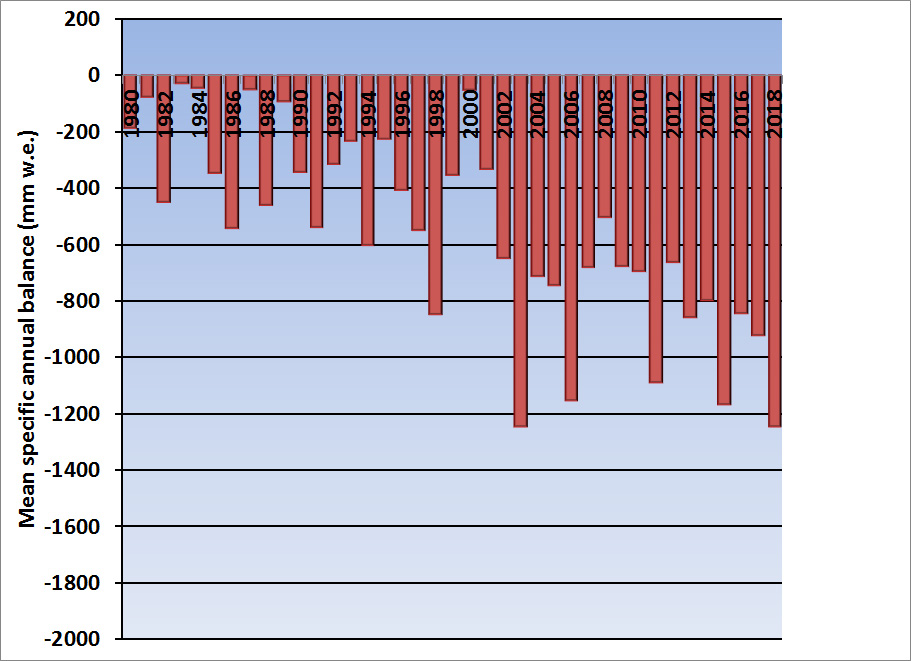
Figure 1. Global Alpine glacier annual mass balance record of reference glaciers submitted to the World Glacier Monitoring Service.

Each year I write the section of the BAMS State of the Climate on Alpine Glaciers.  What follows is the initial draft of that with a couple of added images and an added paragraph.

The World Glacier Monitoring Service (WGMS) record of mass balance and terminus behavior (WGMS, 2015) provides a global index for alpine glacier behavior.  Globally in 2015 mass balance was -1177 mm for the 40 long term reference glaciers and -1130 mm for all 133 monitored glaciers.  Preliminary data reported to the WGMS from Austria, Canada, Chile, China, France, Italy, Kazakhstan, Kyrgyzstan, Norway, Russia, Switzerland and United States indicate that 2016 will be the 37th consecutive year of without positive annual balances with a mean loss of -852 mm for reporting reference glaciers.

Alpine glacier mass balance is the most accurate indicator of glacier response to climate and along with the worldwide retreat of alpine glaciers is one of the clearest signals of ongoing climate change (Zemp et al., 2015).  The ongoing global glacier retreat is currently affecting human society by raising sea-level rise, changing seasonal stream runoff, and increasing geohazards (Bliss et al, 2014; Marzeion et al, 2014).  Glacier mass balance is the difference between accumulation and ablation.  The retreat is a reflection of strongly negative mass balances over the last 30 years (Zemp et al., 2015).  Glaciological and geodetic observations, 5200 since 1850, show that the rates of early 21st-century mass loss are without precedent on a global scale, at least for the time period observed and probably also for recorded history (Zemp et al, 2015). Marzeion et al (2014) indicate that most of the recent mass loss, 1991-2010 is due to anthropogenic forcing.

The cumulative mass balance loss from 1980-2015 is -18.8 m water equivalent (w.e.), the equivalent of cutting a 21 m thick slice off the top of the average glacier (Figure 2).  The trend is remarkably consistent from region to region (WGMS, 2015).  WGMS mass balance based on 40 reference glaciers with a minimum of 30 years of record is not appreciably different from that of all glaciers at -18.3 m w.e.  The decadal mean annual mass balance was -228 mm in the 1980’s, -443 mm in the 1990’s, 676 mm for 2000’s and – 876 mm for 2010-2016.  The declining mass balance trend during a period of retreat indicates alpine glaciers are not approaching equilibrium and retreat will continue to be the dominant terminus response. The recent rapid retreat and prolonged negative balances has led to some glaciers disappearing and others fragmenting (Figure 2)(Pelto, 2010; Lynch et al, 2016).

Below is a sequence of images from measuring mass balance in 2016 in Western North America from Washington, Alaska and British Columbia.  From tents to huts, snowpits to probing, crevasses to GPR teams around the world are assessing glacier mass balance in all conditions.

[ngg_images source=”galleries” container_ids=”7″ display_type=”photocrati-nextgen_basic_imagebrowser” ajax_pagination=”1″ template=”/nas/wp/www/sites/blogsorg/wp-content/plugins/nextgen-gallery/products/photocrati_nextgen/modules/ngglegacy/view/imagebrowser-caption.php” order_by=”sortorder” order_direction=”ASC” returns=”included” maximum_entity_count=”500″]

Much of Europe experienced record or near record warmth in 2016, thus contributing to the negative mass balance of glaciers on this continent. In the European Alps, annual mass balance has been reported for 12 glaciers from Austria, France, Italy and Switzerland. All had negative annual balances with a mean of -1050 mm w.e.  This continues the pattern of substantial negative balances in the Alps continues to lead to terminus retreat.  In 2015, in Switzerland 99 glaciers were observed, 92 retreated, 3 were stable and 4 advanced.  In 2015, Austria observed 93 glaciers; 89 retreated, 2 were stable and 2 advanced, the average retreat rate was 22 m.

In Norway, terminus fluctuation data from 28 glaciers with ongoing assessment, indicates that from 2011-15 26 retreated, 1 advanced and 1 was stable.  The average terminus change was -12.5 m (Kjøllmoen, 2016).  Mass balance surveys with completed results are available for seven glaciers; six of the seven had negative mass balances with an average loss of -380 mm w.e.

In western North America data has been submitted from 14 glaciers in Alaska and Washington in the United States, and British Columbia in Canada.  All 14 glaciers reported negative mass balances with a mean loss of -1075 mm w.e.  The winter of and spring of 2016 were exceptionally warm across the region, while ablation conditions were close to average.

In the high mountains of central Asia five glaciers reported data from Kazakhstan, Kyrgyzstan and Russia.  Four of five were negative with a mean of -360 mm w.e.  Maurer et al (2016) noted that mean mass balance in the eastern was significantly negative for all types of glaciers in the Eastern Himalaya from 1974-2006.

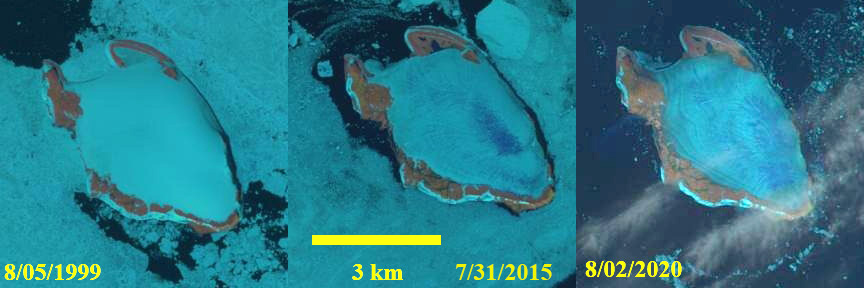
Figure 2. Landsat images from 1995 and 2015 of glaciers in the Clephane Bay Region, Baffin island.  The pink arrows indicate locations of fragmentation.  Glaciers at Point C and D have disappeared.


Coley Glacier Retreat, James Ross Island, Antarctica

coley-compare

Coley Glacier terminus comparsion in Landsat images from 2000 (red arrows) and 2016 (yellow arrow)  indicating a retreat of 2 km along the western side and 1 km along the eastern side.  Purple dots indicate the transient snowline and the purple arrow an area of debris exposed with glacier thinning. 

Coley Glacier is a tidewater glacier on the northeast side of James Ross Island near the tip of the Antarctic Peninsula. Davies et al (2012) observed that 90% of the glaciers of the Northern Antarctic Peninsula including James Ross Island retreated from 1988-2001 and 79% from 2001-2009. They further observed that the rapid shrinkage of tidewater glaciers on James Ross Island would continue due to their low elevation and relatively flat profiles. Rohss Bay Glacier is one example of this having retreated 15 km from 1999-2009 (Glasser et al, 2011).  Barrand et al (2013) note a strong positive and significant trend in melt conditions in the region, driving the retreat.

Coley Glacier in 2000 had a relatively straight calving front running across the embayment. The front represents the joining of four tributary glaciers.  The snowline was generally below the top of the escarpment just west of Point C, the elevation of this lower glacier reach is below 200 m.  This fits the low elevation low slope criteria noted by Davies et al (2012).  By 2016 the glacier has developed a concave glacier front with the northern tributary almost separating the retreat ranges from 2 km on the west side to 1 km on the east side.  The snowline is above the escarpment at 400 m. A comparison below of 2001 and 2015 indicates that the snowline in 2015 was also near 400 m and above the escarpment. A map of the region from the USGS (Ferigno et al.,2006) illustrates the retreat from the 1960’s to 2000.  Nývlt et al (2010)  reported on the retreat and changes on two glaciers on the north side of James Ross Island.coley-tsl-compare

Coley Glacier terminus comparison in Landsat images from 2001 and 2015.  Red arrows is the 2000 terminus and yellow arrows the 2016 terminus.  Purple dots indicate the transient snowline and the purple arrow an area of debris exposed with glacier thinning. 

coley-glacier-map
COASTAL-CHANGE AND GLACIOLOGICAL MAP OF THE TRINITY PENINSULA AREA AND SOUTH SHETLAND ISLANDS, ANTARCTICA: 1843–2001
USGS (Ferigno et al.,2006)