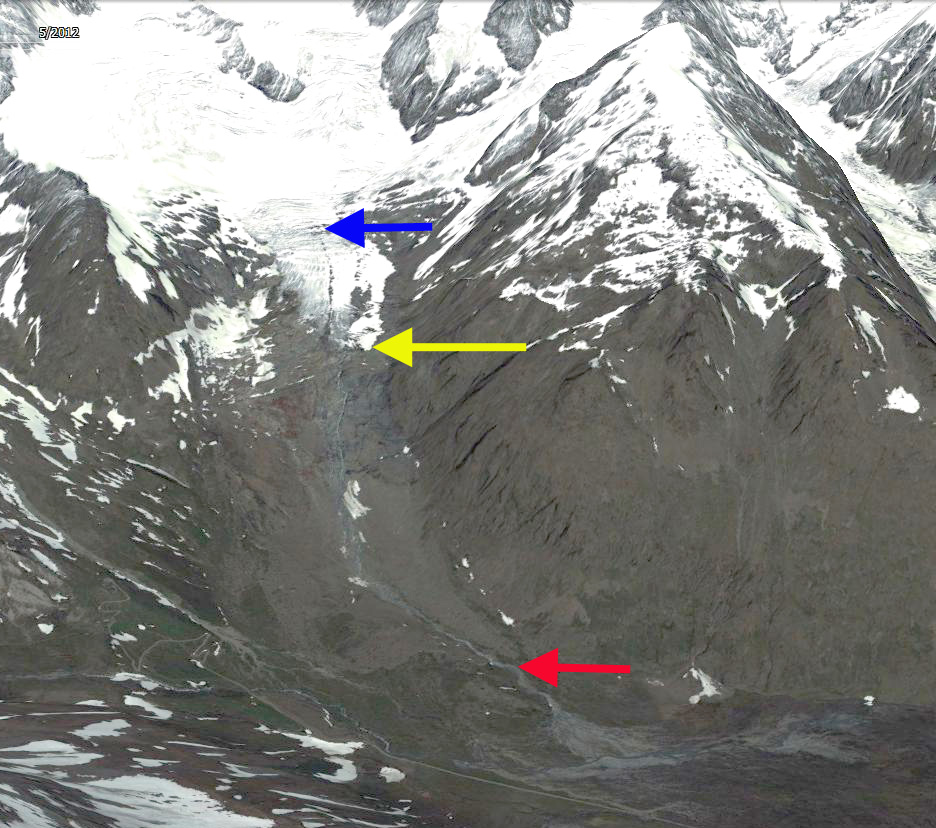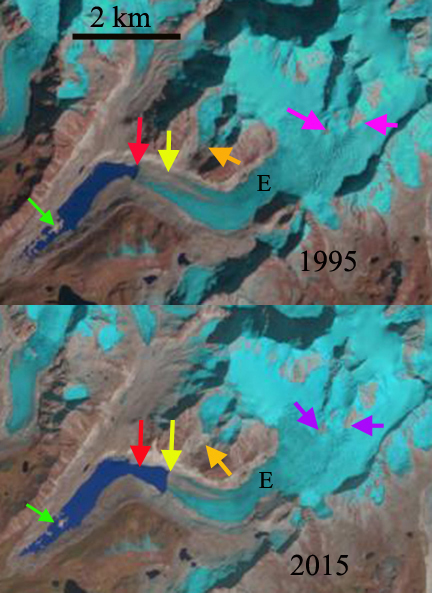
Bernardo Glacier, Patagonia, Chile Accelerated Retreat in Expanding Lake Complex

bernardo compare

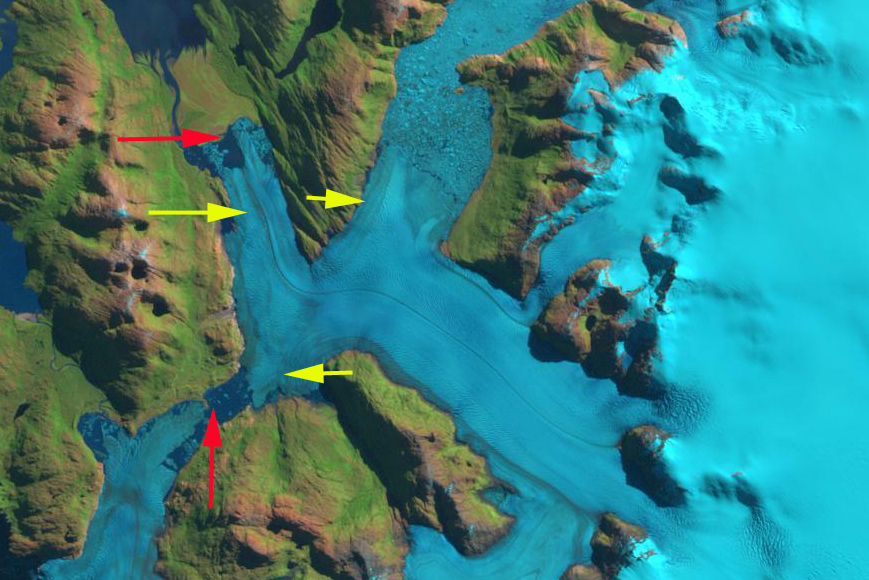
Comparison of 1986 and 2015 Landsat image of Bernardo Glaciers three termini, north, main and south. Red arrows indicate 1986 terminus location and yellow arrows the 2016 terminus location.  Indicating the substantial retreat of each terminus and lake expansion for the north and main terminus, while the lake drained at the southern terminus. 

Bernardo Glacier is a difficult to reach outlet glacier on the west side of the Southern Patagonia Icefield (SPI).  It The glacier currently ends in an expanding proglacial lake system, with three primary termini.  Here we examine changes from 1986 to 2016 using Landsat images. Willis et a (2012) quantify a rapid volume loss of the SPI from 2000-2012 of 20 giga tons per year mainly from rapid retreat of outlet glaciers. They note a thinning rate of 3.4 meters per year during this period of the Bernardo Glacier region. Mouginot and Rignot (2014) illustrate that velocity remains high from the terminus to the accumulation zone on Bernardo Glacier.  They also indicate the accumulation zone does not extend as far east toward the crest of the SPI as previously mapped. Davies and Glasser (2012) indicate that over the last century the most rapid retreat was from 2000 to 2011.

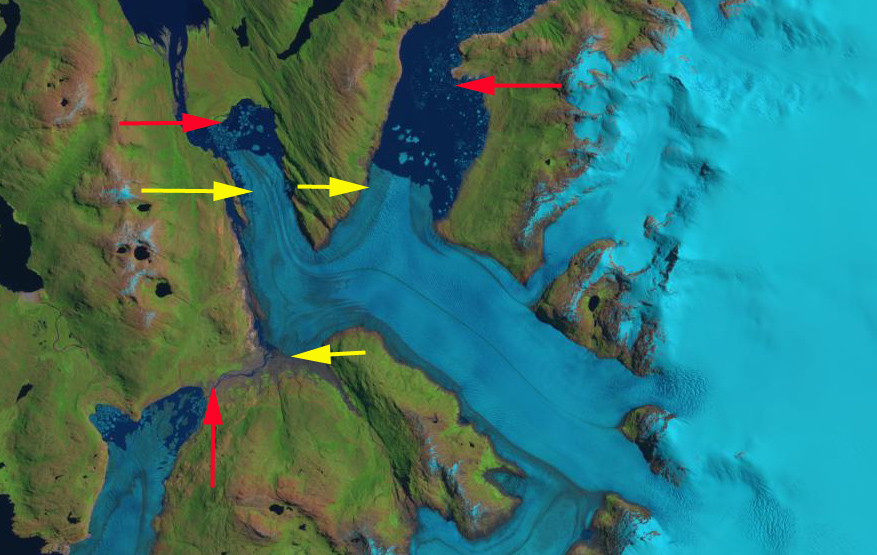
In 1986 Bernardo the southern terminus of the glacier was nearly in contact with Tempano Glacier.  The main terminus primarily ended on an outwash plain with a small proglacial lake developing.  The northern terminus had retreated a short distance south from a peninsula.  By 1998 the northern terminus had retreated into a wider, deeper lake basin, filled with icebergs. The main terminus is still mainly grounded on an outwash plain.  A small lake has developed between Bernardo Glacier and Tempano Glacier to the south. By 2003 the northern terminus had retreated 2 km from 1986, the main terminus 1.5 km and the southern terminus 1.2 km.  By 2015 the lake between Tempano and Bernardo Glacier had drained.  The main terminus had retreated 1.5 km since 1986.  In 2016 the northern terminus had retreated 3.5 km since 1986, the main terminus 2.5 km and the southern terminus 2.75 km.  The largest change is the loss of the lake between Tempano and Bernardo Glacier which slow the retreat of the southern terminus. If this terminus retreat into the another lake basin that shared with the main and north terminus, this would likely destabilize the entire confluence region.  The nearly 1 km retreat in a single year from 2015 to 2016 of the main terminus indicates the instability that will lead to further calving enhanced retreat. The retreat of this glacier fits the overall pattern of the SPI outlet glaciers, for example Chico Glacier and Lago Onelli Glaciers

.bernardo 1998

1998 Landsat image.  Red arrows indicate 1986 terminus location and yellow arrows the 2016 terminus location.

bernardo 2003

2003 Landsat image.  Red arrows indicate 1986 terminus location and yellow arrows the 2016 terminus location.  Main terminus beginning to retreat from outwash plain. 

bernardo 2015

2015 Landsat image.  Red arrows indicate 1986 terminus location and yellow arrows the 2016 terminus location.  Note the considerable difference in main terminus versus one year later in 2016.

Clephane Bay Ice Cap, Baffin Island Being Erased from Map

clephane bay compare

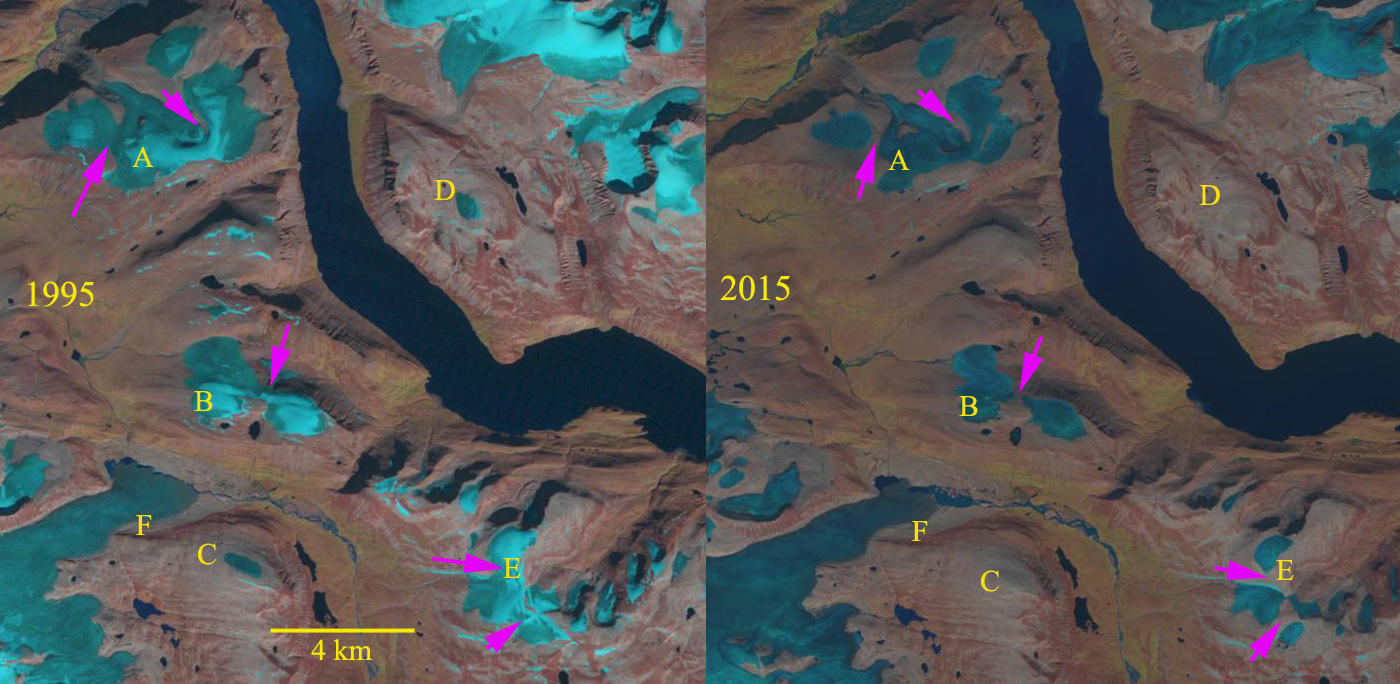
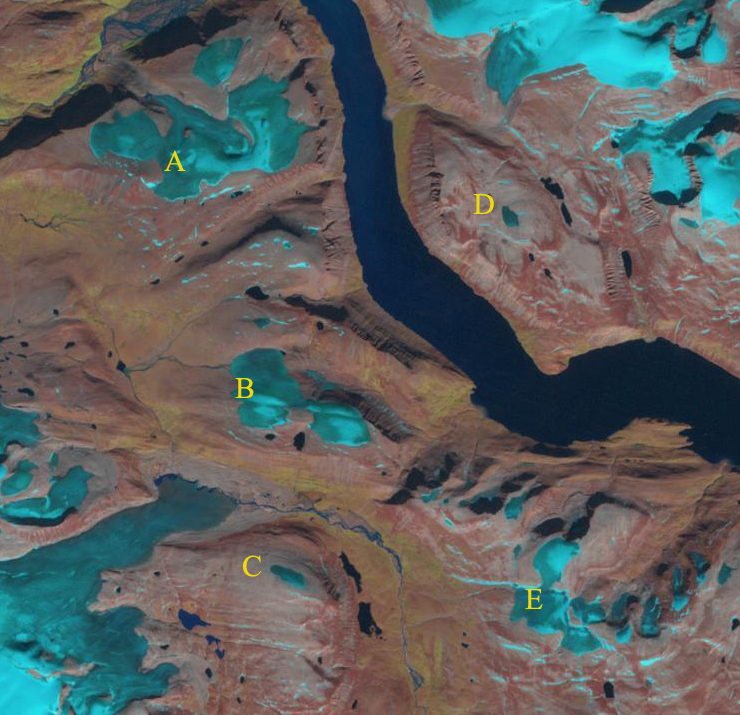
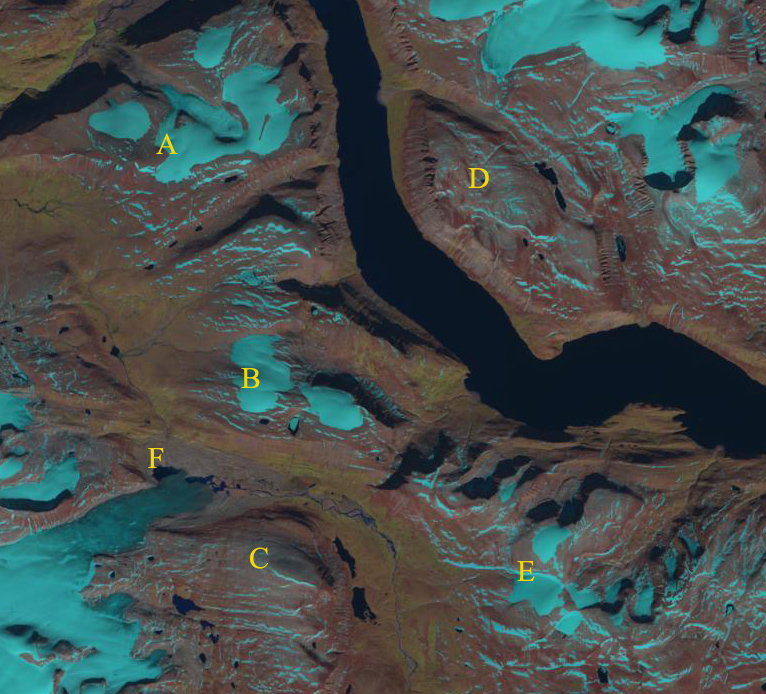
Comparison of 1995 and 2014 Landsat images of ice caps A, B, C, D and E.  Pink arrows indicate where A, B and E separated. C and D have disappeared.  F is an outlet glacier with a retreating terminus.

The southern part of the Cumberland Peninsula on Baffin Island features many small ice caps. Here we examine the disappearance of two and the separation of two others from 1995 to 2014. Way (2015) noted that on the next peninsula to the west, Terra Nivea and Grinnell Ice Cap had lost 20% of their area in the last three decades. The retreat and disappearance of ice caps in the area have led to a INSTAAR project at UColorado-Boulder examining vegetation that had been buried and is now being exposed. Gardner et al 2011 and Sharp et al (2011) both note that the first decade of the 21st century had the warmest temperatures of the last 50 years, the period of record. They identified that the mass loss had doubled in the last decade versus the previous four for Baffin Island. This is causing ice caps like Dexterity and those around Clephane Bay to melt away

In 1995 ice caps A-E are each a single coherent ice cap, there are narrow points of connection between sections on A, B and E.  Ice Caps C and D are simple ice caps between 500 and 800 m across on their widest axis.  The terminus of the outlet glacier at F is an expanded lobe.  Only Ice Cap A has a significant area above 800 m.  The rate of loss from 1995 to 2002 is not as rapid as after, C and D still exist, A,B and E are still connected as a contiguous ice mass. In 2013 ice cap C and D are gone.  The snowline is generally above A, B and E with only a small stripe of retained snow on each.  Ice cap A, B and E have each separated into multiple parts.  In 2014 there is no retained snow on the ice caps, pink arrows indicate the location of separation for ice caps A,B and E. In 2014 the terminus lobe at Point F has lost half of its area, retreat in distance will not accelerate. The lack of retained accumulation most years indicates no accumulation zone and the ice caps cannot survive without that.  The only clear image in 2015 indicates a  snowcover  in August, but this appears to be from a summer snow event.

clephane bay map

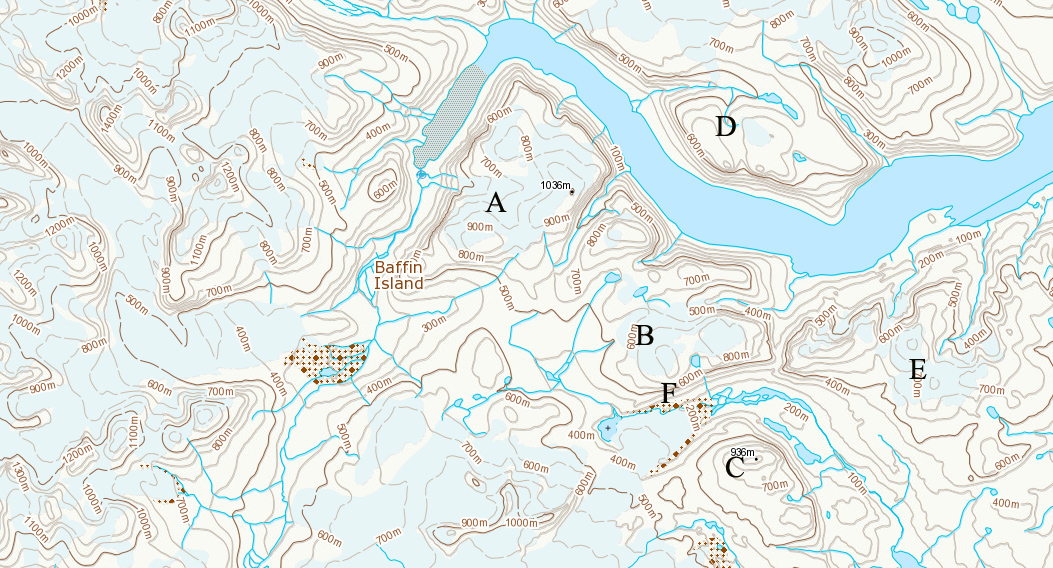
Canada Toporama map of the region.

clephane bay 2000

2002 Landsat image limited retained snowpack

clephane bay 2013

2013 Landsat image no retained snowpack.

clephane bay 2105

2015 Landsat image, appears that a summer snowstorm has spread snow across ice covered regions above 500 m.


Vallelunga and Barbadorso Glacier Retreat, South Tyrol Italy

vallelunga compare

Vallelunga (above) and Barbadorso di Dentro Glacier (below) retreat from 2003 (orange line) to 2015 yellow dots.  Blue arrows indicate flow path and pink arrow the junction of main two tributaries of Vallelunga Glacier.

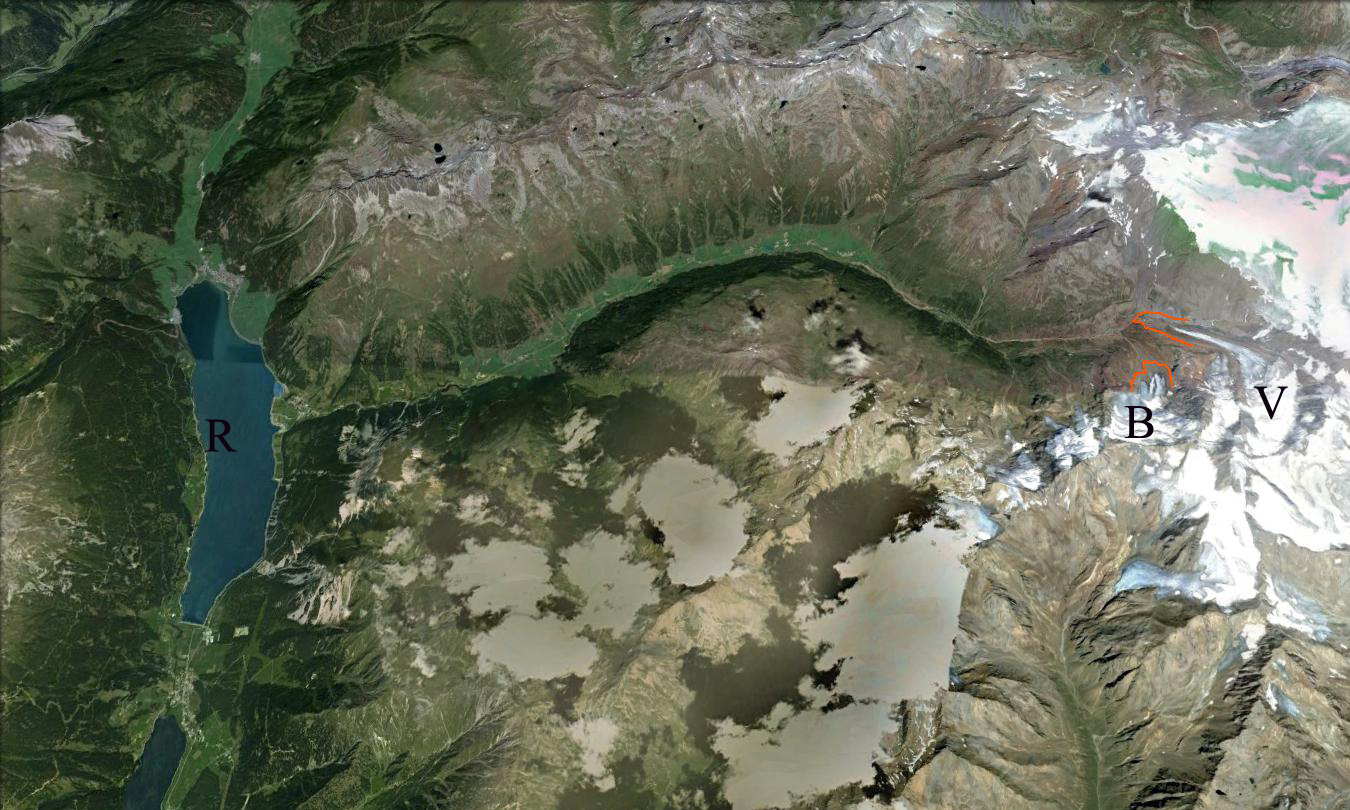
Vallelunga Glacier and Barbadorso di Dentro Glacier are at the headwaters of the Vallelunga watershed which feeds the Reschensee.  Reschensee is a reservoir famous for the church tower that emerges above its surface.  This artificial lake was completed after World War II and is the reservoir for the 105 MW Glurns Hydroproject owned by Seledison.  These two glaciers are examined as part of the annual campaign of the Italian Glacier Committee.  The annual reports for 2011-2013 indicate a retreat of 78 m for Vallelunga and 60 m for Barbadorso.  Here we examine Google Earth images from 2003 and 2015 to indicate the change in a twelve year period.

In 2003 Vallelunga Glacier terminus was at an altitude of 2500 m.  The glacier is comprised of two tributaries that join at the pink arrow. The orange line is the 2003 terminus location. By 2015 the smaller western tributary has nearly separated from the main glacier.  the terminus has retreated 460 m in the 12 year period. Barbadorso Glacier terminated at 2690 m in 2003.  By 2015 the terminus has retreated 250 m and terminates 100 m higher in elevation at nearly 2700 m. On July 31, 2015 the snowline on the two glaciers is at 3100-3200 m with 6-8 weeks left in the melt season.  This indicates another year of negative mass balance that will continue to drive retreat.

These glaciers are just across the border from Gespatcherferner one of the fastest retreating Austrian Glacier’s in recent years. Carturan et al (2016) examining long term Italian glacier mass balance series note the 2004-2013 period as particularly negative.  They further observe that this is mainly due to increased ablation and that annual balance is becoming more closely correlated with accumulation season (October-May) temperature suggesting warmer winters extending melt season and leading to an increased ratio of winter rain events. The continued reduction in glacier area reduces late summer water flow to the reservoir, which will either cause reduced power output or the need for more storage early in summer (Pelto, 2014).

reschensee ge

Vallelunga watershed feeding Reschensee (R).  Vallelunga Glacier (V) and Barbadorso Glacier (B).

vallelunga 2015 tsl

July 31, 2015 Landsat indicating a high snowline, purple dots, with nearly half the summer to go. 


North Fork Grand Plateau Glacier, Alaska-Spectacular 3 km Retreat 2013-15

south alsek glacier compare

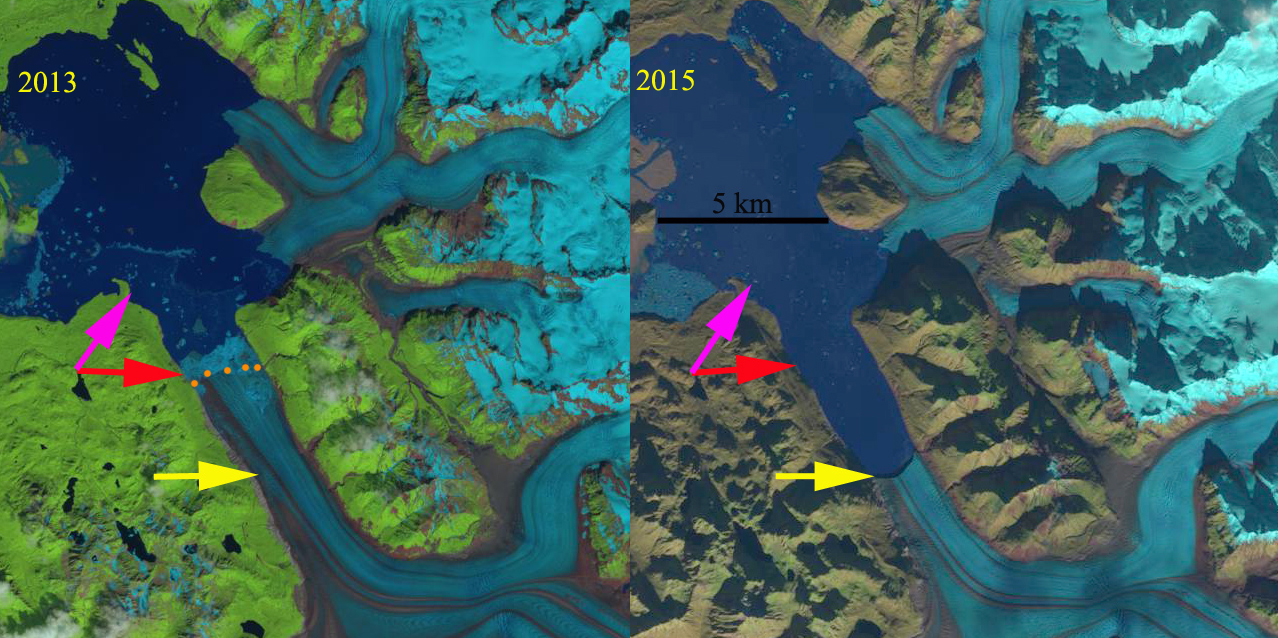
North Fork Grand Plateau Glacier comparison in 2013 and 2015 Landsat images.  Illustrating the rapid retreat and lake expansion in just two years. Pink arrow is 1984 terminus, red arrow is the 2013 terminus and yellow arrow 2015 terminus. The orange dots are the 2013 terminus. 

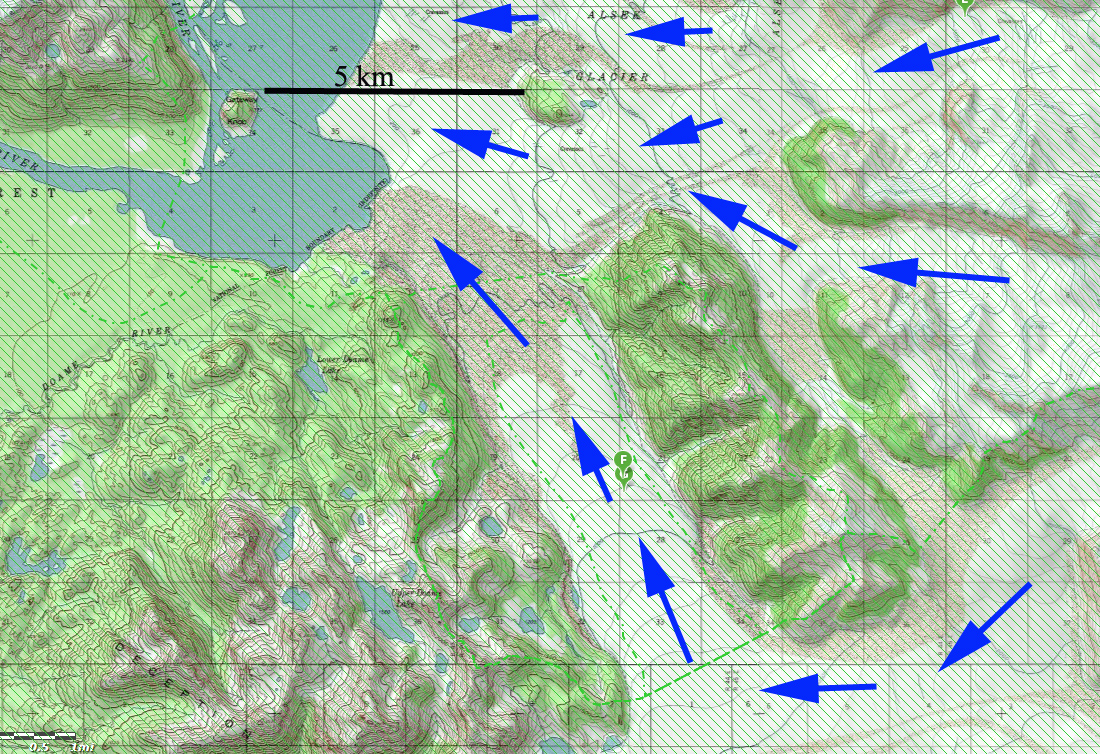
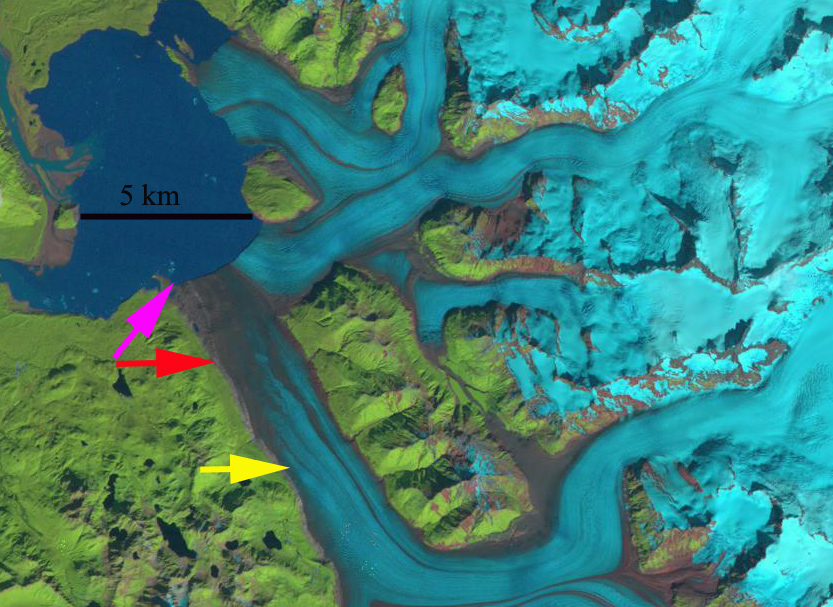
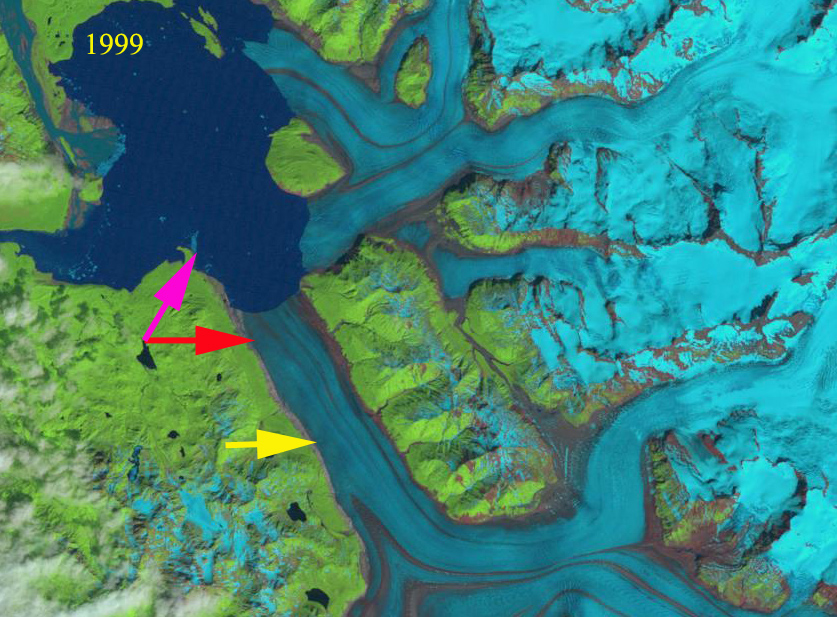
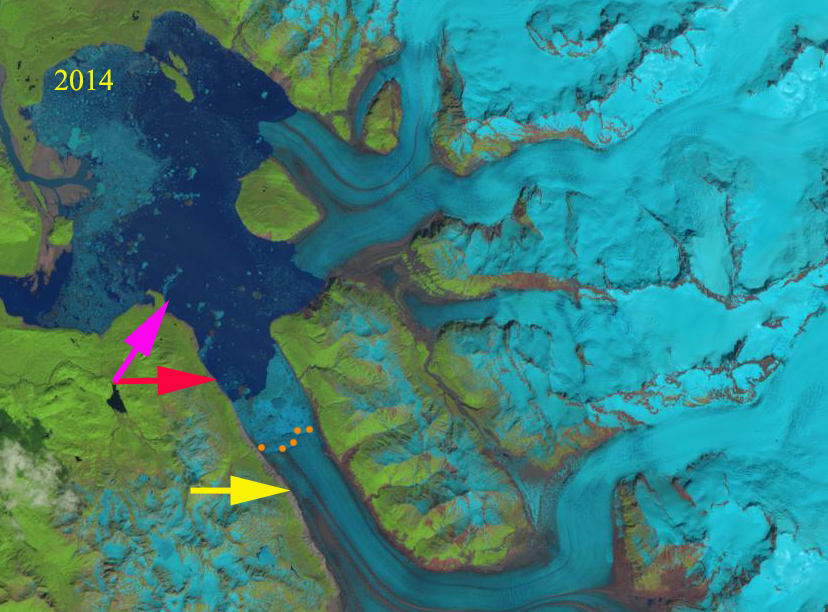
The Alsek Glacier is a large glacier draining into Alsek Lake and the Alsek River in southeast Alaska  Its neighbor the Grand Plateau Glacier has one fork  flows north and joins the Alsek Glacier terminating in Alsek Lake. The USGS topographic map compiled from a 1958 aerial image indicates a piedmont lobe spread out into a proglacial lake that is less than 3 km wide, with a combined ice front of the Alsek Glacier and North Fork Grand Plateau Glacier.. There is a 10.5 km wide calving front in the lake.  By 1984 the glacier had separated into a northern and southern calving front on either side of an island and had a 13 km wide calving front.   Here we focus on the southern lobe, which is comprised of a lobe of  the Alsek Glacier and a the North Fork Grand Plateau Glacier that merges with Alsek Glacier.  From 1984 and 1999 the two lobes separated as the North Fork retreated 2.2 km.  From 1999 to 2013 the North Fork retreated 1.5 km up a newly forming southern arm of Alsek Lake.  The retreat over the 30 period of 3.7 kilometers averaged ~120 meters/year. Landsat imagery in 2013 and 2014 indicate extensive calving from the North Fork Grand Plateau Glacier.  From 2013 to 2015 the terminus has retreated 3.0 km, 1.5 km/year.  This is likely the fastest retreat rate in recent years of any Alaskan glacier. The calving front in Alsek Lake has been reduced to 5.4 km in three separate sections.
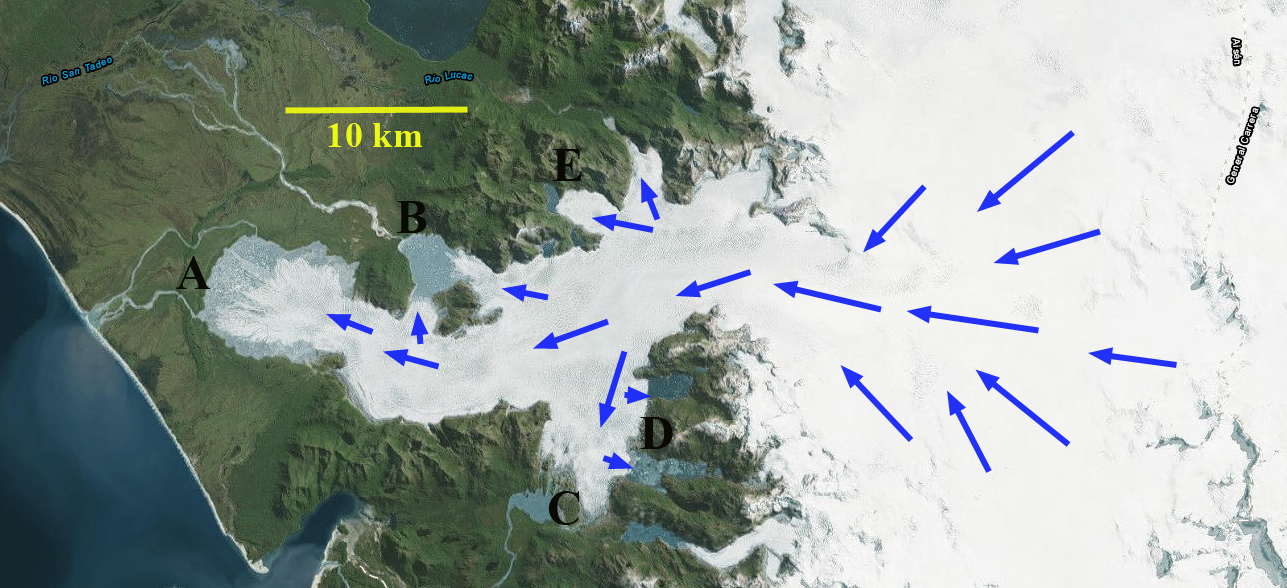
The retreat has been similar in timing to nearby Alsek River watershed glaciers Walker GlacierEast Novatak Glacier and North Alsek Glacier..  The rapid retreat is enhanced by calving in proglacial lakes, a common issue increasing area loss of Alaskan glaciers.  Yakutat Glacier is an example of rapid lake expansion. In the case of Yakutat Glacier unlike the Alsek or Grand Plateau Glacier the glacier lacks any high elevation accumulation zone and cannot survive without an accumulation zone (Trüssel et al 2015).  Grand Plateau Glacier and Alsek Glacier both have large accumulation areas above 2000 m, that are well above the snowline at all times.  The Alsek River is a destination for sockeye salmon fishing and river rafting, see Chilkat Guides or Colorado River and Trail Expeditions.  Continued expansion of lake area as glaciers retreat in the watershed, is changing the nature of the Alsek River.

alsek map

USGS Topographic map of region from 1958 aerial images indicating merging of Alsek Glacier and North Fork Grand Plateau Glacier. 

alsek 1984

1984 Landsat image indicating terminus locations. Pink arrow is 1984 terminus, red arrow is the 2013 terminus and yellow arrow 2015 terminus.

alsek 1999

1999 Landsat image indicating terminus locations. Pink arrow is 1984 terminus, red arrow is the 2013 terminus and yellow arrow 2015 terminus.

alsek 2014

2014 Landsat image.  indicating terminus locations. Orange dots indicate the ice front. Pink arrow is 1984 terminus, red arrow is the 2013 terminus and yellow arrow 2015 terminus.

Kiwa Glacier Retreat, British Columbia 1986-2015

compare kiwa

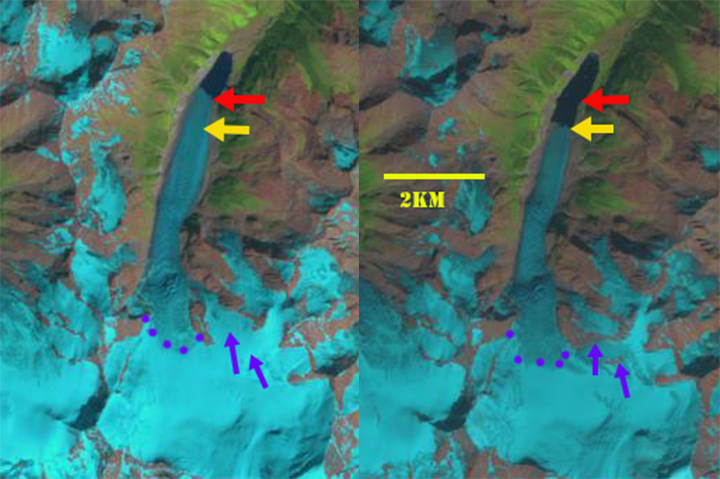
Kiwa Glacier retreat from 1986 to 2015 in Landsat images.  Red arrow is 1986 terminus and yellow arrow 2015 terminus location. Purple arrow indicates upglacier thinning where more bedrock is exposed.  Purple dots indicate the transient snowline

Kiwa Glacier is the longest glacier, at 9 km, in the Cariboo Mountains of  British Columbia.  The glacier drains northwest from Mount Sir Wilfred Laurier and is near the headwaters of the Fraser River, where it terminates in an expanding lake at 1465 m. Here we examine glacier change from 1986 to 2015. In 1986 the glacier terminated in the 700-800 m long proglacial lake.  The glacier has two significant icefalls above the terminus at 2300 m and 1800 m.   The lower icefall generating a series of ogives that are generated annually due to seasonal velocity fluctuations.  The ogives indicate the glacier velocity below this icefall.  There are 20 ogives in the span of approximately 1 km indicating a velocity of 50 m/year.  In 2015 the glacier still terminates in the proglacial lake that is now 1400-1500 m long indicating a retreat of 700 m in the thirty years from 1986-2015.  The lower 300 m of the glacier is nearly flat suggesting the lake will extend at least that far, note 2010 image from Reiner Thoni, Canadian Mountaineer.  This is also the extent that will be lost relatively quickly via iceberg calving and continued surface melt.  Above this point flow remains vigorous and retreat could diminish. Upglacier thinning has expanded bedrock areas even separating sections of the glacier, purple arrows. The transient snowline in mid-August in the Landsat images is at 2550 m. Driving through the area last week, the snowline is at 1000 m, quite high for mid-March.

Beedle et al (2015) note that glaciers in the Cariboo Mountains were close to equilibrium from 1952 to 1985 : 9 glaciers advanced, 12 receded, and 11 did not change. After 1985 they noted that all glacier retreated in the Cariboo Mountains. The response time of the glaciers to climate change is the main cause for the differing response of individual glaciers in the region as has been noted in other Pacific Northwest regions (Pelto and Hedlund, 2001 & Tennant et al, 2012).  Response times are faster for glaciers with steeper slopes, higher velocity/length ratios and a higher ratio of accumulation-ablation/ ice thickness.  The decline of glaciers, warm weather and reduced snowpack combined in 2015 to place a stress of Fraser River salmon due to lower discharge and higher temperature.  This could be an issue in 2016 as well.

adamant 2004 ge copy

Kiwa Glacier in 2004 Google Earth image

kiwa glacier rt

2010 Image from Reiner Thoni.  Well defined trimlines above the lake.  Note flat lower section of the glacier. 
Alpine Glacier Mass Balance in 2015: Competes for Record Loss


Climate-Change-Data BA

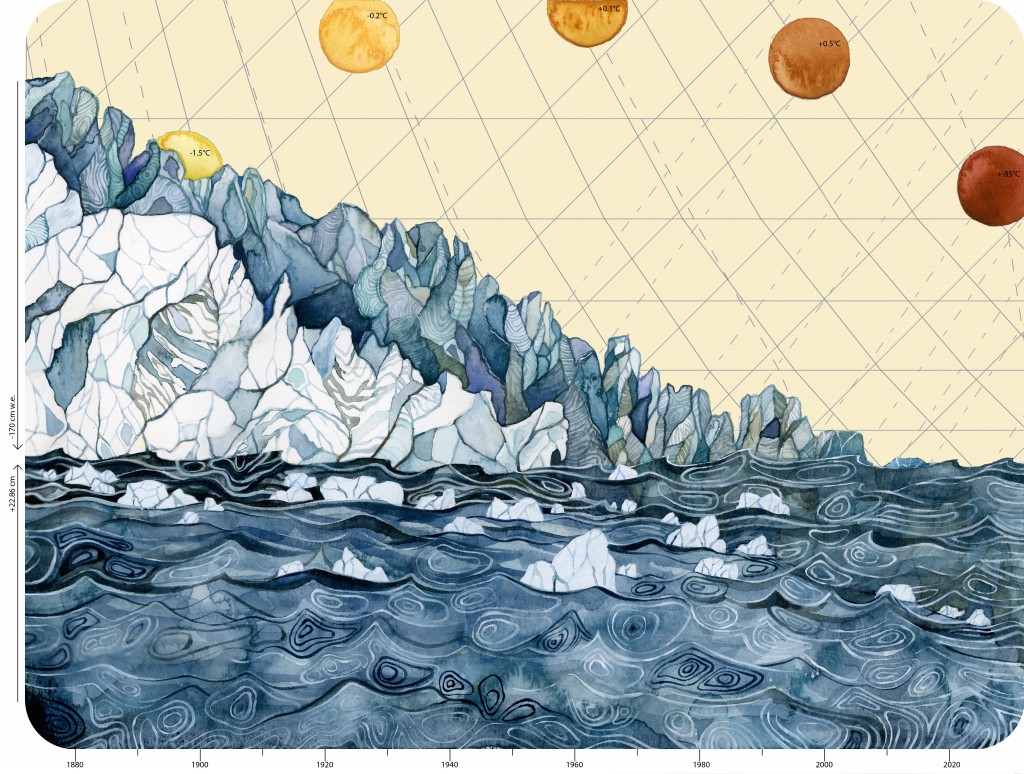
Painting from Jill Pelto illustrating the Climate Change Data using multiple quantities: the annual decrease in global glacier mass balance, global sea level rise, and global temperature increase. The numbers on the left y-axis depict quantities of glacial melt and sea level rise, and the suns across the horizon contain numbers that represent the global increase in temperature, coinciding with the timeline on the lower x-axis.

The World Glacier Monitoring Service (WGMS) record of mass balance and terminus behavior provides a global index for alpine glacier behavior. The WGMS data set for terminus change contains 42 000 observations from 2000 glaciers extending from the mid-19th century. Annual mass balance is the annual change in volume due to snow and ice accumulation and snow and ice losses. Here, mass balance is reported in mm of water equivalent. The following analysis is something I work on annually as the United States Representative to the WGMS, putting the alpine glacier mass balance of the globe in perspective. Preliminary data for 2015 from 16 nations with more than one reporting glacier from Argentina, Austria, Canada, Chile, Italy, Kyrgyzstan, Norway, Switzerland, and United States indicate that 2015 will be the 36th consecutive year of negative annual balances with a mean loss of −-1162 mm for 27 reporting reference glaciers and −1481 mm for 62 of all reporting glaciers (WGMS 2016). The number of reporting reference glaciers is 90% of the total whereas only 50% of all glaciers that will report have reported to date. When all data are available the 2015 mass balance will likely be comparable to 2003 the most negative year at −1268 mm for reference glaciers and −1198 mm for all glaciers.

The cumulative mass balance loss from 1980–2015 is 18.8 m, the equivalent of cutting a 20.5 m thick slice off the top of the average glacier. The trend is remarkably consistent from region to region (WGMS 2015). The decadal mean annual mass balance was −261 mm in the 1980s, −386 mm in the 1990s, -−727 mm for 2000s and −818 mm from 2010–15. The declining mass balance trend during a period of retreat indicates alpine glaciers are not approaching equilibrium and retreat will continue to be the dominant terminus response (Zemp et al. 2015). The recent rapid retreat and prolonged negative balances has led to many glaciers disappearing and others fragmenting (Pelto 2010; Carturan et al. 2013).

wgms annual balance

Annual glacier mass balance record of reference glaciers reporting to the WGMS.

In South America seven glaciers in Columbia, Argentina, and Chile reported mass balance. All seven glaciers had losses greater than −1200 mm, with a mean of −2200 mm. These Andean glaciers span 58°of latitude.

In the European Alps, mass balance has been reported for 14 glaciers from Austria, France, Italy, Spain and Switzerland. All 15 had negative balances exceeding −1000 mm, with a mean of −1860 mm. This is an exceptionally negative mass balance rivaling 2003 when average losses exceeded −2000 mm.

In Norway mass balance was reported for seven glaciers in 2015, all seven were positive with a mean of 860 mm. This is the only region that had a positive balance for the year. In Svalbard six glaciers reported mass balances, with all six having a negative mass balance averaging −675 mm.

In North America Alberta, British Columbia, Washington, and Alaska mass balance data from 17 glaciers was reported with a mean loss of −2590 mm, with all 17 being negative. This is the largest negative mass balance for the region during the period of record. From Alaska south through British Columbia to Washington the accumulation season temperature was exceptional with the mean for November–April being the highest observed.

In the high mountains of central Asia seven glaciers from China, Russia, Kazakhstan, and Kyrgyzstan reported data, all were negative with a mean of –705 mm.

columbia compare 2015


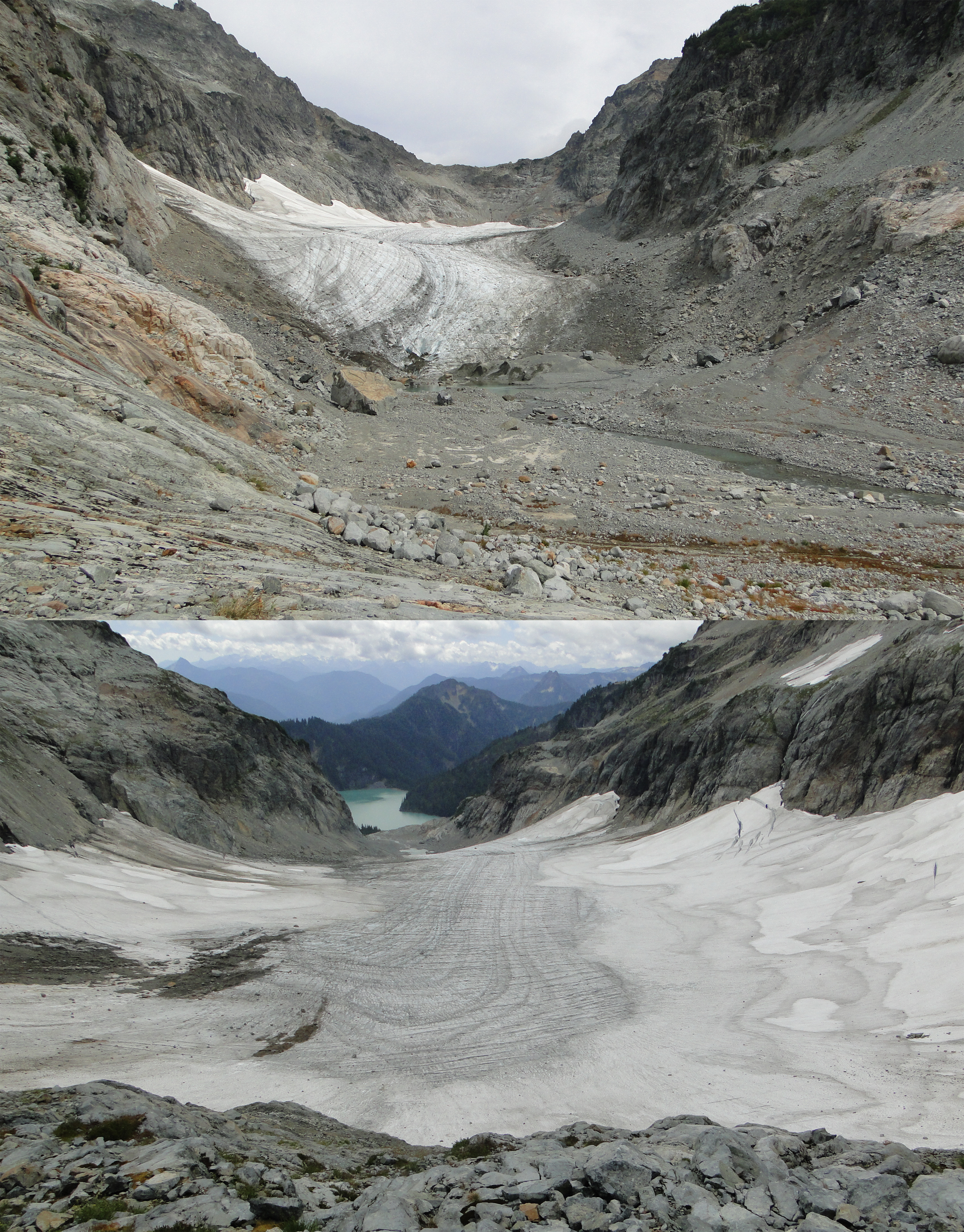
Columbia Glacier, Washington in 2015 during our mass balance observations from the terminus and head of the glacier indicating the lack of snow cover retained and extensive melting,


Mammoth Glacier, Wyoming Ongoing Retreat


mammoth compare

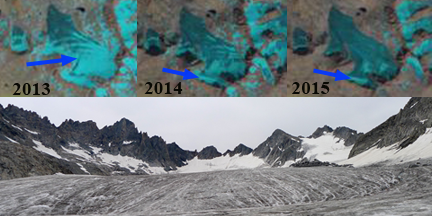
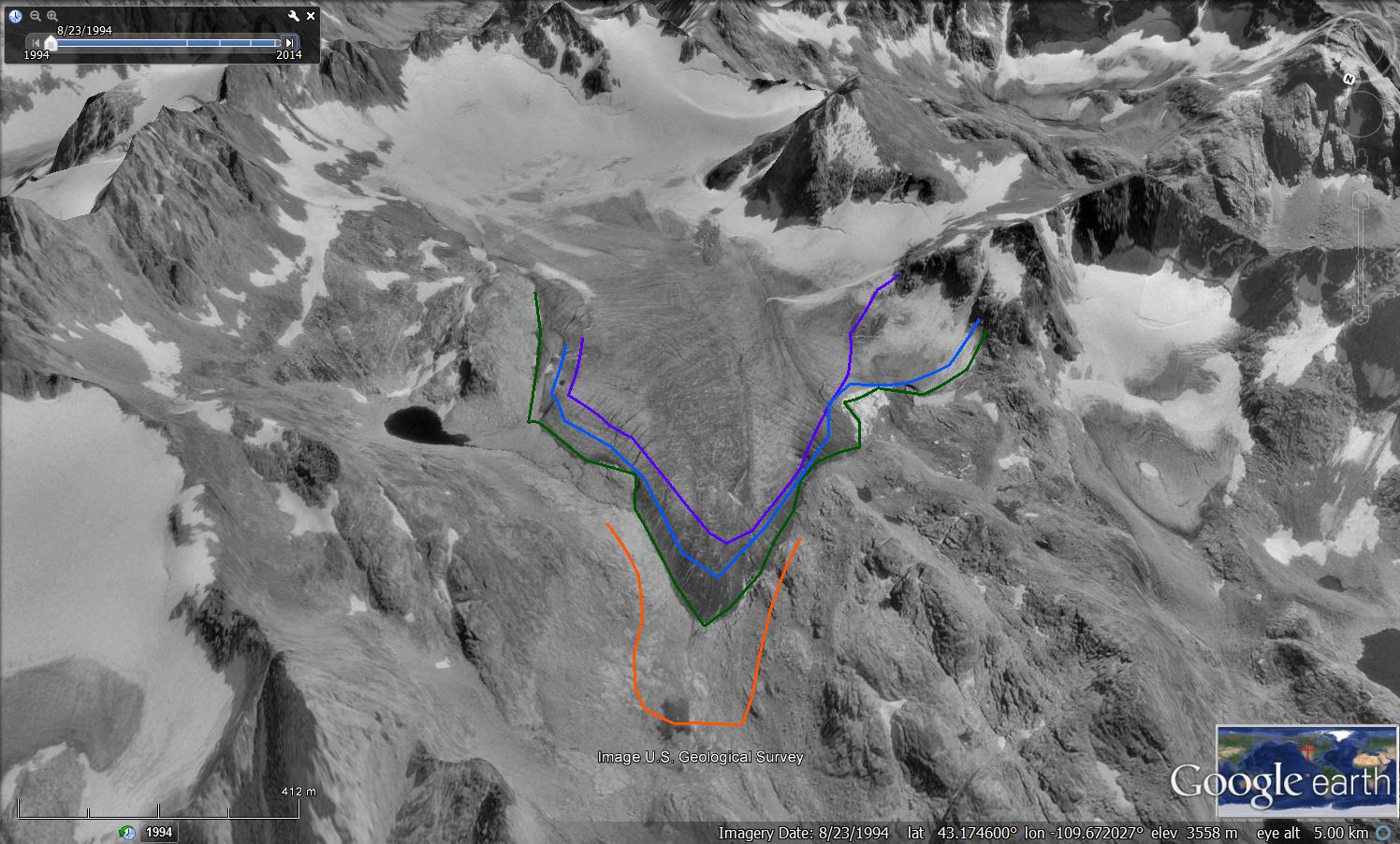
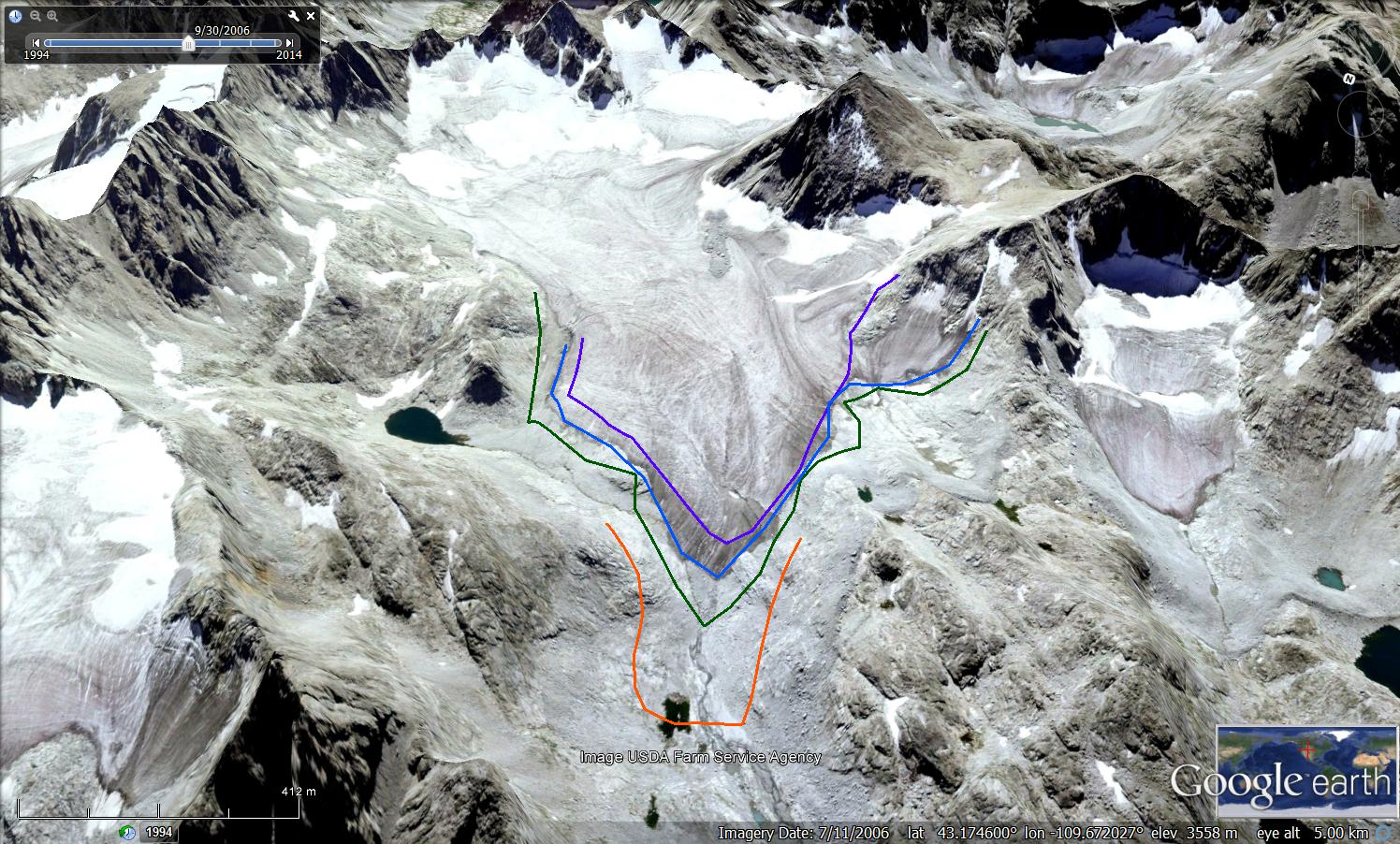
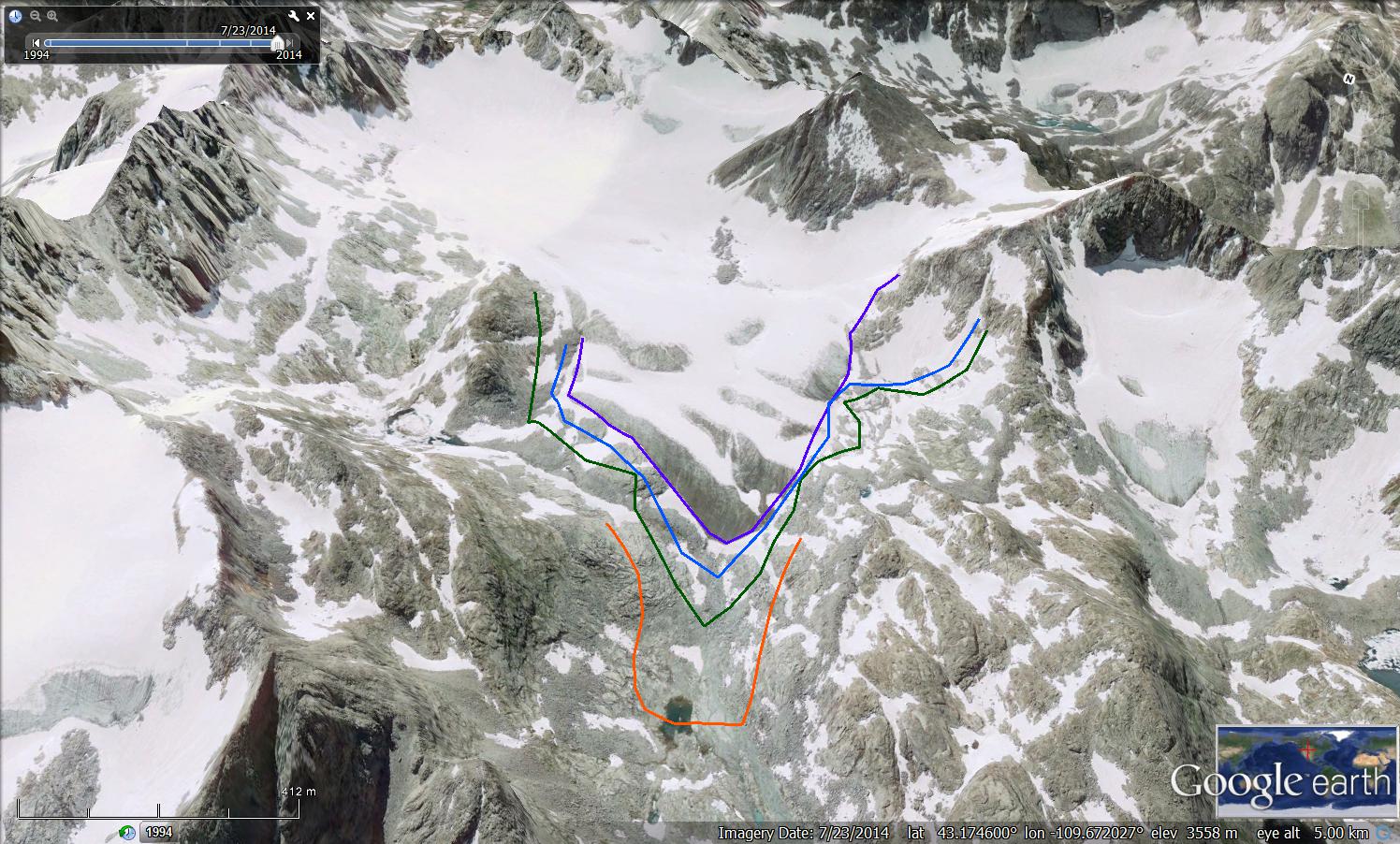
At top Landsat images from September 2013, 2014 and 2015 of Mammoth Glacier.  The blue arrow indicates retained snowcover. A 2013 images of Mammoth Glacier from Sarah Meiser, note low slope and lack of crevassing above

Mammoth Glacier is in the Wind River Range of Wyoming.  The ongoing retreat is leading to a glacier that does not warrant the name mammoth for size, but soon it will for obsolescence.The long and low sloped glacier is the largest west of the Continental Divide in the range. The glacier is at the headwaters of the Green River  and Green River Lakes. The glacier had an area of 4 square kilometers in 1952, 2.1 square kilometers in 2007 and 1.8 square kilometers in 2015.  The Landsat sequence above from 2013, 2014 and 2015 illustrates the problem, insufficient retained snowcover to approach equilibrium, that is also evident in 2006 shown below. The setting is better illustrated with images from Sarah Meiser who I think has the best collection of recent images of Wind River Glaciers. A glacier like Mammoth with limited avalanching needs more than 50% retained snowcover at the end of the summer (accumulation area ratio) to be in equilibrium.  In 2013 with three weeks left in the melt season, the accumulation area ratio (AAR) is slightly below 50%, note Sarah Meisel image below.  In 2014 the AAR is 25 % and in 2015 the AAR is 5-8%.  These periods of sustained bare ice exposure lead to area loss and thinning.  A comparison of Google Earth images illustrate the area loss. In each image the orange line is the 1966 map position, green line 1994 margin, blue line 2006 margin and purple line 2014 margin.  The loss in area at the margin is evident as is the loss on the western side between 2006 and 2014.  Retreat has been 200 m from 1966 to 1994, 95 m from 1994-2006 and 95 m from 2006 to 2014. Area loss after the poor snowcover in 2015 will continue and the glacier will not long be considered mammoth in size.  Pelto (2010) examined glaciers in the Wind River Range and found two-thirds could not survive current climate as they did not have a persistent accumulation zone, including Mammoth Glacier and Sacagawea Glacier. Thompson et al (2011) noted a 38% loss in area of the 44 Wind River Range glaciers from 1966-2006. Maloof et al (2014) noted an even larger drop in volume of 63% of the same glaciers from 1966-2012.


mammoth rocks

 Sarah Meiser image illustrating how close to the top of the glacier the bare ice extends.  This fact indicates that all of the firn had been lost, thus the area shown has not been a recent accumulation area. 

mammoth 1994a

1994 Google Earth Image

mammoth 2006a

2006 Google Earth Image

mammoth 2014

2014 Google Earth image


San Quintin Glacier, Chile terminus disintegration 1987-2015

san quentin compare

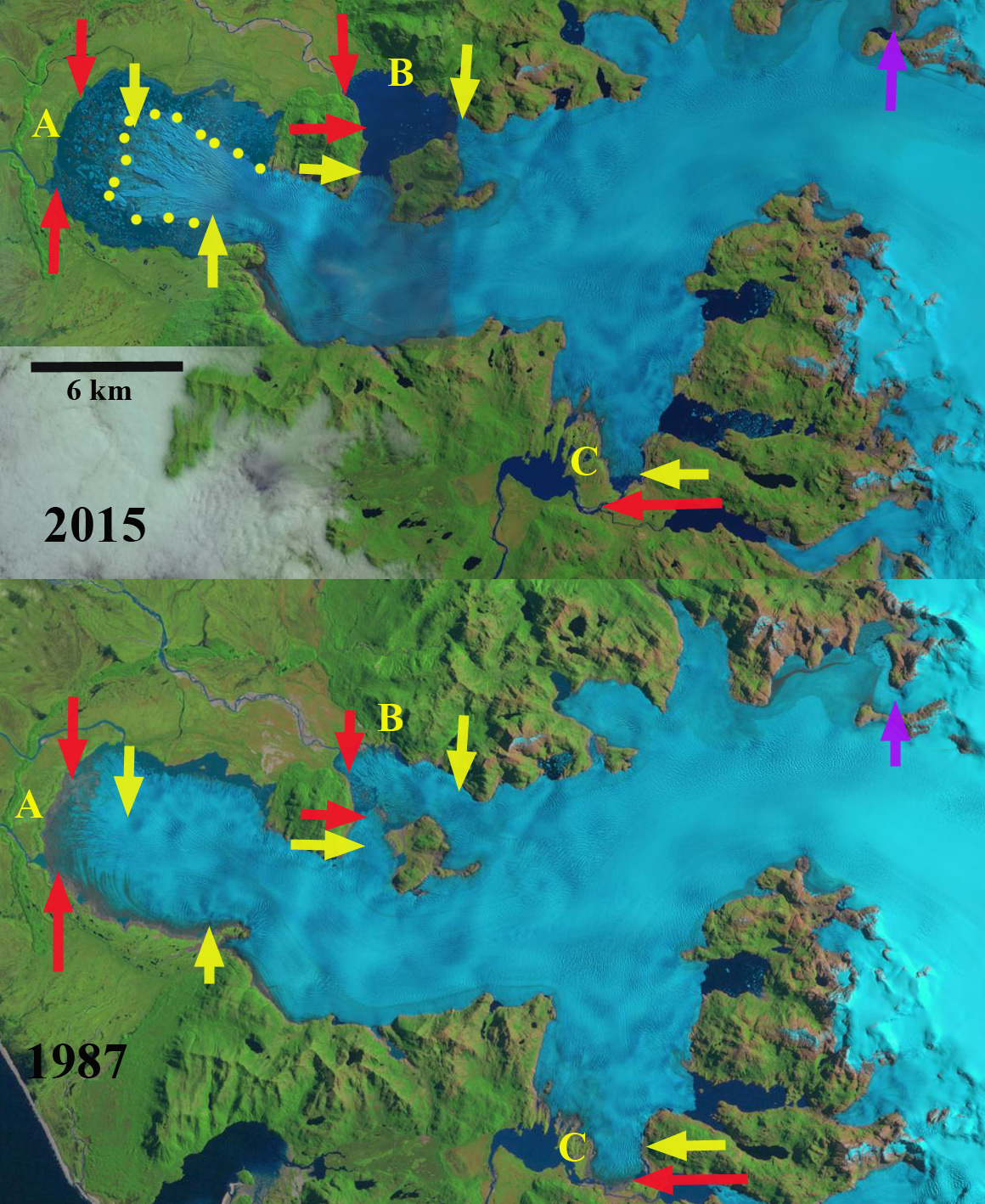
Landsat comparison of San Quintin Glacier in 1987 and 2015: red arrow indicates 1987 terminus location, yellow arrow indicates 2015 terminus location of the three main termini, and the purple arrow indicates upglacier thinning.

San Quintin is the largest glacier of the NPI at 790 km2 in 2001 (Rivera et al, 2007).  The glacier extends 50 km from the ice divide in the center of the ice cap.  The peak velocity is 1100 m/year near the ELA (Rivera et al 2007), declining below 350 m/year in the terminus region.  The velocity at the terminus has increased from 1987 to 2014 as the glacier has retreated into the proglacial lake (Mouginot and Rignot, 2015).  The high velocity zone extends more than 40 km inland an even greater distance than at San Rafael (Mouginot and Rignot, 2015).  Thinning rates in the ablation zone of the glacier are 2.3 m/year (Willis et al, 2012).  The glacier has a low slope rising 700 m in the first 22 km. The low slope, broad piedmont lobe and many distributary terminus lobes is like the Brady Glacier, Alaska.

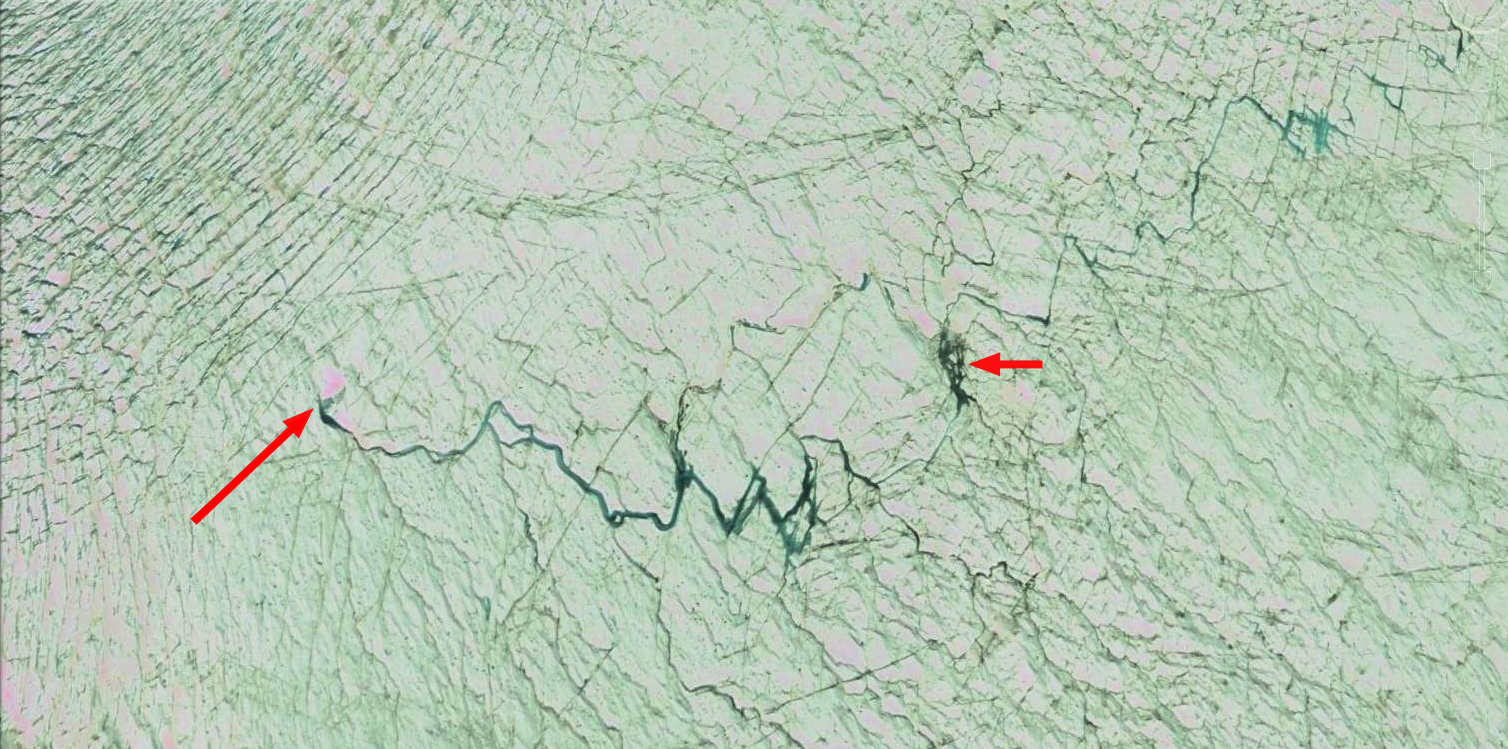
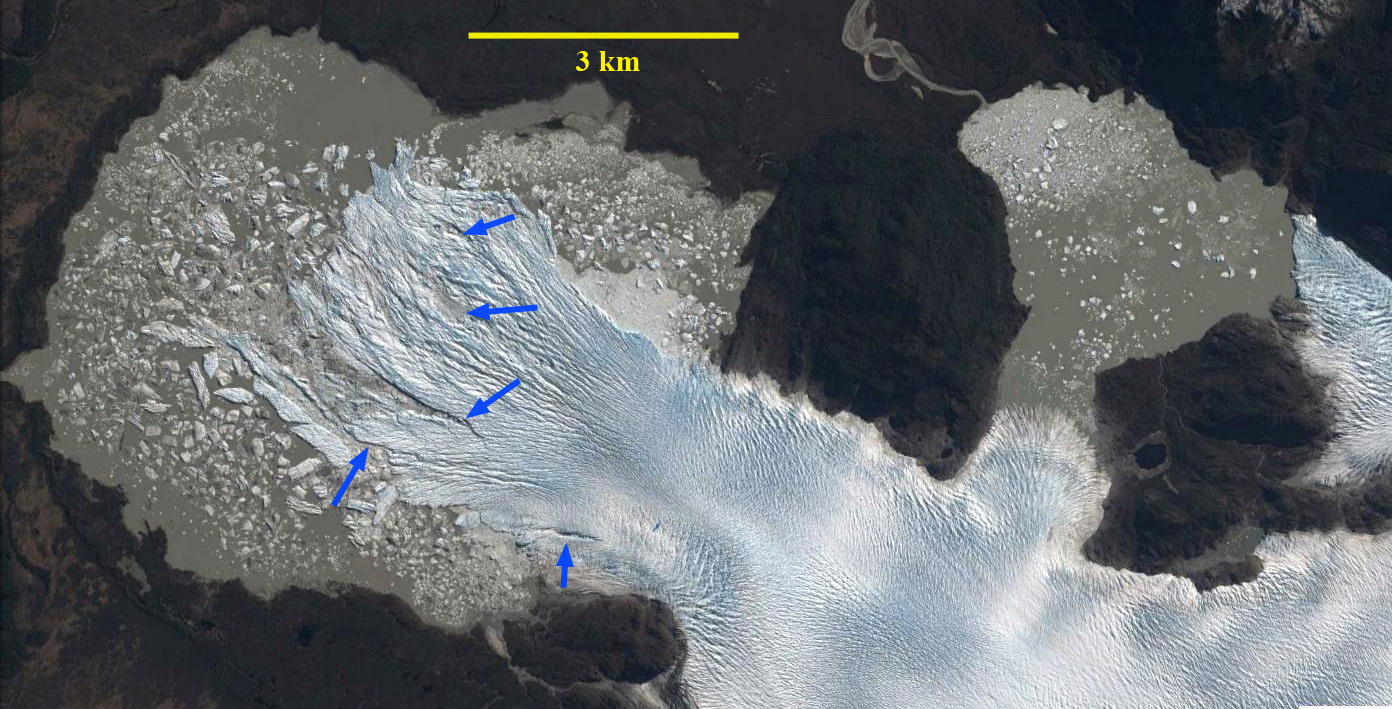
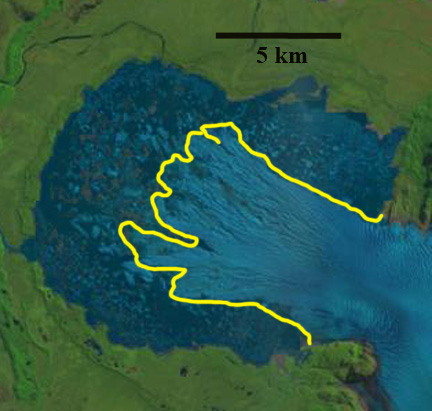
Davies and Glasser (2012) note that San Quintin Glacier terminated largely on land until 1991. The glacier has lost 15 % of its area in the last century (Davies and Glasser, 2012).  The glacier has a main terminus and many subsidiary termini.  In 1987 it is a piedmont lobe with evident minimal marginal proglacial lake development beginning. There is limited lake development at the main southern and northern terminus Point C and B respectively. Harrison et al (2001) observed that in 1993 the glacier terminus was advancing strongly into vegetated ground, while from 1996 to May 2000 the glacier underwent a transition between advance and retreat.  The high rates of thinning are leading to the retreat not just of main terminus but the distributary terminus areas extending north and south into lake basins from the main glacier. From 1987 to 2015 the main terminus retreated 2200 m, almost all after 2000, largely through a disintegration of the terminus tongue in a proglacial lake.  Extensive rifting of the terminus lobe in 2013 and 2015 is still apparent in imagery below, indicating this rapid area loss is not finished.  The main lake, Point A, had an area of 23.8 square kilometers in 2011 (Loriaux and Cassasa, 2013) . The lake at Point B developing on the north side of the glacier, due to a 3500 m retreat, is now over 8 square kilometers.  The southern terminus at Point C, has a narrow fringing lake and a retreat of 1100 meters from 1987-2015. The retreat here follows the pattern of Fraenkel GlacierAcodado Glacier and Steffen Glacier to the south.

san quintin overview

Digital Globe image of San Quintin Glacier in 2011.

san quintin terminus 2013

2013 Google Earth image, with the large rifts indicating glacier weakness noted with blue arrows. 

san quintin terminus 2015

2015 Landsat image, yellow line indicates terminus. Note the tongue is surrounded on three sides by water.


Sierra de Sangra Glacier Retreat, Argentina

mayer compare

Comparison of four outlet glaciers of Sierra de Sangra in Argentina in a 1985 and 2015 Landsat image.  Read arrow is the 1986 terminus location when all terminated in a lake.  By 2015 only one terminates in a lake, yellow arrows. 

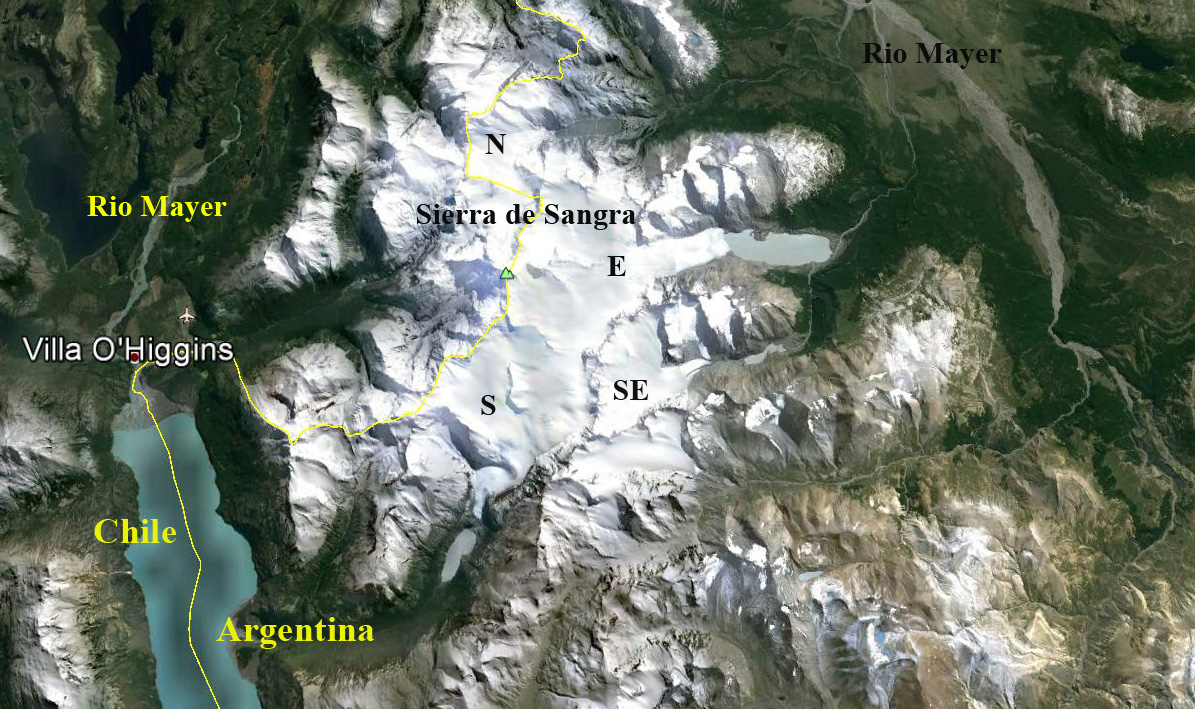
The Sierra de Sangra Range is located along the Chile-Argentina boundary with the east draining glaciers flowing into the Rio Mayer and then into Lake O’Higgins at Villa O’Higgins. Here we examine four glaciers that in 1986 all ended in lakes and by 2015 only one still terminates in the lake. Davies and Glasser (2012) noted the fastest retreat rate of this icefield during the 1870-2011 period has been from 2001-2011. NASA’s Earth Observatory posted an article on this blog post with better resolution images.
mayer ge

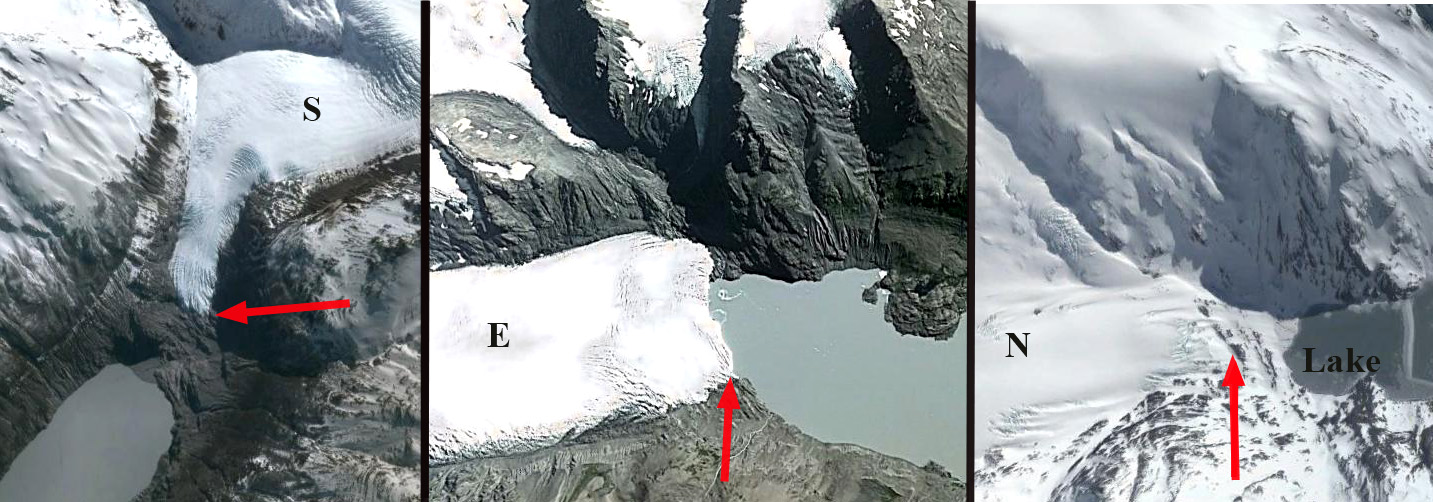
Sierra de Sangra is just east of Villa O’Higgins with the crest of the range on the Chile Argentina border. The four glaciers examined here are indicated by S, SE, E and N. 

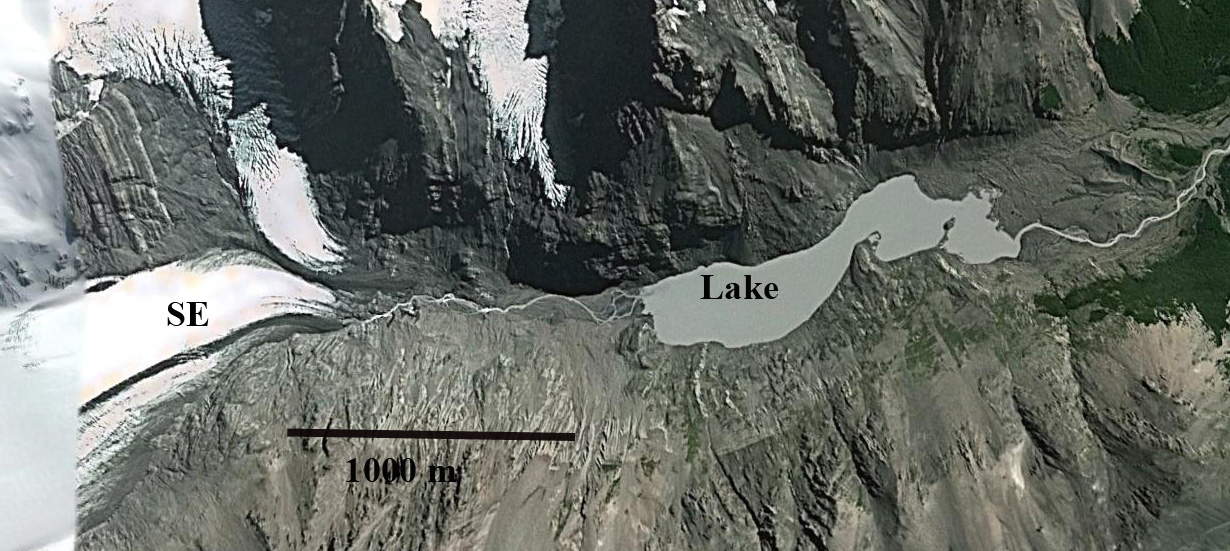
The South Outlet Galcier (S) has retreated 700 m from 1986 to 2015 and terminated in a lake in 1986.  By 2015 it terminates on a steep slope well above the lake.  The Southeast Outlet Glacier (SE) terminates in a lake in 1986.  By 2015 it has retreated 1200 m to a junction with a tributary from the north.  The East Outlet Glacier is the largest glacier and has retreated just 300 m from 1986 to 2015. There is a sharp elevation rise 200 m behind the terminus, which likely marks the end of the lake basin.  This is marked by a crevasse zone.  The North Outlet Glacier (N) ended in a lake in 1986.  By 2015 it has retreated 700 m and ends on a bedrock slope well above the former lake level. All of the glaciers have an accumulation zone in each satellite image examined.  This indicates they can survive present climate. The glacier retreat is not as large as Cortaderal Glacier and Glaciar Del Humo.

mayer terminus

Google Earth images from 2013 of the terminus of three outlet glaciers above and one below.  The red arrow indicates terminus location. Three of the four no longer terminate in a lake. 
mayer southeast

Orpissuup Tasia Glacier slowdown, SW Greenland

transects_chart_1985-2013

Tedstone et al (2015) Figure 3 illustrates the widespread velocity decline along three transects. 

Pelto et al (1989) after a field campaign we mounted in 1985 and 1986 on Jakobshavns Glacier noted that the velocity was essentially the same in the summer of 1964, 1976, 1978, 1985 and 1986.  Further we observed that the agreement between surface mass-balance and volume-flux calculations, suggested that “Jakobshavns Isbrae: is almost in a state of equilibrium”. The point of the study was to establish a baseline of velocity before the anticipated acceleration due to warming. This acceleration due to warming happened beginning in 1992 from 20 m/day at the calving front in 1985 to 46 m/day in 2012, comparing the same locations the annual speed increase was 282% from 1992 to 2012 (Joughin et al 2014).  The Jakobshavns Isbrae is a tidewater glacier, just south of the glacier the margin of the ice sheet is dominated by a land terminating section that has a different dynamic response to warming.

Tedstone et al (2015) in a paper published in Nature in October noted a decadal reduction in glacier velocity for a land terminating region of the Greenland Ice Sheet. This slow down occurred despite a 50% increase in meltwater production. This is emphasized in the figure above indicating the changes along three transects from green earlier to purple later years.  A glacier inhabits a particular topographic environment that establishes the basic flow field. Climate change can affect glacier flow by increasing ice melt, which leads to ice thinning  and a consequent reduction in force generating ice deformation and flow.  This same ice melt can deliver meltwater to the base of the ice sheet, which can lead to short term increases in basal water pressure that will drive acceleration, the acceleration tends to be short lived.  The overall impact of these competing forces is what this study indicates, that just as is the case on alpine glaciers thinning resulting from more melt leads to velocity reductions as a more efficient hydrologic system develops reducing basal water pressure.  This same process clearly does not apply to calving tidewater outlet glaciers. Here we examine the changes at the terminus, evidence of thinning and location of moulins on the outlet glacier that flows into a series of lakes, Orpuussit Tasia, along Transect B.

transect b landsat compare

Landsat image comparison from 2000 and 2015.

In the comparison of Landsat images above from 2000 and 2015 the expansion of small proglacial lakes is evident at each red arrow, #2 has the greatest expansion.  At the yellow arrows thinning is evident at a small lake that is fed by glacier runoff giving it a green sediment laden color, and by 2015 no longer receives meltwater as the ice sheet has thinned below the watershed divide, yielding clearer water which appears darker.  The expansion of the end of the medial moraine also indicates thinning.  Four bedrock areas emerging from the ice have much greater prominence in 2015 than 2000 purple arrows. This is modest thinning and retreat compared to the Jakobshavn and other large outlet glaciers to the north. The first image below indicates the terminus with red dots in a Google Earth image. The terminus as the proglacial lake #2 is pinned on a two bedrock prominences which should slow retreat. Proglacial lake #3 does not have an evident pinning point, and should retreat back towards the peninsula to the south in the near future. The second image below indicates the supraglacial streams and moulins in a small area of this glacier. The linear nature of many streams indicate they are occupying former crevasse features. Just as in the 1980’s little of the runoff reaches the terminus at the surface, almost all is directed to the base via moulins. Tedstone et al (2015) found that velocity did increase in summer, but declined more in the winter.  NASA Landsat and Nasa Earth Observatory provides several excellent figures and explanation of the process in the study area.

.transect b

Google Earth image indicating ice sheet margin in 2012, red dots.

transect b moulins

Google Earth image indicating surface streams and locations of two moulins. 

Lex Blanche Glacier Recession, Mont Blanc Massif, Italy

lex blanche compare

Lex Blanche Glacier (Lb) comparison in a 1990 and 2015 Landsat image.  Red arrow indicates 1990 terminus, yellow arrow the 2015 terminus and the purple arrow a separated tributary. Debris covered Miage Glacier (M) is adjacent. 

Lex Blanche Glacier descends from 3500 m on the southeast flank the Aiguille de Glaciers of the Mont Blanc Massif into the Vale Veny of Italy. The glacier is adjacent to Miage Glacier (M). The glacier advanced over 700 m from 1970 to 1990. In 1990 the glacier extended to the base of a steep slope and turned north to terminate at 1980 m. By 2001 the glacier has retreated up a steep slope to near where the 1970’s advance had begun.  By 2009 and 2011 further retreat has left the terminus just above a particularly steep bedrock slope.  By 2015 the glacier has retreated 1100 m and terminates at 2450 m remaining on a relatively steep slope. The glacier is heavily crevassed a short distance above the terminus suggesting the period of rapid retreat should be ending. A tributary from the north has detached from the main glacier at the purple arrow. In recent warm summers the glacier has retained snowcover above 3150 m.  The mass balance noted in Figure 8  (see below) of a paper by Berthier et al (2014) indicates the thinning is glacier wide but most prominent on glacier tongue.  Berthier et al (2014) used  the Pléiades satellites to identify a negative region wide mass balances of glaciers in the Mont-Blanc area of -1.04 m/year for the 2003-2012 period. The meltwater runoff from this glacier feeds the Dora Baltea River and then the Po River.  Both rivers feature extensive hydropower including the Champagne and Nus hydropower plant on the Dora Baltea  that produce 41 MW.  The retreat of this glacier mirrors that of other glaciers of Mont Blanc including Taconnaz, Bionnassay, Mer de Glace and Tour Glacier.

berthier mass balance lex blanche

Figure 8 from Berthier et al (2014) on glacier wide mass change with thinning in browns, and darker browns greater thinning.

lex blanche 2001

Google Earth image from 2001 indicating the 1990 terminus at red arrow and 2001 terminus at yellow arrow.

lex blanche 2009

Google Earth image from 2009 indicating the 1990 terminus at red arrow and 2009 terminus at yellow arrow.

lex blanche 2011

Google Earth image from 2011 indicating the 1990 terminus at red arrow and 2011 terminus at yellow arrow.  Blue arrow indicates the lowest heavily crevassed region.


Kanchenjunga Glacier, Nepal Volume Losses

kanchenjunga compare
Figure 10-16. Kanchenjunga Glacier (K) from 1991 to 2015, green arrows indicate locations of enhanced supraglacial lakes since 1991. Purple arrow indicates areas of thinning at higher elevations in the region. Location 2 is the main junction area. 

Kanchenjunga Glacier is the main glacier draining west from Kanchenjunga Peak, also listed on maps as Kumbukarni. The glacier is similar to Zemu Glacier flowing east from the same mountain into Sikkim, in the heavy debris cover that dominates the glacier in the ablation zone extending from the terminus for 15 km and an altitude of 5600 m. Identifying the retreat is difficult due to the debris cover. Racoviteanu et al (2015) examined glaciers in this region using 1962 and 2000 imagery. They found area losses of 14% for debris covered glacier and 34% for clean glaciers. The debris covered glaciers terminus response is even more muted indicating why terminus change is an easy measure of glacier change but not always the best. For Kanchenjunga Glacier Racoviteanu et al (2015) indicate the glacier area declined by just 4-8% from 1962-2000.

What is apparent in the Landsat images at the green arrows is the increase from 1991 to 2015 of supraglacial lakes. Also features of thinning are evident in the mid reaches of the glacier, purple arrows, where tributaries have narrowed and detached from the main glacier. A closeup of the main glacier junction 12 km above the terminus indicates the number of large supraglacial lakes. These cannot form in a region where melting does not dominate over glacier motion. The Google Earth image from 2014 of the terminus area indicates a patchwork of moraine cored ice dotted with supraglacial lakes and dissected by the glacial outlet river in the lower 3 km of the glacier. This is clearly not an active portion of the glacier, it is thin not moving and does not fill even the valley floor. An overlay of images indicates the lack of motion. The heavy debris cover has slowed retreat and thinning, however, the lower glacier is poised for an increased rate of retreat with merging of supraglacial lakes, which will lead to further area losses. The Kanchenjunga Glacier is losing volume like all other 41 glaciers examined in detail and linked at the Himalayan Glacier Index page. 

kanchenjunga glacier jct

Google Earth image of the main glacier junction region (2) Supraglacial lakes in the area of at 5200 m. 


kanchenjunga glacier

Google Earth image of supraglacial lakes 2-5 km above the terminus and the region along the north margin of the glacier where the glacier is receding from the lateral moraine. 

kanchenjunga terminus

2014 Google Earth image of terminus reach.  Black arrows indicate ice cored moraine, blue arrow the lowest large supraglacial lake, 2.5 km above the terminus and red arrow the last remnant of ice.