Alpine Glacier Incompatibality with Heat Waves

Bare glacier ice exposed with months left in the melt season enhances melt. Down slope ice bands and surface roughness on Sholes Glacier.

Heat waves and glaciers don’t usually go together; however, in the last several years an increasing number of heat waves have affected alpine glacier regions around the world.  This is true from Arctic Canada to the Himalayas from the Andes to Alaska. Here we review a number of these heat waves from 2018-2022, that I have been involved with assessing and observing. In particular heat waves leave a greater portion of the glacier snow free, which enhances melting and mass balance losses. This is most pronounced when the heat wave occurs prior to or early in the melt season exposing bare glacier ice for the bulk of the melt season. This occurred in summer 2021 in the Pacific Northwest, in summer 2022 in the Central Andes of Chile and Peru, and during the pre-monsoon season in 2022 in the Himalaya. In the summer of 2022 heat waves impacted the glaciers of Svalbard and Europe. In the summer of 2023 the Central Andean glaciers have again been stripped of snowcover.

Lowell Glacier in Landsat images from 7/4, 7/26 and 8/11 with Sentinel images from 7/22 .  The snowline is shown with purple dots. Point A-F are fixed reference locations.  The snowline migrated upglacier 20 km and 300 m in elevation.  A significant snow swamp is between the yellow and purple dots on 7/26, that was not present on 7/22. 

The beginning of this “wave” of observations of heat wave impacts on glaciers, was on Lowell Glacier, Yukon where a large snow swamp formed in a matter of days during a Yukon/Northwest Territories Heat Wave.  On July 26, the slush covered an area of more than 40 square kilometers, with the rapid development of such a large melt area on Lowell Glacier coinciding with four days where daily temperatures at nearby Haines Junction (~60 km northeast of the glacier) reached 29 degrees Celsius. The only way to generate an extensive snow swamp is to have the snow saturated with water all the way to the surface NASA’s Earth Observatory (NASA EO).

Taku Glacier transient snowline (purple dots) in Landsat images from 7/21 and 9/16/2018.

This same heat event led to the observation that the snow lines on Taku Glacier in Alaska were the highest they had been since tracking began in 1946, 200 m higher than previously observed, with the snow line rising +10 m/day during the heat wave (Pelto, 2019).

Fork Beard (F) and Nerutusoq Glacier (N) Baffin Island on June 1, 2019,  June 18, 2019 Sentinel images and June 30 Landsat image. Purple dots indicate the snowline. 

During June 2019 on Baffin island Pangnirtung featured four days with record temperatures for that date June 5 (15.1), June 11 (13.5) and June 12 (13.6), and June 19 (14.4). There were 14 days with a maximum temperature above 10 C. On Fork Beard Glacier and Nerutusoq Glacier this drove a snowline rise from  800 m on June 1  to 1100 m by June 18 and 1150 m on June 30. A rate of over 10 m/day for the month.
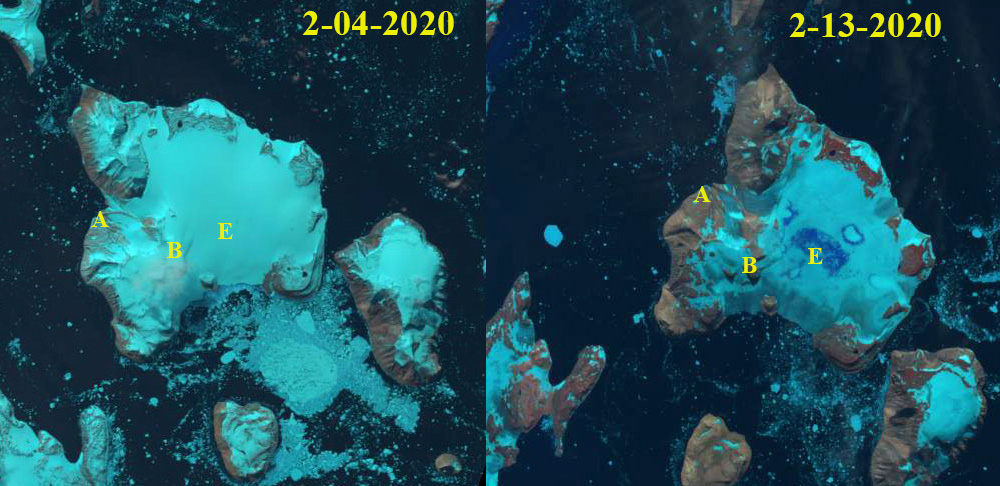
Eagle Island Ice Cap, Antarctica in Landsat images from Feb. 4, 2020 and Feb. 13, 2020.  Point E indicates an are area of snow/firn that is saturated with 

An all-time temperature record for Antarctica in February 2020,  a high-pressure ridge and a blocking high in the Drake Passage caused anticyclonic circulation bringing warm moist air from the Pacific Ocean to the Antarctic Peninsula Xu et al (2021). This led to vertical air flows in a foehn warming event dominated by sensible heat and radiation made generating abrupt warming Xu et al (2021).  The visible impact of this heat event were the rapid  rapid formation of melt ponds on Eagle Island Ice Cap I reported to NASA EO.  On Eagle Island Ice Cap melt averaged 22 mm/day from Feb. 6-11 based on MAR climate model output forced by the Global Forecast System (GFS)  generated by Xavier Fettweis. Rapid melting generating significant snowline rise on Coley Galcier, James Ross Island as well (Pelto, 2020).

Nanpa La (NPL) and Nup La (NL) in October 13, 2020 and January 17, 2021 Landsat imagery indicating the snow line rise that has persisted into mid- winter. Snow line indicated by yellow dots.

When record warmth spread over the Mount Everest region in January 2021, the snow lines near Mount Everest rose durng the October-December 2020 period, and remained at nearly 6,000 meters, including the key glacier passes from Nepal into China being snow free into late January. The National Geographic Perpetual Planet Expedition weather team, led by L. Baker Perry and Tom Matthew, had installed weathers stations at high elevations on Mount Everest in 2019 (Matthews et al 2020). These stations provided field observation of how warm it was during this period, which explained the snow free glaciers in winter. Temperature observations and reconstructions of daily weather conditions, dating back to 1950, indicated that the region had experienced the five warmest winter days since 1950 during a short period in January 2021. Prajjwal Panday examined the decline of snow cover area and rise of sthe snowline on glaciers from Oct. 2020 -January 2021 finding a 15% depleation and 200 m rise respectively.  Even in the highest mountain range in the world, we are seeing melt conditions during the winter. This study was first published by NASA EO within a month of the event, and then in the journal Remote Sensing.

Easton Glacier has limited snowpack with two months left in the melt season in 2021. Dots indicate the firn line.

The next warm weather event was the Pacific Northwest record heat in late June 2021, setting all-time records across the region. Thompson et al (2022). comparison of daily summer maximum temperaturesthat were 3.6 SDs from the mean.. This heat wave quickly melted away much of the winter snowpack on many glaciers. The heat wave and ensuing warmth stripped the snowcover from glaciers right to the summit on the highest mountains from Mount Shasta, California to Mount Baker, Washington by mid- August exposing the dirtier ice that lies underneath the snow and melts more rapidly than snow under the same weather conditions, to the summit of these mountains.  The led to increased discharge in glacier fed streams, while non-glacier fed streams in the region had significant declines in discharge. For the Nooksack River heat waves generate a 24% increase in discharge in the glaciated North Fork and a 20% decline in the unglaciated South Fork (Pelto et al 2022). For water temperature the mean increase was 0.7 °C (±0.4 °C) in the North Fork and 2.1 °C (±1.2 °C) in the South Fork (Pelto et al 2022). The resulting volume loss during the summer season has been the highest we have observed in our 38 years of monitoring North Cascade glaciers. We observed stunted alpine plant growth, experienced days of smoky air limiting visibility and had to navigate and measure more open crevasses than usual.

Whitney Glacier on Mount Shasta in 2021 Sentinel Images.

Jackson and Blackfoot Glacier in early September Sentinel 2 false color images. Point A indicates exposed ice showing annual layers. Point B indicates exposed firn that had been retained through previous summers. The gray color of the firn indicates how dirty it is and that its albedo would enhance melting.  

Mount Shasta in California fared even worse, losing all snow cover on its glaciers by September 6. The largest glacier on the mountain and in California, Whitney Glacier, began to separate. In all, the glaciers there had lost 50 percent of their area and volume this century, including ~10-15 percent this summer, and had fragmented from 6 into 17 glacier pieces (Patel, Washington Post, 2021).

The summer of 2022 in the Central Andes of Argentina and Chile glaciers experience a near total loss of snowpack in January due to early summer warmth, leading to dirty/dark glaciers. The darker surfaces of the glacier melt faster leading to more rapid area and volume loss.  This includes fragmentation and rapid expansion of bedrock areas amidst the glacier. The snow free conditions lasted until the end of March, extending the impact from the January observations emphasizing that this was  a regional issue this summer with snowpack lost from Bajo del Plomo Glacier Cortaderal GlacierPalomo Glacier, Volcan Overo Glaciers, Volcan San Jose Glaciers , Cobre Glacier and Olivares Beta and Gamma Glaciers across the Central Andes of Chile and Argentina.

Volcan San Jose glaciers in Feb. 17, 2022 Sentinel image. This highlights just how dirty the ice surface is and how limited the retained snowcover is.

Cobre Glacier, Argentina in false color Sentinel 2 images from Jnauary 13, 2022 and March 16, 2022. Note the expansion of bedrock area amidst the glacier at Point A, glacier fragmenting at Point B and Point C.

Volcan Overo in Sentinel image continues to fragment with no retained snowcover this summer, and bedrock expansion at Point A.

Sentinel images  the loss of all snowcover on Sollipulli Glacier that continued from January until at least March 13 2022. Note the annual layers preserved in the glacier ice now exposed at the surface.

Langjokulen (La), Kvitisen (Kv), Bergfonna (Be) and Blaisen (Bl) ice caps on Edgeøya in Sentinel image from 8-20-2022 illustrating the lack of snowcover, limited firn areas and numerous annual layers. This pattern of annual layers due to glaciers being stripped of snow cover is becoming increasingly frequent. Note Andes last winter and Pacific Northwest summer 2021.

During the summer of 2022 Svalbard experienced an extended heat wave in August that led to loss of snowpack on a number of ice caps on Edgeoya.

Rapid snowcover loss on Rhone Glacier early in summer of 2022 in Sentinel images

The European Alps were hard hit in the summer of 2022 experiencing their most negative balances observed during the 70 years of observations.

In the summer of 2023 central Andean glaciers lost snowcover during the February heat waves.

Volcan Overo, Argentina with expanding lakes, blue arrows and fragmenting at yellow arrows.
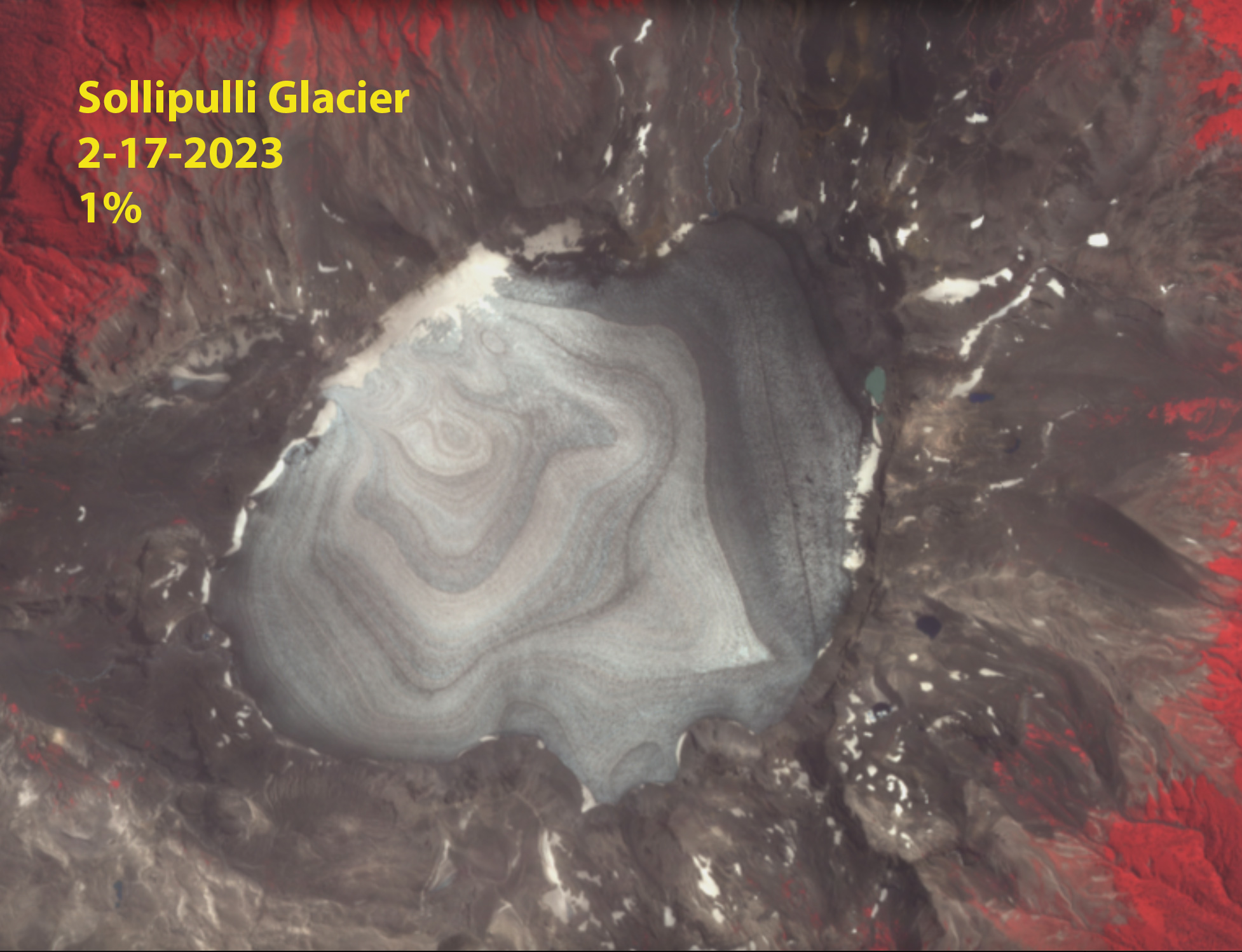
Sollipulli Glacier lost snowcover in February 2023

The bottom line is that glaciers are simply not compatible with recurring heat waves and the intensity and frequency of these is increasing. This is true from Arctic Canada to the Himalayas from the Andes to Antarctica. This year, for the 34th consecutive year, Alpine glacier volume in the world will decline; their business model is not sustainable with our climate.

A 50-year Project on Columbia Glacier Annual Monitoring 1984-2022, 39 Years In

1984-Landsat 5 is launched. The North Cascade Glacier Climate Project was initiated on Earth Day in 1984 with a goal of observing the impact of climate change on glaciers across this mountain range for 50 years. This was in response to a call to action by the National Academy of Sciences to have a project that monitored glaciers across an entire mountain range in the United States, and from climate scientist Stephen Schneider who challenged glaciologists at an IGS meeting  in 1983 to begin the monitoring now, in order to identify the full scope of change. 50-Year Project of Glacier-article in National Geopraphic work

1985- 150,000 year climate record from Antarctic Ice Core . Snow covers the terminus of the glacier at the start of August note lateral moraines it is pressed up against.

1986-Glaciers and Ice Sheets and Sea Level: Effect of CO2 induced Climate Change-Conference Proceedings published. Thinning in 1985 and 1986 is exposing the lateral moraines, which are still ice cored. 

1987-Montreal Protocol signed. Last year of positive global glacier mass balance. Columbia Glacier terminus fully exposed in early August revealing new large rocks at terminus

1988-IPCC formed. The terminus remains strongly convex, with much better snowcover. The slope is impressive note the skier for scale.

1989-Mean Global CO2 levels exceed 350 ppm. Note the annual layers both paralell to the terminus and in upper right avalanche fan annual layers that are diagonal to the terminus.

1990-First IPCC Assessmenent report , Clean Air Act amended to address Ozone Depletion and Acid Rain. Heavier accumulation nearly barely the lateral moraines at the terminus, indicative of a strong avalanche season.

1991-Mount Pinatubo erupts ejecting 15 million tons of SO2 into stratosphere impacting climate. No bare ice exposed in early August for the first time since we began monitoring the glacier. A strong positive mass balane. Widespread snow in the forest below the glacier.

1992- UN Framework on Climate Change signed by 154 nations. ~50% of the glacier bare ice in early August with 90% exposed by the end of summer, resulting in large mass loss.

1993-Melt ponds observations in Landsat images on Wilkins Ice Shelf leading to breakup event published. Lower half of Columbia Glacier exposed by early August.

1994-Velocity data acquired/published for Pine Island and Thwaites Glacier. Third consecutive year of large mass balance losses, lateral moraine increasingly prominent beyond retreating terminus.

1995- Second IPCC report- Another year of negative mass balance on Columbia Glacier leading to thinning from the top to the terminus of the glacier.

1996-CO2 levels exceed 360 ppm. Columbia Glacier has better avalanching than in the last four years, but still loses mass.

1997-First Prius Produced-Kyoto Protocol adopted. Good accumulaiton is back leaving most of the glacier covered in snowpack right through August.

1998-Super El Nino-First year with a +0.50 or greater Global Land-Ocean Temperature anomaly. A warm summer strips the glacier of 90% of its snowcover and much of the retained 1997 firn is lost too.

1999-World Record Snowfall at Mount Baker (28.96 m-1140 inches)- where we measure glacier mass balance. First Year Arctic Sea Ice minimum is below 6 million km2. We crossed part of Blanca Lake on the ice enroute to the glacier buried in deep snow with avalanches reaching the lake shore.

2000-Jakobshavn Isbrae, Greenland speeds up. Another year of good snowcover, though not as deep as in 1999.

2001-Third IPCC Assessment Report.

2002-LarsenB Ice Shelf Breakup. Good snowpack with some very strong avalanches including from the east wall that spread out onto the terminus.

2003-Deadly European Heat Wave. This was the first of several very negative mass balance years.

2004-Sea Level Rise 1993-2004 averages 3.5 mm/year. In Northern Atlantic there are 28 tropical storms. Only snow retained is in the large avalanche fans.

2005-Hurricane Katrina strikes New Orleans a $240 billion disaster. Globally hottest year yet. Most negative balance of our monitoring program, with the glacier losing 98% of its snowcover.

2006-First year exceeding nine million acres burned in US by wildfires Impact of continued mass losses is a thinner glacier, with a reduced slope at the terminus.

2007-Fourth IPCC report-Arctic Sea Ice falls below 4 million km2 for first time. The west side avalanche fans, on left now only areas of persistent accumulation, hence their slope expanding across glacier.

2008-Wilkins Ice Shelf Collapse. Good snowpack with heavy avalanching onto glacier.

2009-37% Increase in US Wind Power Capacity.  Glacier retreat since 1984 exceeds 100 m. Field work occurred during a record heat wave. This leads to an increased focus on heat wave impacts on the glaciers.

2010-Hottest year of record globally. The terminus slope continues to deflate during another year of negative balance.

2011-Global Wind Power capacity exceeds 200 GW. Deep snowpack remained through the summer leading to a signficant mass gain.

2012-Arctic Sea Minimum record at 3.39 million km2. Record loss from Greenland Ice Sheet. Snowpack again persisted through early August, leading to a small positive balance.

2013-Globally 45 Billion dollar weather disasters including 18 flooding events. Extensive summer melt led to snowpack loss and firn exposure from 2011 and 2012.

2014- Global Solar and Wind Power Capacity exceeds 500 GW. Marine Heatwave the Blob in Pacific Ocean. The summer of 2014 was the warmest we had experienced, which led to rapid snowpack removal in late summer.

2015-Paris Agreement-Over 10 million acres burned in US by wildfires. The winter was poor and the summer hot leading to no retained snowpack even in avalanche fans and the formation of a new lake at the terminus.

2016-Solar and wind energy economcially competitive. Hottest year on record. High ablation rates and summer forest fire smoke were the story of another poor year, new lake can be seen.

2017-Global Electric Car sales exeed 1.5 million units.  Coral Reef Bleaching event impacts 2/3 of Great Barrier Reef. New lake continues to expand as glacier thins and retreats.

2018- Solar and Wind Energy installed capacity both exceed 500 GW. Retreat since 1984 exceeds 200 m. No snowpack retention except in avalanche fans.


2019-Global Electric car sales exceed 2.2 million units. Only 14% of the glacier retained snowpack by summer’s end.


2020- Thirty tropical storms in North Atlantic. The lake expanded substantially with a concave stagnant terminus exposed on its margin.

2021- Over 40 Billion dollar weather disasters in last two years in US. A climax avalanche event in February led to deep snowpack on the glacier. An early season heat wave melted off all snow except in the large avalanche fans. 

2022- We will be back in the field for year 39 looking at snowpack depth, melt rate and extent across the glacier.


Kokanee Glacier 2021: slash and burn

The southwest side of Kokanee Glacier from the ridge with Cond Peak at the Right and Sawtooth Ridge at center.

By Ben Pelto, PhD, UBC Mitacs Elevate Postdoctoral Research Fellow

Since 2013 I have been working on the Kokanee Glacier. Located just outside of Nelson in southeastern British Columbia (BC), the Kokanee Glacier is due north of the Washington-Idaho border. This work began as part of a five-year study of the cryosphere in the Canadian portion of the Columbia River. This project was carried out by the Canadian Columbia River Snow and Glacier Research Network — spearheaded by the Columbia Basin Trust. The glacier research, which included the Kokanee Glacier, was led by my former PhD supervisor at the University of Northern British Columbia Dr. Brian Menounos and myself. At the culmination of the project, we published a technical report, and a plain language summary of that report. When the five-year project officially ended in 2018, I learned of a BC Parks program called Living Labs, which offers funding for climate change research in BC Parks, particularly research which documents change and guides protected area management. With Living Labs funding in 2019-2021, I have kept the annual mass balance trips going — now a continuous nine-year record — and a winter mass balance trip in 2021. In conjunction with this, Brian Menounos has secured continued funding (continued from our 5-year project) from BC Hydro for LiDAR surveys of the glacier every spring and fall. These surveys are carried out by the Airborne Coastal Observatory team from the Hakai Institute.

During the 2021 spring trip, we found that the Kokanee Glacier had an average snow depth of 4.4 meters. Using snow density measurements collected with a snow-corer, we found that the winter balance for 2021 was 1.91 meters water equivalent (m w.e.). This value was lower than the 2013-2020 average of 2.18 m w.e. (Pelto et al. 2019).

With a below average winter balance, 2021 would need to feature a cool summer. Instead, multiple heat waves occured, with temperature records being broken across the province. Wildfires burned all over BC and the neighboring US states of Washington and Idaho, swamping the region in smoke for weeks on end. Rather than mitigate for a slightly-below-normal snowpack on the Kokanee, summer 2021 took a blow-torch to glaciers across the region.

We hiked into the Kokanee Glacier on September 12, stopping under a boulder to wait out proximal booms of thunder and flashes in the clouds. We got pelted with bursts of both hail and graupel, and soaked in the rain, before gingerly working our way up boulder field and talus that is climbers route up the Keyhole to the Kokanee Glacier. Like the satellite imagery had shown, there was no snow in sight on the glacier — bare ice only. Instead of my usual camp on the snow, we chose a climbers bivy site to set our tent.

Stepping out onto the glacier, we immediately ran into difficult terrain, crevasse bridges of snow or firn had collapsed, leaving bedroom-width crevasses gaping open, necessitating an exercise in maze navigation. Our first stop was a stake at 2600 m which typically retains snow (50 to 100 cms), but this year had lost 1.6 meters. In fact, two stakes drilled at the site in 2015 and subsequently buried by snow had melted out, demonstrating that all snow/firn from the intervening years had been lost. This observation clued me in to the magnitude of melt to expect this year.

Travel on the glacier was more challenging in spots, but overall faster, as the total lack of snow meant that most crevasse bridges were gone, requiring less probing of crevasse bridges and roped-travel. Later, using a satellite image from the dates of our visit, I mapped the retained snow cover, limited to two tiny patches high on the glacier’s east side. The accumulation area ratio (AAR), or the ratio of snow cover to bare ice/firn was <0.01, meaning that under 1% of the glacier was covered in snow.

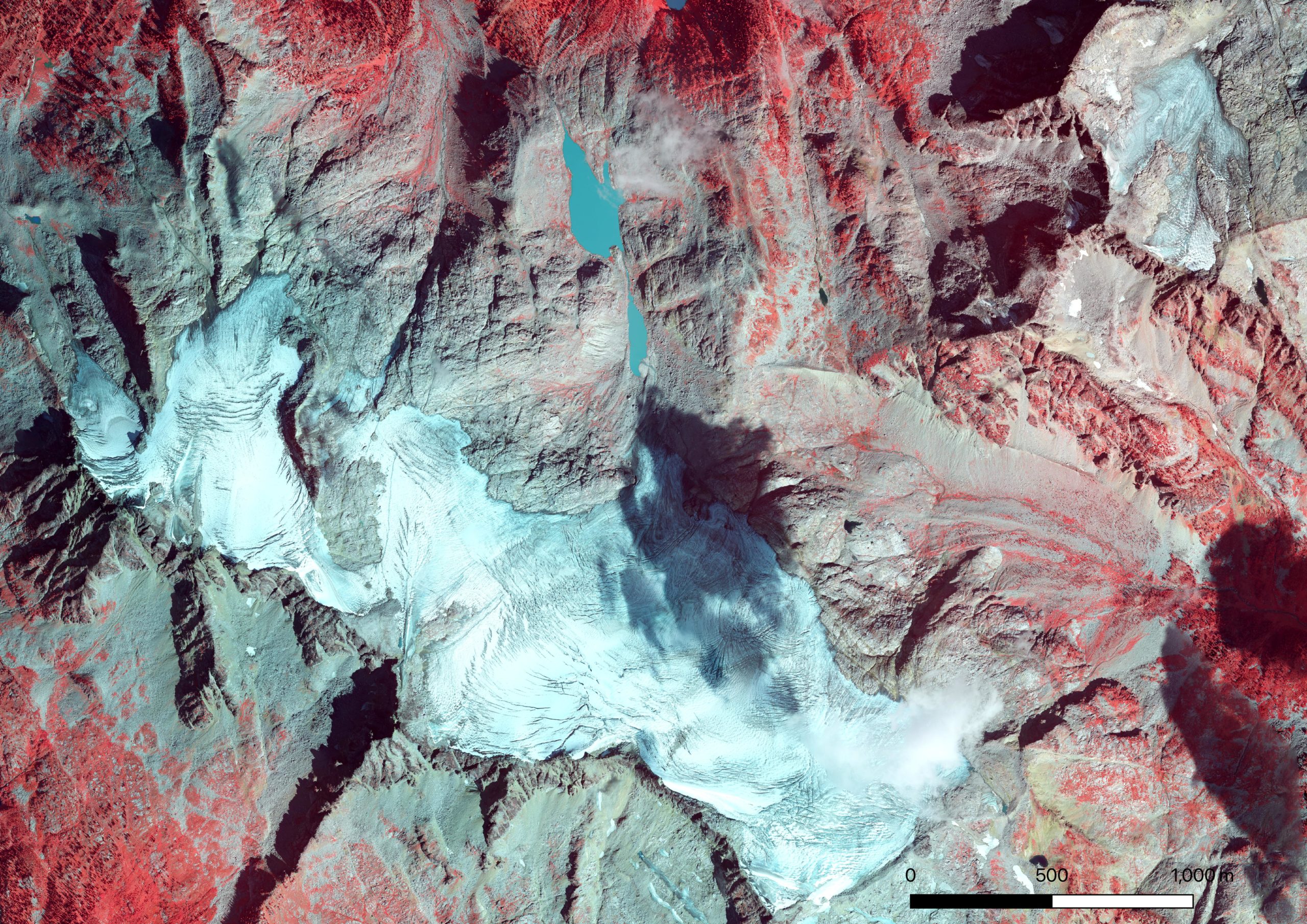
Near infrared-Red-Green 30 cm resolution ortho image of Kokanee Glacier from the Hakai Geospatial/ACO team on Sept. 2, 2021. Note how badly crevassed the glacier is, most crevasses are exposed with no retained snow. The white color and mottled appearance over the upper glacier is a skiff of overnight snow just a few centimeters thick that melted off the next day. Also note bare ice patches exposed under formerly perennial snow patches that have shrunk in recent years and now are disappearing.

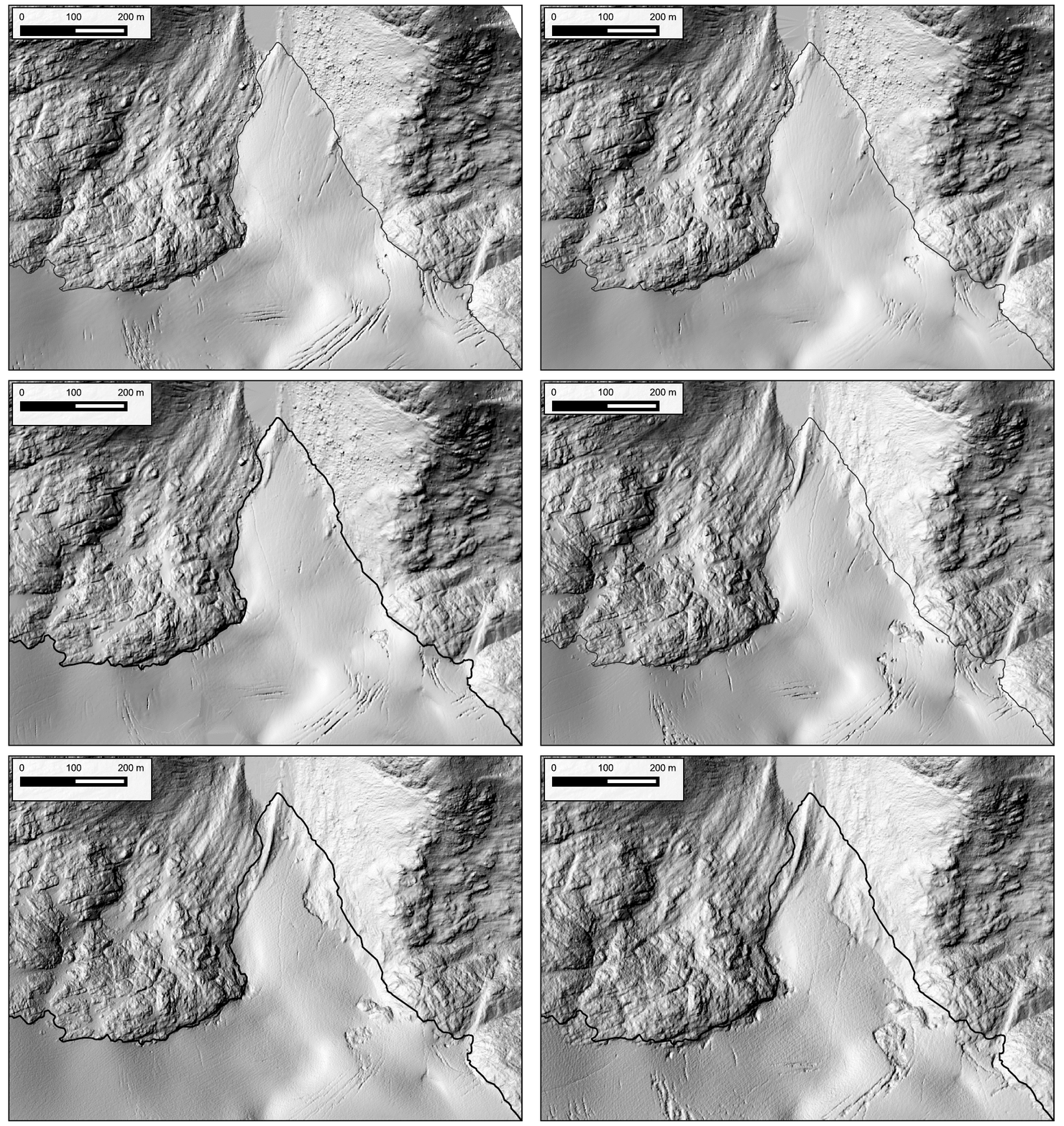
Visiting the toe of the glacier, our lowest stake indicated just under 5 m of ice melt, double that of 2020. In May, this location had 3 m of snow; the combined melt of snow and ice (loss of winter snow and glacier ice) is termed the summer mass balance, and at this site was -6.2 m w.e., far higher than the usual -4 m w.e. I also noticed that much of the thin ice along the margin of the toe was gone, and a little rock nunatak (rock island) that appeared in 2015 (images below) became a bite out of the glacier rather than a island. We estimated that the toe experienced 60 m of retreat. Over the past 5 years, the Kokanee has lost an average of 16 m in length annually. Expecting to see above average thinning and retreat, I was still startled to see how diminished and thin the toe looked.

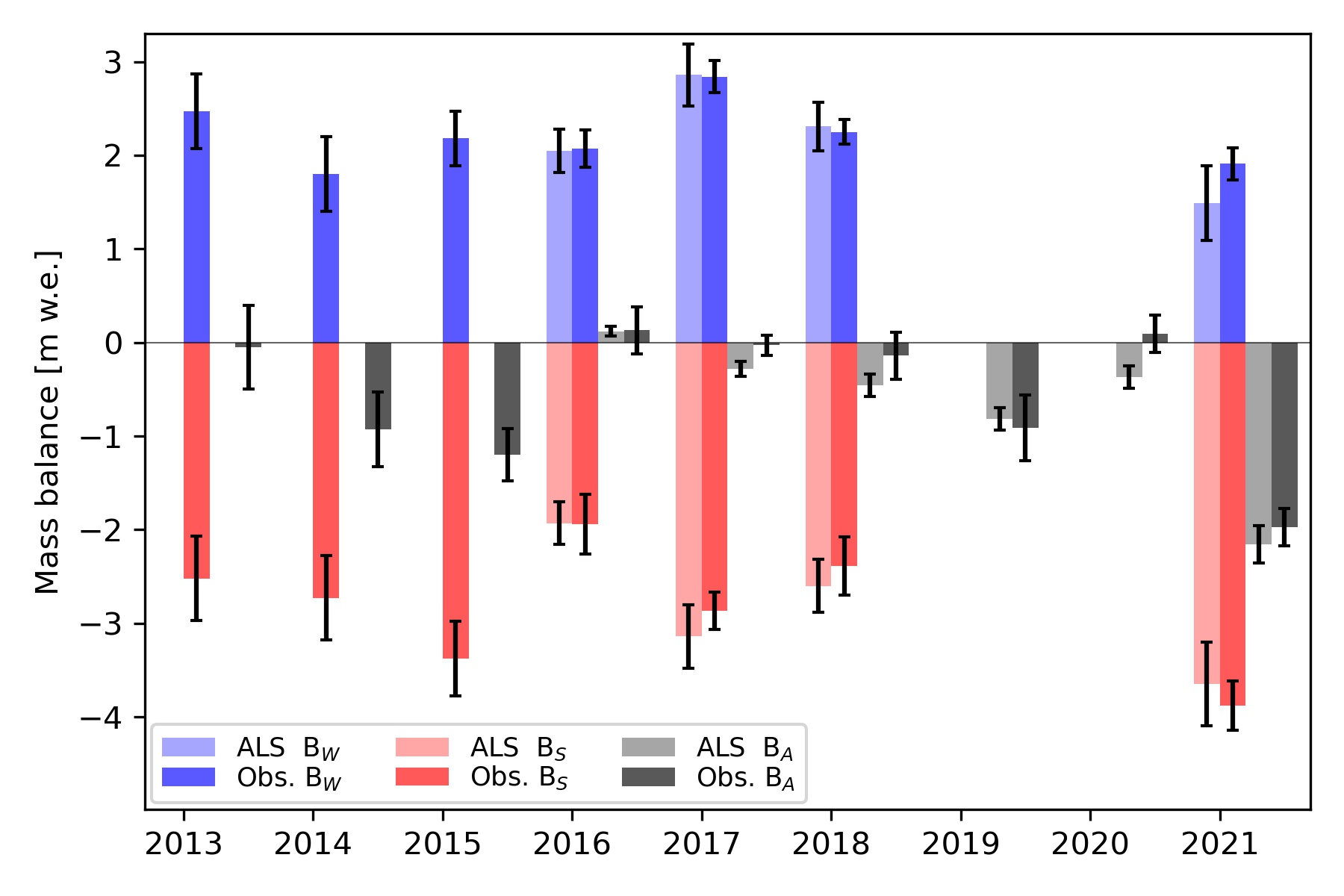
A week prior to my field visit, the Hakai Institute ACO team flew a LiDAR survey of the Kokanee Glacier as part of their work with Brian Menounos at UNBC. Comparing this year’s glacier surface with that from last year’s survey, Brian found a whopping 2.55 m of thinning. After mapping the glacier facies (ice/firn/snow) to represent on the density of the observed thinning, this equates to a glacier mass balance of -2.16 m w.e., higher than the previous record loss of -1.20 m w.e. in 2015.

LiDAR-derived height change 2020 to 2021 from 1 m resolution DEMs from Brian Menounos and the Hakai Institue ACO team. The black line is the 2021 glacier outline, note the bite out of the glacier above the toe to the NE corner of the glacier. Small red patches off-ice are seasonal snow patches losing mass. Points represent mass balance observation locations.
Kokanee Glacier terminus from 2015 to 2021. 140 meters of retreat for 23 m/yr. Data in the GIF are from Hakai Institute and Brian Menounos of UNBC ACO glacier surveys.

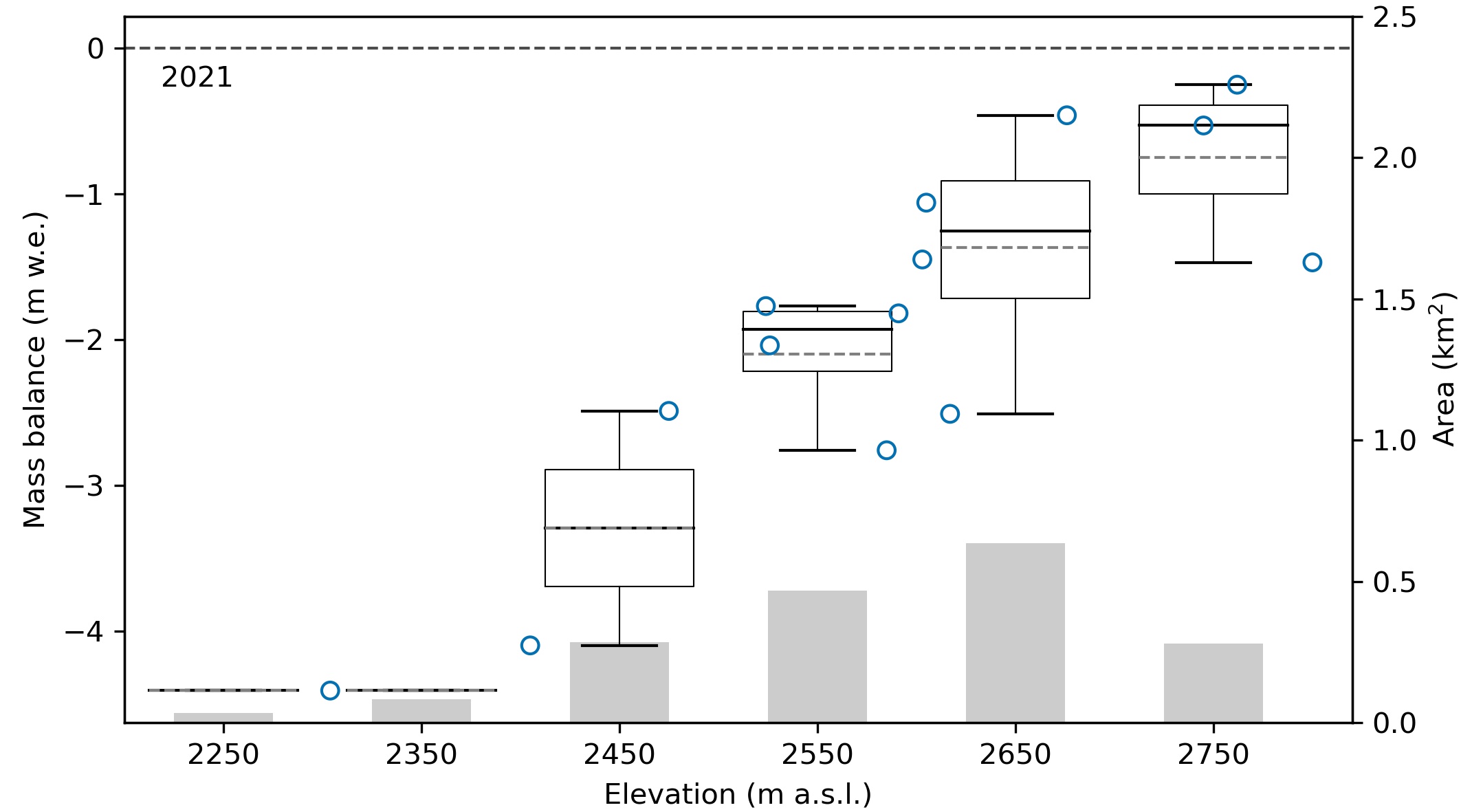
Back home, I crunched the numbers from our glaciological observations of mass balance (consisting of 14 ablation stakes this year) and calculated a mass balance of -1.97 m w.e. With Brian, I published a paper in 2019 (Pelto et al. 2019) comparing glaciological (field) and geodetic (LiDAR) mass balance estimates and found them to be similar — if some factors like snow and firn density were carefully considered. The small difference between estimates is likely due to timing (the LiDAR mass balance is from 8/26/2020 to 9/3/2021, while the field mass balance is 9/12/2020 to 9/13/2021), and that there was a skiff of fresh snow (likely 5-10 cms) on the glacier during the 2020 LiDAR survey.

Kokanee 2021 glacier mass balance. Blue dots are observations. The boxplots show the 100 m bins used to estimate glacier-wide mass balance (median line in black, mean dashed grey line). The grey bars depict the area of the glacier for each 100 m elevation-band
Seasonal and annual mass balance for Kokanee Glacier from LiDAR and glaciological measurements for each balance year from 2013 to 2021 with 2σ uncertainties.

In 2017, I visited the Kokanee Glacier to measure it’s ice thickness using ice-penetrating radar. I found that the glacier on average was 43 m thick using my measurements to tune a glacier model. I published these results in the Journal of Glaciology (Pelto et al. 2020). In the five years since that work, the glacier has lost over 4.8 m of total thickness. That equates to a loss of over 11% of its total volume. 2021 alone wasted away 6% of the glacier’s total volume — an eye-watering number for a single year.

Cumulative mass balance for Kokanee Glacier 2013-2021 from both field and LiDAR measurments. LiDAR-derived mass balance began in 2016.

The heat of 2021 was an outlier, but years like 2021 and 2015 take a toll on the glaciers. Currently, glaciers in western North America are losing around 0.75 m of thickness per year (according to my work in the Columbia Basin (Pelto et al. 2019) and work by Brian Menounos for all of western North America (Menounos et al. 2018)). The better years for Kokanee Glacier (2016 mass balance: +0.12 m w.e.) pale in comparison. That meager surplus was lost the very next year (2017).

Herein lies the issue, positive mass balance years in recent decades are not large enough to offset even average years; hot dry summers take years off the lifespan of glaciers across western North America.

Losing 6% of it’s total volume in 2021, the best we can hope for Kokanee Glacier is a few near-neutral or positive mass balance years to cover back up the exposed firn, to keep the glacier albedo from becoming too dark and increasing the rate at which ice can melt.


Whitney Glacier , Mount Shasta Losing all of its Snowcover and Separating in 2021

Whitney glacier 89-25-2021 comparison

Sentinel 2 False and True Color images from 8-25-2021.  Yellow arrows indicate where glacier is separating and purple arrows the small remanent of 2021 snowpack remaining. This remanent will not last to the end of the melt season. 

The summer of 2021 is proving to be catastrophic for Whitney Glacier on Mount Shasta, California in terms of volume loss, ~15-20% this year leading to long term impacts, adding to the 50% area reduction and 1000 m retreat since 2005.  The glacier will lose 100% of its 2021 snowpack and is in the process of separating into two glaciers. Here we review the glaciers behavior in recent decades and examine using Sentinel Imagery the impacts in summer of 2021.Mount Shasta is a stratovolcano home to the largest glaciers in California, Whitney Glacier on the north side is the longest. In 1981 USGS (Driedger and Kennard, 1986) mapped the area and volume of several of the glaciers, in a landmark study of glacier volume on Cascade volcanoes. Whitney Glacier had an area of 1.3 km2, a maximum depth of 38 m, and a volume of 25 million m 3. The majority of the glacier was in the 20-35 m thick range. The glacier was noted as having a length of 3.0 km ending on the USGS map at 9900 feet.

whitney 1993

Digital Globe image indicating a area of retreat from 2005-2012 and the limited crevassing near 2012 terminus.

Tulaczyk and Howat (2008) noted that Whitney Glacier did advance during the 2000-2005 period, following a retreat in the 1980’s and 1990’s. The most recent advance was limited to the 1999-2005 period due to heavy snowfall from 1998-2002, ended with the glacier 850 m in advance of its 1951 position. There was a period of advance for many Cascade volcanoes glaciers between 1950 and 1980, followed by retreat after. On Mount Baker, Washington all of the glaciers advanced during the 1944-1979 period by an average of 480 m (Pelto and Hedlund, 2001). By 2010 Pelto and Brown (2012) observed all were retreating with an average retreat of 370 m.  In 2012 the glacier is thin in its lower reaches with no crevassing. By 2014 the terminus of the glacier had retreated 700 m from 2005 and was 2.6 km in length and terminated at 10200 feet, 300 feet higher than a decade before or in the 1981 map.

whitney glacier snowpack 2021

Sentinel 2 True Color images from 6-16-2021, 6-28-2021 and 7-18-2021 illustrating the progressive snowcover loss on the glacier. Point A and D are on the upper Glacier, Point B is where the upper and lower glacier have joined and Point C is near the top of the lower glacier. 

The summer of 2021 followed a 15 year period of overall significant mass loss and retreat on Whitney Glacier that led to a thinner glacier with a reduced velocity and consequently fewer crevasses. The stage was set with  60-75% of normal snowpack in early April 2021 at the stations in the region in the 6000-7600′ range, dropping to 20-25% of normal by early May (CDEC, 2021). This was followed by an exceptionally warm early summer, that helped strip the snowpack away early. By June 16, the snowline on Whitney Glacier had risen to 10,800 feet, near Point C, while the upper glacier extending from Point A and D to Point C was nearly all snowcovered. By June 28 the snowline had risen to 11,200 feet on the lower glacier and the upper glacier snowline was near 12,500 feet, with the west facing upper section (Point A) above 13000 feet nearly all bare. By July 18 there is a small area of snowcover near Point C on the lower glacier and Point D on the upper glacier.  Most of the glacier is bare of snowcover.  This underscores the particularly detrimental impact of early season heat waves that strip away winter snowpack and exposes the dirtier glacier ice and firn.  The ice and firn melt ~30% faster than the snowcover for the same weather conditions. Our measurements on Mount Baker during heat waves over the last three decades indicate typical ice melt of 7-9 cm of melt per day. The average temperature over the last 70 days since much of the glacier was bare ice has been 16.8 C at Snow Bowl station at 7617 feet.  Given area summer lapse rates this equates to a temperatures of ~12-13 C at the mean glacier elevation.  The temperature at this station reached 29 C on June 27, 28 C  on June 28 and exceeded 25 C from June 25-June 30. The rapid melt rate led to a number of areas of slushy, swampy glacier surface conditions even high on the glacier (Mount Shasta Avalanche Center ). Using the degree day formula for melt derive on Mount Baker during warm summer conditions (Pelto, 2015 and 2018) of .0053m w.e.C-1D-1, yields a cumulative melt of 4.8 m w.e., equivalent to over 5 m of ice thickness.

This given mean ice thickness in the 25-30 m range indicates that this summer ~15-20% of the glacier ice volume will be lost on Whitney Glacier. The glacier is now 2300 m long and has an area of 0.6 km 2, which is less than 50% of its area just 16 years ago. This is leading to separation of the lower and upper glacier at the yellow arrows.  There is certainly still stagnant ice in this zone, but there is no longer a dynamic connection between the upper and lower Whitney Glacier.

mount-shasta-trail-mapTopographic map of Mt. Shasta.indicating the top of Whitney Glacier near the summit of Shasta and the ~1981 and 2005 terminus position.

Benito Glacier, Chile 2021 Calving Event Drives Further Retreat


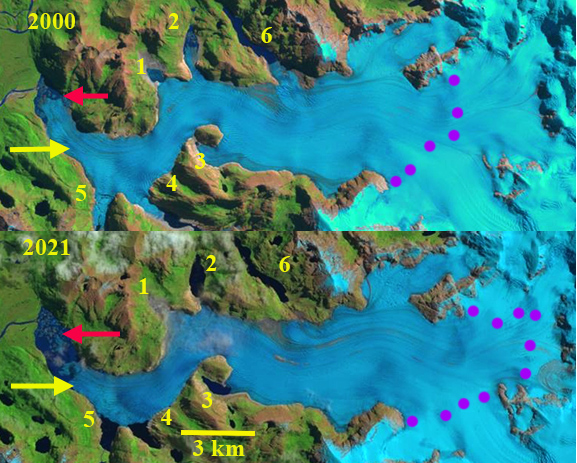
Benito Glacier in 2000 and 2021 Landsat images. Locations 1-6 are current or former distributary terminus locations. Red arrow is the 2000 terminus location and yellow arrow the 2021 terminus location.  A small cloud is obscuring an iceberg near terminus.  Purple dots are the snowline.

Benito Glacier is a temperate outlet glacier on the west side of the North Patagonian Icefield terminating in an expanding lake. The glacier is south of  San Quintin Glacier and north of Acodado GlacierLoriaux and Casassa (2013) examined the expansion of lakes of the Northern Patagonia Ice Cap. From 1945 to 2011 lake area expanded 65%, 66 square kilometers. Ryan et al (2018) identified thinning of 2.8 m/year in the ablation zone from 2000-2013, and that thinning of over 120 m extended from the terminus to ~750 m from 1973-2017. Mouginot and Rignot (2015)  indicate that the velocity of Benito Glacier is between 200-500 m per year along the center line below the snowline. Glasser et al (2016) note the glacier has limited debris cover and that the average transient snowline in 2013-2016 is at 1000 m, substantially above the ~900 m average from earlier.

Benito Glacier in 1987 main terminus was on an outwash plain.  The glacier has five distributary termini (1,2,34,5,6) two of which had open proglacial lakes in 1987.  At Point 3 the glacier flows around a nunatak and reconnects. In 2000 a 1 km long proglacial has formed at the main terminus.  Distributary termini 1,2 and 4 all have proglacial lakes.  The snowline in 1987 and 2000 is 800-825 m. By 2015 there are  five ending in lakes, with Lake 6 having retreated out of a lake basin. A lake has formed at the new distributary terminus at Lake 3. The two tributaries to the north indicated with arrows each retreat approximately 1 km from 1987 to 2015 and in both cases are no longer calving termini.  The main glacier terminus has retreated into a proglacial lake, with a retreat of 2 km from 1987 to 2015. The lowest 1.5 km  has a low slope and peripheral lakes suggesting the lake will expand substantially as Benito Glacier retreat continues. The transient snowline in 2015 is at  900 m. In 2021 a significant iceberg 0.4 km2 has calved off the terminus.  The terminus has retreated 2900 m from 1987-2021 with the lake area expanding to 2.8 km2.  The lower 1.5 km of the glacier remains low sloped suggesting significant lake expansion is ongoing. The glacier no longer reaches the former proglacial lake 2 or 6. Proglacial lake 1 has drained. Proglacial lake 2,3, and 4 continue to expand. The snowline on Feb. 6 2021 is at 875-900 m, rising to 925-950 m by March 16, 2021.

March 17, 2021 Landsat image indicating iceberg located off front of Benito Glacier


Benito Glacier comparison in Landsat images from 1987 and 2015 indicating the terminus position in 1987 red arrows, yellow arrows the 2015 terminus positions. Locations 1-6 are current or former distributary terminus locations. purple arrows where glacier thinning is expanding bedrock areas. The snowline is indicated by purple dots

Leningradskiy Ice Cap Snowcover Vanishes in 2020 More Thinning, Svernaya Zemlya

Leningradskiy Ice Cap  north to south strip in 2000 and 2020 Landsat images illustrating thinning leading to separation of parts of the ice cap at Point 1 and 4 and expansion of bedrock leading to merging bedrock regions at Point 1 and 2. R=snow/firnpack saturated with meltwater and consequent potential refreezing. S=superimposed ice development from surface refreezing.

Leningradskiy Ice Cap is oriented east to west across Bolshevik Island in the Svernaya Zemlya Archipelago of the Russian Arctic. Annual snowfall on the ice caps is limited ~0.4-0.5 m (Sharov and Tyukevina, 2010).  During the brief summer melt season from June-late August, much of the melt is refrozen within the snow/firnpack or as superimposed ice (Bassford et al 2006).  The low snowpack makes the glaciers vulnerable to warm summer conditions. The summer of 2020 has been remarkably warm in the Russian High Arctic leading to high melt rates and surface mass balance loss as shown by Xavier Fettweise MAR model. Here we examine Landsat images from 2000 to 2020 to identify a pattern of thinning on the northern margin of the ice cap.

In 2000 the glacier has a well established glacier runoff stream at yellow arrow. Point 1 is a nunatak amidst a peripheral segment of the ice cap. Point 2 is an area of bedrock separated by a narrow section of ice cap from adjacent bedrock. Point 3 and 4 are locations where the ice cap is thick enough to spillover in to an adjacent basin.  There is little visible snowpack on the ice cap, but a significant area of azure blue indicates snow/firnpack (R) that is saturated with meltwater, some of which will refreeze. There are zones of superimposed ice development(S)  where meltwater is refreezing on top of the cold surface ice. In 2018 there an area of unsaturated snowpack, white area, and saturated snow/firnpack (R) azure blue and areas of superimposed ice development (S).

On August 3, 2020 the ice cap has lost its snowcover with limited areas of firn, limiting the ability of meltwater to refreeze except on the surface as superimposed ice (S).  The lack of snow/firnpack at the surface will lead to a more negative balance as meltwater is not retained. At Point 1 this peripheral glacier area has been cutoff from the main ice cap as thinning has exposed more of the encircling ridge.  At Point 2 bedrock areas have expanded and merged together. At Point 3 there is some spillover still but thinning has led to a reduction and consequent retreat and thinning of this terminus. At Point 4 the ice cap no longer spillovers into the adjacent basin due to thinning. Each location indicates significant thinning that is hard to recover given the slow flow and limited accumulation on these glaciers. On Aug. 22 2020 the surface of the ice cap is frozen, leading to a whiter surface.

The lack of retained snowcover in 2020 was also seen at Hochstetter Ice Cap in Franz Josef Land.  In both cases the high summer temperatures led to more meltwater, and the lack of snowpack to retain leads to more escaping the system. Bassford et al (2006) describe this process “Intense surface melting in the accumulation zone during warm summers prevents the buildup of a thick firn layer by rapid transformation of firn to ice through refreezing and by removing
mass through runoff.”

Leningradskiy Ice Cap  north to south strip in 2018 and 2020 Landsat images illustrating changing distribution of melting (R) and superimposed ice development (S)

North Cascade Glacier Climate Project Observations 2020, 37th Field Season

The North Cascade Glacier Climate Project 2020 field season was our 37th consecutive year of glacier observations.  The field team consisted of Cal Waichler, Mariama Dryak, Jill Pelto and Mauri Pelto.  Each team member has studied glaciers on more than one continent and is passionate about science communication, using either art, videography or writing.

Mauri Pelto, Jill Pelto, Cal Waichler and Mariama Dryak from left to right on Easton Glacier the 2020 field team (Jill Pelto Photograph).

At Columbia Glacier the field team  was joined by Michelle Tanz a Wlderness Stewardship Fellow for the National Forest Service.  The initial observation was that the 2 km bushwhack around Blanca Lake has gotten much brushier as the alpine meadow becomes more sub-alpine. Columbia Glacier is a low elevation avalanche fed glacier that developed a new lake at its terminus a decade ago that continues to expand.  The east side of the glacier has been thinning much faster than the west side altering the very shape of the glacier.  Observed snowpack in 2020 was below average except for on the slopes of the main west side avalanche fans. The upper basin at 1550-1650 m averaged 2.2 m of snowpack at the 70 probing locations, which is 70% of normal.  This snowpack will not survive the melt season, only snowpack in the main avalanche fans will remain. Terminus retreat has been 217 m since our first observation in 1984.

Lower Curtis Glacier is fed by avalanches from the slopes of Mt. Shuskan.  We were joined in the field by Tom Hammond for the 17th consecutive year and artist Claire Giordano.  There was a similar pattern to Columbia Glacier in that snowpack across most of the glacier was below average, while the primary avalanche fan on the east side had above average snowpack.  The avalanche fans on the central headwall of the glacier fed from the Upper Curtis Glacier continue to thin rapdily, as avalanching has declined.  The terminus slope which had been a daunting 42 degrees in 2015 is now 34 degrees. For the sixteenth consecutive year we had at least one artist in the field, below are field sketches from Cal Waichler and Jill Pelto and a painting from Claire Giordano.  We will be combining the science findings and art in forthcoming articles on Lower Curtis and Easton Glacier.

Claire Giordano working on painting of Lower Curits Glacier and Mt. Shusksan (Mariama Dryak Photograph).

Jill Pelto completes sketch, while sitting on ice chunk, of Easton Glacier icefall (Mariama Dryak Photograph).

Cal Waichler annotated story board style sketches both capture and explain the scene at Columbia Glacier (Mariama Dryak Photograph).

Rainbow Glacier has a terminus that is largely buried by avalanches, but is now is close to detaching from the main valley glacier.  Snowpack at 1700 m averaged 2.4 m which is 75% of average. The saddle with Mazama glacier at 2000-2100 m averaged 3.9 m, which is 85% of normal. Subglacial bedrock knobs continue to become more prominent in expanding crevassing above and slope below the slope change, as the glacier thins.

Sholes Glacier had the highest percentage of surface blue ice of the glaciers observed.  Snowpack had been reduced from at a rate of 8 cm/day during the first week of August, a relatively warm period. A snow cave at the terminus could be entered from a terminus crevasse that was 50 m long, 10 m wide and 2-5 m high.  This is indicative of a relatively stagnant rapidly retreating terminus. From 2014-2020 the glacier has retreated 80 m, which is equivalent to the retreat from 1990-2014. Glacier runoff continues to be monitored just below the glacier by the Nooksack Tribe, while we provide continued rating curve development.  Runoff during early August was averaging 0.25 m3/sec.

On Easton Glacier the terminus slope was the gentlest we had seen in our 31 years of consecutive observations.  The terminus has retreated 430 m in this period. The significant thinning in the last few years had both reduced crevassing in the lowest icefall, but had reduced crevasse depth.  Jill Pelto has been observing the crevasses depth in all the open crevasses in this icefall over the last decade.  The biggest change has been from 2018-2020 with average depth being reduced by 40%. Snowpack on the bench at 2000 m averaged 2.4 m at the 45 observation sites, which is 75% of normal.  The snowpack remained below normal at 2200 m, before a sharp increase to above normal snowpack averageing 5.1 m in 14 crevasse observations at ~2500 m. At this same elevation retained snowpack, now firn from previous years averaged 2.25 m. Based on the storm stratigraphy one significant difference was the result of an atmospheric river precipitation event of 12+ cm of precipitation from 1/31-2/2, that led to a snow depth and snow water equivalent decline at the Middle Fork Nooksack Snotel at 1550 m, while above 2300 m this all fell as snow.  The freezing levels were above 2000 m for much of the event.  The better high elevation snowpack will help Easton Glacier’s mass balance in 2020.

Easton Camp from adjacent to 1990 terminus position (Jill Pelto Photograph).

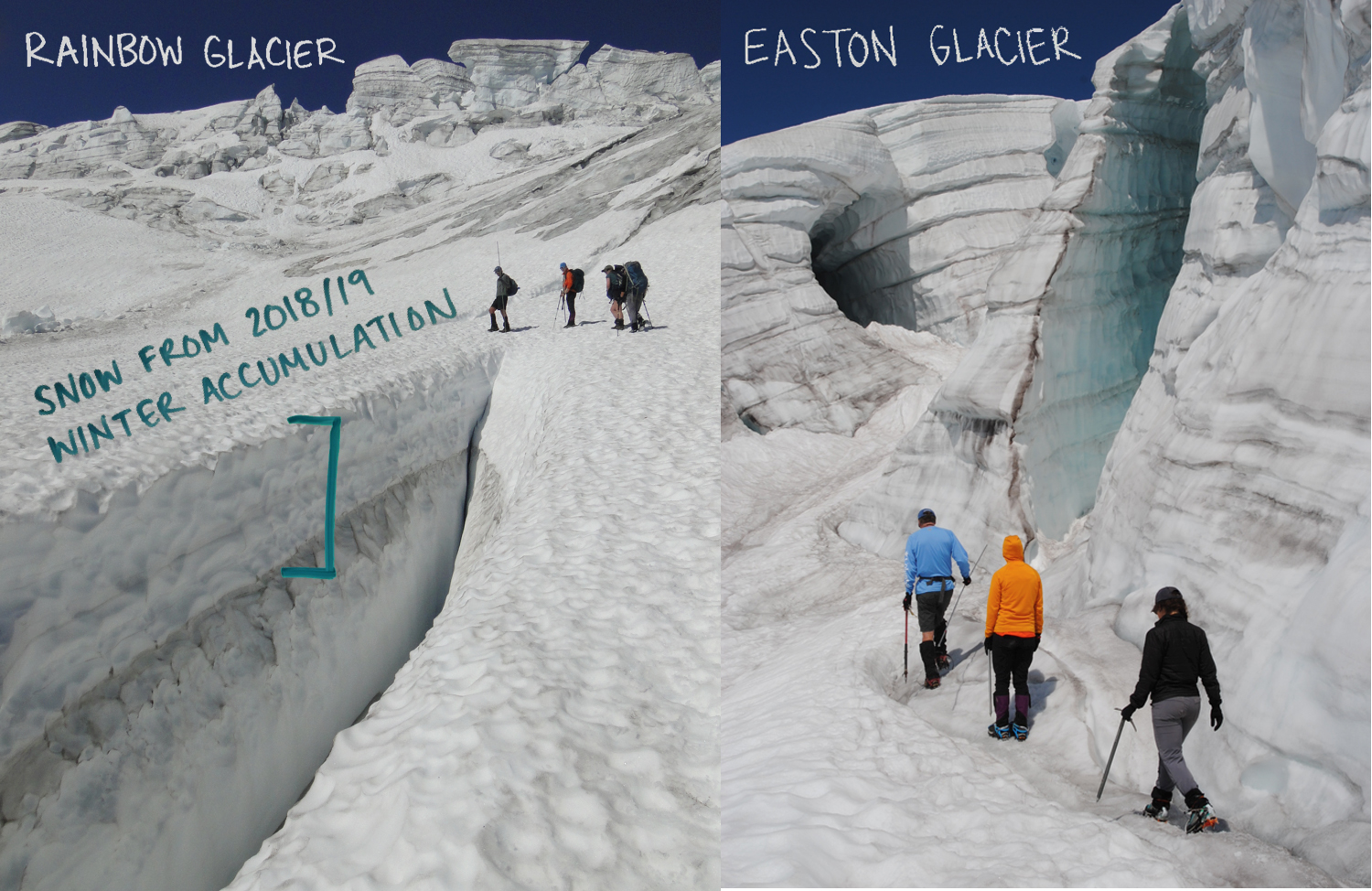
Crevasse stratigraphy at 2500 m on Easton Glacier indicates an average of 5.1 m of 2020 snowpack in crevasses and 2.25 m for previous annual layers from the 2016-2019 period (Mauri Pelto and Jill Pelto Photographs)


NORTH CASCADE GLACIER CLIMATE PROJECT 2020-37th Annual Field Program

Field season images from 2019 indicating crevasse stratigraphy, annotated by Clara Deck.

Director: Mauri S. Pelto, mspelto@nichols.edu-Nichols College

Field Artist & Scientist: Jill Pelto, pelto.jill@gmail.com

Who we are? NCGCP was founded in 1983 to identify the response of North Cascade glaciers to regional climate change, particularly changes in mass balance, glacier runoff and terminus behavior.   NCGCP is a field project that has a broader interdisciplinary scope and examines more glaciers than any other program in North America.  It does so cost effectively relying on no permanent camps, helicopter support or salaries for the director. The field season includes no days off and each day is spent completing measurements on glaciers.  The focus is on glacier mapping, mass balance measurement, terminus observations and glacier runoff monitoring.  This program monitors two of the World Glacier Monitoring Service’s reference glaciers. There are ~45 such glaciers in the world with 30 years of continuous measurements. We complete mass balance and terminus observations on Columbia, Daniels, Easton, Ice Worm, Lower Curtis, Lynch, Rainbow and Sholes Glacier with runoff measurements below Sholes and Ice Worm.

Why study glaciers in the North Cascades? Glaciers are one of the world’s best climate monitors and are a critical water resource to many populated glaciated regions. This is particularly true in the North Cascades where 700 glaciers yield 200 billion gallons of summer runoff and glaciers have lost 30 % of their area in the last century.

Field Team 2020:

Jill Pelto is an artist and scientist from New England who grew up loving winter sports and trips to the mountains. She incorporates scientific research and data into paintings and prints to communicate environmental changes. Her multi-disciplinary work weaves visual narratives that reveal the reality of human impacts on this planet, as earlier in July was illustrated on the cover of TIME. She completed both her B.A. degrees in Studio Art and Earth and Climate Sciences and her M.S. focused on studying the stability of the Antarctic Ice Sheet at the University of Maine, spending two field seasons at a remote camp in the southern Transantarctic Mountains. Jill will be joining the project for her 12th field season. She is excited about continuing to document the change in North Cascade glaciers that she has witnessed each of the last ten years — through science and art.

Mauri Pelto has directed the project since its founding in 1984, spending more than 700 nights camped out adjacent to these glaciers. He is the United States representative to the World Glacier Monitoring Service, author of the AGU blog “From a Glacier’s Perspective”, and on the Science Advisory Board for NASA’s Earth Observatory.  His primary job is Dean of Academic Affairs at Nichols College, where he has been a professor since 1989.

Cal Waichler is an environmental science major at Colby College in Maine and is from Winthrop, WA. She looks to bridge the gap between science and the public by creating impactful, accurate climate art and storytelling. This summer’s research goal is to generate building blocks to contextualize her work within two fields: glacier science and climate communication.

Mariama Dryak (she/her) is an earth scientist, science communicator/writer and an advocate for action on creating solutions to the global climate crisis. Mariama is the creator and editor of an environmental advocacy blog Let’s Do Something BIG. and the ‘we persist.’ podcast, which shares the stories of underrepresented people in the earth, ocean and environmental sciences. Mariama received her Master’s from the University of Maine in 2019 in Earth and Climate Science, during which she drew connections between inferred ocean conditions and glacier change along the Antarctic Peninsula. Mariama can most often be found chatting science, going on adventures or getting muddy whilst doing something outdoors.

Columbia Glacier terminus with the 2018 field team.

 Field Partners 2020

Victoria Jarvis and Michelle Tanz are Wilderness Stewardship Fellows who will be gathering information about the Henry M Jackson Wilderness including the glacier. They are looking to understand the Columbia Glacier and our research within the scope of the 5 qualities of wilderness character (untrammeled, undeveloped, natural, solitude and primitive rec, other). They will then be able to incorporate our long-term monitoring efforts into their wilderness character narrative– a synthesized agency document providing insight about the wilderness.

Alia Khan, Western Washington University Cryosphere Studies and Aquatic Biochemistry Lab:

The research team including grad students Molly Peek and Shannon Healy focus on environmental chemistry in the cryosphere, including black carbon and snow algae to document global change of glacier and snow melt in mountainous and polar regions.

Tom Hammond, North Cascade Conservation Council,Will be joining us for the 17th year leveraging his experience with our for understanding the ongoing impact of climate change and our stewardship on the region.

Nooksack Indian Tribe, for the 9th consecutive year we will be conducting field work aimed at providing field validation and streamflow calibration data below Sholes Glacier for the ongoing work of the tribe.

Measuring flow below Sholes Glacier

Global Glacier Change Bulletin 3 (WGMS) Reports Increasing Mass Balance Losses

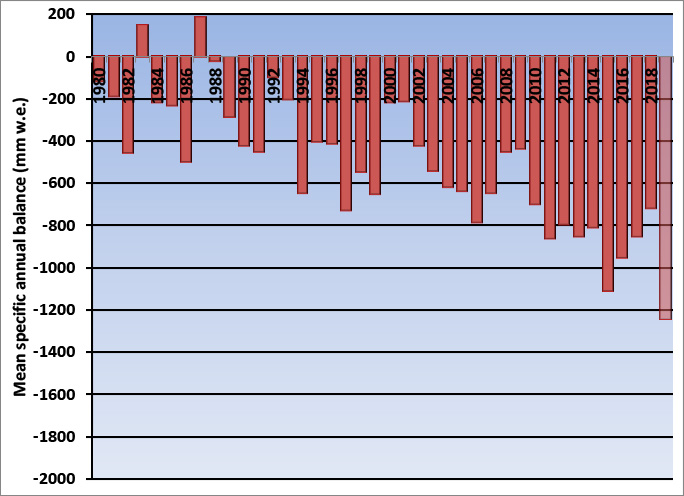
Figure 1. Regionalized mean annual mass balance of WGMS reference glaciers 1980-2018, with 2019 being a mean of reference glaciers.

Glaciers have been studied as sensitive indicators of climate for more than a century and are now experiencing a historically unprecedented decline (Zemp et al, 2015).  Glacier fluctuations in terminus position, mass balance and area are recognized as one of the most reliable indicators of climate change. This led to glacier mass balance being recognized during the International Geophysical Year (IGY) in 1957 as a key focus area for developing long term data sets and the need to establish an international data repository.

Today this data reporting system is managed by the World Glacier Monitoring Service (WGMS). WGMS annually collects standardized observations on changes in mass, volume, area and length of glaciers with time, and additionally collecting statistical information on the distribution of glaciers from inventories.  WGMS just published their third Global Glacier Change Bulletin, a comprehensive data report covering the 2015/2016 and 2016/2017 hydrologic years. I review some of that information here with updated reference glacier mass balance data from WGMS for 2018 and 2019.

The data set compiled by the World Glacier Monitoring Service has 45,840 measurements on 2540 glaciers (WGMS, 2020). Annual mass balance measurements are the most accurate indicator of short-term glacier response to climate change.  WGMS, (2020) data set has 7300 annual balance values reported from 460 glaciers, with 41 reference glaciers having 30+ year consecutive ongoing records. Annual mass balance is the change in mass of a glacier during a year resulting from the difference between net accumulation and net ablation.

The key data set is the annual balance record from the reference glacier network, these glacier have extensive continuous field monitoring programs with at least a 30 year record.  For example on Columbia Glacier, Washington I have been in the field 36 consecutive summers, over 120 days taking 4600 measurements with 63 assistants. Figure 1 above illustrates glacier mass balance for the set of global reference glaciers for the time-period 1980-2019. Global values are calculated using a single value (averaged) for each of 19 mountain regions in order to avoid a bias to well observed regions.

In the hydrological year 2016/17, observed glaciers experienced an ice loss of -550 mm, and 2017/18 of -720 mm. For 2018/19 hydrologic year a regionally averaged value will not be available until December 2020, the overall mean of all reference glaciers of -1241 mm, compared to -1183 mm in 2017/2018. This will make 2019 the 32nd consecutive year with a global alpine mass balance loss and the tenth consecutive year with a mean global mass balance below -700 mm. The simple mean mass balance of WGMS records has a slight negative bias compared to geodetic approaches, but this bias has been effectively eliminated with the regionalized approach now used by WGMS, see Figure 2 (WGMS, 2020).

Figure 2. Glaciological mass balance of all glacier, reference glaciers (mean), regional mean of reference glaciers and regionalized mean geodetic mass balances for the 1930-2017 period.  Pay particular note to the 1960-2017 period where the data records are better.  Observe the similarity in cumulative mass balance losses regardless of approach.

The decadal averaged annual mass balance was -172 mm in the 1980’s, -460 mm in the 1990’s, 500 mm for 2000’s and – 889 mm for 2010-2019.  The increasing rate of glacier mass loss, with eight out of the ten most negative mass balance years recorded after 2010, during a period of retreat indicates alpine glaciers are not approaching equilibrium and retreat will continue to be the dominant terminus response (Pelto, 2019; WGMS, 2020).  The accumulation area ratio is an indication of the expansion of the ablation areas globally, despite retreat accumulation areas are shrinking.  The decline in accumulation area extent, hence AAR has been rapid, the data in 2017/2018 yields a mean of 13%, whereas the average needed to be in balance is 56%. The low AAR in 2019 is illustrated at two reference glaciers Lemon Creek, Alaska and Alfotbreen, Norway below.

Years

Ba

AAR

1980-1989

-172

47

1990-1999

-460

44

2000-2009

-525

35

2010-2019

-889

28

Table 1 Glaciologic annual balance for each decade from the WGMS reference glacier mean of the 19 regions. The AAR is a simple mean of the reference glaciers.

Landsat images of Lemon Creek Glacier, Alaska and Alfotbreen, Norway in 2019. White dots indicate the glacier boundary on Alfotbreen, purple dots the snowline. Lemon Creek AAR=0%  Alfotbreen AAR=~15%

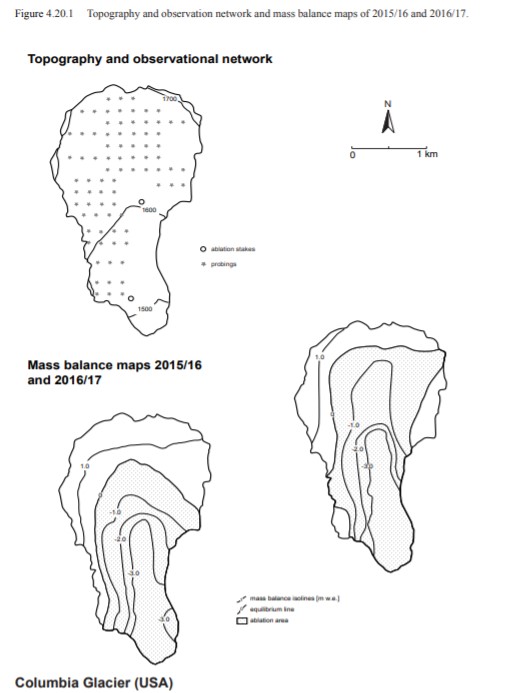
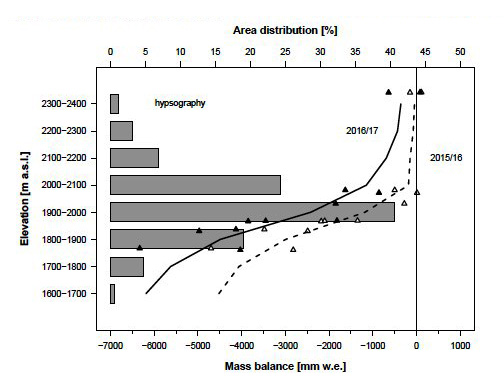
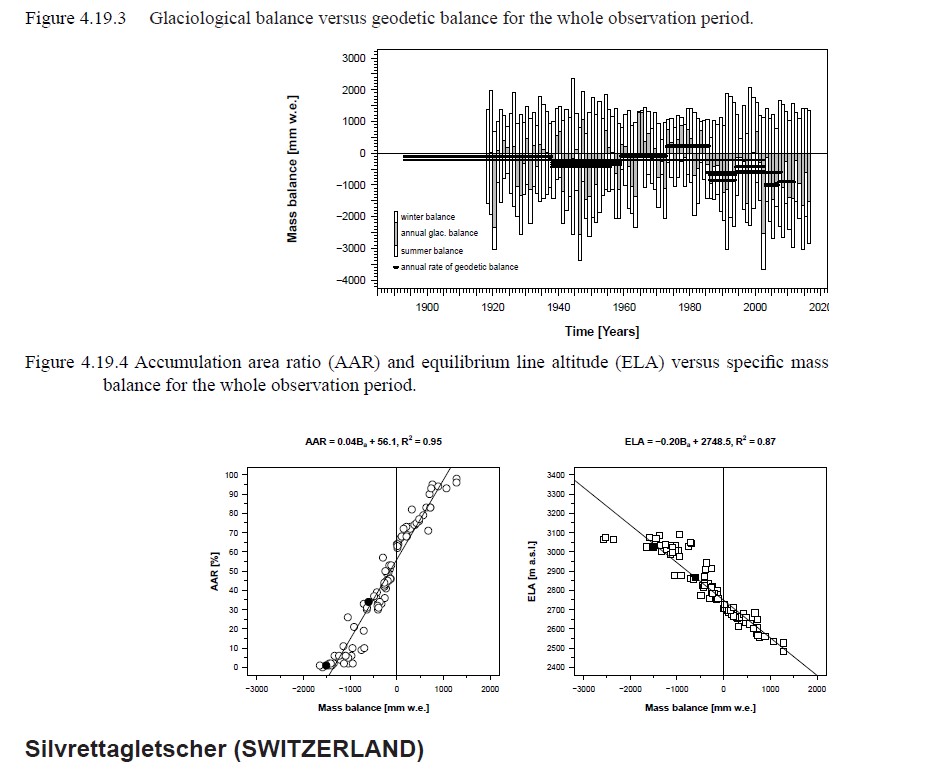
Detailed information is reported for 20 glaciers distributed around the globe that includes annual mass balance maps as illustrated from Columbia Glacier. The relationship between elevatation and annual balance is the balance gradient seen below for Mocho Glacier, Chile. This glacier is in the lake district of Chile at 39.90° S and 72.00° W and did not have significant accumulation in 2016 or 2017.  The  AAR-annual balance relationship and the ELA-annual balance relationship and annual balance record are reported, as exemplied by Silvretta Glacier, Switzerland, where negative balances occurred in 2016 and 2017.

The result of the rising snowline is mass losses, which drives glacier retreat. This also leads to decreased average albedo and surface lowering, which in turn cause pronounced positive feedbacks for radiative and sensible heat fluxes. This rapid decline in mountain glaciers chronicled by WGMS is expected to accelerate.  Huss et al (2017) describe a cascade of effects that are occuring, impacting ecosytems, communites and our economy.

Annual mass balance maps and measurement network on Columbia Glacier.

Annual balance gradient for Mocho Glacier, Chile.

Annual balance record and annual balance relationship to both AAR and ELA on Silvertta Glacier.

Glacier Crevasses As A learning Tool

Guest Post by Clara Deck

Instagram: @scienceisntsoscary


Crevasses on mountain glaciers are large cracks in the ice which often propagate from the surface downward. The initial break will happen when stress exceeds the inherent ice material strength. This article will focus on surface crevasses, though this basic physical understanding also applies to basal crevasses or large-scale rifts in ice sheet and shelf settings.


In mountain glacier systems, crevassing is likely to occur as ice flows over bedrock “steps.” Imagine you are baking a pie, and it is time to mold your pie crust to the pan. You must be very careful when bending the dough around the pie pan, because it may crack if you fold it too much or too suddenly.

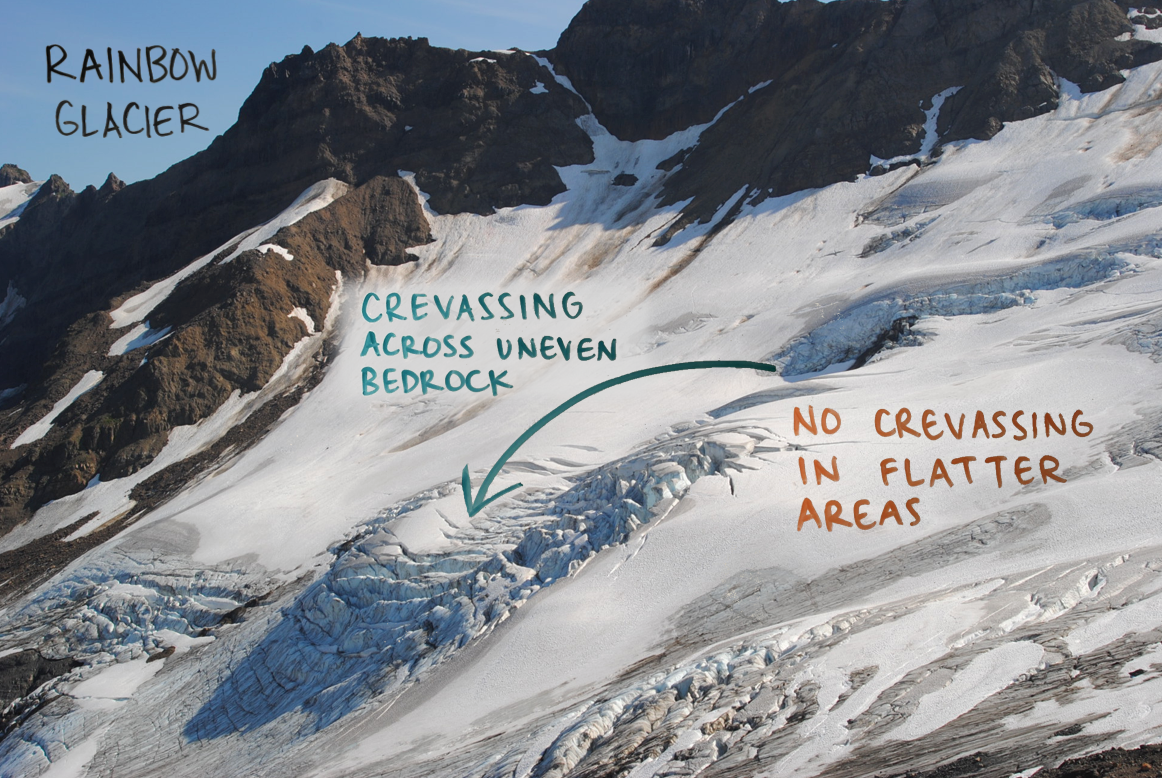
Glaciers are the same way, and so another driver for crevasse formation is ice flow speed up in these areas. Other factors that could be at play are roughness of the underlying bed or drag along valley walls. The above photo of Rainbow Glacier shows a complex surface of crevassed and smooth areas, which hints to a similarly complex underlying bed.

During the 2019 field season of the North Cascades Glacier Climate Project, we measured these crevasses in a few different ways. Seven field seasons ago, Jill Pelto began collecting data on crevasse depth. She uses a cam line, which is essentially a weighted tape measure, to determine total crevasse depth on each glacier. This photo shows Jill measuring a crevasse on Easton Glacier. She tries to analyze crevasses in similar regions of the glaciers from year to year to achieve a cohesive dataset which could be useful on a long-time scale. This data has the potential to shed light on important glacial changes and how they may relate to regional warming or shifts in precipitation patterns in the North Cascades. The data could also illuminate differences in the behavior of each individual glacier. Overall the number of crevasses has declined, in 2019 average depth on Easton Glacier was 10-15 m.

Another technique we used in the field is crevasse stratigraphy. Upon looking inside open vertically-walled crevasses in the accumulation zone, there are clear layers exposed on the crevasse walls. The layers are the remaining snow from each accumulation season, with the most recent winter’s snow on top. Using a rope marked at each decimeter, we work together to measure the depth of each exposed snow layer. These measurements give a pinpointed measurement of mass balance, and thus glacial health, throughout the past couple of years.

In some open crevasse features, you can see that many more years of stratigraphy are preserved, like in this photo on Easton Glacier. Each visible layer is from a year during which the amount of snowfall exceeded the summer melt, and there is no remaining evidence from years with higher melt than snow accumulation.

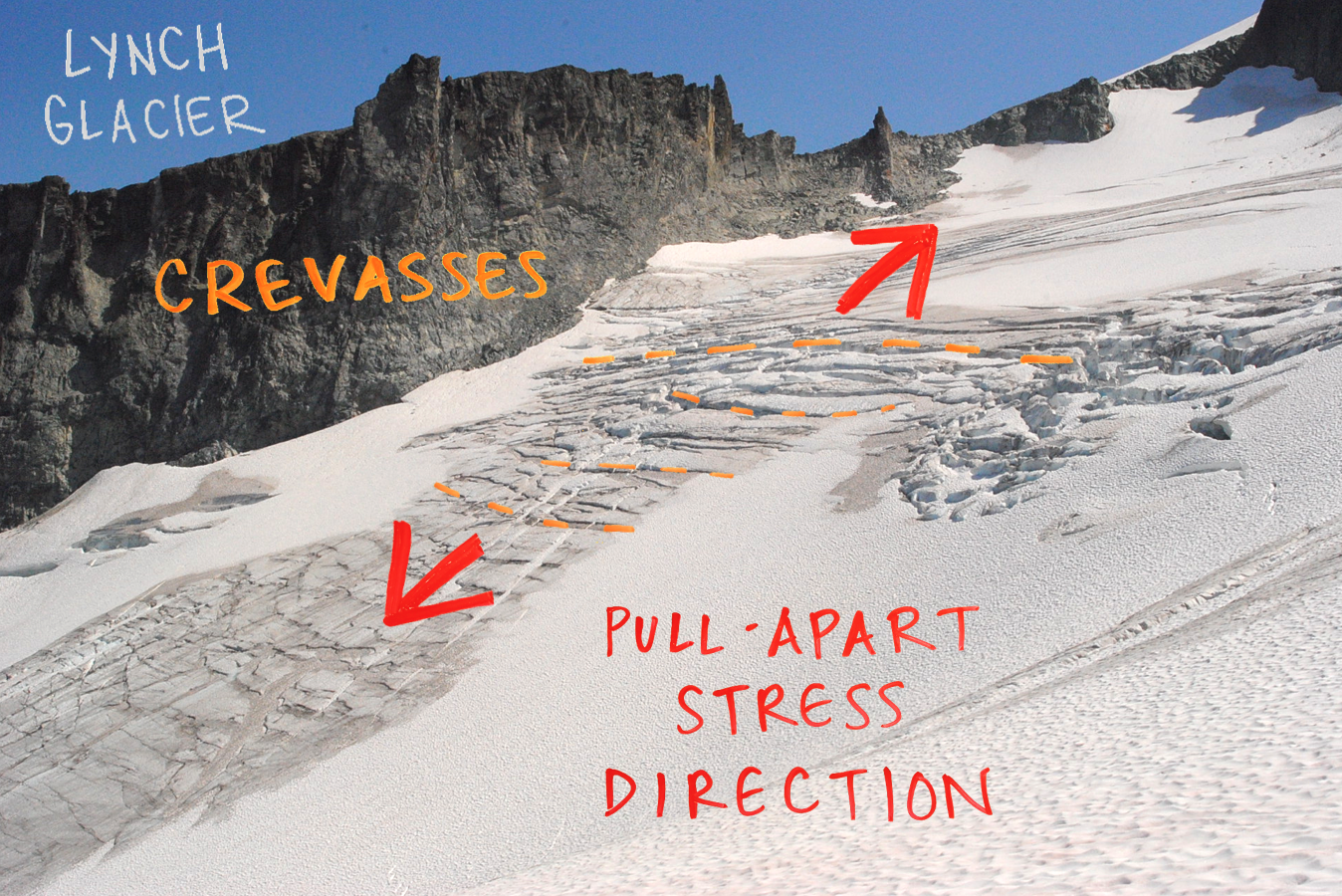
Other information we can gather from crevasses is related to the internal stresses in the ice. Crevasses are opened by pull-apart forces which act perpendicular to the trend of the crevasse.

If you are able to relate the crevasse orientations to the stress within the glacier, it is useful in evaluating the dominant stresses and how they change throughout the glacier spatially. Identifying the locations of crevasse groupings is also a valuable observation, as it reveals the areas with high stress, and may give clues as to where bedrock steps exist below the glacier.

Crevasses are often perceived as scary and have a negative connotation, and while they are hazardous to glacial travelers (always be VERY careful and have the correct gear when navigating crevasses), they are actually a sign of glacial productivity. A healthy glacier’s crevasses are frequent and deep, because thick, flowing ice generates high stress conditions.

The North Cascades Glacier Climate Project has observed glacial thinning due to lower rates of snowfall paired with more intense summer melt seasons over the past 36 years. This has led to a reduction in the number of crevasses in many areas. During summer 2019, the glaciers we visited in the North Cascades will lose up to 2 meters of snow from their surfaces to melting. It is likely that as this pattern continues, there will be even less surface crevassing on the glaciers.

Varied Snowcover Extent Diagnostic of Glacier NP Glacier Climate Response

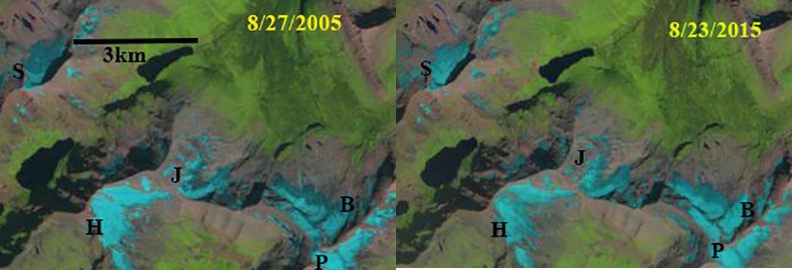
Snowcover extent in Landsat images from August, 1998 and 2018. S=Sperry, H=Harrison, J=Jackson, B=Blackfoot and P=Pumpelly

Five of the eight largest glaciers in Glacier National Park are clustered in a small area: Jackson Glacier, Sperry Glacier, Pumpelly Glacier, Harrison Glacier, and Blackfoot Glacier. The USGS in Glacier National Park has over the last 15 years maintained an extensive glacier monitoring program led by Dan Fagre.  This program has led to consistent mass balance observations on Sperry Glacier, and repeat mapping of the 37 named glaciers, 25 of which still qualify as glaciers.  The repeat mapping indicates the area lost from 1966 to 2015, (USGS, 2017).  There is considerable variation between glaciers , some have lost more than 80% of their area and others having lost less than 20% during this 50 year period. Snowcover extent in late summer is a good indicator of glacier mass balance, which controls changes in glacier volume/glacier area.  Glaciers that lack a persistent accumulation zone cannot survive current conditions (Pelto, 2010).  Observations of the snowcover extent in years of limited snowpack illustrate which glaciers do have a persistent snowcover and can survive vs those that cannot (Pelto, 2011). Here we examine Landsat imagery from mid to late August in 1998, 2005, 2015 and 2018, all years of extensive mass loss to identify the difference in snowcover extent, which will drive mass balance loss and subsequent retreat. These images are not at the minimum snowcover extent, which usually occurs n September. For a glacier to be in equilibrium it needs more than 50% of its area to be snowcovered at the end of the melt season.

In 1998 glacier mass balance losses were significant in the region, in mid-August the accumulation area (snowcovered area) on Harrison Glacier exceeded 80%, Blackfoot Glacier was ~60 % snowcovered,  Jackson Glacier ~50% snowcovered and Sperry Glacier ~30% snowcovered.  In 2005 another year of minimum mass balance in the region in late August, Harrison Glacier had ~80% snowcover, Blackfoot Glacier~60% snowcover, Jackson Glacier ~40% snowcover and Sperry Glacier ~20% snowcover. In 2015 glacier volume losses in the region were again large, with Sperry Glacier having a loss of -1.22 m. The retained area of accumulation on Harrison Glacier in mid-August of 2015 was ~60%, on Blackfoot Glacier 50%, on Jackson Glacier 30-40% and on Sperry Glacier less than 20%. In mid-August of 2018 snowcover extent was greater than 75% on Blackfoot, Harrison and Jackson Glacier, while Sperry Glacier had ~40%.

The USGS identified the area of Blackfoot Glacier in 2015 as 1.5 km2, a reduction of 18% from 1966-2015 and 8% from 1998-2015 (USGS, 2017).  Harrison Glacier had an area of 1.7 km2, losing 17% of its area from 1966-2015, and 10% from 1998-2015. Jackson Glacier had an area of 0.8 km2, losing 40% of its area from 1966-2015, and 6% from 1998-2015.  Sperry Glacier had an area of 0.8 km2 in 2015 having lost 40% of its area from 1966-2015, and 16%  from 1998-2015. The persistent pattern of limited snowcover extent on Sperry Glacier indicates why the percentage of area loss has been greater than on the other glaciers. The lack of significant retained snowcover indicates Sperry Glacier cannot survive current climate.  The retention of significant snowcover on Blackfoot and Harrison Glacier even in low snowpack years indicate these glaciers, unlike most in the National Park, can survive the current climate. The Jackson Glacier is in between these two scenarios.

Jackson is the lowest elevation glacier and Harrison is the highest.  Blackfoot, Jackson and Sperry are all north facing. Pumpelly which faces south has lost the least area of the five glaciers from 1998-2015. This underscores the utility of Landsat imagery in assessing glacier mass balance response. Three of the glaciers that retain significant snowcover indicates these glaciers are not as vulnerable to warming and will continue to persist until 2050 at least.

USGS Data on glacier area.

Observation Year LIA 1966 1998 2005 2015
Jackson 3.1 1.3 0.8 0.8 0.8
Harrison 3.5 2.1 1.8 1.7 1.7
Blackfoot 5.0 1.8 1.6 1.6 1.5
Sperry 3.8 1.3 1.0 0.9 0.8

Snow cover extent in Landsat images from August, 2005 and 2015. S=Sperry, H=Harrison, J=Jackson, B=Blackfoot and P=Pumpelly

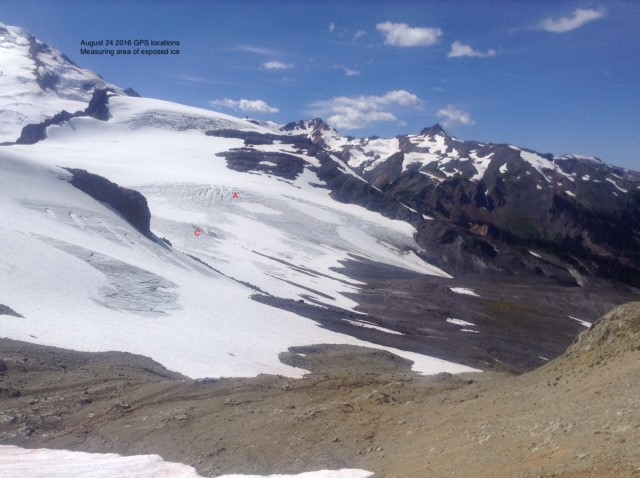
Sholes Glacier August, 24 2016 with the snowcover extent vs the exposed glacier ice.

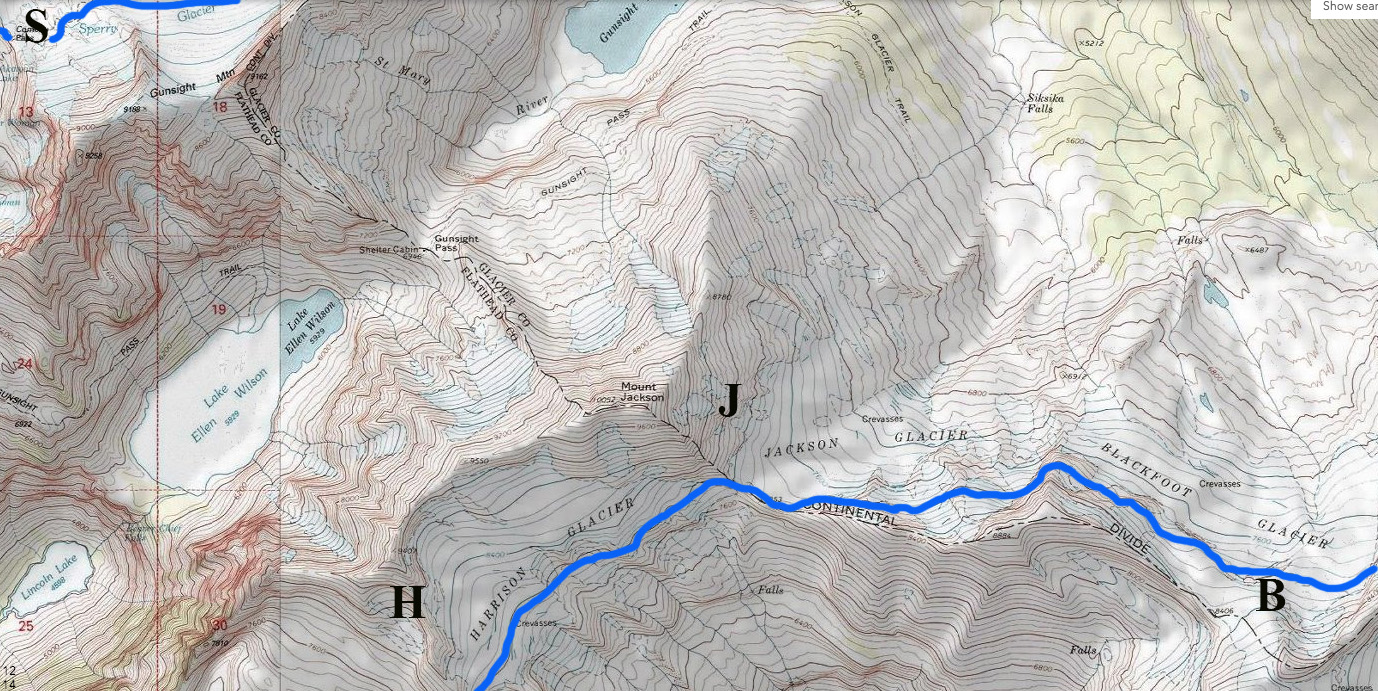
USGS Topo Map of the area with the blue line indicating the 8000 foot contour.

Drogpa Nagtsang Glacier, China Mass Balance Loss, Separation, Slow Down

Drogpa Nagtsang Glacier change in Landsat image from 1989 and 2018.  Yellow arrow indicates 2018 terminus location, red arrow 1989 terminus location, red dot the lowest elevation of clean glacier ice. Points A-E are the same locations for comparison.

Drogpa Nagtsang Glacier, China is a glacier that is 30 km west of Mount Everest that terminates in an expanding proglacial lake. The glacier begins on the Nepal border at 6400 m, and its meltwater enters the Tamakoshi River. The Upper Tamakoshi Hydropower project is a 456 MW peaking run of river  is a hydropower project on the Tamakoshi that is to be finished in 2019.  King et al (2017) observed the mass balance of 32 glaciers in the Mount Everest area including Drogpa Nagtsang and found a mean mass balance of all glaciers was −0.52 m water equivalent/year, increasing to -0.7 m/year for lake terminating glaciers. Dehecq et al (2018) in an exceptional paper examined velocity changes across High Mountain Asia from the 2000-2017 period identifying a widespread slow down in the region.  The key take away is the same we see for alpine glaciers around the globe, warming temperatures lead to mass balance losses, which leads to velocity slow down, Mass balance is the key driver in glacier response, a sustained negative mass balance leads to thinning, which leads to a glacier velocity declines whether the glacier is in the Himalaya, Alps or Andes. This study simply could not have been completed without the availability and affordability of Landsat imagery.  Here we look at one example in the region that highlights the important findings.

In 1989 Drogpa Nagtsang Glacier had a substantial number of coalescing supraglacial ponds on its relatively flat stagnant debris covered terminus.  At Point A the former tributary is are no longer contributing to the main glacier, while at B, C, D and E there is a still a contribution.  The snowline in 1989 is at ~5450 m.  The clean glacier ice extends almost to the tributary glacier at Point B at 5200 m, red dot. In 1992 the supraglacial ponds have further expanded, but a true proglacial lake has not formed. The snowline is at~5500 m. Quincey et al (2009) observed flow of less than 10 m/a in lower 5 km of glacier in 1996 and peaking at 20-30 m/a 8 km from terminus. By 2015 a 2.7 km long lake has developed.  The clean glacier ice now extends just past Point E at 5350 m.  The snowline is at 5600 m. The tributaries at Point B, C and E no longer reach the main glacier.  At Point D the medial moraines indicate that flow from this tributary has been reduced and now is a smaller contributor to the valley tongue. In 2018 the clean glacier ice extends to just 5400 m.  The lake has expanded to a length of 2.9 km indicating a retreat of the same distance from 1989-2018.  The snowline is exceptionally high at 5700 m. The former tributaries at B, C and E have also markedly retreated away from the main glacier. Only the tributary at Point D is still contributing to the main glacier. The high snowline observed in recent years are an indication that mass balance losses are even larger in this region, which causes further thinning, reduction in velocity, retreat and expansion of debris cover.  King et al (2018) observed the thinning and velocity profile on Drogpa Nagtsang and noted the velocity decreased over time and was stagnant in the debris covered zone, thinning occurred along the entire profile, which began close to the ELA. The stagnant nature of the terminus tongue is evident in the Digital Globe image below from 2017.  The red arrows show a deeply incised supraglacial stream that is over 2 km long, that would only develop on stagnant ice.  This process has played out on other nearby glaciers such as Yanong Glacier  and Lumding Glacier.  The high snowlines have also been observed at the nearby Nup La on Ngozumpa Glacier in recent years and on many glaciers in the Mount Everest region in recent winters such as in 2018.  This indicates continuing mass losses through a greater period of the year.

Drogpa Nagtsang Glacier change in Landsat image from 1992 and 2015.  Yellow arrow indicates 2018 terminus location, red arrow 1989 terminus location, red dot the lowest elevation of clean glacier ice. Points A-E are the same locations for comparison.

Digital Globe image with yellow dots indicating terminus, red arrows a supraglacial stream, blue arrows ice flow direction.  B is the same tributary has noted in the Landsat images above.