Pashleth Glacier, BC Retreat Driven Fragmentation 1987-2021

Pashleth Glacier in 1987 Landsat and 2021 Sentinel image. Red arrow is 1987 terminus location, yellow arrow 2021 terminus location. Point B-D mark locations where separation has or is occurring along the main glacier and Point A on the western arm.

Pashleth Glacier, British Columbia drains into Pashleth Creek a tributary to the Machmell River, Owikeno Lake and then River Inlet on the British Columbia Coast. Here we examine the glacier retreat and fragmentation that has occurred from 1987-2022. The Machmell River is an important salmon spawning area in its lowest 20 km, particularly for sockeye, with chinook, coho, pink and chum salmon up to the cascades just downstream of junction with Pashleth Creek (Hillaby, 1998). The Rivers Inlet fjord had the third largest run in the province with annual returns of up to 3.1 million sockeye from 1948 to 1992 (Hakai, 2021). The Rivers Inlet sockeye stock has recently received much attention because of a dramatic decline in total abundance from the with an estimated 94% decline in sockeye salmon equilibrium population size (from 3,115,000 to 200,000) hitting a low of under 10,000 in 1999 (Adams et al 2021). In the 1980’s Machmell River escapement numbers averaged 20,000, dropping to 5000 in the 1990’s  (Rutherford et al 1998). Harvest rates were reduced in the 1980’s and the commercial fishery closed in 1996.  The commercial fishery has remained closed since 1996, with  a small amount of fishing permitted by the Wuikinuxv First Nation maintain a modest food, social, and ceremonial harvest. The Rivers Inlet sockeye salmon stock has experienced limited recovery consistently exceeding ~100,00o, and averaging ~250,000 in the last two decades (Adams et al 2021). The study also examined the decline in grizzly bear population and the connection to salmon decline.  They observed grizzly bear diet finding the percentage of the diet from salmon declined from ~70% pre-collapse to 23% in the 1990’s and rebounding today with fewer grizzly bears to 64%.

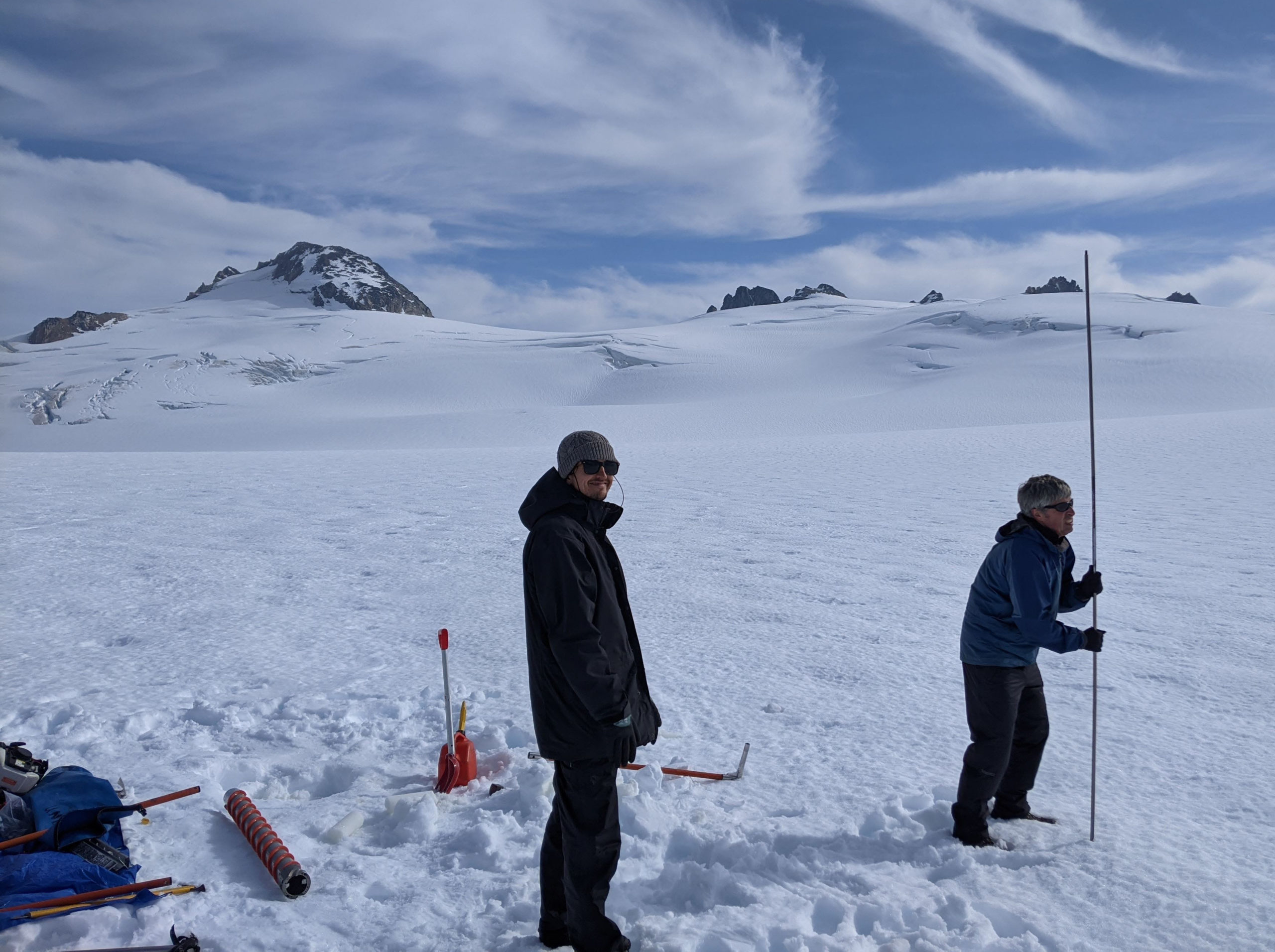
In 1987 Pashleth Glaciers main terminus was at 1000 m and the west terminus at 1100 m, with the snowline at 1700 m. By 2000 significant retreat has occurred and tributaries at Point A-D are all feeding the main glacier. The snowline is at 1800 m in 2000. In 2014 tributaries A-D are still feeding the main glacier. The snowline is at 2000 m in 2014. In 2020 Brian Menounos and Ben Pelto (UNBC) visited the accumulation area of this glacier at 2300 m and found 4.2 m of snow remaining, see below. This area has retained accumulation each and every year. In 2021 tributaries at Point A and B have separated from the main glacier, while the tributary at Point C is on the verge of separation, likely will happen in 2022. At Point D this region is developing a rock rib that indicates contribution from this small triburary is limited and will cease in the near future. The snowline in late August is at 1950 m. The main terminus has retreated 1250 m from 1987-2021 and the west arm 1700 m.

Pashleth Glacier is a large glacier that will continue to supply a large magnitude of summer glacier runoff.  The challenge for the salmon will continue to be in the ocean.  The neighboring Klippi Glacier retreated 1400 m from 1987-2016, with the two main branches having separated and also feeds the Machmal River. Draining the same icefield to the south Klinaklini Glacier is also rapidly retreating (The Tyee, 2021).

Pashleth Glacier in 1987 and 2014 Landsat image Red arrow is 1987 terminus location, yellow arrow 2021 terminus location. Point B-D mark locations where separation has or is occurring along the main glacier and Point A on the western arm.

Brain Menounos, UNBC probing snowpack on the upper glacier. Searching for a potential measurement station high on the glacier (Image from Ben Pelto).

Crevasse stratigraphy indicates the depth of retained accumulation on upper glacier ( (Image from Ben Pelto)

Cobre Glacier, Argentina Rapid Retreat and Area Loss in 2022

Cobre Glacier, Argentina in false color Sentinel 2 images from Jnauary 13, 2022 and March 16, 2022. Note the expansion of bedrock area amidst the glacier at Point A, glacier fragmenting at Point B and Point C.

Cobre Glacier drains east from Cerro Orejas a 3949 m peak on the Chile-Argentina border and discharges into the Rio Tordillo. The summer of 2022 has been a difficult season for glaciers in the Central Andes of Chile and Argentina as has been observed with early snowpack loss on Bajo del Plomo Glacier,  Cortaderal GlacierPalomo Glacier, Volcan Overo Glacier and Olivares Beta and Gamma Glaciers.  Here we can utilize Sentinel 2 satellite imagery to observe the retreat from 2016-2022 and the area losses apparent during the summer of 2022.

In March 2016 Cobre Glacier terminated on the northern shore of a proglacial lake at ~3000m.  By March 2022 the glacier had retreated 700 m from the lake in just six years. During this period thinning of the glacier had narrowed the connections at Point A-C, while a new lake basin is evolving at Point D.  Early summer warmth led to a rapid loss of snowpack on Cobre Glacier in 2022. By January 13, 2022 ~5% of the glacier had small pockets of snowcover above 3800 m. Bare ice glacier surfaces melt more rapidly than snow covered surfaces. After over two months of bare ice ablation the small areas of emergent bedrock on January 13, near Point A have enlarged and merged with the margin of the glacier by March 16. At Point B a small ice cap is separating from the main glacier. At Point C a narrow tongue of ice that had connected the main glacier to a small terminus segment has been severed.  At Point D margin retreat is leading to expansion of the proglacial lake along the margin of the glacier.  In just two summer months the impact of a single warm summer is evident on Cobre Glacier.  It is also evident that with no persistent accumulation zone this glacier cannot survive current climate( Pelto, 2010). Dussaillant et al (2019) identified slower mass loss  -0.28 m/year in this region from 2000-2018, than further south in the Patagonia Andes or north in the Tropical Andes. In 2022 the Central Andes are experiencing a rapid loss.

Cobre Glacier in Sentinel 2 images from March 2016 and March 2022. Illustrating retreat from 2016 terminus (red arrow) to 2022 terminus (yellow arrow). Fragmentation of the glacier underway at Point A-C is evident. A new evolving lake is at Point D.

Ongoing Detachment at Victoria Glaicer, New Zealand

Victoria Glacier in Sentinel images from February 2017 and February 2022. Red arrow is 2002 terminus location, yellow arrow marks 2022 debris cover take over and beginning of stagnating ice region. Point C is lowest point of clean ice in 2017 and just above terminus in 2022. Point A, B and D are icefalls where detachment is underway.

Victoria Glacier in New Zealand’s Southern Alps is the westward draining valley glacier between Fox and Franz Josef Glacier. Victoria Glacier has limited terminus observations over the last 25 years indicating a stationary terminus position from 1998-20o1, retreat in 2005, advance in 2008 and 2009, stationary position 2010-2013 and retreat from 2014-2017 (WGMS, 2021). Here Landsat and Sentinel imagery are used to explore changes to this glacier from 2002-2022. Chinn and Chinn (2020) reported a 3.7 m/year rise in the mean New Zealand end of summer snowline on glaciers over the last 40 years, which is driving mass loss and retreat of glaciers across the range. Baumann et al (2020) provide an inventory of NZ glaciers noting that most of the glacier tongues below 1000 m are debris covered including several that are detached and a 21% decrease in area was noted for the 1978-2016.

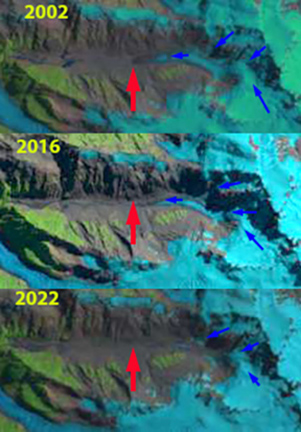
In 2002 the glacier extends 2.3 km downvalley from the base of the Icefall at Point A. The active ice front marking the terminus is at 1150 m and clean ice begins 300 m upglacier from the terminus. In 2017 following first a period of advance and retreat the terminus has retreated ~100 m since 2002, clean ice begins 400 m from the terminus, at Point C .The width of the clean ice area is reduced from 2002.  In 2017 there is active crevassing in the icefalls at Point and D extending to the valley trunk below.  At Point B there is a clean ice connection in 2017, but not active crevassing to the base of the icefall. From 2017-2022 rapid downwasting of the terminus tongue resulted in a 500 m retreat of the active ice front, which is near Point C. There is only small patch of clean ice in the last 1 km of the glacier.  Crevassing in the icefalls at Point B and D no longer extends all the way to the valley trunk of the glacier.  At the yellow arrow is both where debris cover dominates in 2022, but also marks the beginning of a deeply carved surface stream, indicating near stagnation of the glacier in this region. The recent high snowlines observed in the annual end of summer surveys  (NIWA, 2018) will lead to continued reduced flux of ice through the icefalls and detachment at Point B and D in the near future.
Victoria Glacier topographic map with flow arrows and specific elevations. 

Victoria Glacier in 2002, 2016 and 2022 Landsat images.Red arrow marks 2002 terminus position, blue arrows indicate flow lines.

Volcan San Jose, Central Andes Glacier Decline and Snowcover Loss in 2022.

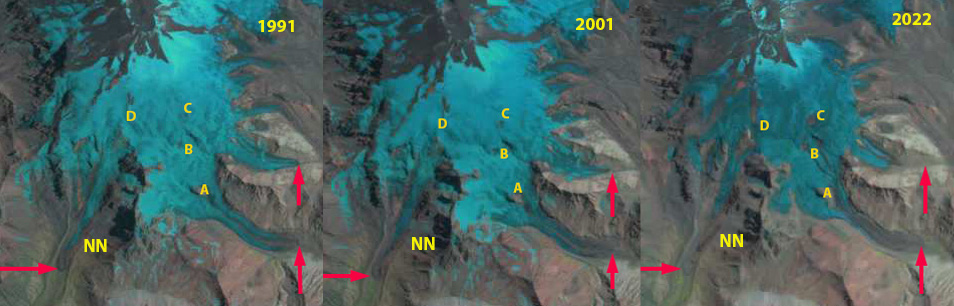
Volcan San Jose, Chile/Argentina Glacier change in Landsat 5-7-9 images from 1991, 2001 and 2022. Red arrows indicate the 1991 terminus location of three glaciers draining from the summit region, including Nieves Negras Glacier (NN). Point A-D are locations of expanding bedrock amidst the glacier.  Snowpack very limited in 2022.
Volcan San Jose is a 5850 m glacier draped volcano that straddles the Argentina-Chile border. Here we focus on the glaciers on its souther flank including the Nieves Negras Glacier. Nieves Negras drains into Rio Volcan a tributary of Rio Maipo, while the Argentina terminating glaciers drain into Rio Salinillas.  Ayala et al (2020)  examined glacier change from 1955–2016 in the Rio Maipo Basin and found a decreasing glacier mass balance trend and that glacier volume decreased by 20%. Dussaillant et al (2019) identified slower mass loss  -0.28 m/year in this region from 2000-2018, than further south in the Patagonia Andes or north in the Tropical Andes. Here we examine glacier changes from 1991 to 2022 with Landsat imagery and the low snowpack conditions of 2022 with Landsat and Sentinel images.

In 1991 Nieves Negras and the Rio Salinillas headwater glaciers terminated between 3100 and 3200 m.  The snowline is at 4500 m, and there is insignificant bedrock exposed at Point B and C.  By 2001 limited retreat had occurred, while bedrock exposure is apparent at Point B. The snowline is at 4600 m in 2001. In February of 2022, the glacier has retained less than 10% snowcover, with the snowline at 5200 m. The surface is notably dirty, which has enhanced melting during this summer.  Bedrock area at Point A is now 0.25 km2. Bedrock exposed at Point B has now generated two medial moraines. The bedrock exposed at Point C now has an area of 0.1 km2. At Point D there is nearly continuous bedrock extending along the ridge that marks the International boundary and the east margin of Nieves Negras. Glacier retreat of Nieves Negras is 1.7 km, there is stagnant ice below the current terminus. The debris cover obscures the actual terminus of the glacier at the headwaters of Rio Salinillas. While the northern terminus location indicates a retreat of 900 m.

The lack of snowcover matches that seen in other glacier of the Central Andes in summer 2022 such as ate the runoff into the Rio Plomo  Earlier observations indicate this is a regional issue this summer with snowpack lost from Bajo del Plomo Glacier,  Cortaderal GlacierPalomo Glacier, Volcan Overo Glacier and Olivares Beta and Gamma Glaciers across the Central Andes of Chile and Argentina

Volcan San Jose glaciers in Feb. 17, 2022 Sentinel image. This highlights just how dirty the ice surface is and how limited the retained snowcover is.

Bajo del Plomo Glacier, Argentina is 100% Bare Ice in February 2022

Bajo del Plomo Glacier in 2018 and 2022 Sentinel images illustrating the lack of any retained snowpack in 2022 and the expansion and emergence of bare rock areas amidst the glacier at Point A-D.

Bajo del Plomo Glacier at 7 km in length is one of two large glaciers at the headwaters of the Rio Plomo, Argentina, which is a tributary to Rio Tupungato and then Rio Mendoza. Glaciers in this region have lost ~30% of their area since 1955 (Malmros et al 2016). The majority of runoff to the Rio Plomo in summer is from snowmelt, with glaciers becoming more critical by late summer (Masiokas et al 2006)..  In February of 2022 with no snow evident in the upper basin on or off the glaciers, glaciers will dominate the runoff into the Rio Plomo  Earlier observations indicate this is a regional issue this summer with snowpack lost from Cortaderal Glacier, Palomo Glacier, Volcan Overo Glacier and Olivares Beta and Gamma Glaciers across the Central Andes of Chile and Argentina. Here we examine Sentinel and Landsat imagery to identify the lack of snowpack in summer 2021/22 on Bajo del Plomo Glacier and the expansion of bare rock areas.

Bajo del Plomo Glacier terminates at 4100 m and has two main accumulation zones that extend from 4600-5000 m near PointB and C respectively. In February 2018 there is limited bedrock expose near Point B and C, while Point A has two principal bedrock exposures with an area of   0.12 km2. In 2018 the snowline is at 4600 m.  The Dec. 21, 2021 Sentinel image indicates that the snowline is already at 4800 m. By January 18, 2022 Sentinel imagery indicates less than 10% of the upper glacier above 4900 m has retained snowcover.  By February 8, 2022  a Landsat 9 images indicates that all the snowpack on the glacier and surrounding area has been lost. The darker ice/firn surface of the glacier melts faster than a snow covered glacier surface leading to thinning and expansion of bedrock area including new exposures at Point B and D.  The area of exposed rock at Point A has doubled to 0.24 km2, and bedrock exposed at Point C is notably expanded too. The emergence of bedrock amidst the accumulation zone of a glacier is indicative of a glacier that cannot survive current climate as it is not consistently retaining snowpack (Pelto, 2010).

With a month left in the melt season Bajo del Plomo will continue to lose area and volume.

Bajo del Plomo Glacier in 2021 and 2022 Sentinel images illustrating the loss of snowpack from Dec. 21, 2021 to January 18, 2022 and the expansion and emergence of bare rock areas amidst the glacier at Point A-D.

Landsat 9 Image from Feb. 8, 2022 illustrating lack of retained snowpack.


Palomo Glacier, Chile Snow Cover Loss in 2022 and Accelerating Retreat

Palomo Glacier, Chile in Landsat 5, 8 and 9 images illustrating retreat from 1987 position, red arrow, and expansion of bare rock areas amidst the glacier at Point A,B and C. Note lack of retained snowcover in 2022.

Palomo Glacier is a large valley glacier in Central Andes of Chile. Adjacent to the Cortaderal Glacier and Universidad Glacier, it flows east from Volcan Paloma (4860 m)  and drains into the Rio Cortaderal. Rio Cortaderal is in the Cachapoal River watershed that supplies two Pacific Hydro projects; a 110 MW run of river project at Chacayes and the 78 MW Coya run of river project a short distance downstream. The glacier is an important water resource from December-March. Bravo et al (2017) quantified this resource for nearby Universidad Glacier that supplied 10-13% of all runoff to the Tinguirica Basin during the melt season. La Quesne et al (2009) reported that Palomo Glacier retreated 1160 m from 1955-1978 and advaned ~50 m from 450 m 1987-2007. They reported that Palomo Glacier had an equilibrium balance durng the 1987-2000 period, which drove the lack of retreat. Here we examine the changes of this glacier from 1987-2022 using Landsat 5, 7, 8 and 9 images, and the unusually high snow lines during the winter of  2022 due largely to a January heat wave (Washington Post, 2022). This is the first post using Landsat 9, that extends this invaluable data record.


In 1987 Palomo Glacier terminus had been in slight advance over the previous decade. The area of bare rock at Point A was 0.25 km2. At Point B and C limited exposed rock was evident on two rock ribs.  The snowline is below Point A at 3300 m. By 2002 there is minor retreat and the area of exposed rock at Point A has expanded, with the snowline at 3600 m. By 2015 the terminus has retreated 700 m to the north end of steep slope on the east margin of the glacier. The exposed bedrock area at Point A is now 1 km2. the snowline is at 3800 m.  By mid-January 2022 the glacier has only ~10% snowcover remaining, mostly above 4000 m. Retreat since 1987 is now ~1200 m. The bedrock area at Point A is 1.5 km2. Point B is expanding ridge of bedrock and the rib or rock at Point C now separates the glacier from flow on the south facing slope east of Point C.

By February 8, 2022 with six weeks left in the melt season there is no evident retained snowpack. This will accelerate both retreat, thinning and area loss of this glacier.  This story is playing out at glaciers across the region such at Olivares Glacier, Chile,  Cortaderal Glacier, Chile and Volcan Overo, Argentina

Palomo Glacier, Chile in Landsat 7 and 9 images illustrating retreat from 1987 position, red arrow, and expansion of bare rock areas amidst the glacier at Point A,B and C.

Firn Area Ratio an Emerging Metric for Glacier Mass Balance?

Columbia Glacier in 2015 viewed from the ridge above the glacier. The firn line is marked by blue dots. The age of the snow surface of 2015 and the firn surfaces of 2011-2014 are noted.

For an alpine glacier to be in equilibrium at the end of summer the glacier needs to be 50-70% covered in snow from the previous winter. This is the accumulation area ratio (AAR). AAR is a good measure of mass balance, which is why AAR is reported for WGMS reference glaciers. In recent years we have seen periodic strongly negative balance years that have removed all or nearly all of the snowpack from a glacier leaving an AAR of less than 10%, and considerable exposed firn. This typically occurs in assocation with  a year that feature prolonged dry warm conditions in winter that limit snow accumulation or even reduce it, and/or summers with heat waves and extended warm periods that melt away the snowpack rapidly, particularly early in the melt season.  This leads to exposure of firn, which is the snowpack retained from previous winters, hence more than a year old, but not yet glacier ice and significantly dirtier/darker than snow from the most recent winter. This firn melts more rapidly than snow, largely because it is darker.  This leads to additional mass loss for the glacier. By the end of summer in strongly negative years we can see where the firn area boundary with glacier ice.  This marks the region below which no accumlation has been retained in recent years, hence older ice is exposed.  As such it delineates the multi-year accumulation area, the effective accumulation zone of the glacier.  This would not be accuately determined from an simple average of annual AAR values. It is also readily visible in aerial or satellite imagery.

This scenario played out both in the Pacific Northwest in summer 2021 and in the Central Andes summer 2022. Pelto et al (2022) examine the impact of the heat waves on glacier runoff specifically. In New Zealand the 2022 NIWA annual snowline survey also indicate exposed firn below the annual snowline.

The blue dotted line on Columbia Glacier marks the accumulaiton zone for the 2011-2015 period, below that line no snow or firn was retained during that five year period. The is was a year of exceptional mass balance loss in the North Cascade Range (Pelto, 2018). Below is an example from Sholes Glacier in 2014 indicating the snow line in August and again in September now with a separte firn line apparent. Note the difference between the snowline for 2014 and the firn line for the 2011-2013 period. Below that point no firn has been retained.

Sholes Glacier snowline and firn line in August and September of 2014.

High negative balance years exposing significant firn areas at he surface have played out with increasing frequency in glaciated mountain regions from the North Cascade Range north through British Columbia to Alaska and across continents to the Alps, Canadian Arctic, Himalaya, and Andes.  Glaciers where much of their snow cover is lost by mid-summer, then have the darker firn and ice exposed for enhanced ablation for the rest of the summer.  There is no sunscreen they can apply for protection.

For Blackfoot and Jackson Glacier in Glacier National Park, Montana just one small area of snow remained on Blackfoot Glacier in early September of 2021.  The area of firn on both glaciers is extensive nearly 50% of the glacier indicating overall an accumulation area of significant size. For Adams Glacier in late summer 2021 there is ~10% snowcover (A), while firn cover is 40% at the end of August.

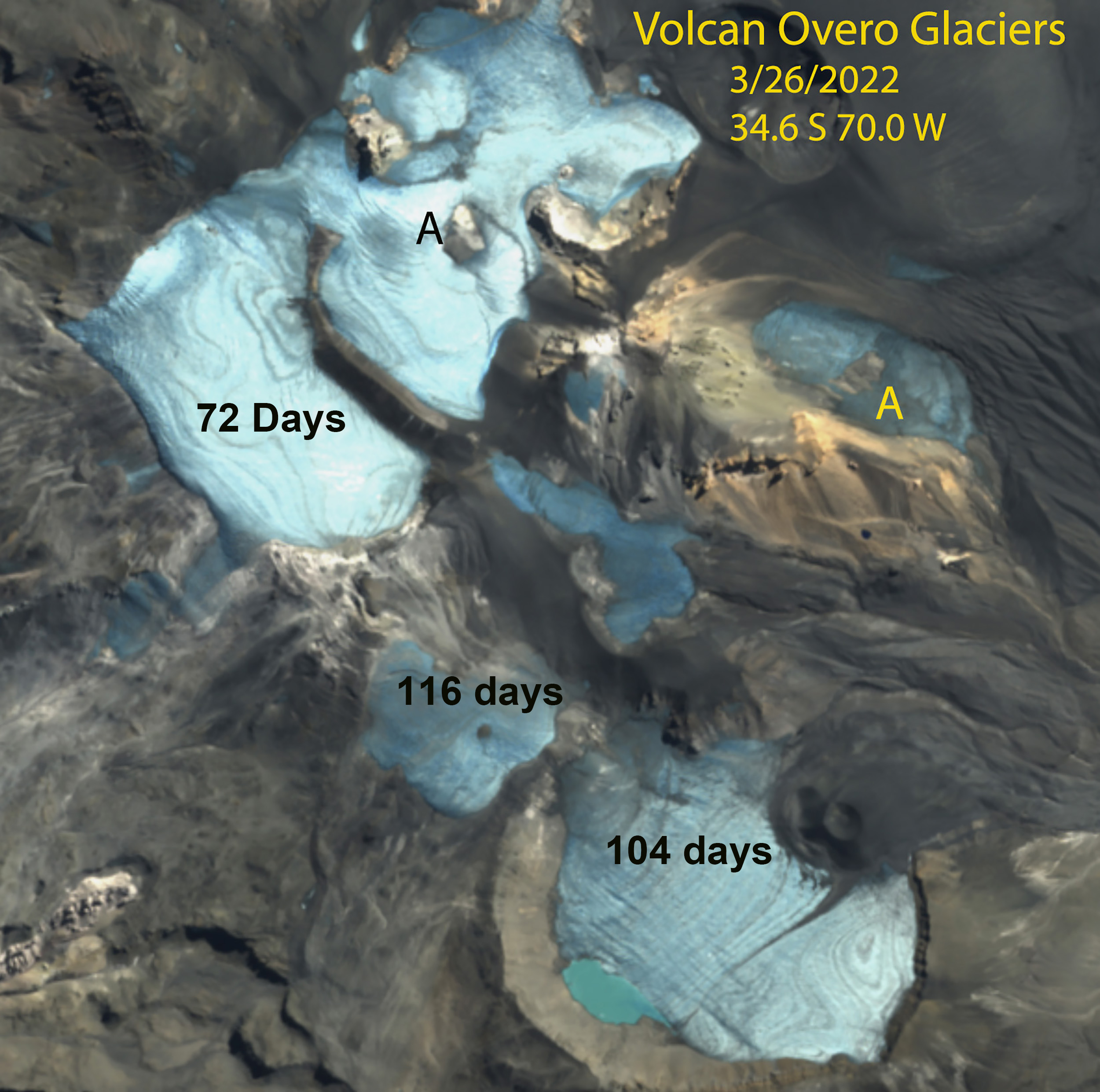
In January 2022 the Central Andes of Argentina and Chile have experienced nearly complete snowcover loss on many glaciers. Volcan Overo, Argentina has four ice masses A-D with limited firn or remaining snowpack. Ice mass E has limited snowcover, but reasonable firn cover extent, not blue dots between firn and bare ice. On Olivares Beta and Gamma Glacier, Chile almost no snowcover remains from Winter 2021, the firn line is limited to the upper portion of both glaciers. This indicates less than 30% of the glacier is an accumulation zone during recent years. There is still six weeks left in the melt season to further reduce this area. The bare surfaces lasted from mid-January into late March leading to extensive mass loss.

For each of the glaciers illustrated here the firn area can be delineated accurately due to the glacier having a significant mass balance loss.  The age of the firn cannot be determined without specific knowledge of the glacier or area, but for temperate alpine glaciers firn typically is converted to ice is 5-7 year

The snow cover (S) reamining on Jackston and Blackfoot Glacier in a Sentinel image by early September of 2021 is minimal. The firn area (F) in gray is more extensive.

Adams Glacier with areas of acccumulation (A) and firn (F) in a Sentinel image from Aug. 30, 2021. Green dots indicate the glacier boundary.

Olivares Beta and Gamma Glacier in Sentinel image, with ~10% snowcover remaining and 30% firn cover (blue dots) on January 20, 2022.


Olivares Beta and Gamma Glacier in Sentinel image indicating days of exposure at surface of firn and ice , March 26, 2022.


Volcan Overo, Argentina in January 13, 2022 Sentinel image, with  negligible snowcover remaining in mid-summer and firn cover remaining on 30% of the Glacier E.

Volcan Overo  in Sentinel image indicating days of exposure at surface of firn and ice , March 26, 2022.

Honeycomb Glacier (H) with evident firn lines below the annual snowline on Oct. 19, 2022 in a Sentinel image.


Olivares Beta and Gamma Glaciers, Chile Bare of Snowcover in 2022

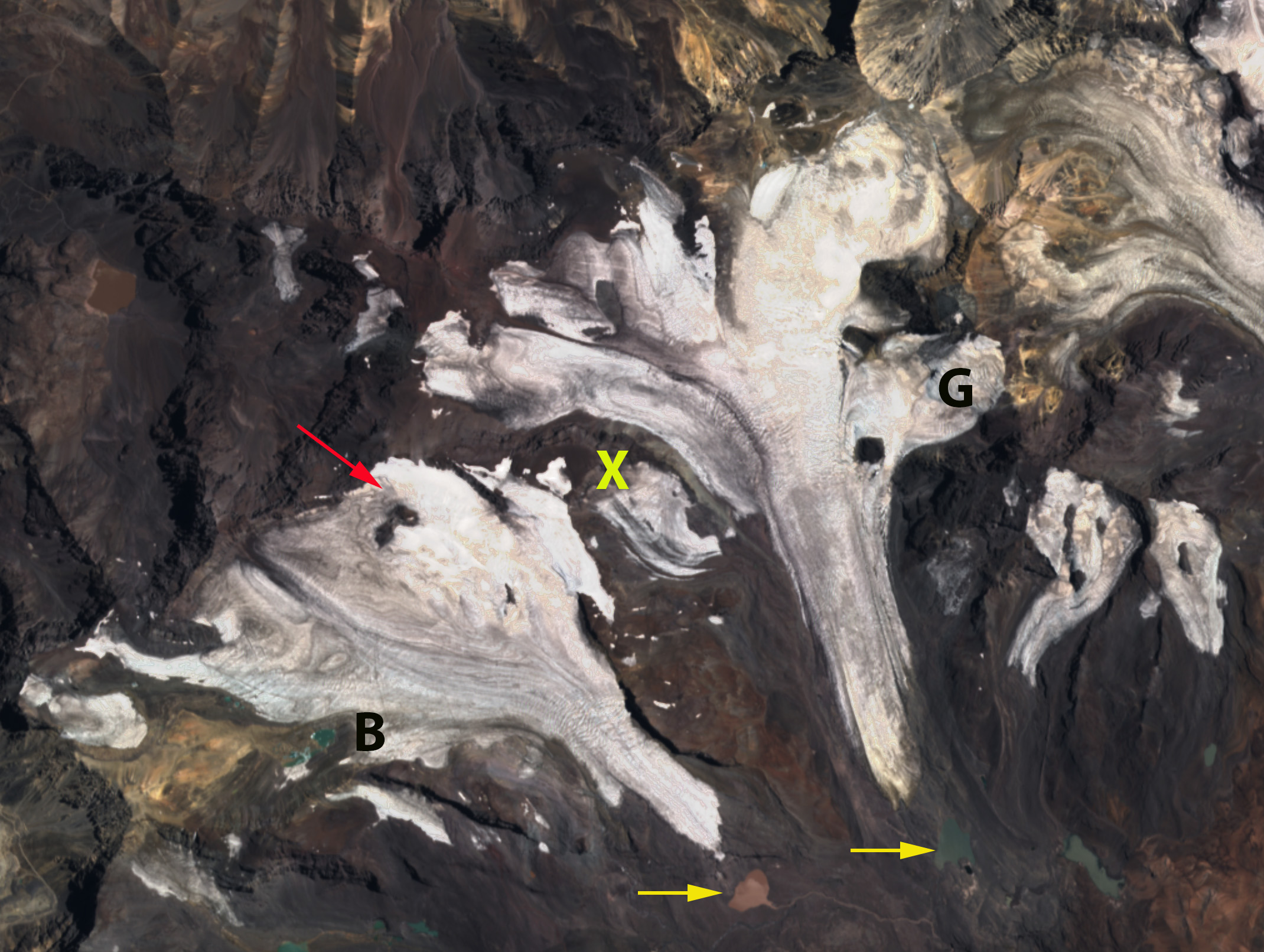
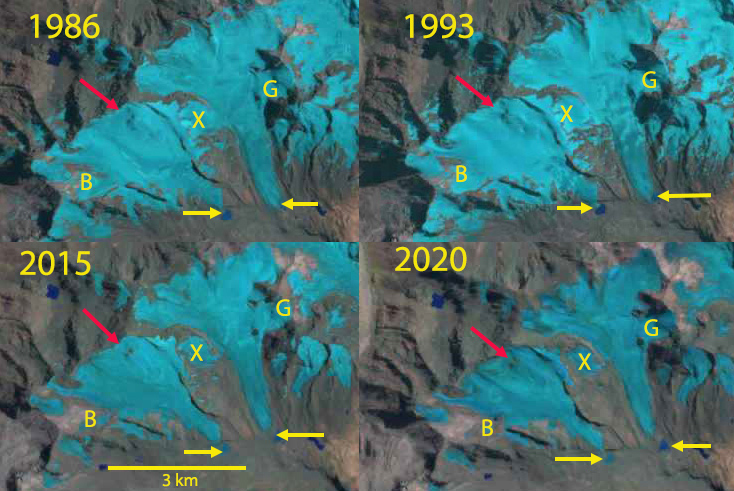
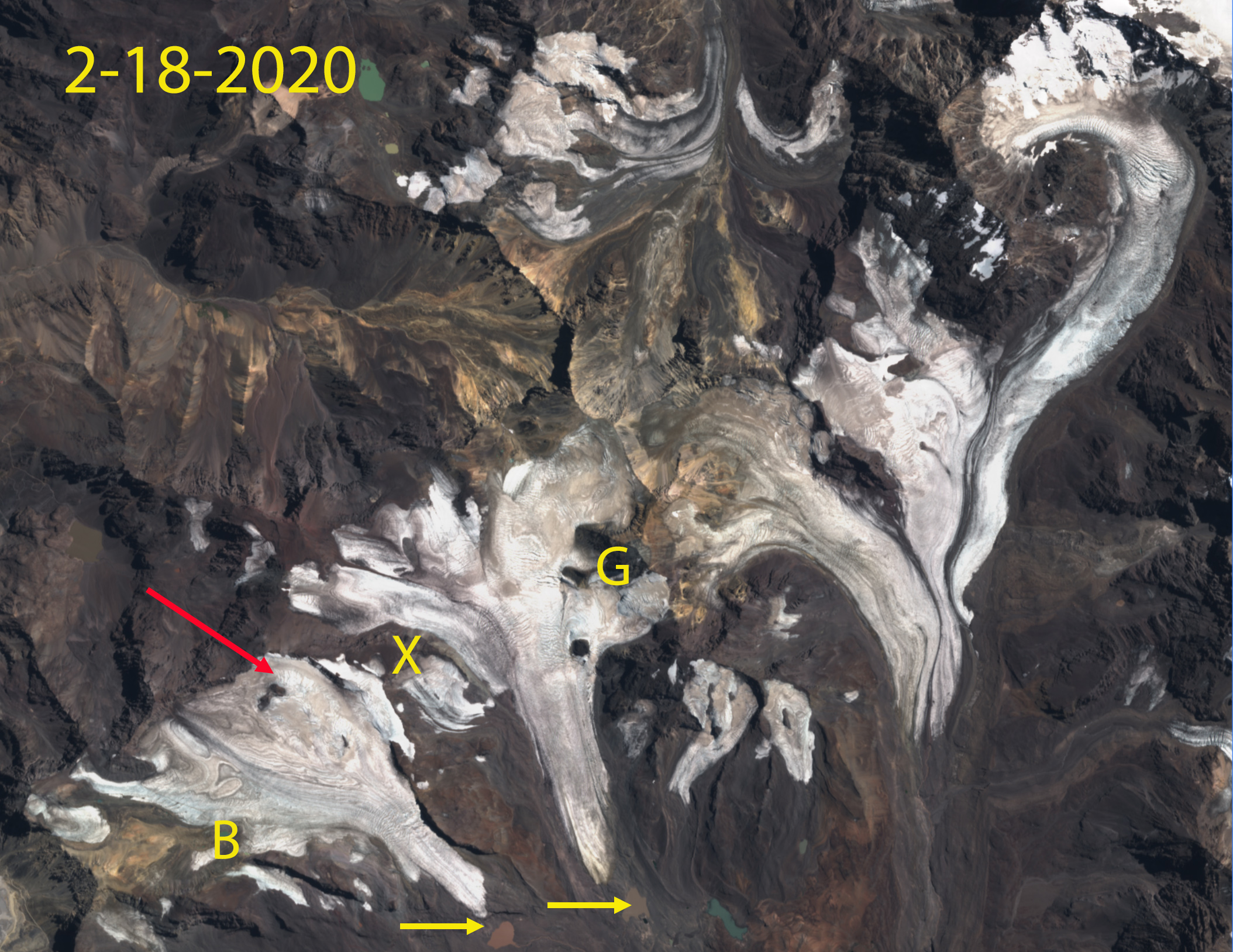
Olivares Beta (B) and Olivares Gamma (G) Glacier in Sentinel image from 1-23-2022, illustrating the lack of retained snowcover with 8 weeks left in the melt season. The yellow arrow marks proglacial lakes below each glacier. The red arrow an area of emerging bedrock on the upper Beta, X marks a location where the glaciers were joined in 1986 and now have separated. 

Olivares Beta and Olivares Gamma Glacier are adjacent glaciers 50 km NE of Santiago Chile in the central Andes of Chile. The glaciers are at the headwaters of the Olivares River, which drains into the Coloardo River. The Alfalfal Hydropower Planton the Colorado River is a 178 MW run of river plant completed in 1991 and owned by AES Andes. Malmros et al (2016) identified the retreat and area change of te Olivares glaciers for the 1955-2013 period. They noted a retreat of 979 m from 1955-1994 on Olivares Beta and 753 m on Olivares Gamma Glacier. The identified area loss from 1955-2013 was 21% on Olivares Beta and 34% Olivares Gamma.  Dussaillant et al (2019) identified a slower mass loss  -0.28 m/year in this region from 2000-2018, than further south in the Patagonia Andes or north in the Tropical Andes. Here we examine Landsat imagery from 1986-2020 and Sentinel Imagery from 2020-2022 to identify changes in area and snowcover.  The lack of retained snowcover indicates mass balance losses which will drive further retreat.
Olivares Beta (B) and Olivares Gamma (G) Glacier in Landsat images from 1986, 1993, 2015 and 2020. The yellow arrow marks the terminus location in 1993 of both glaciers, the red arrow an area of emerging bedrock on the upper Beta, X marks a location where the glaciers were joined in 1986 and now have separated. 

In  1986 and 1993 both glaciers terminated in small proglacial lakes, yellow arrows, and were connected adjacent to Point X.  There is no evident bedrock emerging on the upper Beta. In 1986 there is limited retained snowcover, ~10% of total area by early March. In 1993 there is 30% snowcover on the glaciers in March. By 2015 the glacier had receded from the proglacial lakes, bedrock is emerging at the red arrow on the upper Beta, and the glaciers are barely connected at Point X. Snowcover is ~10% of total area in mid-February.  In 2020 the glaciers have disconnected at Point X and there is less than ~10% retained snowcover by mid-February. The proglacial lakes are also quite brown suggesting high runoff from the dirtier/darker glacier. By January 23, 2022 both glaciers have again lost almost all snowcover with 8 weeks left in the melt season. The dirtier firn and ice at the surface melts at a faster rate than snow for the same weather conditions.  The result will be large mass balance losses in 2022 that will further lead to glacier thinning and recession. Both glaciers currently extend from ~3800 m to ~4800 m, with areas below 4600 m consistently being in the ablation zone.

The early loss of snowcover has been seen on other nearby glaciers Cortaderal Glacier, Chile and Volcan Overo, Argentina due to the unsually warm conditions in the region, particularly in the first half of January.

Olivares Beta (B) and Olivares Gamma (G) Glacier in Sentinel image from 2-18-2020 illustrating the lack of retained snowcover with 4 weeks left in the melt season. The yellow arrow marks proglacial lakes below each glacier. The red arrow an area of emerging bedrock on the upper Beta, X marks a location where the glaciers were joined in 1986 and now have separated. 

Olivares Beta and Olivares Gamm


Volcan Overo, Argentina Glaciers No Retained Snowcover at Midsummer

Volcan Overo glaciers in Sentinel images from January-2017, 2021 and 2022 illustrating fragmentation and no retained snowcover in 2022 with half the summer to go.

Volcan Overo is a 4619 m high Andean mountain in Argentina with a relatively low sloped broad summit region above 4000 m. This mountain has been the site of sulfur mining, with both an old tram and mining road leading to the summit region. The summit region is host to a glacier complex that is shrinking and fragmenting. In mid-January, 2022 the glacier has lost all of its snow cover.  La Quesne et al (2009) reported significant annual thinning in the latter half of the 20th century on nearby glaciers in Argentina and Chile. Dussaillant et al (2019) identified a slower mass loss  -0.28 m/year in this region from 2000-2018, than further south in the Patagonia Andes or north in the Tropical Andes. Here we examine Landsat images from 1986-2022 to identify longer term changes and with Sentinel images from 2017-2022 the recent changes including the impact of the recent January heat wave (Washington Post, 2022).

In 1986 there are four discrete glaciers around the caldera, covering ~12 km2 the largest E around the summit ranges in elevation from 4200-4500 m.  D is an isolated area at 4000-4100 m. A,B and C is a single glacier extending from 3900-4300 m. F is an area of rapidly diminishing glacier ice. In the early February image snowcover is good across all ice areas except F. In 2003 there is limited evident change with good snowcover across all except D. By 2013 A, B and C have fragmented into three separate glaciers and F is nearly gone. Only E has significant snowcover. In 2022 C and D have declined to less than 50% of their 1986 area, the overall Volcan Overo glaciated area has decline to ~8.1 km2.  It is not quite mid-summer on January 8, 2022 yet all snowcover has been lost from the glaciers of Volcan Overo. The glacier remnants at F are now gone.

Sentinel images in January of 2017 indicate good snowcover across the caldera glaciers with a total glacier area of 9.4 km2.  In January 2018 snowpack has been lost from A-D, exposing annual layers on A. Only the higher elevation E has retained snowcover. In January 2019 snowcover is good across all of the glaciers. In January 2020 snowcover is minimal on all glaciers except E. In January 2021 A, C and D have lost nearly all snowcover while B and E both are at least 50% snowcovered. In January 2022 there is no retained snowcover on any of the glaciers. The glacier area has been reduced as well. Glacier A, B, C and D no longer retain snowcover consistently and cannot survive current climate. Glacier B, C and D will continue rapidly diminishing.  Glacier A is much thicker and will take longer to disappear. The persistent lack of an accumulation zone indicates the glacier cannot survive (Pelto, 2010). Glacier E continues to recede at a slower rate, and continues to maintain snowcover most summers, but not in 2022.

The minimal snowcover of January 2022 on Volcan Overo matches that of Corataderal Glacier, Chile 30 km due west.

.

Volcan Overo glaceir complex in Landsat images from 1986-2022. The three main glaciers in 1986 have fragmented into five glaciers by 2022 and one glacier (F) has disappeared. Glacier area declined by ~30% and no snowcover is retained in mid-January of 2022.

Volcan Overo glaciers in Sentinel images in January-2018, 2019 and 2020 illustrating fragmentation and snowcover.

Cortaderal Glacier, Chile 2022 Heat Wave Reduces Snow Cover, Retreat Continues

Cortaderal Glacier in Landsat images from 2014 and 2022. The glacier retreated 1400 m during this interval. The snowline in January 2014 is at 3750 m. On January 15, 2022 the snowline averages 4100 m with less than 15% snowcovered with 2.5 months left in the melt season. Red arrow is 2014 terminus and yellow arrow is 2022 terminus.

Cortaderal Glacier is a large valley glacier in Central Andes of Chile. Adjacent to the Universidad Glacier, it flows from Volcan Paloma (4860 m) and Nevado Penitente (4350 m) and drains into the Rio Cortaderal. Rio Cortaderal joins the Cachapoal River, that supplies two Pacific Hydro projects; a 110 MW run of river project at Chacayes and the 78 MW Coya run of river project a short distance downstream. The glacier is an important water resource from December-March. Bravo et al (2017) noted for Universidad Glacier that it supplied 10-13% of all runoff to the Tinguirica Basin during the melt season. La Quesne et al (2009) reported that Cortaderal Glacier retreated 110 m from 1970-2000 and 450 m from 2000-2007. Here we examine the retreat of this glacier from 2014-2022 and the unusually high snow lines in mid-January of 2022 due to the recent January heat wave (Washington Post, 2022).

Cortaderal Glacier in Sentinel images from 2016 and 2022. Point A is the bedrock area that emerged in 2016 and was at the glacier front by 2022. Point T marks the 2016 terminus position, Point B is at 3750 m and Point C is at 4200 m. Snowline on January 22, 2016 is at 3200 m and averages 4100 m on January 13, 2022.

In February of 2014 the glacier terminated on the outwash plain at 2800 m. The snowline in mid January was at 3750 m. On January 9, 2016 the snowline was at 3200 m.  At Point A a small bedrock area has emerged from beneath the ice  1 km upglacier of the terminus. On January 16, 2017 the snowline is at 3750 m. On January 19, 2019 the snowline is at 3700 m. The bedrock exposed at Point A is no longer surrounded by ice due to expansion and glacier retreat. On December 14th the snowline is at 3700 m and the glacier is 50% snowcovered. By January 15 there is less than 15 % snowcover, and the snowline averages 4100 m, nearly at the top of the glacier. With 10 weeks left in the melt season snowcover will decline further. This is reminiscent of reduced snowcover on glaciers in the Pacific Northwest due to the summer 2021 heat wave (Pelto, 2021).

The glacier has retreated to Point A, with an average frontal recession of 1300 m from 2014-2022. This is greater than the retreat from 1990-2014 of ~800-900 m (Pelto, 2014).  The glacier now terminates at 3050 m in a region of much steeper slope that will reduce the retreat rate in the near future.

Cortaderal Glacier snow covered area change in two Landsat images one month apart. Snowcover declined from ~50% to 15%.

Cortaderal Glacier in Sentinel images from 2017 and 2019. Point A is the bedrock area that emerged in 2016 and was at the glacier front by 2022. Point T marks the 2016 terminus position, Point B is at 3750 m and Point C is at 4200 m. Snowline on January 16, 2017 is at 3750 m and averages 3700 m on January 19, 2019.

Landsat image indicating retreat from 1990-2014 of Cortaderal Glacier, red arrow 1990 position, yellow arrow 2014 position.

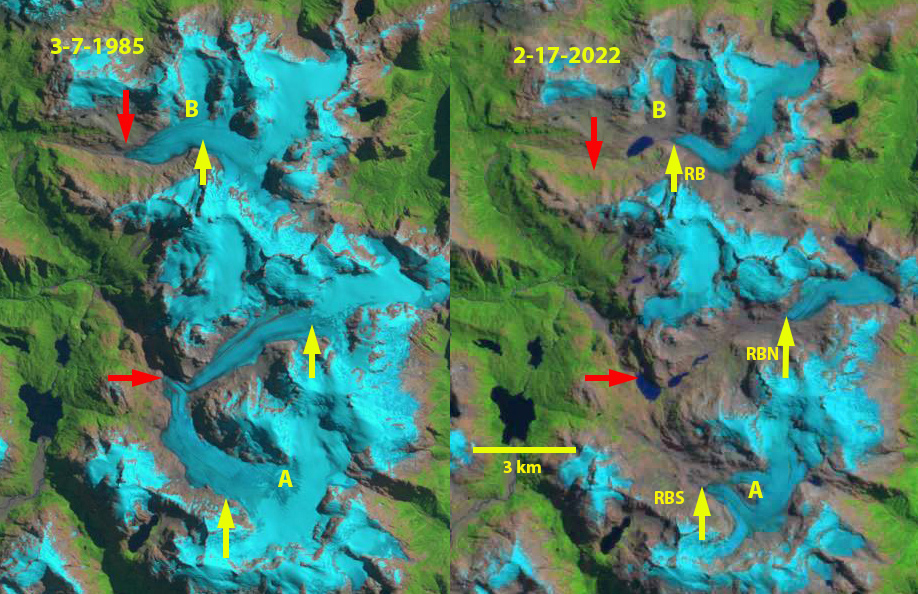
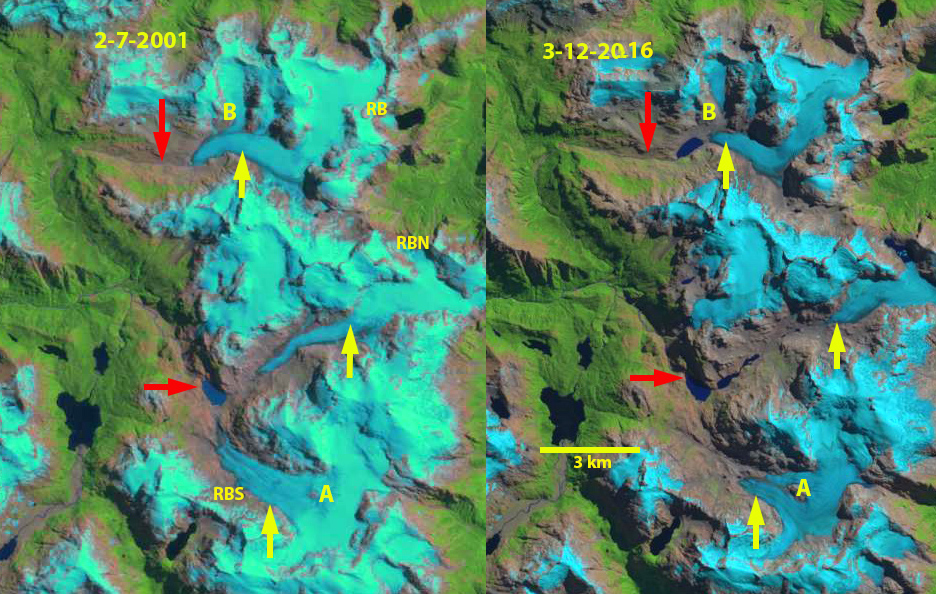
Braithwaite Icefield, British Columbia Fragments, Proglacial Lakes Develop and Accumulation Zone is Lost

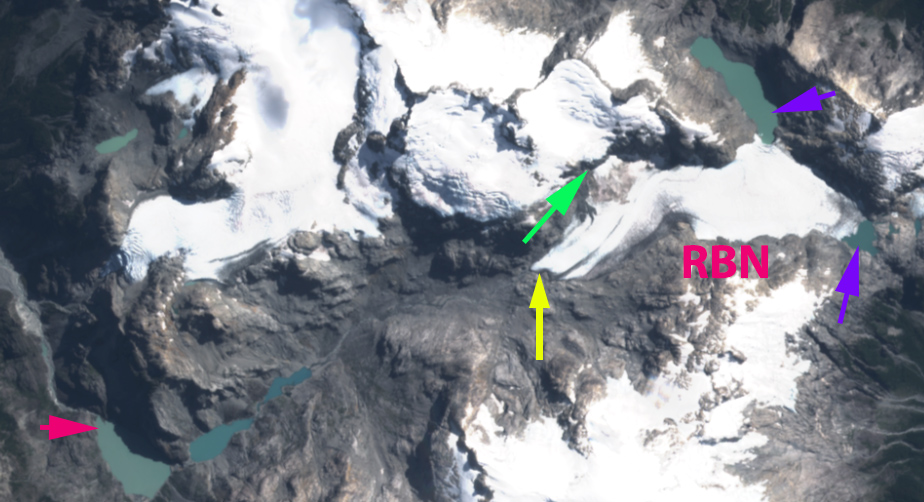
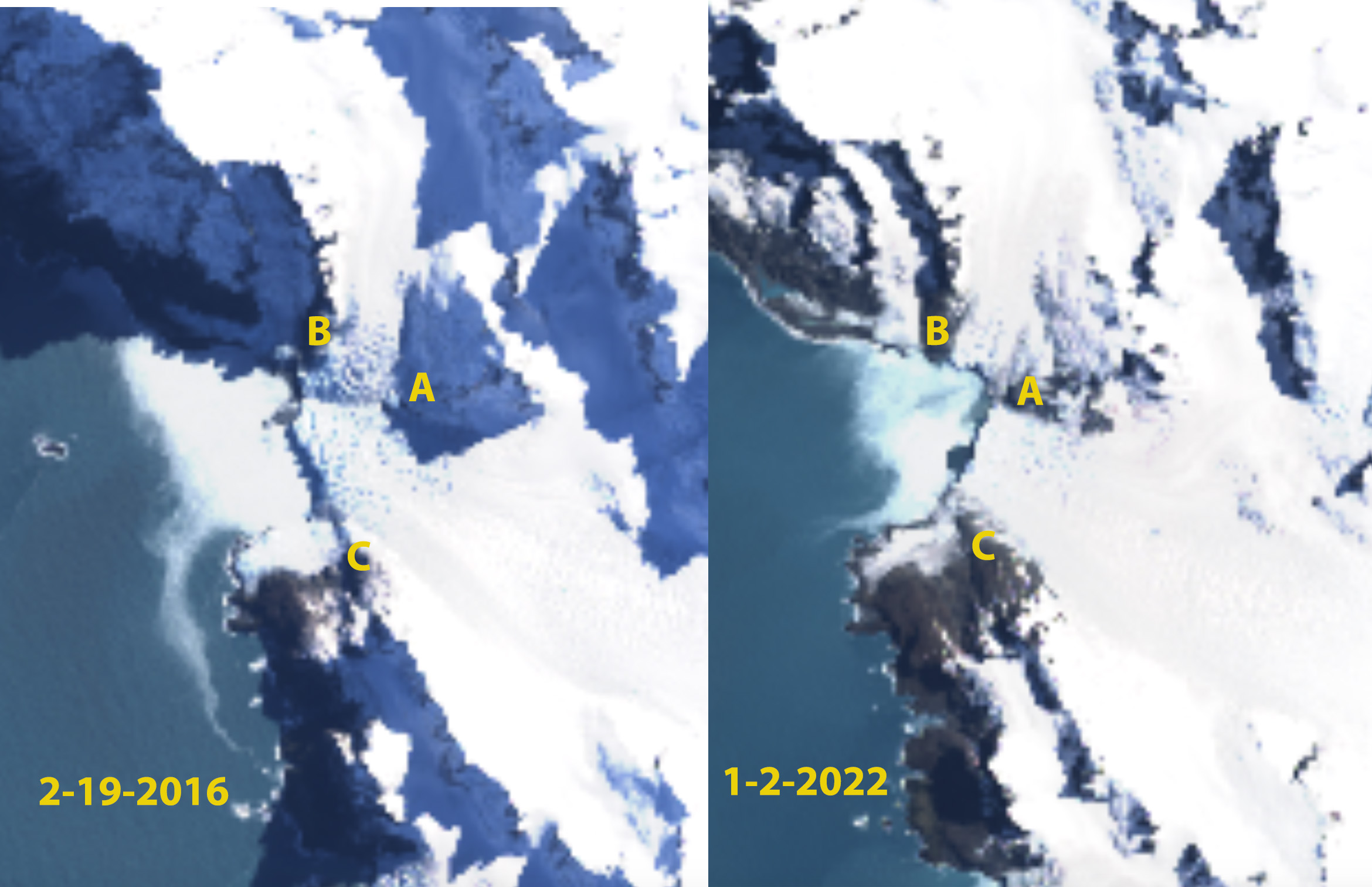
East Creek Glacier, a Braithwaite Icefield glacier in Sentinel images from 2018, 2019 and 2021 illustrating the at Point A and B  where the glacier has disconnected from other glaciers of the icefield . Point C is a the terminus of one icefield outlet glacier that develops a proglacial lake. Point D is adjacent to the ice divide where ice flows both north and south from.  Note the area is snow free in 2018, 2019 and 2021. The ice divide has ~12 annual layers exposed as rings.

The Braithwaite Icefield is east of Hobson Lake is in the Columbia Mountains an interior range of British Columbia. Our focus here is on a glacier at the headwaters of East Creek, “East Creek ” Glacier. This glacier has experienced changes that exemplify the recent changes of glaciers across western Canada. An extensive western Canada glacier inventory of the 1984-2020 period using optical satellite imagery noted an accelerated area loss Bevington and Menounos (2022).  Specifically they quantified glacier fragmentation accelerated from 26  to 88  occurrences per year. They note that about 1141 glaciers disappeared from the inventory falling below the 0.05 km2 detection limit. The retreat also led to proglacial lake area formation accelerating from ~9 km2/year to 49 km2/year.

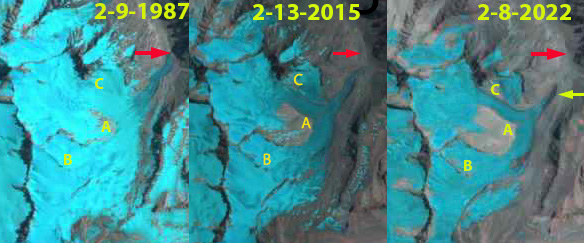
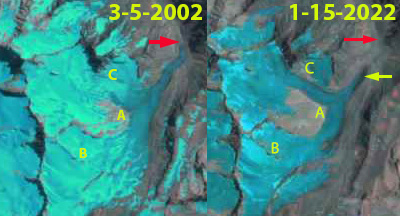
In 1987 East Creek Glacier accumulation zone adjacent to Point D drains north and south to separate terminus areas. In 1987 the outlet glacier that terminates at Point C is connected at Point B to the East Creek Glacier at its southern terminus.  Adjacent to its northern terminus it is connected at Point A to another icefield glacier.  By 2015 the glacier has separated at Point B from the outlet glacier terminating at Point C. There is not retained accumuluation at the glacier divide adjacent to Point D. This exposes a ring of ~12 annual layers preserved in glacier ice, from former annual accumulation layers that had been retained. In the ensuing summers of 2016, 2017, 2018 2019 and 2021 all of the snowpack was lost. Two proglacial lakes have formed, the area of the lake at the East Creek southern margin is 0.03 km2, the area of the lake at Point C is now 0.1 km.

The persistent lack of an accumulation zone indicates the glacier cannot survive (Pelto, 2010).  The glacier still has an area of 2.5 km2, that will allow it to endure for several decades. Ben Pelto,  and Menounos a(2021) reported that the mass balance of Zillmer Glacier, due east in the same range, had a mean negative balance of ~-0.7 m/year from 2014-2018, with an average ELA of 2465 m. The glacier had a mean altitude of 2380 m and a high elevation of 2860 m. The mean elevation of Zillmer Glacier is higher than the divide on East Creek Glacier, which along with a relatively steep mass balance gradient of 5 to 8 mm w.e. m-1, leads to the glacier maintaining an accumulation zone.  The retreat is not as substantial as many glaciers in the region, note Kiwa Glacier or Franklin Glacier, but the overall changes are profound.

East Creek Glacier a Braithwaite Icefield glacier in Landsat images from 1987, 2015, 2019 and 2021 illustrate the changes. Point A and B are points where the glacier is connected to other glaciers of the icefield that separate-fragment during this period. Point C is a the terminus of one icefield outlet glacier that develops a proglacial lake. Point D is adjacent to the ice divide where ice flows both north and south from.  Note the area is snow free in 2015, 2019 and 2021.


Changsang Glacier, Sikkim 2 km retreat and Lake Expansion 1989-2021

Changsang Glacier in Landsat images from 1989 and 2021, illustrating a 2.05 km retreat from 1989 terminus position-red arrow to the 2021 terminus position-yellow arrow.  Formation of a new lake is also evident. The snowline is marked by purple dots.

Changsang Glacier (Karda Glacier) is a valley glacier just north of Kanchengjunga, Nepal/Sikkim. A comparison of Landsat imagery from 1989 to 2021 identifies the formation of a lake at the end of the glacier.

The Changsang Glacier was reported to be retreating 22 m/year from 1976 to 2005 (Raina, 2009). Shukla et al (2018) inventoried lakes in Sikkim during the 1975-2017 period and found 35 proglacial lakes in contact with a glacier in 2017. The number and area of these lakes had increased 34% and 90% respectively during this period. One of the rapidly expanding lakes is at Changsang Glacier.

In 1989 there is no evidence of a significant lake either on top of the glacier-supraglacial or proglacial, at the end of the glacier. In 2000 there are a several small lakes beginning to develop with a combined area of 0.22 km2 (Shukla et al., 2018), the snowline is at 5650-5700 m. In 2002 the supraglacial lakes are noticably more connected, and the snowline is at 5700 m in mid-December . By 2011 the main lake is 1000 meters long and has one debris covered ridge that separates it from a second lake. By 2015 the lake has expanded incorporated the second lake and is now 1600 meters long with an area of 0.70 km2 .  The snowline is notably high at 6000 m in mid-October . On Christmas Day 2020 the snowline is particularly high at 6100 m, reflecting the warm post-monsoon early winter period observed at Mount Everest last year (Pelto et al , 2021). In December 2021 the proglacial lake at ~5400 m is 0.93 km2 and the glacier has retreated 2050 m since 1989. Lake expansion since 2015 has been slower. The lake is impounded by a 400 m wide moraine belt on the low slope valley floor beyond the lake margin, and does not appear to be a significant GLOF risk. The retreat of this glacier is similar to that of Kokthang Glacier and Middle Lhonak Glacier.

Changsang Glacier in Landsat images from 2000 and 2020 illustrating retreat from 1989 terminus position-red arrow to the 2021 terminus position-yellow arrow.  Transition from small supraglacial lakes to a single proglacial Lake is evident. The snowline is marked by purple dots, which in late Deember 2020 reached 6100 m.

Changsang Glacier in Landsat images from 2002 and 2015 illustrating retreat from 1989 terminus position-red arrow to the 2021 terminus position-yellow arrow.  Coalescing supraglacial lakes into a single proglacial lake is evident. The snowline is marked by purple dots which in October 2015 reached 6000 m.