Benito Glacier, Chile 2021 Calving Event Drives Further Retreat


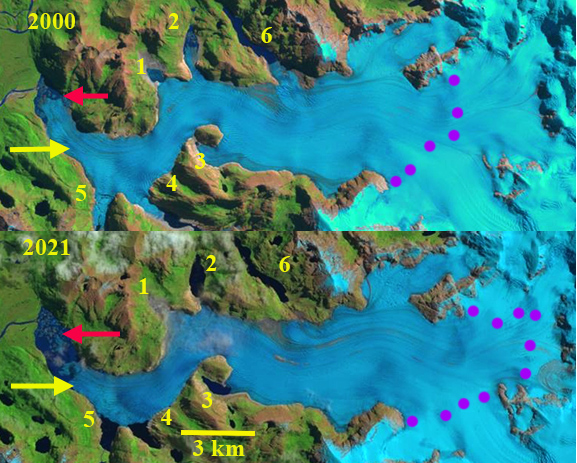
Benito Glacier in 2000 and 2021 Landsat images. Locations 1-6 are current or former distributary terminus locations. Red arrow is the 2000 terminus location and yellow arrow the 2021 terminus location.  A small cloud is obscuring an iceberg near terminus.  Purple dots are the snowline.

Benito Glacier is a temperate outlet glacier on the west side of the North Patagonian Icefield terminating in an expanding lake. The glacier is south of  San Quintin Glacier and north of Acodado GlacierLoriaux and Casassa (2013) examined the expansion of lakes of the Northern Patagonia Ice Cap. From 1945 to 2011 lake area expanded 65%, 66 square kilometers. Ryan et al (2018) identified thinning of 2.8 m/year in the ablation zone from 2000-2013, and that thinning of over 120 m extended from the terminus to ~750 m from 1973-2017. Mouginot and Rignot (2015)  indicate that the velocity of Benito Glacier is between 200-500 m per year along the center line below the snowline. Glasser et al (2016) note the glacier has limited debris cover and that the average transient snowline in 2013-2016 is at 1000 m, substantially above the ~900 m average from earlier.

Benito Glacier in 1987 main terminus was on an outwash plain.  The glacier has five distributary termini (1,2,34,5,6) two of which had open proglacial lakes in 1987.  At Point 3 the glacier flows around a nunatak and reconnects. In 2000 a 1 km long proglacial has formed at the main terminus.  Distributary termini 1,2 and 4 all have proglacial lakes.  The snowline in 1987 and 2000 is 800-825 m. By 2015 there are  five ending in lakes, with Lake 6 having retreated out of a lake basin. A lake has formed at the new distributary terminus at Lake 3. The two tributaries to the north indicated with arrows each retreat approximately 1 km from 1987 to 2015 and in both cases are no longer calving termini.  The main glacier terminus has retreated into a proglacial lake, with a retreat of 2 km from 1987 to 2015. The lowest 1.5 km  has a low slope and peripheral lakes suggesting the lake will expand substantially as Benito Glacier retreat continues. The transient snowline in 2015 is at  900 m. In 2021 a significant iceberg 0.4 km2 has calved off the terminus.  The terminus has retreated 2900 m from 1987-2021 with the lake area expanding to 2.8 km2.  The lower 1.5 km of the glacier remains low sloped suggesting significant lake expansion is ongoing. The glacier no longer reaches the former proglacial lake 2 or 6. Proglacial lake 1 has drained. Proglacial lake 2,3, and 4 continue to expand. The snowline on Feb. 6 2021 is at 875-900 m, rising to 925-950 m by March 16, 2021.

March 17, 2021 Landsat image indicating iceberg located off front of Benito Glacier


Benito Glacier comparison in Landsat images from 1987 and 2015 indicating the terminus position in 1987 red arrows, yellow arrows the 2015 terminus positions. Locations 1-6 are current or former distributary terminus locations. purple arrows where glacier thinning is expanding bedrock areas. The snowline is indicated by purple dots

Bonar Glacier Retreat, New Zealand

Bonar Glacier in 1992 and 2021 Landsat image.  Red arrow is the 1992 reconstituted terminus location, yellow arrow the 2021 terminus location and purple dots the snowline.

Bonar Glacier is on the west flank of Mount Aspiring flowing north from Mount before turning sharply west and descending towards a lake and draining into the Waipara River. The NIWA glacier monitoring program noted that  30 per cent of New Zealand’s ice that was existed in the late 1970s has been lost in the past 40 years as snowlines have been rising. The retreat has been driven by a series of  increasingly warm summers (NIWA, 2019).  Bonar Glacier is one of the six largest west side glaciers in the NZ Alps  and has no significant debris cover (Baumman et al 2021). Here we examine Landsat imagery from 1992-2021 to identify changes.

In 1992 the glacier descends west down the steep slope to its terminus at 1150 m avlanching down the steep slope to a reconstituted glacier at the head of a 1 km long proglacial lake at ~550 m.  In 2001 there is no reconstituted glacier at the lake, the terminus is at ~1200 m in elevation. By 2020 the glacier terminus has receded to ~1250 m, the snowline is at 1900 m above the first icefall in early March. In 2021 the glacier has retreated 200 m, with its overall length being reduced by 3%  since 1992. The snowline in 2021 is again at the top of the 1900 m icefall.

The retreat is more limited than at either Volta Glacier  which is on the east side of Mount Aspiring, or at Snow White Glacier  to the southwest. The mean elevation of glaciers in New Zealand is 1950 m (Baumman et al 2021). The mean elevation of Bonar Glacier is 2075-2090 m, which has enabled the glacier to endure recent warming better.

Bonar Glacier in aerial image from 2020, with red arrow indicating 1992 terminus location, note heavily crevassed areas on the east side draining from 2500 m on the slopes of Mount Aspiring and at the three icefalls areas on the main glacier.

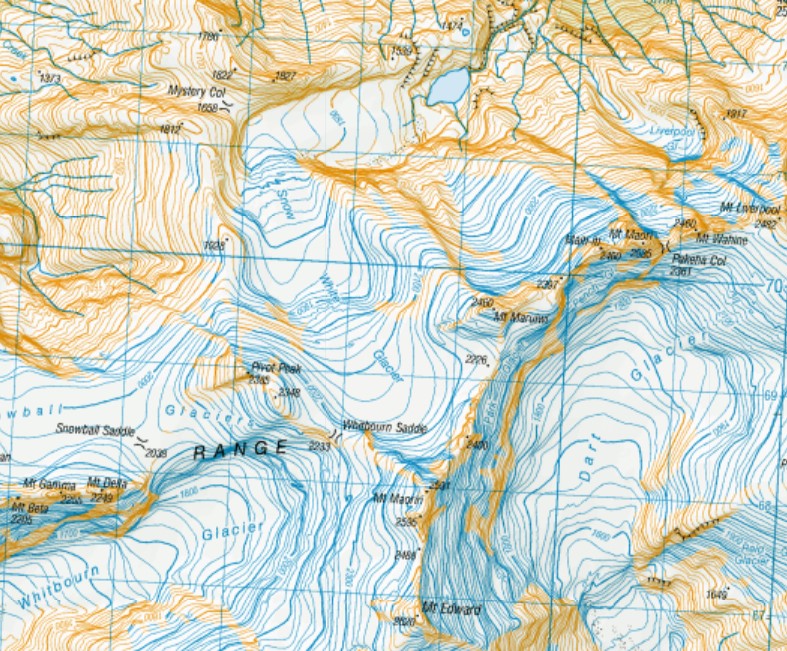
Bonar Glacier topographic map, blue arrows indicate glacier flow. Icefalls at 2000 m, 1800 m and from 1600 m to the terminus at 1300 m.

Bonar Glacier in 2001 and 2020 Landsat image.  Red arrow is the 1992 reconstituted terminus location, yellow arrow the 2021 terminus location and purple dots the snowline.

Art and Science on the Easton Glacier: Reflections from the NCGCP 2020 Field Season

The field team at Camp discussing science communication and gazing at the Easton Glacier. Photo by Jill Pelto

By: Cal Waichler, Jill Pelto, and Mariama Dryak. 

It is the evening of Aug. 9th, 2020 and six of us are camped near the terminus of Easton Glacier. The sun has dropped below the moraine ridge above camp and a chilly breeze has forced us to put on layers. We are enjoying dinner cooked on our camp stoves, discussing what we observed on the ice today.  The toll of climate change on Easton Glacier, on the southern flank of Mount Baker, is impossible to escape. We are here to both measure this change and communicate what it means.

Within our team of six, four of us are trained as scientists, and all of us highly value creative science communication. This passion can manifest as art (painting, printmaking, sketching), writing, podcasting, blogging or video-making. We all appreciate that exercising creativity with others can provide us with a unique context for communicating about glaciers and climate change. 

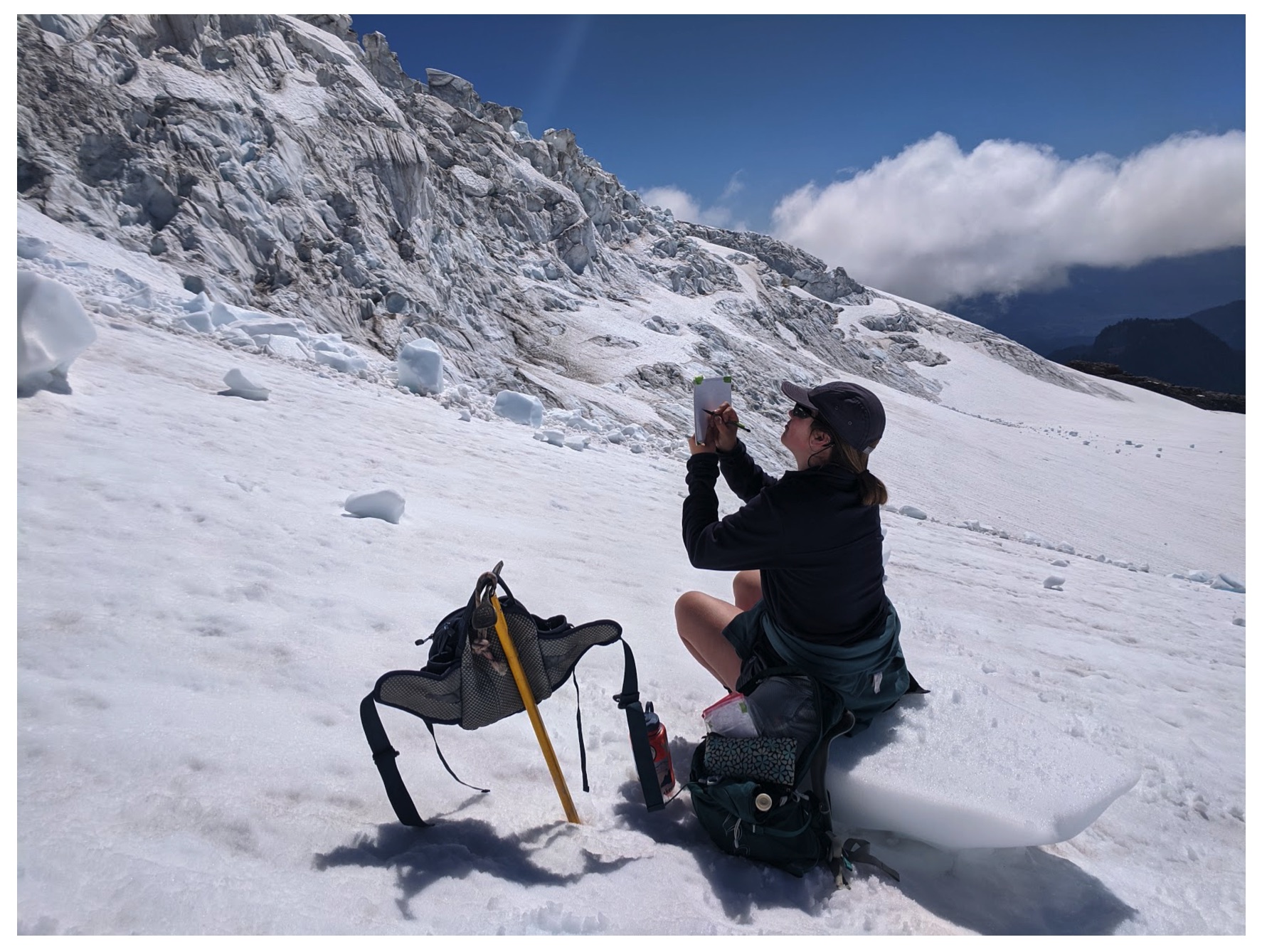
Cal creates at Columbia Glacier–sketching and taking notes to capture the power of our lunch spot that day. Photo by Mariama Dryak.
Jill paints the icefall. Photo by Mariama Dryak.                                                                                                                                                                                                                  .

The Easton Glacier is large and stretches up to 2950 m elevation. We are here to monitor its health for the 31st consecutive year: its snow coverage, snow depth, terminus retreat, change in surface profile, and its annual mass balance (snow gain vs. snow loss). Easton Glacier is one of the forty-two World Glacier Monitoring Service reference glaciers, meaning it has 30+ consecutive year of mass balance observations, qualifying it for this select group. To learn more about this glacier over time, check out https://glaciers.nichols.edu/easton/  and a previous Easton Glacier update.

While we are at Easton Glacier to measure annual changes, we also see this landscape in the realm of both art and science. From the artistic lens we may note the same things that we do during research: the debris covering the retreating terminus, the crevasses melting down and getting shallower. But we also notice the beauty of these structures, how the crevasse patterns splay out across a knob, and the parallel lines preserved on a serac – recording five years of accumulation like rings on a tree. Observation is a theme in both art and science. We train our eyes to notice things in different ways, to pay attention to certain details. We are able to document these changes in our field notebooks, but also in sketchbooks, journals, photos, and videos.

The records of beauty stored in our sketchbooks serve as a qualitative reminder of what this landscape looks and feels like. In the process of depicting the landscape at the end of a field day, we paint our joy and exhaustion onto the page. In the moment, this act uncovers more details and allows us to reflect. Weeks later when we are off the mountain, we reopen our water-logged, dirt-streaked pages and are taken back to that place where we were. Field sketches, poems and paintings help us capture the emotion of moving through and attempting to understand sublime spaces. They are a vital link between our memories and sharing the meaning of our experience with others. They are also a deliberate recording of time and place — a kind of data in their own right.

The experience of working in this environment is memorable to us — we get to observe a plethora of crevasses, dozens of meltstreams, and strikingly beautiful colors. We can feel a range of excited, inspired, and nervous emotions throughout the day. For us, this experience is giving us the emotional context to our research: being present we can understand that “why”. That reason why the work matters not just for scientific knowledge, or the local ecosystem, but also for humanity. The science results alone can share the data that underlies that, but they might not always connect with other people in a way that elicits that comprehension. Our creative communication through writing and art can elicit that deeper, emotional understanding of why it’s important to preserve and protect these places, and why we need to understand the amount of change that will occur to the climate and ecosystem. Our collection of art shares stories about Easton Glacier in ways that connect with the science, and also go beyond it. 

This summer we all felt especially fortunate to be in the North Cascades. Covid-19 has kept us all so isolated and often indoors. The chance to work on the glaciers and live at their feet for two weeks gave us back some of the breathing room we lacked in 2020 – a lucky opportunity indeed.

Cal’s Art – clairewaichler.com

Mariama’s website – Let’s Do Something Big

Jill’s Art – jillpelto.com


Snow White Glacier, New Zealand Withers with Climate Change in 21st Century

Snow White Glacier in Landsat images from 2002, 2016 and 2021.  Point A is an alpine lake, Point B is  new proglacial lake location, Point C is lower icefall and Point D the Upper Icefall.  Blue arrows indicate glacier flow.

The Snow White Glacier is in the Snow Drift Range and Olivine Wilderness in Mt Aspiring National Park, New Zealand. The glacier flows north from 2400 m on the slopes of Mount Maoriri and Maruiwi through an icefall at 2000 m (D) and a second icefall (C) at 1700 m before taking a sharp eastward turn for the terminus reach and then draining into the Arawhata River. The NIWA glacier monitoring program noted that  30 per cent of New Zealand’s ice that was existed in the late 1970s has been lost in the past 40 years as snowlines have been rising. The retreat has been driven by a series of  increasingly warm summers (NIWA, 2019). The NIWA 2021 snowline survey indicated near normal average end of summer snowline despite a La Nina (Drew Lorrey in NZHerald, 2021). Here we report on changes in Snow White Glacier using Landsat and Sentinel imagery from 2002-2021.

In a 2002 Landsat image Snow White Glacier had a wide terminus tongue filling a basin at Point B ~1400 m in elevation, 600 m from a small lake at Point A. The glacier is 400 m wide at the lower icefall and 600 m wide at Point B. By 2016 the lower icefall reach is down to 200 m in width, which means less ice is flowing from high on the glacier to the terminus.  As a result the terminus lobe width has been reduced to 300 m and an incipient glacial lake is forming near Point B. By 2020 in a Sentinel image and Digital Globe image the lake forming at Point B is evident fringing much of the glacier. Notice the snowline reaches the upper icefall in 2020, and the icefall at Point C is too narrow to be stable.  The lake in the Digital Globe image has an area of 0.1 km2. The icefall connection is less than 100 m wide and will soon disconnect the upper glacier from the terminus. In 2021 Landsat imagery indicates the terminus lake is continuing to expand and the icefall reach is even more tenuous. The glacier has retreated 450 m since 2002. The impending detachment will lead to a jump in the retreat to the new active terminus in the lower icefall, with the 1 km long stagnant tongue left behind.

This glaciers retreat parallels that of other glacier in the region such as Gunn Glacier and Donne Glacier, where new alpine lakes have recently formed also. The detachment is quite similar to that of Volta Glacier.

Digital Globe 2020 image of the terminus reach of Snow White Glacier indicating new lake near Point B.

.

Snow White Glacier in Sentinel and Digital Globe image from 2020.  Point A is an alpine lake, Point B is  a new proglacial lake, Point C is the lower icefall and Point D the Upper Icefall. 

Topographic map of Snow White Glacier from NZTopo Map


Bailang and Angge Glacier, China Retreat and Lake Expansion 1995-2020

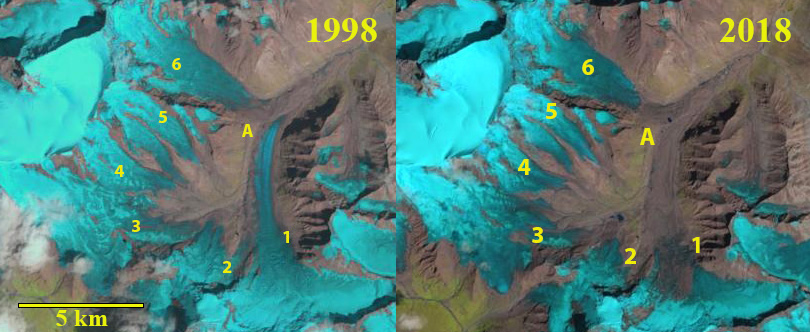
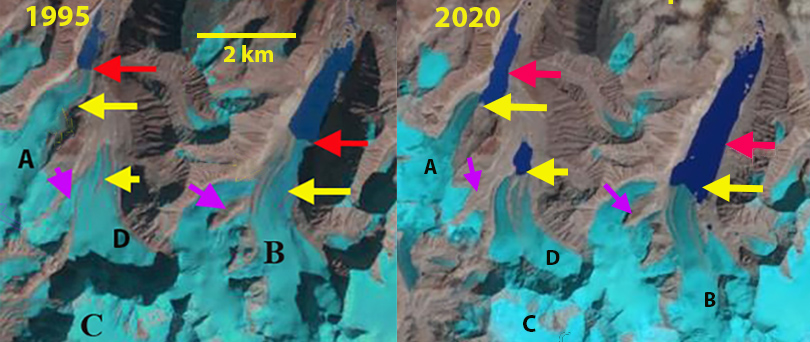
Bailang (B) and Angge Glacier (A) in 1995 and 2020 Landsat images indicating retreat and lake expansion. Red arrow is the 1995 terminus location, yellow arrow the 2020 terminus location, purple arrow rock ridges that expand separating tributaries. Chubda Glacier (C) to the south and an unnamed glacier Point D between Angge and Bailang.

Bailang Glacier and Angge Glacier, China are adjacent to the Chubda Glacier, Bhutan, They drain north from Chura Kang and are summer accumulation type glaciers that end in proglacial lakes. The glacier runoff feeds the Xung Qu River a tributary of the Kuri Chhu in Bhutan that powers the Kurichhu Hydropower plant a 60 mw run of river plant in Eastern Bhutan. Both lakes are impounded by broad moraines that show no sign of instability for glacier lake outburst flood. The number of glacier lakes in the adjacent Pumqu Basin to the west has increased from 199 to 254 since the 1970’s with less than 10% deemed dangerous (Che et al, 2014).  In the Yi’ong Zangbo basin to the east  Hongyu et al (2020) observed that from 1970 to 2016 total area of glaciers in the basin  decreased by 35%, whereas the number of glacial lakes increased by 86. Here we compare Landsat images from 1995 and 2020 to identify their response to climate change.

Bailang Glacier in 1995 terminated in a proglacial lake that was 2.1 km long at an elevation of ~5170 m, red arrow. Angge Glacier terminated in a lake that was 1 km long at an elevation of ~5020 m. Between the two is an unnamed glacier labeled “D” here that does not end in a proglacial lake.  By 2001 both glaciers experienced minor retreat of less than 250 m.  By 2014  Bailang Glacier had retreated  800-900 m and the lake was now 3 km long and had no change in water level.  A key tributary on the west side near the purple arrow had also detached. Angge Glacier retreat from 1995 to 2015 was 700 to 800 m, with the glacier retreating to a westward bend in the lake basin.  The glacier has an icefall just above the current terminus suggesting the lake basin will soon end, which should slow retreat.  The D Glacier between them has developed a proglacial lake as well. By 2020 the Bailang Glacier has retreated 1300 m since 1985 and has lost connection with tributaries on either side of the ridge on the west side of the glacier noted by the purple arrow. Angge Glacier has retreated 1100 m since 1995 and has a very narrow connection to the lake, which is now ~2 km long. The glacier in between Bailang and Angge, D Glacier, has developed a 900 m long proglacial lake which also matches the retreat during the last 25 years. This glacier has lost contact with its western tributary as well at western purple arrow.

The reduced lake contact at Angge Glacier is similar to that seen at Shie Glacier, while the lake expansion at Bailang Glacier is similar to that at Daishapu Glacier and Drogpa Nagtsang Glacier.

Bailang (B) and Angge Glacier (A) in 2001 and 2014 Landsat images indicating retreat and lake expansion. Red arrow is the 1995 terminus location, yellow arrow the 2020 terminus location, purple arrow rock ridges that expand separating tributaries. Chubda Glacier (C) to the south and an unnamed glacier Point D between Angge and Bailang.

Gorra de Nieve East Glacier, Chile Retreat-Lake Expansion

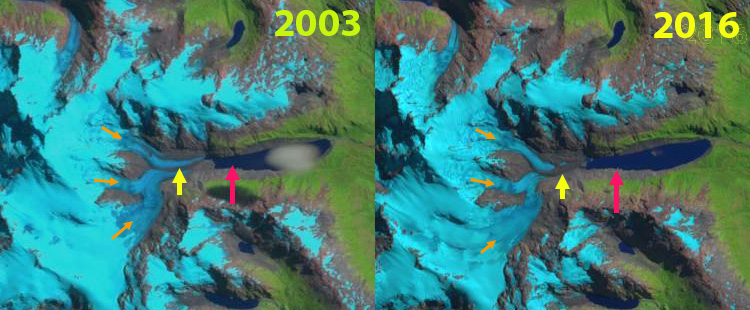
Gorra de Nieve East Glacier in 1986 and 2021 Landsat images. Red arrow is the 1986 terminus location, yellow arrow is the 2021 terminus location, orange arrows the three main tributaries.

The Gorra de Nieve massif is 50 km southwest of Monte San Lorenzo, draining its eastern flank the largest glacier of this massif is unnamed and referred to here as Gorra de Nieve East Glacier. The glacier consists of three main tributaries that join shortly above the proglacial lake the glacier has terminated in, which drains into the Rio Bravo. In this region glaciers thinned by ~0.5 m/year from 2000-2012 with most of the thinning on  Gorra de Nieve East Glacier occurring on the lower sloped valley section below 1100 m (Falaschi et al 2017). The glacial history of the region is detailed in a visual map that includes moraines and trimlines including around the expanding proglacial lake discussed here Davies et al (2020).  Here we examine the changes of the glacier and the expanding proglacial lake from 1986 to 2020.

In 1986 the glacier terminated in a 3 km long proglacial lake, red arrow.  Three primary tributaries joined ~2 km above the terminus at 900 m, orange arrows. By 2003 the glacier has retreated ~500 m and the lateral moraines have become more prominent covering a majority of the glacier width.  By 2016 the glacier has retreated ~900 m from the 1986 position and lateral moraine debris covers nearly the entire lower 1 km of the glacier.  In 2021 the tributaries are separating with the northern tributary the only one feeding the terminus. The glacier has retreated 1500 m since 1986 and the proglacial lake is 4.5 km long.  The two southern tributaries will separate soon and the northern tributary will also retreat from the lake.

The retreat is similar to that  at San Lorenzo Sur Glacier or Calluqeuo Glacier.

Gorra de Nieve East Glacier in 2003 and 2016 Landsat images. Red arrow is the 1986 terminus location, yellow arrow is the 2021 terminus location, orange arrows the three main tributaries.

Nellie Juan Glacier Loses Contact with Contact Glacier, Alaska

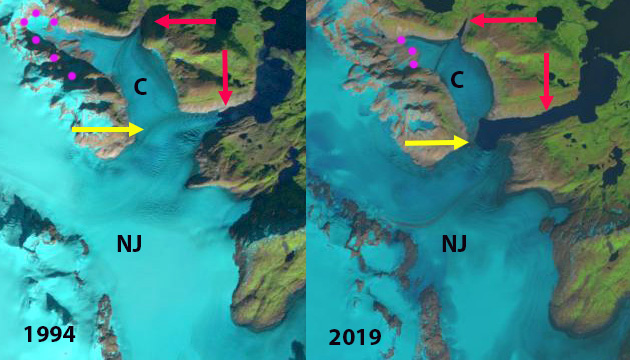
Nellie Juan Glacier (NJ) and Contact Glacier (C) in 1986 and 2020 Landsat images. Red arrow is the 1986 terminus location of both glaciers. Yellow arrow marks the terminus location in 2020 after glacier separation and purple dots mark the upper limit of Contact glacier at that time.

Nellie Juan Glacier is a tidewater outlet glacier of the Sargent Icefield, Alaska. Just after 1935 the glacier retreated from moraine shoal into deeper water of the fjord leading to a rapid calving retreat of 2250 m from 1950-2000, a rate of ~45 m/year (Barclay et al 2003).  The rate of retreat increased to ~124 m/year from 2006-2018 (Maraldo, 2020).  Harbor seals enjoy Port Nellie Juan and the icebergs from the glacier, with a population of ~44,000 identified in 2019 for the greater Prince William Sound region. From 1950-2018 Port Nellie Juan was fed in part by the Contact Glacier, a tributary that also had a separate terminus.  Here we examine the changes of Nellie Juan and Contact Glacier using Landsat imagery from 1986-2020.

In 1986 the glacier terminated in a 0.5-km-wide calving front 1 km down fjord from the junction with Contact Glacier, which was 2 km wide. The snowline is at 500 m, the upper margin of Contact Glacier is indicated by purple dots and ranges from 400-500 m.  The retreat by 1994 is ~300 m, the snowline is at 500 m and Contact Glacier has almost no snowcover. In 2000 the connection with Contact Glacier is 1.9 km wide. By 2018 terminus retreat in the center of Nellie Juan Glacier since 1986 is 2500 m.  There is fringing connection of ice 300 m wide with Contact Glacier. Contact Glacier upper margin is now at 250 m, resulting in a more rapid retreat of the head of the glacier on the northern arm 1800 m since 1986, than that of the main terminus of Contact Glacier of 500 m. The snowline in 2018 is at 900 m, leaving the primary accumulation zone of Nellie Juan Glacier without snowcover.  In 2019 there is still a narrow connection between Nellie Juan and Contact Glacier. In 2020 the two glaciers have separated.  Contact Glacier, which had an area of 6.5 km2 in 1986, in 2020 has an area of 3.5 km2.  Contact Glacier has lacked an accumulation zone during most years in this period and cannot be sustained. Nellie Juan Glacier has retreated 2800 m along the former centerline and what is now its northern margin since 1986.  In 2020 the main accumulation area of Nellie Juan Glacier is again without snowcover, with a snowline above 900 m.

The glacier is terminating near a region of prominent crevassing indicating a bedrock step that may mark the head of the fjord. This will lead to an end to calving retreat and iceberg production, which will impact harbor seal haul out in the fjord (Jansen et al 2015). The retreat of Nellie Juan is less extensive than at Excelsior Glacier or Ellsworth Glacier draining the south side of the icefield. The percent loss in area of Contact Glacier is greater than other regional examples.

Nellie Juan Glacier (NJ) and Contact Glacier (C) in 1994 and 2019 Landsat images. Red arrow is the 1986 terminus location of both glaciers. Yellow arrow marks the terminus location in 2020 after glacier separation and purple dots mark the upper limit of Contact glacier at that time. In 2019 the glaciers are still connected.

Nellie Juan Glacier (NJ) and Contact Glacier (C) in 2000 and 2018 Landsat images. Red arrow is the 1986 terminus location of both glaciers. Yellow arrow marks the terminus location in 2020 after glacier separation and purple dots mark the upper limit of Contact glacier at that time. In 2018 the glaciers are still connected

HPN4 Glacier, Chile New Lake Forms and Drains in 2021

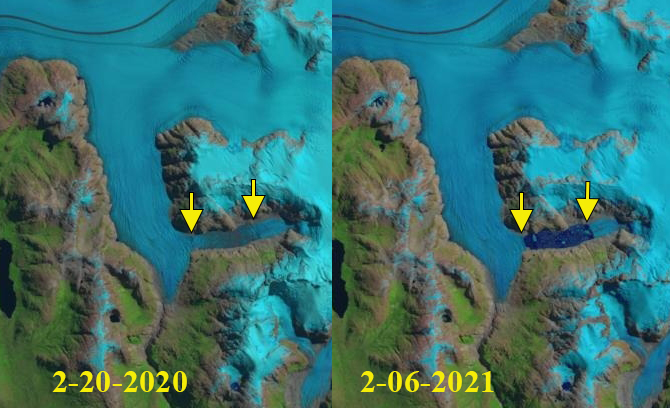
Glacier dammed lake formation at HPN4 Glacier, Chile between Landsat images of Feb. 2020 and Feb. 2021, yellow arrows indicating new calving fronts on either end of lake. 

HPN4 Glacier drains the southern side of NPI just east of Steffen Glacier. The terminus retreated little from 1987-2015, see below (Pelto, 2015 and 2017). The main change is in the eastern tributary 1-2 km north of the terminus. In 1987 there were five separate feeder ice tongues descending from the ice cap into this valley.  By 2015 there was just one.  Further this tongue has narrow and downwasted and a new lake is developing.

In February 2020 the lake has still not formed, note yellow arrows. In February 2021 the lake has formed between the yellow arrows and is 2 km long and has an area of 1.1 km2. The drainage of this lake was reported by on Claudio Bravo Lechuga comparing PlanetLab images from 2-15-2021 and 2-23-2021.

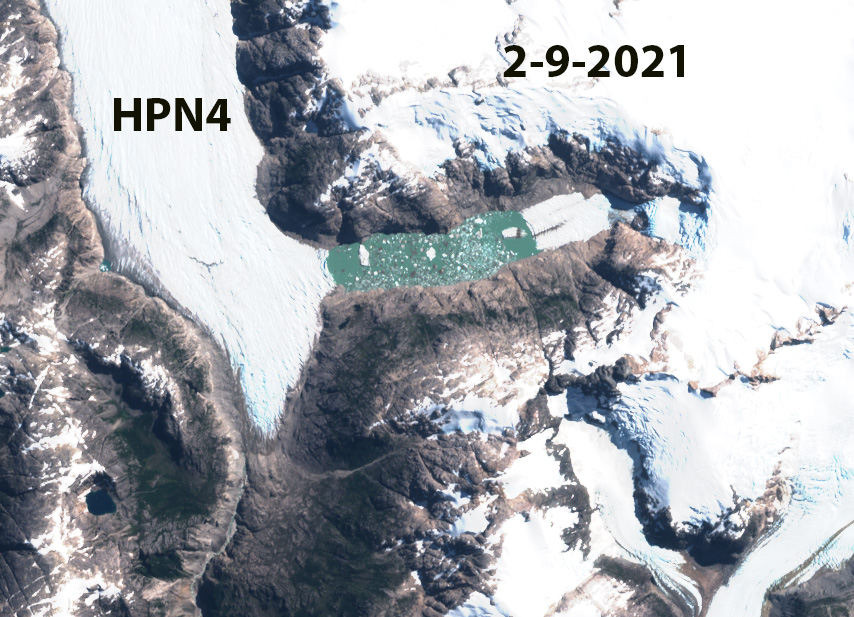
HPN4 and glacier dammed lake in Sentinel2 Image from 2-9-2021.

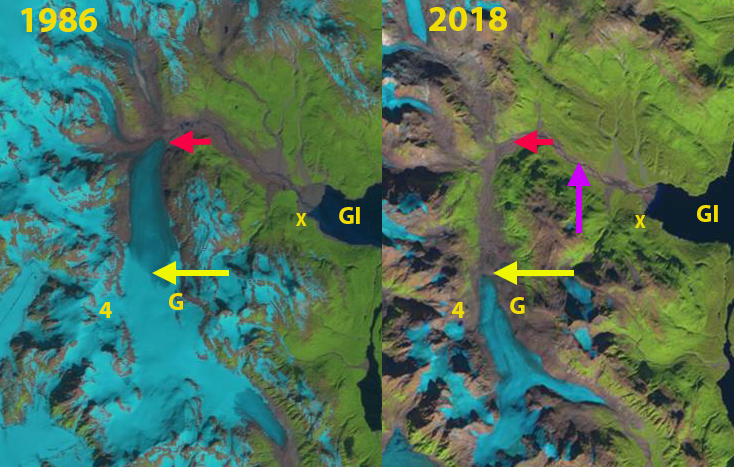
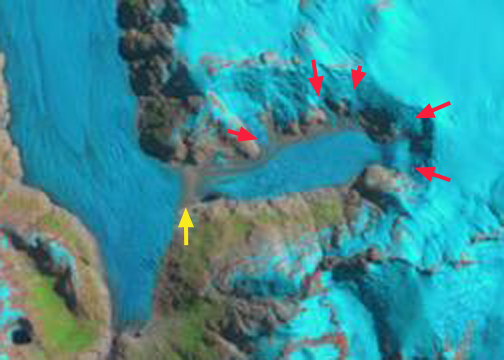
HPN4 Glacier in 1987 and 2015 Landsat imagery.  Red arrow indicates 1987 terminus, yellow arrow 2015 terminus, purple arrows indicate medial moraines

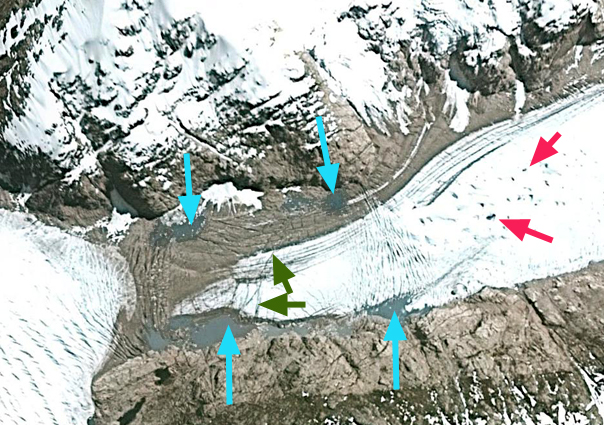
The below is from Pelto (2015 and 2017). In 1987  and 2004 there were five contributing glacier tongues to the downwasting tributary, see below. It is like a bathtub being filled with five taps at once. The purple arrow indicates a medial moraine at the mouth of the valley, signaling the lack of current contribution of the downwasting tributary to HPN4 Glacier.  The medial moraine has shifted east indicating that the main HPN4 Glacier is now flowing into the valley instead of the downwasting tributary being a contributing tributary to HPN4.  By 2015 there is only one contributing glacier tongue to the downwasting tributary, only one tap for this draining bathtub, the other four contributing tongues have retreated from contact with the downwasting tributary.  The medial moraine has spread eastward and some fringing proglacial/subglacial lakes are evident  A closeup 2013 Digital Globe image indicates both fringing ponds-blue arrows, rifts caused by varying flotation-green arrows and expanding supraglacial ponds, red arrows.  The rifts are a sign of instability and typically lead to break up of this portion of the terminus. The downwasting tributary continues to demise faster than HPN4 Glacier, which crosses the valley mouth, hence it is likely that a glacier dammed lake will form and that HPN4 Glacier will continue to flow further east up this valley.

Schaefer et al (2013) discuss the HPN4 Glacier because the main terminus has changed little given its modeled mass balance, and the modeled mass balance to the east appears too negative, which they suggest indicates wind redistribution from the HPN4 to the Pared Sud Glacier just east. Davies and Glasser, (2012)  identify this region of the icefield as retreating faster from 2001-2011 than during any measured period since 1870.  This has led to the formation and expansion of many lakes in the basin Loriaux and Cassasa (2013)Glasser et al (2016) observed that proglacial and ice-proximal lakes of NPI increased from 112 to 198 km2. The largest expansion this century being at San Quintin Glacier at ~24 square kilometers.

hpn-4 2004

2004 Landsat image showing five contributing tributaries

hpn4-ge

Google Earth image 2013

Tres Puntas Glacier, Chile Loses 50% of its Length this Century

Tres Puntas Glacier, Chile in 1999 and 2021 Landsat imagery. Red arrow is 1999 terminus location, yellow arrow the 2021 location, Point A is where tributaries joined in 1999 and Point B is where an adjacent glacier drains west.

Tres Puntas Glacier flow south from Cerro Tres Puntas draining south into Lago O’Higgins in Patagonia. The icefield is east of the Patagonia icefields where Davies and Glasser (2012) noted the nearby (50 km se) Lago Del Desierto glaciers lost 0.6% of its glacier area from 2001-2011, a much higher rate than from 1986-2000.

In 1999 the glacier is 5.6 km long with two significant tributaries joining at 850 m (Point A) before terminating in a proglacial lake at 600 m. The glacier shares a broad divide near Point B with glacier flowing west. In 2002 the snowline is at 1100 m, the terminus is still terminating in the proglacial lake. By 2020 the glacier tributaries have separated and now terminates at 900 m, above Point A. At Point B there is a separation between this glacier and the glacier draining west. By mid-February of 2021 the west tributary has retreated 2.8 km, 50% of its 1999 length, while the eastern tributary has retreated 2.4 km of its 5.0 km length. The snowline in mid-February of 2020 and 2021 has been at 1200 m, above the median glacier elevation. Further retreat of the eastern arm should lead to an additional alpine lake forming.

The retreat of this glacier is more extensive than that of the nearby Sierra Sangra glaciers,  Argentina.  The retreat from an expanding proglacial lake also has played out at Cordillera Lago General Carrera Icefield, Chile

Tres Puntas Glacier, Chile in 2002 and 2020 Landsat imagery. Red arrow is 1999 terminus location, yellow arrow the 2021 location, Point A is where tributaries joined in 1999 and Point B is where an adjacent glacier drains west.

Potential Preconditioning for Landslide High 2020 Glacier Snow Lines in Rishi Ganga Basin, India 2020

Snowline elevation on Trisul (T) and Bethartoli Glacier (B) in a 10-26-2020 Landsat and 10-18-2020 Sentinel image.  The snowline ranges from 5800-6000 m, purple dots.

The catastrophic landslide and resulting flood in the Rishi Ganga basin Uttarakhand, India on Feb. 7 was triggered on a formerly glaciated slope at 5600 m detailed in a blog post by Petley (2021). This event occurred after a post-monsoon season featuring high snowlines on adjacent glaciers and the warmest January in the last six decades  in Uttarakhand, India. Glacier snowlines are a proxy for the elevation where melting predominates. Were these preconditioning factors? Here we examine the elevation of the glacier snowlines in 2020.

The headwaters of the Rishi Ganga Basin, India feature a number of large glaciers draining the slope of  Nanda Devi, Trisul and other high Himalayan peaks. The response of glaciers of the Rishi Ganga basin to climate change was examined by Kumar et al, (2020). They found a 10% reduction in glacier area from 1980-2017.  They further observed the ELA to fluctuate from 5200-5700 m.

Nanda Devi region glaciers in 10-16-2020 image indicating the snowline at between 5800 and 6000 m on all the glaciers in the upper Rishi Ganga: Bethartoli (B), Dakshini (D), Ramani (R), Rinti (Ri), Trisul (T), Uttar Nanda Devi (UN), Uttar Rishi (UR).

In 2020 at the end of the summer monsoon the snowline on glaciers in the Rishi Ganga Basin were high at 5600-5700 m on Sept.13 as noted in particular on Trisul (T), Rinti (Ri), Ramani (R), Uttar Rishi (UR), Uttar Nanda Devi (UN), Dakshini (D) and Bethartoli Glacier (B) and an Rinti Glacier to the west that the landslide debris ended falling below. By mid October the snowline on the glaciers had risen to ~5800-6000 m on these seven glaciers in Landsat and Sentinel imagery.  On Ramani Glacier there is no retained snowpack with the top elevation of the glacier at 5800 m. The amount of dark blue bare ice is striking. The snowline indicates an elevation that the freezing level during that year frequently rose above. This indicates the freezing line rose above the trigger elevation site ~5600 m frequently enough in 2020 that melting exceeded snowfall. This is higher than Kumar et al (2020) had observed during the recent period of increased glacier snow lines. By January 11, 2021 the area was blanketed by snow down to 4400 m, the subsequent warm period led to widespread melting and snow cover loss up to at least 5000 m on Trisul Glacier and Uttar Rishi Glacier.  The freezing line and glacier snowline elevations in the post monsoon period are similar to near Mount Everest, where the January warmth led to even greater high elevation melt (NASA, 2021).

Whether the unusually high elevation melting and freezing levels observed on glaciers in the region in 2020 were pre-conditioning cannot be answered with analysis such as this, but it does demonstrate the the elevation range of landslide initiation was below the observed glacier snow lines in 2020 and in an elevation zone that experienced unusual melt conditions in 2020. The increased freezing levels in the region over the last several decades were documented for the Mount Everest area by Perry et al (2020),indicative of a long term trend.

Snowline elevation on Trisul (T) and Bethartoli Glacier (B) in a 9-13-2020 Landsat and 1-20-2021 Sentinel image.  The snowline ranges from 5600-5700 m in September.

Rio Frio Glacier, Chile Retreat-Lake Formation 1990-2020

Rio Frio Glacier (RF) in 1990 and 2020 Landsat images. Red arrow 1990 terminus, yellow arrow 2020 terminus, orange arrow new lakes formed after 2000, purple dots snow line.

The “Rio Frio” Glacier is at the headwaters of the Rio Frio a tributary to Rio Palena in Parque Nacionale Corcovado of Palena Province of Chile.  Davies and Glasser (2012) noted that overall glaciers in the region lost 14% of their area from 1986 to 2011. Paul and Molg (2014)  assessed changes of glaciers in the Palena district, Chile revealing a  total area loss of 25% from 1985 to 2011.  Area loss below 1000m elevation was 50–100% and the number of proglacial lakes increased from 223 to 327. Carrivick et al (2016) reported the glaciers in the region had an average thickness of 41 m, this is relatively thin allowing for the rapid area loss. Here we examine glacier change from 1990 to 2020 using Landsat imagery.

The Rio Frio Glacier terminated in a proglacial lake in 1990 at 720 m and the snowline is at 1100 m.  The next glacier to the south has two arms terminating at 900 m with no proglacial lakes at the terminus see orange arrows. In 2000 there is limited retreat and Rio Frio Glacier still terminates in the lake, and the snowline is at 1150 m. At the next glaciers south there is no proglacial lakes evident at the terminus. By 2019 Rio Frio Glacier has retreated from the lake and the snow line is at 1100 m at the start of February.  The next glacier south two new proglacial lakes have developed at orange arrows. By 2020 the glacier terminus has retreated 500 m to an elevation of ~880 m.  Rio Frio glacier has lost more than 50% of its area below 1000 m.  The glacier still has maintained an accumulation zone each year indicating that without further warming it can survive. The next glacier south has retreated exposing two new proglacial lakes that now are no longer reached by the glacier.

The large scale loss of these two glaciers is typical for the region as noted by the references above and by the examples of Tic Toc Glacier, Erasmo Glacier and Hornopiren Glacier. In this case the two new proglacial lakes are small and no longer in contact with the glacier, result they pose little glacier outburst flood risk. The lake beyond the terminus of Rio Frio Glacier has neither adjacent significant steep slopes or ice in contact and poses little risk as well.

Rio Frio Glacier in 2000 and 2019 Landsat images. Red arrow 1990 terminus, yellow arrow 2020 terminus, orange arrow new lakes formed after 2000, purple dots snow line.

January 2021 Thaw on Mount Everest Region Generates Ablation, Rolwaling Glacier, Nepal

Rolwaling Glacier in October 13, 2020, December 16, 2020 and January 17, 2021 Landsat imagery indicating the snow line rise that has persisted into mid- winter. Snow line indicated by yellow dots.

Recent observations of rising snow lines on glaciers during the October- 2020-January 2021 period in Landsat imagery indicates that once again there is significant ablation occurring  on Himalayan glaciers, as has been the case in several recent years (Pelto, 2017; 2019). For the first time we now have weather stations providing real time data in the Everest region that are high enough to transect the region of post monsoon snow line elevations, emplaced by the Rolex National Geographic Perpetual Planet expedition, with the Base Camp station at 5315 m and the South Col station at 6464 m (Matthews et al 2020). Combining the in-situ weather records and remote sensing data provides a unique opportunity to examine the impact of the warm and dry conditions during the 2020 post monsoon through 2020/2021 winter on Everest region glaciers. The ablation season is ongoing as of January 22, 2021, when will it end? How significant has ablation been during this interval? (For more information See NASA Earth Observatory and paper published by Pelto et al 2021)

On October 13, 2020 Landsat imagery indicates the snow line on Mount Everest region glaciers averages 5600 m. By December 16 the mean snow line had risen to 5800 m (Pelto, 2020). On January 4-5, 2021 a minor snow event covered the area glaciers, which subsequently melted during an unusual warm period that extended from January 10-15. During this six-day January thaw daily maximum temperatures exceeded 3 C at the Base Camp weather station each day, peaking at 7 C on January 13 .  At the Camp 2 weather station temperatures reached above -4 C each day during this period, with a maximum of 1 C on January 10 and 13. The daily maximum freezing line during the six-day period given the winter lapse rate of 0.54 C/100m is ~6000 m. Yes, mid-winter freezing levels at 6000 m on Mount Everest. This indicates melting even if limited in the vicinity of the snow line. From January 9-22 maximum temperatures have exceeded 0 C at Base Camp on 8 days. 

The impact is evident on Rolwaling Glacier which is 20 km south of Nanpa La and 35 km southwest of Mount Everest. This glacier is best known for being the primary glacier feeding the expanding and dangerous Tsho Rolpa, the lower part is often referred to as Trakarding Glacier (Rounce et al 2020). The glacier has a gentle slope allowing accurate assessment of the snow line. On October 13, 2020 the snow line is at 5725 m adjacent to Point A.  By December 16 the snow line has risen to just south of Point B at 5800 m.  On January 17 despite a small snow event on January 4-5, the snow line has risen above Point B  to 5825 m. That the majority of the glacier remains snow free in mid winter and that ablation continues will hasten glacier retreat and Tsho Rolpa expansion.

The snow line also remains above Nangpa La (5800 m) on January 17, 100 m higher than on October 13 when the snow line was at 5700 m, see below. Bolch et al (2011) indicated thinning on Khumbu Glacier was greatest in the clean ice zone, above the debris cover and below the snow line. This is both because of the higher albedo increasing the amount of solar radiation absorbed versus snowcover and the lack of an insulating debris cover.  The rising snow line elevation has in the short term expanded this zone and bare ice is more susceptible to melt in the dry, sunny conditions of winter as temperatures are near 0 C.

Mount Everest glaciers are summer accumulation type glaciers with ~75% of annual precipitation occurring during the summer monsoon, which is also the period of maximum melt lower on the glaciers (Wagnon et al 2013; Perry et al 2020). The freezing limit in summer separates the region where frozen precipitation or liquid precipitation predominates. Bocchiola et al (2020) report that on West Kangri Nup Glacier, tributary to Khumbu Glacier, in the 5400-5500 m range significant accumulation is no longer being retained through the summer monsoon, indicating the recent freezing limit.  Perry et al (2020)  identified a ~100 m rise in summer freezing level since 1980, to ~5400 m in the Mount Everest region, using ERA5 June, July, August, and September freezing-level heights.  The rising freezing level is also evident in the ELA on Mera Glacier measured in October where Wagnon et al (2020) note that from 2008-2016 the ELA ranged from 5335-5680 m, and then rose to above 5700 m each year from 2017-2019. 

October has been considered the end of the melt season in the region with little precipitation in the post monsoon and early winter season (October-December), averaging just ~3% of the total annual precipitation (Perry et al 2020)  Winters (December-February) have been characterized as cold and dry, though they do have the most variable precipitation (Wagnon et al 2020). Salerno et al (2015) noted that winter ablation was only significant near the terminus of glaciers on the southern flank of Mount Everest.  Litt et al (2019) use a glacier mass balance ablation model that does not account for potential winter ablation over much of the glacier.  Sherpa et al (2017) examining the mass balance of Changri Nup concluded that winter mass balance is close to zero at all elevations based on the 2010-2015 period.  The assumption that the ablation season endin October, appears appropriate prior to the last decade. It is acknowledged that sublimation did occur in winter, but that was secondary to winter accumulation. Wagnon et al (2013) noted that ablation was significant in the ablation zone during the four winters surveyed from 2009-2012 at 5505 m on Mera Glacier in the Dudh Koshi Basin that Mount Everest south side drains intoThis indicates that at least in recent years we need to account for winter ablation on Himalayan glaciers and the new high elevation weather record from Mount Everest are key to this Matthews et al (2020).

Nanpa La (NPL) and Nup La (NL) in October 13, 2020 and January 17, 2021 Landsat imagery indicating the snow line rise that has persisted into mid- winter. Snow line indicated by yellow dots.

Daily Photograph from the Rolex National Geographic Perpetual Planet expedition Base Camp weather station on January 22, indicating the lack of snowcover on the bare rock surfaces in foreground.