34th Annual Field Program NORTH CASCADE GLACIER CLIMATE PROJECT 2017


2016 Field Season Video

NORTH CASCADE GLACIER CLIMATE PROJECT 2017

For the thirty fourth consecutive summer it is time to head into the field to monitor the continued response of North Cascade glaciers to climate change.  In 1984 when I began this program we selected 10 key glaciers to monitor.  Two of these have now disappeared.  All the glaciers have retreated extensively and lost considerable volume.  The mass balance loss is 19 m of water equivalent thickness, which is over 20 m of ice thickness loss on glaciers that averaged less than 75 m thick. This is significant with 25-30% of their entire volume lost. This project looks at the implications of the glacier loss as we complete an annual inventory of ice worms on Sholes Glacier, mountain goats on Ptarmigan Ridge region and monitor runoff all summer below Sholes Glacier with the Nooksack Indian tribe. 

Illustration of research (Megan Pelto and Jill Pelto)

The result of volume loss and area loss is that despite higher melt rates, the reduction in area of melting glaciers has led to a decline in glacier runoff in the region. The reduced runoff effects salmon, hydropower and irrigation. Details of the runoff impacts are detailed in a Book “Climate Driven Retreat of Mount Baker Glaciers and Glacier Runoff and summarized in Salmon Challenges from the Glaciers to the Salish Sea.

The focus will be on mass balance observations, longitudinal profiles and terminus observations. For Mount Baker, Washington the winter freezing level was much lower than the previous two winters, and was 100 m below the long term mean. The snowpack on April 1st snowpack was 110% of normal, by June 10th, the snowpack is trending down steeply, but remained just above average.  Since then a persistent dry period and the impending heat wave that begins today, Aug. 1 has led to rapid snow loss.  The most recent  comparable year is 2009, which featured a good winter snowpack and very warm mid to late summer conditions. We will first travel north to Mount Baker and the Easton Glacier.    Of the 40 glacier in the World Glacier Monitoring Service Reference glacier list we have two Columbia and Rainbow, as soon as Easton Glacier has 30 years, the minimum requirement it will be added, that is in 2019. The field team consists of Mauri Pelto, 34th year, Jill Pelto, UMaine for the 9th year, Anthony Himmelberger, Clark University 1st year.  Tom Hammond, 14th year will join us for a selected period as will Pete Durr, Mt. Baker Ski Area, 2nd year.   We will report on our findings in a month. Field photos will be posted periodically on Twitter.

Measuring terminus change and snowpack thickness in 2016

Aug.   2:  Hike into Easton Glacier
Aug.   3:  Easton Glacier
Aug.   4:  Easton Glacier
Aug.   5:  Hike Out Easton Glacier, Hike in Ptarmigan Ridge
Aug.   6:  Sholes Glacier
Aug.   7:  Rainbow Glacier
Aug.   8:  Sholes Glacier
Aug.   9:  Hike out and into Lower Curtis Glacier
Aug. 10:  Lower Curtis Glacier
Aug. 11: Hike out Lower Curtis Glacier- Hike in Blanca Lake
Aug. 12:  Columbia Glacier
Aug. 13:  Columbia Glacier
Aug. 14:  Hike out Columbia Glacier; Hike in Mount Daniels
Aug. 15:  Ice Worm Glacier
Aug. 16:  Daniels and Lynch Glacier
Aug. 17:  Ice Worm Glacier, Hike out Mount Daniels-Hike out-

Plaine Morte Glacier, Switzerland July 2017 Bare of Snow

Landsat images from 2013, 2014 and 2015 and Sentinel Image from 2017 indicating lack of snowcover on Plaine Morte Glacier (PM).  Nearby Wildstrubel Glacier (W) terminus has separated since 2005.

Glacier de la Plaine Morte  (Plaine Morte: PM) is in the Swiss Alps just north of Crans Montana.  The Crans Montana resort has a lift that ends just above the glacier, and a ski loop traverses the middle of the glacier (see map below).  The glacier has a limited elevation range from 2900-2500 m.  It has a low slope 4 degree or less over the main plateau area of 5 square kilometers between 2650 m and 2800 m.  Huss et al (2013) observed the glacier lost an average of 35 m in thickness from 1954-2011, this represents a greater mass loss than the regional average of 22 m. At the southeast margin of the glacier is Lac des Faverges, that forms and drains each summer which Huss et al (2013)  expect to expand substantially with further retreat and downwasting.  The glacier is just east of Wildstrubel Glacier (W)

What is clear from examining Landsat imagery is that the glacier does not retain substantial areas of snowcover most years.  This means the glacier lacks a consistent accumulation zone and cannot survive (Pelto, 2010).  The warm summer of 2017 has left the glacier without snowcover even though it is only mid-July.  The mass balance loss this year will be substantially over 1 m this year. This has been the case in 2013, 2014 and 2015 as well by the end of August.  The loss of of snowcover is also observed in Landsat images from 2003, 2004 and 2005.  The 2009 image is from Google Earth, Lac des Faverges has not drained yet (F) and the glacier is yet again lacking snowcover.  The glacier is larger than the soon to disappear Cavagnoli and loses its snowpack more often than Basodino.  The glacier cannot survive, but is still large and will not disappear quickly. There is clearly a concentric basin to the right (east) of the PM in the glacier center. Wildstrubel Glacier in 2004 and 2005 terminated beyond the convergence of two glacier tongues, yellow arrow.  In 2015 and 2017 it is evident that retreat has led to a separation of the glaciers. 

Landsat images from 2004,  and 2005 indicating lack of snowpack on Plaine Morte Glacier (PM).  Nearby Wildstrubel Glacier (W) terminus is joined in 2005.

Google Earth image from 2009 of glacier, with Lac Faverges evident (F).

Ski trail map of Crans Montana

Ellsworth Glacier Retreat & Lake Expansion, Alaska

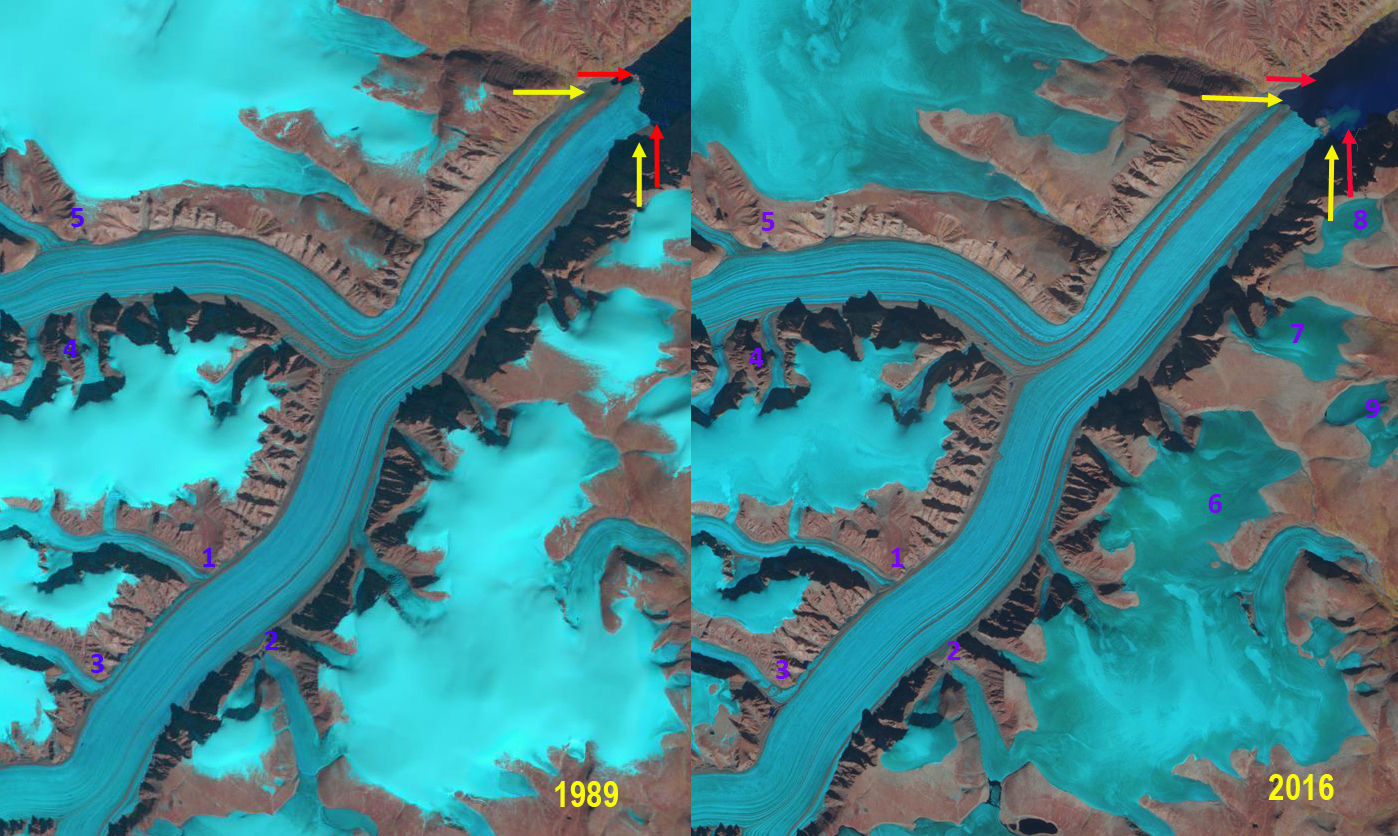
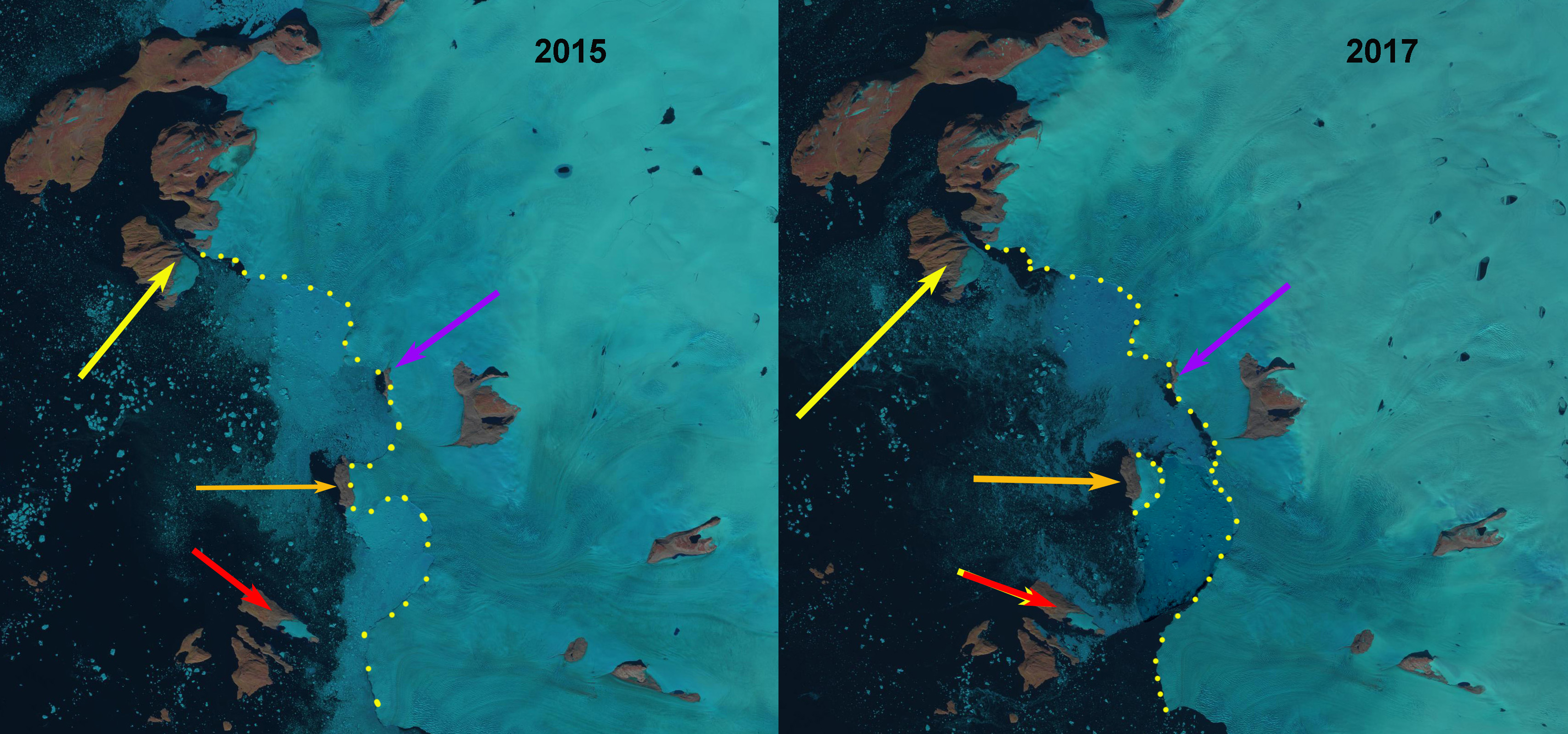
Ellsworth Glacier in 1989 and 2016 Landsat images.  Upper yellow arrow marks the west terminus in 2016 and the lower yellow the 2016 east margin.  Purple dots mark the snowline and purple arrows tributaries from the east that are thinning and disconnecting.  Orange arrow marks icebergs in the lake. 

Ellsworth Glacier is a valley glacier draining south from Sargent Icefield on the Kenai Peninsula in Alaska. Along with the Excelsior Glacier it has been the longest glacier of the icefield.  The glacier retreated into an expanding proglacial lake in the early 20th century (USGS-Molnia, 2008). The terminus in 2000 was reported to be  3.5 to 4.5 km from the 1908 position (USGS-Molnia, 2008).  Here we examine Landsat images to document changes from 1989 to 2016. 

In 1989 the snowline was at 925 m, purple dots, a tributary from the east joined just above the terminus, lower yellow arrow.  The terminus had a small embayment on the west side.  In 2001 the snowline was at 875 m, with little evident change in the terminus position.  By 2015 the tributary from the east has detached from the main glacier, the snowline is at 1000 m.  The lake has expanded considerably along the western margin and the tongue of the glacier has narrowed in the lower 2 km.  In 2016 the snowline is at 975 m, the lake has now extended 3 km along the western edge.  This rapid lake expansion indicates that the lower 3 km of the glacier occupies a basin that will become a lake and that the tongue is partially afloat and given the narrowing thinning tongue is poised for collapse, see below.  The number of icebergs in 2016 indicates that significant ice calved during that year. The retreat of the eastern margin has been 500 m, with a 3.4 km retreat on the west side.  The main tongue in the lower two kilometers is 800 m wide versus 1200 m wide in 1989.  It is also worth noting the greening of the elongated nuntak in the middle of the glacier several kilometers above terminus.  Along with the rapid 3.5 km retreat of the adjacent Excelsior Glacier, leaves the longest glacier from the icefield up for grabs. 

Ellsworth Glacier in 2001 and 2015 Landsat images.  Upper yellow arrow marks the west terminus in 2016 and the lower yellow the 2016 east margin.  Purple dots mark the snowline and purple arrows mark tributaries from the east that are thinning and disconnecting. 

Ellsworth Glacier in2016 Landsat image.  Upper yellow arrow marks the west terminus in 2016 and the lower yellow the 2016 east margin.  Purple arrows mark tributaries from the east that are thinning and disconnecting.  Orange arrow marks icebergs in the lake. 

Lucia Glacier, Chile Retreat Opens New Embayment

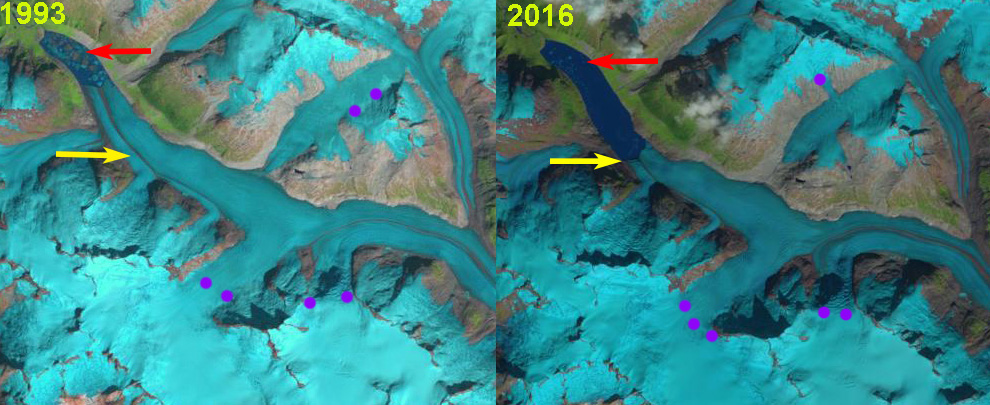
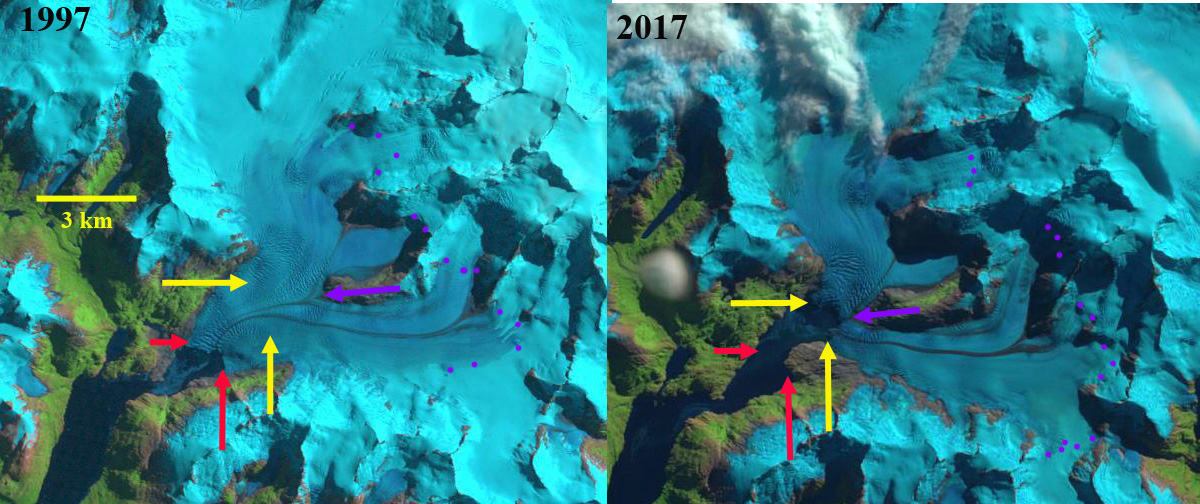
Lucia Glacier retreat from 1987 to 2016 in Landsat images.  Red arrows mark 1987 terminus, yellow arrows 2016 terminus, orange arrow an emerging bedrock area, pink arrow a tributary with increased debris cover and purple dots the snowline.

Lucia Glacier terminates in Lago Berguez at the northern margin of the Southern Patagonia Icefield.  The lake drains into the Rio Pascua.   Willis et al (2012) observed that between February 2000 and March 2012 the Southern Patagonia Icefield rapidly lost volume and that thinning extends even to high elevations.   Mouginot and Rignot (2014) illustrate that velocity peaks at 1 km/year and reamins above 500 m/year  from the terminus to the accumulation zone on Lucia Glacier. The overall retreat has been driven by increasing calving rates from the 1975-2000 to the 2000-10 period (Schaefer et al, 2015). The pattern of retreat is consistent between these glaciers and the region as noted by Davies and Glasser (2012).  They note Lucia Glacier terminus retreat rate from 1870 to 2011 was highest from 1986-2001.  Glasser et al (2016) observed both an increase in glacier proximal lakes and in debris cover on glaciers with glacier retreat from 1987-2015. In this case the glacier is now terminating in an expanding proglacial lake, and except for one western tributary that has had increased significant debris cover, the glacier has limited debris cover.

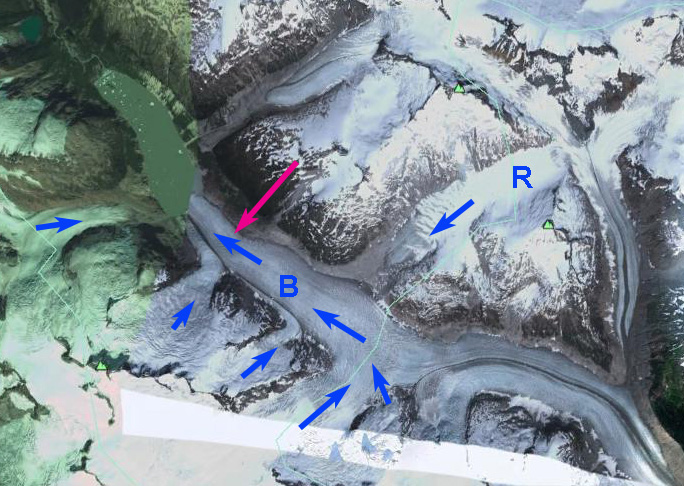
In 1987 the glacier terminated in a north south front in the lake, at red arrows.  The snowline was at 1050 m.  The western tributary at the pink arrow had 25% debris cover, while the orange arrow indicates a location covered by ice. By 1998 the glacier has retreated into a new arm of Lake Berguez and has an east west front. The snowline is at  1275 m.  The western tributary now has 55% debris cover.  In 2003 the snowline is at 1250 m and the orange arrow indicates and emerged bedrock area forming a new lateral moraine. By 2016 the glacier has retreated 3600 m on the west side and 1700 m on the east side.  The mean frontal retreat is ~2700 m in the 30 year period, 90 m/year   The snowline is at 1150 m in 2015 and 1300 m in 2016.  The western tributary is now 80% debris covered.  The terminus itself in 2003 was 1.3 km wide.  In 2016 the calving front is 1.1 km wide.  Upglacier of the current terminus the calving front will expand to 2 km in width  with a ~1.5 km  retreat.  This indicates the glacier is at a narrow point now that minimizes calving and that continued retreat will soon lead to an increase in calving.  The retreat has exposed steep unstable slopes particularly on the east side of the glacier note below and NASA image.  The retreat is greater than neighboring Gabriel Quiroz Glacier and less than Bernardo Glacier.

Lucia Glacier retreat from 1987 to 2016 in Landsat images.  Red arrows mark 1987 terminus, yellow arrows 2016 terminus, orange arrow an emerging bedrock area, and purple dots the snowline.


Google Earth image indicating the front of Lucia Glacier (yellow dots) and slopes destabilized by glacier retreat and thinning, pink arrows.

Gabriel Quiroz Glacier, Chile Retreat Forms New Lake

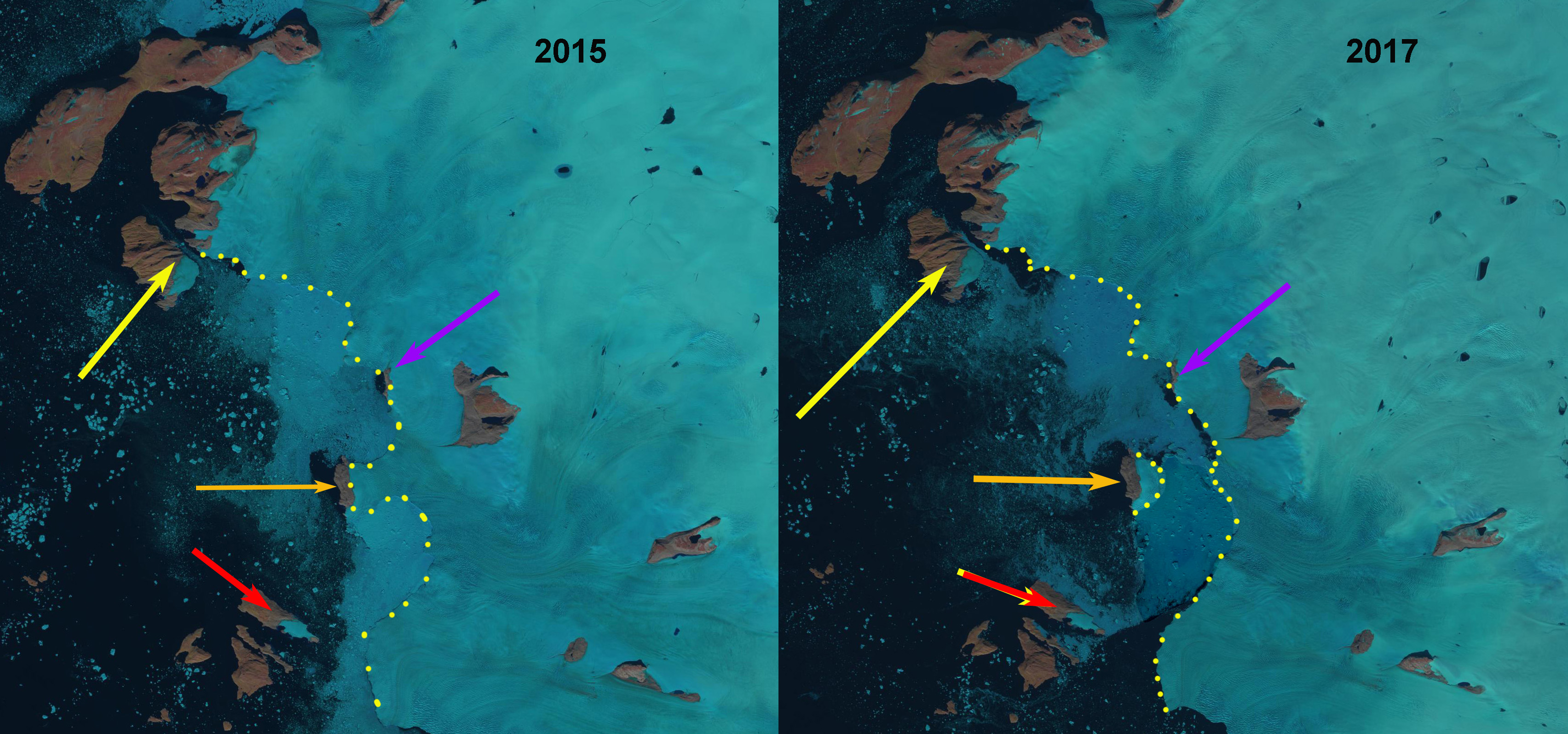
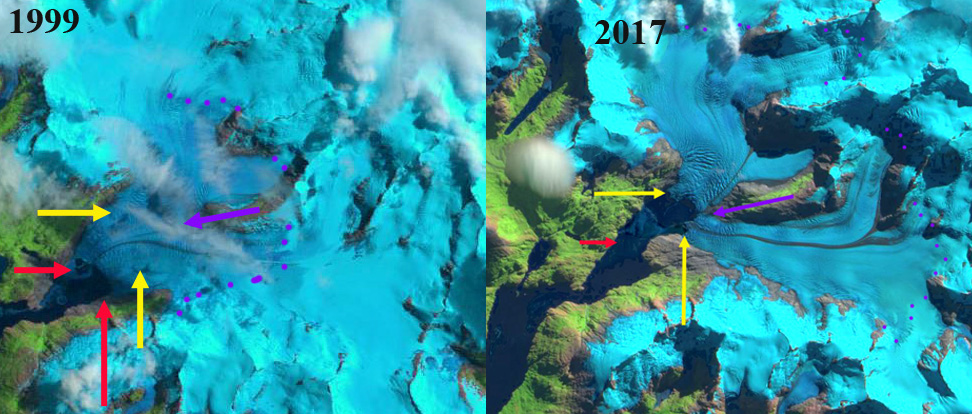
Gabriel Quiroz Glacier, Chile in 1987 and 2016 Landsat images illustrates the retreat.  Red arrow is 1987 terminus, yellow arrow the 2016 terminus, purple arrow a retreating northern tributary and purpe dots the snowline.

Gabriel Quiroz Glacier is a northern outlet glacier of the Southern Patagonia Icefield that drains into the Rio Pascua.  The glacier in 1987 terminated within 250 m of Lago Gabriel Quiroz.  Willis et al (2012) observed that between February 2000 and March 2012 that the Southern Patagonia Icefield is rapidly losing volume and that thinning extends even to high elevations.  The overall retreat has been driven by increasing calving rates from the 1975-2000 to the 2000-10 period (Schaefer et al, 2015). The pattern of retreat is consistent between these glaciers and the region as noted by Davies and Glasser (2012), annual rates of shrinkage in the Patagonian Andes increased in from 0.10% year from 1870-1986, 0.14% year from 1986-2001, and 0.22% year from 2001-2011, though they note Gabriel Quiroz Glacier retreat rate from 1870-2011 was low.  Glasser et al (2016) observed both an increase in glacier proximal lakes and in debris cover on glaciers with glacier retreat from 1987-2015. In this case the glacier is now terminating in a new and expanding proglacial lake, but has limited debris cover.

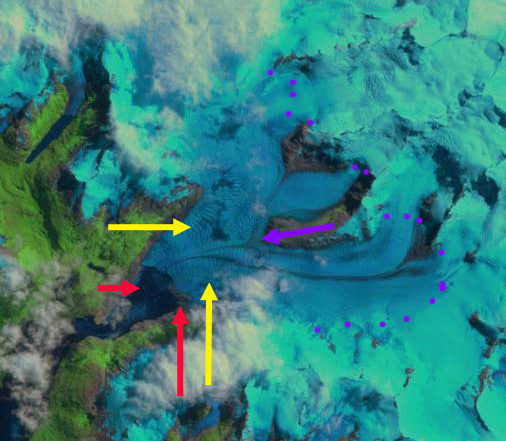
In 1987 the glacier terminates 250 m beyond the western shore of Lago Gabriel Quiroz there is no sign of a proglacial lake at the terminus.  The snowline is at 950 m in 1987,  A tributary from the north almost joins the main glacier, purple arrow.  In 2000 a small proglacial lake is evident at the terminus, which has retreated 300 m. The snowline is at 950 m. By 2015 a substantial proglacial lake has formed with an island in it.  The lake is 1.6 km long, which represents the retreat of the glacier since 1987. The snowline in 2015 is at 1050 m.  In 2016 the proglacial lake is filled with icebergs indicating continue calving driven terminus retreat totaling 2.1 km since 1987. The snowline in 2016 is at 950 m. The terminus remains poised for additional calving retreat, though the calving front has narrowed.  The upper limit of the lake basin is not evident.  The northern tributary has retreated up valley away from the main glacier.  This indicates that even without calving the mass balance of the glacier would be negative and there would be retreat. The retreat is similar to that seen at Balmaceda Glacier,  Bernardo Glacier and Glacier Onelli.   

Gabriel Quiroz Glacier, Chile in 2000 and 2015 Landsat images illustrates the retreat.  Red arrow is 1987 terminus, yellow arrow the 2016 terminus, purple arrow a retreating northern tributary and purpe dots the snowline.

Pedersen Glacier, Alaska Rapid Retreat 1994-2015

Pedersen Glacier Kenia Peninsula, Alaska retreat from Landsat images in 1994 and 2016. The red arrow indicates 1994 terminus, yellow arrow is 2016 terminus, orange arrow indicates northern tributary and purple dots indicates snowline. 

Pedersen Glacier is an outlet glacier of the Harding Icefield in Kenai Fjords National Park near Seward, Alaska. The glacier drops quickly from the plateau of the icefield through a pair of icefalls terminating in a lake at 25 meters above sea level.  The Harding Icefield glaciers that drain east are in the Kenai Fjords National Park, which has a monitoring program.  Giffen et al (2014) observed that from 1950-2005 all 27 glaciers in the Kenai Icefield region examined retreated.  Giffen et al (2014) observed that Pedersen Glacier retreated slow but steady from 1951-1986 at 706 m (20 m/a) and 434 m (23 m/year) from 1986-2005. Here we compare a 1994, 2013, 2015 and 2016 Landsat imagery illustrating a rapid increase in retreat rate from the previous periods.

In 1994 the terminus proglacial lake at the terminus is small and much of the terminus is on land.  The snowline in 1994 is at 550 m.  The tributary entering from the north, orange arrow, is 400 m wide as it reaches Pedersen Glacier.  In 2005 the Google Earth image below indicates extensive terminus crevassing, indicating substantial terminus velocity, and that the retreat is driven by calving.  In 2005 the lake is now 1.1 km long on its center axis.  By 2015 the glacier has retreated 2600 m since 1994, a rate of 125 m/year, much faster than before.  The snowline is average 800 m.  The northern tributary is now barely reaching the main glacier and has a width of 150 m. Note there was a medial moraine separating the tributary from the main glacier in 1994 and now this is merely a lateral moraine. This tributary is not particularly impacted by calving losses and indicates a rising snowline is also a source of mass loss for the glacier. A comparison of the 2013, 2015 and 2016 terminus indicates the recession has remained rapid.  The glacier is approaching the base of an icefall that would represent the inland limit of the lake and the end of rapid retreat.  The snowline in 2013 averages 850 m and is at 800 m on Sept. 30 2016. The glacier follows the pattern of nearby Bear GlacierYakutat GlacierHarris Glacier and the inital phase of retreat on Brady Glacier.

Pedersen Glacier Kenia Peninsula, Alaska retreat from Landsat images in 2013 and 2015. The red arrow indicates 1994 terminus, yellow arrow is 2015 terminus, green arrow indicates 2016 terminus and purple dots indicates snowline. 

Pedersen Glacier in 2005, note crevassing at the terminus, pink arrow. The northern tributary is indicated by orange arrow and green arrow indicates 2016 terminus position. 

Monacobreen Separates from Seligerbreen, Svalbard

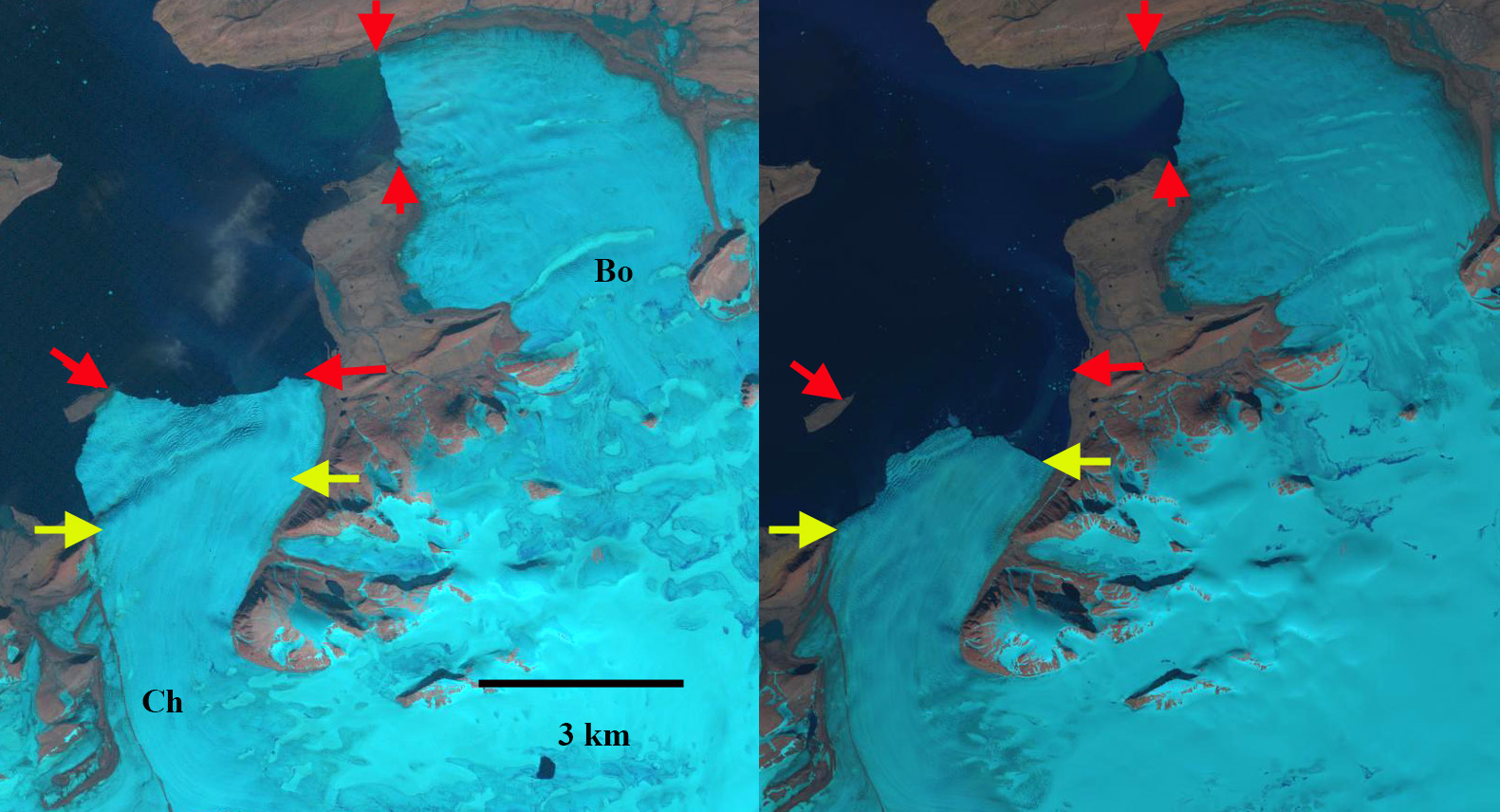
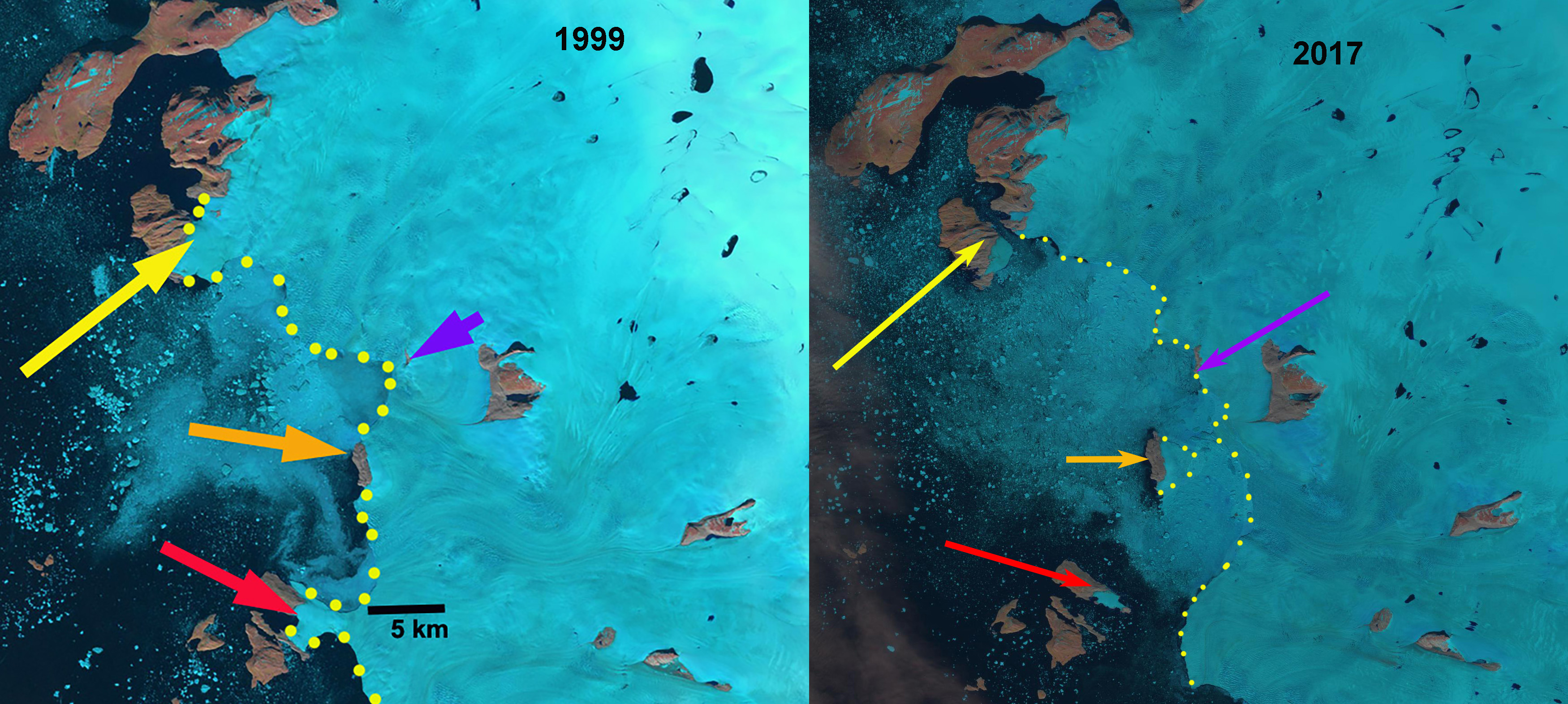
Monacobreen Separation from Seligerbreen in 1999 and 2016 Landsat images.  The red arrow is the 1999 terminus location and yellow arrow the 2016 terminus location. 

Moancobreen  is a glacier that terminates at the head of Liefdefjorden , a branch of Woodfjorden in Spitsbergen, Svalbard. NW Spitsbergen is a region that has experienced extensive long term glacier thinning from 1965 to 2007 (Nuth et al, 2010). Svalbard is host to 163 tidewater glaciers with a collective calving front of 860 km (Błaszczyk et al, 2009), Monacobreen has a 4.4 km wide calving front.  The glacier has surged in the past. Oceanwide Expeditions has expeditions to the region that capture the beauty including the polar bears and ringed seals of the area. 

In 1999 Seligerbreen and Monacobreen had a joint terminus that was 6.5 km wide.  By 2013 the glaciers had separated and the tidewater terminus of Monacobreen was 4.4 km long.  Monacobreen had retreated 2200 m from 1999-2016. The snowline in 2016, see below, was at 525 m.  There are significant melt features apparent in the 2013 Google Earth image of the 500 m elevation area and melt ponds in the 1999 image. The retreat of Monacobreen  is similar to that of most tidewater glaciers in Svalbard such as,  PaierbreenHornbreen and Svitjodbreen.

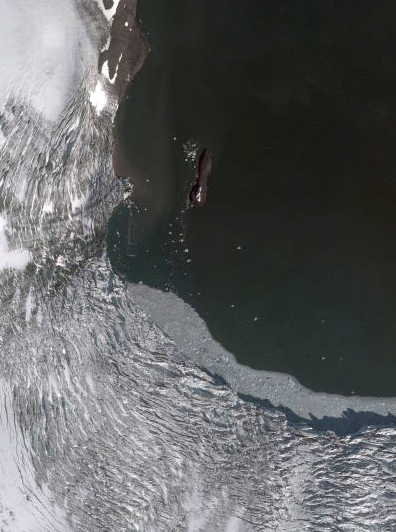
Google Earth image of Monacobreen from 2013, indicating separation had occurred, note plume of sub glacial meltwater outflow. 

TopoSvalbard place name image of the area

Landsat image indicating melt features and snowline in 1999 and 2016 Landsat images. 

Melt water drainage features in the region from 400-550 m on Monacobreen

Mensu Glacier, Siberia Russia Retreat 1994-2016

Mensu Glacier, Russia in comparison of 1994 and 2016 Landsat images.  Red arrow is the 1994 terminus, yellow arrow 2016 terminus, purple arrow a tributary and purple dots the snowline. 

Mensu Glacier (Lednik Mensu) drains northeast from Gora Belukha in the Russian Altai.  The glacier drains into the Ob River and then the Arctic Ocean.  This glacier has not been the focus of detailed research to date. Khromova et al (2014) report that at the end of the century the glacier degradation in Russian mountain ranges strengthened including glacier area loss of 13% in the Tien Shan, 19% in the Altai and 22.3% in the Polar Urals.  The icecap draining west from Gora Belukha was cored to look at longer term climate records (Fujita et al 2004).  The core at 4500 m is high enough so that significant melt events affecting the record were rare. Shahgedanova et al (2010) noted that the retreat has largely been driven by summer warming. 

In 1994 the glacier terminates at the red arrow at 2150 m.  The glacier has an icefall from 3200 m to 2700 m that generates annual ogives, note Google Earth image below. The snowline in the 1994 Landsat  image averages 3000 m.  There is a tributary joining the main glacier at the purple arrow.  A neighboring glacier terminates in a proglacial lake at the orange arrow.  By 2001 the glacier has retreated and the snowline is at 3100 m. By 2016 the glacier terminates at 2200 m and has retreated 600  m to the yellow arrow.  The tributary at the purple arrow has separated from the main glacier.  This illustrates substantial glacier thinning  6 km above the terminus. The glacier at the orange arrow  no longer reaches the proglacial lake. In August 2016 below the snowline is at 3100 m in September 2016 the snowline has descended to 2800 m.  The lowest 800 m of the glacier has few crevasses, appears stagnant and will be lost to retreat.

Retreat is similar to the nearby Potanin Glacier, Mongolia. 

Mensu Glacier, Russia in comparison of 2001 and 2016 Landsat images.  Red arrow is the 1994 terminus, yellow arrow 2016 terminus, purple arrow a tributary and purple dots the snowline. 

Google Earth image indicating the snowline at the top of the icefall and the ogives beginning at the bottom near the orange arrow.


Terminus of Mensu Glacier in 2013 note lack of crevassing.

Bonnet Glacier, Alberta Retreat & New Lake Formation

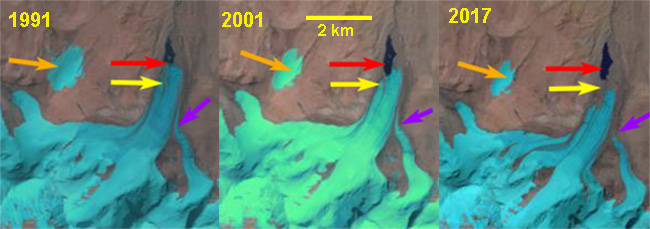
Bonnet Glacier, Alberta compared in Landsat images from 1987 and 2016. The red arrows mark the 1987 terminus, yellow arrows are the 2016 terminus location and the orange arrow notes a separate glacier that has disappeared.

Bonnet Glacier is at the headwaters of Douglas Creek that feeds into the Red Deer River.  The glacier drains north from Bonnet Peak in the Sawback Range 30 km east of the crest of the Rocky Mountains and 40 km north of Banff.   Here we examine changes in this glacier from 1987 to 2016, a period when retreat has led to the formation of new alpine lakes. An inventory of glaciers in the Canadian Rockies indicate area loss of 15% from 1985 to 2005 (Bolch et al, 2010), with Alberta glaciers losing area at a higher rate.  Tennant et al (2012) noted that from 1919-2006 the glaciers in the central and southern Canadian Rocky Mountains lost 40% of their area.  Of the 523 glaciers they observed 17 disappeared and 124 separated. The more famous Columbia Icefield, 125km northwest, has lost 23 % of its area from 1919-2009 with ice loss at a minimum during the 1970′s (Tennant and Menounos, 2013)

In 1987 the glacier had two primary termini, red arrows with no evident proglacial lakes at either terminus, red arrows.  In 1987 the glacier spilled over a bedrock bench shortly above the terminus in both cases onto a lower bench   The glacier has 25% retained snowpack.  The orange  arrow indicates a small avalanche fed glacier on the east side of the ridge extending north from the glacier. In 1988 the lack of proglacial lakes is noted at the pink arrows.  The retained snowpack is again 25% of the glacier area, well short of the 50-60% needed for a glacier to be in equilibrium. In 1990 the snowcovered area is 30% there is a small lake developing at the northern most terminus. In 2015 four new alpine lakes have formed two are separated from the glacier due to retreat, with both active termini also terminating in lakes. The retained snowpack covers 10% of the glacier in 2015. In 2016 snowcover is retained on 20% of the glacier. The glacier has lost 20% of its total area since 1987 with the main terminus retreating 900 m and the secondary terminus 425 m.   The 900 m retreat is ~20% of the total glacier length. The lack of retained snowcover even in these August Landsat images indicate a glacier that cannot survive current climate. The retreat is less impressive than on the larger Freshfield Glacier  and more in line with retreat and separation seen on Conway Glacier  and Fraser Glacier.

Bonnet Glacier, Alberta compared in Landsat images from 1988, 1990 and 2015. The pink arrows mark the locations where lakes developed after 1988 and the orange arrow notes a separate glacier that has disappeared.

Topographic map of the Bonnet Glacier region, Alberta.

Potanin Glacier Area, Mongolia Retreat & Fragmentation

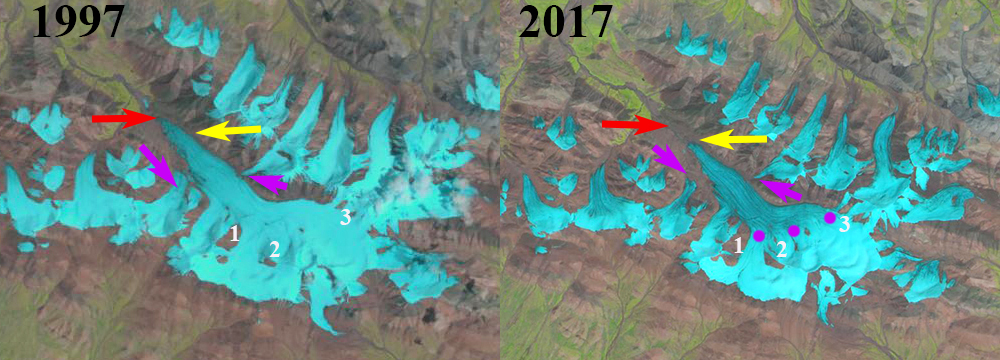
Potanin Glacier, Mongolia comparsion in 1991 and 2016 Landsat images.  Yellow dots indicate 2016 terminus, purple dots the snowline, red arrow the southeast margin of proglacial lake, and purple arrows peripheral alpine glaciers that are fragmenting. 

Potanin Glacier is in the Altay Mountains of the Tavan Bogd region in western Mongolia, and is the nations longest glacier.  The glacier ranges from 2800 to 4000 m a.s.l. and is length is about 11 km long. Konya et al (2008) note the ELA was roughly estimated as 3600 m. The conclude that given the area altitude distribution this indicates the  mass balance of Potanin Glacier is negative and it is probable that the glacier is experiencing a negative trend. Konya et al (2010) observed that ablation calculated by an equation using the measured radiation showed good correlation with observed daily ablation, whereas a degree-day model had good correlation with cumulative observed ablation.  This region has experienced a substantial warming of  1.6 C in the last sixty year, which has led to a 4.2% decrease in glacier area from 1989 to 2009 in the Tovan Bogd region (Krumwiede et al, 2014). A 2016 expedition to the area led by Aaron Putnam, UMaine Climate Change Institute provides an excellent view of the region (Climate Change, Northwestern, 2016).  There expedition was focused on assessing the timing of ice loss at the end of the last ice age. This warming abruptly ended the last ice age and Putnam’s team was looking for the switches that initiate such climate events.

Here we examine Landsat imagery from 1991 to 2016 to identify changes in Potanin Glacier and neighboring glaciers. In 1991 Potanin Glacier terminates near a 500 m diameter proglacial lake, red arrow.  The snowline is at 3600 m, purple dots. Three peripheral alpine glaciers at purple arrows 1-3 are each single contiguous glaciers. In 1996 the proglacial lake remains, the snowline is at 3500 m and the peripheral alpine glaciers remain contiguous. By 2014 the proglacial lake is 30% of its former size, with the southeastern margin of the lake remains the same. The snowline is at 3500 m in 2014.  In 2016 the three neighboring alpine glaciers have fragmented into multiple sections. Each section remaining has also lost significant area.  This is indicative of negative mass balance in the region during the period.  The smaller glaciers are more responsive to climate and subsequent mass balance change.  The yellow dots on the 1991 and 2016 image represent the 2016 margin. The margin has experience modest retreat averaging 250 m from 1992-2016. At Point 1 the glacier has fragmented into three sections since 1991 with the southern most nearly gone.  At Point 2 the glacier has separated into two parts with the eastern one largely gone. The continued fragmentation of smaller glaciers will lead to their disappearance in the coming decades.  The large supraglacial streams that are present indicate the limited velocity and high melt rates in the terminus region, see below. The mass balance of the World Glacier Monitoring Service Maliy Aktru, in the Russian Altay has been negative in all but five years since 1990. 

Potanin Glacier, Mongolia comparsion in 1996 and 2014 Landsat images. Purple dots the snowline, red arrow the southeast margin of proglacial lake, and purple arrows peripheral alpine glaciers that are fragmenting.


Streams channels on surface of Potanin Glacier in Google Earth image. The extent and size indicates limited velocity and high ablation. 

West Ganglung Glacier, Tibet Glacier Loses 20% of Length

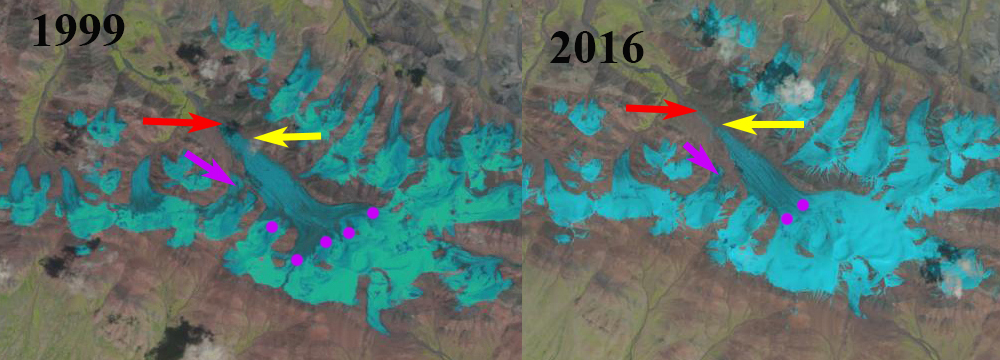
Landsat image comparison from 1991, 2001 and 2016 of West Ganglung Glacier, red arrow is the 1991 terminus, yellow arrow the 2016 terminus, green arrow the eastern glacier proglacial terminus lake and purple arrow expanding zone between a former tributary and West Ganglung Glacier

West Ganglung Glacier is on the China-India border 6 km west of Ganglun Grangri Peak meltwater enters the Sultej River and then Mapam Tso.  the glacier terminates in a proglacial lake at 5200 m with its head on the border at 5750 m. This region is part of the Indus Basin, the second China glacier inventory noted a 23% decline in glacier area from 1970 to 2007 (Guo et al 2015) Assessing the sensitivity of the Sutlej River basin to climate change Miller et al (2012) noted that with a warmer climate melt contributions from lower parts are reduced because of decreased snow cover and a shorter melting season.  Significant glacier area loss will also lead to less runoff despite an increase in rate. Singh et al (2012) noted a decline in runoff from the Sutlej basin after 2000, whereas there had been a rise before that. 

Here we examine teh unnamed West Ganglung Glacier change from 1991 to 2016 in a series of Landsat images. In 1991 the glacier terminates at the red arrow, and the lake is 1050 m long. At the glacier just to the east there is a small proglacial lake 200 m long. By 2001 glacier retreat had led to lake expansion to 1400 m long. The proglacial lake at the end of the eastern glacier is now 350 m long. By 2016 the proglacial lake at the terminus had expanded to a length of 1850 m, a retreat of 800 m in 27 years.  The proglacial lake at the terminus of the eastern glacier in 2016 is 650 m long, indicating a retreat of 450 m.  In both case the retreat is a significant loss of overall glacier length, ~20%.  The purple arrow indicates the increasing separation between a tributary and the West Ganglung Glacier glacier.

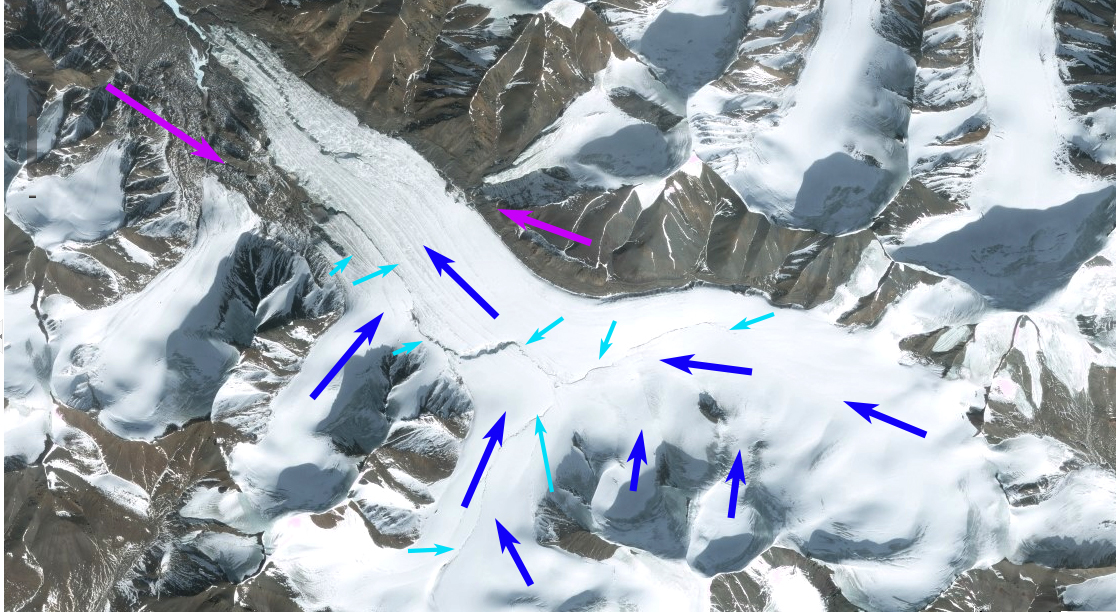
Google Earth image of West Ganglung Glacier, red arrow is the 1991 terminus, yellow arrow the 2016 terminus, green arrow the eastern glacier proglacil terminus lake and purple arrow expanding zone between a former tributary and West Ganglung Glacier


Landsat image from2014 of West Ganglung Glacier, red arrow is the 1991 terminus, yellow arrow the 2016 terminus, and green arrow the eastern glacier proglacial terminus lake.

Torfajökull, Iceland Accumulation Zone Demise Drives Recession

Torfajökull in 1994, adn 2014 Landsat images.  Note the lack of retained snowpack in 2014 and emerging bedrock areas within icecap, purple arrows.

Torfajökull is a small ice cap north of  Myrsdaljökull in Iceland.  The glacier’s lowest elevation is 750 m and the highest elevation is 1150 m.  This low of an elevation range in a climate driving higher snowlines places this type of ice cap at great risk for losing its accumulation zone and its ability to survive.   The Iceland Glaciological Society spearheads an annual terminus monitoring program led by Oddur Sigurðsson. In 2013 the report indicates all seven glaciers in the region near Torfajokull were in retreat.  In this post we look at the loss of the accumulation zone in 2014 and the longer term change in size noted by the Iceland Glaciological Society. This is not a good area for acquiring a suntan as the lack of clear imagery indicates for 2015 or 2016. 

In 2006 the Iceland Glaciological Society began monitoring the terminus of this glacier, the measurement is completed at the northeastern terminus.  From 2006-2014 the glacier has retreated 150 m.  The monitored terminus the location where areas of bedrock have begun to emerge from beneath the thinning ice cap, purple arrows. The bedrock areas exposed within the ice cap were not evident in 1994 images or the 2000 glacier outline. The loss of glacier area from 1946-2000 in the Iceland Glaciological Society map indicates area loss around the entire margin of the icecap including the highest elevations, located on the southern margin.  Recession at the head of a glacier suggests a glacier that lacks a persistent accumulation zone.

The change from 2000 to 2014 has been more pronounced on the eastern lobes that extend away from the main glacier.  The loss in ice cap area from 2000-2014 is ~10%.  In 2014 the glacier had 12% retained snowcover on August 12th, note Landsat image above and Google Earth below, by Sept.2014 there was no retained snowpack.  There is some retained firn the lightest blue, but even this is limited indicating that the snowpack from the previous few winters had not survived over most of the glacier either.

This is a recipe for glacier loss. The snowline on Aug. 12, 2014 shown below on Myrsdaljökull was at 1225 m, well above the top elevation of Torfajökull.  This glacier lacks the higher accumulation zone of some smaller Icelandic ice caps such as Eiriksjökull.
 

Iceland Glaciological Society map of glacier boundaries in 1890, 1946 and 2000, with the 2014 boundary added from the Landsat images above.  

Landsat image of Myrdalsjokull on 8/12/2014 with snowline at purple dots., 1225 m.