Sierra Nevada, California Glaciers Rapid Decline 2018-2022

MacClure and Lyell Glacier in 2018 and 2022 Sentinel images illustrating a decline from 0.09 to 0.06 km²

The Sierra Nevada, California has a number of small glaciers that have clung to the north facing slopes of the High Sierra. An inventory of these glaciers completed by Basagic and Fountain (2011) identified glacier area in 2004, which had declined by 55% since 1903. At that time the MacClure Glacier had an area of 0.15 km², the West Lyell Glacier an area of 0.42 km², Conness Glacier an area of 0.16 km² and Darwin Glacier an area of 0.12 km². The Palisade Glacier is the largest glacier, with an area of 0,84 km² in 1984. Yosemite NPS has been assessing area change of Lyell and MacClure Glacier, they found a rapid acceleration of area loss beginning in 2012, noting a thickness loss of 3-4 m per year during the 2012-2015 drought.  These losses are similar to those observed on Whitney Glacier, Mount Shasta. The NCEI NOAA Division 5 climate data for this area indicates that meltseason temperatures have been the primary cause of the recent decline, though declining accumulation season precipitation has been as well, see bottom.

The thickness loss of 2012-2015 has been matched during the 2020-2022 drought. Area decline from 2018-2022 on West Lyell Glacier has been from 0.18 to 0.13 km², on MacClure Glacier from 0.09 to 0.06 km², on Conness Glacier from 0.08 to 0.05 km² and on Palisades Glacier from 0.62 to 0.48 km². In September of 2021 and 2022 all of these glaciers were completely bare of snowcover, even in areas of avalanching. A glacier requires 50-60% snowcover at the end of summer to be in equilibrium and cannot persist without a consistent accumulation zone. This illustrates the glaciers cannot survive the climate of the last decade. The area has declined ~30% in just five years from 2018-2022 on West Lyell, MacClure, and Conness Glacier, they each lost all of their snowcover both years by late August. Fiske (0.01 km²),  Dana (0.04 km²), Darwin (0.026 km²), Matthes (0.01 km²) and Powell Glacier 0.04 km² no longer qualify as glaciers. The next glaciers to join this class will be MacClure and Conness Glacier. The only glacier with even a small persistent accumulation zone has been Palisades Glacier.
The lost of glacier thickness in just 2021 and 2022 is 5-6 m w.e. ice thickness. To replenish this loss requires 5 m w.e of snowpack to be retained at the end of the melt season in early October. This equates to 8-9 m of snowpack remaining. This will not happen in a single season even a record snowfall year such as 2023.

Palisades Glacier in 2018 and 2022 Sentinel images, retreat indicated by lake expansion. Purple dots indicate area of firn indicating region where some snow from recent years has remained, but less than 10% of glacier area in 2021 and 2022. Note marginal recession along east and west edge of glacier.

Conness Glaciuer diminishing and darkening from 2018 to 2022 in Sentinel images. Area declined from 0.08 to 0.05 km². If it is hard to pick out the glacier on high resolution imagery like this, that is telling.


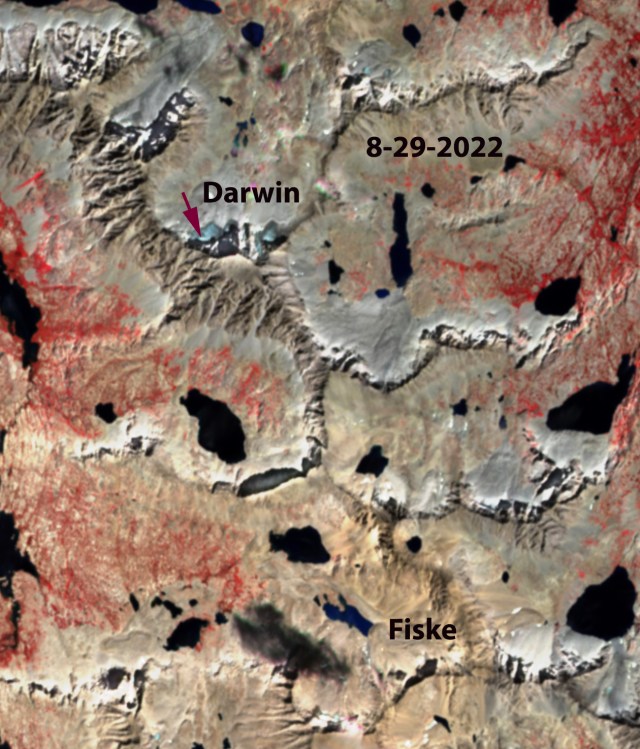
Darwin and Fiske Glacier no longer have sufficient area to qualify as glaciers at 0.026 km²  for Darwin Glacier and 0.008 km² for Fiske Glacier. No retained snowcover in 2021 or 2022. That they are hard to discern is visual evidence of their current insignficance as ice masses.

Dana Glacier has an of perennial ice of 0.04 km².  No retained snowcover in 2021 or 2022. 

Matthes Glacier in 2021 with no retained snowpack and an area of perennial ice of 0.015 km².

Palisade Glacier with narrow fringe of snow and firn in 2021.

Lyell ad MacClure Glacier in 2021 with no retained snowpack.

NCEI NOAA Division 5 climate data for melt season temperatures  (May-Sept.) and accumulation season precipitation (November-April)

Soler Glacier, Chile Terminus Tongue Breakup in 2023

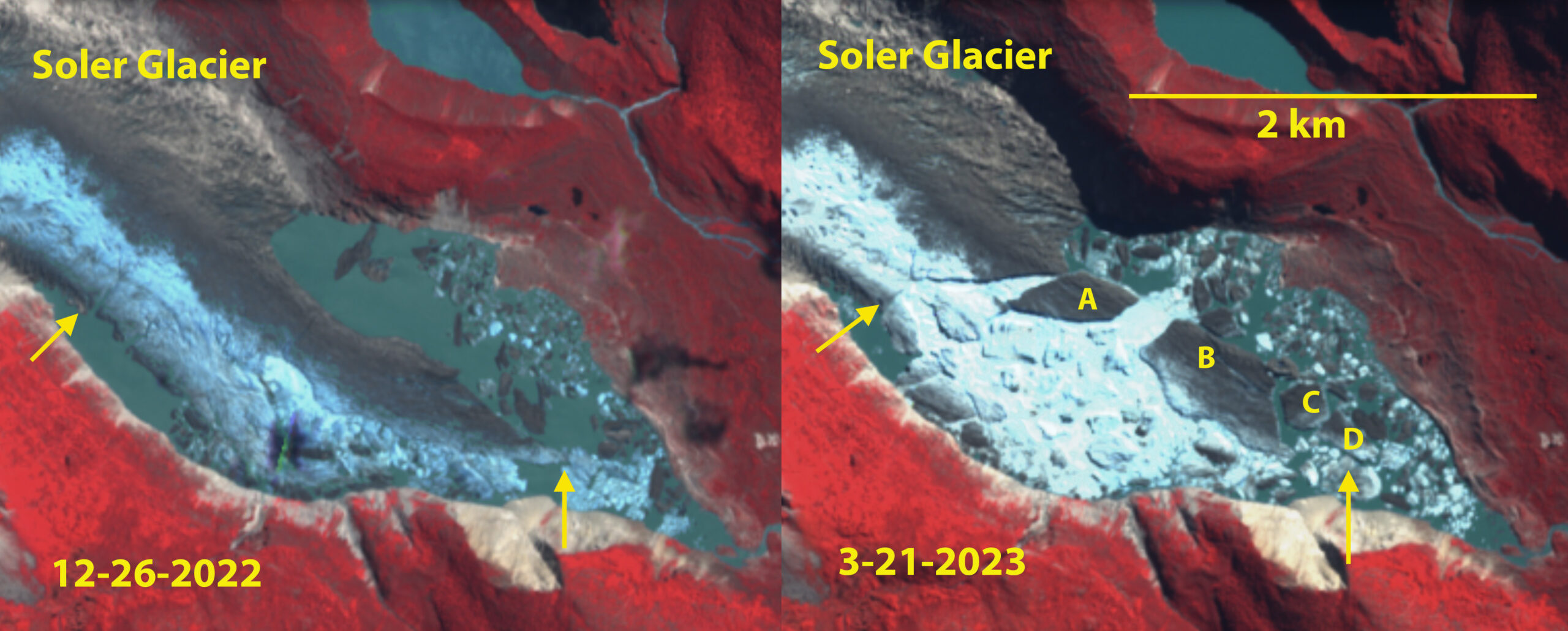
Soler Glacier, Chile terminus tongues is 1.9 km long on 12-26-2022 and by 3-21-2023 it has broken up, with four larger bergs A-D. False color Sentinel images.

In 2020 I noted that the Soler Glacier “terminus tongue in its lowest 1.5 km continue to thin and will collapse in the lake in the near future.” Here the breakup of this tongue in 2023 is reported. Soler Glacier is an outlet glacier on the east side of the Northern Patagonia Icefield (NPI). The terminus response of this glacier was slower and more limited than on most NPI glaciers, just 200-350 from 1944 to 1984 (Aniya and Fujita 1986).  Glasser et al (2016) note the recent 100 m rise in snowline elevations for the NPI, which leads to the 2 m thinning per year identified by Willis et al, (2012)  in the ablation zone from 1987-2011.  Loriaux and Casassa (2013) examined the expansion of lakes on the Northern Patagonia Ice Cap reporting that from 1945 to 2011 lake area expanded 65%, 66 km2.

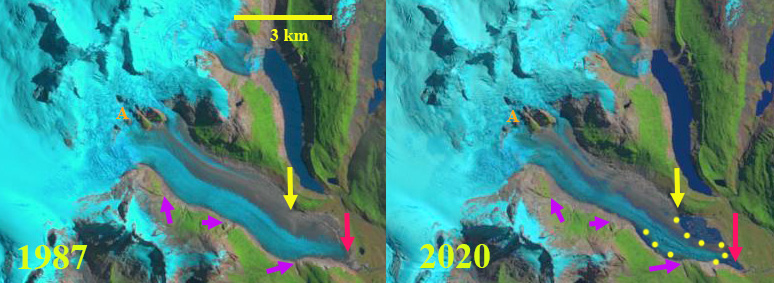
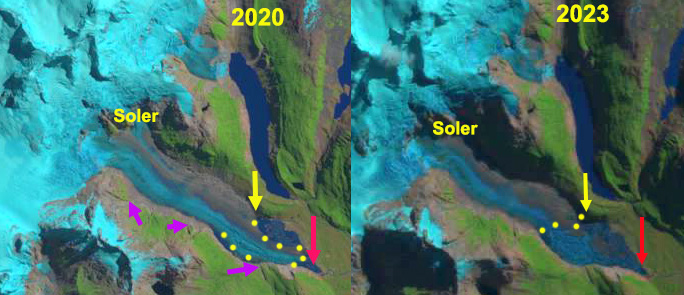
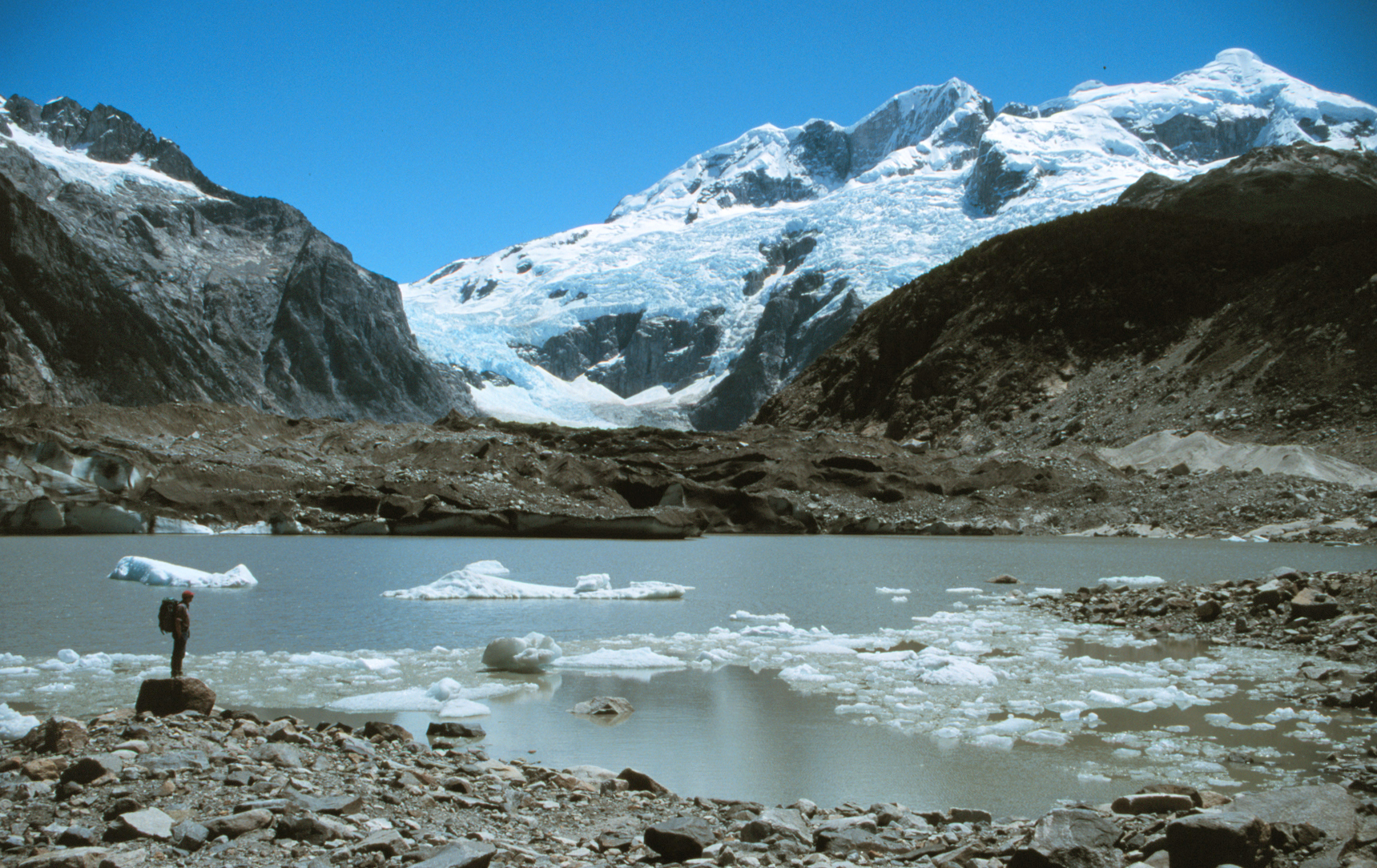
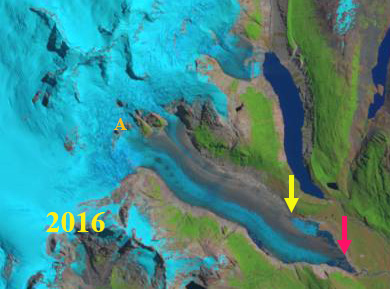
Soler Glacier had no proglacial lake in 1987. By 2000 a small lake had developed both on the north and south side of the main terminus with a total area of ~0.3 km2 see Mike Hambrey image below. In 2016  lake had expanded, with the northern arm mostly filled with ice.For Soler Glacier lake formation did not occur until the last decade reaching an area of 1 km² by 2020. As the 2022/23 melt season began the glacier had a 1.9 km long central tongue extending down the middle of the lake, that had an area of 1.4 km², as evidenced on Dec. 26, 2022. By early March the tongue had broken up as revelaed by the Sentinel image on March 21, 2023. On this date the lake surface has refrozen on the south side and has some new snow on it. The lake has expanded to 2.75 km², with the largest iceberg B, occupying 10% of the lake. The lake expansion is small compared to Steffen Glacier or San Quintin Glacier, but just as significant for this smaller glacier.

Soler Glacier in 1987 and 2020 Landsat images.  Red arrow indicates 1987 terminus location, yellow arrow indicates 2020 terminus location on north side of glacier.  Yellow dots indicate margin of lake and purple arrows indicate specific locations where glacier thinning is evident.

Soler Glacier in 2020 and 2023 Landsat images.  Red arrow indicates 1987 terminus location, yellow arrow indicates 2020 terminus location on north side of glacier.  Yellow dots indicate margin of lake and purple arrows indicate specific locations where glacier thinning is evident in 2020.

Mike Hambrey Photograph of Soler Glacier in  2000, illustrating narrow nature of the proglacial lake.


Soler Glacier in 2016 Landsat image.  Red arrow indicates 1987 terminus location, yellow arrow indicates 2020 terminus location on north side of glacier. Lake area is still limited.


Snowcover Free Glaciers in Antarctica in 2023

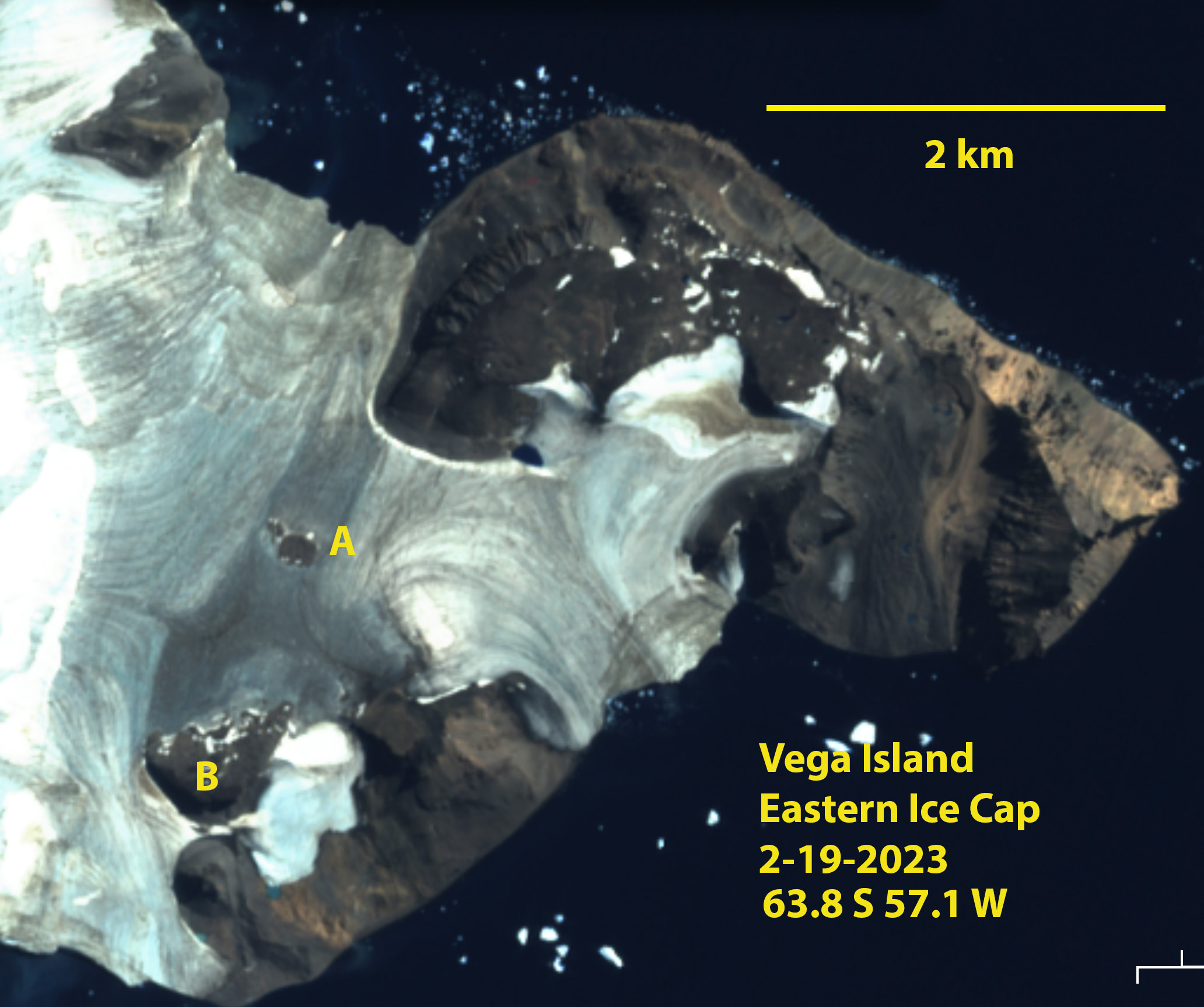
Eastern Ice Cap on Vega Ice Cap is snow free in Feb. 19, 2023 Sentinel images. Bedrock areas at Point A and B will expand with snow free conditions.

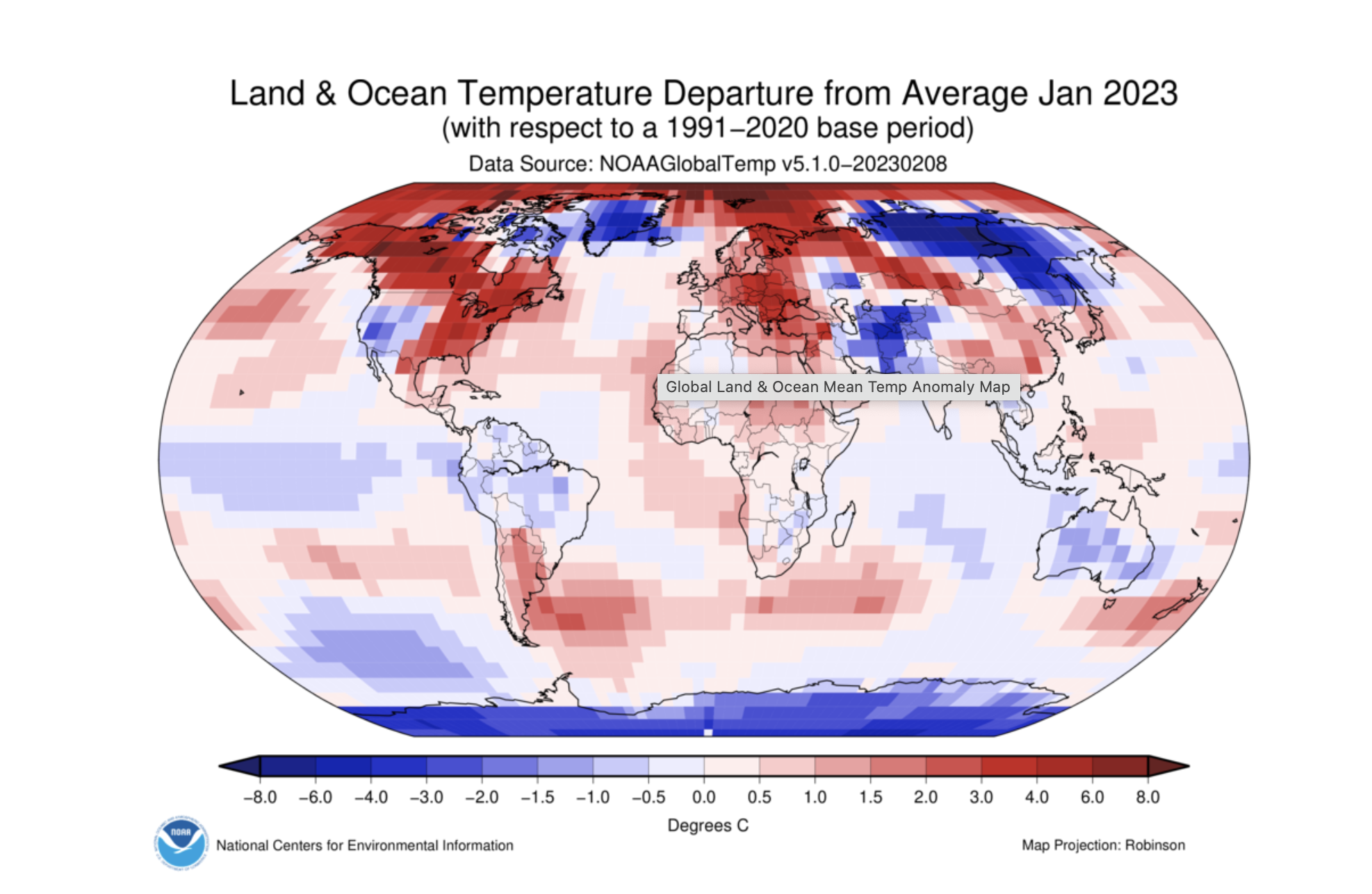
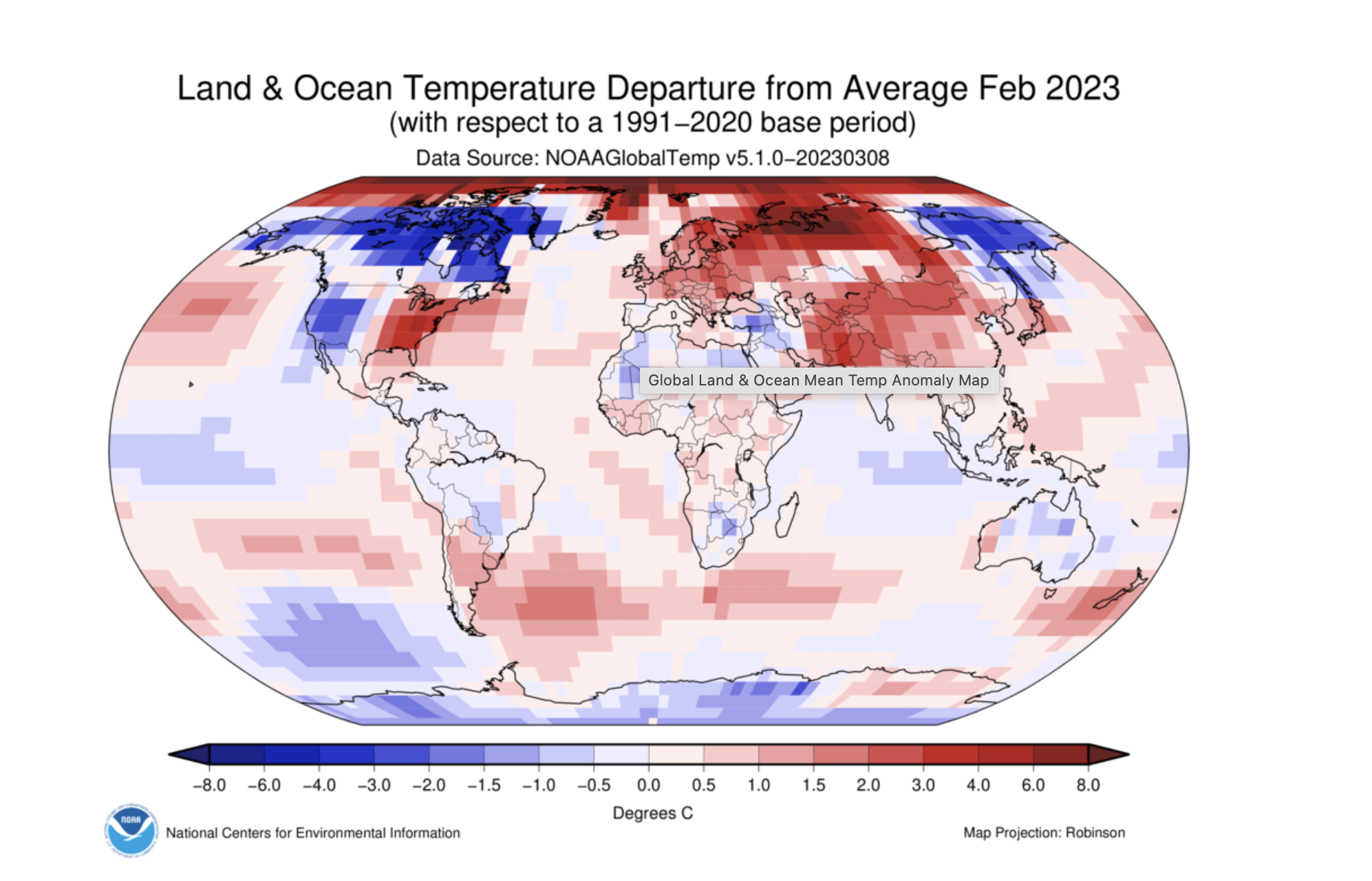
In 2023 the near complete loss of snowcover is apparent on a number glacier and ice caps In Antarctica, on several islands along the Antarctic Peninsula. This yields a more extensive bare ice and firn surface area, that increses melt rate and increases the density of light absorbing particles on the surface.  This snowcover loss is the result not of a heat wave but of a consistenly warm summer. At Esparanza Base:

  • November mean temperature 2.5 C above average
  • December mean temperature 0.5 C above average
  • January mean temperature 1.5 C above average
  • February mean temperature 1 C above average

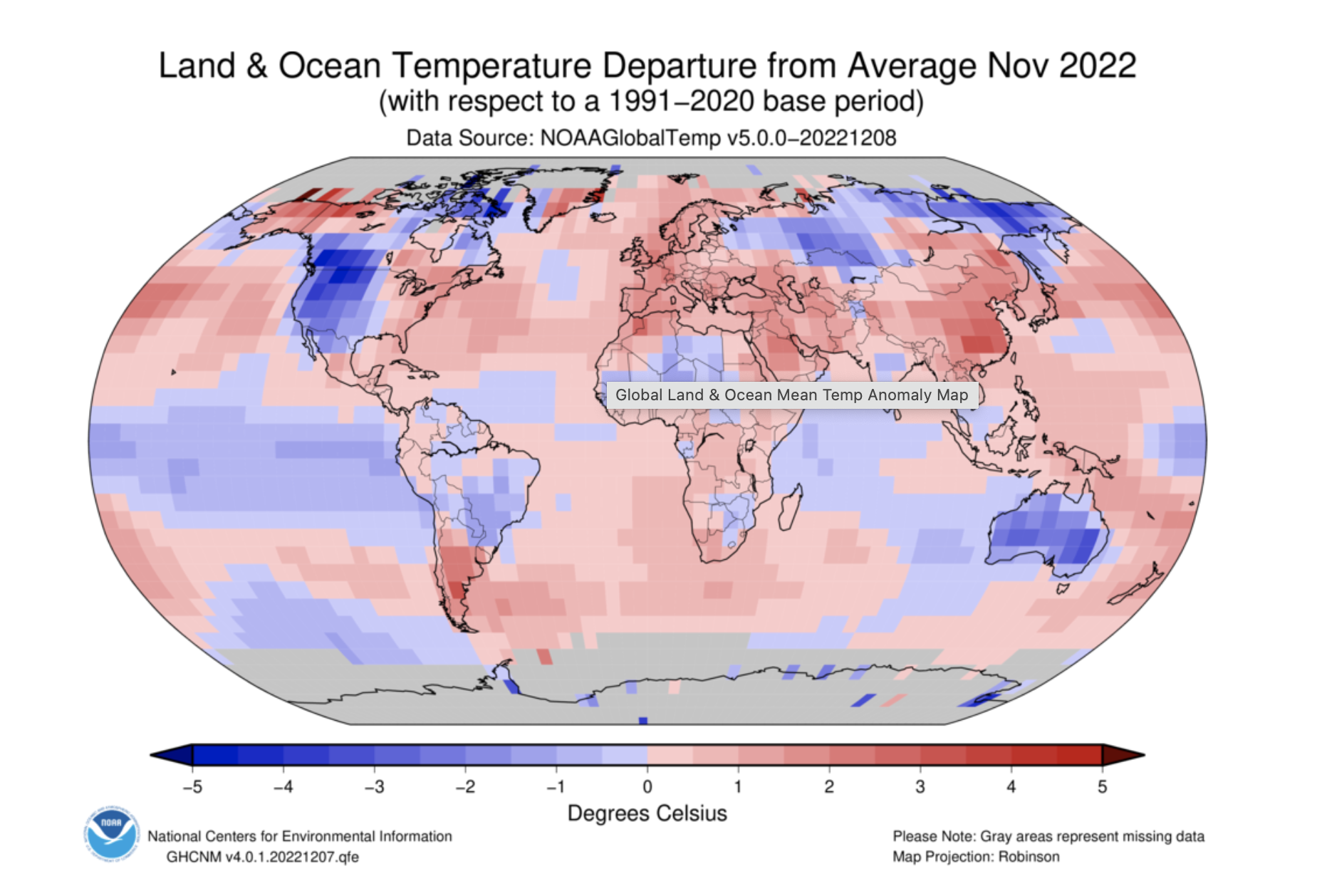
This yields an mean melt season temperature 1.5 C above average compared to 2020 that had a mean average temperature 0.5 C above average.  The most anomalously warm month was November. Monthly temperature anomlies for the region are evident in the global monthly maps from NCEI NOAA, see below. The net amount of melt for these temperatures is still low, which indicates the limited accumulation in the region.

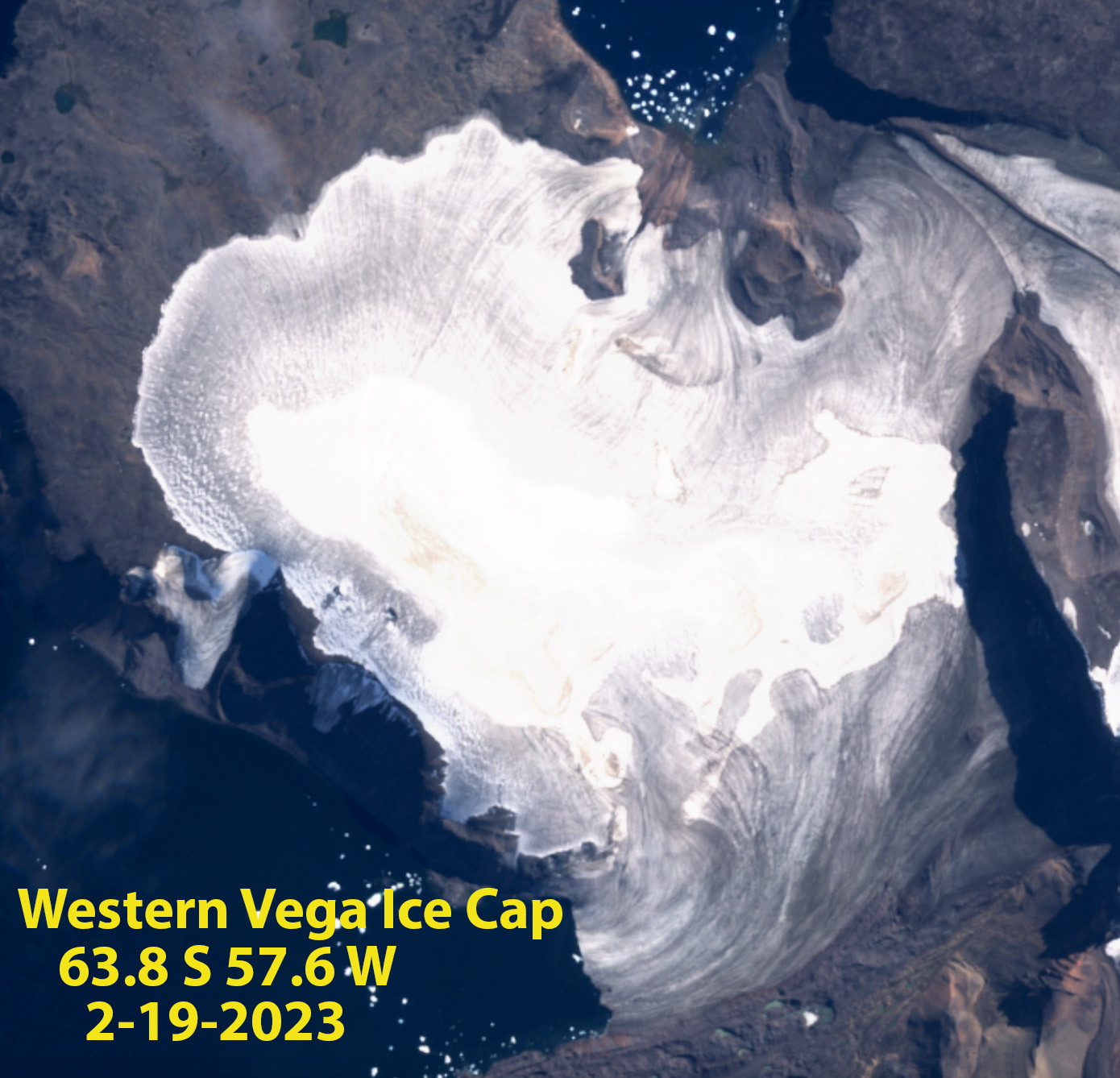
On Vega Island the eastern end features an ice cap that has no retained snowcover from the north to south shore, with two expanding areas of bedrock amidst the glacier at Point A and B. Snowcover begins at 300 m on an ice cap toward center of island. On Vega Island’s western end the ice cap has lost 70% of its snowcover, with snow retained above 400 m.

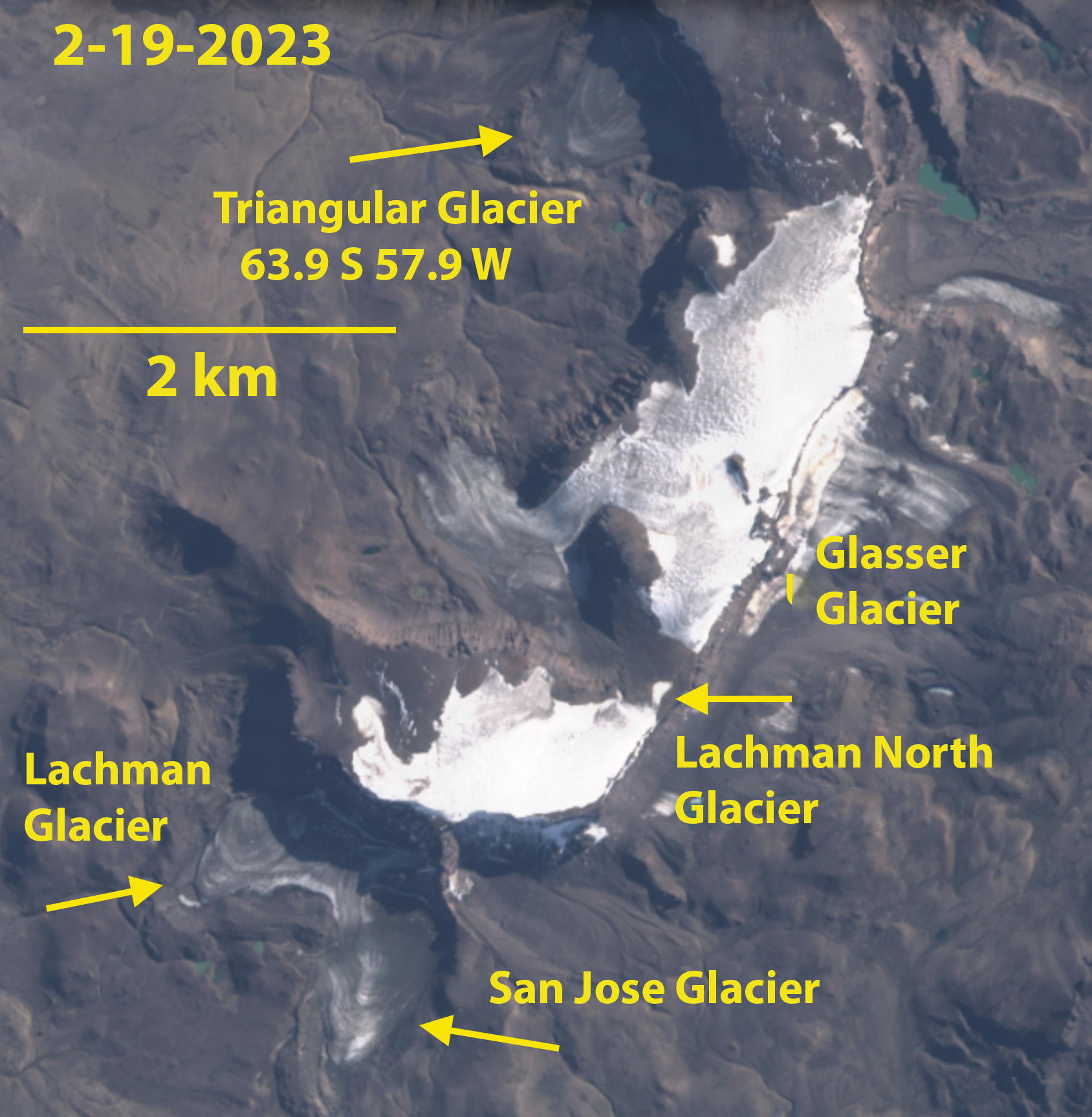
On the Ulu Peninsula of James Ross Island three of five glaciers along the Lachman Crags are snowcover free. Triangular, Lachman and San Jose Glacier lack snowcover and have a much darker surface, which further enhances melting, then seen in field photographs of these glaciers (Davies, 2020) and Jennnings et al (2021). Glasser and Lachman North Glacier both have significant snowcover above 500 m.

Whisky Glacier is a tidewater glacier terminating in Whisky Bay. This glacier is 90% snowcover free on Feb. 19, 2023. Snow patches are evident above 250 m near the ice divide, note green arrow. The southwest extension (SW) is also snow free.

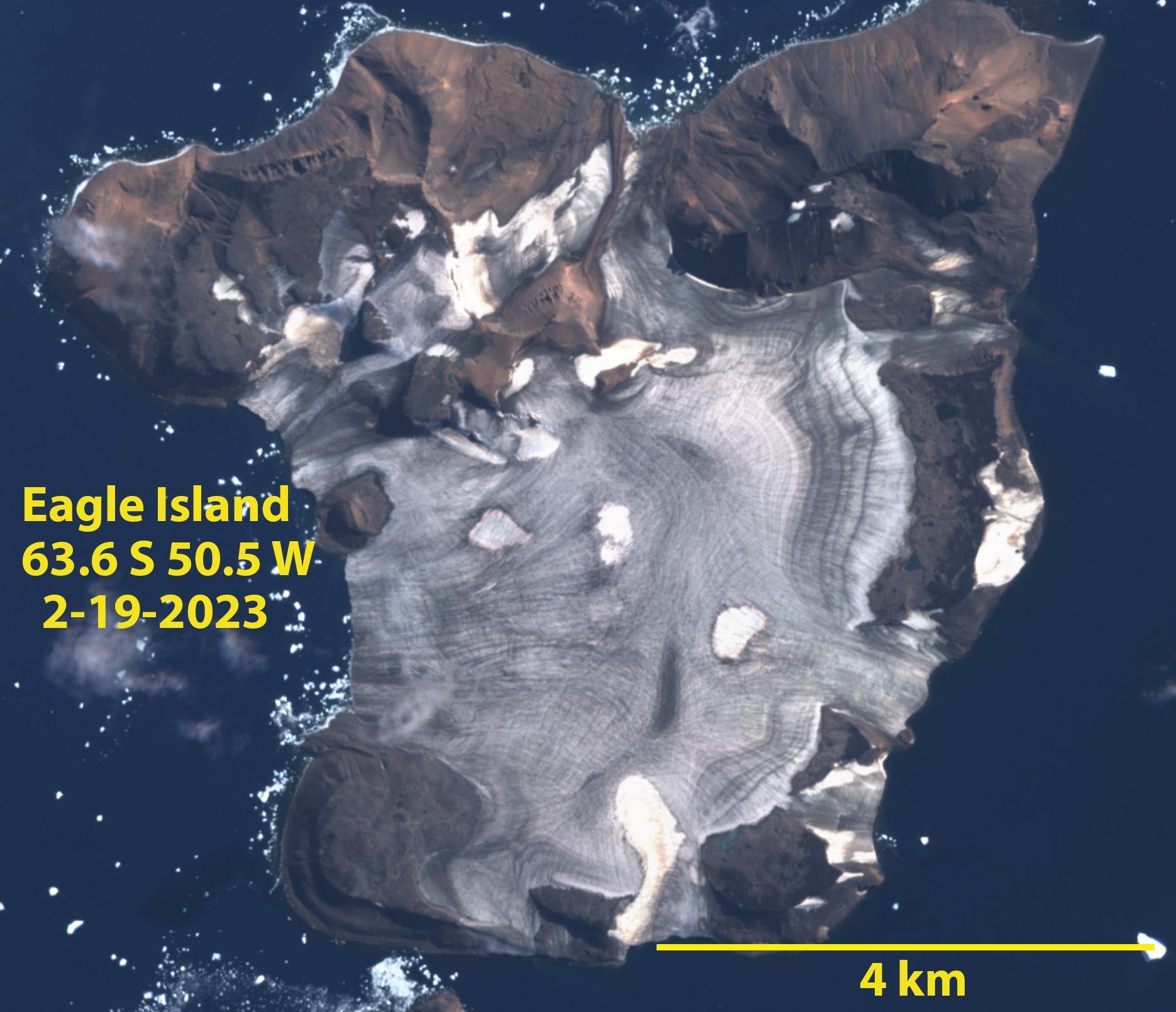
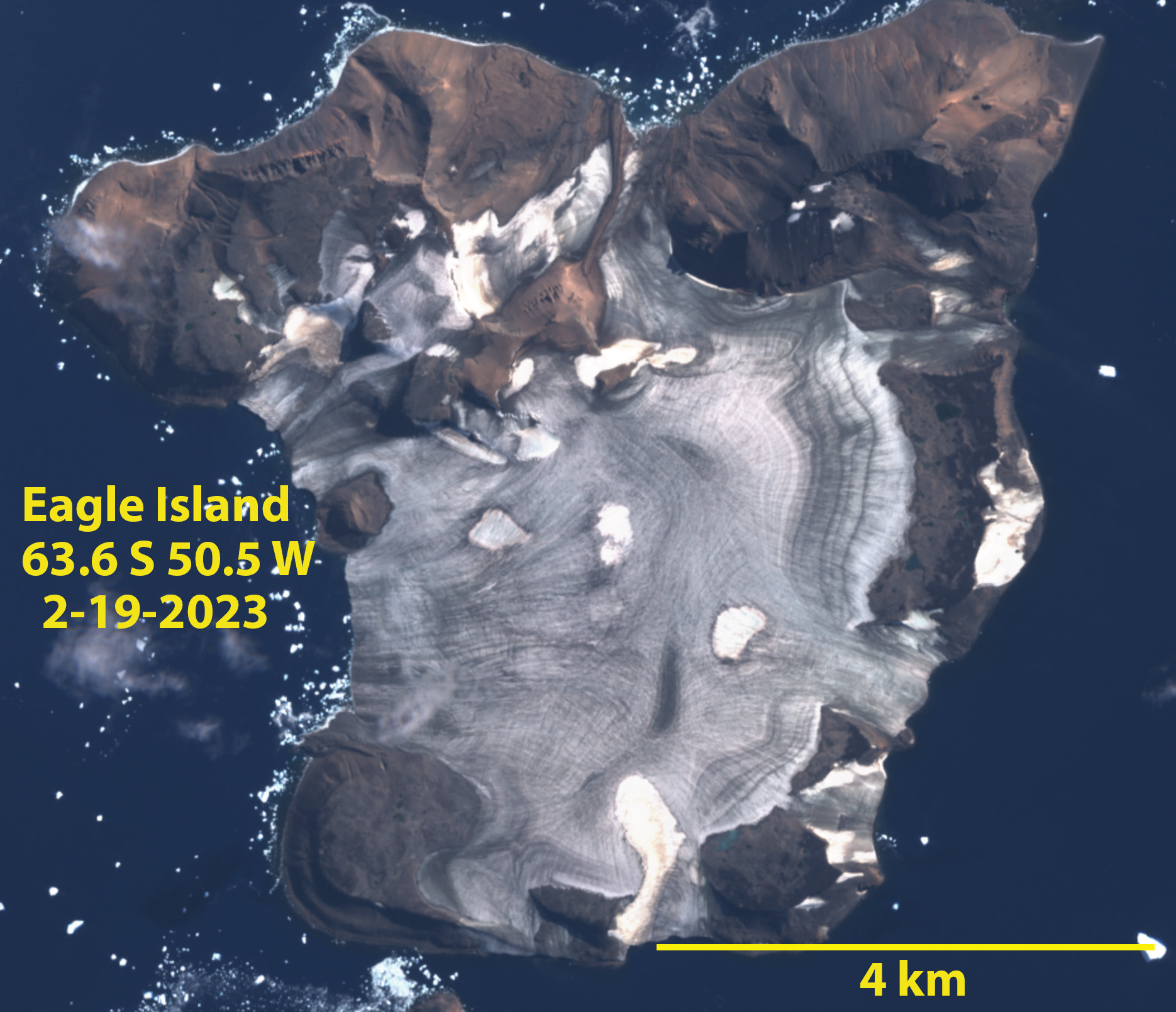
As reported separately, Eagle Island Ice Cap in Sentinel image from Feb. 19, 2023 has only small patches of snowcover left, 5-10% of ice cap all above 300 m. The peripheral ice caps and glaciers here are not an indicator of the larger ice sheets. They are an indicator that snowcover free glaciers are now occurring not just at temperate latitudes. These glaciers like many glaciers in the Central Andes of Chile and Argentina have lost nearly all their snowcover.


A series of glaciers on the Ulu Peninsula of James Ross Island Feb. 19, 2023 Sentinel images. San Jose, Lachman and Triangular have lost all snowcover and have a low albedo. Glasser and Lachman North Glacier have snowcover above 500 m.

Whisky Glacier on the Ulu Peninsula of James Ross Island Feb. 19, 2023 Sentinel image, illustrating 90% of the snowcover has been lost, green arrow is ice divide.

Western Vega Island Ice Cap in Feb. 19, 2023 imnage is 70% snowcover free with snow along summit area above 400 m.

Eagle Island Ice Cap in Sentinel image from Feb. 19, 2023 illustrating only small patches of snowcover left, 5-10% of ice cap. 

NCEI NOAA Monthly Global temperature anomalies.


Eagle Island Ice Cap, Antarctica Loses its Snowcover in 2023

Screenshot

Eagle Island Ice Cap in Sentinel image from Feb. 19, 2023 illustrating only small patches of snowcover left, 5-10% of ice cap. 

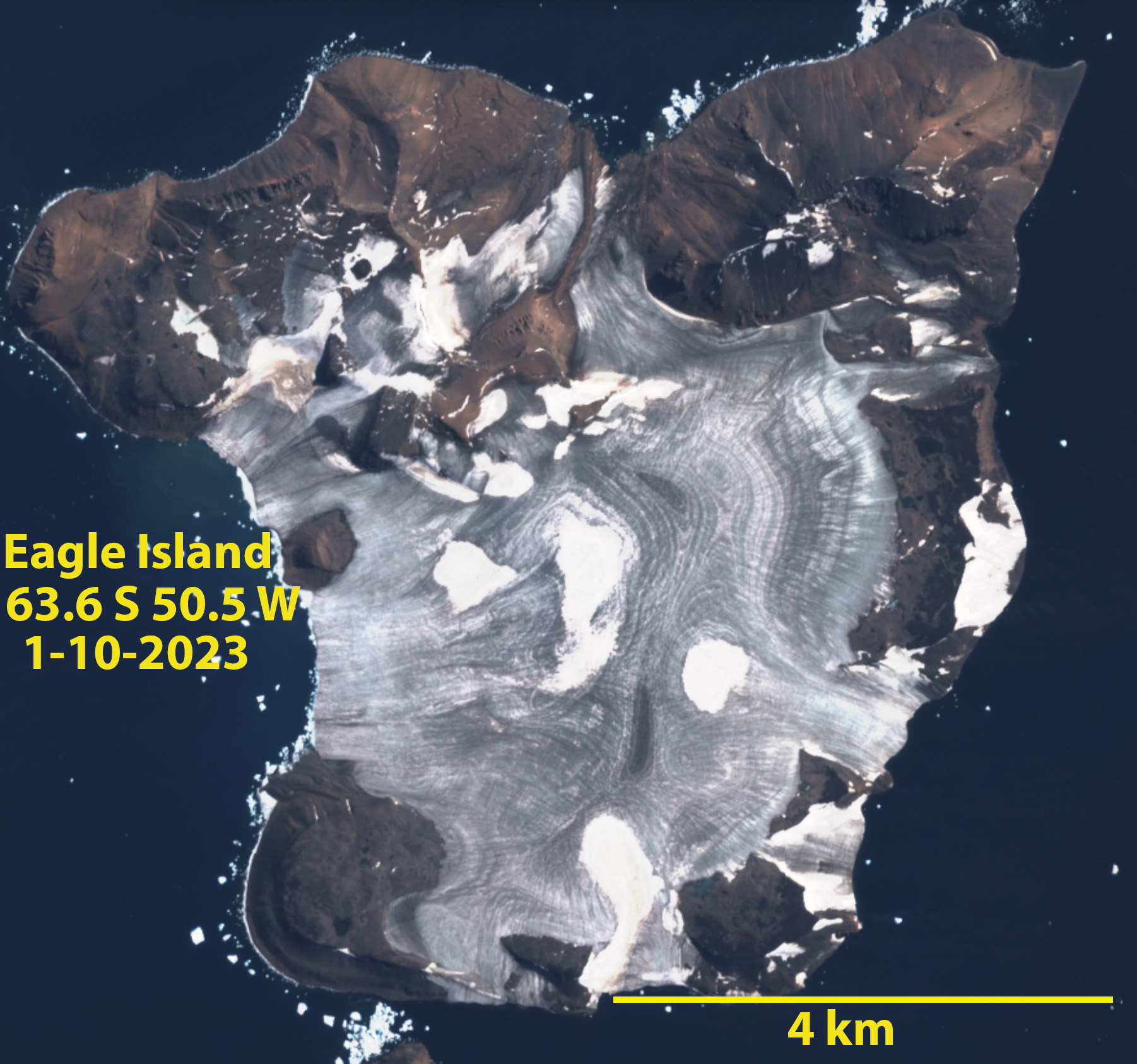
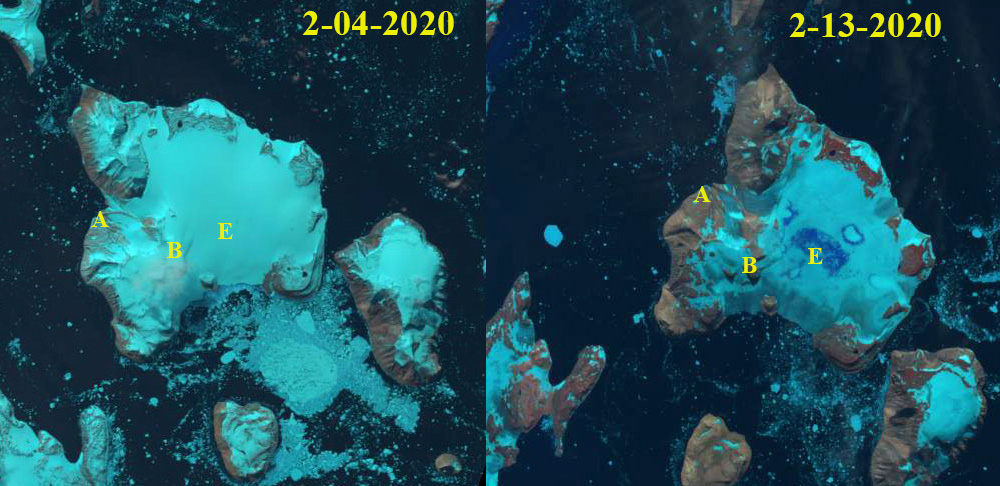
On February 19, 2023 Eagle Island Ice Cap, Antarctica has less than 10% snowcover. This is less snowcover than observed even after the period of record warm weather over the Antarctic Peninsula in February 2020.  Temperature when the all time Antaractica temperature record was set at Esperenza Base. That year also led to record melt and ponding on the George VI Ice Shelf  (Banwell et al, 2021). Here we examine Landsat and Sentinel imagery of the Eagle Island Ice Cap (63.65 S 55.50W), 40 km from Esperanza, to identify surface melt extent and surface melt feature development in 2020, 2022 and 2023. The summit of the ice cap is at 250-300 m and it has an area of 21 km².

In 2020 we observed blue ice areas (BI) and saturated snow areas (SS) rapidly developed from a snow covered ice cap during the heat wave (NASA EO, 2020). The impact of short term melt events like this on an ice cap like this, is visible and significant for annual mass balance, but not large in terms of long term glacier mass balance (volume change) and area. In 2022 a similar patter nof blue ice developed, but no saturated snow. In 2023 the loss of snowcover is nearly completely yielding a more extensive bare ice and firn surface area. This is the result not of a heat wave but of a consistenly warm summer. At Esparanze Base:

  • November mean temperature 2.5 C above average
  • December mean temperature 0.5 C above average
  • January mean temperature 1.5 C above average
  • February mean temperature 1 C above average

This yields an mean melt season temperature 1.5 C above average compared to 2020 that had a mean average temperature 0.5 C above average.  The most anomalously warm month was November. This led to a mostly snow free ice cap by January 10. The ice cap then experienced a month of mostly snow free conditions with the darker ice melting more rapidly then the snow would. This in particular will lead to marginal retreat of the ie cap along bare rock margins.

Screenshot

Eagle Island Ice Cap in Sentinel image from Jan. 10, 2023 illustrating only 15-20% snowcover left.

eagle-2-2020

Eagle Island Ice Cap, Antarctica in Landsat images from Feb. 4, 2020 and Feb. 13, 2020.  Point E indicates an are area of snow/firn that is saturated with meltwater. Point A and B indicate locations where the amount of bare rock/ground and hence albedo have changed dramatically. 

Volcan Peteroa Glaciers Argentina/Chile Fragment During Snow Cover Free Summers

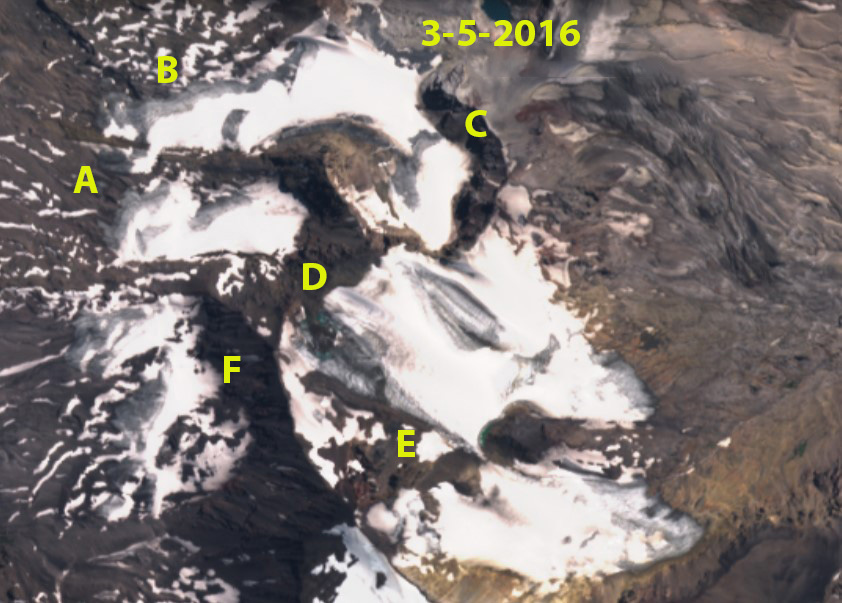
Volcan Peteroa glaciers in Sentinel images from March 2016 (below) and March 2023 (above). This illustrates fragmentation, 50% area loss, and a new lake formation. All the result of repeated snowcover free glaciers. 

For an alpine glacier to survive it must remain mostly snowcovered throughout the year, even at the end of the summer. This is one reason for the majesty of glaciated mountains, they shine brightly even in summer.  This summer in the Central Andes of Argentina and Chile, just as in 2022, I have chronicled the near total loss of snowpack due to summer heat waves, leading to dirty/dark glaciers (Pelto, 2022).  The heat wave this summer led to maximum temperature anomalies 3-5 C during the first half of March in the Central Andes of Argentina (SMN Argentina, 2023). An ice surface melts faster than a snow surface and the darker surface of the glacier also enhances melt rate leading to more rapid area and volume loss. This includes fragmentation and rapid expansion of bedrock areas amidst the glacier, other regional glacier obsrvations include: Sollipulli Glacier, Rio Atuel Glaciers, Palomo-Cipreses Glacier and Volcan Overo Glaciers,Here we examine Volcan Peteroa glaciers on its north flanks, which straddles the Chlile-Argentina border during the 2016-2023 period using Sentinel images. Reinthaler et al 2019 observed a ~2% annual area loss of Volcan Peteroa glaciers.

Here we examine the impact of several years of snow cover loss on the Volcan Peteroa glaciers. In 2016 it is evident there are six key ice masses on the north flank of the glacier A-F, with a combined area of 4.5 km².  In 2022 early snowcover loss led to rapid glacier thinning and lake formation, see below.  In 2023 the glacier at Point A has contracted by 50% to 0.22 km². At Point B and C the glacier has separated and is now two fragments with area of 0.36 km²  and 0.12 km² respectively. At Point D a new lake has expanded rapidly in 2022 and 2023, the lake has an area of 0.12 km² and the glacier a area of  1.21 km².  At Point E the glacier fragmented and pulled away from D and its two fragments have an of 0.36 km². At Point F the glacier has melted away. The combined area of 2.27 km² is ~50% of the glacier area just seven years prior. This is much faster than the 2% loss of the 1986-2015 period. The significant darkening of the snowfree surface will speed the loss of this glacier that no longer has a consistent accumulation zone.

Volcan Peteroa Glacier in false color Sentinel image continues to fragment with ~2% retained snowcover in 2022.  New lake at Point D. A small fragment of ice is apparent at Point F. and bedrock expansion at Point A. New lake has also formed.

Snowcover Free Glaciers Generates Fragmenting in Central Andes, Chile

Snowcover free glaciers in the Central Andes in 2014 ad 2023 Landsat images. The ongoing fragmentation and retreat is evident at Point A-H, see closeup details below. The glacier as Point B has melted away, At Point G and H glacier tributaries have separated from the Norte Cipreses Glacier in the valley below. At Point D-F expanding bedrock areas amidst glacier driving further fragmentation. Glaciers at Point A and C rapidly melting away. 

Palomo Glacier and North Cipreses  are three comparatively large glaciers in the Central Andes of Chile. The three glaciers are adjacent to each other with the Palomo and Coton Glacier feeding  the Rio Cortaderal. Rio Cortaderal is part of the Cachapoal River watershed that supplies two Pacific Hydro projects; a 110 MW run of river project at Chacayes and a  78 MW Coya run of river project. Norte Cipreses Glacier feeds the Rio Cipreses. These glaciers are important water resource from December-March Bravo et al (2017) quantified this resource for adjacent Universidad Glacier, which supplied 10-13% of all melt season runoff to the Tinguirica Basin. La Quesne et al (2009) reported that Palomo Glacier retreated 1160 m from 1955-1978 and advanced ~50 m 1987-2007, due tot Palomo Glacier having an equilibrium balance durng the 1987-2000 period. Pelto (2022) reported a retreat of the glacier front of 1250 m from 2002-2022.  Here we examine the changes of this glacier from 2014-2023 using Landsat 8 and 9 images along with Sentinel images, that illustrate the impact of essentially snowcover free glaciers during the summer of  2022 and 2023 due largely to a January heat wave in 2022 (Washington Post, 2022) and February heat wave in 2023 (Pelto, 2023).

Point A is a small glacier in a south facing cirque below Alto de los Pejerreyes. From 2014 to 2023 area declined from 0.3 km² to 0.1 km². There is remanent glacier ice, but this is no longer active ice and will soon disappear. At Point B in 2014 the area of remanent glacier ice is 0.1 km², by 2023 it is gone. At Point C the glacier has declined from  0.35 km² to 0.15 km² and retreated 300 m from 2014-2023.  At Point D a bedrock area amidst the Maria Angeles Glacier, has expanded from 0.04 km² to 0.20 km², this reflects the lack of flow now reaching the terminus, which retreated 700 m from 2014-2023. At Point E the glacier has retreated 300 m and is separating into three fragments. At Point F the bedrock area amist Palomo Glacier has expanded from 1.1 km² to 1.7 km² between 2016 and 2023. This again reflects diminineshed flow to the terminus which has retreated 800 m during this period, ~100 m/year.  At Point G two glacier tongues connected to the Norte Cipreses Glacier in the valley below in 2014. By 2018 they had nealy separated and by 2023 they had completely separated from the glacier below, retreating 200-300 m to the top of this bedrock step. At Point H, the glacier disconnected from Norte Cipreses Glacier in the valley below after 2002 and retreated 300 m from 2014-2023. There is also a new expanding bedrock area high on the glacier, Point I below. The story is not unique with Sollipulli Glacier to the south and Rio Atuel glaciers in the next watershed to the east also having lost their snowcover in 2022 and 2023.

Retreat of Palomo Glacier from 2016 (red arrow) to 2023 (yellow arrow), 800 m. Separation of tributaries at G, yellow arrows that had fed Norte Cipreses Glacier. False color Sentinel images.


Glacier loss at Point B, Glacier retreat at Point C, yellow arrows marks 2016 location. Bedrock expansion at Point D, E and I. retreat from green arrow to yellow arrow of the Maria Angeles Glacier terminating near Point D. Glacier retreat at Point H, yellow arrows marks 2016 location. False color Sentinel images.

Glacier O’Higgins, Chile Rapid Calving Retreat 2016-2023

Glacier O’Higgins in February 16, 2023 Sentinel image with the 2002, 2016 and 2019 terminus also indicated. Point D marks a detached lobe on of ice on the northern margin in 2023. Point F marks the southern margin terminus front.

Glacier O’Higgins is a large outlet glacier of the Southern Patagonia Icefield (SPI) that terminates in Lago O’Higgins. Cassasa et al (1997) report that from 1896-1979 the glacier had retreated 13.8 km up an inlet of Lago O’Higgins.  The glacier remained stable in this position from 1979-1986 with a retreat of 800 m from 1986-1995.  Schaefer et al (2015) examined the mass balance of SPI and found Glacier O’Higgins had a calving flux of 2.15-2.97 cubic kilometers/year, and a calving front velocity of 2300 m/year. Malz et al (2018) noted a mean elevation change of -1.04 m/year for Glacier O’Higgins from 2000-2016, with the greatest thinning near the terminus.  Despite this thinning there is limited retreat during this period as the glacier terminated on a shallow bedrock sill (Gorlet et al 2016). They observed that the bed elevation of O’Higgins dropped off into a deeper basin beyond this ~1 km wide sill and remained below sea level for 15-20 km inland of the 2012 ice front location. Here we use 2016-2023 Landsat imagery to update changes observed from 1986-2018.

Topographic map of the terminus area of Glacier O’Higgins, with the ~2016 terminus. Note the elevation step at both the 2016 terminus sill and the sill just upglacier of the 2023 terminus.

From 2002-2016 retreat is limited with the terminus located on a sill, then in 2016 the glacier begins to retreat off of the sill into the deeper sub-glacial basin leading to a rapid retreat from January 2016 to February 2019 of  1900 m on the southern margin, 1800 m in the center and 600 m on the north side, with total recession of 3.0 km². The calving front was 1.75 km widenwith the glacier having retreated into a confined channel. From 2019-2023 the rapid retreat across the sub-glacial basin continued isolating a stagnant region on the north side of the terminus (Point D). The main calving front in 2023 is 1.6 km long with the stagnant region still calving as well. The recession from 2016-2023 has been 7 km² with 4 km² from 2019-2023.  The retreat since 2016 has been 3000 m on the northern margin, 3700 m in the center and 3500 m on the southern margin. The glacier along the southern margin in 2023 is near the next bedrock sill as identified by Millan et al (2019).  The sub-glacial basin between sills is ~4-5 km across, helping drive the rapid retreat across the basin. This is evident in the topographic map as well. The northern terminus still is over deep water, and has ~1 km to retreat to reach the sill crest.  Millan et al (2019) Figure 3 illustrates this is a wide sill that should provide short-term terminus stability until further thinning driven by mass balance losses leads to retreat much as occurred from 2000-2016. The retreat of this glacier is similar to that of Dickson Glacier and Upsala Glacier.

Glacier O’Higgins in Jnauary 9, 2016 Sentinel image Point D marks a detached lobe on of ice on the northern margin in 2023. Point F marks the southern margin terminus front in 2023.

Glacier O’Higgins in February 10, 2019 Sentinel image . Point D marks a detached lobe on of ice on the northern margin in 2023. Point F marks the southern margin terminus front in 2023.

Glacier O’Higgins in February 16, 2023 Sentinel image with the 2002, 2016 and 2019 terminus also indicated. Point D marks a detached lobe on of ice on the northern margin in 2023. Point F marks the southern margin terminus front. LM marks the lateral moraine from the Little Ice Age. FF is the forefield that has been deglaciated for ~50 years.

Rio Atuel Glaciers, Argentina Stripped of Snowcover February 2023

Snowcover loss on Cofto, Fiero and Del Humo Glacier in Sentinel images from January 13 and February 9, 2023, snowpack diminished from 45% to less than 3%.

Rio Atuel drains from the high Central Andes in Western Argentina and is a snow and glacier fed system In the headwaters region there are a series of glaciers that have been losing mass and retreating.The most negative mass balance rates from 2000–2018 in this region of Argentina were in the  Atuel basin at −0.70  m/year (Ferri et al 2020). Both minimum and annual discharge in the Rio Mendoza has diminished from 1980-2010 (Lauro et al 2019).

Here we examine the snowcover loss between January 13 and February 9, 2023 on four of these glaciers from south to north Fiero, Corto, Del Humo and La Laguna. In mid-January snowcovered 40-50% of these glaciers. After a significant heat wave from January 28-Feb. 9. the snowcover had declined to less than 3% with six weeks left in the melt season.  This is the second year in a row these glaciers have lost all snowcover. This has further concentrated light absorbing particles at the surface, decreasing albedo, and increasing glacier melt. The glaciers simply put look quite dirty.  This is a cumulative process that is enhanced by consecutive high melt years and causes rapid volume loss.  Shaw et al (2020) found a significant ongoing decline in ice albedo in these region of the Andes that is impacting their overall mass loss.  The increased frequency of heat events continues to enhance melting of Central Andean glaciers. This process is playing out this year on Sollipulli Glacier and in 2022 on many Central Andean glaciers.

Snowcover loss on La Laguna Glacier in Sentinel images from January 13 and February 9, 2023, snowpack diminished from 40% to less than 3%.

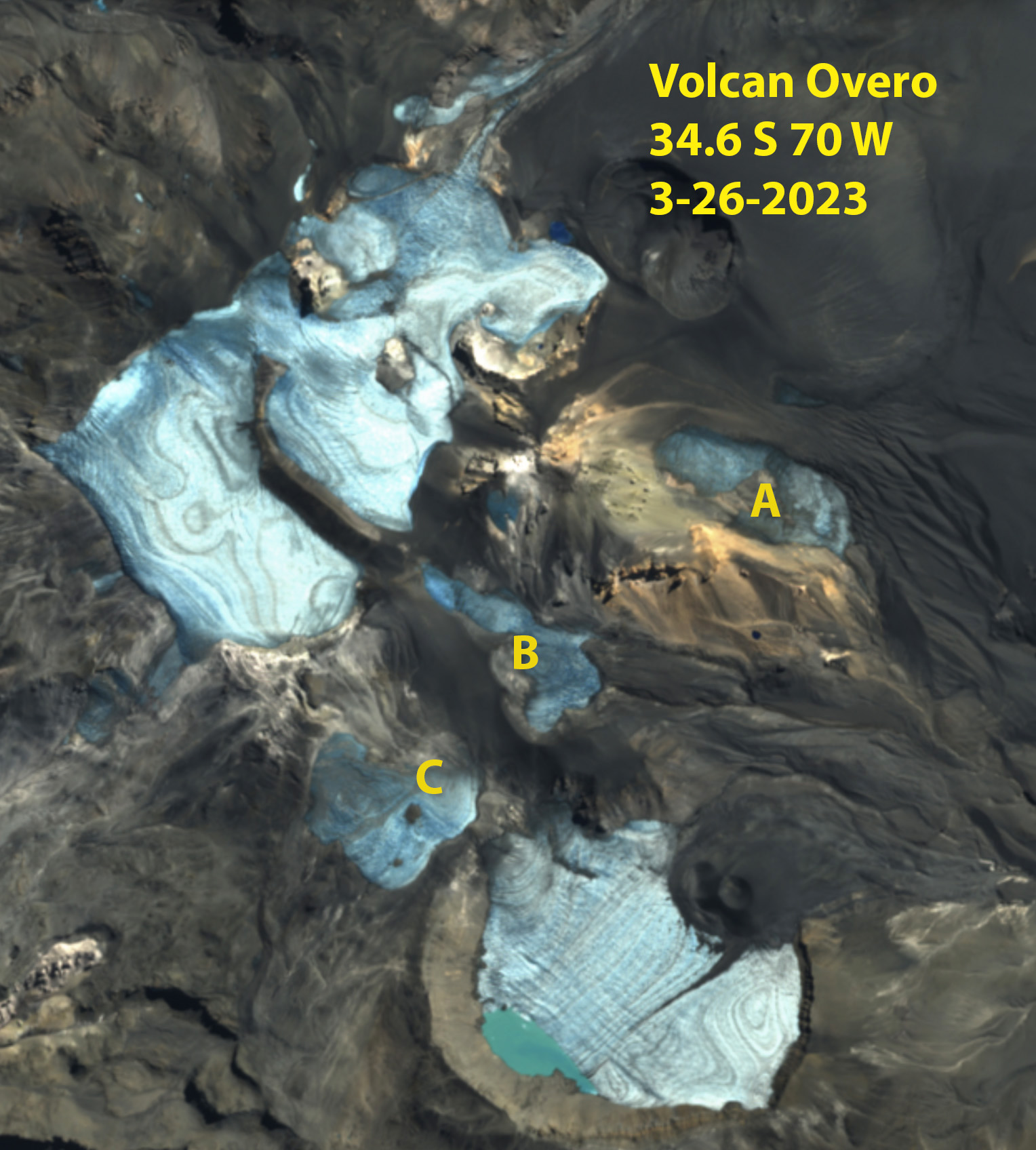
Volcan Overo is a 4619 m high Andean mountain in Argentina with a relatively low sloped broad summit region above 4000 m. The summit region is host to a glacier complex that is shrinking and fragmenting. In mid-January, 2022 the glacier has lost all of its snow cover. Volcan Overo in February 2023 the glacier complext has again lost all snowcover, which is leading to furtherfragmentation at the yellow arrows, even since 2022.

Volcan Overo in 2022 and 2023 having lost all of its snowcover. Expanding lakes at blue arrows.


Sollipulli Glacier, Chile Rapid Melt: Fire and Ice February 2023

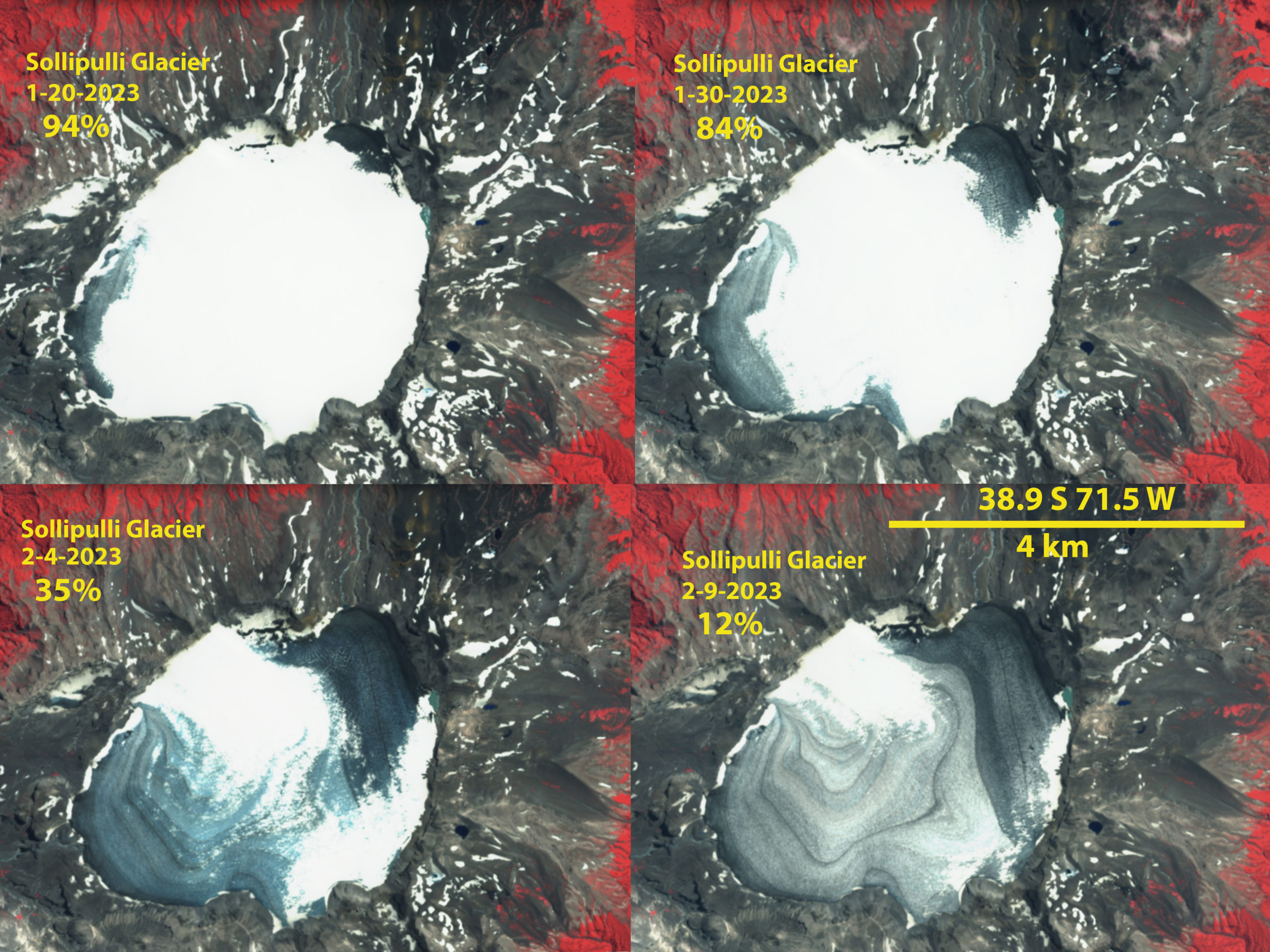
Sollipulli Glacier, Chile snowcover loss during summer 2023 heat wave in false color Sentinel images from January 20-Feb. 9. Snowcover delcined from 94% to 12% in 20 days.

Nevados de Sollipulli is a volcano, is in the central Andes of Chile near the border with Argentina in Parque Nacional Villarica, Chile. The 4 km wide summit caldera at ~2100 m is filled by a glacier.  In 2022 the summer heat waves stripped the glacier of all snowpack in January and that persisted through March, see below (Pelto, 2022). The volcano is dormant last producing lava flows 700 years ago and last erupting 2900 years ago (NASA, 2017). Reinthaler et al (2019) identified a 27% decline in glacier area from 1986-2015 on 59 volcanoes in the Andes. The study included Sollipulli where the area declined from 16.2 kmin 1986, 20 12.5 km2 in 1999 and 11.1 km2 in 2015 (Reinthaler et al 2019). Here we examine Landsat imagery illustrating the recession from 1986-2022 and the loss of all snowcover for most of the summer of 2022. The summer of 2022 led to early summer loss of most/all the snowpack on Central Andes glaciers from 30-40 S. (Pelto, 2022).

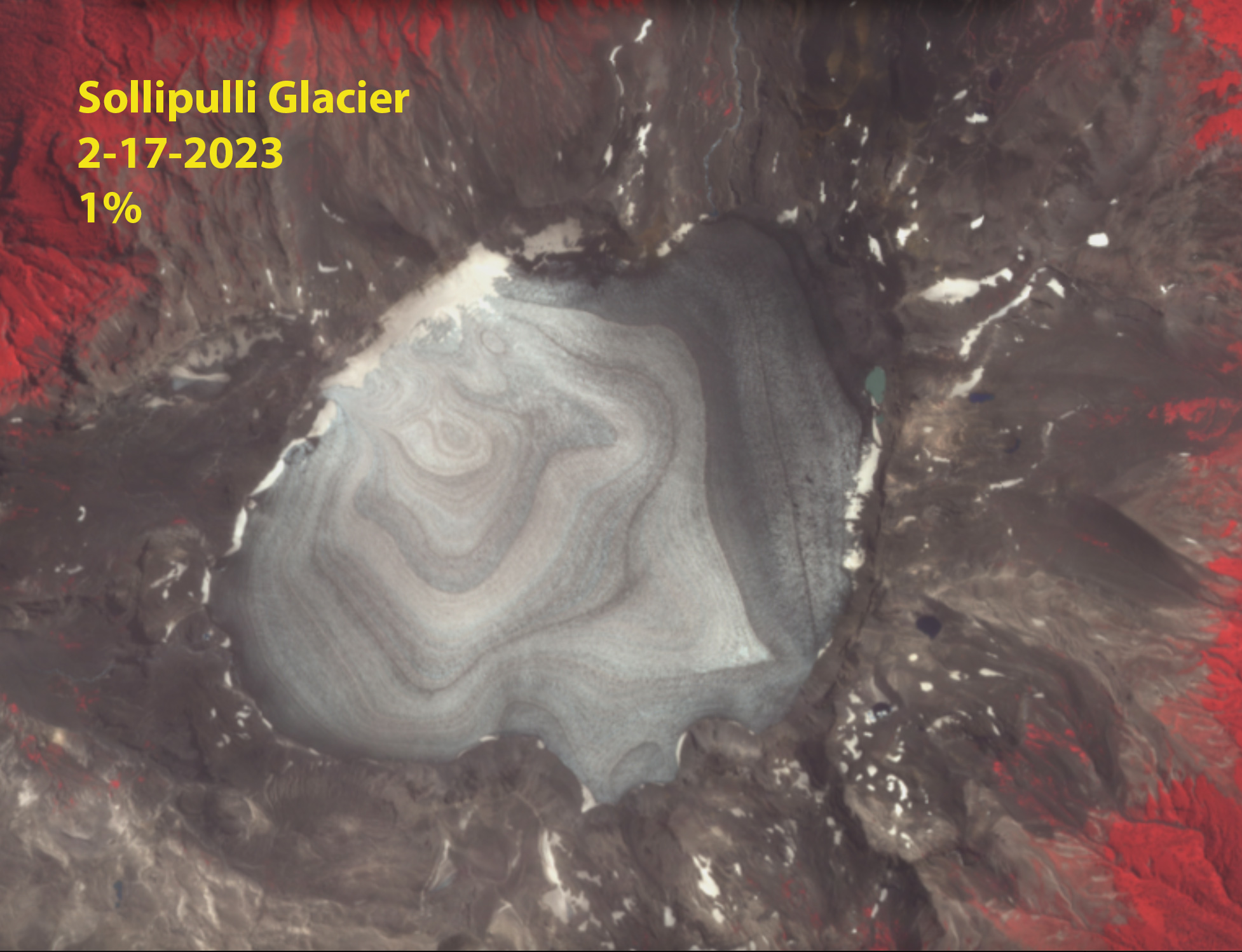
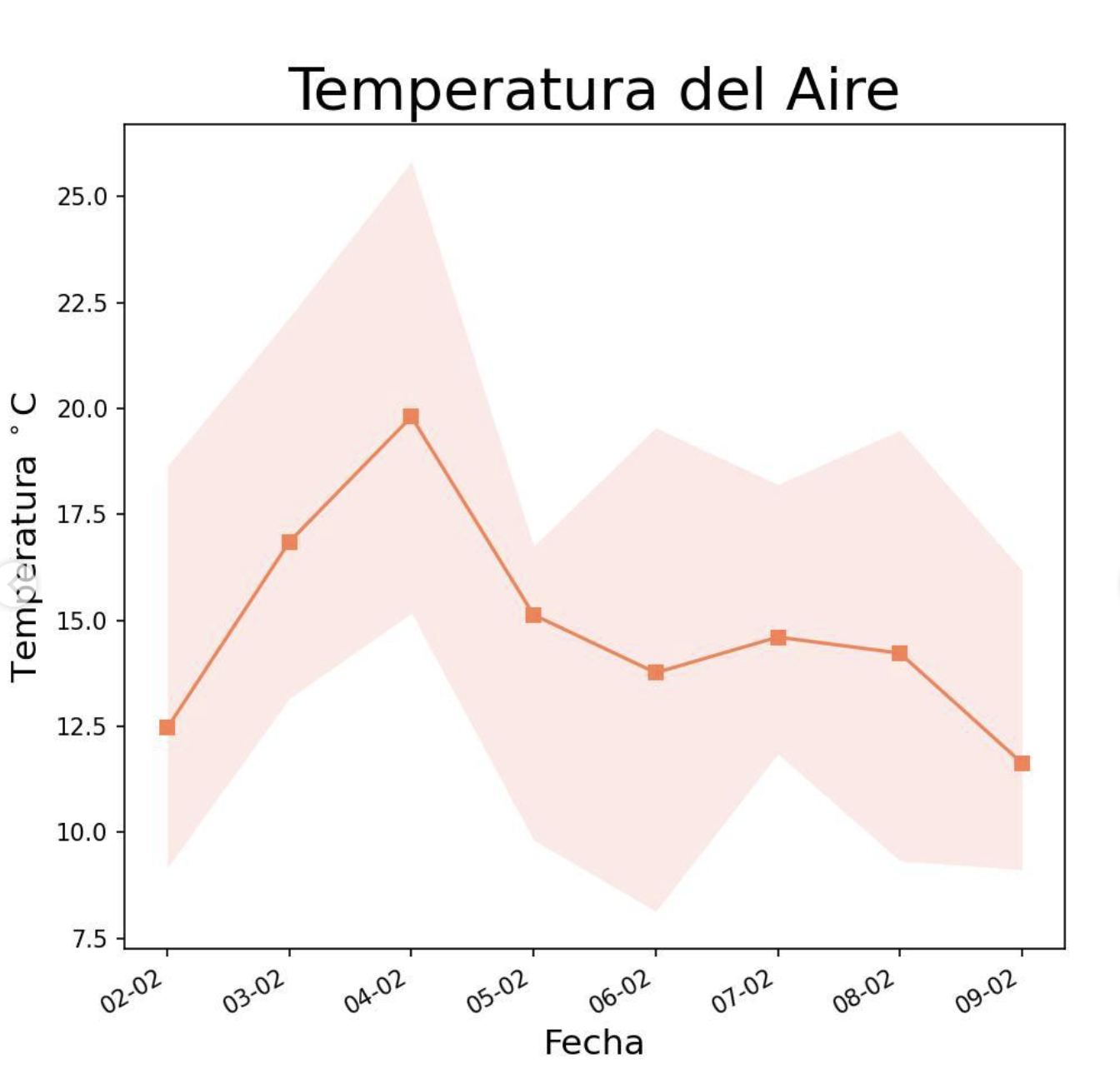
This summer central Chile has experienced a persistent extreme heat wave that has generated ongoing disastrous forest fires (NASA EO, 2023), CONAF continues to update the fire area daily. Most of the Solllipulli Glacier is at  2000-2200 m elevation, CECS has a weather station at 1900 m on nearby Volcan Villarrica that had a high temperature on Jan. 29 and Feb. 4 of  over 24 C. The highe tempertature has been above 16 C everday from Jan. 28 to Feb. 8 (see below). This has led to the snowcover diminishing rapidly on Sollipulli Glacier from January 20 to February 9, 2023. The glacier was 94% snowcovered on Jan. 20, 84% on January 30, 35% on Feb. 4 and 12% on Feb. 9. How long until it is down to 0%? This blog will be updated in this coming week to identify that and to better quantify the heat. By February 17, 2023 snowcover is down to 1%

Sollipulli Glacier, Jan. 20, 2022 and fifty five days later the glacier is still bare of snowpack.

Sollipulli Glacier on Feb. 17, 2023 in false color Sentinel image, 1% snowcover left.

Temperature from the CECS station on Volcan Villarica at 1900 m. showing the average minimum and maximum.


Burroughs Glacier, Alaska Down to Last 1%

Burroughs Glacier in 1986 and 2022 Landsat images. The red arrow marks the west margin and the yellow arrow the east margin in 1986. Yellow dots mark the outline of the glacier in 2022. Glacier area declined from 12.5  km² to 1.5 km² during this 36 year period.

Burroughs Glacier in Glacier Bay National Park, Alaska has been retreating without pause since 1892 when it was part of the Muir Glacier complex. The glacier is unusual in that it has not had an accumulation zone over the last century, where snow persists through the year. Without an accumulation zone a glacier cannot survive (Pelto, 2010). Mickelson (1971) summarized the retreat of the glacier from 1892-1960. In 1892 the Burroughs ice plateau was assessed as a 10 km by 25 km ice cap. By 1960 it had thinned by as much as 750 m and its calving margin had retreated 27 km.. By the 1970’s the glacier was essentially stagnant (Molnia, 2008). In 1982 I briefly visited the western terminus, which provided a still imposing slope, made more so by the rain and clouds lowering onto its surface.

Here we examine the glacier in Landsat imagery from 1986 to 2022 to illustrate the retreat, the lack of snowcover  and the thinning. In the 1948 map of Burroughs Glacier, the glacier is 12.1 km long, and much of the glacier is already stagnant, the glacier has both a north and south terminus, purple arrows. To the west of Burroughs Glacier is Plateau Glacier (P).

burroughs map

Burroughs Glacier in 1948 USGS map.

In 1948 Burroughs Glacier has an area of 22 km² and is 12.5 km long, with the crest of the glacier at ~1500 feet. In 1986 Burroughs Glacier has an area of 12.5 km² and has no snowcover by mid-summer. The glacier terminates in proglacial lakes at both the north and south terminus red and yellow arrow respectively, and is 9 km long, purple arrows indicate 1948 terminus. By 1986 Plateau Glacier has only three small remnants marked by P, surrounding these vegetation is still limited, with considerable expanse of bare glacial sediments. By 2003 Plateau Glacier is gone and vegetation is filling in most of the area that was still bare sediment in 1986. In 2003 Burroughs Glacier again lacks any snowcover. The southern terminus has retreated 2.2 km from the lake, and the northern terminus has retreated into a second lake basin. The glacier is 6.3 km long, half of its length in 1948. In 2004 snowcover is again lacking anywhere on the glacier. In 2010 snowcover is lacking and retreat has continued shrinking the glacier to 5.4 km in length.  The glacier was assessed with an area of 2.8 km² and a median elevation of  313 m (1025 feet) by GLIMS. In 2013 the glacier lacks snowcover in this September Landsat image even though snow has returned to the surrounding mountains. This indicates how far below the snowline the glacier lies. Portions of a glacier are supposed to be the first locations that receive snowcover. The terminus has continued to retreat and the glacier was 4.6 km long in 2013. The northern terminus was retreating into a third basin of the proglacial lake. Vegetation has reclaimed almost all of the Plateau Glacier area and has reclaimed the region deglaciated by Burroughs Glacier before 2003. By 2022 the glacier area has been reduced to 1.5 km², this is just 12% of its area remaining from 1986 and 1% of the 1892 area.  The length of the glacier in 2022 is 2.3 km, only 50% of the lenght just a decade ago, and ~20% of the 1948 length.

Thinning of this glacier from 1948-2016 is evident from a comparison of topographic maps. Thinning in remaining glacier are averages 225 m during this period, that is a rate of ~3.3 m/year. Larsen et al (2007) had found a thinning rate of ~3 m/year for the 1948-2000 period.

Overlay of 1948 (blue labeled contours) and 2014 elevation map (Brown labeled contours) for Burroughs Glacier.

Burroughs Glacier has not been in equilibrium with climate since the end of the Little Ice Age. Its retreat has been hastened by the rising snowline of the last decade note by Pelto et al (2013) on Brady Glacier. This glacier area has declined by 88% since 1986, with volume loss being even larger.  Retreat usually increases as elevation declines and as the size of the remnant ice declines. There is no debris cover or persistent snowcover to slow the loss. Thus, it seems likely this glacier will be gone within 25 years. The 2011 Google Earth image at bottom indicates no snow, the reduced albedo from the dirty surface and a few crevasses near the margin that are collapse features. This is unlike nearby glaciers that are retreating significantly but not disappearing, like Brady Glacier, Geikie Glacier, Yakutat Glacier and Riggs Glacier. 

r.

1986 Landsat image of Burroughs Glacier. The  purple arrows mark the 1948 margin, red arrow the west margin in 1986 and the yellow arrow the east margin.

2003 Landsat image of Burroughs Glacier. The red arrow marks the west margin in 1986 and the yellow arrow the east margin.

2004 Landsat image of Burroughs Glacier. The red arrow marks the west margin in 1986 and the yellow arrow the east margin.

2010 Landsat image of Burroughs Glacier. The red arrow marks the west margin in 1986 and the yellow arrow the east margin.

2013 Landsat image of Burroughs Glacier. The purple arrows mark the 1948 margin, red arrow the west margin in 1986 and the yellow arrow the east margin in 1986, pink arrows the 2013 margin.

2022 false color Sentinel image of Burroughs Glacier. The ice is dirty but not debris covered at this point.


Grasshopper Glacier, Wyoming Disintegration Underway

Grasshopper Glacier, Connie Glacier, J Glacier and Sourdough Glacier in 1966 map (black outline of glaciers) and in 2022 false color Sentinel image (green dots for glacier outline). The area of Grasshopper Glacier declined from 3.28 km² to 0.81 km². Closeup of area in 2021 and 2022 illustrates the many glacier fragments.

Grasshopper Glacier in the Wind River Range of Wyoming has a southern terminus calving into a lake, and a northern terminus. The southern terminus is calving and retreating expanding the unnamed lake it terminates in and retreated 350 m from 1966-2006 (Pelto, 2010).  The northern terminus retreated 730 m from 1966-2006 the most extensive retreat in the Wind River Range. (Pelto, 2010). The main accumulation area on the west side of the glacier has become segmented by large bare rock areas as noted by comparing the 1966 map and 2006 image. The area declined from 3.28 km² to 2.34 km², a 27% decline (DeVisser and Fountain, 2015).  Thompson et al (2011) noted a 38% loss in area of the 44 Wind River Range glaciers from 1966-2006. Maloof et al (2014) noted an even larger drop in volume of 63% of the same glaciers from 1966-2012.The combined retreat of the two terminus is over 1000 m is 26% of its 1966 length of 3.8 km. In 2006 it was clear that the significant thinning and marginal retreat at the head of the glacier was symptomatic of a glacier that would disappear with current climate.  Here we return to examine how this glacier has fared particularly in the exceptionally warm summers of 2021 and 2022 using false color Sentinel images and comparison with the 1966 map.

In 2021 and 2022 the glacier was nearly snowless by the end of August, this resulted in significant thinning and marginal recession. In 2021 and 2022 there are six glacier fragments with remaining glacier ice that are no longer connected to the glacier. In 2022 the glacier area has declined to 0.81 km², a 75% loss in area since 1966 and a 66% loss since 2006. The overall length from the north to south terminus is now 2.1 km in 2022. What is leading to the rapid area loss is the lack of avalanche accumulation on this glacier and increased summer temperatures, leading to additional ablation. The length is declining less than the area, because the central axis of the glacier has the thickest ice. Because the glacier in many years such as 2021 and 2022 has retained no snowpack, and any snowpack that had been retained in other years, as firn, has also been lost, the glacier no longer has an accumulation zone. With current climate it still will disappear. This is the same forecast as for most Wind River Range glaciers, such as Sacagawea and Mammoth.

Grasshopper Glacier in September 2021 and 2022 false color Sentinel images. Separated glacier fragments numbered 1-6.

Google Earth image with outline of glacier in 2006 and 1966 map outline in orange.

Grasshopper Glacier southern terminus in 2012 Sarah Meiser image.


Marconi Glacier, Chile Fragmentation and Retreat 1986-2022

Marconi Glacier in Landsat images from 1986 and 2022. Red arrows=1986 terminus locations, yellow arrow=2022 terminus location. Tributaries labelled 1-6, bedrock divides A-D and LE=Lago Electrico. In 1986 Lago del Marconi does not exist, by 2022 it is apparent at red arrow.

Marconi Glacier, Argentina is one of the more common routes onto the Southern Patagonia Ice Cap (SPI) via Marconi Pass. The glacier is no longer fed by the ice cap itself. The glacier drains into Electrico Lake and Rio Electrico. The good news is despite the name Rio Electrico will not be developed, since it is in Parque Nacional Los Glaciares, Argentina.  A decade ago I wrote about the retreat of this glacier, noting an overall retreat from 1986 to 2012 of 800-850 m. Here we update the changes in the glacier observed in Landsat imagery from 1986 to 2022. This encompasses nearly the entire history of nearby Argenitne trekking captial El Chalten, created in 1985, with routes to Lago Electrico.

In 1986 the glacier ends in the valley bottom, without a proglacial lake km from Electrico Lake, red arrow.  The glacier has one connection to the SPI with Tributary 2 at Point D. The glacier has already separated from Tributary 1. Tributary 4 and 5 are not separated at this time. In 2002 the glacier retreat has exposed a new developing proglacial lake, Lago del Marconi and a lateral moraine is developing at Point B.  By 2012 the glacier has retreated from the Lago del Marconi  it ended in. In 2015 there is exposed bedrock at Point B, Tributary 6 is still only separated by a lateral moraine from Tributary 5. In 2022 the glacier is no longer connected to the SPI. The bedorck areas at Point A-C have significantly expanded further separating Tributaries 3-6. Tributary 6 has fragmented no longer connecting to the main glacier. From 1986-2022 Marconi Glacier has separated from two key tributaries, this fragmentation a common result of signficiant retreat and glacier thinning. Retreat from 1986-2022 of Marconi Glacier is 1200 m, and for Tributary 1 is 1000 m.

Average thinning of this glacier from 2000-2015 was reported as 1.5 m/year by Malz et al (2018). From 2011-2017 Forestra et al (2018) found a similar rate of thinning. The rising snowlines, drive thinning and then retreat similar to other SPI glaciers such as San Lorenzo Sur Glacier , Oriental Glacier and Lucia Glacier.

Marconi Glacier in Landsat images from 2002 and 2015. Red arrows=1986 terminus locations. Tributaries labelled 1-6, bedrock divides A-D and LE=Lago Electrico.

Marconi Glacier in Sentinel image from 2-24-2022.  Tributaries labelled 1-6, bedrock divides A-D and LE=Lago Electrico.