Fingers Glacier, Alaska loses a finger to melting

finger compare
Landsat comparison of terminus area of Fingers Glacier 1986 and 2015

Fingers Glacier flows from the southern end of the Fairweather Range to the coastal plain, where is expands into a segmented piedmont lobe. The southernmost finger is heavily debris covered. In the Mount Fairweather B-4 quadrangle USGS map based on 1951 aerial photographs the glacier has four prominent fingers each eroding its own basin.  Here we examine Landsat imagery to illustrate the changes in this glacier from 1951 to 2015.  From 1950-1980  glacier’s just to the north In Lituya Bay were advancing. The La Perouse Glacier its immediate neighbor to the north was stable. Palma Glacier directly to the southeast has retreated throughout the 1950-2015 period.  Larsen et al (2015) identify that from 1994-2013 this region of Alaska is a significant source of glacier volume loss and hence contributor to sea level rise.  The loss of 75 gigatons per year from glaciers in southern Alaska was determined in this study to be largely from surface melt not from calving losses.  The mass balance of both Taku and Lemon Creek Glacier of the Juneau Icefield have had a notable decline in mean mass balance from 1986-2015 versus the 1951-28985 period (Pelto et al, 2013).  The nearby Brady Glacier also experience a higher snowline (Pelto et al, 2013b) which led to volume losses quantified by Larsen et al (2015).
fingers map

USGS map based on 1951 images

By 1986 the glacier still had four fingers with retreat from the 1951 position yellow arrow to the 1986 position red arrows.  Retreat was 900 m for the first finger, 400 m for the second finger, 300 meters for the third and 400 meters for the fourth southernmost finger.   A new lake had developed at the second finger, well lake expansion occurred at the first and third finger.  By 1999 a lake is beginning to form at the fourth finger.  In 2015 the first finger has retreated 600 meters in 30 years.  The second finger has disappeared after a 700 m retreat from 1986-2015..  The third finger has lost half of its length to the expanding lake, a retreat of 600 m in 30 years.  The fourth finger which is the most debris covered, leading to slower thinning, has retreated 600 meters since 1986, with a lake at the terminus that is continuing to expand.

fingers 1986

1986 Landsat Image

fingers 1999

1999 Landsat Image

fingers 2015

2015 Landsat Image
fingers glacier

Google Earth Image indicating flowlines.
Palma Glacier, Alaska Retreat Opens Lake Passage

Palma Compare
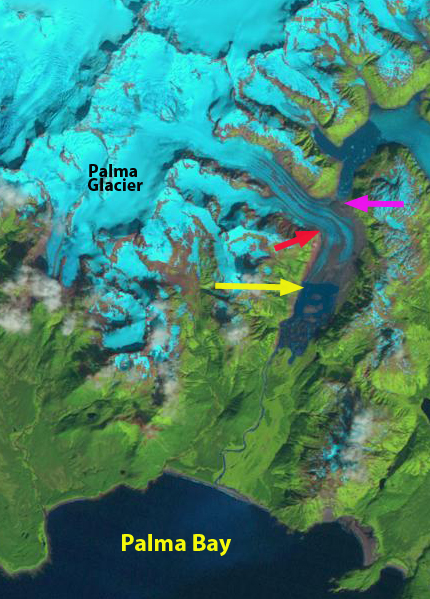
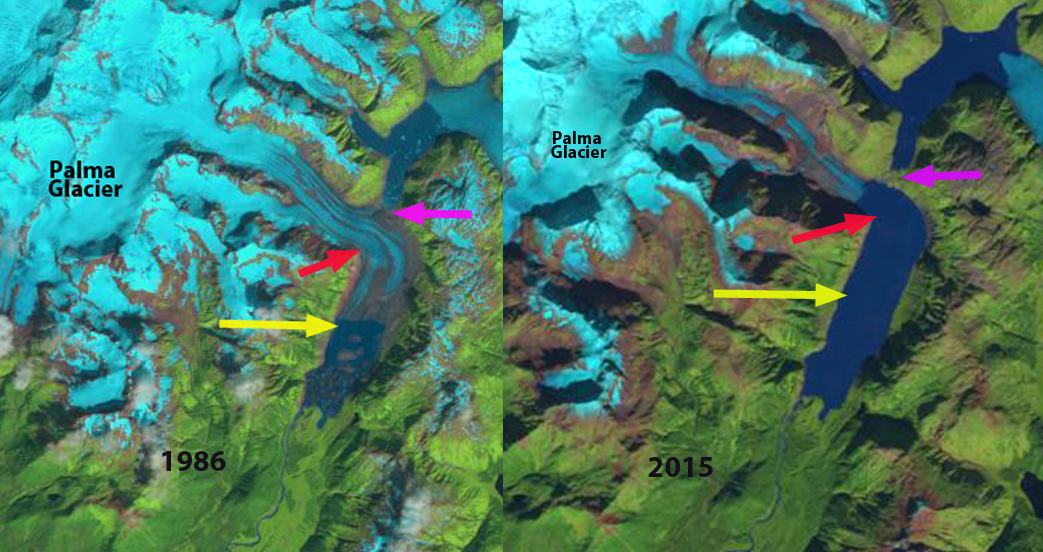
An August 1986 and September 2015 Landsat Image of Palma Glacier, 1986 terminus yellow arrow.
Palma Glacier is an unnamed glacier just west of Brady Glacier and Glacier Bay that is the principal glacier draining into Palma Bay.  Here we examined the changes in this glacier from 1986 to 2015 with Landsat Imagery.  The glacier has terminated in a lake at the head of a river draining into Palma Bay at least since the 1950 USGS map was prepared.The neighboring Brady Glacier advanced for much of the 20th century,  its tributary lobes began to retreat after 1970.  The main Brady Glacier terminus did not begin to retreat until 2009 and is poised to begin a rapid retreat as lake development at the terminus continues due to ongoing thinning (Pelto et al, 2013)..

palma glacier ge

Google Earth image of the Palma Bay and Palma Glacier region

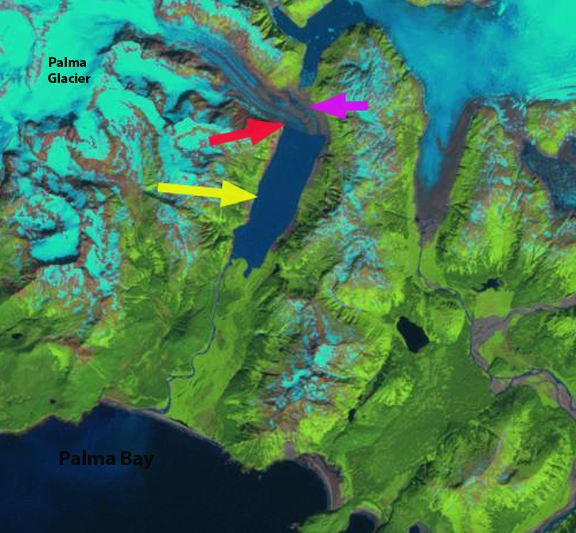
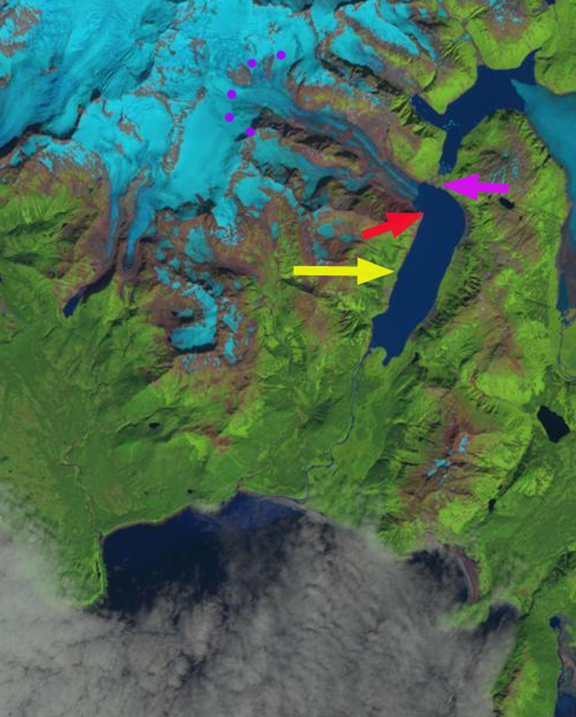
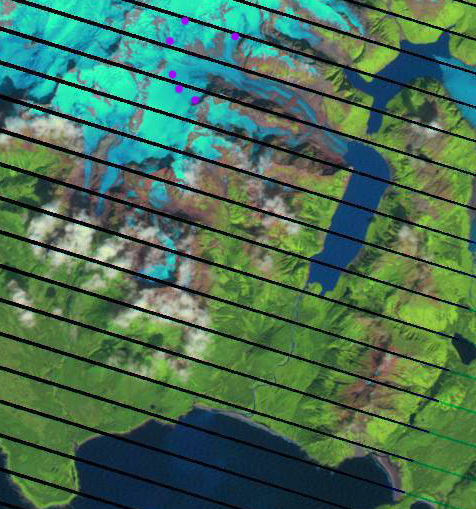
In 1986 Palma glacier flowed south out of the mountains before turning sharply west for 2 km before terminating in a lake at the yellow arrow. The lake had considerable debris covered ice bergs that had recently calved. By 1999 the glacier had retreated to the westward turn, red arrow, but did extend to the south side of the lake.  By 2014 the glacier had retreated from the westward turn, red arrow, and the strip of land between the two lakes at the purple arrow has been exposed and vegetated. it is now possible to paddle up one lake and portage to the next. The snowline purple dots is at 1000 m.  In 2015 this September image at top is after an early season snowfall, the last image below is an August image indicating the snowline is again at 1000 m with several weeks left in the melt season.  The glacier has retreated 2100 meters from 1986 to 2015 and still terminates in the lake. The retreat has slowed since 1999 after the lake narrowed at the westward turn. Retreat will continue as a snowline at 1000 m is to high to sustain even the current size of Palma Glacier.

palma Glacier1986
1986 Landsat image

palma glacier1999
1999 Landsat Image
palma glacier 2014
2014 Landsat Image
Palma snowline Aug 2015
2015 Landsat Image

Bionnassay Glacier Terminus Tongue Detaches, Mont Blanc, France

Bionnassay Glacier drains west from Dôme du Goûter and Aiguille de Bionnassay of the Mont Blanc Massif in France. The glacier has a heavily debris covered terminus and has experienced less retreat from 1980-2010 then other Mont Blance glaciers. Bionnassay retreated 200 m (Moreau et al , 2012), while Mer de Glace retreated 500 m in the interval 1998 to 2008. Gardent et al (2014) observed a 25% decline in the area of glaciers in the French Alps from 1970 to 2009, with the rate increasing significantly recently.  Bionnassay is now in rapid retreat as the stagnant terminus tongue is detached from the active glacier tongue.

bionnassay overview

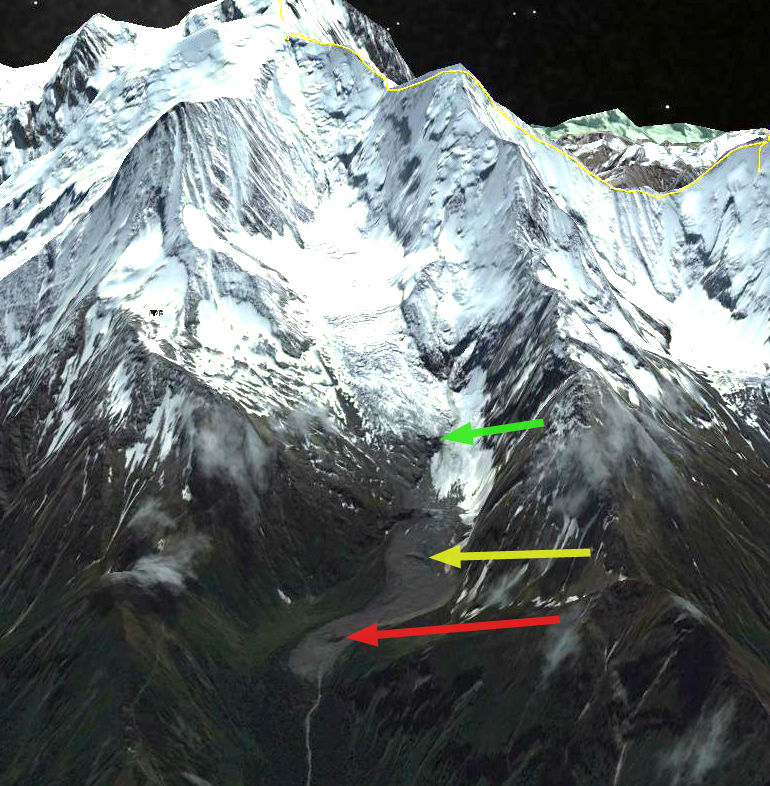
Bionnassay Glacier.  Red arrow indicates terminus of stagnant region.  Yellow arrow indicates bedrock emerging that is separating stagnant terminus tongue.  Green arrow indicates lower limit of active glacier. 

In 1985 the glacier terminus is at the yellow arrow. The debris covered ice is crevassed and covers the entire region at the red and green arrow. Points B and C are ice covered and Point A has a small exposure of bedrock. In 1999 retreat from the yellow arrow is evident the glacier still covering the region at the red and green arrow. In 2001 Google Earth image the terminus is evident at the red arrow, the region at the green and yellow area are covered by glacier ice. In 2011 the terminus has retreated 180 m since 2001, bedrock has emerged at the green arrow, beginning to separate the stagnant debris covered terminus tongue. At the yellow arrow the crevassing has diminished greatly. In 2015 the terminus has retreated to the pink arrow. Bedrock has been exposed from below the glacier terminus tongue at the yellow arrow. The active glacier terminus is now at the green arrow. At Point B and C glacier thinning has led to marginal retreat and exposure of bedrock where there was glacier ice. At Point A the expanse of exposed bedrock has greatly expanded.  The retreat of the main glacier terminus is around 200 m.  However, the retreat to the newly emergent bedrock separating the glacier is 750 m.  The active terminus is now 1700 m from the 1985 terminus position at the green arrow.  In the next few years this will become a well defined terminus, as the lower stagnant zone melt away.

Bionnassay Glacier is just south of Taconnaz Glacier, which is also retreating.
bionnassay 1985
1985 Landsat image
bionnassay 1999
1999 Landsat image
bionnassay glacier ge 2001
2001 Google Earth Image
bionnassay glacier ge 2011
2011 Google Earth Image
bionnassay 2015
2015 Landsat image

500 m

Acodado Glacier, Chile Rapid Retreat 1987-2015

acodado compare
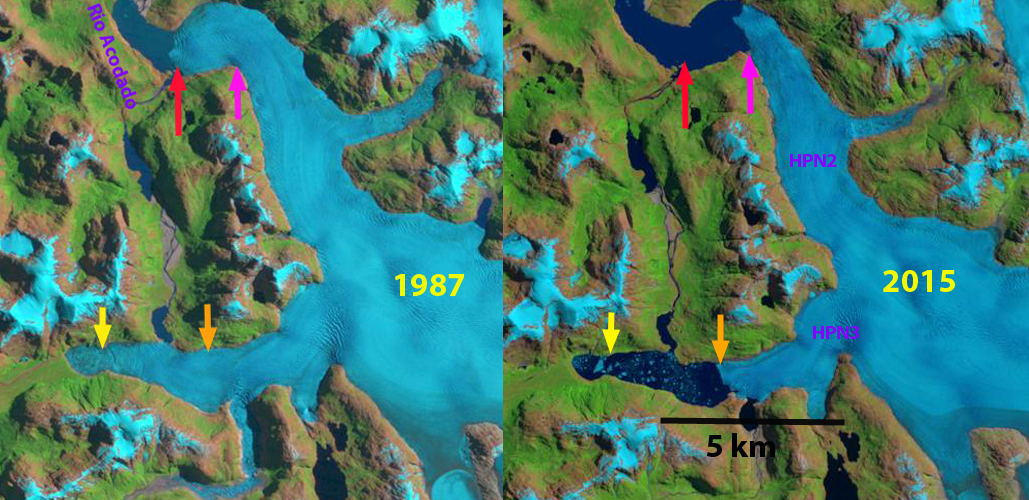
Landsat image comparison 1987 and 2015
Loriaux and Casassa (2013) examined the expansion of lakes of the Northern Patagonia Ice Cap. From 1945 to 2011 lake area expanded 65%, 66 square kilometers. Rio Acodado has two large glacier termini at its headwater, HPN2 and HPN3. that are fed by the same accumulation zone and comprise the Acodado Glacier. The glacier separates from Steffen Glacier at 900 m. The lakes at the terminus of each were first observed in 1976 and had an area of 2.4 and 5.0 square kilometers in 2011. (Loriaux and Casassa, 2013). Willis et al (2012) noted a 3.5 m loss per year from 2001-2011 in the ablation zone of the Acodado Glacier, they also note annual velocity is less than 300 m/year in the ablation zone. Davies and Glasser (2012) noted that the Acodado Glacier termini, HPN2 and HPN3, had retreated at a steadily increasing rate from 1870 to 2011. Here we examine the substantial changes in Acodado Glacier from 1987 to 2015 using Landsat imagery. acodado ge
Digital Globe image of Acodado Glacier and the termini HPN2 and HPN3.

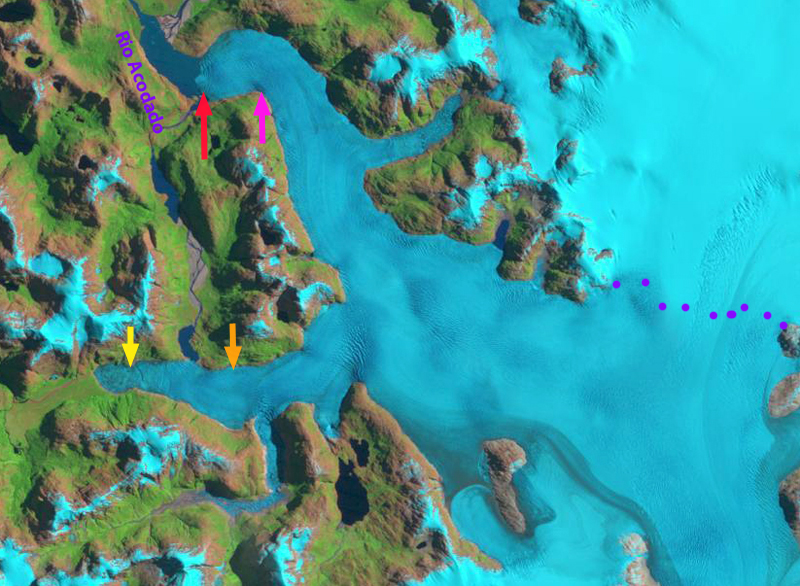
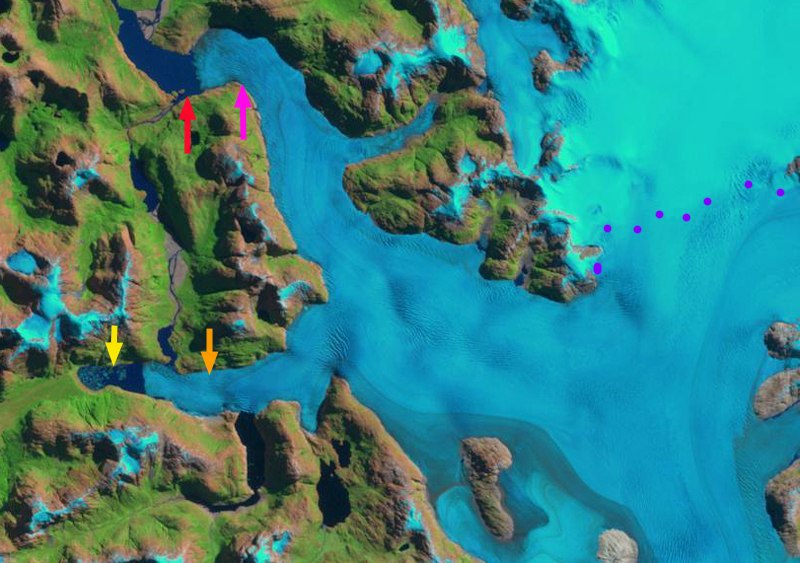
In HPN2 terminates at the red arrow in 1987 and HPN3 at the yellow arrow, the snowline is at the purple dots at 1000 m. By 2000 the glacier has retreated from the red and yellow arrow by 400 m and 900 m respectively, and the snowline is at 1100 m.   In 2014 there are many large icebergs in the lake at the terminus of HPN3, these are from recent calving retreat.  This is not an area where the lakes develop even seasonal lake ice cover.  The  snowline is again at 1100 m.  In 2015 it is apparent that HPN2 has retreated 2100 m from the red arrow to the pink arrow.  HPN3 has retreated 3200 m from the yellow to the orange arrow.  The snowline is again at 1100 m.  The retreat accelerated after 2000 for both glaciers. This high of a snowline indicates warm temperatures generating high ablation rates, which will lead to more retreat. HPN3 has a sharp rise in elevation 2.5 km above the terminus, before it joins the main Acodado Glacier, it should retreat rapidly toward this point and then calving will end and retreat will slow.  The retreat here is synonymous with the pattern observed at other Northern Patagonia Ice Cap outlet glaciers each with rapid calving retreats in expanding proglacial lakes; Fraenkel Glacier, Gualas and Reichert Glacierand Steffen Glacier.
acodado 1987
Landsat image from 1987

acodado 2000
Landsat image from 2000

acodado 2014
Landsat image from 2014

acodado 2015
Landsat image from 2015

Fraenkel Glacier Retreat, Patagonia, Chile

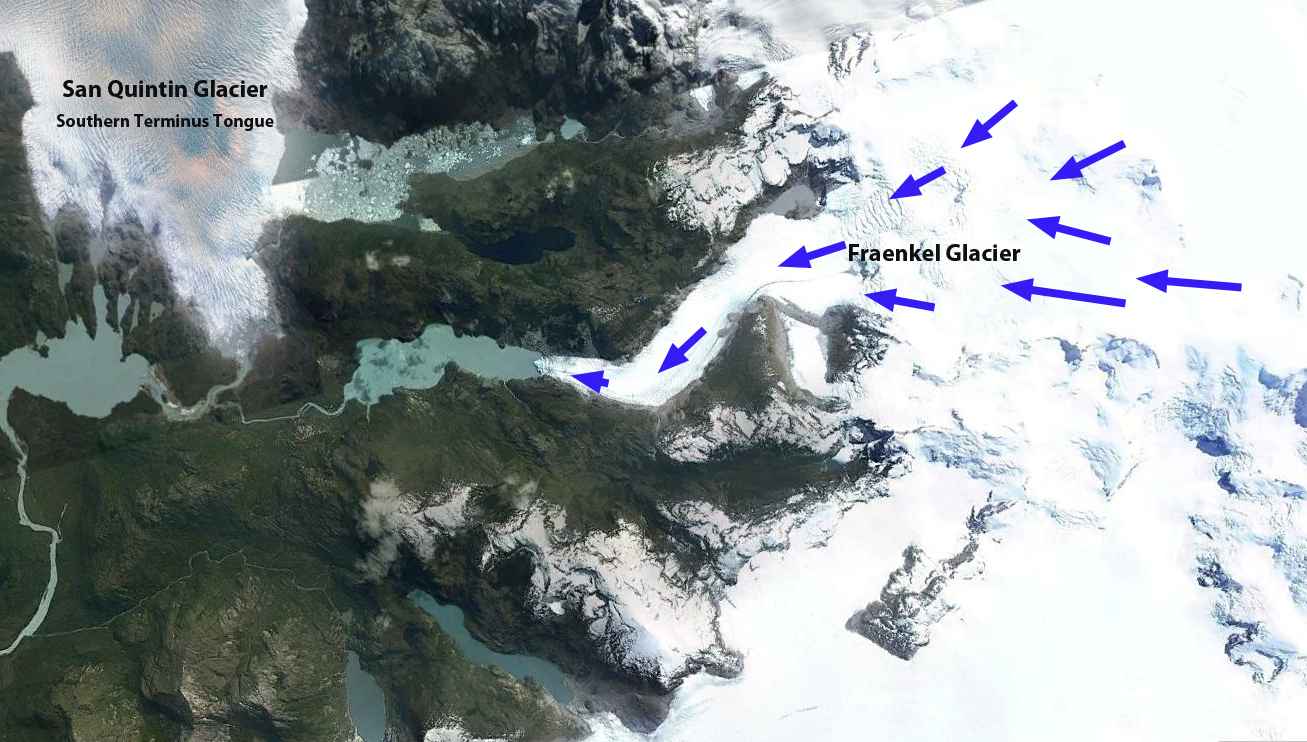
Fraenkel Glacier drains the west side of the Northern Patagonia Ice Cap (NPI) just south of Glaciar San Quintin. The retreat of this glacier in the last 30 years mirrors that of Gualas and Reichert Glacier, which also terminate in an expanding proglacial lake.   Davies and Glasser (2012) work, had an excellent Figure indicating two periods of fastest recession since 1870, are 1975-1986 and 2001-2011 for NPI glaciers.  They noted the loss was 0.07% from 1870-1986, 0.14% annually from 1986-2001 and 0.22% annually from 2001-2011. Willis et al (2011) observed that the thinning rate of NPI glaciers below the equilibrium line has increased substantially from 2000-2012. On Fraenkel Glacier they observed a 2.4 m per year thinning in the ablation zone. Here we examine the changes in this glacier from 1987 to 2015 using Landsat Image.

fraenkel ge

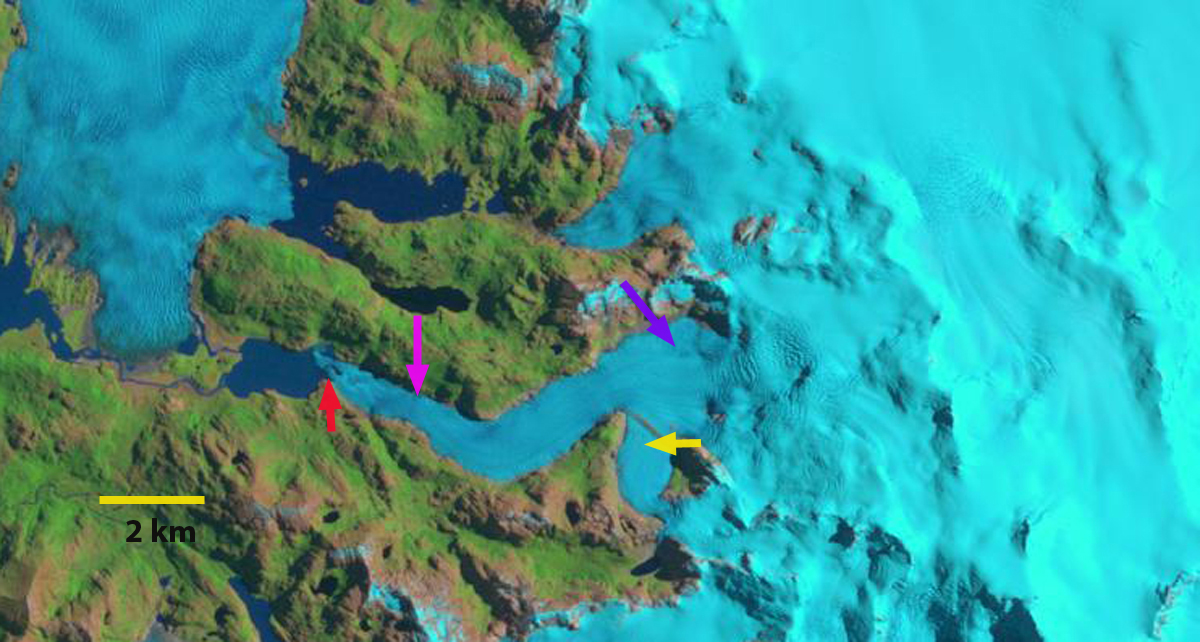
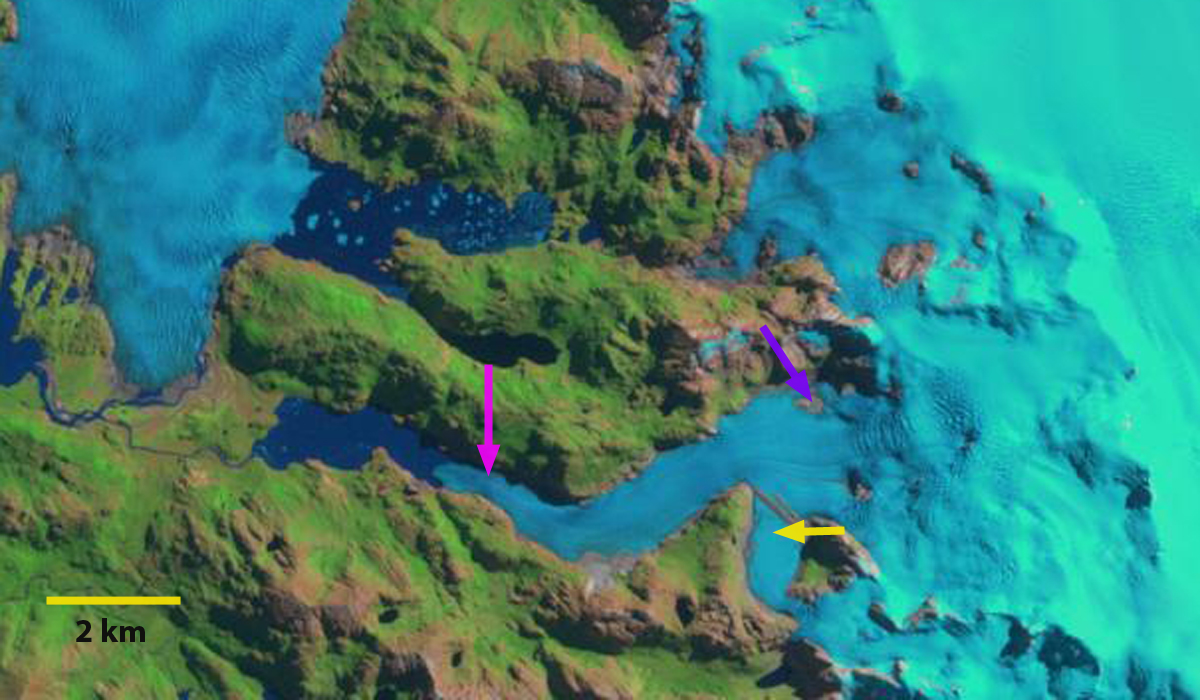
In 1987 the glacier terminus was at the end of a peninsula red arrow and the proglacial lake it terminates in is 2 km long. There is a medial moraine on the glacier at the yellow arrow and the glacier covers the terrain below an icefall at the purple arrow. By 2000 at the purple arrow bedrock is appearing from the base of the glacier. The medial moraine at yellow arrow is little changed. The terminus has retreated 800 m. By 2015 the area around the purple arrow has been deglaciated emphasizing the amount of thinning in the ablation zone even well upglacier of the terminus. At the yellow arrow the medial moraine has been replaced by a wide rock rib separating the glacier from a former tributary. The main terminus is at the pink arrow, indicating a retreat of 1.4 km since 1987. The retreat rate of 50 meters per years though large is less than on Reichert Glacier or Gualas Glacier.  Mouginot and Rignot (2014) observe that Fraenkel Glacier does not have the high velocity of the neighboring Benito and San Quintin Glacier or the Gualas and Reichert Glacier, this leads to the potential for greater mass loss of the ablation zone and even faster retreat.

fraenkel Glacier 1987
Fraenkel Glacier Landsat Image 1987
fraenkel glacier 2000
Fraenkel Glacier Landsat Image 2000

fraenkel glacier 2015
Fraenkel Glacier Landsat Image 2015

Hess Mountain Glacier Retreat, Yukon

In the Selwyn Mountain Range, Yukon at the headwaters of the Hess River is the Hess Mountains and Keele Peake the highest peak in the region. A series of glacier radiate from this region. The Yukon Territory is host to numerous small alpine glaciers that have been rapidly losing area and volume.  From 1958-2007 glaciers lost 22% of their volume in the Yukon (Barrand and Sharp, 2010).  Due to the high snowlines David Atkinson, at University of Victoria notes the rate of retreat has increased since then, and is using weather stations to identify the specific conditions driving the ice loss. Semmes and Ramage (2013 ) observed in the Yukon River Basin from 1988 to 2010 a significant lengthening of melt duration t with earlier melt onset in high elevations  and significant later end of melt refreeze in theintermediate elevations ( 600 to 1600 m). Here we examine in particular a glacier draining southeast from the Hess Mountains that feeds the Hess River using Landsat imagery from 1986 to 2015.
hess map

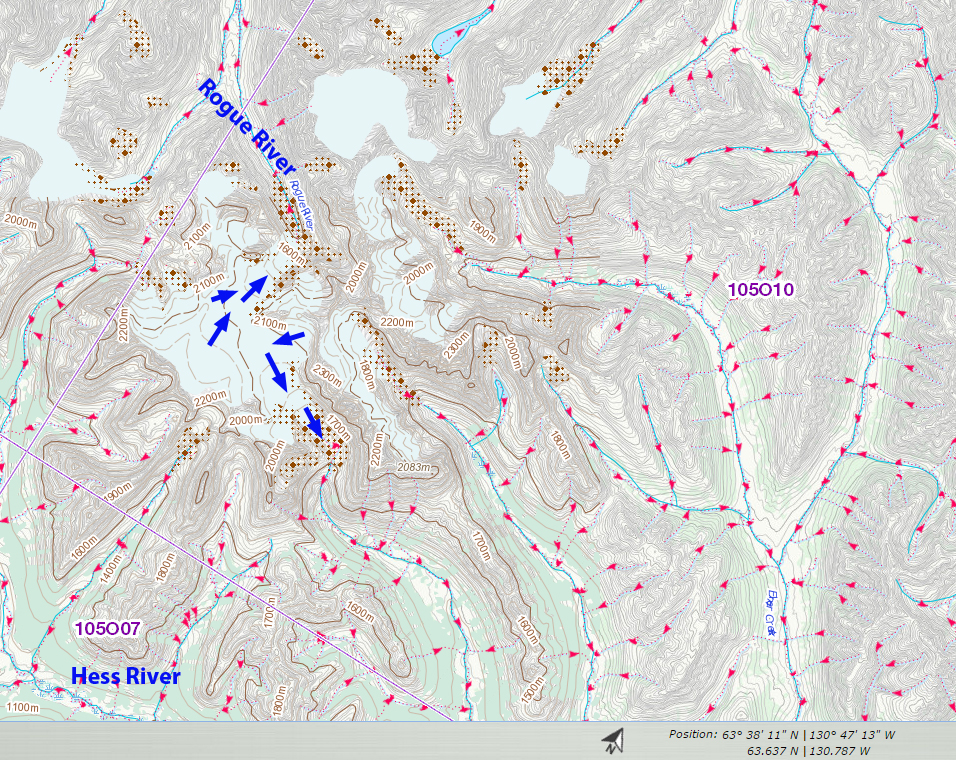
In this Canadian Toporama image the glacier of primary interest has flow indicated by the blue arrows.

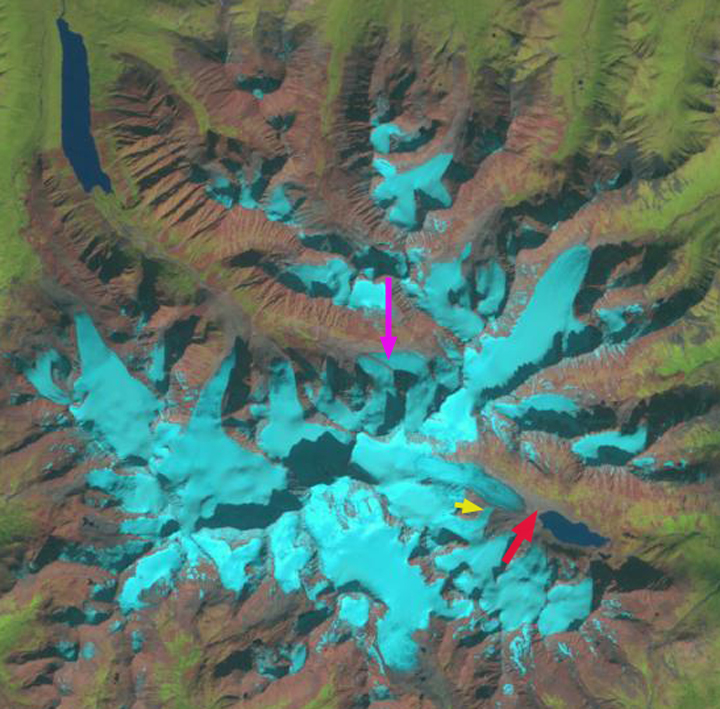
In 1986 the glacier extended to within a 100 meters of an alpine lake, with the terminus indicated by the red arrow.  The glacier was joined near the terminus by a tributary at the yellow arrow.  At the pink arrow a separate glacier terminus is formed by the merging of two glaciers.  In 1992 the main glacier tongue has retreated further from the lake.  By 2015 the tributary no longer is connected to the main glacier and terminates 600 meters above the valley.  The main glacier terminus has retreated 800 meters since 1986, and is now just over 3 km long. The terminus area at the glacier flowing north at the pink arrow, is no longer formed by the merging of two glacier termini, as two distinct termini exist.hess 1986

1986 Landsat Image

hess 1992

1992 Landsat Image

hess 2015

2015 Landsat Image


Rogue River Icefield Rapid Retreat, Selwyn Mountains, Yukon

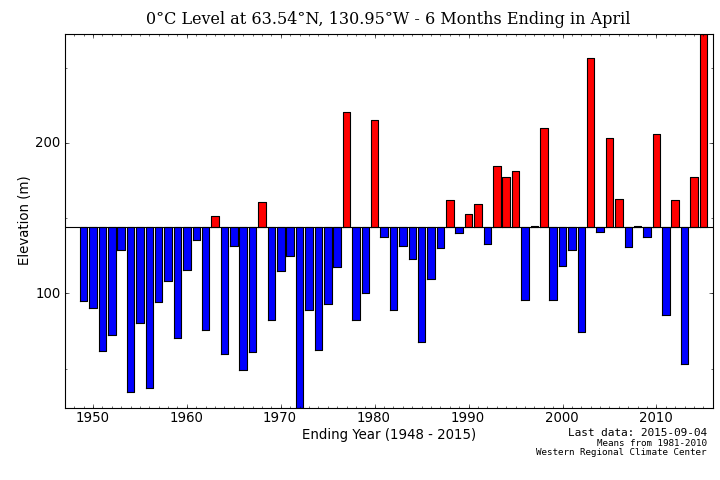
The Selwyn Mountains, Yukon Territory are host to numerous small alpine glaciers that have been rapidly losing area and volume. David Atkinson, atmospheric scientist at University of Victoria has been examining the weather conditions leading to the extensive melting and higher snowlines. From 1958-2007 glaciers lost 22% of their volume in the Yukon (Barrand and Sharp, 2010).  Due to the high snowlines Atkinson notes the rate of retreat has increased since then.  The freezing level as determined by the North American Freezing Level Tracker illustrates this point with 2015 being the highest winter freezing level. Here we examine response of the Rogue River Icefield using Landsat imagery from 1986-2015.  The icefield is at the headwaters of the Rogue River and also drains into the Hess River.
rogue river

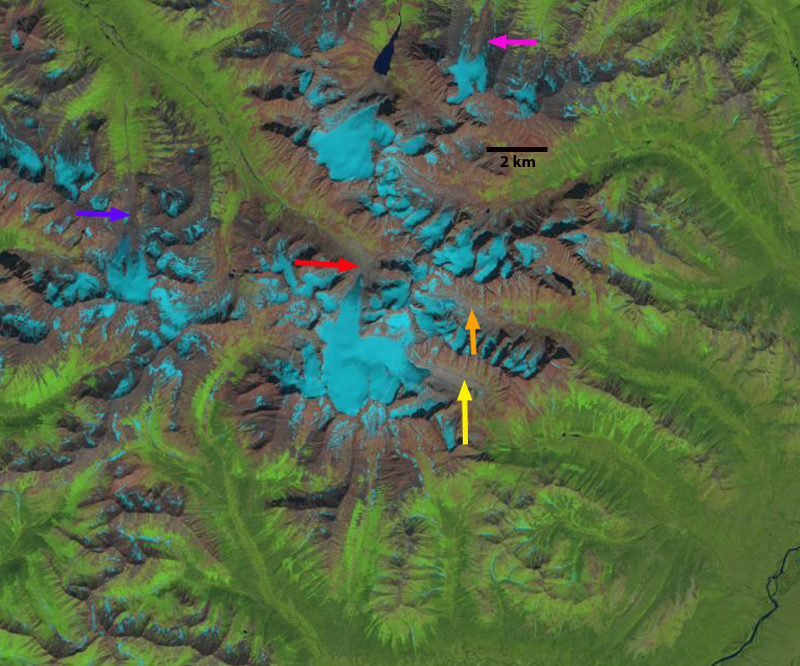
Canada Toporama map of the region.

selwyn

Selwyn Mountain November-April freezing levels.

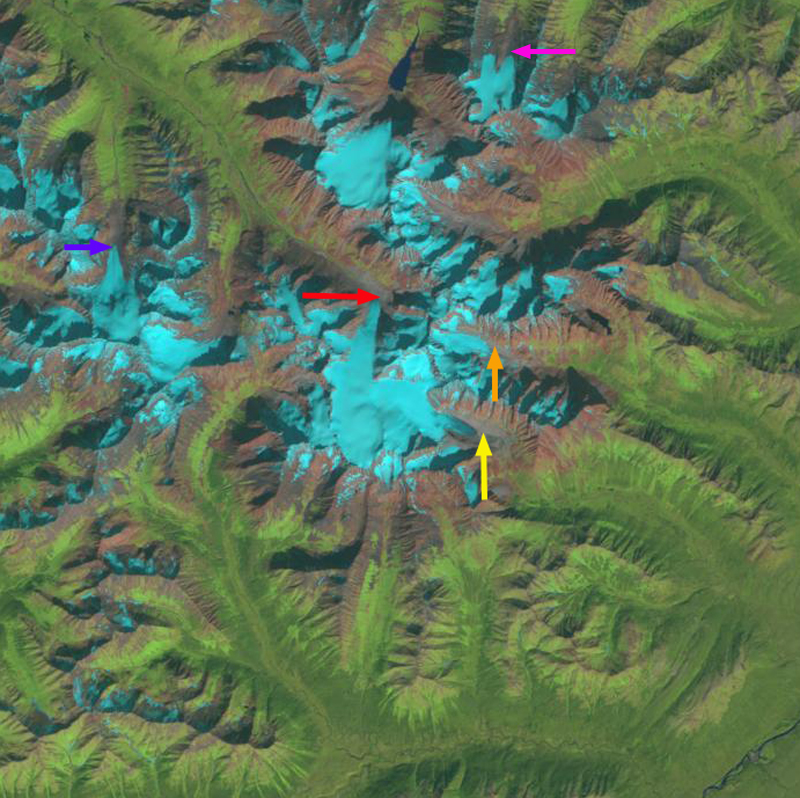
In 1986 the primary icefield glacier is shown with blue arrows above indicating flow direction towards both the north and southeast terminus.  The north terminus reached the valley bottom at the red arrow and the southeast terminus extended to the yellow arrow in 1986. All arrows are in fixed locations in every image. The purple and orange arrows indicate the terminus of smaller valley glaciers in 1986.  The pink arrow indicates a valley glacier that is split into two terminus lobes by a ridge. By 1992 the only significant change is the southeast terminus of the primary glacier at the yellow arrow. In 2013 the snowline is exceptionally high at 2200 meters, with glacier elevations only reaching 2300 m.  Retreat is extensive at each terminus.  In 2015 the satellite image is from early July and the snowline has not yet risen significantly.  Terminus retreat at the yellow arrow is 900 meters, at the red arrow 400 m, at the purple arrow 600 m, at the pink arrow 400 m and at the orange arrow 500 m.  Given the length of these glaciers at 1-3 km this is a substantial loss of every glacier.  Further south in the Yukon high snowlines are also a problem for Snowshoe Peak Glacier.

rogue river 1986

1986 Landsat image

rogue river 1992

1992 Landsat image

rogue river 2013

2013 Landsat Image

rogue river 2015

2015 Landsat image


Visualizing Glacier Melt Impacts

Key questions emerge from the summer of 2015 in the Pacific Northwest glacier basins. That can both be visualized and quantified.

With record temperatures and minimum flows in most rivers in the Cascade Range during July and August of 2015, a key question was how much did glaciers contribute in basins that are glaciated?  Note the water pouring off the glacier and the lack of snowcover in the first few minutes of the video.

You can examine flow per unit watershed area as a first order observation. In the unglaciated South Fork discharge was 0.5 cfs/square mile, rising to 0.7 cfs/square mile in the lightly glaciated Skykomish River and 4.3 cfs/square mile in the heavily glaciated North Fork Nooksack.   For a more direct measure we measured ablation from July 29 to August 17th in the North Fork Nooksack and Skykomish River basin.  With the Nooksack Tribe we also measured discharge below glaciers in the North Fork but those recorders are still deployed in the field.

Because the glaciers had mostly ice, not snow at the surface, melting was enhanced.  We found in the Skykomish Basin that glacier runoff was 45 CFS versus a mean discharge of 375 CFS , this is 12% of the total flow despite covering only 1.3 % of the basin.  In the North Fork Nooksack glacier runoff was 340 CFS versus total flow of  460 CFS, this is 74% of the total flow though only 6.1 % of the basin has glacier cover. In both cases the glaciers contributed a river flow percentage 12 times greater than the percent of basin area they cover.  With a substantial loss in glacier area occurring this summer, next year glacier runoff for the given climate conditions will be reduced. Given this higher flow the glacier fed streams offer less stressful conditions this summer to salmon.

How much did glacier runoff water temperature amelioration?

In the South Fork Nooksack without glaciers stream temperature was above 20 C on eight days between Aug.1 and Aug. 20. In the North Fork Nooksack with glacier contribution, the stream temperature peaked at 13-14 C.

With the early loss of snowcover and exposure of the underlying ice, how are glacier ice worms impacted?  In the video note ice worms featured in the first minute in a glacier filled crevasse.

These worms live on snow algae primarily, which would seem to be in short supply in a summer with limited snowpack on the glaciers.  How well can they survive being on the glacier ice for extended periods?  For the 21st year we conducted ice worm population surveys.  The numbers were the lowest we have seen at 175-250 ice worms per square meter, but it should be next year when the full impact would be evident.

How much glacier area will be lost?  Note the visual of terminus retreat.
The summer is not over, but our observations indicate a 5-7 % volume loss will occur.  This should be approximately equaled by area loss.  Hopefully good satellite imagery in September will provide a specific answer.  The Aug. 17th Landsat image is excellent. Retreat just this summer has been 40 m on Easton Glacier, 32 meters on Columbia Glacier, 25 meters on Sholes Glacier and 30 meters on Lower Curtis Glacier.

mount baker 9172015


Aug. 17 Landsat image.  Arrows indicate areas where we observed rapid area loss of glacier ice this summer. 

Mount Caubvick Glacier Retreat, Labrador

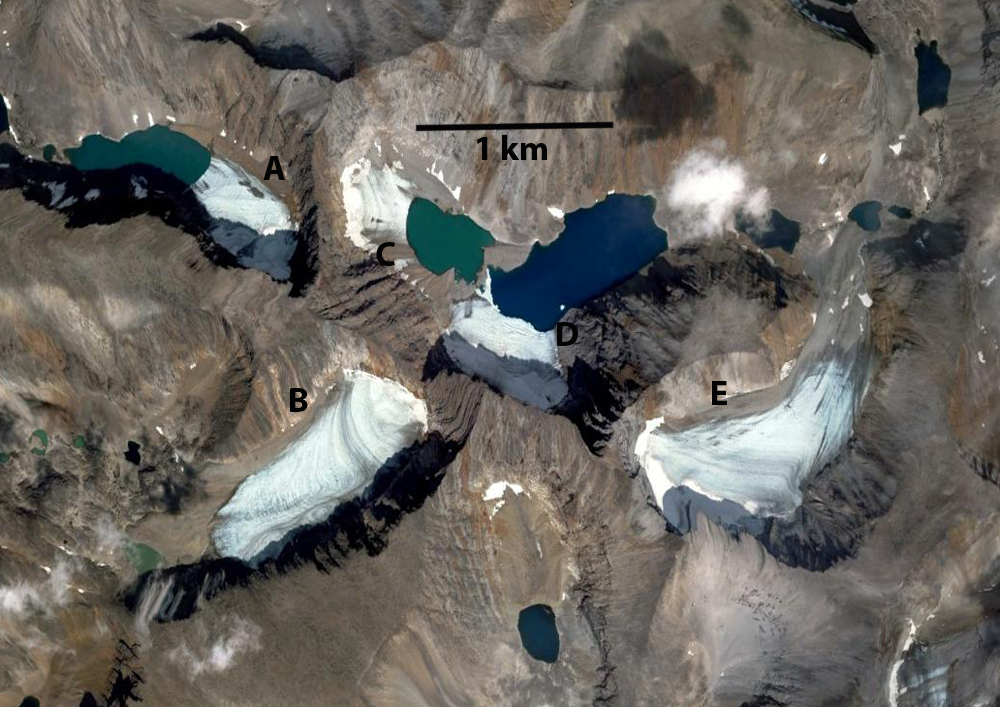
Mount Caubvick is in the Torngat Mountains of Labrador 35 km inland of the Atlantic Ocean and south of Nachvak Fjord. Way et al (2014) identified 105 active glaciers that had flow indicators in these mountains.  The mean elevation of these glaciers is quite low at 776 meters above sea level. The radiational shading and higher accumulation from protected cirque locations and proximity to the ocean are key to the low elevations. The elevation of the glaciers around Mount Caubvick is higher. Here we use Landsat images from 1992, 1997 and 2015 to identify response to climate change. The annual layers preserved in the glacier ice are evident in glacier B,C and E.

caubvick

2013 Google Earth image of Mount Caubvick, Torngat Mountains, Labrador.

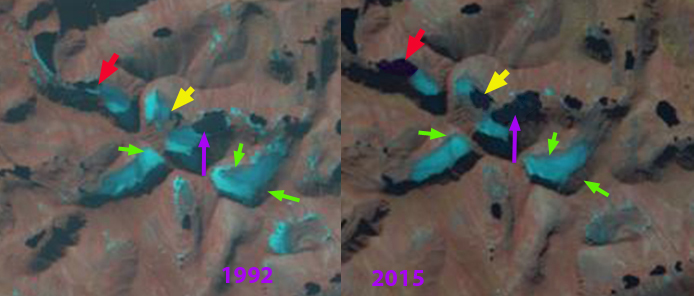
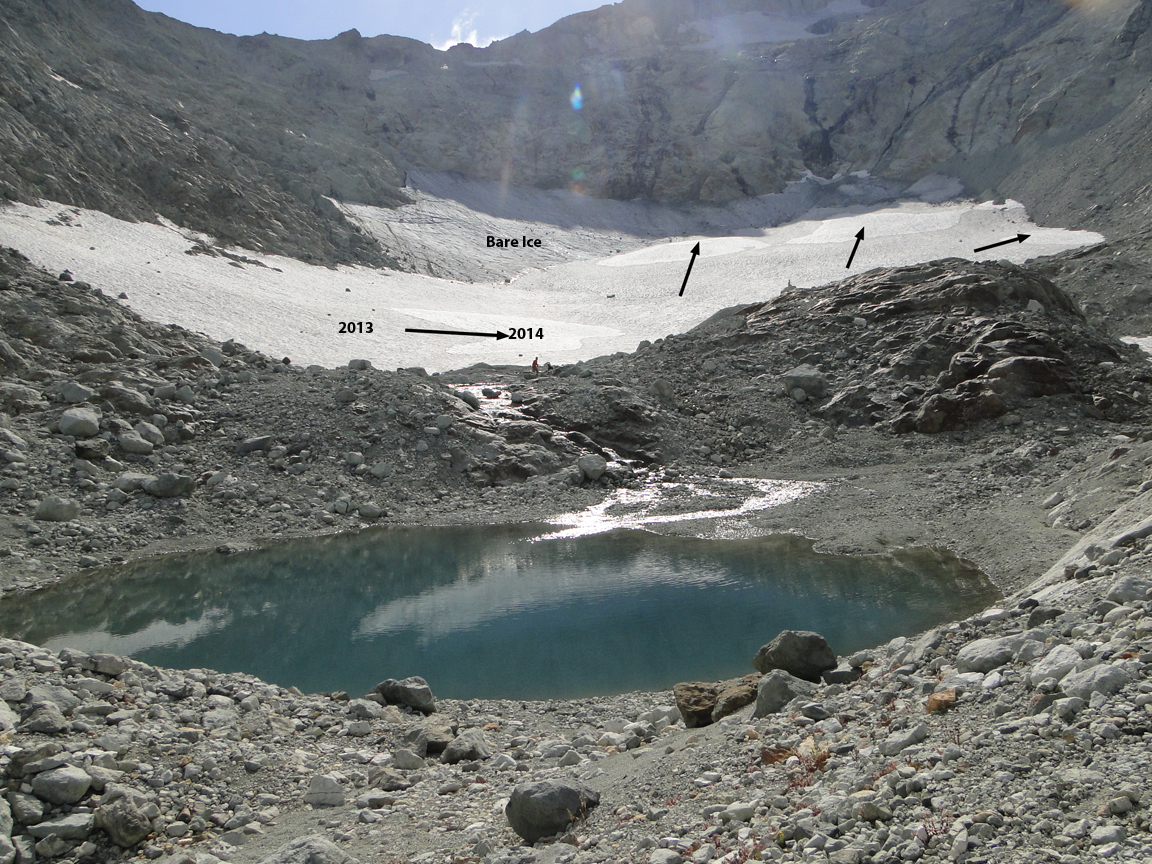
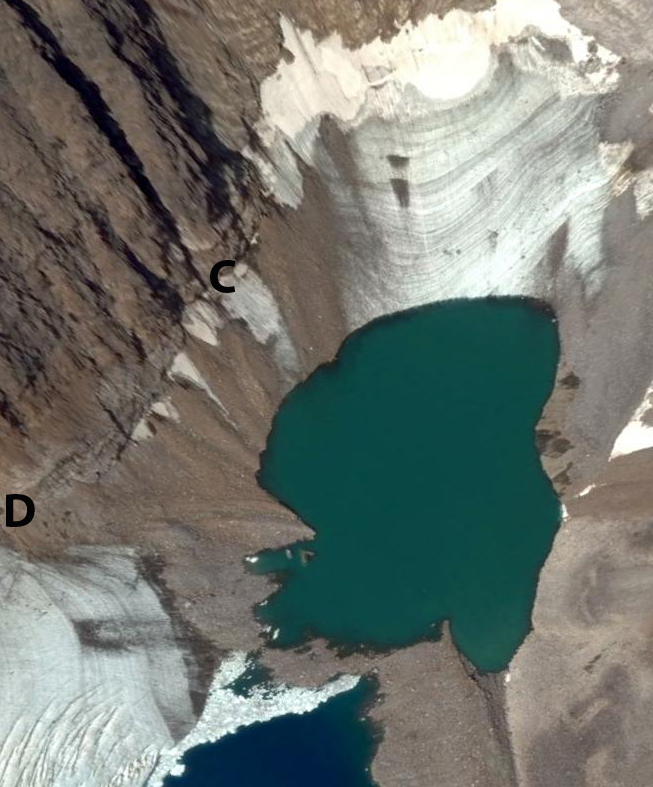
In 1992 Glacier A terminates at the red arrow in an expanding lake. Glacier C terminates at the yellow arrow in a just forming glacial lake.  Glacier E terminates at the purple arrow in a glacial lake that is similar in length to the glacier. In 2015 each lake has notably expanded.  The arrows are in the same locations in the 2015 image.  At the red arrow, Glacier A has retreated 200 m, which is 20% of its entire length. Glacier C, yellow arrow has retreated 250 m, 40% of the total glacier length.  At the purple arrow, Glacier D has retreated 225 m, which is 35% of its total length.  The retreat of Glacier B and E is less clear as the terminus locations are hard to determine in 1992.  What is most evident is the reduction in ice area at the higher elevations of the glaciers noted by the green arrows. In 1997 there is little expansion of the three lakes since 1992, indicating most of the retreat has been in the last 18 years.  Glacier B provides a good snapshot of annual layers.  The black arrow indicates the lack of an accumulation zone, without which a glacier cannot survive (Pelto, 2010). The red arrow indicates a band of annual layers that marks what had been the typical snowline Indeed none of the glaciers in 2015 in either the 2013 Google Earth image or 2015 Landsat have significant retained accumulation, indicating none can survive current climate. Way et al (2014) figure 4 indicates an example of the same snowline setup on a different glacier near Ryans Bay. .  it is evident that in the last decade firn and snow are not retained consistently. Sharp et al (2014) indicate in Figure 52 the mass loss of Canadian Arctic glaciers in general, that parallels that of Labrador.

caubvick compare

1992-2015 Landsat comparison of Mount Caubvick glaciers

torngat 2014 annual layers

Glacier B with numerous annual layers with the snowline indicates by red arrow and lack of accumulation black arrow.

torngat cirque layers


Glacier C annual layers. 

Barskoon Mountain Glacier Widespread Retreat, Tien Shan Range, Kyrgyzstan

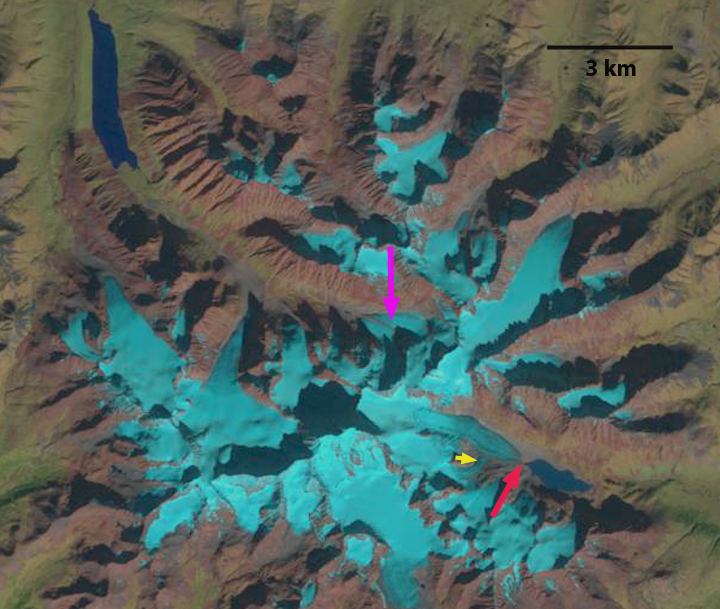
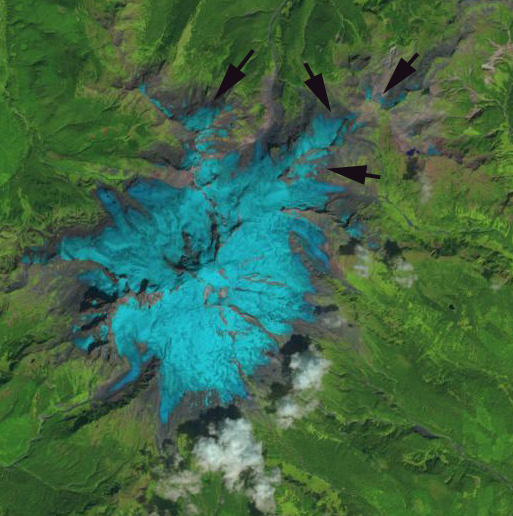
Farinotti et al. (2015) used three approaches to assess glacier change in the Tien Shan from 1961 to 2012.  The results converge on an overall loss of glacier area of 19-27%,a spatial extent of 2960 square kilometers of glacier area.  They further observe that it is primarily summer melting that has driven the change.  Here we examine the change of several glaciers in a small sub-range in the Barskoon Mountain area of Kyrgyzstan using Landsat images from 1990-2013.. The A364 road extends up the Barskoon valley and was part of the silk road. It is now more widely used as the main road to the Kumtor Gold Mine (Colgan, 2015).

Barskaun mountains

Google Earth image of Tien Shan Mountains and glaciers in Kyrgyzstan, study area is Barskoon Mountains.

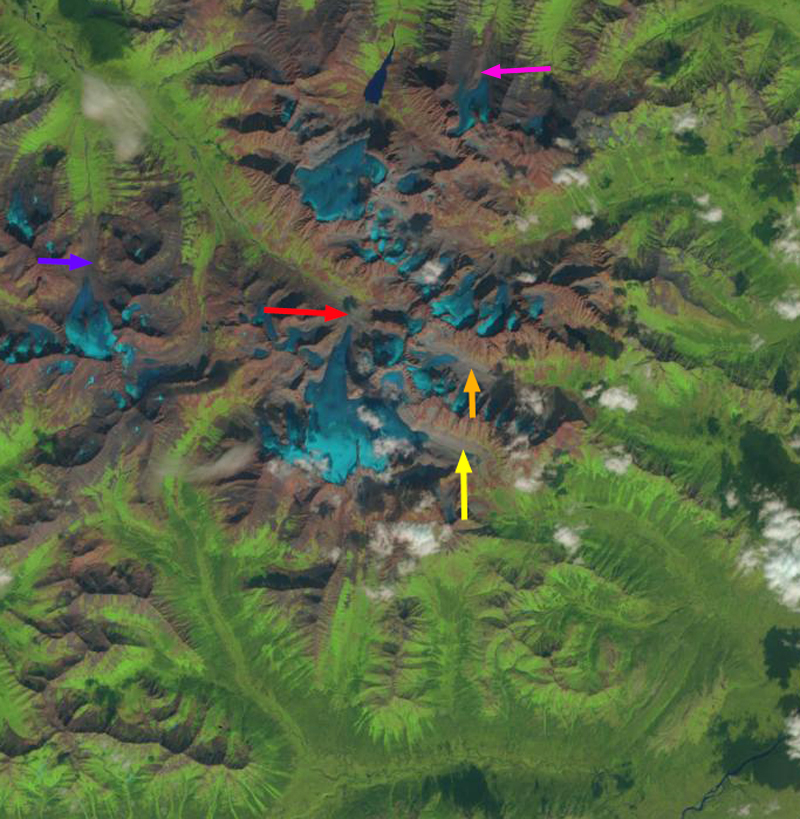
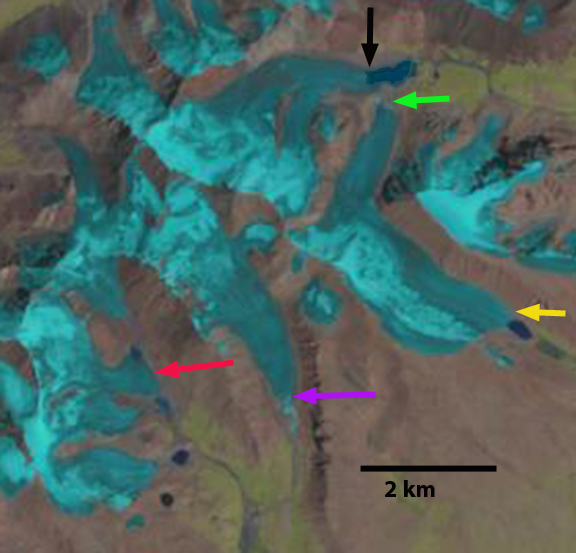
In 1990 working clockwise from the black arrow, which indicates two glaciers merging and then ending in a proglacial lake.  At the green arrow is a third glacier that now terminates short of this developing lake.  At the yellow arrow a fourth glacier terminates in a small proglacial lake. At the purple arrow a glacier ends in a valley lacking any lake.  At the red arrow the glacier expands into a broad terminus lobe in a valley with two small lakes both north and south of the terminus.  By 1997 the lake at the black arrow has extended as the glacier terminating in it has retreated.  The glacier at the green arrow terminates further from the lake.  At the red arrow the terminus lobe is much thinner. By 2013 the two glaciers that terminated in the lake have now receded from the lake with a total retreat of 400-500 m since 1990. At the green arrow the glacier now terminates 600 m from the lake instead of 300 m in 1990. At the yellow arrow the glacier no longer reaches the lake it had terminated in.  At the purple arrow a new 200 m long lake has formed.  The most dramatic change is at the red arrow where the terminus tongue is only 30% of the area it was in 1990. All of these are unnamed glaciers, and each like those adjacent without arrows indicating specific changes have been retreating and losing area.  The typical length of these glaciers is 2-4 km, and those indicated have lost at least 10% of their length from 1990 to 2013.  This is a sustained loss of mass balance, on glacier that do not experience any calving losses. The changes are similar for larger glaciers in the Tien Shan such as Petrov Glacier.
terskey 1990

1990 Landsat image

terskey 1997

1997 Landsat image
terskey 2013

2013 Landsat Image

Disastrous Year for North Cascade Glacier Mass Balance (Snow/Ice Economy)


Mass loss of North Cascade glaciers visualized.

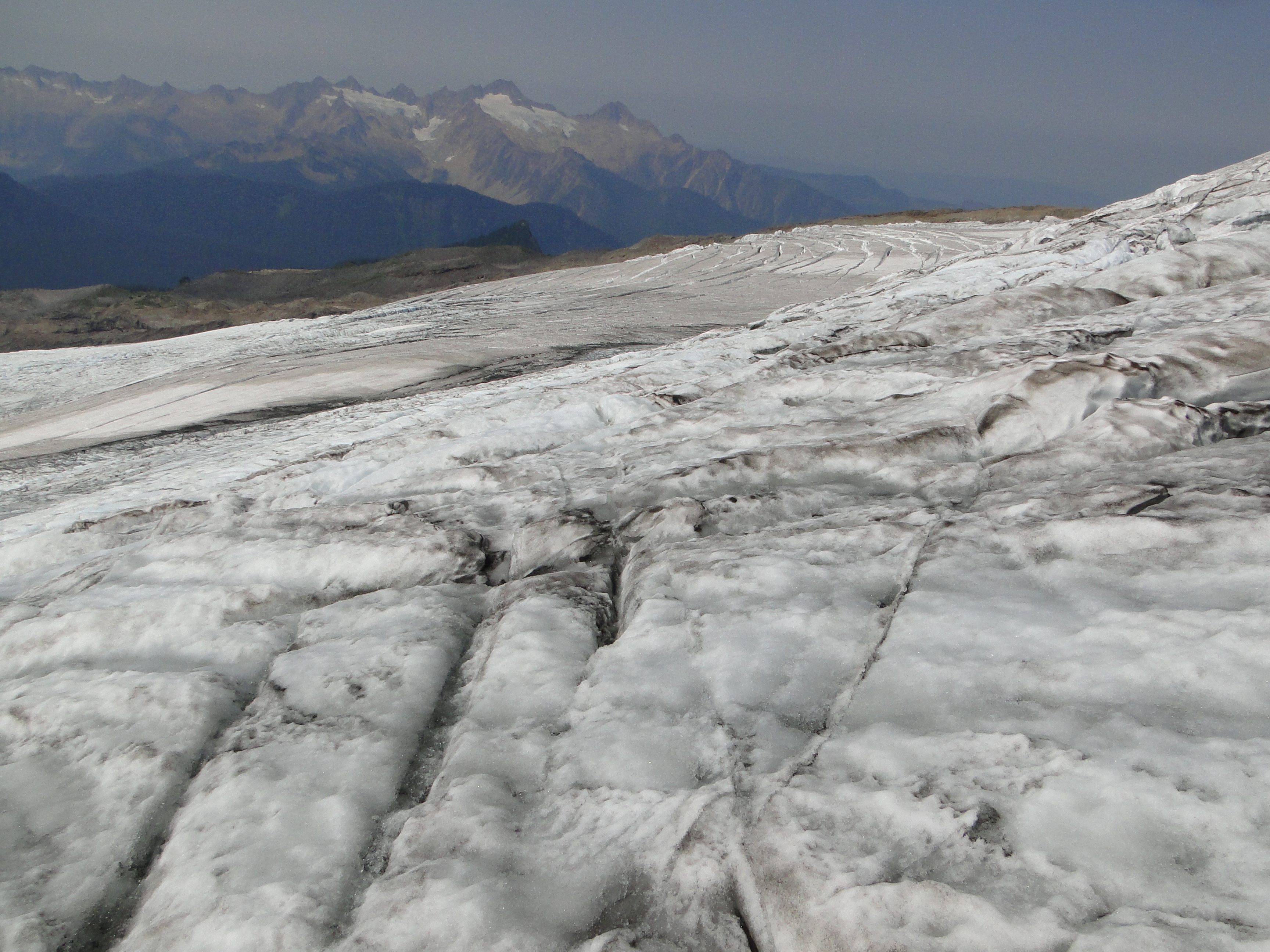
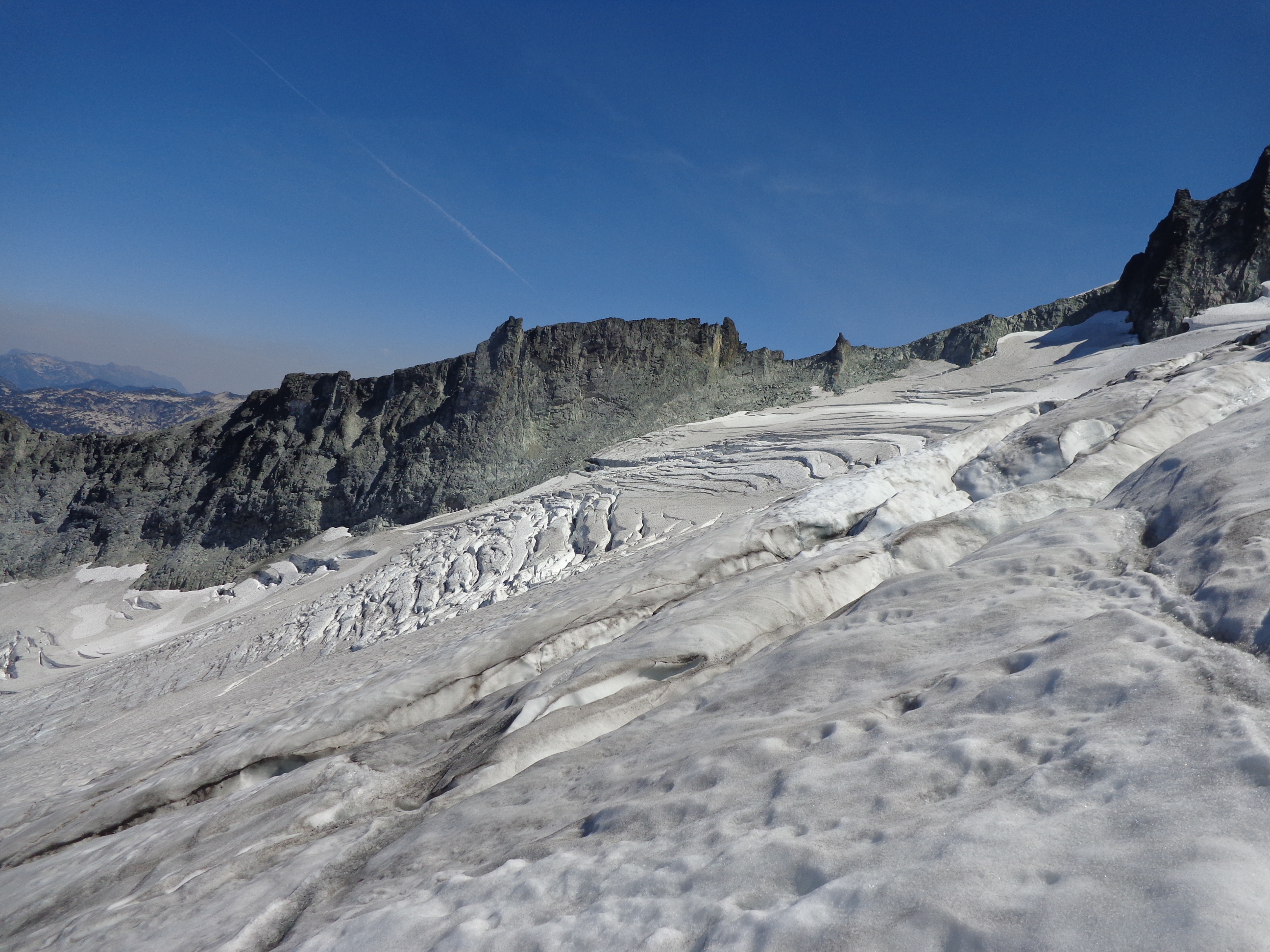
A disastrous year is unfolding in 2015 for North Cascade glaciers, if normal melt conditions continue the range will lose 5-7% of its entire glacier volume in one year! For the 32nd consecutive year we were in the North Cascade Range, of Washington to observe the mass balance of glaciers across the entire mountain range. The melt season is not over, but already the mass loss is greater than any other year, with six weeks of melting left. An alpine glacier’s income is the snow that accumulates, and to be have an equilibrium balance sheet for a year, alpine glaciers typically need 50-65% snowcovered surfaces at the end of the melt season.  Below the accumulation zone, net assets are lost via ablation.

In 2015 of the 9 glaciers we examined in detail, 6 had less than 2% retained snowcover, which will be gone by the end of August.  Two more had no 2015 snowpack greater than 1.7 m in depth, which will also melt away before summer ends.  Average ablation during the August field season was 7 cm per day of snow, and 7.5 cm of ice. Only one glacier will have any retained snowcover at the end of the summer, we will be checking just how much in late September. This is the equivalent of a business having no net income for a year, but continuing to have to pay all of its bills. Of course that comes on top of more than 27 years of consecutive mass balance loss for the entire “industry” of global alpine glaciers.  The business model of alpine glaciers is not working and until the climate they run their “businesses” in changes, alpine glaciers have an unsustainable business model. Below this is illustrated glacier by glacier from this summer.  A following post will look at the glacier runoff aspect of this years field season.  The Seattle Times also featured our summer research.JillPeltoGMB_720_494_s_c1_c_c
Jill Pelto Painting of mass balance time series loss from 1984 to 2014. 

In a recent paper published in the Journal of Glaciology spearheaded by the WGMS group  (M. Zemp,  H. Frey, I.Gartner-Roer, S.Nussbaumer, M.Hoelzle, F.Paul, W.Haeberli and F.Denzinger), that I was co-author on, we examined the WGMS dataset on glacier front variations (~42 000 observations since 1600), along with glaciological and geodetic observations (~5200 since 1850).  The data set illustrated that “rates of early 21st-century mass loss are without precedent on a global scale, at least for the time period observed and probably also for recorded history.The rate of melting has been accelerating, and in the decade from 2001 to 2010, glaciers lost on average 75 centimetres of their thickness each year”, this is compared to the loss in the 1980’s and 1990’s 25 cm and 40 cm respectively each year (Pelto, 2015).  A comparison of the global and North Cascade Glacier mass balance records since 1980 indicate the cumulative loss, at bottom.

DSC08917

Columbia Glacier terminus August 3, 2015 with new expanding lake.

DSC00199

Upper portion of Columbia Glacier on Aug. 5, 2015 note lack of snowcover and all previous firn layers (firn is snow that survived a melt season but is not yet glacier ice).

DSC00503

Foss Glacier lacking snowcover and losing area fast this summer, this glacier will lose more than 15% of its volume in 2015.

DSC00435

Measuring firn from 2011-2014 retained in a crevasse on Easton Glacier, 2015 snowpack lacking.

DSC00429

The typical end of summer snowline elevation on Easton Glacier, bare ice and firn in 2015.

DSC09197

Rainbow Glacier amidst the normal accumulation zone, where there should be 3-4 m of snowpack, none left.

DSC09602

Lynch Glacier view across the typical end of summer snow line region on Aug. 17th 2015.

DSC00413

Terminus of Lower Curtis Glacier with many annual layers exposed to rapid melt, 31 m of retreat from spring to August 11th, 2015.

DSC00448

ice worm firn

Only firn from 2013 and 2014 and bare ice at surface of Ice Worm Glacier.

ba2014


Comparison of cumulative glacier mass balance in the North Cascades and Globally (WGMS)

DSC00348

Primary field team for the from left, Mauri Pelto (Nichols College), Jill Pelto (UMaine), Tyler Sullivan (UMaine), Ben Pelto (UNBC) and Erica Nied (U-Colorado) summer with contributions from Justin Wright, Tom Hammond, Oliver Grah and Jezra Beaulieu not pictured

Embarking on the 32nd Annual North Cascade Glacier Climate Project


sholes compare
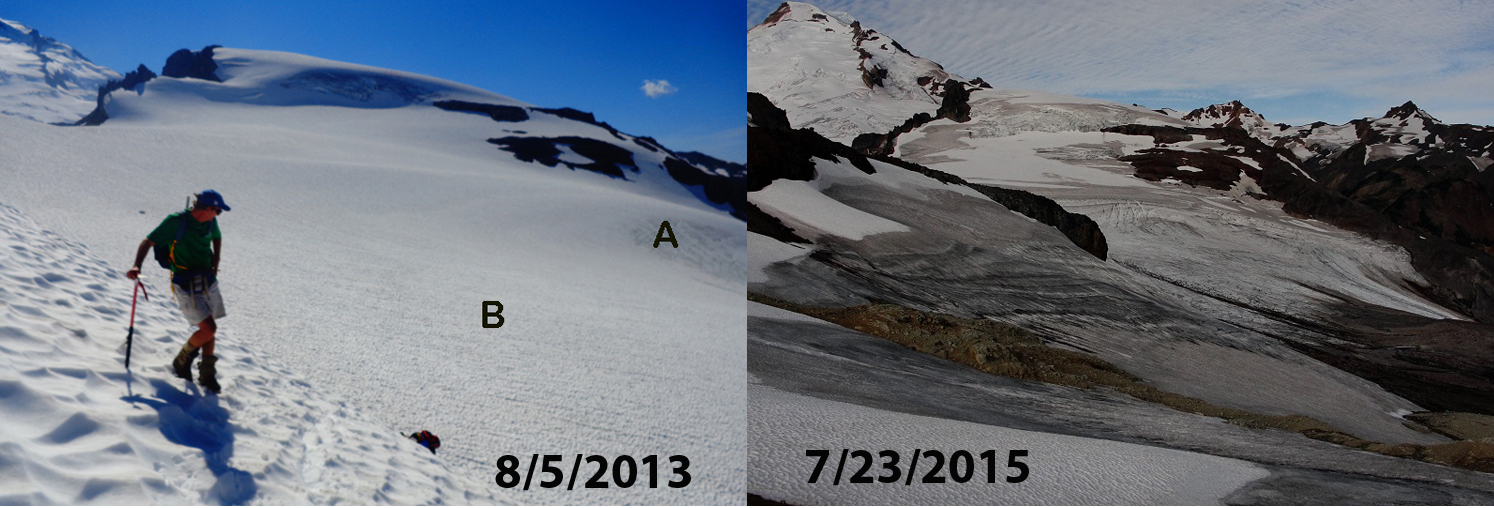
Sholes Glacier snowcover Aug. 5, 2013 (Jill Pelto) and Sholes Glacier July 23, 2015 (Oliver Grah)

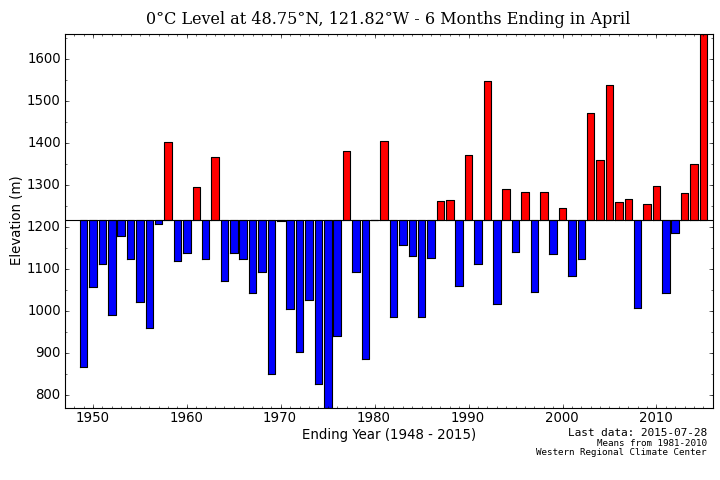
For the 32nd straight summer we will be investigating North Cascade glaciers and their response to climate change over the next three weeks (that means no new posts until Aug. 20).  In 1984 the program was initiated to study the impacts of climate change across an entire mountain range, instead of on just one glacier.  This had been a high priority of the National Academy of Science, I felt I could address.  The glaciers in the North Cascades provide water resources for irrigation, hydropower, salmon and municipal supply.  During our 32 years we have seen the loss of 25% of the entire glacier volume of the range.  Unfortunately 2015 is almost certainly going to be the worst year during this period.  We will likely lose over 5% of the volume of these glaciers in one year.  The problem has been high freezing elevations in the winter, note the difference from other years below.  Because of the drought conditions glaciers are even more crucial to runoff, note the daily spike in flow due to glacier melt in the Nooksack River in July, black arrows.  Blue arrow indicates rain storm.

winter 2015nooksack

Freezing levels on Mount Baker during winter 2015 versus previous winters.  Nooksack River discharge from the USGS in July.

This has been followed by the warmest June and now July the region has seen. This has led to record low streamflow from either rain, groundwater or snowpack from non-glacier areas.  The result is that in glacier fed basins glacier runoff which is above normal because of the warm temperatures is even more important.  We are measuring flow below glaciers and melting on glaciers to quantify the percent of total flow contributed by glaciers.  In 2014 in the North Fork Nooksack River glaciers contributed more than 40% of total stream discharge in the river on 21 days, all in August and September. We again with the Nooksack Indian Tribe will be examining the issue, particularly at Sholes Glacier. We will also be measuring the mass balance, terminus change and mapping ten glaciers we visit every year, including Columbia Glacier seen below.

columiba compare

Terminus of Columbia Glacier and accumulation zone looking bare in 2005, the lowest snowpack year of the last 32 until this year

The glaciers are all in Wilderness areas which means no motorized vehicles or equipment, we have to hike everything in.  This has provided the opportunity to spend over 600 nights in a tent examining the glaciers, hiking/skiing over 3000 miles across the glaciers, and eating oatmeal each morning for breakfast.  It has also provided the opportunity to train and work with more than 60 different scientists.  This year the field team consists of Erica Nied from the University of Colorado, Tyler Sullivan from the University of Maine, Jill Pelto from the University of Maine for the seventh year and myself for the 32nd year.  We will be joined at times by Justin Wright, Oregon State, Tom Hammond, University of Washington, Ben Pelto University of Northern British Columbia, Oliver Grah and Jezra Beaulieu of the Nooksack Indian Tribe. Below are three videos from last year that illustrate: 1: Visual report on initial 2015 findings 2: How and why we measure mass balance.3. The Nooksack Indian Tribe perspective on threats of glacier runoff and our measurements of it.