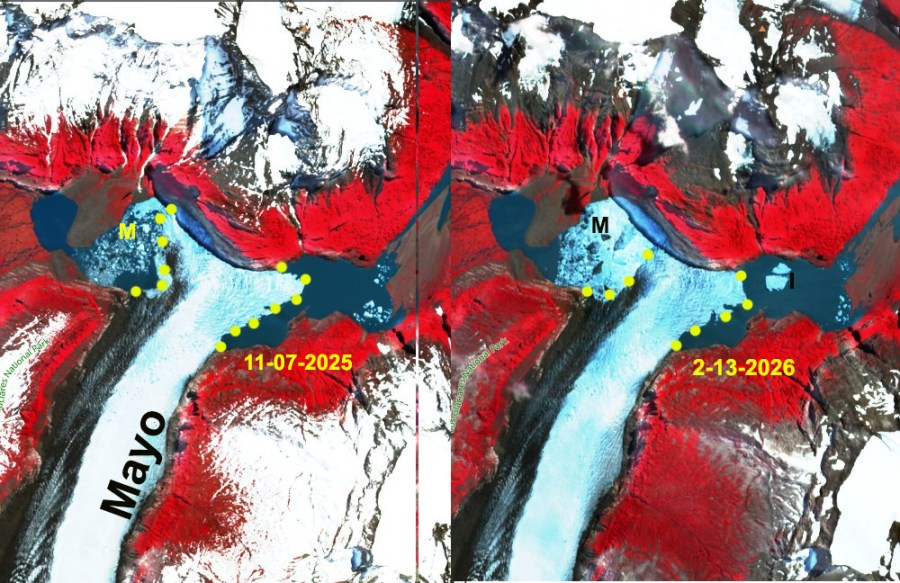
Glaciar Mayo terminus change from November 2025 to February 2026 illustrated in Sentinel images. The yellow dots indicate the margin, which has retreated on both sides forming a melange (M) and new icebergs (I).
Glaciar Mayo, Argentna in Los Glaciares National Park is an eastern outlet of the Southern Patagonia Ice Cap. The glacier has terminated on the northern shore of a glacial lake for the last ss years. The mass balance from 1975-2011 was identified as slightly positive by Schaefer et al (2015). This enabled the glacier to terminate on the northern shore of a glacial lake, an arm of Lago Argentino from 1984-2020. From 2000-2019 Minowa et al (2021) noted that Glaciar Mayo had transitioned to a negative balance and overall thinning. This thinning is what has led to the terminus beginning to collapse into the lake.
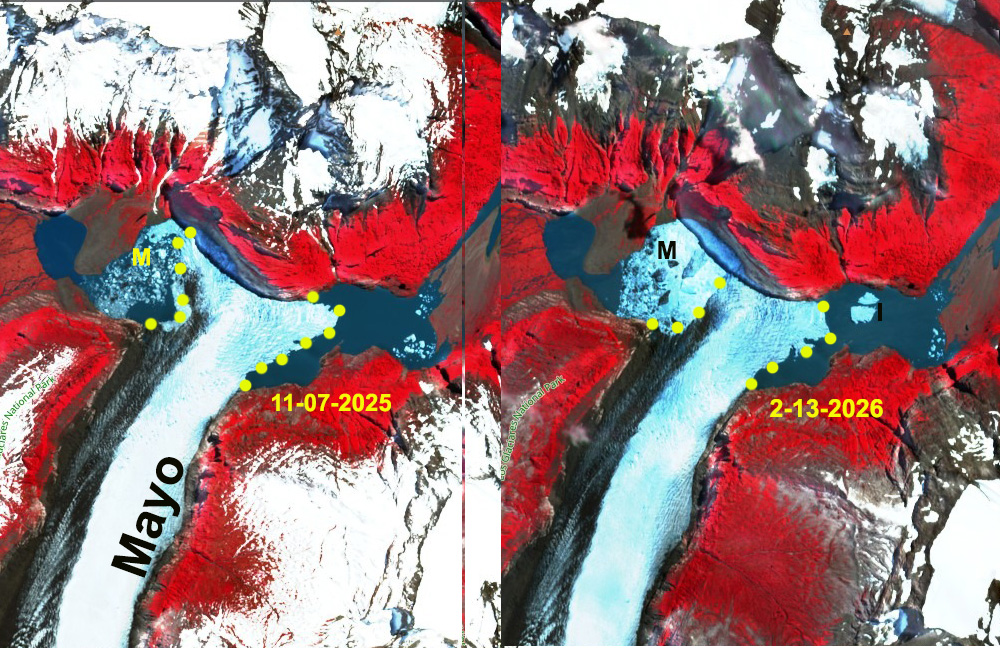
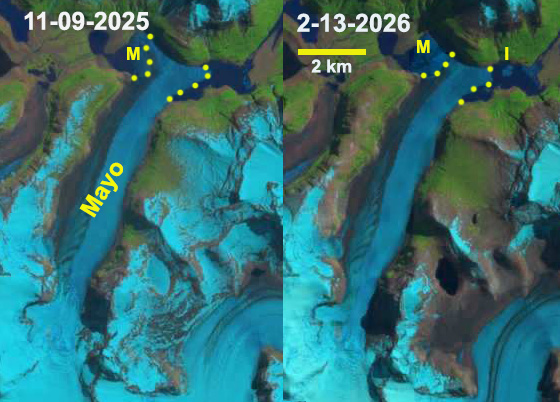
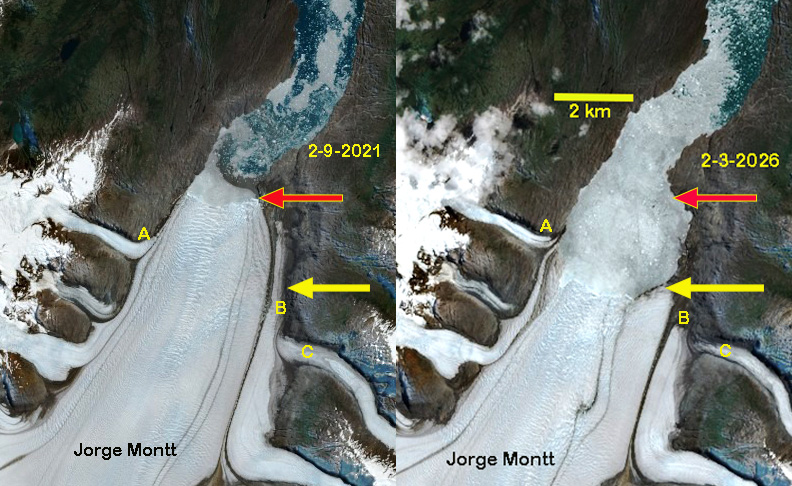
The terminus tongue projecting into the lake had been 2.5 km2, had now declined to 1.4 km2. The terminus along the northern shore had been 2000 m wide and is now 1150 m wide. There is further crevassing/rifting that suggests the glacier tongue is not done thinning in 2026. This continues to be an active year for calving retreat in Patagonia as seen at Upsala and Jorge Montt Glacier, see below.
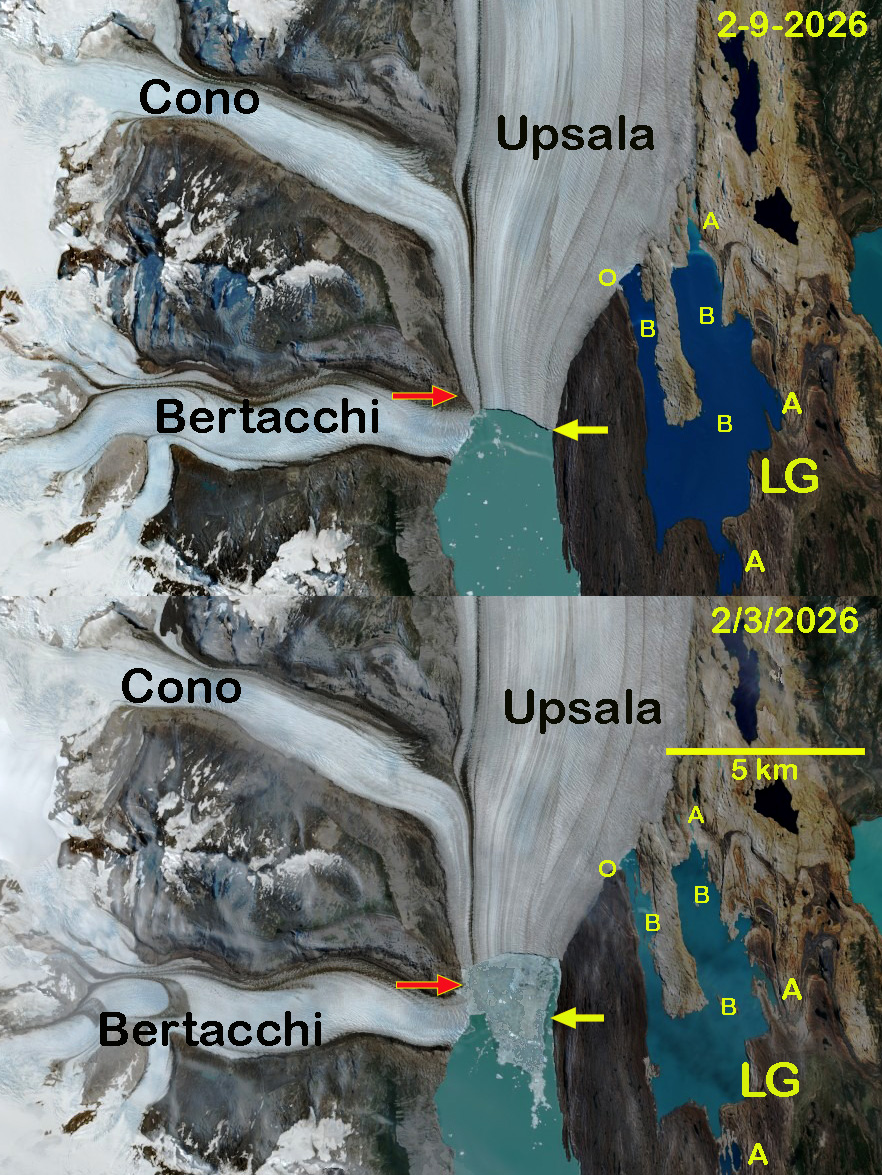
Glaciar Mayo terminus change from November 2025 to February 2026 illustrated in Landsat images. The yellow dots indicate the margin, which has retreated on both sides forming a melange (M) and new icebergs (I).Jorge Montt Glacier retreat from 2021-2026 with a particularly extensive and packed melanage in 2026, observed in Sentinel images.Upsala Glacier had a burst of calving in Feb. 2026. The comparison to 2021 highlights both the retreat, separation from Bertachhi Glacier and substantial drainage of Lago Guillermo.
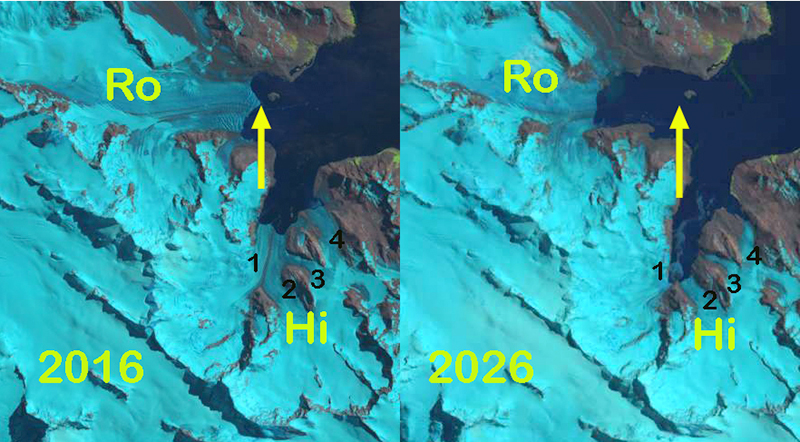
Novosilski Glacier (N) on the west coast, Risting Glacier (R) in Drygalski fjord, Salomon Glacier (S) on the south shore, Twitcher Glacier (T) in Twitcher Bay and Hindle (Hi) and Ross Glacier (RO) in Royal Bay eachexperienced a detachment (D) from a tributary glacier due to glacier retreat from 2016 to 2016, as noted in these Landsat images.
South Georgia Isalnd is a notoriously cloudy location. A remarkably clear Landsat image from Jan. 21, 2026 provides a good snapshot of glacier change since a similarly clear day on February 19, 2016. Here we examine several glacier near the southern tip of the island that have experienced retreat leading to glacier detachment. Pelto (2017) documented the retreat of 11 of these glaciers during the 1989-2015 period. I worked with NASA Earth to document the retreat of some east coast glaciers evident in Landsat images at that time. BAS map provides context on wildlife populations and glacier retreat.
Novosilski Glacier (N) in 2016 is still connected to Tributary 1. By 2026 tributary 1 is separated from the main glacier due to a 1.3 km retreat.
Novosilski Glacier is a large tidewater outlet glacier on the west (cloudier) coast of South Georgia terminating in Novosilski Bay It shares a divide with the rapidly retreating Ross and Hindle Glacier on the east coast. The glacier retreated 1.3 km from 2020 to 2026 leading to Tributary 1 no longer connecting to the main glacier.
From 2016 to 2026 Ross Glacier retreated 2.5 km and Hindle Glacier 1.6 km. The Hindle retreat led to Tributary 1, 2 and 3 all detaching from one another.
For Ross and Hindle Glacier in 1989 the glaciers joined 2.5 km from the terminus spanning Royal Bay with a 3.2 km wide calving front. By 2001 the glacier front had retreated 800 m, but was still a single joined calving front. By 2009 the glaciers had separated due to an additional retreat of 1.4 km. The Hindle Glacier front was now retreating south up opening a new separate fjord from Ross Glacier. The calving front in 2009 was 1.6 km wide. By 2015 a 1.6 km retreat led to the separation of Hindle from Tributary 4. From 2016 to 2026 a further 1.6 km retreat to the approximate head of the fjord led to separation of Tributary 1, 2 and 3. Ross Glacier retreated 2.5 km from 2016-2026 without separating from any tributary.
A 1 km retreat of Risting Glacier (R) led to Tributary 2 detaching from the Tributary 2 and 3 between 2016 and 2026,
Risting Glacier terminates in Drygalski Fjord on the southeast coast of South Georgia. Risting and Jenkins Glacier were joined until the 1980’s. Cook et al (2010) note the glacier had a relatively uniform retreat rate from 1955-1999 of 40 to 50 meters/year, with retreat increasing after 2000. From 2002-2016 Risting Glacier retreated 1100 m, a rate of ~80 m/year twice the 1955-1999 rate. From2016-2026 the glacier retreated another 800 m, continuing at the same rate. This led to detachment of tributary 1 from the rest of the glacier.
Twitcher Glacier (T) retreated 3.7 km from 2016 to 2026 leading to detachment of Tributary 1.
Twitcher Glacier is the next glacier south of Herz Glacier (H) on the east coast of South Georgia. Until 1989 the glacier ended at the tip of a peninsula that separates it from Herz Glacier., the ensuing retreat has led to the opening of a new fjord. By 2015 the glacier has retreated 2.2 km. An accelerated retreat from 2016-2026 of 3.7 km led to separation from Tributary 1.
The story is the same from glacier to glacier with extensive retreat leading to tributaries detaching from each other. These glaciers still maintain snow cover across a significant area of the glacier and can survive current climate.
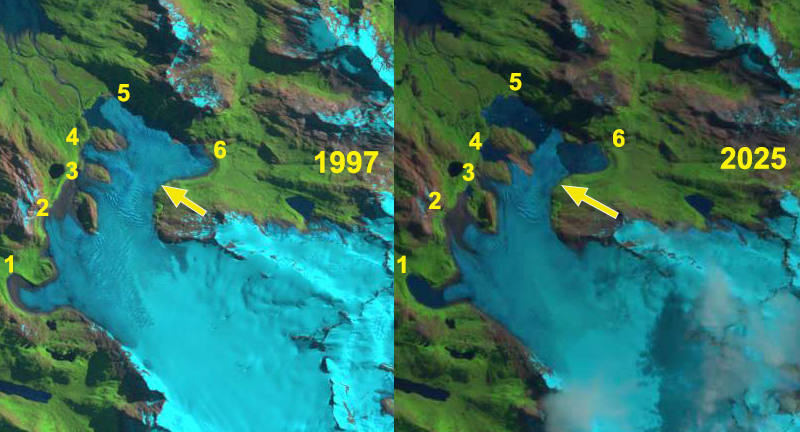
Videla Glacier, Chile is an outlet glacier of the Cordillera Darwin Icefield. The glacier has a number (Point 1-6) of terminus lobes where retreat has led to proglacial lake development between 1997 and 2025, as seen in these annotated Landsat images.
Videla Glacier is a land terminating glacier in the northwest portion of the Cordillera Darwin Icefield (CDI) in Tierra del Fuego, Chile. The glacier has terminates in several expanding proglacial lakes each in front of a different tongue of the glacier. The glacier flows northwest from Cerro Ambience towards Fiordo Profundo. Meier et al (2018) identified area change of Patagonia glaciers from 1870-2016 with a ~16% area loss of CDI, with more than half of the loss occurring since 1985. They also noted that CDI glaciers were retreating fastest between 1986 and 2005. Izagirre et al (2025) identified a 124% increase in glacier lake area from retreat between 1945 and 2024. The retreat has been largest on tidewater glaciers such as Marinelli Glacier and Ventisquero Grande Glacier.
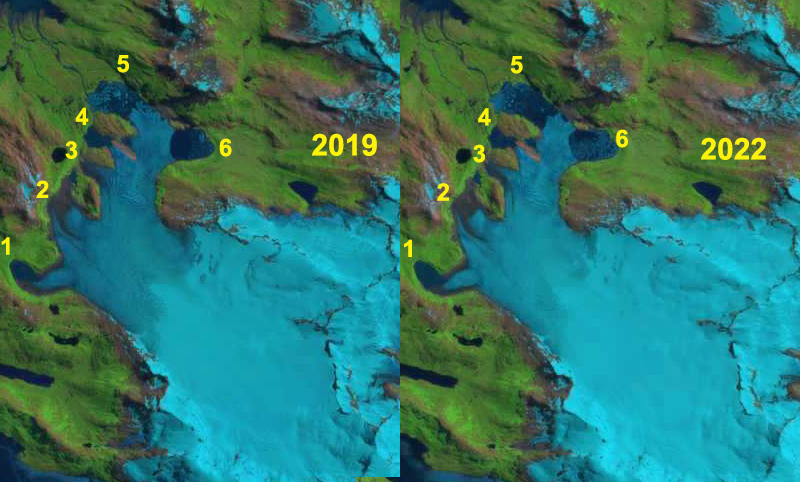
In 1997 of Videla Glacier’s six main terminus lobes, five did not exhibit a proglacial lake, only the two northern most lobes (Point 4, 5, and 6) ending in a fringing yet to develop proglacial lake. The terminus lobes at Point 2 and 3 were joined. By 2019 lobes 1 and 4 had developed significant proglacial lakes, while the main terminus at Point 5 and 6 had opened up two halves of the same proglacial lake. The terminus lobes at Point 2 and 3 had separated. A rib (yellow arrow) was developing upglacier of the main terminus indicating thinning and reduced flow. A new lake had developed just downstream of this rib.
In 2025 the terminus at Point 1 had receded 950 m creating a 0.75 km2 proglacial lake. Terminus Lobe 2 and 3 had separated by 400 m. At Point 4 a 0.5 km2 proglacial lake had formed with the 1050 m retreat. The main terminus at Point 5 and 6 extends across the lake basin in a narrow 350 m wide tongue. The lake has grown to 3 km2, with 1.5 km of recession from Point 6 and 1.8 km from Point 5. This narrow tongue may well break off this coming summer.
Videla Glacier, Chile ongoing retreat and proglacial lake growth at terminus lobes (1-6) illustrated by Landsat images from 2019 and 2022.
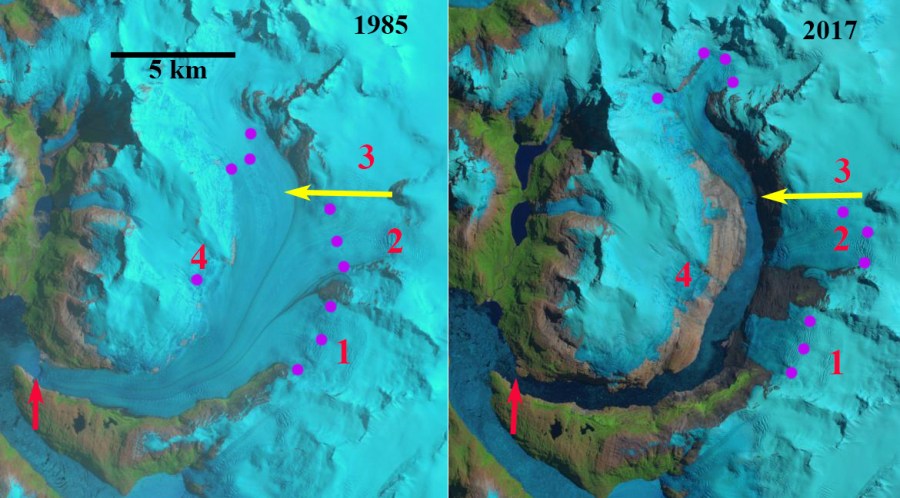
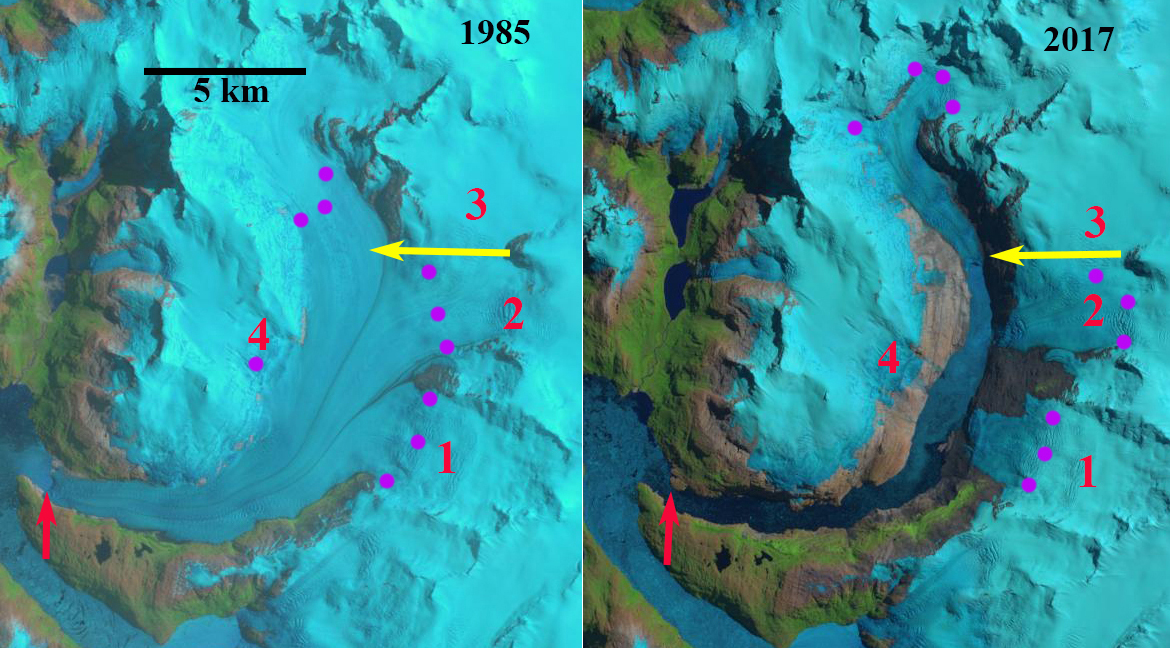
HPS-12 Glacier in 1985 and 2017 Landsat images. The red arrow indicates 1985 terminus, yellow arrows the 2017 terminus, purple dots the snowline and 1-4 are tributaries. By 2017 all tributaries have detached and the glacier has retreated 13 km.
HPS-12 is an unnamed glacier draining the west side of the Southern Patagonia Ice Cap (SPI). The glacier terminates in a fjord and is adjacent to Upsala Glacier to the east and Pio IX Glacier to the north. This developing fjord is also unnamed but feeds into Estero Falcon. Here we update the 2017 NASA Earth Observatory project I completed in 2017, that identified this as the fastest retreating glacier in Chile in the 1985-2017 period, using Landsat imagery from 1985-2025.
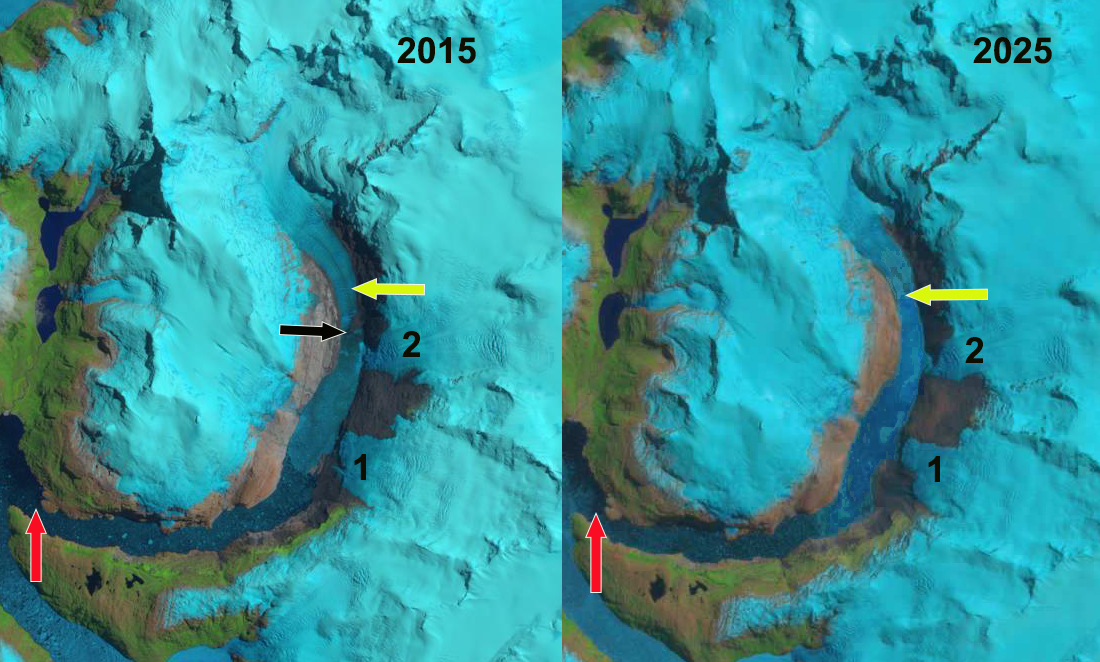
HPS-12 Glacier in 2015 and 2025 Landsat images. The red arrow indicates 1985 terminus, yellow arrows the 2025 terminus, black arrow the 2015 terminus. Former tributary 1 and 2 have declined in width .
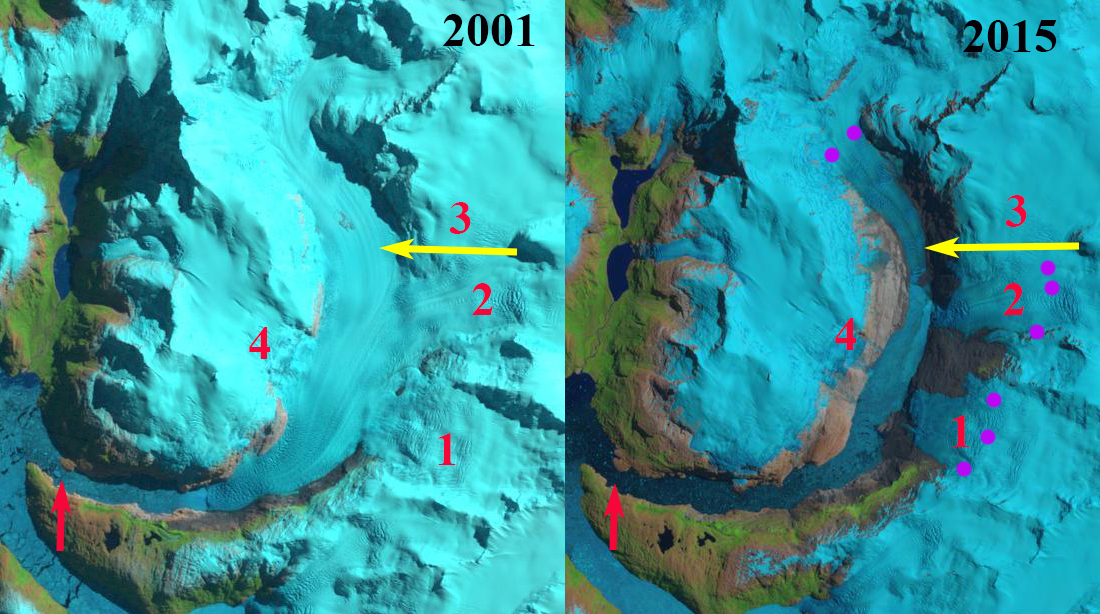
In 1985 the HPS-12 terminates 1.5 km from the junction of two fjords that are occupied by HPS-12 and HPS-13. These are separated by a peninsula. The glacier is fed by four tributaries labelled 1-4. The snowline in 1985 is at 900 m. In 2001 the four tributaries still join the main glacier, but the terminus has retreated 3.5 km. In 2015 glacier retreat has led to separation of tributary 1, 2 and 4 from the main glacier, tributary 3 only feeds tributary 2 and not the main glacier. The glacier retreat has continued to 2017, the current terminus is 800 m wide vesus 2800 m wide in 1985 . Total retreat from 1985 to 2017 was 13 km. By 2025 the glacier has retreated 14.75 km and has lost more than 50% of its total length. Tributary 1 and 2 continue to narrow from 2015 to 2025 illustrating that flow from the icefield accumulation zone is being reduced. This suggests less discharge into the terminus reach of HPS-12.
This glacier follows the pattern of retreat we have reported from Bernardo Glacier, O’Higgins Glacier, Tyndall Glacier and Upsala Glacier. The retreat is driven by the SPI have been experienced significant mass loss a. Malz et al (2018) noted a ~1 m/year mass loss from 2000-2016 with HPS-12 and Jorg Montt Glacier losing the most. Minowa et al (2021) found that 35% of all ablation of the Patagonia Icefields stemmed from frontal ablation.
HPS-12 Glacier in 2001 and 2015 Landsat images. The red arrow indicates 1985 terminus, yellow arrows the 2017 terminus, purple dots the snowline and 1-4 are tributaries. By 2015 tributaries 1, 2 and 4 have detached.
Core field team in 2025 Emmett Elsom, Mauri Pelto, Jill Pelto and Caitlin Quirk.
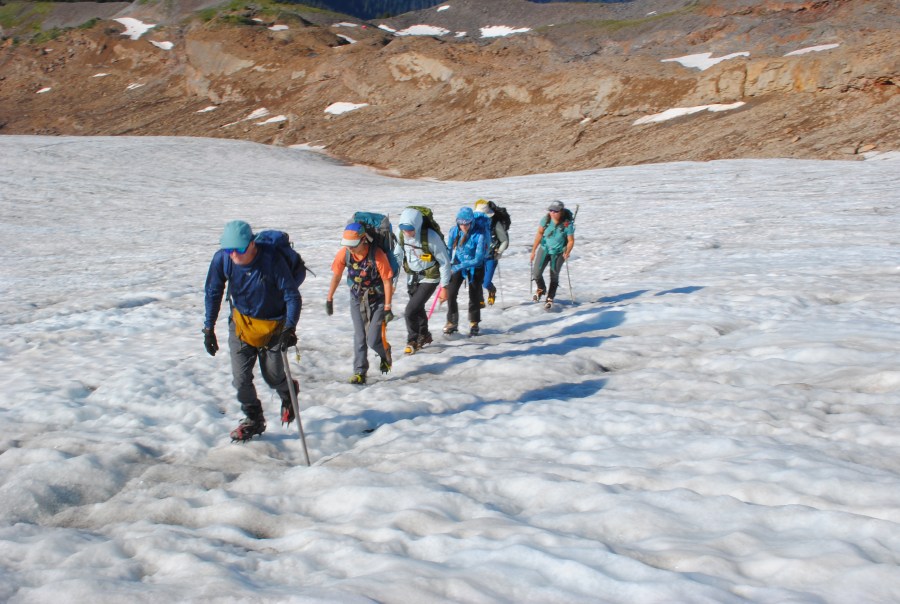
We hiked into North Cascade glacier to complete detailed observations for our 42nd consecutive year. These annual observations provide a detailed assessment of their response to climate change. For the third consecutive year North Cascade glacier on on average lost more than 2 m of glacier thickness. This cumulative loss of 7-8 m on most of the ranges glaciers that average 25-40 m in thickness represents 20% of their volume lost in just three years. On a few of the largest glaciers, such as those on Mount Baker that average 40-60 m in thickness the loss represents 12% of their volume lost.
The consequence is an acceleration of the collapse of the North Cascade glacier system. This landscape that has for long been shaped by ice is rapidly losing that glacier element. The rate of retreat for the glaciers we work on has accelerated so quickly that we are faced each year with changing terrain and new challenges. Beyond that, we are starting to really see the effect this retreat and the decrease in water has on the ecosystems both near the glaciers and further downstream. During the field season we love seeing the wildflowers, eating blueberries, and counting mountain goats. These are all parts of a habitat that is built around glaciers and snowpack. Seeing these shifts has been really difficult, but it helps to still return to these landscapes and continue to tell their stories through science and art. Below the story is told in images with captions by each of us who participated.
Two things that stood out during the 2025 field season were the strength of our collaborations, and the changing resources the glaciers are able to provide to the surrounding ecosystem. This visible change attracted the attention of KING5-Seattle NBC affiliate and CBS Morning News. At the bottom of this post the resulting footage is embedded. The film “Shaped By Ice” Jill and I worked on with Dan McComb has been a finalist in two recent film festivals, this footage also at bottom of this long read post.
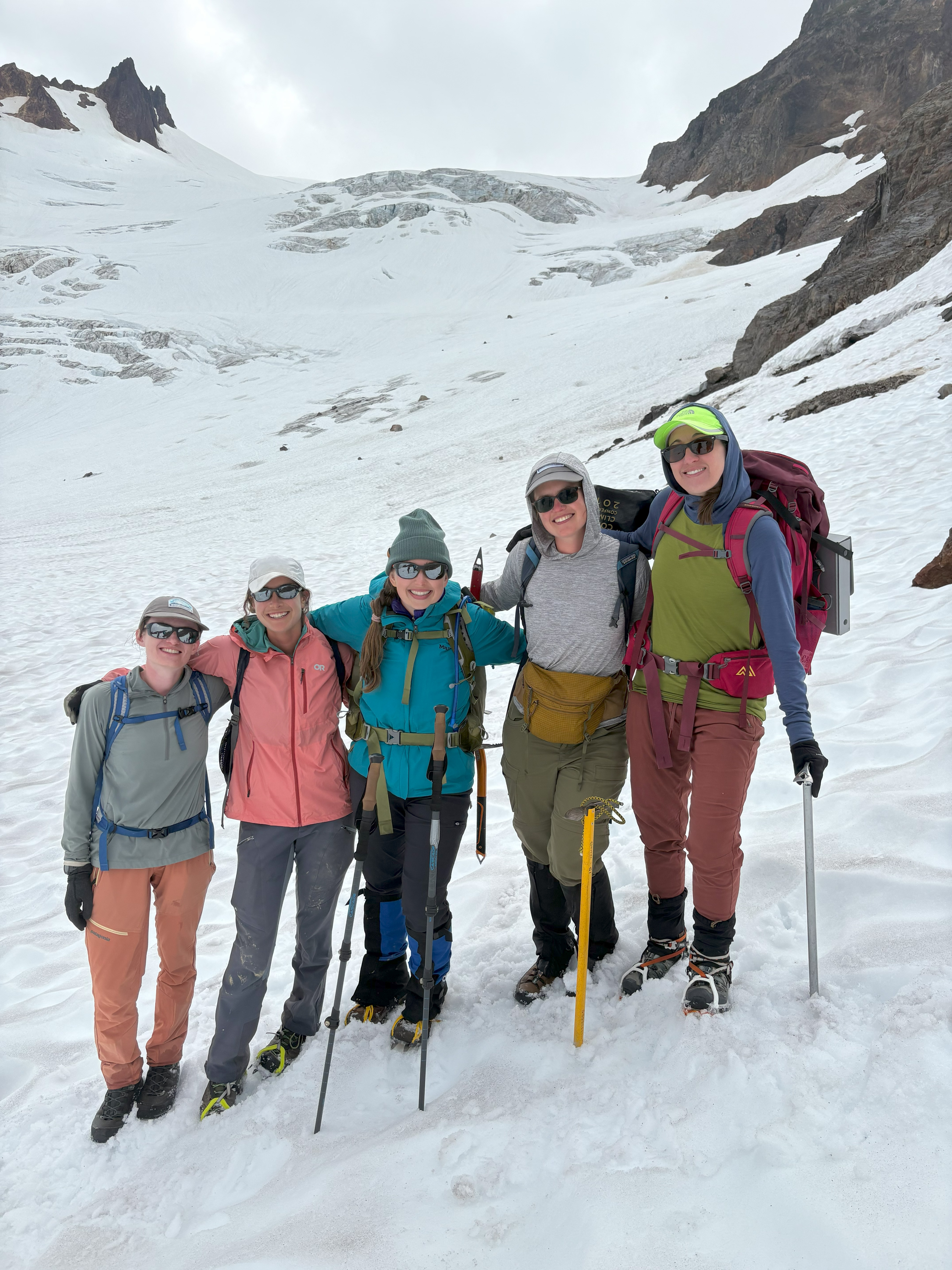
Working on Rainbow Glacier from left-Katie Hovind, Caitlin Quirk, Claire Seaman, Jill Pelto and Margaret Kingston
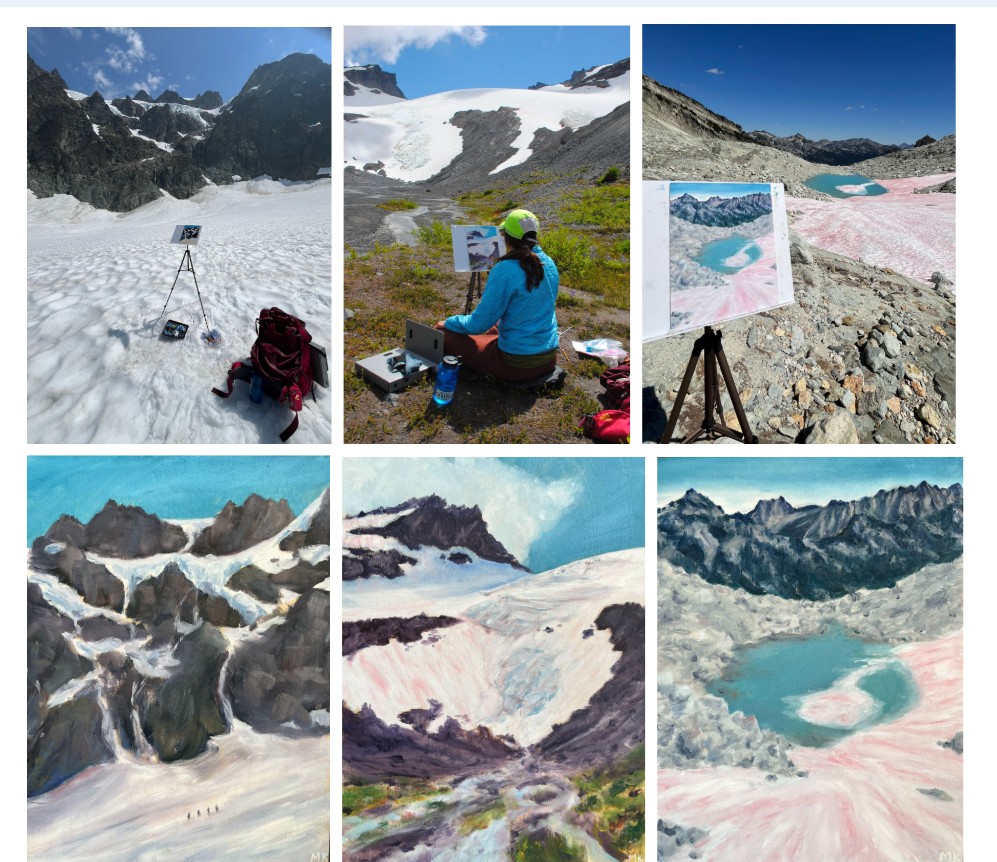
We worked with two oil painters, one watercolor painter, one printmaker, two news film crews, a team of botanists, and more. The result of all these collaborations has led to so many great stories being created and shared about our collective work. It also meant our core group of field assistants had to be flexible to a changing group and the sometimes difficult and imperfect logistics that accompany that. -Jill Pelto
This photograph of an icefall at 2000 m (6700 ft) on the Easton glacier encompasses the wide range of emotions that I felt working on these glaciers this summer. The focal point of the picture is the wound inflicted upon the glacier by our changing climate. Bedrock and sediment creep through the gaping wound in the lowest icefall of the Easton, the opening visible for the first time in the project’s 42-year history. The place also holds a beauty, a sense of majesty that cannot be diminished by the tragic context of our work. The seracs at the top of the scene lean at impossible angles, destined to crash down onto the slope below, piercing the quiet of the snowy expanse in dramatic fashion. The dark annual layers in the glacier speak to the age of the ice, flowing down the flank of Mt. Baker over decades. The landscape has been a facet of my life for the past few years, as it falls upon the Easton Glacier route to the mountain’s summit. The icefall has always drawn me in as I pass, sparking a profound sense of wonder. It makes me deeply sad to see the beauty of such special places diminished, sad in a way that little else does. Over the past few years, I’ve come to like visiting these places to visiting an elderly loved one. While time may change them and even take them away from us, their beauty and meaning to me will hold true.-Emmett Elsom
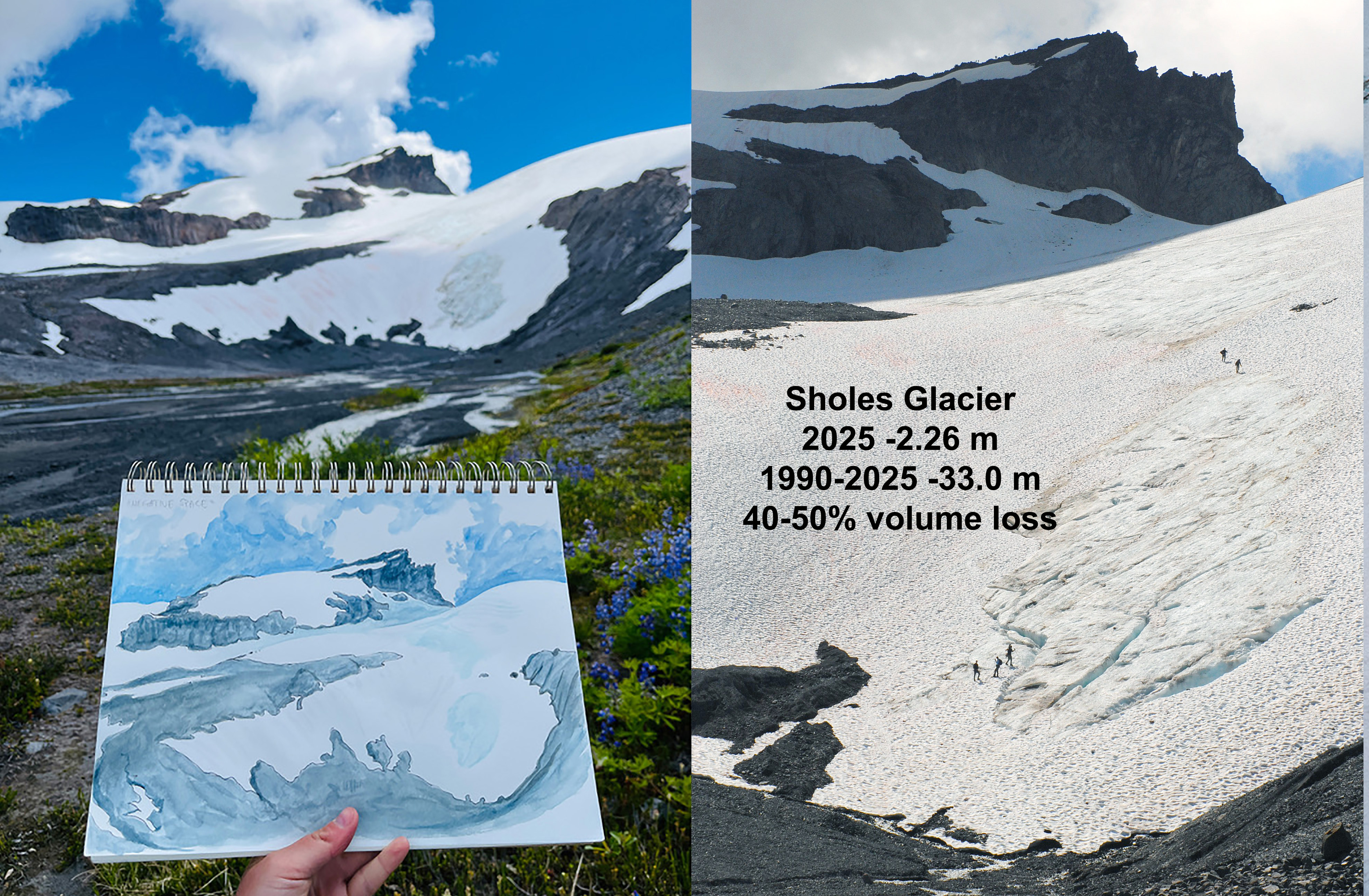
How does being present in a place shape our understanding? To the left is a view of Sholes Glacier, complete with my on-site rendition. I can’t express how lucky I feel to have had the chance to experience these places first hand. To interact with a place by attempting to capture its likeness — paying attention to the negative space not only between the white snowpack and black exposed rock, but in the empty, carved-out area that used to be filled with ice. Experiencing the texture of the glacier under your feet, the cool air drifting off the snow, the good tired feeling of your body after physically traversing top to bottom. This is what you don’t get from a photo. To know places such as these is to love them and see their role in the world, and want to protect them. But so many never get the chance to understand them this way.-Claire Seaman
This field season I focused on exploring the once-barren foreland a glacier leaves behind. Studying the plants growing in the wake of the Easton Glacier made me reflect on the way life responds to these major changes. This photo of a bright monkeyflower cluster in the streambed of the nearby Sholes Glacier exemplifies this resilience and optimism to me. The Sholes, in the background, drains a lifeblood that will feed the watershed downstream into the Nooksack, supporting people, fisheries, and a whole riparian ecosystem. The eventual loss of glacial ice feeding the river will be catastrophic, yet the scarred space left behind will blossom with vegetation. Witnessing firsthand how staggering the extent of glacial retreat is can be overwhelming, but that bright patch of flowers stands as encouragement. Alone in an altered landscape, those flowers will pave the way for more to follow. Change is nuanced, and as we watch it occur we can change, sharing stories of the beauty of this environment supported by ice, and adapting our lives and policies in a way that can be the difference which keeps glaciers flowing.-Katie Hovind
As a backcountry skier and oil painter focused on winter landscapes of the North Cascades, the idea of painting glaciers in the field was a dream come true! I knew what we would see and learn about the health of our glaciers from the scientists would be highly emotional, but the power of these environments disappearing in our lifetimes is something my words fail to communicate how devastating that feels. During the study on Rainbow glacier I caught on film the moment a serac collapsed, loudly crashing, crumbling from a newly melted out rock knob down the mountain splitting into smaller and smaller pieces. It looked sickly as it broke before our eyes. Another unique experience was going into a teal, translucent, otherworldly ice cave. I have started 2 paintings to capture this vanishing environment. My goal is to assist the project in translating the study’s findings through landscape paintings that communicate the beauty of these places with titles that call attention to the retreating glaciers in the North Cascades. We all have a responsibility as humans to make individual changes to combat climate change and vote like fresh water and air depends on it, because it does. -Margaret Kingston
The pace of glacier change struck me hard this summer. Never before have humans lived with such a deglaciated Cascades mountain range. Not the settlers, not the fur trappers, not the first people who have been here for 13,000 years or more. Cultures and ecosystems spawned from the retreating edge of the Cordilleran Ice sheet into the Puget Sound area. Alpine glaciers fed streams, rivers, salmon, all kinds of human projects in Washington State. Our societies are shaped by the ice and now we are experiencing glaciers disappear.
I write this at the end of the 2025 hydrological year, waiting for winter snow to shelter the land I love in a cool white blanket. The devastation of the alpine glaciers has surfaced so frequently in conversation these last couple months. Those who have seen the mountains are alarmed as beds of ice they once knew to be hundreds of feet thick look shallow and frail, ice pitches that were once climbed are now grey gullies of rock, and volcanoes which have always been white are unnervingly gray and shrouded in smoke. The realities of climate change in the Northwest are clear.
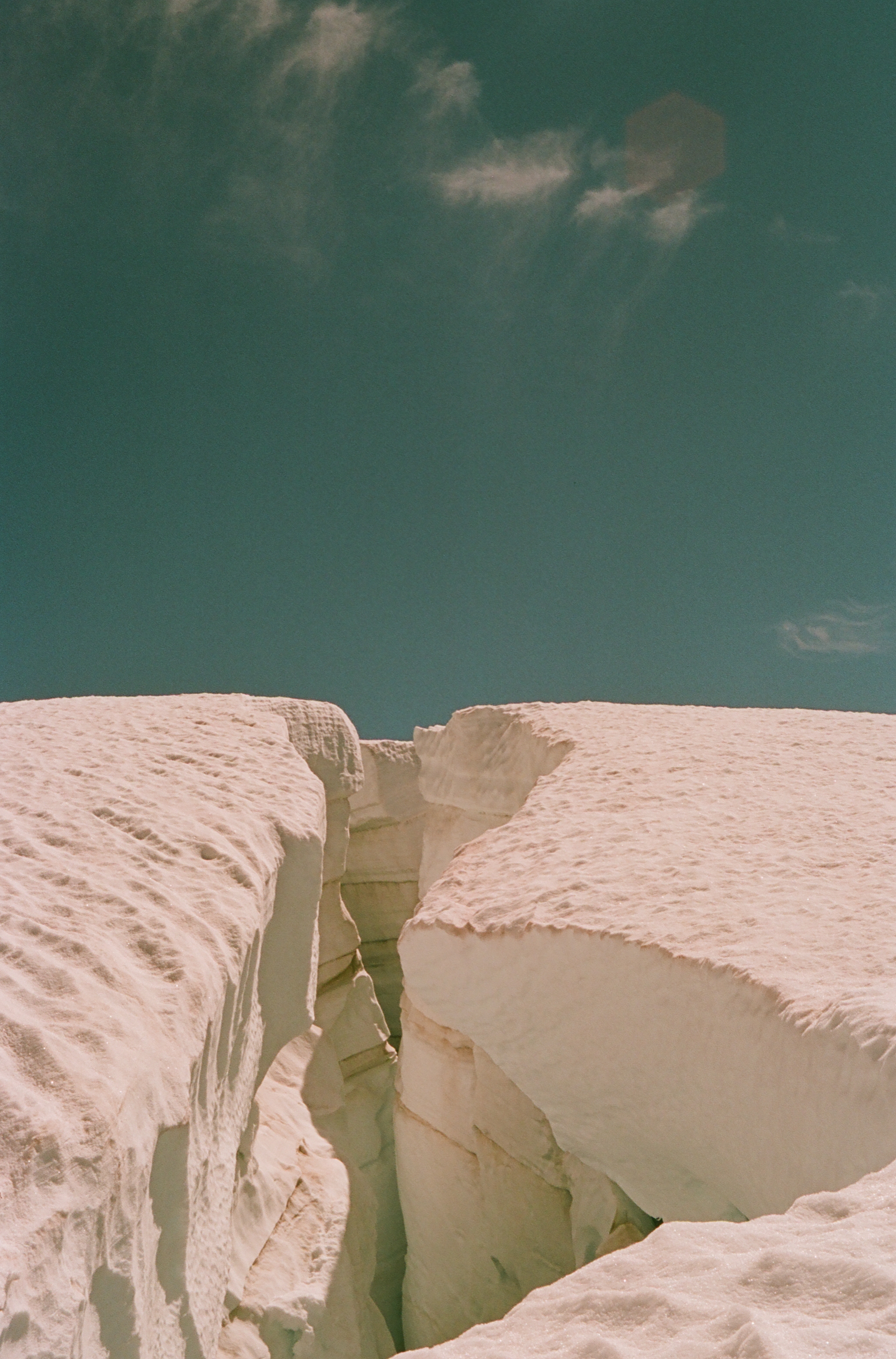
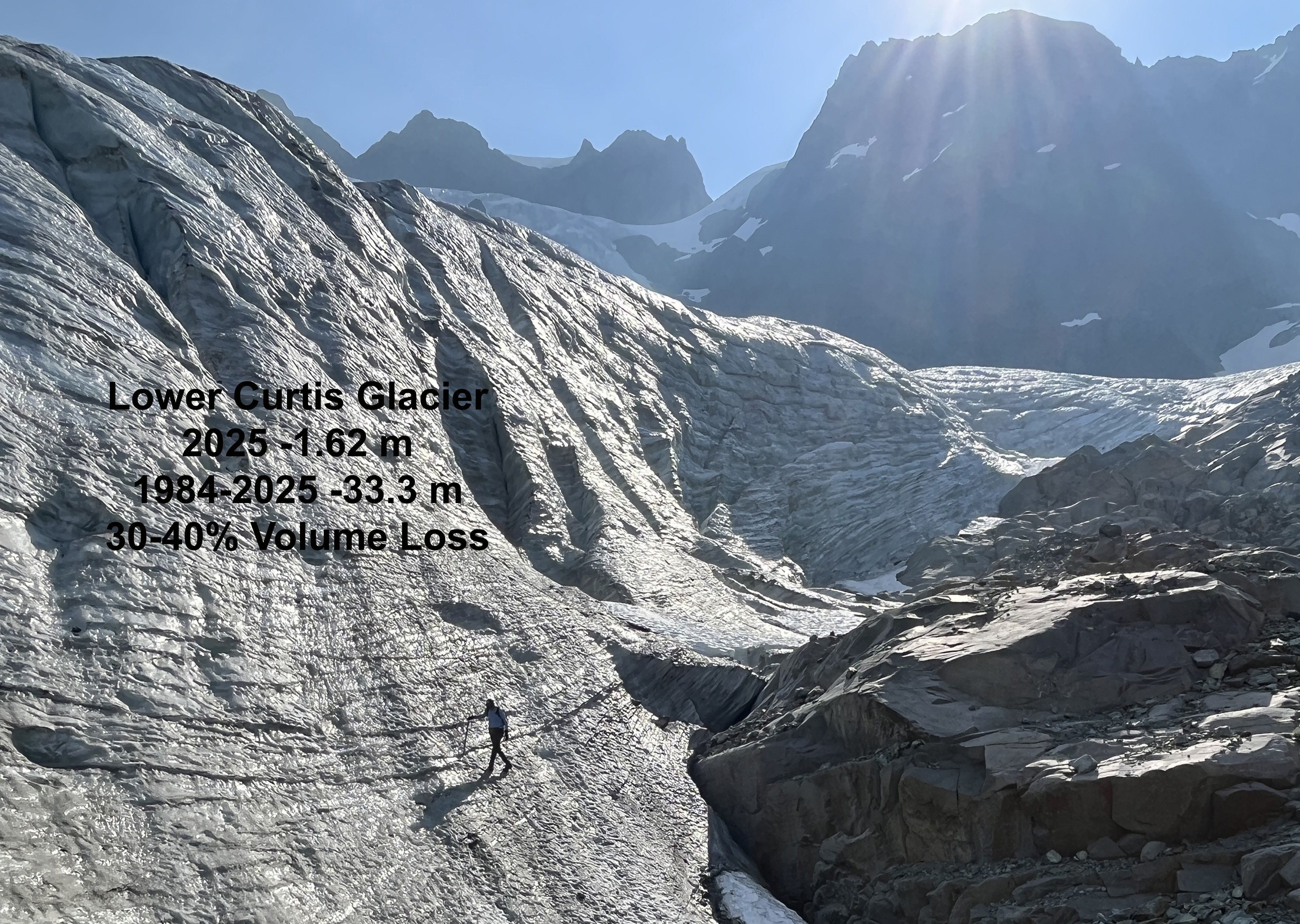
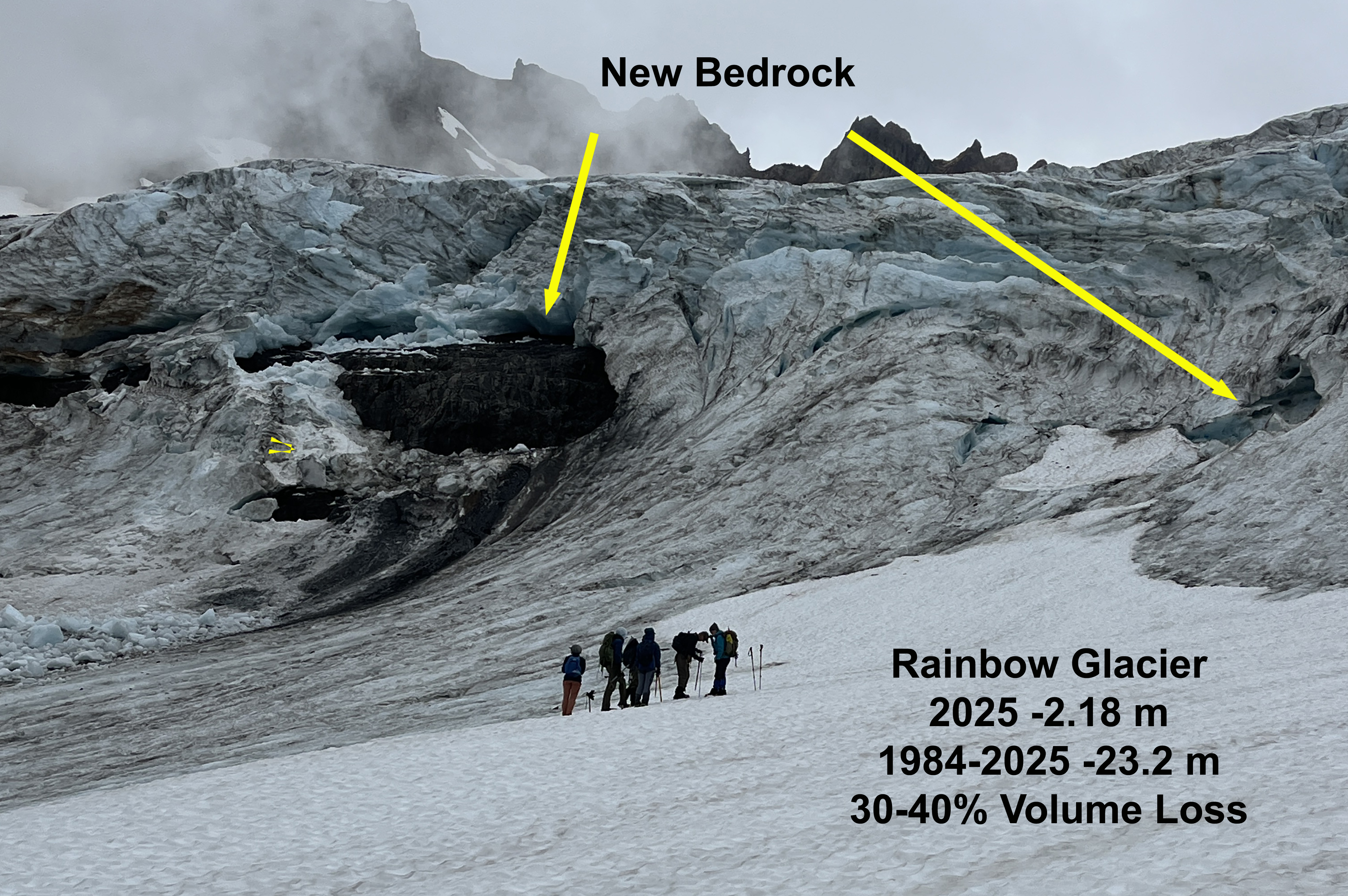
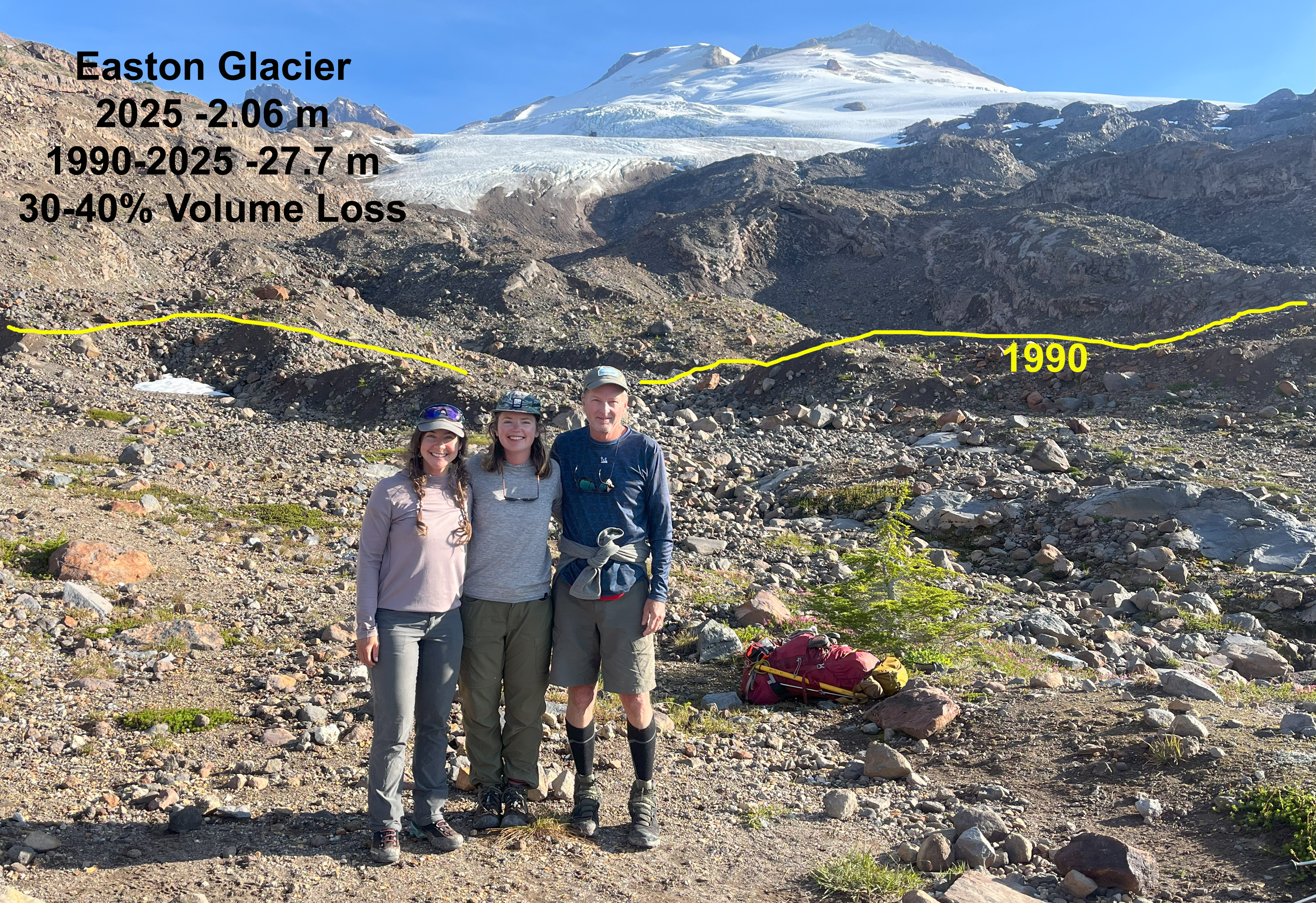
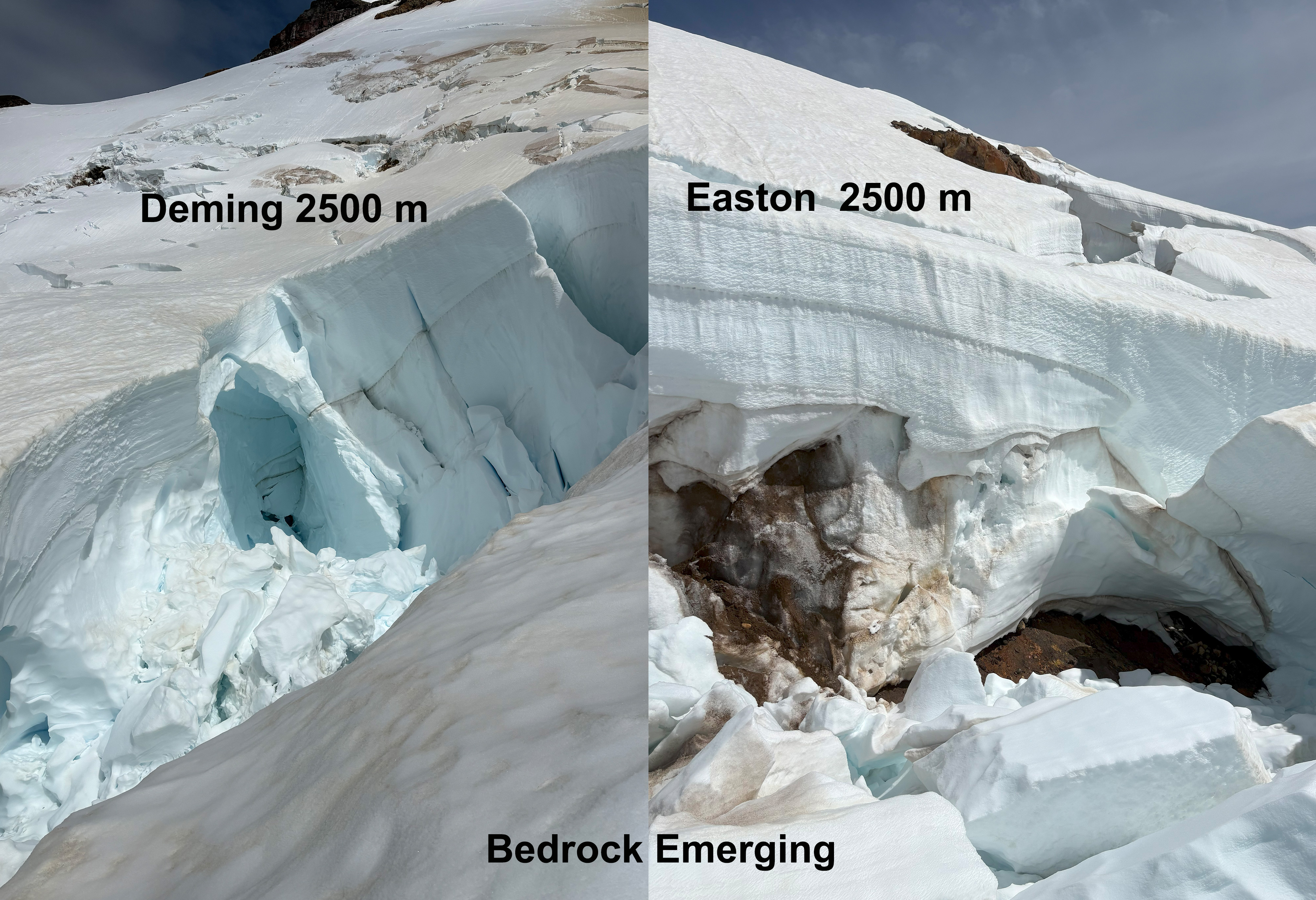
It is a painful time to care about the glaciers of the Cascades. Witnessing the erosion of something so much older and bigger and impactful than myself is staggering. There is much action to be done in this new terrain but for now, I come back to this: I sit in the dying glaciers warm light as the sun rises, summon the deepest snowfall in years and tell the glacier that we care, that we were grateful for all the help watering our food and feeding our oceans and making sure our salmon had somewhere to live. We are here because of you. -Cal WaichlerImage description: This image shows a crevasse on the Easton Glacier of Mount Baker. The saturation is distorted because I shot this photo on 35mm and pre-exposed the film to light and heat to parallel the material effects of global warming on our glacier systems. The Easton glacier is a source of water for Baker Lake, which provides recreation and hydropower to the region. When I see this photo, I think of the impacts of glacial melt to water, energy, cultural, and economic resources in Washington. -Caitlin QuirkColumbia Glacier is one of sixty global reference glaciers. This summer it lost 5% of its volume.Lower Curtis Glacier continues to rapidly thin at the top of the glacier as well as at the terminus. The glacier retained additional avalanche accumulation, leading to a less negative balance than other glaciers.Rainbow Glacier is one of the sixty global reference glaciers. This year new bedrock began to emerge and expand in several icefalls, leading to serac fall.Easton Glacier has retreated 700 m since 1990 and has a number of bedrock areas emerging in icefall up to 2500 m.Lynch Glacier east and west side are separating. The upper basin did retain some snow in 2025.Daniels Glacier lost all snowpack by the end of the summer and bedrock is quickly expanding amongst the glacier.
The trajectory for most North Cascade glaciers is one of fragmentation. This is illustrated by Foss Glacier on the east flank of Mount Hinman, that we began observing annually in 1984 but stopped measuring as it fragmented.Foss Glacier from the top was a 1 km long and nearly 600 m wide glacier. In Sept. 2025 Cal Waichler captured view from the top with the two main fragments now less than 50 m wide and 300 m long.-Mauri Pelto
Leah Pezzetti KING5 meterologist hiked in with us to Lower Curtis Glacier.
The CBS team hiked into Sholes Glacier with usspending the night, and we had three generations of Pelto’s.
Hofsjokull East is snow free on 8-17-2025 in this false color Sentinel image. This leads to ice melt, thinning and bedrock expansion at Point A-D.
Hofsjokull East, Iceland is a small ice cap east of Vatnajokull with a summit elevation of 1100 m. In the last decade the snow line has often been above the ice cap. The ice cap had an area or 4.97 km2 in 2003 declining to 2.51 km2 in 2023 (Iceland Glacier Viewer). In 2024 all 10 glaciers in Iceland had significant mass loss (Pelto, 2025).
In August 2020 the ice cap has lost nearly all of its snow cover, this occurred again in 2023 and 2024. The result in 2025 when the ice cap again lost all its snowcover, is significant glacier surface melt and thinning. This leads to expansion of bedrock. At Point A there has been rapid expansion of the bedrock knob. At Point B and C new bedrock has been exposed and rapidly expanded. At Point D a bedrock rib at the edge of the ice cap has spread into the ice cap.
The lack of snow cover indicates the ice cap no longer has an accumulation zone and cannot survive. In 2025 the ice cap area is 2.10 km2 . Ice cap area has declined by ~60 % in the last 22 years. The story here is similar to that at the larger Prándarjökull 10 km to the northeast. The summer of 2025 in Iceland was exceptional beginning with a May heatwave, followed by a July heatwave. The May heat wave led to high snow lines as summer began on Vatnajokull.
Hofsjokull East is nearly snow free on 8-14-2020 in this false color Sentinel image. Contrast the area of bedrock at Point A-Dto the 2023 and 2025 images.
Hofsjokull East is nearly snow free on 9-3-2023 in this false color Sentinel image. Point B and C now have evident bedrock areas.
Prándarjökull on August 20, 2025 has no retained snowpack-with weeks left in the melt season (Sentinel false color image)
Prándarjökull is an icecap northeast of Vatnajokull that has a summit elevation of 1215 m, and a margin between 875 and 925 m. In 2003 the ice cap had an area of 17.3 km2, declining to 12.8 km2 by 2023 (Iceland Glacier Viewer). In 2024 all 10 glaciers in Iceland had significant mass loss (Pelto, 2025)
In 2021 the ice cap lost at least 90% of its snow cover as noted in the Sentinel image from 8-24-2021. In 2023 The ice cap again lost nearly all of its snow cover.
Prándarjökull on August 31, 2023 has only 5-10% retained snowpack-with weeks left in the melt season (Sentinel false color image)
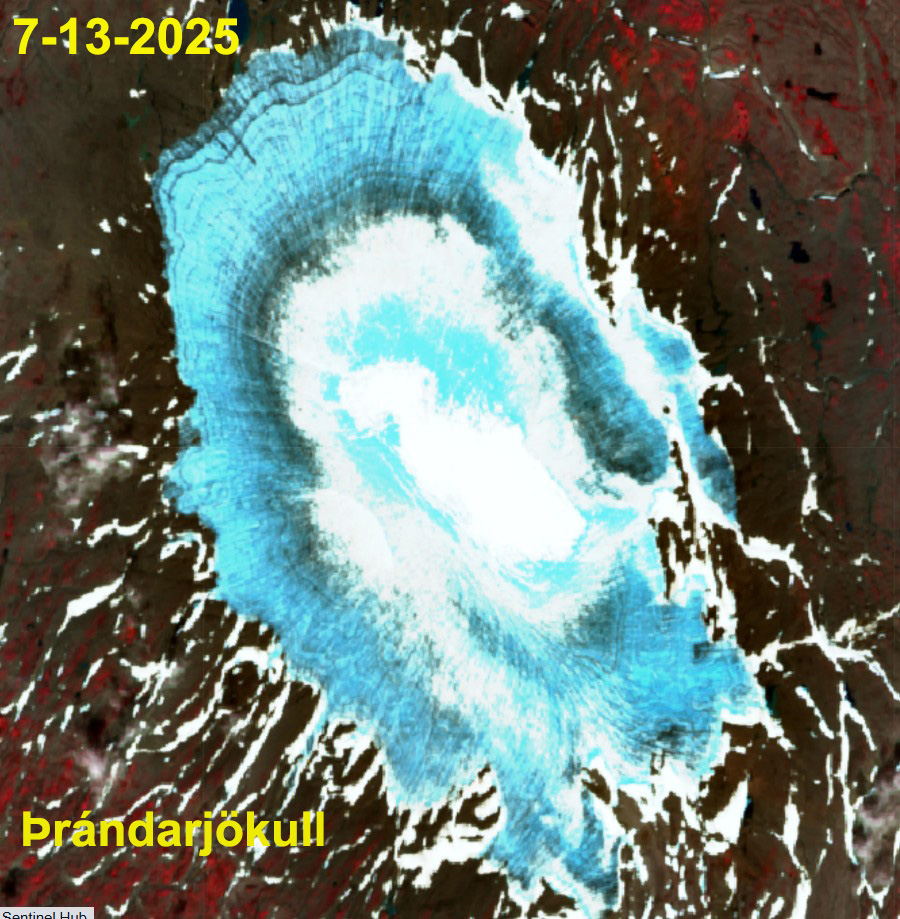
The spring and early summer of 2025 was one of record warmth for Iceland. This led to a rapid rise of the snowline to 900-1000 m on Vatnajokull. By mid-July 60% of the Prándarjökull was snow free. There is an area of water saturated snow-light blue amidst the snowpack.
Prándarjökull on July 13, 2025 the ice caphas 40% retained snow cover-with weeks left in the melt season (Sentinel false color image)
By August 20, 2025 the ice cap had no snow cover. The early exposure of ice in recent years is leading to the continued recession of the ice cap and the intrusion of bedrock areas into the ice cap at Point A and B. At Point C in 2021 recent firn is exposed, that has melted away by 2025. The area of the ice cap has declined to 11.5 km2. There is no recent retained firn-indicating that in the last five year no snow cover has persisted to the end of this summer. This indicates the lack of an accumulation zone, without which the glacier cannot survive.
Prándarjökull on August 31, 2023 has only 5-10% retained snowpack-with weeks left in the melt season (Sentinel false color image)
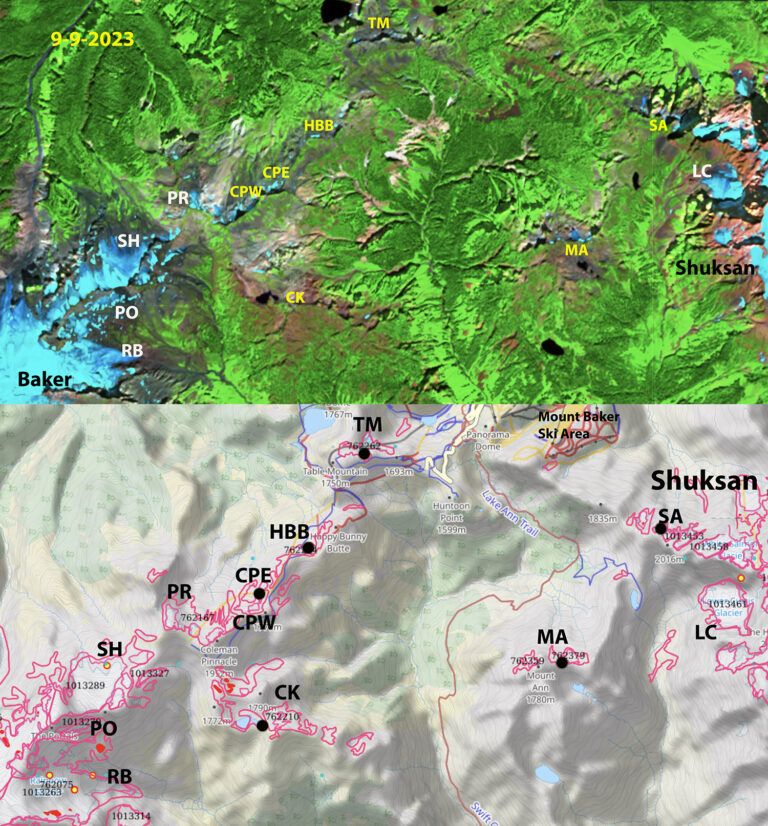
Glaciers on the ridge from Moutn Shuksan to Mount Baker that we observed to be active in mid 1980s, identified in GLIMS map below. Above Sentinel image from 9-9-2023. Glaciers that are no longer glaciers in yellow, seven of them including Mount Ann=MA, Shuksan Arm=SA, Coleman Pinnacle East/West=CPW/CPE, Camp Kiser=CK, Table Mountain=TM and HBB=Happy Bunny Butte. We still monitor each year Lower Curtis, Rainbow and Sholes.
The two most prominent mountains of the North Cascades Mount Shuksan and Mount Baker are connected by a ridge from Shuksan Arm to Ptarmigan Ridge. We visited 12 glaciers along and close to this ridge in the mid-1980s, to decide which to monitor annually. At that time each of these had active crevasses and significant area of glacier ice. We By the end of 2023 seven of the twelve glaciers are gone. We continue to monitor Lower Curtis, Rainbow and Sholes Glacier in detail. Portals and Ptarmigan Ridge Glacier which we visit every year, but do not assess in detail, will likely disappear in the next few years. Below is the evolving area and the date the glacier was lost, the area reported in the 1958/84 period and 2015 are from GLIMS and the 2023 area we determined from Sentinel imagery.
Glacier
GLIMS ID
Year Lost
1958/84 Area
2015 Area
2023 Area
Camp Kiser
G238275E48809N
1993
0.22
0.03
0
Happy Bunny Butte
G238277E48834N
2005
0.166
0
0
Table Mountain
G238295E48850N
2015
0.158
0
0.008
Coleman Pinnacle
G238269E48826N
2018
0.56
0.031
0.018
Mount Ann
G238341E48818N
2022
0.12
0.07
0.01
Shuksan Arm
G238362E48838N
2023
0.16
0.07
0.03
1963 image of Ptarmigan Ridge sent to me by Austin Post.
Ptarmigan Ridge glaciers in 1993-all small but still all nearly joined.
In 2024 the lack of glacier ice or perennial snow along Ptarmigan Ridge is evident.
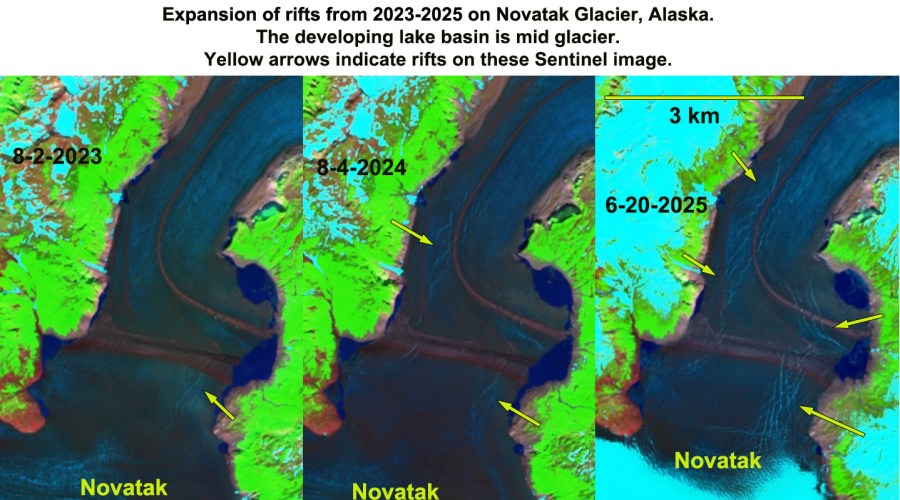
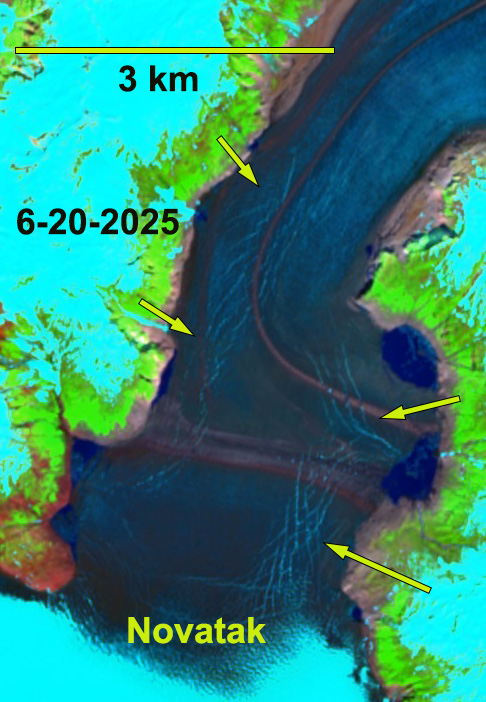
A network of extensive rifts have developed since 2023, yellow arrows. The fringing proglacial lake has not expanded. Rifting indicates uplift from partially floating glacier area.
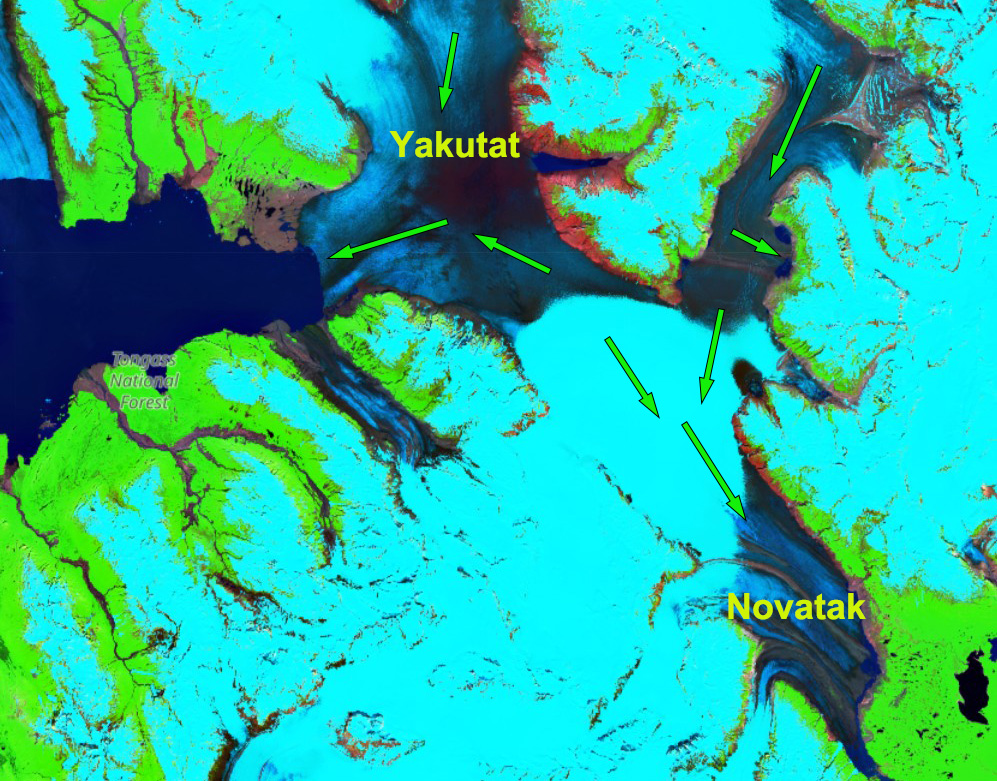
Ice flow in the region around the developing lake, which is near the boundary with Yakutat Glacier in Sentinel Image from June 20, 2025
Novatak Glacier is between the Yakutat and East Novatak Glacier in southeast Alaska. The glacier retreated 1 km from 1987-2023 (NASA EO, 2015). The majority of the accumulation zone of these three glaciers is below 1000 m, which has made them particularly vulnerable to the warming climate. The result has been expansion of the proglacial lake, Harlequin Lake, at Yakutat Glacier from 1984 to 2024 from 50 km2 to 108 km2 (Pelto & NASA EO, 2024). There was no lake in 1908.
Novatak Glacier has been slow to form a substantial terminus lake unlike its neighbors, possibly because it lacks a sufficient basin. This has limited the retreat of this glacier as it thins. The developing rifts does show a large lake will form, with an area of 10-12 km2 . This will isolate the terminus from the main inflow to Novatak’s terminus, which will hasten a rapid meltdown. The rifts represent places where water level change causes flexure of the glacier, leading to their formation and expansion. They are not related to flow, but to uplift and down fall of ice where it is somewhat afloat. Rapid meltwater inflow to this basin will raise water level further stressing this region this summer. The degree of rifting indicates the ice is thin, but none are open enough to see water. This suggests breakup will not happen this summer. This type of rifting in 2010 and 2015 led to further breakups at Yakutat Glacier.
June 20, 2025 rifting of Novatak Glacier.The rifts represent places where water level change causes flexure of the glacier, leading to their formation and expansion. They are not related to flow, but to uplift and down fall.
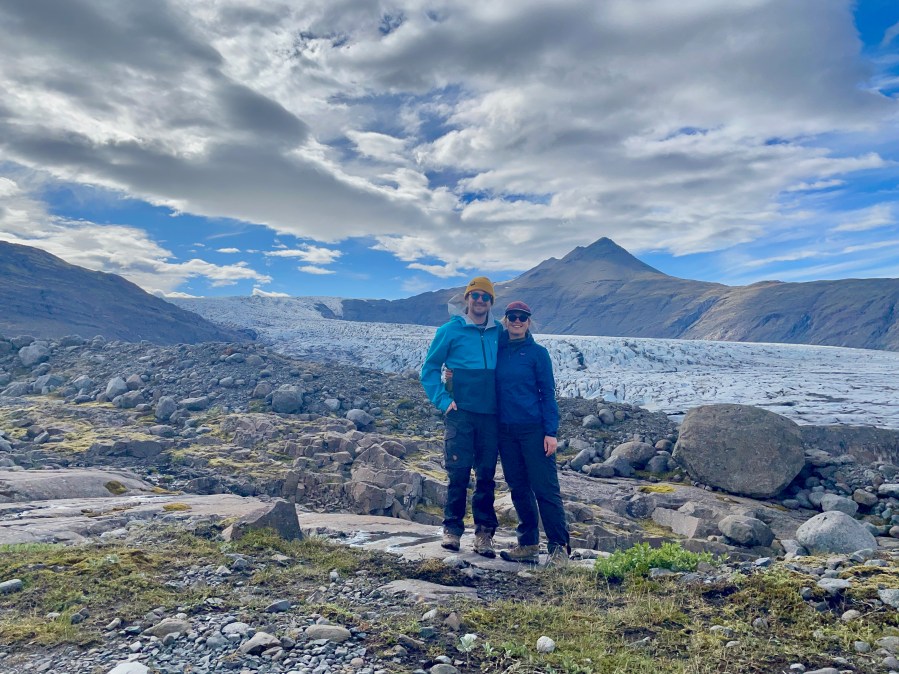
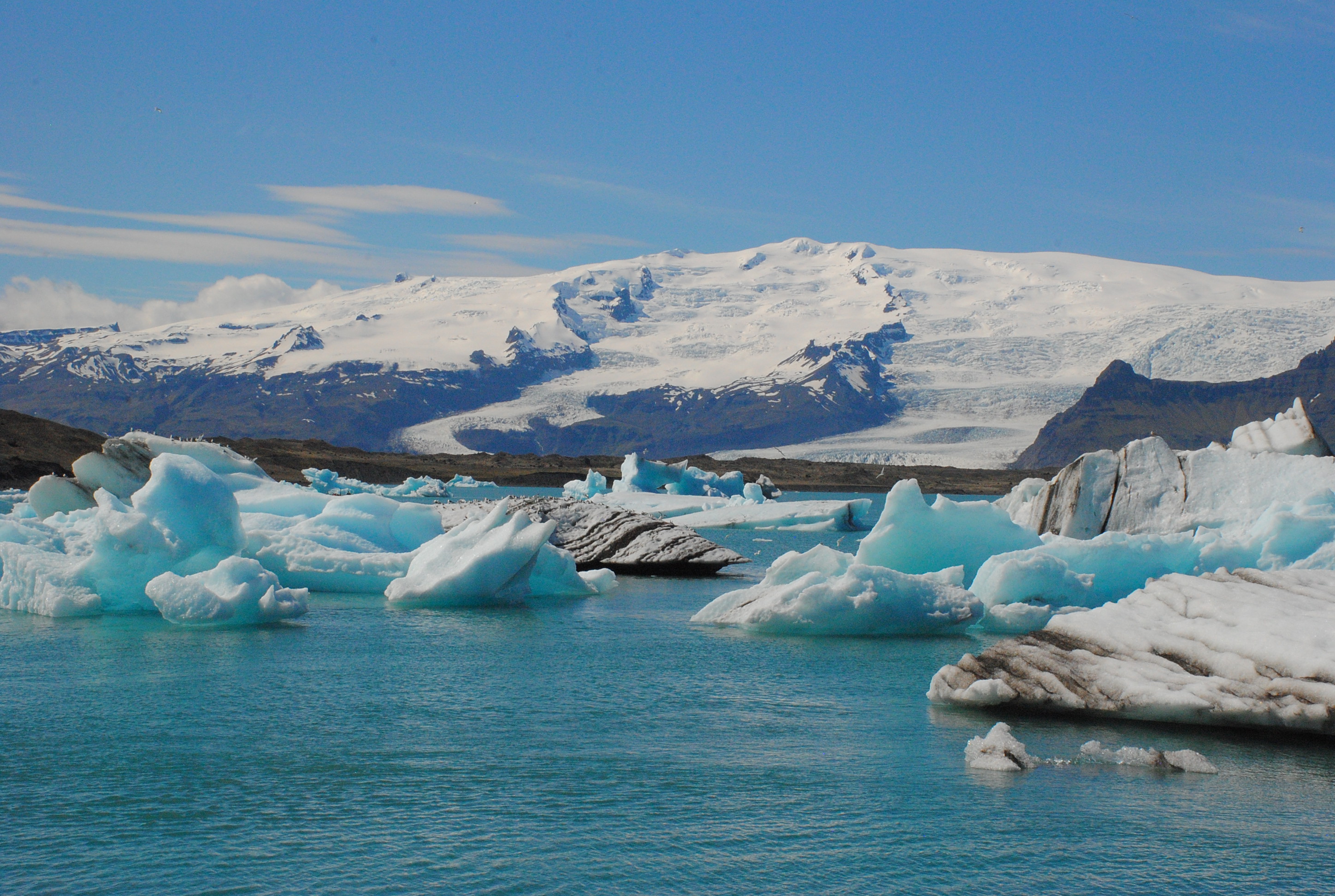
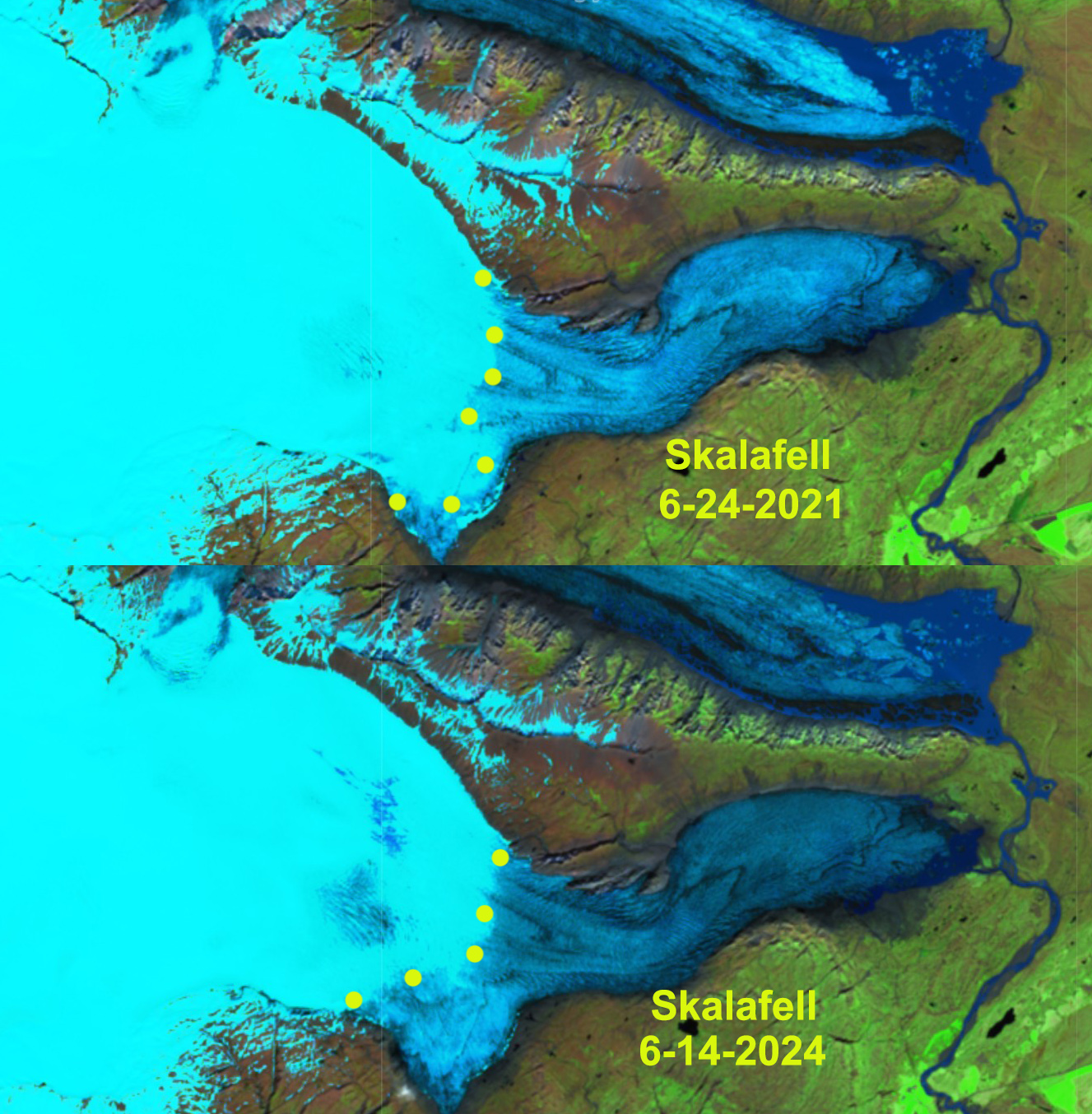
A view across Jokulsarlon Lagoon toward Fjalljökull and Hrutarjökull of the ÖræfajökullIce Capon May 25 above. Below, is Skalafellsjokull of Vatnajökull Ice cap on May 26 with Jill and Kevin Duffy in foreground next to lateral moraine (Jill Pelto). Öræfajökull is a connected to Vatnajökull.
Iceland experienced an unusually warm and sunny May, with record high temperatures averaging 10 C above average. This led to a rapid rise in the snow line to elevations more typical of late June than May on the ice caps in southern Iceland, here both Vatnajökull and its southern extension Öræfajökull. We use Sentinel images (Mauri Pelto annotated) and photographs from (Jill Pelto) to illustrate. The University of Maine Sea to Sky Experience explored Iceland in May, and Jill as the artist faculty for the program had a chance to see Iceland with blue sky days.Most days during my two weeks in Iceland were full sun with high temperatures from 10-15 C. The record heatwave reaching into the low 20 C range, rare even for summer here. The lower parts of outlet glaciers already were mostly bare ice, even though melt season should not really have begun yet. Locals were shocked by the weather, and most I heard from were not happy about it, even though it was “nice” out.
On May 20, 2025 the snow line on the southern part of the Öræfajökull Ice Cap averages 800 m, purple dots. SK=Skaftafells, SV=Svinafells, HR=Hrutarjokull, KV=Kviar, FJ=Fjalls, JL=Jokulsarlon Lagoon, H1=Southern Highway.
As May began conditions were typical with the snow line not far from the glacier terminus areas at 350-400 m, May 2 image of Skalafellsjökull. By May 20, the snow line had risen to 750-800 m, a rapid rise of ~400 m in three weeks, represents more than 50% of the rise that should occur by end of summer. By May 26, (Jill image) the snowline had risen further to 800 m+. This snow line elevation is above the typical elevation seen in latter June other years (see below). In 2024 all ten glaciers in Iceland had a negative mass balance (WGMS, 2025). The rapid melt in May 2025, indicates that 2025 will see similar widespread mass loss.
Hrutarjökull with snowline at 800 m on May 26, 2025.Skalafellsjökull on May 2 and 20, 2025 illustrating rapid snow line rise (yellow dots). Contrast that to the images from mid-late June in 2021 and 2024, below.
As April ends there is a sharp snowline ranging from 1200 m at Mount Baker to 1400 m at Cascade Pass. Above 1500 m the melt season is just getting started.
As the accumulation season comes to an end for North Cascade glaciers it is worth reviewing this winter and looking ahead with a forecast for glacier mass balance by the end of summer 2025. The winter of 2025 at NOAA’s Washington Cascade Mountain West Division 5 records indicate that this winter was below the declining trendline of total precipitation with a mean of 54.8 inches, down slightly from last year. Winter temperatures were again warm at 33.2o F but close to the expected rising trend line average.
The 1946 to 2025 winter (November-March) mean temperature and total precipitation for the Western Cascade Mountains-Division 5 weather stations.
The mean April 1 snow water equivalent (swe) at the six North Cascade Snotel sites with a consistent long term record was 0.72 m. This is below the declining trend line and 31% below the long term average for the 1946-2025 period. This is above the 2024 value, but in the lowest quintile. Mount Baker ski area has reported 585 inches of snowfall through April 21, which is ~30% percentile. April 1 swe is the key date for asssessment for winter snowpack water resources. For glaciers the accumulation season typically continues until the end or April or early May. This year snowpack depth at Mount Baker Ski Area (1280 m) increased from 148 inches on April 1 to 164 inches on April 9 and then declining to 119 inches by May 1 (80% of normal). A similar pattern was seen at Stevens Pass-Grace Lake station (1460 m) with snowpack depth on April 1 of 107 inches, increasing to 114 inches by April 9 and decreasing to 82 inches by May 1. These stations are several hundred meters below glacier elevations. At Lyman Lake Snotel (1800 m) snowpack SWE which most closely matches the glacier elevations was 40.1 inches rising to 42.5 inches by April 11 and declining to 35.9 inches by May 1, ~60% of normal. At the Middle Fork Nooksack site (1520 m) snowpack was 44.8 inches SWE on April 1, rising to 49 inches by April 11 and declining to 46 inches on May 1, 67% of normal . This illustrates that at glacier elevations snowpack would have also increased in mid-April, before a slow decline in the latter part of the month. There were a number of atmospheric rivers that drove a higher snowline than usual as May starts, but also led to a rapid increase in snowpack above the snowline.
The mean April 1 SWE from 1946-2025 at six long term SNOTEL stations: Stampede Pass, Fish Lake, Stevens Pass, Lyman Lake, Park Creek and Rainy Pass.
As the melt season begins, based on the above the winter snowpack on glaciers on May 1 are 70-80% of normal. Eric Gilbertson measured snowpack on the summit Colfax Peak at 17.3 ft (5.27 m) on April 18, 2025. This is a location that is to some extent wind scoured and would be less than the depth on the adjacent glacier, a normal year there is 8-9 m of snowpack at 2300-2800 m. On Eldorado Peak they found 25.3 feet on April 27, 2025. This is the depth expected for this location in a year with 75-80% of normal snowpack. It is a location that appears to balance enhanced deposition and scour. Weather conditions in the Pacific Northwest are forecast to have above average temperatures for the upcoming 90 day period. This combined with the below average snowpack on glaciers on May 1, will yield another year where ice thickness loss exceeds 1 m across the glaciers, as each of the last four years have. The average from 2014-2024 has been -1.41 m, which is a 1.5 thick slice of the glacier lost each year. The range expected this year is -1.2 m to -2.4 m. How much will depend on the specific weather and the frequency and intensity of heat waves.
Mean mass balance observed in the field annually by the North Cascade Glacier Climate Project.
March 21, 2025, the “World Day for Glaciers”, is part of the UN International Year for Glaciers’ Preservation.” Rapid and accelerating glacier loss this century led to this day. In 2023 and 2024 for the first time all 58-reporting Global Reference glaciers had a negative mass balance. Acceleration of glacier’s disappearing led to creation of an extinct glacier data layer in GLIMS global glacier inventory.
To preserve a glacier, we have to understand how a glacier is formed. Easton Glacier, Mount Baker is our sample location, we’ve monitored this Global Reference for four decades. Easton still has an accumulation zone and may survive current climate at a reduced size. We’ve observed 28 North Cascade glaciers disappear this century, including Ice Worm Glacier after visiting every year for 40 years, lost in 2023.
Recipe: Creating a North Cascade Glacier
Location with cold temperatures 7+months/year.
Substantial snowfall 10 m on slope of 10-30O.
Let stand 2-4 decades, with melting, refreezing and burial creating dense ice, until thickness exceeds 20 m and a volume over 500,000 m3.
Movement will commence and crevasses develop.
Snowmaking
Easton Glacier area is 2.5 km2 and is losing 1.5 m water equivalent thickness annually, this is 3.75 million m3 of water equivalent snow.
Largest snow making operation is Killington, VT, daily maximum capacity of 35,000 m3 of water converted to snow.
At max-capacity the 2000+ snow guns require 108 days to produce 3.75 million m3.
Address environmental laws and logistics of deployment and maintenance for water piping, snow gun placement and electricity in harsh environment of avalanches and crevasses.
Geotextile:
Cover 1.5 million m2 (60%) of Easton Glacier with geotextiles installed each summer and removed in winter.
Summer recreation would no longer viable.
The short-lived geotextiles cost ~$2 m2.
Anchoring and connecting on a crevassed glacier very difficult,
Renewables:
When I began in 1984 solar and wind power were not significant electricity sources.
Global Solar Photovoltaic energy production capacity rose from 4 GW in 2004 to 1600 GW in 2023.
Global Wind power capacity rose from 48 GW in 2004 to 1070 GW in 2023.
With 500 MW added in 2023 this is a preservative that can work in concert with power grid improvement.





















 From a Glaciers Perspective