McBride Glacier Increased Retreat and Harbor Seals, Glacier Bay, Alaska

mcbride compare

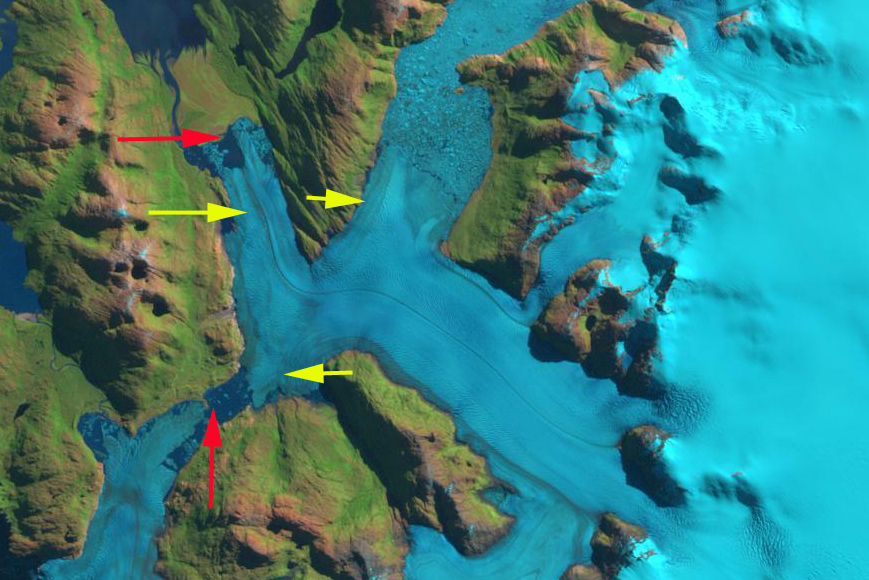
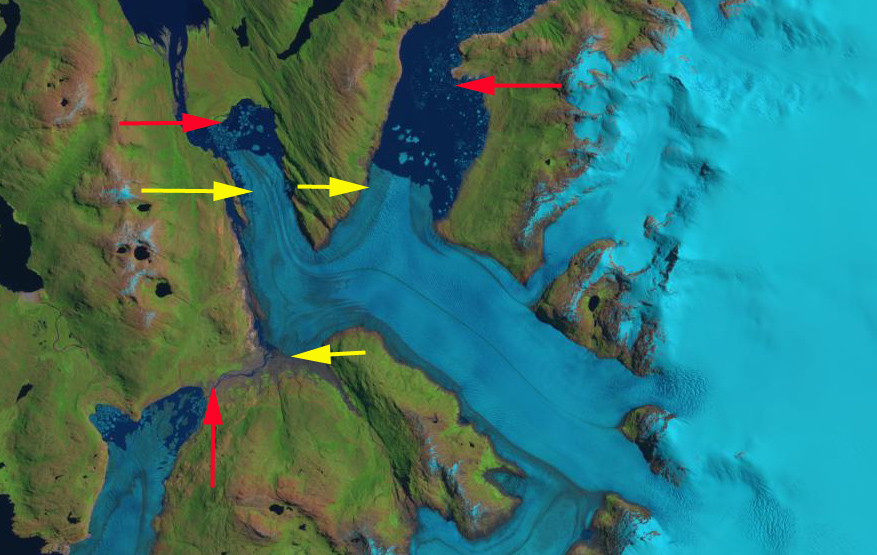
McBride Glacier (M), its secondary terminus (Ms), MCbride Inelt (MI) and Riggs Glacier (R) in Landsat image comparison from 1985 and 2015.  The red arrows indicate the 1985 terminus location and the yellow arrows the 2015 terminus location.  Main terminus 4.4 km retreat, secondary terminus 2.7 km retreat.

McBride Glacier was part of the Muir Glacier complex in Glacier Bay, Alaska, until the 1960’s when it separated from Muir and adjacent Riggs Glacier.  Riggs Glacier and Muir Glacier are no longer calving tidewater glaciers, while McBride has continues to terminate in a tidewater inlet.  Riggs Glacier’s retreat from the sea was complete by 2009.The continued rapid retreat of McBride Glacier is enhanced by calving. Calving generates icebergs, the number of icebergs has had a direct relationship with number of harbor seals. The number of harbor seals observed has declined substantially in Glacier Bay since 1993 (Glacier Bay NPS).  In particular the population has declined in front of Muir Glacier which no longer calves, while a smaller population has remained in front of McBride Glacier (Womble et al, 2010).  Here we examine Landsat imagery from 1985 to 2015 to quantify the retreat and estimate how long until this glacier too will no longer calve.

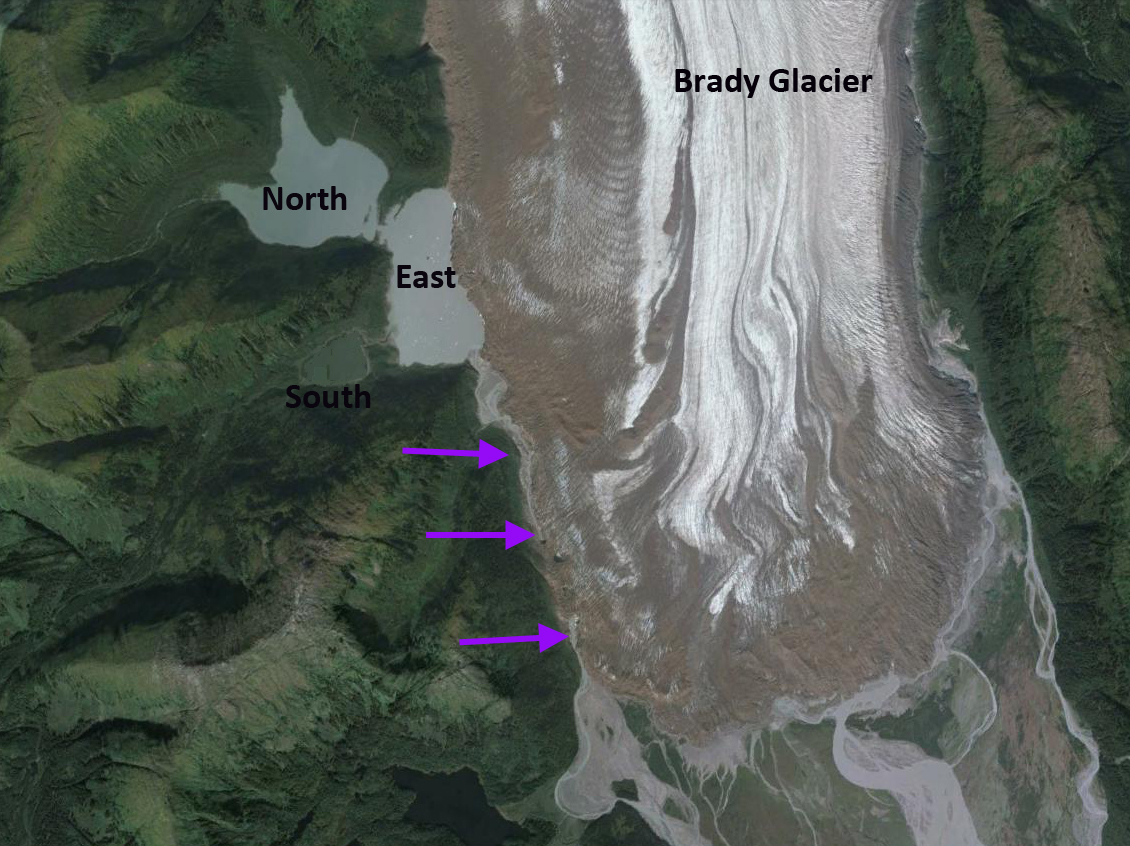
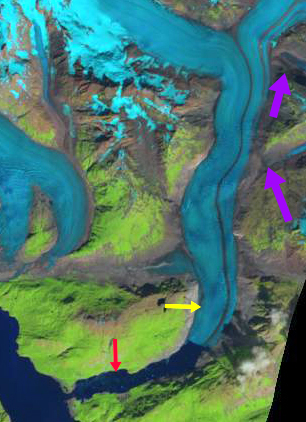
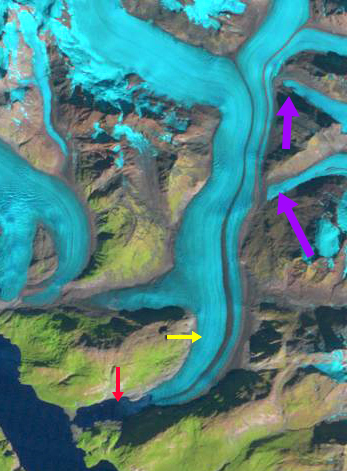
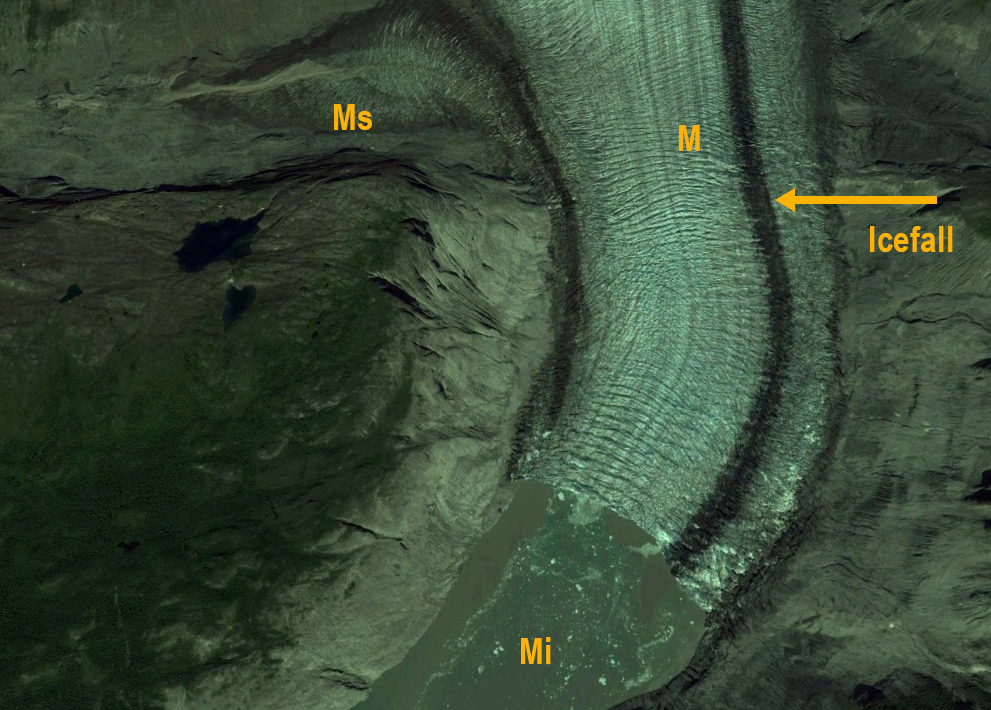
Inn 1985 the main glacier terminated 1.3 km from Muir Inlet, with a narrow connecting stream to Muir Inlet.  The secondary terminus extended west down a separate valley, 3.75 km from the main glacier nearly reached the Riggs Glacier. The snowline was at 900 m.  By 1996 the main terminus had retreated 1.1 km, and the connection with Muir Inlet had expanded to 200 m.  The secondary terminus had narrowed but still nearly reached Riggs Glacier. There are two tributaries from the east at purple arrows connected to main glacier. By 2013 the glacier has retreated an additional 2.0 km and reached a northward turn in the inlet, The secondary terminus had mostly disappeared extending only 1.25 km from the main glacier.  The eastern tributaries, purple arrows, had both retreated and detached from main glacier. By 2015 the glacier had retreated 4.4 km since 1985 including 1.3 km since 2013.  The glacier now terminates at the head of a 6 km long inlet. The glacier is still actively calving, which is good for the harbor seals.  However, a small icefall 0.8-1.1 km from the current terminus indicates a possible location for the end of the tidewater portion of this valley, note orange arrow in Google Earth image below. The retreat of the secondary terminus has been 2.7 km during this same period, without any calving. In 2013 and 2015 the snow line was above 1000 m, which as on nearby Brady Glacier is well above the equilibrium average which will continue to drive retreat Pelto et al, 2013).  In 2016 southeast Alaska has had its hottest spring, which will continue this chapter.

Counting harbor seals is a task completed by the Glacier Bay NPS, they follow two populations the larger in John Hopkins Inlet off of Glacier Bay and the other in Glacier Bay proper.  Both have declined by over 80% since 1992.  In 2009 there were 200 harbor seals in McBride inlet Glacier Bay NPS.  Glaciers are part of the local ecosystem where they exist, glacier changes do result in broader ecosystem changes, in this case harbor seals is one monitored example.  The NPS prepares annual reports on glacier change in the region and notes widespread thinning in the region since 1995 and a 15% decline in glacier area in the last half century Loso et al (2014). The team of N.Loso, A.Arendt, C Larsen, N.Murphy and J.Rich have produced annual reports in recent years with valuable detail on changes of glaciers across Alaskan National Parks.
mcbride Glacier 2013

1996 Landsat image indicating terminus positions from 1985, read arrow and 2015 yellow arrow.  The purple arrow indicates tributaries attached to main glacier.
mcbride Glacier 1996

2013 Landsat image indicating terminus positions from 1985, read arrow and 2015 yellow arrow.  The purple arrow indicates tributaries detached from main glacier.
mcbride ge

2014 Google Earth image indicating the icefall in relation to 2014 terminus.  The icefall has increased calving and a 100 m increase in elevation.  This is certainly a location where the valley bottom rises, and may be the end of the tidewater reach of the inlet.
Suatisi Glacier Retreat, Mount Kazbek, Georgia

Suatisi compare

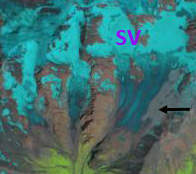
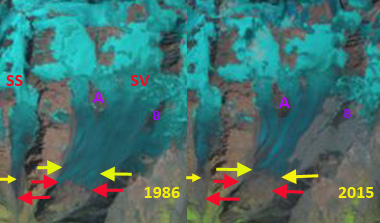
Comparison of Suatisi Vost (SV) and Suatisi Sredny (SS) in 1986 and 2015 Landsat images.  The red arrow is the 1986 terminus and the yellow arrows the 2015 terminus.  Point A and B are to areas of expanding bedrock amidst the glacier. 

Suatisi Vost and Suatisi Sredny Glacier are two glaciers on the south flank of Mount Kazbek in northern Georgia.  The region is prone to landslides and debris flows. On September 20, 2002 a collapse of a hanging glacier from the slope of Mt Dzhimarai-Khokh onto the Kolka glacier triggered an avalanche of ice and debris that went over the Maili Glacier terminus then slid over 15 miles (NASA Earth Observatory, 2002). It buried small villages in the Russian Republic of North Ossetia, killing dozens of people. The glacier runoff from Suatisi Glacier supplies the Terek River, which has a hydropower project under construction.  The Dariali Hydroplant will have an installed capacity of 108 MW and is a run of river type plant near Stepantsminda, Georgia. This plant has suffered from two landslides in 2014 (Glacier Hub, 2014) that jeopardize its completion.

Shagadenova et al (2014) examined glaciers in the Caucasus mountains and found that from 1999/2001 and 2010/2012 total glacier area decreased by 4.7%. They also noted that recession rates of valley glacier termini increased between 1987– 2000 and 2001–2010, with the latter period featuring retreats averaging over 10 m/year.  A positive trend in summer temperatures forced glacier recession (Shagadenova et al 2014). Here we examine changes in Suatisi Glacier from 1986 to 2015 with Landsat imagery.

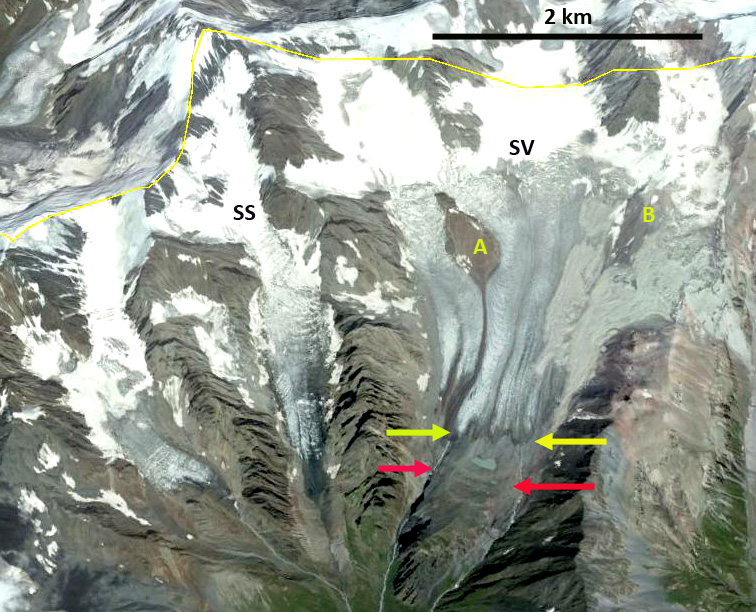
In 1986 Suatisi Vost western side terminates at the top of deep canyon, red arrow.  The eastern side of the terminus is on a flatter till plain.  The area around Point B is all glacier ice.  Suastisi Sredny terminates near the end of the valley it occupies in 1986.  In the 2001 image a large debris flow/landslide has covered the eastern margin of Suatisi Vost surrounding the area of Point B, black arrow in 2001 image below.  By 2010 the Google Earth image indicates significant retreat of Suatisi Vost and the debris flow below point B is a light gray color. The bedrock at Point B has expanded.   By 2015 Suatisi Vost terminus has retreated 350 m since 1986, what is just as evident is the loss in width of the terminus in the 1986-2015 side by side comparison. Suatisi Sredny has retreated 450 m.  The snowline is at an elevation of 3750-3800 m in 1986, 2010 and 2015. With the terminus at 3250 m and the highest elevation at 3950-4000 m, this is too high to sustain the glacier at its current size and retreat will continue. The debris cover has reached the terminus on the east side of the glacier by 2015. The changes are the same across the border in Russia, for example Lednik Midagrabin.

suatisi ge

2010 Google Earth image of Suatisi Vost and Suatisi Sredny.  

suatisi 2001

2001 Landsat image indicating the landslide covering surface of Suatisi Vost.

suatisi j2015

2015 Landsat image indicates Landslide deposit evolution, with movement downglacier and retreat, it is now close to the ice front on the east side of the margin.

Chutanjima Glacier Retreat & High Snowline, Tibet, China 1991-2015

mugunong glacier tibet compare

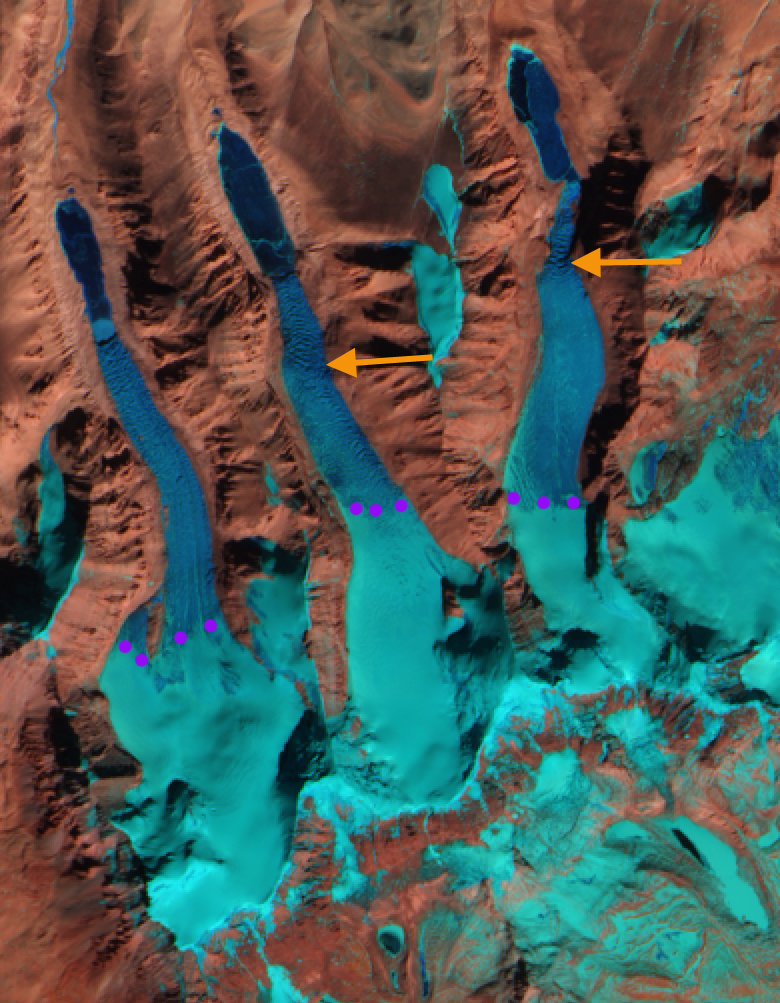
A comparison of three Tibet glaciers in 1988, 1991 and 2015 Landsat images. Red arrows are the 1988 terminus position, yellow arrow the 2015 terminus location and purple dots the snowline in late October 2015.  U=unnamed, CH=Chutanjima Glacier and MO=Mogunong Glacier: which did not retreat significantly and lacks a red arrow.

A recent European Space Agency Sentinel-2A image of southern Tibet, China and Sikkim illustrated three very similar glaciers extending north from the Himalayan divide on the China-India Border. We examine these three glacier in this post. The three glaciers all drain into the Pumqu River basin, which becomes the Arun River. The largest is unnamed the two easternmost are Chutanjima and Mogunong Glacier.The glaciers all have similar top elevations of 6100 -6200 m and terminus elevations of 5260-5280 m.  All three are summer accumulation type glaciers with most of the snow accumulating during the summer monsoon, though this is also the dominant melt period on the lower glacier.  Wang et al (2015) examined moraine dammed glacier lakes in Tibet and those that posed a hazard, none of the three here were identified as hazardous.  The number of glacier lakes in the Pumqu Basin has increased from 199 to 254 since the 1970’s with less than 10% deemed dangerous, but that still leaves a substantial and growing number (Che et al, 2014). Here we compare Landsat images from 1988, 1992  and 2015 to identify their response to climate change.   The second Chinese Glacier inventory (Wei et al. 2014) indicated a 21% loss in glacier area in this region from 1970 to 2009.The pattern of retreat and lake expansion is quite common as is evidenced by other area glaciers, such as Gelhaipuco, Thong Wuk, Baillang Glacier and Longbashaba Glacier.

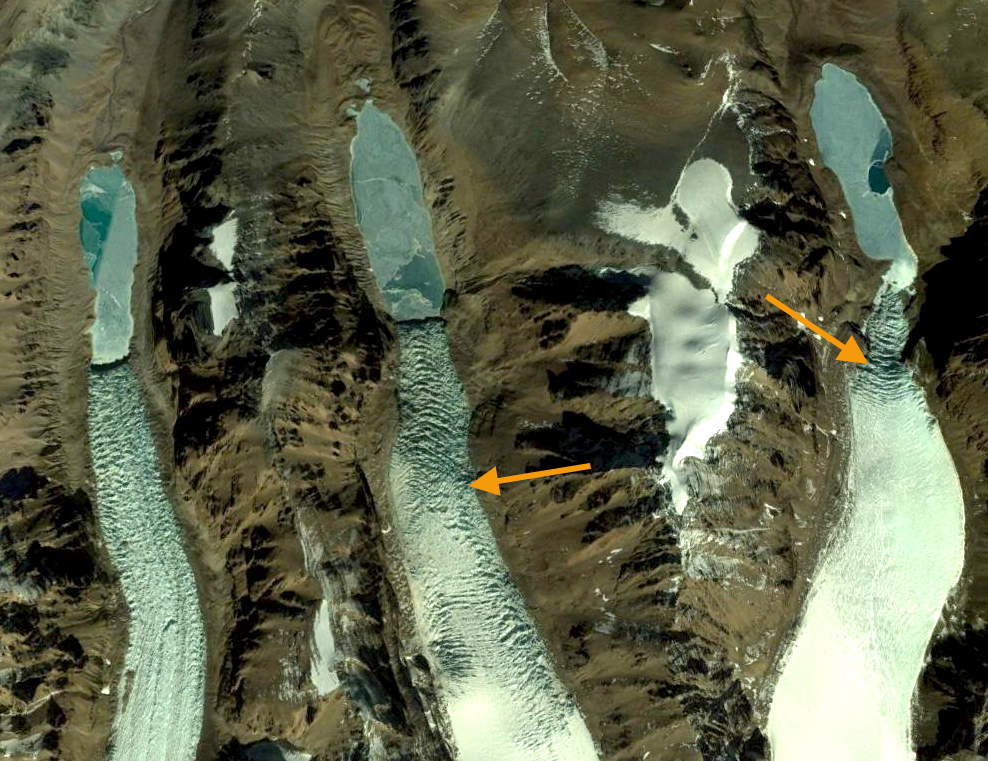
In the 1988 image all three glaciers terminate at the southern end of a proglacial lake with seasonal lake ice cover, red arrows.  In 1991 the lakes are ice free and have some icebergs in them.  By 2015 the retreat has been 500 m for the easternmost glacier, 400 m for Chutanjima Glacier and 100 m at most for Mogunong Glacier. Each glacier has remained extensively crevassed to the terminus indicating they remain vigorous.  The retreat is greatest for the two ending in expanding lakes.  Mogunong Glacier appears to be near the upper limit of the lake, and is not calving, which likely led to less retreat. An icefall is apparent 700 m from the front of Mogunong Glacier.  The width of the glacier below this point has diminished considerably from 1988 to 2015, though retreat has been minor, indicating a negative mass balance.  There is an icefall 1 km from the icefront of Chutanjima, indicating the maximum length the lake would reach.

The Sentinel image indicates an important characteristic and trend in the region.  This is an early February image and the snowline is quite high on the glacier in the midst of winter.  The snowline is at 5850-5900 m nearly the same elevation as in late October of 2015 seen above. This illustrates the lack of winter accumulation that occurs on these summer accumulation glaciers.  It also indicates a trend toward ablation processes remaining active, though limited from November-February.  The lack of snowcover on the lower glaciers as the melt season begins hastens ablation zone thinning, mass balance loss and retreat.

mugunong glacier 2016

Europenan Space Agency, Sentinel-2A image from 1 February 2016. Orange arrow indicates icefalls and purple dots the snowline.

mogunong ge
2014 Google Earth image of the region. Orange arrows indicate icefalls, note the crevassing extending to glacier front.

Brady Glacier, Alaska 2016 Early Melt Season & Lake Expansion

brady lake compare 2016

Comparison of Brady Glacier in 1986 and 2016 Landsat images.  The snowline is similar in May 2016 and August 1986. Lakes noted are: A=Abyss, B=Bearhole, D=Dixon, N=North Deception, O=Oscar, Sd=South Dixon, Sp=Spur, T=Trick.

Brady Glacier,  is a large Alaskan tidewater glacier, in the Glacier Bay region that is beginning a period of substantial retreat Pelto et al (2013). In 2016 the melt season has been intense for the Brady Glacier in Alaska. Pelto et al (2013) noted that the end of season observed transient snowline averaged 725 m from 2003-2011, well above the 600 m that represents the equilibrium snowline elevation. On May 20, 2016 the transient snowline (TSL) is at 500 m. Typically the TSL reaches 500 m in early July: 7/13/2004=530; 7/8/2005=550, 7/3/2006=500, 7/22/2007=520, 7/3/2009=500; 7/10/2013=500. The high early season snowline is indicative of an early opening and filling of the many proglacial lakes that secondary termini of the glacier end in. The lakes Trick, North Deception, Dixon, Bearhole, Spur, Oscar, and Abyss continue to evolve. In addition two new lakes have developed. The changes are evident in a comparsion of 1986 and 2016 Landsat images. The TSL on May 20/2016 is remarkably similar to the August 20, 1986 TSL.
base figure

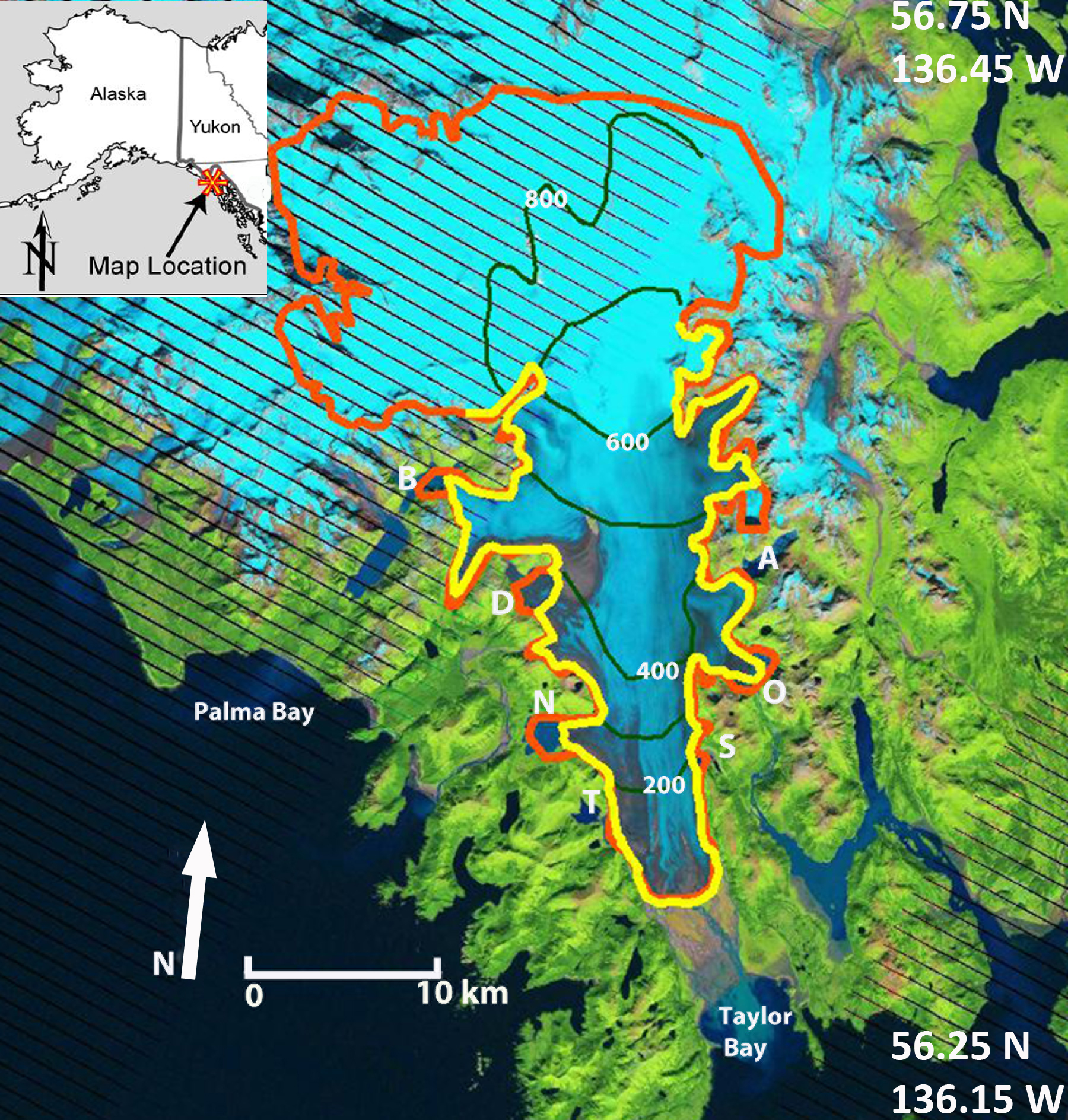
2010 Landsat image of the glacier indicating the 1948 margin in Orange and the 2016 margin in yellow. Lakes noted are: A=Abyss, B=Bearhole, D=Dixon, N=North Deception, O=Oscar, S=Spur, T=Trick.

There is a consistent pattern in the change in position of the glacier margin at each of the lakes between 1948 and 2010. The rate of retreat of the glacier margin at all seven lakes accelerated later during this period; the mean retreat rate is 13 m/a from 1948 to 2004 and 42 m/a  from 2004 to 2010 (Pelto et al, 2013). Lake area and calving fronts were measured for each lake: Spur, Abyss, North Deception, Bearhole, Oscar, and East Trick based on the September 2010 imagery, with earlier measurements from Capps et al. (2010). Lake areas have increased as a result of glacier retreat, and can decrease due to declines in surface water levels as previously ice-dammed conduits form to drain the lake. Lake water levels have fallen in Abyss, Bearhole, Dixon, North Deception, Spur, and Trick since 1948 Capps et al (2010). Only Oscar Lake, the most recent to form, has maintained its surface level. Retreat of the glacier margin has been greatest at Bearhole, North Deception Lake, and Oscar Lake, which as a consequence have expanded substantially in area. Lake water level declines at Abyss, Spur, and Trick have offset the increase in area resulting from glacier retreat, leading to small changes in lake area. The seven lakes have changed dramatically in response to this acceleration in retreat.

Trick Lakes: In 1986 North and South Trick Lake are proglacial lakes in contact with the glacier. By 2016 the two lakes are no longer in contact with the glacier, water levels have fallen and a third lake East Trick Lake has formed. The more recently developed East Trick Lake is the current proglacial Trick Lake, a large glacier river exits this lake and parallels the glacier to the main Brady Glacier terminus, going beneath the glacier for only several hundred meters.

trick 2014

2014 Google Earth image of Trick Lakes, and the glacier river exiting to the main terminus, purple arrows.

North Deception Lake had a limited area in 1986 with no location more than 500 m long. By 2016 retreat has expanded the lake to a length over 2 km. The width of the glacier margin at North Deception Lake will not change in the short term, but the valley widens 2 km back from the current calving front, thus the lake may grow considerably in the future.

South Dixon Lake This new lake does not have an official name. It did not exist in 1986, 2004, 2007 or 2010. It is nearly circular today and 400 m in diameter.

Dixon Lake: It is likely that retreat toward the main valley of the Brady Glacier will lead to increased water depths at Dixon Lake, observations of depth of this lake do not exist. Retreat from 1986 to 2016 has been 600 m.

Bearhole LakeBearhole Lake is expanding up valley with glacier retreat, and there are no significant changes in the width of the valley that would suggest a significant increase in calving width could occur in the near future. Currently the lake is 75 m deep at the calving front and there has been a 1400 m retreat since 1986 Capps et. al. (2013).
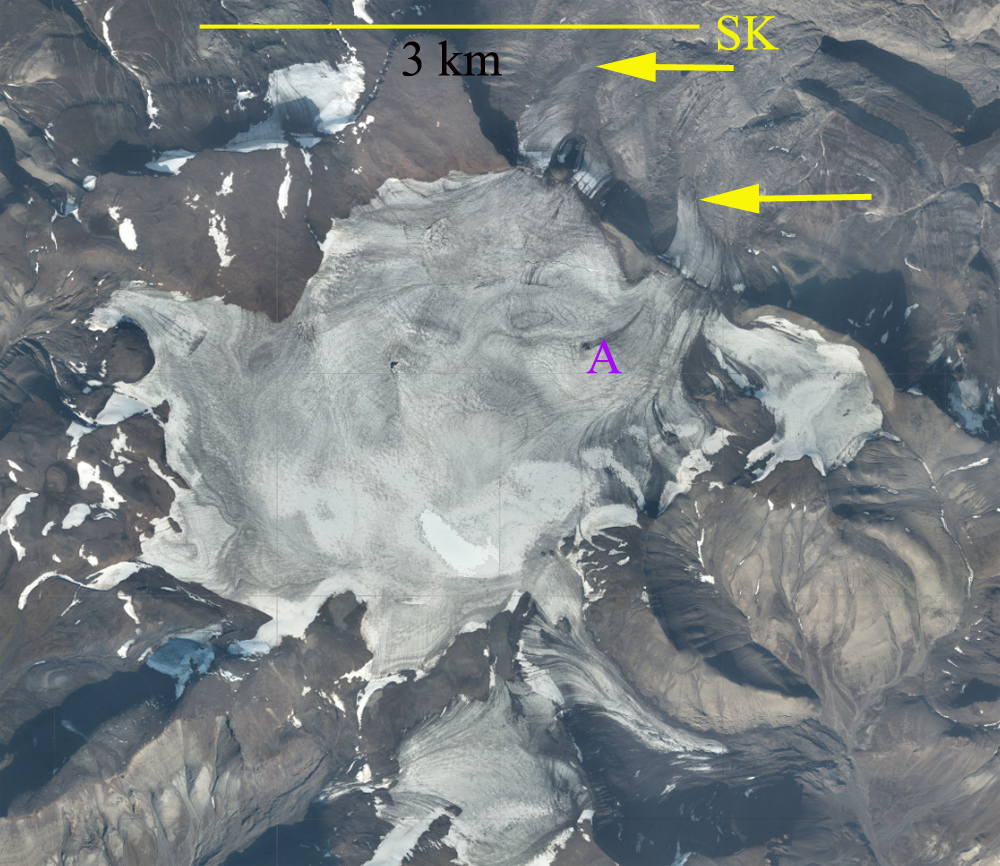
Spur Lake:It is likely that retreat toward the main valley of the Brady Glacier will lead to increased water depths at Spur Lake. the depth has fallen as the surface level fell from 1986-2016 as the margin retreated 600 m, leaving a trimline evident in the 2016 imagery.

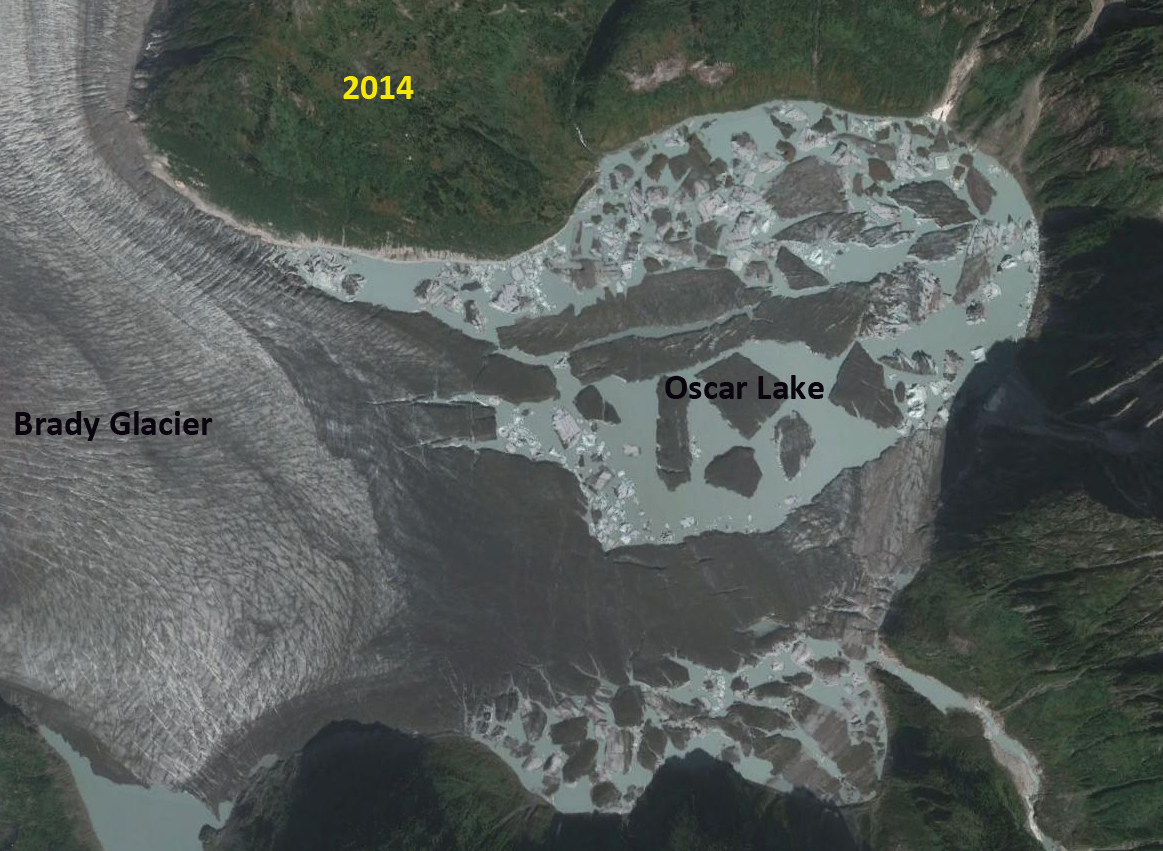
Oscar Lake has experienced rapid growth with the collapse of the terminus tongue. Depth measurements indicate much of the calving front which has increased by an order of magnitude since 1986 is over 100 m. The tongue as seen in 2014 Google Earth image will continue to collapse and water depth should increase as well. The central narrow tongue has retreated less than 200 m since 1986, but the majority of the glacier front has retreated more than 1 km since 1986.

oscar 2014

Google Earth image of Oscar Lake, illustrating the number of large icebergs of this ongoing terminus collapse.

Abyss Lake: Continued retreat will lead to calving width expansion> The retreat from 1986 to 2016 has been 400 m. The water depth has been above 150 m at the calving front for sometime and should remain high.

Glacier thinning and retreat near the lakes dammed by Brady Glacier have led to changes in the widths of calving fronts between. The combined increase in the width of the six secondary calving fronts is 34% from 1948 to 2004, and 15% from 2004 to 2010 (Pelto et al, 2013) With the inclusion of South Dixon Lake and continued expansion of Dixon and Oscar Lake the calving width has continued to increase up to 2016. Calving widths at Bearhole Lake, Spur Lake, and Trick Lake will not change appreciably. Spur Lake and Trick Lake parallel the margin of the glacier, and although this margin will likely continue to recede, the length of the depression filled by the two lakes probably will not change.

Water depth is an important factor affecting the calving rate of glaciers in lacustrine environments; velocity and calving rate increase with water depth by a factor of 3.6 (Skvarca et al., 2002). Capps et. al. (2013) determined the bathymetry and calving depths of five of the lakes at Brady Glacier. Water depths increase toward the calving fronts at Abyss Lake, Bearhole Lake, Oscar Lake, and Trick Lake; only at North Deception Lake does the water not currently become deeper towards the calving front; however it almost certainly will as the east margin moves into the main Brady Glacier valley. The observations suggest that mean calving depths of proglacial lakes, at least in the short term, will increase with continued retreat. Increases in calving width and depth will lead to increased calving at the secondary termini in the near future (Pelto et al, 2013).
Harris Glacier Retreat, Kenai Fjords, Alaska

harris compare

Landsat images of Harris Glacier from 1986 and 2015.  The red arrow indicates 1986 terminus location, yellow arrow the 2015 terminus position.  The orange arrow indicates a key eastern tributary and the pink arrow a smaller eastern tributary. 

Harris Glacier flows from the northwest corner of the Harding Icefield, Alaska and it drains into Skilak Lake.  The glaciers that drain east toward are in the Kenai Fjords National Park, which has a monitoring program.  Giffen et al (2014) observed the retreat of glaciers in the region. From 1950-2005 all 27 glaciers in the Kenai Icefield region examined  are retreating. Giffen et al (2014) observed that Harris Glacier (A Glacier) retreated 469 m from from 1986-2005.  Here we examine Landsat imagery from 1986-2015 to illustrate the retreat of this glacier and other upglacier changes. The glacier supplies meltwater to Skilak Lake which is a critical salmon habitat for the Kenai. Chinook Salmon spawn on a section of the Kenai River between Kenai Lake and Skilak Lake. With Skilak Lake being the resulting home for ninety percent of the salmon fry for the Kenai River, and with the most of any nursery in the Cook Inlet area. Escapements of chinook in the Kenai River exceed 50,000 annually in two runs (Heard et al 2007).

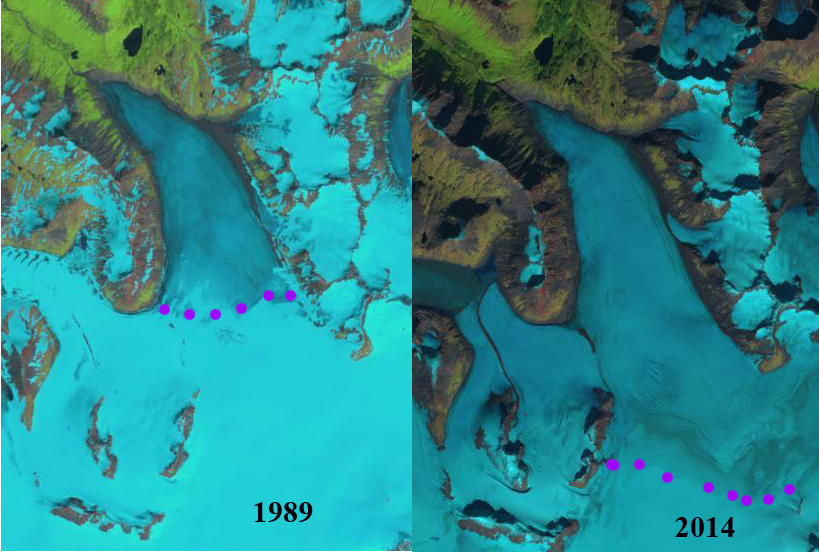
In 1986 the glacier extended to an elevation of 590 m, on the east side of the glacier there were two smaller tributaries reaching the glacier at the orange and pink arrow.  By 2015 the terminus had retreated 600 m from 1986.  The eastern tributary at the pink arrow had detached from the main glacier.  The tributary at the orange arrow still reaches the main glacier, but the blue ice extent after joining the glacier has diminished significantly. Below is a closeup of the terminus from 1996 and 2015 illustrating a 225 m retreat and associated thinning.  It is also interesting to note the prominent ash layer has shifted little.  This suggests the terminus area is relatively stagnant. There is no active crevassing in the lower 1 km suggesting retreat will be ongoing.   In 1989 the snowline is at 975 m whereas in 2014 the snowline is at 1125 m.  This higher snowline is too high to maintain the glacier. The snowline in 2015 was again above 1100 m, though it is lower in the mid-August image at 1050 m. The retreat of this glacier is less than neighboring glaciers such as Grewingk, Pederson and Bear Glacier that have calving termini.

harris snowline

Landsat images from 1989 and 2014, with the snowline indicated by purple dots. 

harris terminus

Terminus of Harris Glacier in Google Earth images from 1996 and 2015.  Margin with purple dot, purple arrow indicates 1996 terminus lcoation, with a 225 m retreat by 2015. Note the prominent ash layer

Bailang Glacier and Angge Glacier Retreat, China 1995-2015

bailang compare

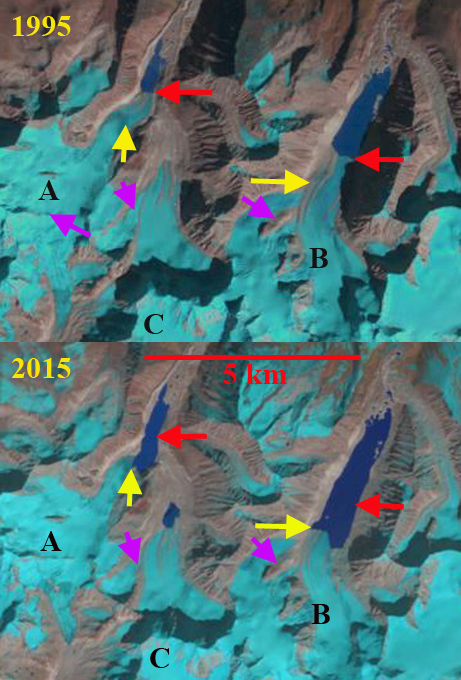
Comparison of 1995 and 2015 Landsat image illustrating 1995 (red arrows) and 2015 terminus locations (yellow arrows) of Bailang Glacier (B) and Angge Glacier (A).  Purple arrows indicate areas upglacier of expanding bedrock due to glacier thinning. Head of Chubda Glacier (C), Bhutan indicated. 

Bailang Glacier and Angge Glacier, China are adjacent to the Chubda Glacier, Bhutan.  Despite being in a different nation on a different side of the Himalaya, the behavior is the same. These are both summer accumulation type glaciers that end in proglacial lakes.  Both lakes are impounded by broad moraines that show no sign of instability for a potential glacier lake outburst flood. The number of glacier lakes in the adjacent Pumqu Basin to the west has increased from 199 to 254 since the 1970’s with less than 10% deemed dangerous  (Che et al, 2014) Here we compare Landsat images from 1995 and 2015 to identify their response to climate change.   The second Chinese Glacier inventory (Wei et al. 2014) indicated a 21% loss in glacier area in this region from 1970 to 2009.

Bailang Glacier in 1995 terminated in a proglacial lake that was 2.1 km long at an elevation of ~5170 m, red arrow. Angge Glacier terminated in a lake that was 1 km long at an elevation of ~5020 m.  By 2001 both glaciers had experienced minor retreat of less than 250 m.  By 2014 both lakes had expanded considerably due to retreat, no significant change in water level had occurred. By 2015 Bailang Glacier had retreated  800-900 m and the lake was now 3 km long.  A key tributary on the west side near the yellow arrow had also detached. There is no significant slope change in the lower 1 km of the glacier indicating retreat should continue enhanced by melting in and calving in the proglacial lake.  For Angge Glacier retreat from 1995 to 2015 was 700 to 800 m, with the glacier retreating to a westward bend in the lake basin.  The glacier has an icefall just above the current terminus suggesting the lake basin will soon end, which should slow retreat. The pattern of retreat and lake expansion is quite common as is evidence by Gelhaipuco, Thong Wuk and Longbashaba Glacier.

bailang glacier 2001

2001 Landsat image illustrating 1995 (red arrows) and 2015 terminus locations (yellow arrows) of Bailang Glacier (B) and Angge Glacier (A).  Head of Chubda Glacier (C), Bhutan indicated. 

bailang glacier 2014

2014 Landsat image illustrating 1995 (red arrows) and 2015 terminus locations (yellow arrows) of Bailang Glacier (B) and Angge Glacier (A).  Head of Chubda Glacier (C), Bhutan indicated. 


Chubda Glacier Retreat, Bhutan 1995-2015

chubda glacier compare

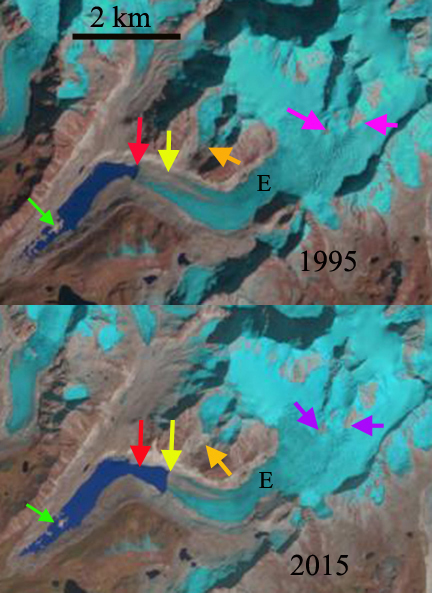
Chubda Glacier comparison in 1995 and 2015 images.  Red arrow indicates 1995 terminus location and yellow arrow is 2015 terminus location.  Pink arrows indicate areas upglacier of expanding bedrock. Green arrow indicates moraine areas amidst the lake.  The orange arrow indicates a secondary glacier.

Chubda Glacier, Bhutan drains south from Chura Kang on the Bhutan/China border.  The glacier terminates in Chubda Tsho, a glacier moraine dammed lake, Komori (2011) notes that the moraine is still stable and the lake is shallow near the moraine, suggesting it is not a threat for a glacier lake outburst flood. Mool et al, (2001) indicate the glacier was 3.4 km long and 0.3 km wide in the late 1990’s. Jain et al., (2015) noted that in the last decade the expansion rate of this lake has doubled. The glacier feeds the Chamkhar Chu basin which has a proposed 670 MW hydropower project under consideration. Here we examine changes in the Chubda Glacier from 1995 to 2015 with Landsat imagery.

In 1995 Chubda Glacier terminated at the red arrow and there was considerable ice cored moraine remaining in the southern portion of Chubda Tsho, green arrow.  The glacier is 700 m wide at Point E and has limited exposed bedrock areas just above the snowline above 2100 m, pink arrows.  A pair of secondary glacier have a joint terminus at the orange arrow In 2001 there are only minor changes from 1995.  In 2014 the snowline is at 2100 m, bedrock areas have expanded at pink arrows, and the amount of lake area at the southern end has expanded as ice cored moraine has melted out. In 2015 the glacier terminus has retreated 600 m since 1995, the lake area has expanded by ~2 square kilometers.  In 2015 the southern end of Chubda Tsho remains shallow and the wide moraine dam stable. The snowline is again at 2100 m and the glacier is only 500 m wide at Point E.  This indicates a continued decline in glacier flow into the terminus zone, which will lead to continued retreat. The secondary glaciers have now separated significantly, orange arrow.  The retreat of this glacier is similar to that of other glaciers such as Lugge and Thorthomia Glacier and just across the range in China, Zhizhai Glacier and Gelhaipuco Glacier.

chubde ge

Google Earth image of Chubda Glacier. Blue arrows indicate flow, brown arrow indicates wide moraine dam, green arrow indicates shallow moraine areas. 

chubde galcier 2001

Chubda Glacier 2001 Landsat image.  Red arrow indicates 1995 terminus location and yellow arrow is 2015 terminus location.  Pink arrows indicate areas upglacier of expanding bedrock. Green arrow indicates moraine areas amidst the lake.  

chubde glacier 2014

Chubda Glacier Landsat image in 2014.  Red arrow indicates 1995 terminus location and yellow arrow is 2015 terminus location.  Pink arrows indicate areas upglacier of expanding bedrock. Green arrow indicates moraine areas amidst the lake.  


Tingmiarmit Glacier Retreat Separates Tributaries, South East Greenland

tingmiarmit compare

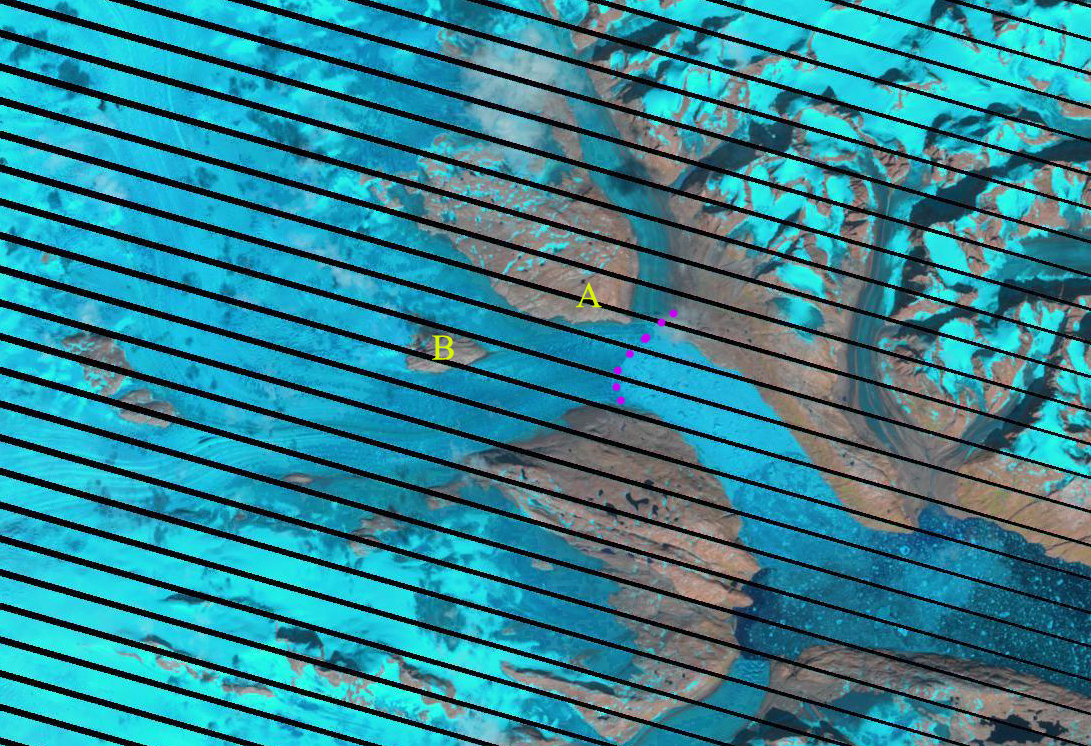
Tingmiarmit Glacier comparison in 1999 and 2015 Landsat images indicating the separation of tributaries at the terminus. The red arrows indicate the 1999 terminus and the yellow arrows the 2015 terminus location.  Point A is peninsula where the tributaries joined, and Point B is a nunatak just upglacier from the 2015 terminus.

Tingmiarmit Glacier (Timmiarmiit also) ends in the Tingmiarmit Kangertivat Fjord in southeast Greenland.  The glacier is just south of Heimdal Glacier and is noted by Rignot et al (2012) as having a velocity of 1.4 to 3 km/year. Moon et al (2012) note that most glaciers in SE Greenland experienced a significant velocity increase after 2000. In 1999 the glacier terminus was beyond the junction of two main tributaries, with little variation from 1994.  Here we examine 1999-2015 imagery to identify the separation and retreat. The retreat is similar to that of nearby Thrym Glacier, which also had a tributary separation and nearby Puisortoq.

In 1999 the glacier terminates 1 km beyond the junction of the two tributaries, indicated by red arrow on each image.  The fjord is 2.2 km wide at this point.  The terminus had not changed in 2001 Landsat imagery.  By 2010 terminus is now located at the junction of the two glaciers. which still share a single calving front, though the calving front is longer with northern and western facing section.  In 2015 retreat has led to complete separation of the western and northern tributary. The western tributary is the main glacier and has retreated 2.4 km and the northern tributary has retreated 2.2 km in the sixteen year period.  The retreat of the northern tributary has been slower since 2010.  The western tributary now terminates 1.5 km from former junction.The fjord is expanding in width, which suggests the current terminus is not at a stable location. The nunatak marked B is a potential point of stability but not likely as the main arm of the glacier goes south of this location and then the fjord continues to expand.  Moon and Joughin (2008) observed an ice sheet tidewater glacier retreat rate increase from 2000-2006, coinciding with an increase here. Howat and Eddy (2010) noted a mean change for this region of -107 m per year.  Tingmiarmit Glacier’s rate of retreat was slightly higher at 120 m/year for the 1999-2010 period and . Polar Portal continues to expand the number of glaciers with updated terminus positions from satellite imagery with 20 presently.

Mountain Photographer Jack Brauer  captured an excellent image of the terminus area in late August, particularly given it was out a commercial airliner window.  This image illustrates the steeper slopes and much smaller contribution of the tributaries to the right (east) of Point A and B.  The image also indicates that Point B is likely not a significant pinning point to stabilize the terminus. The map below from the Greenland Geological Data viewer indicates the change with the tributaries now disconnected.

Aerial Greenland 6

Image from Jack Brauer, looking northwest toward Tingmiarmit. 

tingmiarmiit map

Greenland Geological Data, from the Geological Survey of Denmark and Greenland. 

tingmiarmiit 2001

2001 Landsat image

tingmiarmiit 2010

2010 Landsat image, purple dots indicate ice front. 


Eagle Glacier, Alaska Retreat Losing a Wing

eagle glacier change

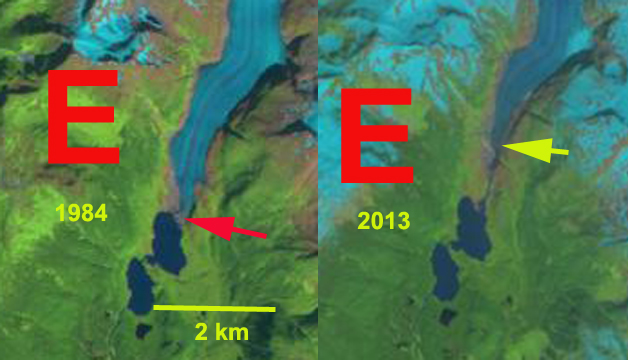
Above is a paired Landsat image from 1984 left and 2013 right indicating the 1100 m retreat during this period of Eagle Glacier.

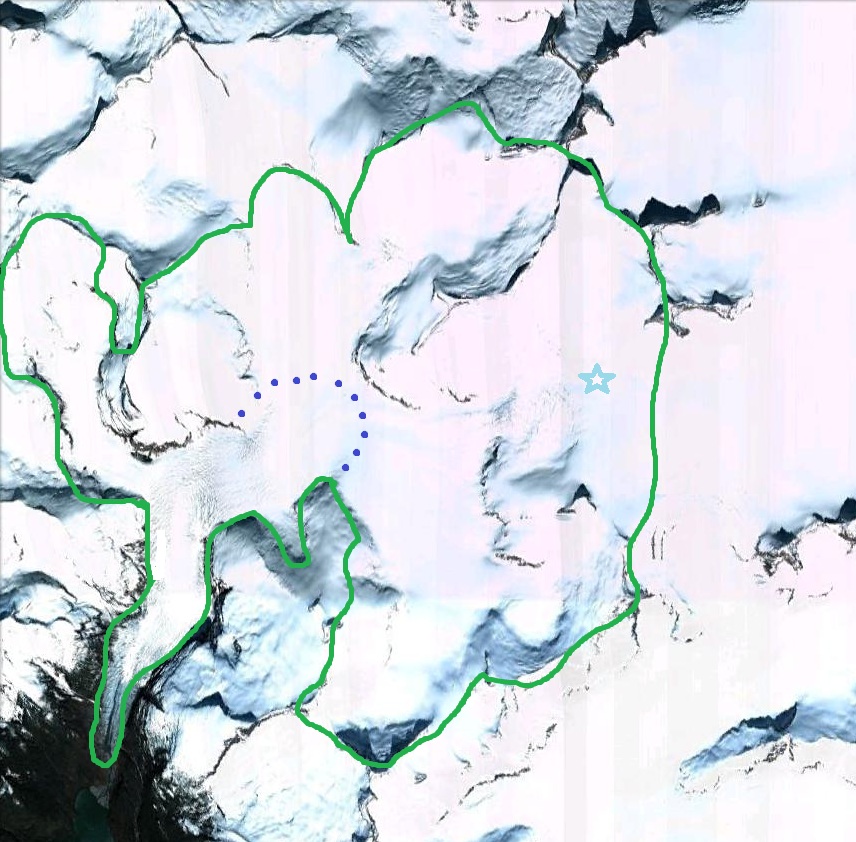
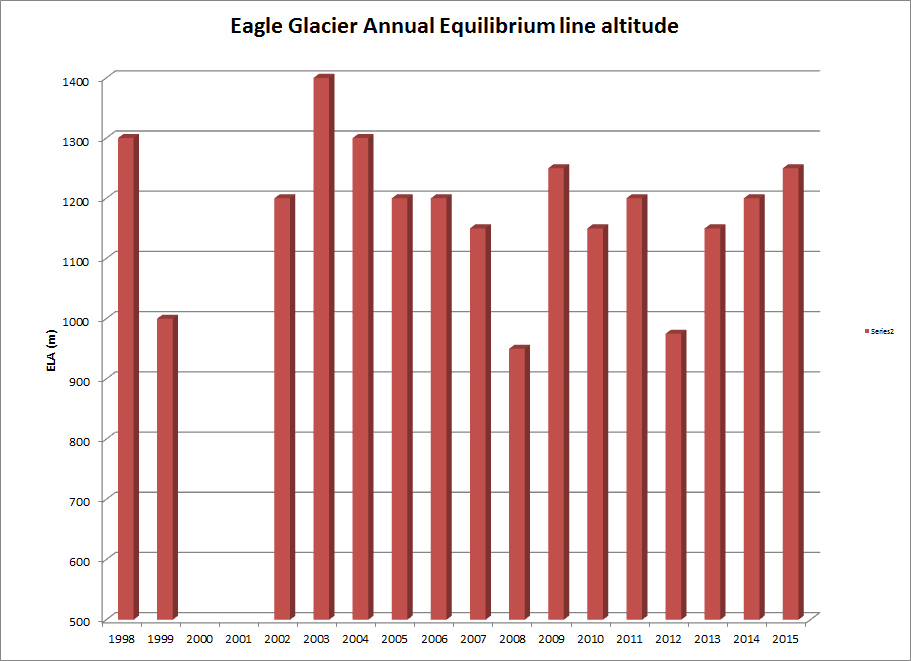
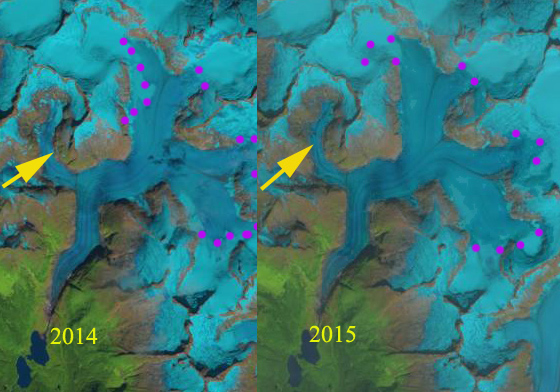
My first visit to the Eagle Glacier was in 1982 with the, ongoing and important, Juneau Icefield Research Program, that summer I just skied on the glacier. In 1984 we put a test pit at 5000 feet near the crest of the Eagle Glacier to assess the snowpack depth. This was in late July and the snowpack depth both years was 4.3 meters, checking this depth in nearby crevasses yielded a range from 4-4.5 meters.In 1984 the snowline at the end of the summer melt season in early September was at 1050 meters.The equilibrium line altitude (ELA) which marks the boundary between the accumulation and the ablation zone each year. On Eagle Glacier to be in equilibrium the glacier needs to have an ELA of 1025 meters. In the image below the glacier is outlined in green, the snowpit location is indicated by a star and the snowline that is needed for the glacier to be in equilibrium at 1025 meters is indicated. The number of years where the ELA is well above 1050 meters dominate since 2002, all but two years see chart below, leading to mass loss, thinning and glacier retreat. This follows the pattern of Lemon Creek Glacier that is monitored directly for mass balance, which has lost 26 meters of thickness on average since 1953.The more rapid retreat follows the pattern of more negative balances experienced by the glaciers of the Juneau Icefield (Pelto et al. 2013). The high snowlines have left the western most tributary with no retained snowpack in 2013, 2014 and 2015, yellow arrow in the 2014 and 2015 Landsat image.  This will lead to the rapid downwasting of this tributary.

Eagle Glacier has experienced a significant and sustained retreat since 1948 when it terminated near the northern end of a small lake.  By 1982 when I first saw the glacier and when it was mapped again by the USGS the glacier had retreated to the north end of a second and new1 kilometer long lake. In the image below the red line is the 1948 terminus, magenta line the 1982 terminus, green line 2005 terminus and orange line the 2011 terminus. From 1984 to the 2005 image the glacier retreated 550 meters, 25 meters/year. From 2005-2015 retreat increased to 60 meters/year. Going back to the 1948 map the terminus in 2011 is located where the ice was 150-175 m thick in 1948. The high snowlines in 2014 and 2015 along with extended melt season continued the rapid retreat.  Total retreat from 1984-2015 is now 1200 m. The retreat hear is less rapid than on nearby Gilkey Glacier or Antler Glacier, but the upglacier downwasting is more severe than at Gilkey Glacier.

Snowline location and snowpit location in 1984

eagle ela
ELA of Eagle Glacier from Landsat images.

eagle wing compare

2014 and 2015 Landsat image indicating snowline on Eagle Glacier, purple dots. Yellow arrow indicates tributary that lacks any retained snowpack,

Terminus change map on 2005 Google Earth image.  Red line is 1948, magenta line is 1982, green line is 2005 and orange line is 2011. 

Bernardo Glacier, Patagonia, Chile Accelerated Retreat in Expanding Lake Complex

bernardo compare

Comparison of 1986 and 2015 Landsat image of Bernardo Glaciers three termini, north, main and south. Red arrows indicate 1986 terminus location and yellow arrows the 2016 terminus location.  Indicating the substantial retreat of each terminus and lake expansion for the north and main terminus, while the lake drained at the southern terminus. 

Bernardo Glacier is a difficult to reach outlet glacier on the west side of the Southern Patagonia Icefield (SPI).  It The glacier currently ends in an expanding proglacial lake system, with three primary termini.  Here we examine changes from 1986 to 2016 using Landsat images. Willis et a (2012) quantify a rapid volume loss of the SPI from 2000-2012 of 20 giga tons per year mainly from rapid retreat of outlet glaciers. They note a thinning rate of 3.4 meters per year during this period of the Bernardo Glacier region. Mouginot and Rignot (2014) illustrate that velocity remains high from the terminus to the accumulation zone on Bernardo Glacier.  They also indicate the accumulation zone does not extend as far east toward the crest of the SPI as previously mapped. Davies and Glasser (2012) indicate that over the last century the most rapid retreat was from 2000 to 2011.

In 1986 Bernardo the southern terminus of the glacier was nearly in contact with Tempano Glacier.  The main terminus primarily ended on an outwash plain with a small proglacial lake developing.  The northern terminus had retreated a short distance south from a peninsula.  By 1998 the northern terminus had retreated into a wider, deeper lake basin, filled with icebergs. The main terminus is still mainly grounded on an outwash plain.  A small lake has developed between Bernardo Glacier and Tempano Glacier to the south. By 2003 the northern terminus had retreated 2 km from 1986, the main terminus 1.5 km and the southern terminus 1.2 km.  By 2015 the lake between Tempano and Bernardo Glacier had drained.  The main terminus had retreated 1.5 km since 1986.  In 2016 the northern terminus had retreated 3.5 km since 1986, the main terminus 2.5 km and the southern terminus 2.75 km.  The largest change is the loss of the lake between Tempano and Bernardo Glacier which slow the retreat of the southern terminus. If this terminus retreat into the another lake basin that shared with the main and north terminus, this would likely destabilize the entire confluence region.  The nearly 1 km retreat in a single year from 2015 to 2016 of the main terminus indicates the instability that will lead to further calving enhanced retreat. The retreat of this glacier fits the overall pattern of the SPI outlet glaciers, for example Chico Glacier and Lago Onelli Glaciers

.bernardo 1998

1998 Landsat image.  Red arrows indicate 1986 terminus location and yellow arrows the 2016 terminus location.

bernardo 2003

2003 Landsat image.  Red arrows indicate 1986 terminus location and yellow arrows the 2016 terminus location.  Main terminus beginning to retreat from outwash plain. 

bernardo 2015

2015 Landsat image.  Red arrows indicate 1986 terminus location and yellow arrows the 2016 terminus location.  Note the considerable difference in main terminus versus one year later in 2016.

Frostisen Ice Cap Svalbard, Ongoing Defrosting 1990-2015

frostisen compare

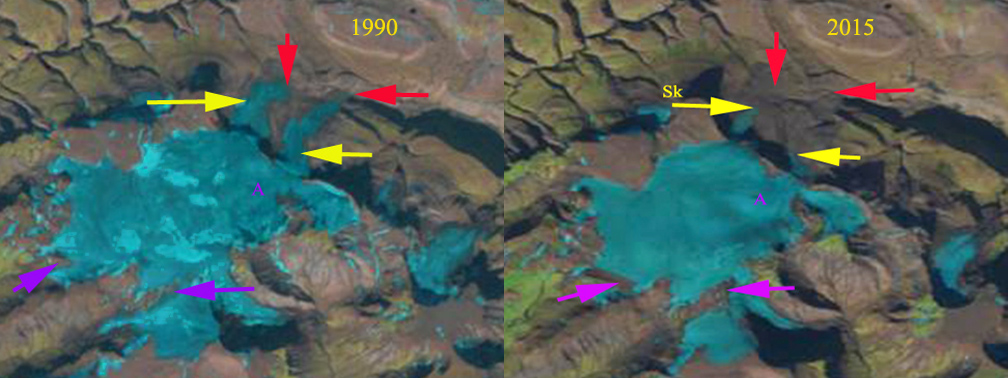
Frostisen Ice Cap in 1990 and 2015 Landsat images.  Red arrow is the 1990 terminus location, yellow arrow the 2015 terminus location.  Purple arrows indicate thinning on the upper margin of the ice cap, and the letter A indicates an outcrop of rock emerging through the ice.

Frostisen is an ice cap in Dickson Land of Central Svalbard.  The World Glacier inventory of 1960 listed the area of the ice cap at 19 square kilometers, by 2007 the Randolph Glacier Inventory indicated the ice cap area at 13.4 square kilometers.  Malecki (2013) examined seven glaciers in this region and found an acceleration in losses from 1990-2011 compared to 1960-1990 due to an increase in summer temperature post-1990 which led to higher annual equilibrium line altitudes.  The seven glacier lost 39% of their volume from 1960-2009. Here we compare 1990 and 2015 Landsat images to indicate changes in the ice cap . Malecki (2013) also noted evidence of a rapid increase in thinning rates in the upper parts of the studied glaciers, linked to decreasing albedo in former accumulation zones.

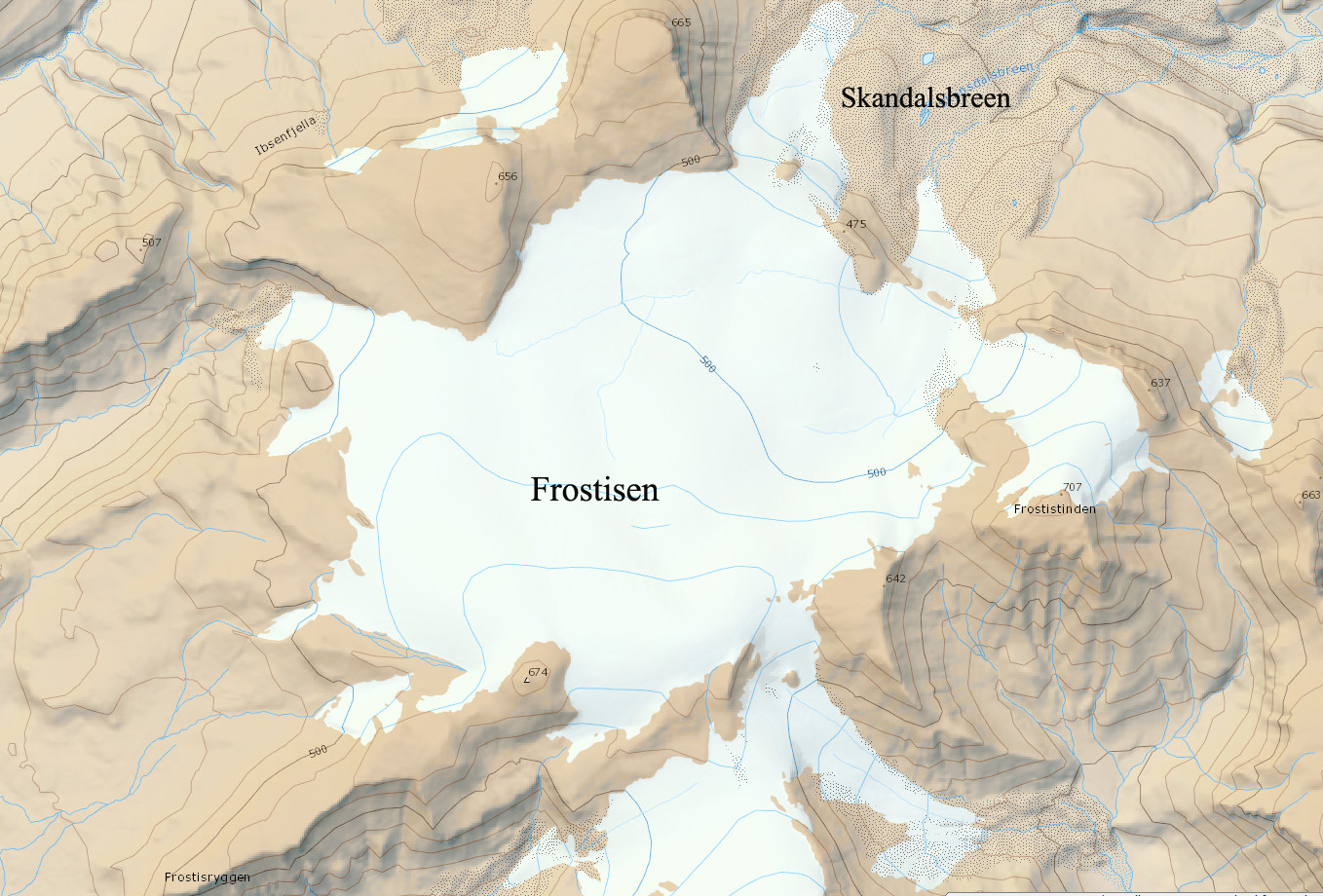
In 1990 two outlet glaciers on the east side of the icefield, Skandalsbreen and Studentbreen, after dropping over a prominent sill at 475 m extended approximately 2 km downvalley.  At Point A there is no sign of bedrock. There are limited snowpatches 10% of the ice cap with three weeks left in the melt season. In 2015 the eastern outlet glaciers have a limited extent after descending the sill, Skandalsbreen has retreated 975 m and Studentbreen 1300 m since 1990.  At Point A bedrock has emerged, this is easier seen in the image below. This is an indication of thinning in the midst of what should be the accumulation zone.  In 2013 and 2015 and many other years the ice cap has lost all of its snowcover indicating it has no accumulation zone and cannot survive (Pelto, 2010). The purple arrows indicate thinning at the upper margin of the glacier near 650 m, this would not happen if this area was acting as an accumulation zone. Nuth et al (2013) noted a 7% loss in glacier area in the last 30 years in Svalbard. The tidewater glaciers of Svalbard get most of the attention, but Frostisen like other inland terminating glaciers such as Belopolskijbreen is losing volume rapidly. .

frostisen image

TopoSvalbard satellite view above and map view below of Frostisen Ice Cap.  The maximum elevation of 650 m has been below the regional snowline many recent years. 

frostisen map

Vallelunga and Barbadorso Glacier Retreat, South Tyrol Italy

vallelunga compare

Vallelunga (above) and Barbadorso di Dentro Glacier (below) retreat from 2003 (orange line) to 2015 yellow dots.  Blue arrows indicate flow path and pink arrow the junction of main two tributaries of Vallelunga Glacier.

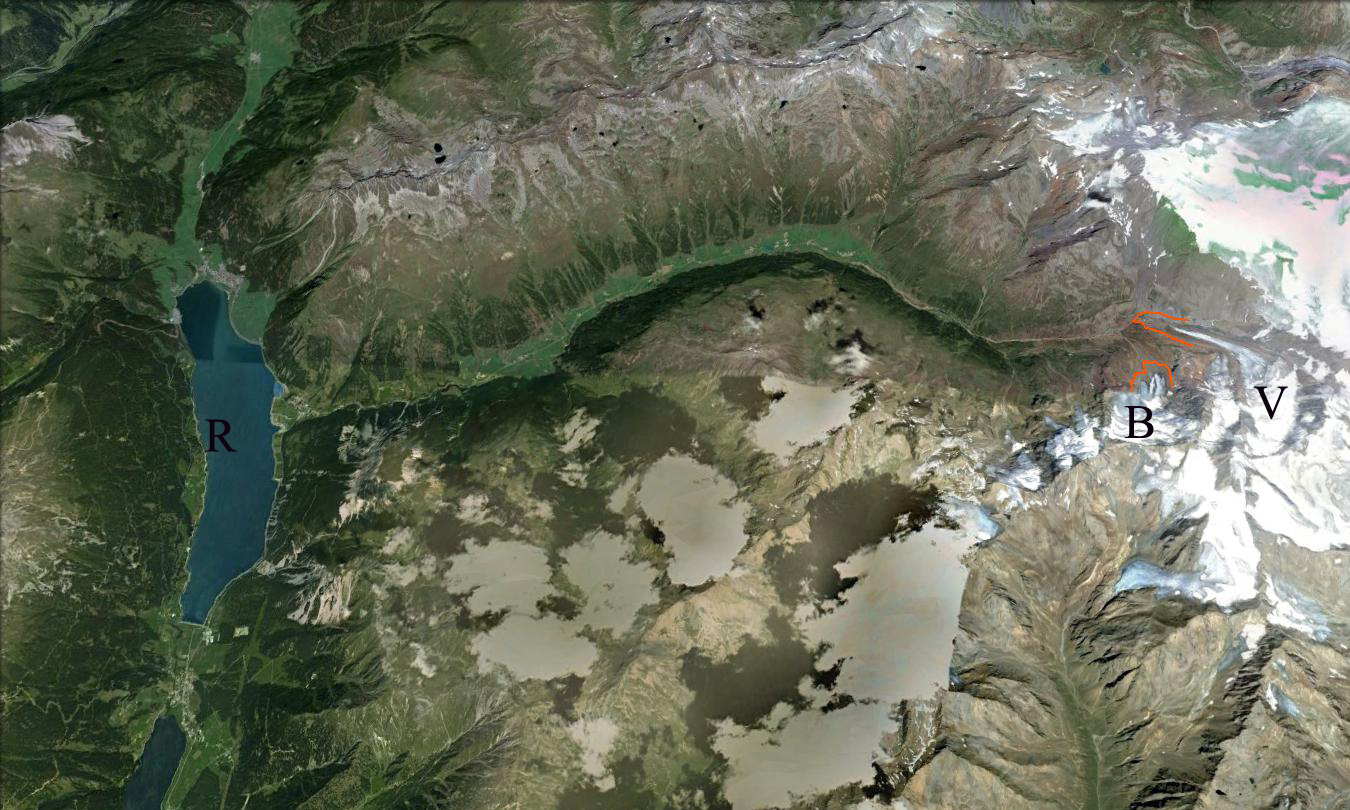
Vallelunga Glacier and Barbadorso di Dentro Glacier are at the headwaters of the Vallelunga watershed which feeds the Reschensee.  Reschensee is a reservoir famous for the church tower that emerges above its surface.  This artificial lake was completed after World War II and is the reservoir for the 105 MW Glurns Hydroproject owned by Seledison.  These two glaciers are examined as part of the annual campaign of the Italian Glacier Committee.  The annual reports for 2011-2013 indicate a retreat of 78 m for Vallelunga and 60 m for Barbadorso.  Here we examine Google Earth images from 2003 and 2015 to indicate the change in a twelve year period.

In 2003 Vallelunga Glacier terminus was at an altitude of 2500 m.  The glacier is comprised of two tributaries that join at the pink arrow. The orange line is the 2003 terminus location. By 2015 the smaller western tributary has nearly separated from the main glacier.  the terminus has retreated 460 m in the 12 year period. Barbadorso Glacier terminated at 2690 m in 2003.  By 2015 the terminus has retreated 250 m and terminates 100 m higher in elevation at nearly 2700 m. On July 31, 2015 the snowline on the two glaciers is at 3100-3200 m with 6-8 weeks left in the melt season.  This indicates another year of negative mass balance that will continue to drive retreat.

These glaciers are just across the border from Gespatcherferner one of the fastest retreating Austrian Glacier’s in recent years. Carturan et al (2016) examining long term Italian glacier mass balance series note the 2004-2013 period as particularly negative.  They further observe that this is mainly due to increased ablation and that annual balance is becoming more closely correlated with accumulation season (October-May) temperature suggesting warmer winters extending melt season and leading to an increased ratio of winter rain events. The continued reduction in glacier area reduces late summer water flow to the reservoir, which will either cause reduced power output or the need for more storage early in summer (Pelto, 2014).

reschensee ge

Vallelunga watershed feeding Reschensee (R).  Vallelunga Glacier (V) and Barbadorso Glacier (B).

vallelunga 2015 tsl

July 31, 2015 Landsat indicating a high snowline, purple dots, with nearly half the summer to go.