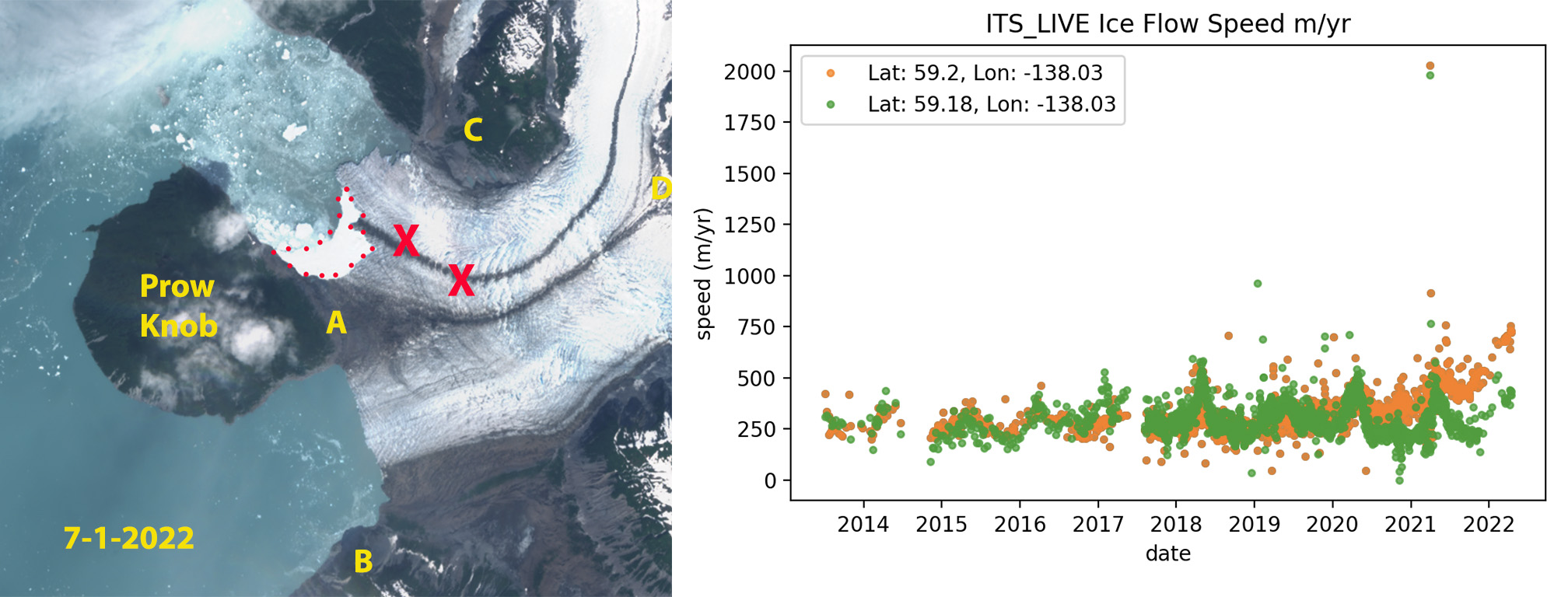
Alsek Glacier, Alaska in a Sentinel Image from July 1, 2022 indicating an area of rapid recent calving, red dots. The northern tongue has accelerated in the last six year (NASA ITS_Live).
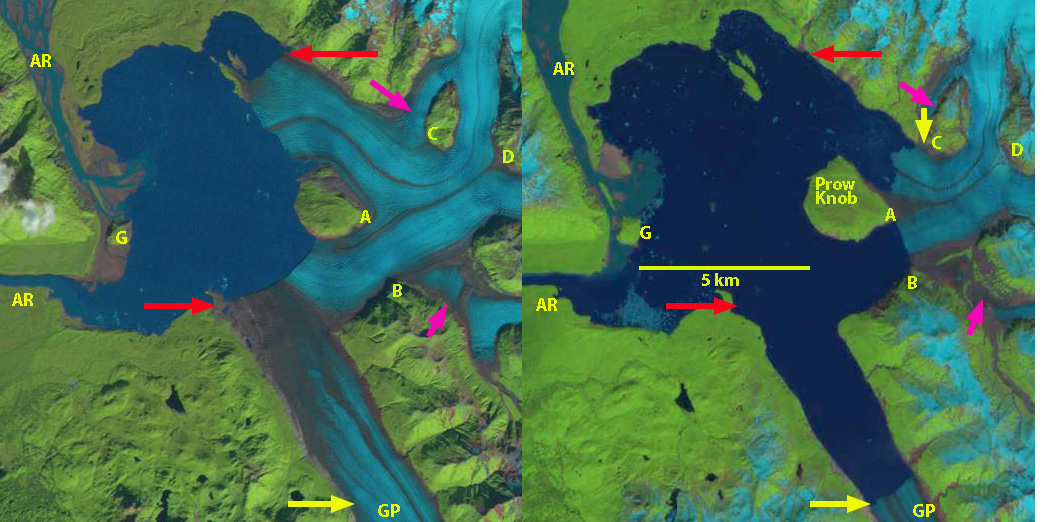
Alsek Glacier descends from the Fairweather Range terminating in Alsek Lake on the coastal plain. The glacier terminated at Gateway Knob (G) near the outlet of Alsek River from Alsek Lake in the early part of the 20th century (Molnia, 2005). At that time it had a joint terminus with Grand Plateau Glacier. The glacier retreated 5-6 km by 1984 along the central margin from Gateway Knob. In 1960 the glacier had a single terminus joining downstream of an unnamed island in Alsek Lake, that Austin Post told me reminded him of a boats prow. This “Prow Knob” (P) much like Gateway Knob a century ago stabilizes the terminus. Retreat from this knob will lead to an increase retreat of Alsek Glacier. Loso et al (2021) note that retreat of Grand Plateau Glacier will change the outlet of Alsek Lake from Dry Bay to the Grand Plateau Lake. Here we examine the change from 1984-2022 with Landsat and Sentinel imagery updating Pelto (2017)
Alsek Glacier retreat from 1984-2022 in Landsat images. Red arrows mark the 1984 terminus location, yellow arrows the 2022 terminus location, pink arrows indicate tributary separation, AR=Alsek River, GP=Grand Plateau, G=Gateway Knob, A=glacier junction, B=tributary separation, C=tributary separation, D=tributary confluence.
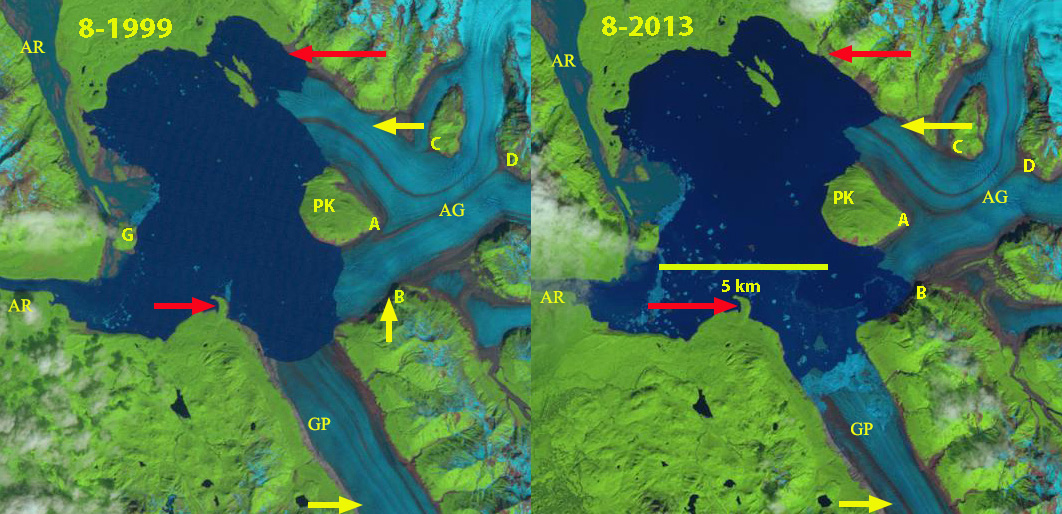
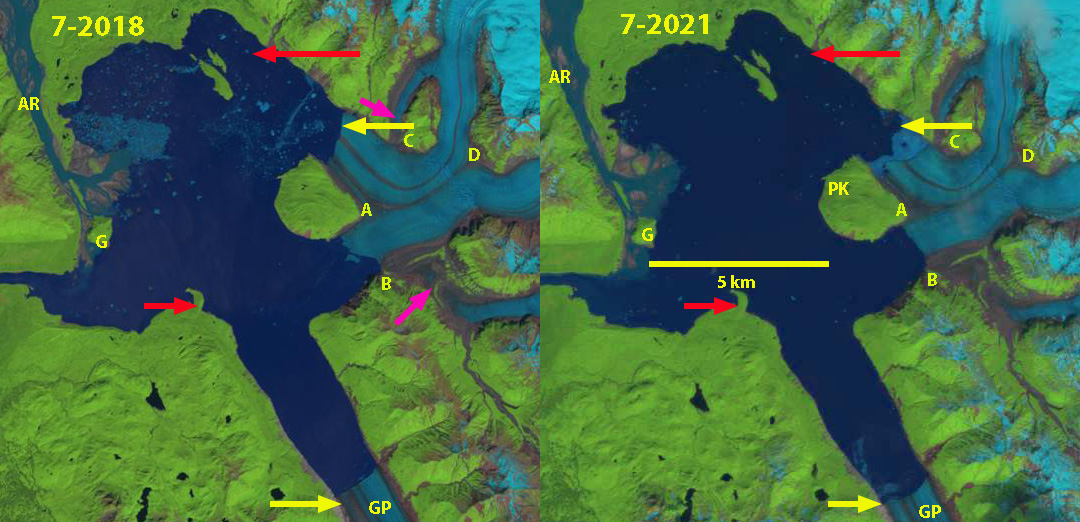
In 1984 the terminus location is denoted with red arrows it has separated into two termini on either side of “Prow Knob”. The northern terminus tongue is located on a narrow island on the north side of Alsek Lake. The southern tongue merges with the northern arm of Grand Plateau Glacier in 1984. Two tributaries at the pink arrows merge with the main glacier. By 1999 the northern tongue has retreated from the narrow island, which exposes the terminus to enhanced calving. The southern terminus has separated from the Grand Plateau Glacier. By 2013 the northern terminus has retreated to the northern end of “Prow Knob” and the southern terminus is directly south of “Prow Knob” in a 1.8 km wide channel. By 2018 two tributaries of Alsek Glacier are fully detached from the glacier, pink arrows. In 2018 the northern terminus tongue has retreated 3.7 km since 1984 into the 2.0 km wide channel on the northeast side of “Prow Knob”. The center of the southern terminus has retreated 2.5 km since 1984 and remains in the channel on the south side of “Prow Knob”. The length of the calving front has declined from an 8 km long calving front in 1984 to a 4 km calving front in 2018. By 2021 further retreat has led to a 2.8 km wide calving front, and a 1.6 km long contact with Prow Knob. From 1984-2022 the retreat and loss of area has been: 4.3 km and 8.6 km2 respectively for the northern terminus, 2.7 km and 5.1 km2 for the southern terminus and 7 km and 13.1 km2 for the northern arm of Grand Plateau Glacier.
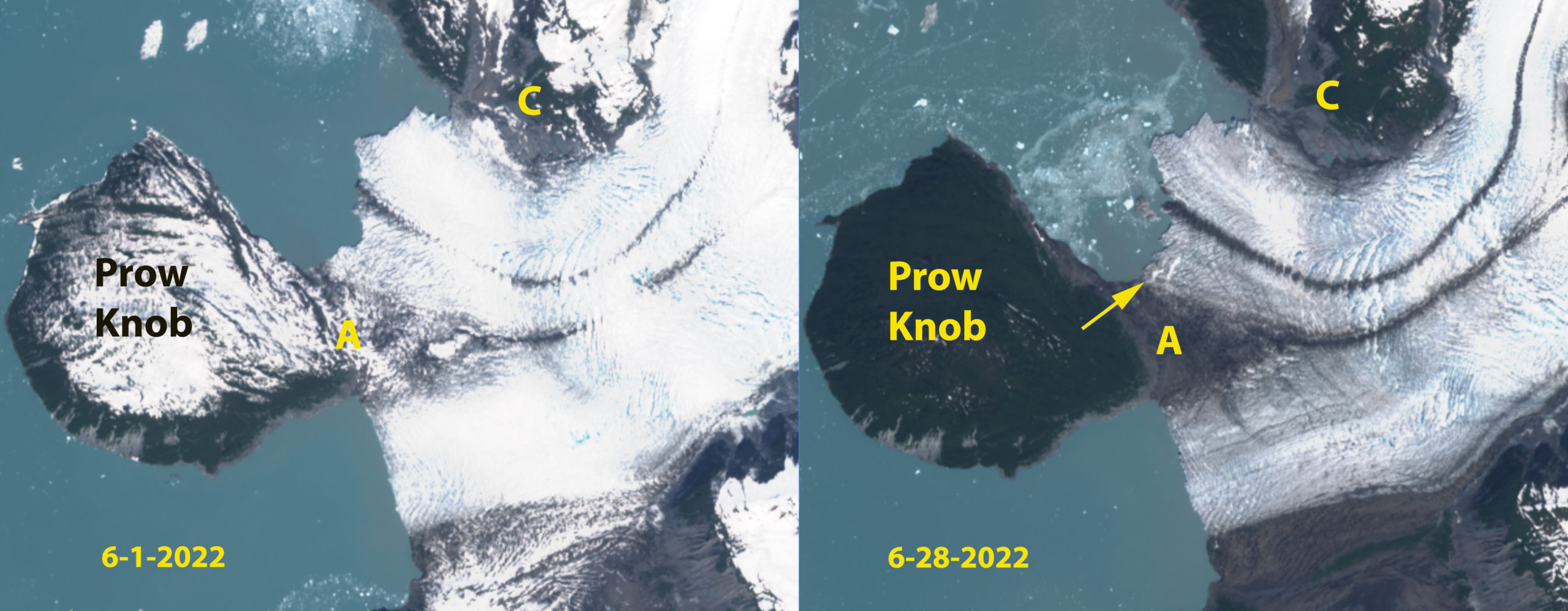
In 2022 the northern terminus arm has accelerated within 1 km of the calving front, note the two red X, marking velocity locations. This has generated additional calving and rifting, that is evident in the June 28 image. The NASA ITS_LIVE velocity measurement tool uses Landsat and Sentinel images to determine velocity using feature tracking. The rifting and acceleration is producing enhanced calving and retreat. The area of enhanced calving on July 1 is 0.3 km2. The acceleration and rifting is typically an indication of a greater degree of terminus flotation that can be due to thinning and/or reduced contact with Prow Knob. This will lead to additional calving events this summer as the glacier progressively detaches from Prow Knob.
Alsek Glacier retreat from 1999-2013 in Landsat images. Red arrows mark the 1984 terminus location, yellow arrows the 2022 terminus location, AR=Alsek River, GP=Grand Plateau, PK=Prow Knob, G=Gateway Knob, A=glacier junction, B=tributary separation, C=tributary separation, D=tributary confluence.
Alsek Glacier retreat from 2018-2021 in Landsat images. Red arrows mark the 1984 terminus location, yellow arrows the 2022 terminus location, pink arrows indicate tributary separation, AR=Alsek River, GP=Grand Plateau, PK=Prow Knob, G=Gateway Knob, A=glacier junction, B=tributary separation, C=tributary separation, D=tributary confluence.
Sentinel images from June 2022 illustrating the development of rifting at yellow arrow, that leads to the July 1 calving event. A=glacier junction, B=tributary separation, C=tributary separation
Zarilang Glacier in 1998 and 2021 Landsat images illustrating glacier retreat and lake expansion. Point A marks the junction of two tributaries.
Zarilang Glacier, China flows north from the Bhutan border is in the Yarlung Zangbo River watershed draining the northwest flank of Kula Kangri. Yarlung Zangbo which becomes the Brahmaputra River supplies the Zangmu Dam (510 MW), online in 2015, that produces 2.5 billion kwh of electricity a year. Wang et al (2021) observe a significant increase in discharge of Yarlung Zangbo due to glacier melt and permafrost degradation. Zhang et al (2020) observed glacier retreat leading to lake expansion averaging 20 m/year in the Himalaya for the 2008-2016 period, with Yarlung Zangbo basin having the highest average rate of lake expansion.
In 1998, Zarilang Glacier terminated in a proglacial lake that was 1.0 km long with an area of 0.24 km2, 1.8 km upglacier from the terminus was a significant junction at Point A, with a medial moraine marking the boundary extending to the terminus. In 2001 the calving front is 400 m wide and has retreated ~100 m since 1998. By 2014 the glacier has retreated into a narrowing portion of the lake. By 2018 the medial moraine marks the eastern margin of the glacier, which means the eastern tributary is no longer reaching the lake. In 2021 the glacier has retreated 700 m and the lake is now 1.7 km long and has an area of 0.50 km2. In 2022 the calving front is 200 m wide and the glacier terminates 900 m from the junction at Point A, and the eastern tributary ends 100 m short of the lake. The lake area has doubled since 1998, which is a higher rate than the already high rate of 51% globally for glacial lakes noted by Shugar et al (2019) for glacial lakes 1990-2018.
Sun et al (2022) rated the hazard of a glacier lake outburst flood from this lake as low. The retreat is similar in scope to that of other glaciers retreating in expanding lakes in this region of China such as Sepu Kangri and Quiaqing Glacier. Examining glacier mass loss in the Himalaya King et al (2019) noted that lake terminating glaciers lost 30% more volume than other Himalayan glacier from.
Sentinel images in 2022 of Zarilang Glacier and the glacial lake. On May 31 there is some lake ice left. Note the medial moraine now is the eastern margin of the terminus.
Zarilang Glacier in 2001 and 2018 Landsat images illustrating glacier retreat and lake expansion. Point A marks the junction of two tributaries.
Grande Murailles Glacier, Italy (GM) in June Sentinel images. The yellow line is the glacier margin, the expansion of bare glacier ice from 1-3% of the glacier on June 10 to 20% of the glacier by June 18 is evident. The snowline is ~3200 m.
The heat wave during the last week that has impacted western Europe and the Alps has led to a predictable impact on glaciers (WMO, June 17, 2022). A month ago I focussed on the fact that heat waves and glaciers don’t usually go together; however, in the last several years an increasing number of heat waves have affected alpine glacier regions around the world (Pelto, 2022). In particular heat waves leave a greater portion of the glacier snow free, which enhances melting and mass balance losses. This is most pronounced when the heat wave occurs prior to or early in the melt season exposing bare glacier ice for a the bulk of the melt season. Di Mauro and Fugazza (2022) identified an increasing melt season length and decreasing minimum albedo on glaciers in the Alp from 2000-2019, that does enhance melt. Here we utilize Sentinel 2 images from June 10 and June 18 to look at the rate of snowcover loss on three glaciers in the Alps.
On June 10 ~98% of Grande Murailles Glacier is snowcovered, 96% of Gries Glacier, and 100% of Sabbione Glacier is snowcovered. After eight days of unusual heat, the bare glacier ice regions have expanded notably, ~80% of Grande Murailles Glacier is snowcovered, 80% of Gries Glacier, and 65% of Sabbione Glacier remain snowcovered. Grande Murailles Glacier drins west from Dent d”Herens just west of the Matterhorn. Sabbione Glacier feeds Lago del Sabbione a hydropower reservoir. Gries Glacier feeds Griessee a Hydropower reservoir. This rapid snowcover loss early in the summer is a particular issue given bare glacier ice melts ~50% faster than snowcover. This same scenario was observed last year in the Pacfic Northwest following a June Heat wave and in the Central Andes this summer 2022 after a January heat wave. In each case substantial mass balance losses occurred by summers end on these glaciers. This will continue to accelerate the fragmentation and loss of Sabbione Glaciers. This year the early season heat waves ability to strip snowcover from glaciers is enhanced by the limited snowpack that was received during the winter season that @VAW_glaciology has been reporting during spring monitoring of Swiss glaciers. This post will be updated on June 23 with additional images.
Gries Glacier, Switzerland (G) draining into the Griessee (Gs) in June 2022 Sentinel image. The terminus tongue, yellow arrow, extends below 2650 m to the terminus.
Sabbione Glacier, Italy (S) draining into Lago del Sabbione (LS) in June 2022 Sentinel images. The west and south Sabbione Glacier are both entirely snowcovered on June 10. By June 18 most of the west Sabbione Glacier is bare glacier ice and
Todd Icefield in 1987 and 2020 Landsat images illustrating retreat and separation. Red arrows indicate 1987 terminus location, Point A indicates location where the glacier has separated. Point B and C are locations of expanding bedrock high on the icefield. Point D is further glacier separation.
Todd Icefield is an icefield 30 km northeast of Stewart BC at the head of Portland Canal, with Todd Glacier being the main outlet glacier draining north to Point A and Erickson Glacier draining south near Point B. Glaciers of this icefield retreated and downwasted significantly from 1974-1997, with retreat rates of 9-76 m/year (Jackson et al 2008). Menounos et al (2019) indicate mass loss averaging -0.5 m/year from 1985-2018 in this region.
In 1987 Todd Glacier terminates in a small proglacial lake 1 km beyond a glacier junction at Point A. At Point B and C there are small bedrock outcrops. It is also worth noting that you could hike from the end of Todd Glacier on the northside across the icefield divide to the Erickson Glacier on the south side without crossing any snowcover. By 1997 Todd Glacier has retreated from the now 0.5 km long proglacial lake, with the two glacier tributaries joining just before the terminus. Again the snowline is above the Todd Icefield divide.
In 2013, 2014, 2015, 2018 and 2019 the snowline again rose above the icefield divide, leading to continued thinning even at the divide leading to increased bedrock exposure at Point B and C in 2018-2021. By 2020 Todd Glacier has retreated m since 1987 and separated from the main tributary at Point A. In 2018-2021 it is evident that Erickson Glacier is terminating in two new expanding proglacial lakes (0.2 km2) that may merge, and Todd Glacier is also now terminating in a new proglacial lake.
Retreat of Todd Glacier has been 2.4 km from 1987-2021, which is 30-40% of it entire length. The retreat is in line with that observed at nearby Bromley Glacier and Chickamin Glacier.
Todd Icefield in 1997 and 2021 Landsat images illustrating retreat and separation. Red arrows indicate 1987 terminus location, Point A indicates location where the glacier has separated. Point B and C are locations of expanding bedrock high on the icefield. Point D is further glacier separation.
Todd Icefield in 2018 and 2019 Sentinel images, note the dirty ice extends across the icefield divide in both years, yellow arrows indicate proglacial lakes developing.
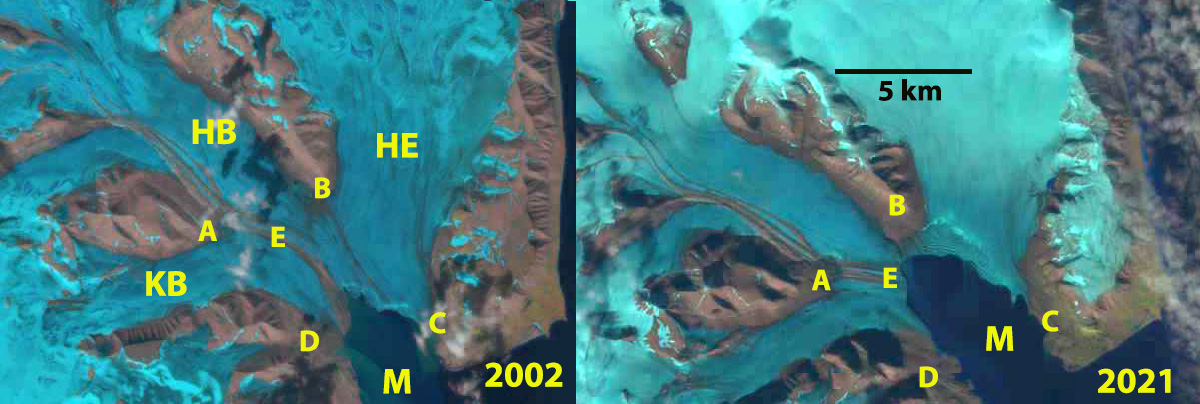
Hayesbreen (HB), Heuglinbreen (HE) and Konigsbergbreen (KB) terminating in Mohnbutka (M) in 2002 and 2021 Landsat imagery. Retreat to Point E, and reduction in connection at Point B is evident and distance from Point A to the terminus.
Hayesbreen, Heuglinbreen and Konigsbergbreen merge forming a single tidewater front in Mohnbutka on the east coast of Svalbard. Here we examine the retreat of this glacier system and ongoing separation of Hayesbreen and Heuglinbreen with Landsat imagery from 2002-2021. Blaszczyk et al’s (2009) identified 163 Svalbard tidewater glaciers with the total length calving ice−cliffs at 860 km for the 2001-2006 period. They observed that 14 glaciers had retreated from the ocean to the land over the last 30–40 year period. They noted that Hayesbreen was retreating 20-40 m per year in 2003-2005 and had a 4 km long ice cliff terminating in Mohnbutka. They noted the glacier last surged i 1901. Sevestre et al (2018) documented two mechanisms that help generate terminus initiated surges, tidewater retreat from a pinning point and/or crevasses allowing meltwater rainwater to access the bed. the terminus zone near Point 1.
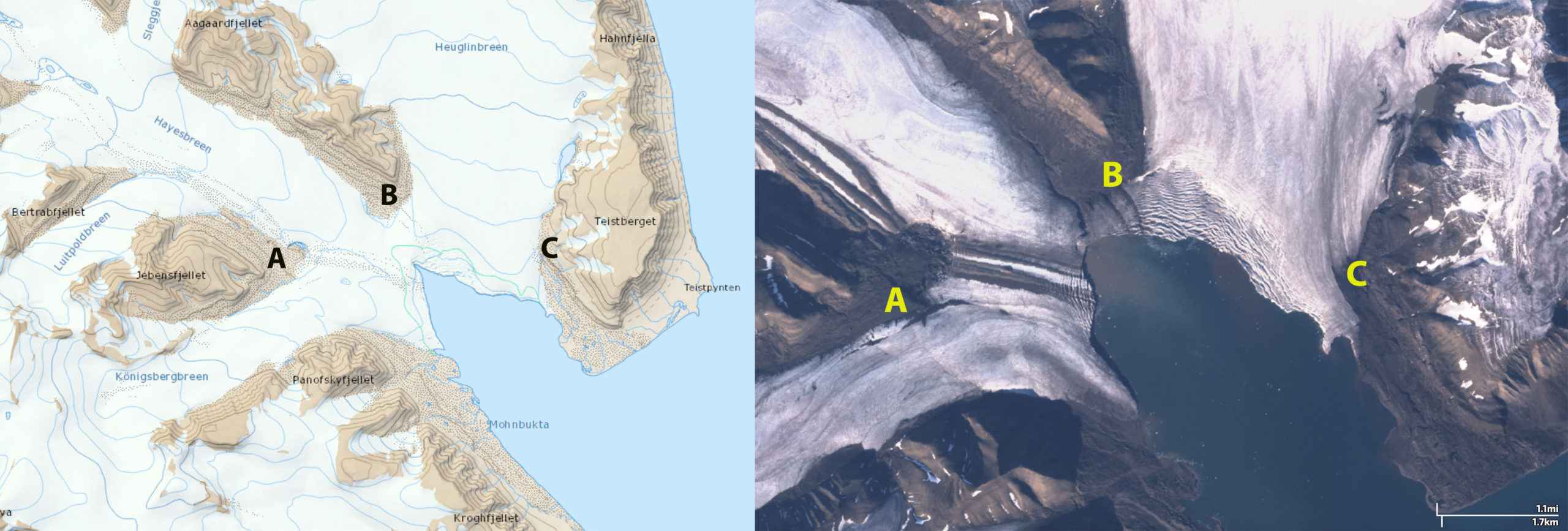
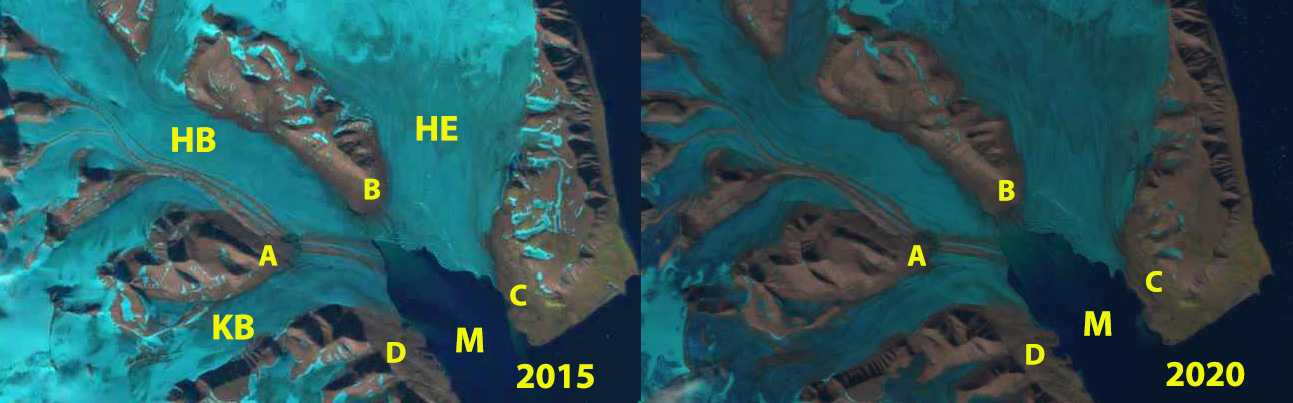
In 2002 the prominent lateral moraines of Hayesbreen extended 5 km from Point A to the terminus. The glacier margin adjacent to Point B was 2.75 km to the terminus junction of Hayesbreen and Heuglingbreeen. By 2015 there was only 1.2 km of ice between Point B and the terminus, while from Point A to the margin was 3 km. The snowline in 2020 reached between 400-450 m near the ice divide on Heuglinbreen and close to the top of Konigsbergbreen. Hayesbreen extends above 800 m and still had an extensive accumulation area. By August 2021 the now disconnected lateral moraines from the upper glacier extend 2 km from Point A to the terminus, and there is just 0.6 km of ice connecting Heuglinbreen to Hayesbreen. The center of the glacier front has retreated 2.25 km since 2002. Mohnbutka has expanded as the glaciers have retreated. The ice connection between Heuglinbreen and Hayesbreen has narrowed from 3 km to 0.6 km during the period. This is similar to the separation at Strongbreen.
Sevestre et al (2018) noted a distinctive crevasse development pattern of terminus initiated surge progression, “Upward migration of the surge coincided with stepwise expansion of the crevasse field”, for specific observed recent surges in Svalbard. There is no evidence of this process at Hayesbreen during the last 20 years as it retreats and separates.
.
Map of the region fro TopoSvalbard, and August 8, 2021 Sentinel image illustrating the limited connection between Hayesbreen and Heuglinbreen.
Hayesbreen (HB), Heuglinbreen (HE) and Konigsbergbreen (KB) terminating in Mohnbutka in 2015 and 2020 Landsat imagery. The narrowing ice connection at Point B and reduction in glacier extending beyond Point A is evident. The high snowline in 2020 exposes considerable ablation area
Grand Pacific Glacier in 1984 and 1999 Landsat images. Red arrow indicates the front of the clean ice flow of the Grand Pacific that also marks its lateral boundary with Ferris Glacier. B and C indicate locations where tributary tongues have been retreating from the main glacier. M is the Margerie Glacier.
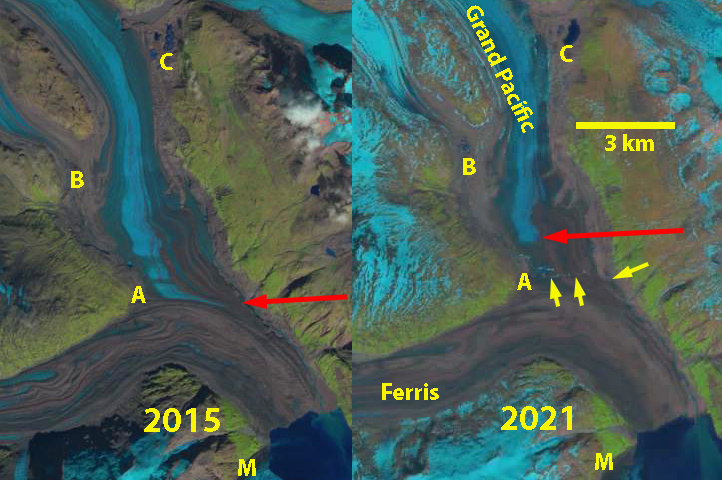
Grand Pacific Glacier in 2015 and 2021 Landsat images. Red arrow indicates the front of the clean ice flow of the Grand Pacific that also marks its lateral boundary with Ferris Glacier and the front of its active ice. Yellow arrow indicates outlet stream that is now beginning to separate the glaciers. B and C indicate locations where tributary tongues have been retreating from the main glacier. M is the Margerie Glacier.
The Grand Pacific joins with Ferris Glacier before ending at the head of Tarr Inlet in a ~1.9 km wide glacier front and 20-50 m high ice front. William Field observed the glacier advancing steadily from the 1930’s-1968 at 35 m/year , extending ~.0.5 km across the US/Canada boundary. This advance continued behind its protective shoaling moraine/outwash plain until it was 1.5-1.6 km across the national boundary and just meeting the Margerie Glacier. A slow recession of 200 m has occurred since, with the current terminus having a width of 1.8 km, most in shallow water or terminating on a tidal flat. The Grand Pacific Glacier has been thinning for more than 50 years, which is leading to the recession, though not nearly as significant at for Melbern Glacier which it shares a divide with. Clague and Evans (1993) noted a 7 km retreat of Melbern Glacier from 1970-1987, and a 5.25 km retreat from 1986-2013 (Pelto, 2011-2017). The mass loss of the Grand Pacific Glacier system is part of the 75 Gt annual loss of Alaskan glaciers that make this region the largest alpine glacier contributor to sea level rise from 1984-2013 (Larsen et al 2015).
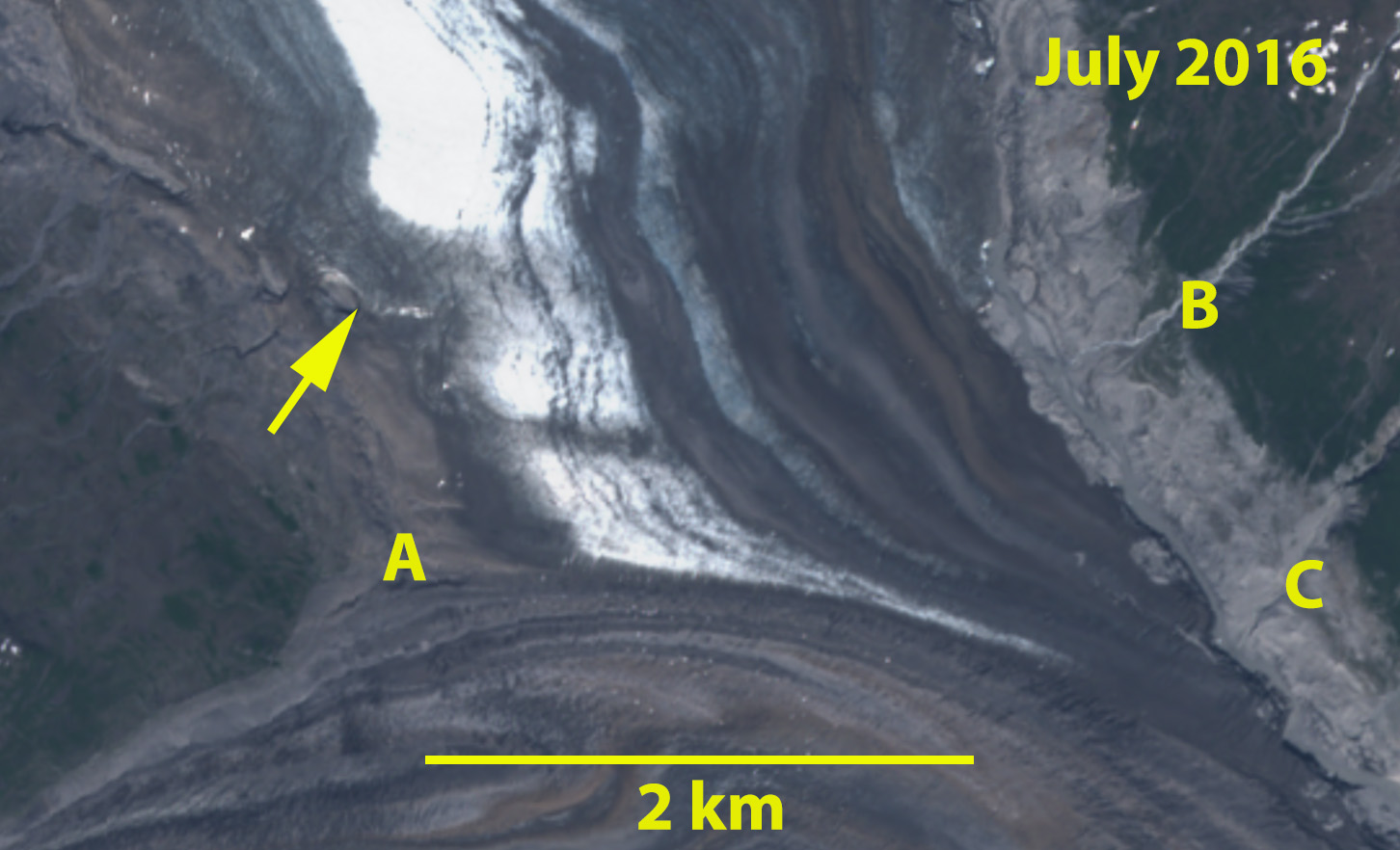
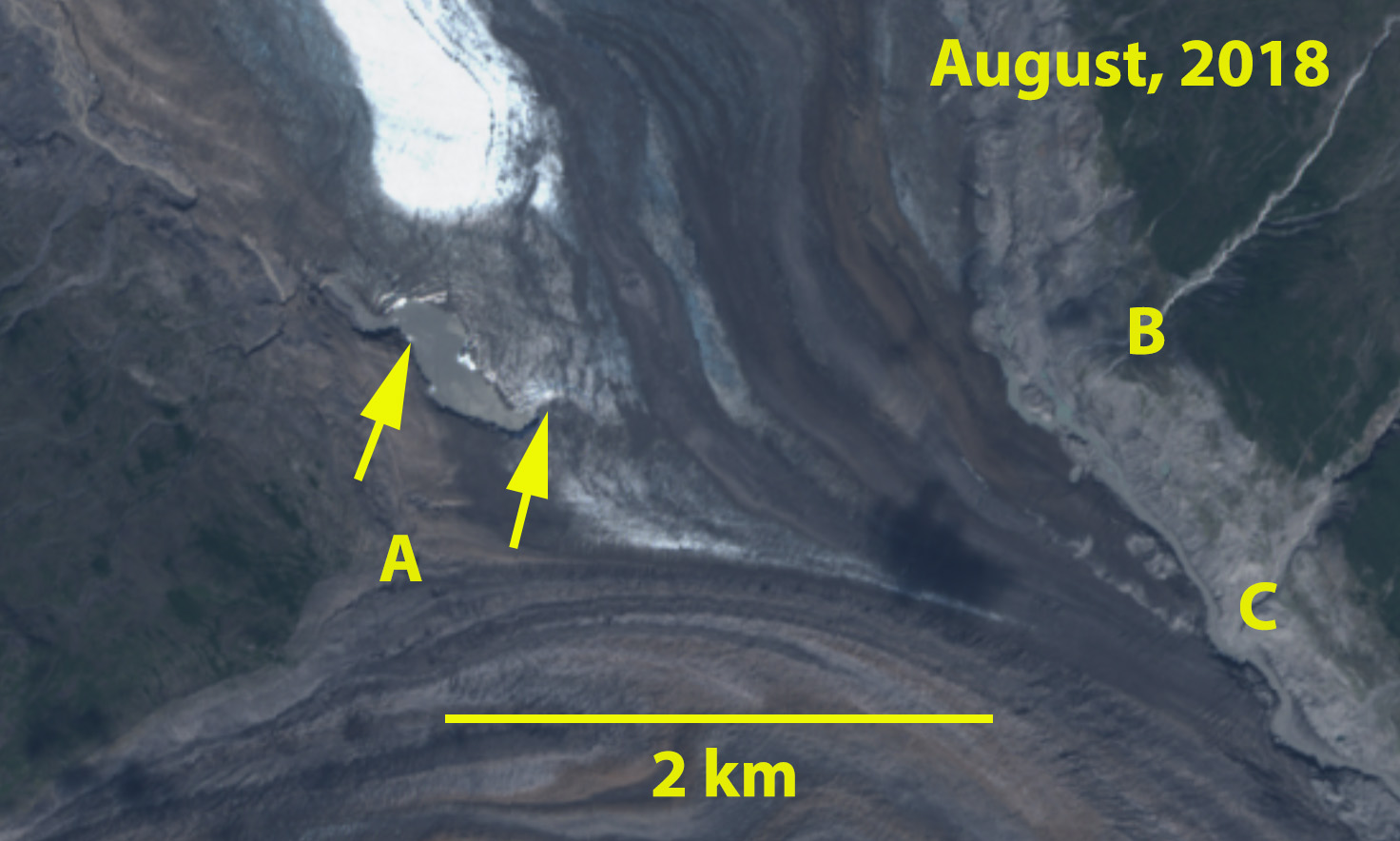
William Field reported that Grand Pacific Glacier comprised 80% of the joint glacier front with Ferris Glacier in 1941, declining to 40% in 1964. In 1984 Landsat imagery illustrates that the Grand Pacific is still supplying ice to the glacier front but only comprises 25% of the ice front. In 1999 this has diminished to 20% of the ice front, that is now entirely on an outwash plain above the tidal level. Tributary C has disconnected from Grand Pacific Glacier between 1984 and 1999, and tributary B has retreated substantially from the Grand Pacific. By 2015 the junction of the Ferris and Grand Pacific Glacier indicates all flow of the latter is diverted east along the Ferris margin and does not reach the ice front. There is a band of clean glacier ice that reaches the junction in 2015 and in the 2016 Sentinel image, but no longer reaches the eastern margin. In 2016 the glacier outlet stream along the west side of the Grand Pacific goes under the glacier to the east margin near the junction. By 2018 the surface exposed section of the stream extends ~700 m across the Grand Pacific Glacier before going beneath the glacier along the Ferris/Grand Pacific margin. In 2021 the glacier outlet stream cuts halfway across the glacier before going beneath and emerges prior to reaching the east margin, note yellow arrows below on the Sentinel image . The clean ice area no longer reaches the junction with the Ferris Glacier in 2021. The rapid expansion of the surficial outlet stream that is physically separating the two glacier will continue to cut across the entire width of the Grand Pacific Glacier. This glacier no longer has a connection to the Pacific Ocean, and no longer presents a grand front. The retreat is limited in distance compared to Grand Plateau or Fingers Glacier, but the separation is dramatic.
Sentinel 2 image of Grand Pacific Glacier in July 2016, yellow arrow indicates glacier outlet stream beginning to transect glacier.
Sentinel 2 image of Grand Pacific Glacier in August 2018, yellow arrow indicates glacier outlet stream expanding across glacier.
Sentinel 2 image of Grand Pacific Glacier in July 2016, yellow arrow indicates glacier outlet stream nearly transecting the entire width of the Grand Pacific Glacier front/margin with Ferris Glacier.
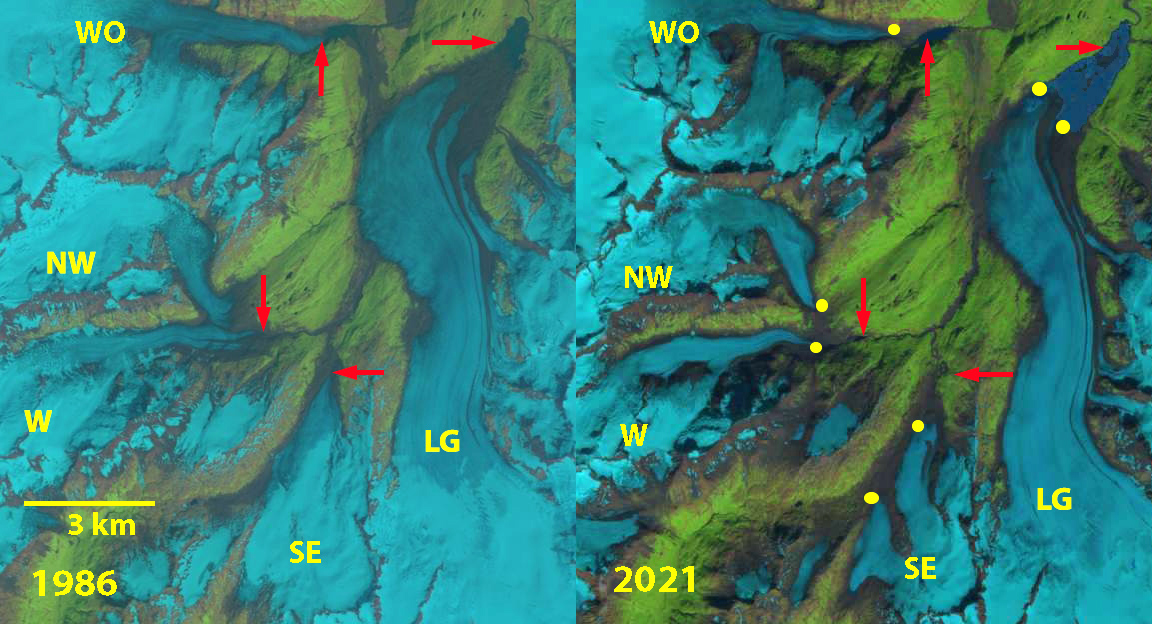
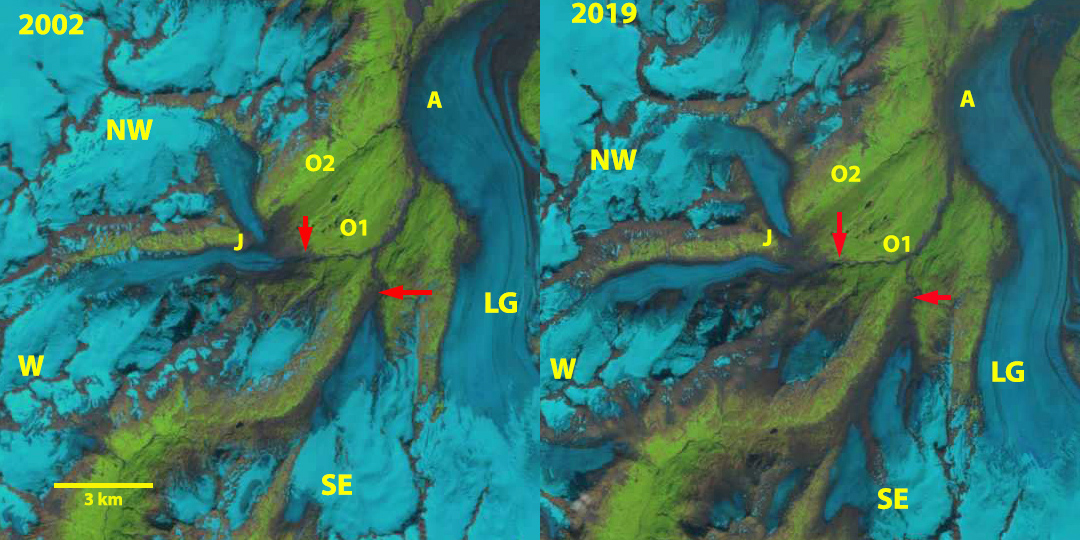
Glaciers in the Lake Fork Knik River watershed in 1986 and 2021 Landsat images. LG=Lake George Glacier and WO=Whiteout Glacier with the remainder unnamed, labelled here as W=West, NW=Northwest and SE=Southeast. Red arrows mark 1986 terminus locations and yellow dots the 2021 terminus locations.
At the headwaters of the Lake Fork of the Knik River are a series of glaciers undergoing retreat and separation. The headwaters is dominated by the Lake George Glacier, which had terminated in the large proglacial Lake George that periodically drained past/beneath Knik Glacier (Stone, 1963), after 1966 the lake no longer filled (Post and Mayo, 1971). A new smaller proglacial lake began to form due to the retreat of Lake George Glacier by. Here we examine the changes in this headwater glacier group from 1986-2021 with Landsat imagery. The proglacial lake at the terminus of Lake George Glacier is moraine dammed and has expanded from 1986-2021, this is representative of the expansion of moraine dammed lakes in Alaska with an 87% areal increase from 1984-2019 noted by Rick et al (2022).
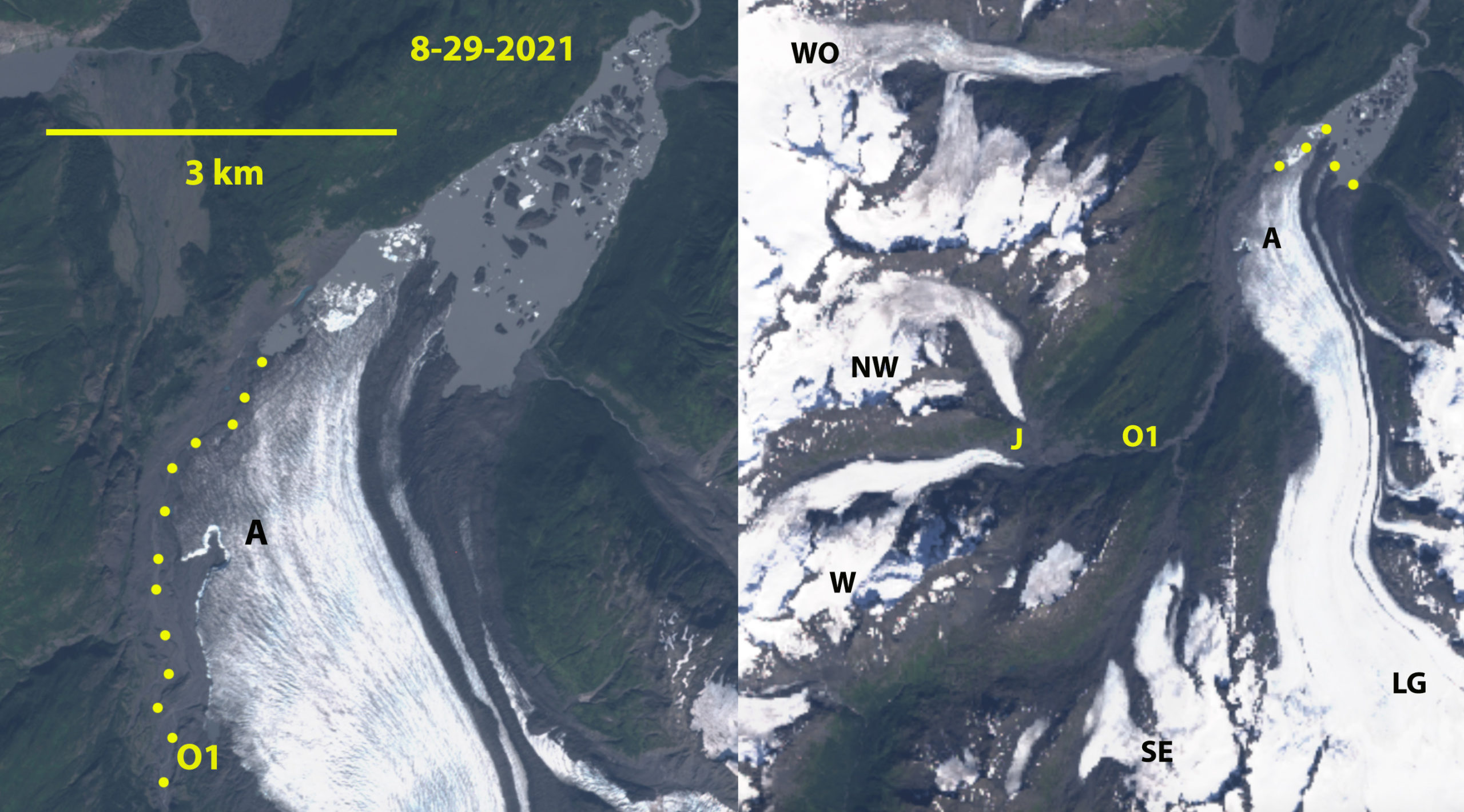
In 1986 Lake George Glacier terminated in a small proglacial lake with an area of 0.3k m2,. Whiteout Glacier terminated at 300 m, within 3 km of LG. West and Northwest Glacier had a joint terminus (Point J) at 600 m, with two outlet streams O1 and O2. Southeast Glacier had a single terminus at 500 m and had an area of 18.4 km2,. In 2002 the main change was the separation of West and Northwest Glacier. The snowline on LG was at 900 m in August 2002. By 2019 Southeast Glacier has two separate termini, with the ridge just north of SE dividing the glacier, with the snowline at 1100 m in August. The proglacial lake at the end of Lake George had an area of 4.0 km2,. By 2021 the proglacial lake had expanded to an area of 4.3 km2,, a 4.0 km2, increase since 1986. Terminus retreat has been 2100 m for Lake George Glacier 1100 m for Whiteout Glacier, 1250 m for West Glacier, 1000 m for Northwest Glacier and 1100 m for Southeast Glacier. Southeast Glacier now has an area of 12 km2, a 33% area loss since 1986, ~1% per year. In 2021 the Outlet Stream from W, NW, and SE glacier parallels the margin of Lake George Glacier, but no longer goes under or is in contact. A notch at Point A has developed, from a meltwater runoff channel. Icebergs occupy much of the lake in 2021 indicating there is still active development of the lake. The lake development and separation of glaciers is similar to that observed at Field Glacier, Sheridan Glacier and Excelsior Glacier.
Glaciers in the Lake Fork Knik River watershed in 2002 and 2019 Landsat images. LG=Lake George Glacier with the remainder unnamed, labelled here as W=West, NW=Northwest and SE=Southeast. O1 and O2 are the outlet streams of the W and NW Glacier in 1986, with O2 abandoned by 2002.
Glaciers in the Lake Fork Knik River watershed in August 29, 2021 Landsat image. LG=Lake George Glacier and WO=Whiteout Glacier, with the remainder unnamed, labelled here as W=West, NW=Northwest and SE=Southeast. O1 is the outlet streams of the W and NW Glacier, yellow dots at right indicate the course. Note the notch in Lake George glacier at Point A.
Landsat images of Sollipulli from 1986 and 2022. Point A-D are locations where the glacier spilled out of the caldera in 1986, but no longer does so in 2022.
Nevados de Sollipulli is a volcano, is in the central Andes of Chile near the border with Argentina in Parque Nacional Villarica, Chile. The 4 km wide summit caldera at ~2100 m is filled by a glacier. The volcano is dormant last producing lava flows 700 years ago and last erupting 2900 years ago (NASA, 2017). Reinthaler et al (2019) identified a 27% decline in glacier area from 1986-2015 on 59 volcanoes in the Andes. The study included Sollipulli where the area declined from 16.2 km2 in 1986, 20 12.5 km2 in 1999 and 11.1 km2 in 2015 (Reinthaler et al 2019). Here we examine Landsat imagery illustrating the recession from 1986-2022 and the loss of all snowcover for most of the summer of 2022. The summer of 2022 led to early summer loss of most/all the snowpack on Central Andes glaciers from 30-40 S. (Pelto, 2022)
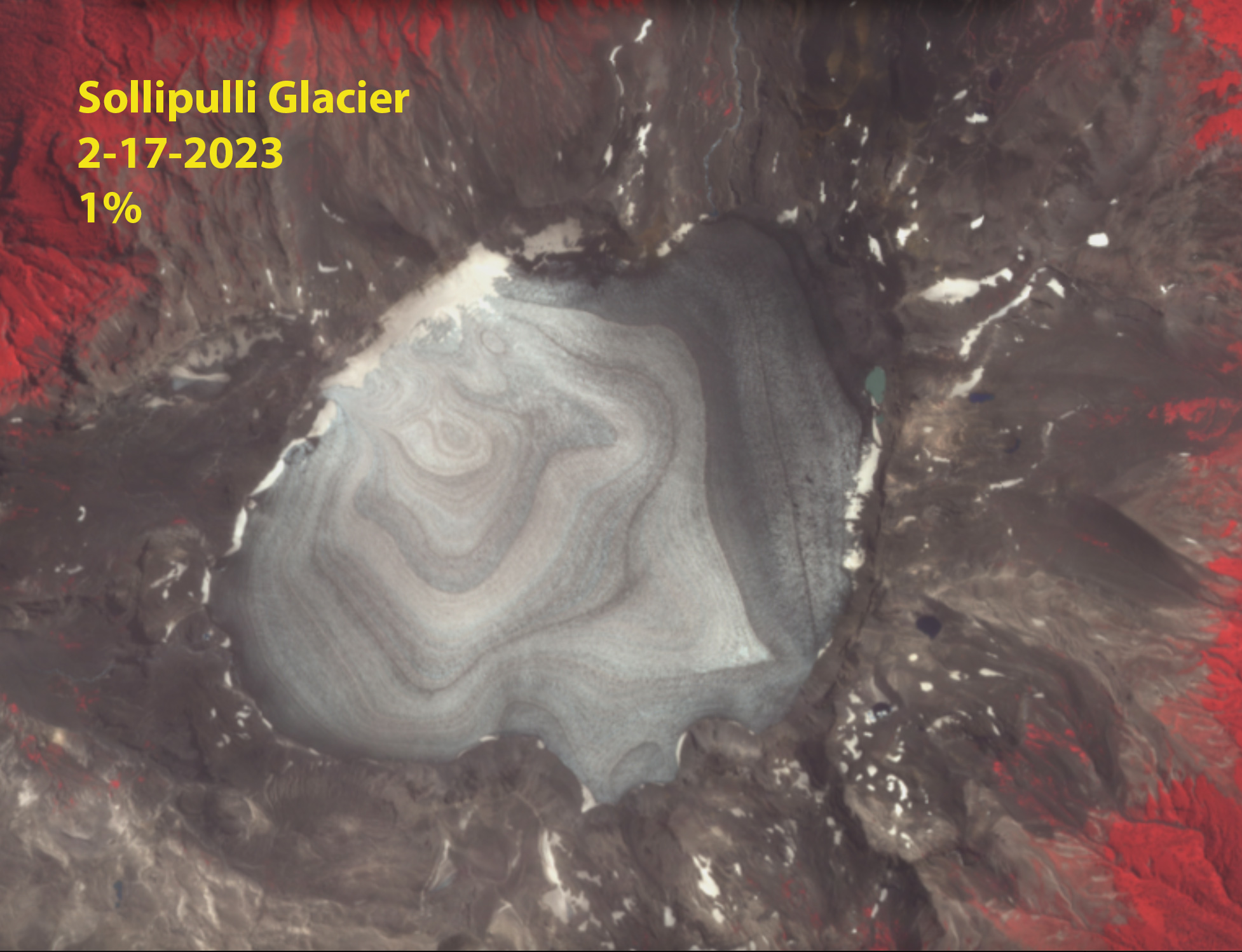
In 1986 a Landsat 5 image illustrates that the glacier not only fills but overflows the caldera at Points A-D, with Point A and B feeding significant glacier area. The glacier is also almost completely snowcovered in late February. In 2003 the glacier is still spilling over at Point A, and is almost entirely snowcovered in mid-February. On January 8, 2022 the glacier is already 95% free of snowcover with some snow patches on the NW margin. By January 24 the glacier is 99% snow free and remains snow free through mid-March in a Landsat and Sentinel image from 3-13 and 3-16 respectively. There is a small patch of relict glacier ice near Point B, while the former glacier at Point A has disappeared. The annual layering preserved in the glacier ice as seen in the Landsat Band 5 image will continue to evolve as the glacier thins. The dirty nature of this ice enhances solar radiation melting, particularly compared to snowcover. Two months of exposure at the 2100 m elevation ice cap will have led to several meters of ice loss. The extent of the glacier has declined to 10.2 km2 in March 2022 a 37% decline since 1986.
Landsat images indicating the near complete snowcover in Landsat 7 image from 2003 and the loss of all snowcover that continued from January until at least March 13 2022. Note the annual layers preserved in the glacier ice now exposed at the surface.
Sollipulli Glacier in early January with only a fringing area of snowpack along the northwest margin. Sixty-four days later the glacier is still bare of snowpack.
Bare glacier ice exposed with months left in the melt season enhances melt. Down slope ice bands and surface roughness on Sholes Glacier.
Heat waves and glaciers don’t usually go together; however, in the last several years an increasing number of heat waves have affected alpine glacier regions around the world. This is true from Arctic Canada to the Himalayas from the Andes to Alaska. Here we review a number of these heat waves from 2018-2022, that I have been involved with assessing and observing. In particular heat waves leave a greater portion of the glacier snow free, which enhances melting and mass balance losses. This is most pronounced when the heat wave occurs prior to or early in the melt season exposing bare glacier ice for the bulk of the melt season. This occurred in summer 2021 in the Pacific Northwest, in summer 2022 in the Central Andes of Chile and Peru, and during the pre-monsoon season in 2022 in the Himalaya. In the summer of 2022 heat waves impacted the glaciers of Svalbard and Europe. In the summer of 2023 the Central Andean glaciers have again been stripped of snowcover.
Lowell Glacier in Landsat images from 7/4, 7/26 and 8/11 with Sentinel images from 7/22 . The snowline is shown with purple dots. Point A-F are fixed reference locations. The snowline migrated upglacier 20 km and 300 m in elevation. A significant snow swamp is between the yellow and purple dots on 7/26, that was not present on 7/22.
The beginning of this “wave” of observations of heat wave impacts on glaciers, was on Lowell Glacier, Yukon where a large snow swamp formed in a matter of days during a Yukon/Northwest Territories Heat Wave. On July 26, the slush covered an area of more than 40 square kilometers, with the rapid development of such a large melt area on Lowell Glacier coinciding with four days where daily temperatures at nearby Haines Junction (~60 km northeast of the glacier) reached 29 degrees Celsius. The only way to generate an extensive snow swamp is to have the snow saturated with water all the way to the surface NASA’s Earth Observatory (NASA EO).
Taku Glacier transient snowline (purple dots) in Landsat images from 7/21 and 9/16/2018.
This same heat event led to the observation that the snow lines on Taku Glacier in Alaska were the highest they had been since tracking began in 1946, 200 m higher than previously observed, with the snow line rising +10 m/day during the heat wave (Pelto, 2019).
Fork Beard (F) and Nerutusoq Glacier (N) Baffin Island on June 1, 2019, June 18, 2019 Sentinel images and June 30 Landsat image. Purple dots indicate the snowline.
During June 2019 on Baffin island Pangnirtung featured four days with record temperatures for that date June 5 (15.1), June 11 (13.5) and June 12 (13.6), and June 19 (14.4). There were 14 days with a maximum temperature above 10 C. On Fork Beard Glacier and Nerutusoq Glacier this drove a snowline rise from 800 m on June 1 to 1100 m by June 18 and 1150 m on June 30. A rate of over 10 m/day for the month.
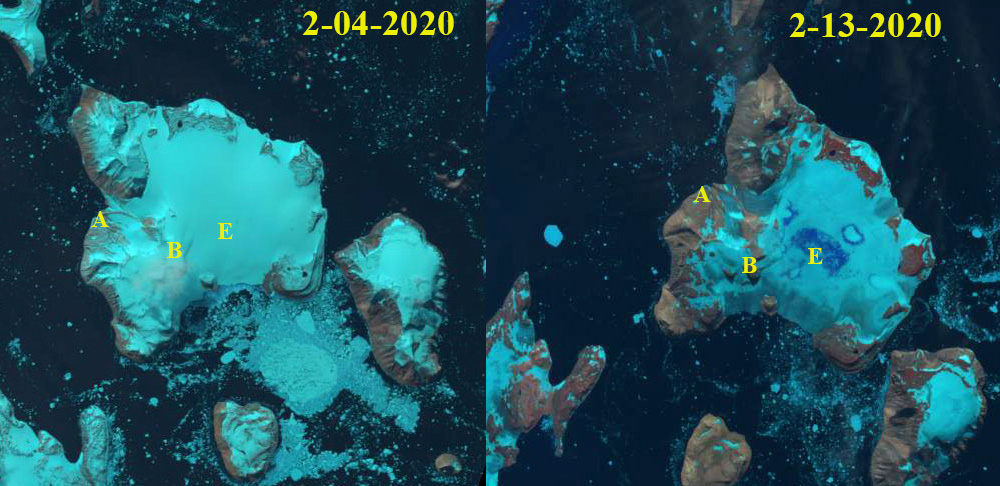
Eagle Island Ice Cap, Antarctica in Landsat images from Feb. 4, 2020 and Feb. 13, 2020. Point E indicates an are area of snow/firn that is saturated with
An all-time temperature record for Antarctica in February 2020, a high-pressure ridge and a blocking high in the Drake Passage caused anticyclonic circulation bringing warm moist air from the Pacific Ocean to the Antarctic Peninsula Xu et al (2021). This led to vertical air flows in a foehn warming event dominated by sensible heat and radiation made generating abrupt warming Xu et al (2021). The visible impact of this heat event were the rapid rapid formation of melt ponds on Eagle Island Ice Cap I reported to NASA EO. On Eagle Island Ice Cap melt averaged 22 mm/day from Feb. 6-11 based on MAR climate model output forced by the Global Forecast System (GFS) generated by Xavier Fettweis. Rapid melting generating significant snowline rise on Coley Galcier, James Ross Island as well (Pelto, 2020).
Nanpa La (NPL) and Nup La (NL) in October 13, 2020 and January 17, 2021 Landsat imagery indicating the snow line rise that has persisted into mid- winter. Snow line indicated by yellow dots.
When record warmth spread over the Mount Everest region in January 2021, the snow lines near Mount Everest rose durng the October-December 2020 period, and remained at nearly 6,000 meters, including the key glacier passes from Nepal into China being snow free into late January. The National Geographic Perpetual Planet Expedition weather team, led by L. Baker Perry and Tom Matthew, had installed weathers stations at high elevations on Mount Everest in 2019 (Matthews et al 2020). These stations provided field observation of how warm it was during this period, which explained the snow free glaciers in winter. Temperature observations and reconstructions of daily weather conditions, dating back to 1950, indicated that the region had experienced the five warmest winter days since 1950 during a short period in January 2021. Prajjwal Panday examined the decline of snow cover area and rise of sthe snowline on glaciers from Oct. 2020 -January 2021 finding a 15% depleation and 200 m rise respectively. Even in the highest mountain range in the world, we are seeing melt conditions during the winter. This study was first published by NASA EO within a month of the event, and then in the journal Remote Sensing.
Easton Glacier has limited snowpack with two months left in the melt season in 2021. Dots indicate the firn line.
The next warm weather event was the Pacific Northwest record heat in late June 2021, setting all-time records across the region. Thompson et al (2022). comparison of daily summer maximum temperaturesthat were 3.6 SDs from the mean.. This heat wave quickly melted away much of the winter snowpack on many glaciers. The heat wave and ensuing warmth stripped the snowcover from glaciers right to the summit on the highest mountains from Mount Shasta, California to Mount Baker, Washington by mid- August exposing the dirtier ice that lies underneath the snow and melts more rapidly than snow under the same weather conditions, to the summit of these mountains. The led to increased discharge in glacier fed streams, while non-glacier fed streams in the region had significant declines in discharge. For the Nooksack River heat waves generate a 24% increase in discharge in the glaciated North Fork and a 20% decline in the unglaciated South Fork (Pelto et al 2022). For water temperature the mean increase was 0.7 °C (±0.4 °C) in the North Fork and 2.1 °C (±1.2 °C) in the South Fork (Pelto et al 2022). The resulting volume loss during the summer season has been the highest we have observed in our 38 years of monitoring North Cascade glaciers. We observed stunted alpine plant growth, experienced days of smoky air limiting visibility and had to navigate and measure more open crevasses than usual.
Whitney Glacier on Mount Shasta in 2021 Sentinel Images.
Jackson and Blackfoot Glacier in early September Sentinel 2 false color images. Point A indicates exposed ice showing annual layers. Point B indicates exposed firn that had been retained through previous summers. The gray color of the firn indicates how dirty it is and that its albedo would enhance melting.
Mount Shasta in California fared even worse, losing all snow cover on its glaciers by September 6. The largest glacier on the mountain and in California, Whitney Glacier, began to separate. In all, the glaciers there had lost 50 percent of their area and volume this century, including ~10-15 percent this summer, and had fragmented from 6 into 17 glacier pieces (Patel, Washington Post, 2021).
The summer of 2022 in the Central Andes of Argentina and Chile glaciers experience a near total loss of snowpack in January due to early summer warmth, leading to dirty/dark glaciers. The darker surfaces of the glacier melt faster leading to more rapid area and volume loss. This includes fragmentation and rapid expansion of bedrock areas amidst the glacier. The snow free conditions lasted until the end of March, extending the impact from the January observations emphasizing that this was a regional issue this summer with snowpack lost from Bajo del Plomo Glacier, Cortaderal Glacier, Palomo Glacier,Volcan Overo Glaciers,Volcan San Jose Glaciers , Cobre Glacier and Olivares Beta and Gamma Glaciers across the Central Andes of Chile and Argentina.
Volcan San Jose glaciers in Feb. 17, 2022 Sentinel image. This highlights just how dirty the ice surface is and how limited the retained snowcover is.
Cobre Glacier, Argentina in false color Sentinel 2 images from Jnauary 13, 2022 and March 16, 2022. Note the expansion of bedrock area amidst the glacier at Point A, glacier fragmenting at Point B and Point C.
Volcan Overo in Sentinel image continues to fragment with no retained snowcover this summer, and bedrock expansion at Point A.
Sentinel images the loss of all snowcover on Sollipulli Glacier that continued from January until at least March 13 2022. Note the annual layers preserved in the glacier ice now exposed at the surface.
Langjokulen (La), Kvitisen (Kv), Bergfonna (Be) and Blaisen (Bl) ice caps on Edgeøya in Sentinel image from 8-20-2022 illustrating the lack of snowcover, limited firn areas and numerous annual layers. This pattern of annual layers due to glaciers being stripped of snow cover is becoming increasingly frequent. Note Andes last winter and Pacific Northwest summer 2021.
During the summer of 2022 Svalbard experienced an extended heat wave in August that led to loss of snowpack on a number of ice caps on Edgeoya.
Rapid snowcover loss on Rhone Glacier early in summer of 2022 in Sentinel images
The European Alps were hard hit in the summer of 2022 experiencing their most negative balances observed during the 70 years of observations.
In the summer of 2023 central Andean glaciers lost snowcover during the February heat waves.
Volcan Overo, Argentina with expanding lakes, blue arrows and fragmenting at yellow arrows.
Sollipulli Glacier lost snowcover in February 2023
The bottom line is that glaciers are simply not compatible with recurring heat waves and the intensity and frequency of these is increasing. This is true from Arctic Canada to the Himalayas from the Andes to Antarctica. This year, for the 34th consecutive year, Alpine glacier volume in the world will decline; their business model is not sustainable with our climate.
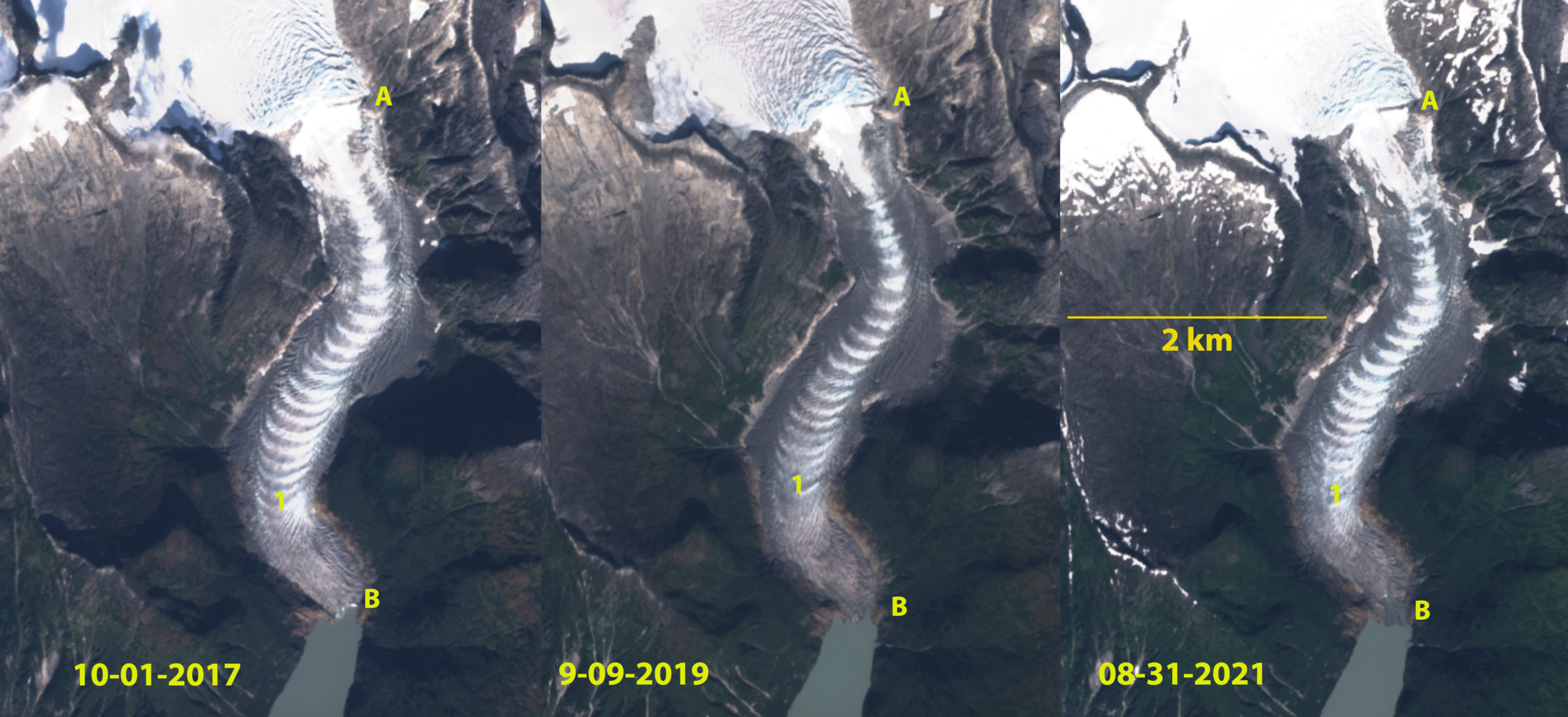
East Twin Glacier in Sentinel 2 images from 2017, 2019 and 2021. Point A marks the threshold, B the terminus contact with lake in 2017, Point 1 is the first ogive above the terminus.
East Twin Glacier is a narrow valley outlet glacier from the Juneau Icefield. The glacier descends from the icefield through an icefall at 975 m- 600 m that generate ogives at the icefall base. The extensive crevassing begins at 975 m with a threshold at 900 m. Davies et al (2022) examination of the Juneau Icefield found 63 glaciers had disappeared since a 2005 inventory, with a 10% reduction of glacier area. This study noted the importance of glacier disconnections occurring which separates the accumulation and ablation zones, leading to stagnation of the glacier segment below. We found 176 such disconnections in the outlet and valley glaciers of the Juneau Icefield Davies et al (2022). The focus of this post is on the development of a disconnection on the main stem of the East Twin Glacier.
In 1984 I had a chance to complete mass balance observations on the glacier. The terminus in the lake was 600 m wide, and the threshold at 900 m was also 600 m wide in 1984. The glacier retreated 900 m from 1984 to 2015 (Pelto, 2017). The terminus has calved into Twin Lake for over a century, but by 2015 the width of the terminus calving into the lake has declined by 75% since 1984, to 150 m. In 2017 there is still a very narrow steepened calving front. By 2019 the terminus no longer has a calving front, but was in contact with the lake. By 2021 the glacier terminates 200 m from the lake on the west side and 100 m from the lake on the east side. The total retreat from 1984-2021 is 650 m. In 2018 the snowline reached ~1250 m, 300 m higher than the long term average. In 2019 the snowline again reached this level. The result is an accelerated reduction in accumulation flowing towards the top of the icefall, along with glacier thinning at the threshold, which enables the disconnection to rapidly develop. The high snowline elevations and exceptional melt in 2018 and 2019 helped to further narrow the glacier at the threshold to 240 m in 2021. The bedrock threshold is quickly cutting across the glacier, this is limiting flow through the icefall and may have shut off the production of new ogives.
The declining mass balance of the Juneau Icefield indicated by the high snowlines is driving thinning, disconnections and retreat (Pelto 2019).
East Twin Glacier in 2018 and 2019 the highest snowlines since observations began on the Juneau Icefield in 2018. Snowline is the purple dots at 1250-1275 m, well above the threshold at Point A which had just below the mean 950 m snow line position from 1946-2000.
East Twin Glacier terminus change from 1984-2021 in Landsat images. Red arrow is the 1984 terminus, yellow arrow the 2021 terminus.
1984-Landsat 5 is launched. The North Cascade Glacier Climate Project was initiated on Earth Day in 1984 with a goal of observing the impact of climate change on glaciers across this mountain range for 50 years. This was in response to a call to action by the National Academy of Sciences to have a project that monitored glaciers across an entire mountain range in the United States, and from climate scientist Stephen Schneider who challenged glaciologists at an IGS meeting in 1983 to begin the monitoring now, in order to identify the full scope of change. 50-Year Project of Glacier-article in National Geopraphic work
1985- 150,000 year climate record from Antarctic Ice Core . Snow covers the terminus of the glacier at the start of August note lateral moraines it is pressed up against.
1986-Glaciers and Ice Sheets and Sea Level: Effect of CO2 induced Climate Change-Conference Proceedings published. Thinning in 1985 and 1986 is exposing the lateral moraines, which are still ice cored.
1988-IPCC formed. The terminus remains strongly convex, with much better snowcover. The slope is impressive note the skier for scale.
1989-Mean Global CO2 levels exceed 350 ppm. Note the annual layers both paralell to the terminus and in upper right avalanche fan annual layers that are diagonal to the terminus.
1990-First IPCC Assessmenent report , Clean Air Act amended to address Ozone Depletion and Acid Rain. Heavier accumulation nearly barely the lateral moraines at the terminus, indicative of a strong avalanche season.
1991-Mount Pinatubo erupts ejecting 15 million tons of SO2 into stratosphere impacting climate. No bare ice exposed in early August for the first time since we began monitoring the glacier. A strong positive mass balane. Widespread snow in the forest below the glacier.
1992- UN Framework on Climate Change signed by 154 nations. ~50% of the glacier bare ice in early August with 90% exposed by the end of summer, resulting in large mass loss.
1993-Melt ponds observations in Landsat images on Wilkins Ice Shelf leading to breakup event published.Lower half of Columbia Glacier exposed by early August.
1994-Velocity data acquired/published for Pine Island and Thwaites Glacier. Third consecutive year of large mass balance losses, lateral moraine increasingly prominent beyond retreating terminus.
1995- Second IPCC report- Another year of negative mass balance on Columbia Glacier leading to thinning from the top to the terminus of the glacier.
1996-CO2 levels exceed 360 ppm. Columbia Glacier has better avalanching than in the last four years, but still loses mass.
1997-First Prius Produced-Kyoto Protocol adopted. Good accumulaiton is back leaving most of the glacier covered in snowpack right through August.
1998-Super El Nino-First year with a +0.50 or greater Global Land-Ocean Temperature anomaly. A warm summer strips the glacier of 90% of its snowcover and much of the retained 1997 firn is lost too.
1999-World Record Snowfall at Mount Baker (28.96 m-1140 inches)- where we measure glacier mass balance. First Year Arctic Sea Ice minimum is below 6 million km2. We crossed part of Blanca Lake on the ice enroute to the glacier buried in deep snow with avalanches reaching the lake shore.
2005-Hurricane Katrina strikes New Orleans a $240 billion disaster. Globally hottest year yet. Most negative balance of our monitoring program, with the glacier losing 98% of its snowcover.
2006-First year exceeding nine million acres burned in US by wildfires. Impact of continued mass losses is a thinner glacier, with a reduced slope at the terminus.
2007-Fourth IPCC report-Arctic Sea Ice falls below 4 million km2 for first time. The west side avalanche fans, on left now only areas of persistent accumulation, hence their slope expanding across glacier.
2009-37% Increase in US Wind Power Capacity. Glacier retreat since 1984 exceeds 100 m. Field work occurred during a record heat wave. This leads to an increased focus on heat wave impacts on the glaciers.
2011-Global Wind Power capacity exceeds 200 GW. Deep snowpack remained through the summer leading to a signficant mass gain.
2012-Arctic Sea Minimum record at 3.39 million km2. Record loss from Greenland Ice Sheet. Snowpack again persisted through early August, leading to a small positive balance.
2013-Globally 45 Billion dollar weather disasters including 18 flooding events. Extensive summer melt led to snowpack loss and firn exposure from 2011 and 2012.
2014- Global Solar and Wind Power Capacity exceeds 500 GW. Marine Heatwave the Blob in Pacific Ocean. The summer of 2014 was the warmest we had experienced, which led to rapid snowpack removal in late summer.
2015-Paris Agreement-Over 10 million acres burned in US by wildfires. The winter was poor and the summer hot leading to no retained snowpack even in avalanche fans and the formation of a new lake at the terminus.
2017-Global Electric Car sales exeed 1.5 million units. Coral Reef Bleaching event impacts 2/3 of Great Barrier Reef. New lake continues to expand as glacier thins and retreats.
2018- Solar and Wind Energy installed capacity both exceed 500 GW. Retreat since 1984 exceeds 200 m. No snowpack retention except in avalanche fans.
2019-Global Electric car sales exceed 2.2 million units. Only 14% of the glacier retained snowpack by summer’s end.
2021- Over 40 Billion dollar weather disasters in last two years in US. A climax avalanche event in February led to deep snowpack on the glacier. An early season heat wave melted off all snow except in the large avalanche fans.
2022- We will be back in the field for year 39 looking at snowpack depth, melt rate and extent across the glacier.
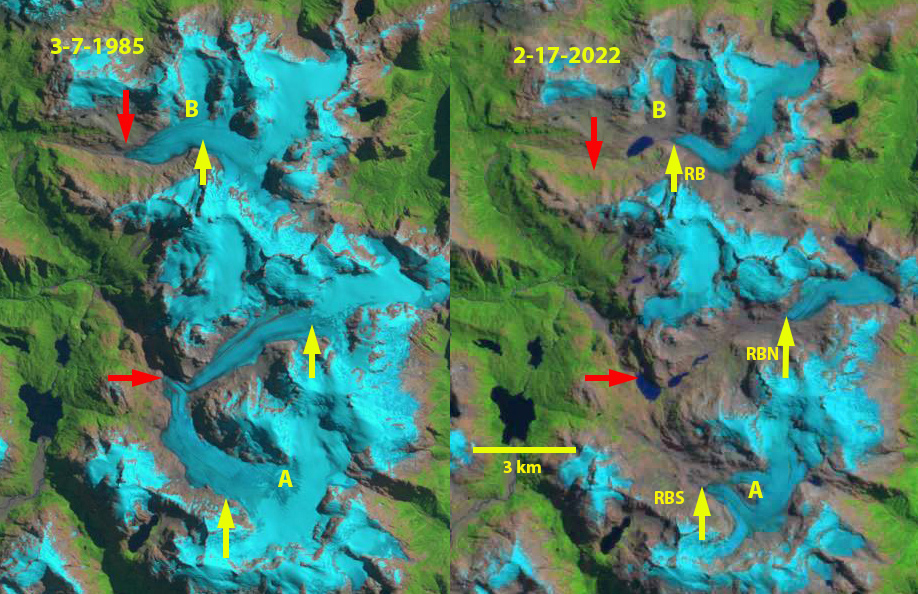
Rio Blanco Glaciers in Hornopirén Naitonal Park, Chile in Landsat 5 and 9 images from 1985 and 2022. Red arrows indicate 1985 terminus position, yellow arrows 2022 terminus position. Point A is an emerging bedrock nunatak and Point B is where tributary separation has occurred.
Hornopirén National Park is in the Los Lagos region of Chile. The park is host to a number of glaciers that are in rapid retreat. Davies and Glasser (2012) mapped the area of these glaciers with 113 km2 in 1986 and 96 km2 in 2011. The retreat of the largest glaciers in the park is spectacular in recent years.Barcaza et al (2017) indicate that Inexplorado glaciers have lost 0.46-0,48 km2 from 2003-2015. Here we examine Landsat imagery to identify changes in three of the larger valley glaciers from 1985-2022. These glaciers from the headwaters of the Rio Blanco and are designated Inexplorado (RB), Rio Blanco North (RBN), Rio Blanco South (RBS). Rio Blanco enters the ocean just east of the community of Hornopirén.
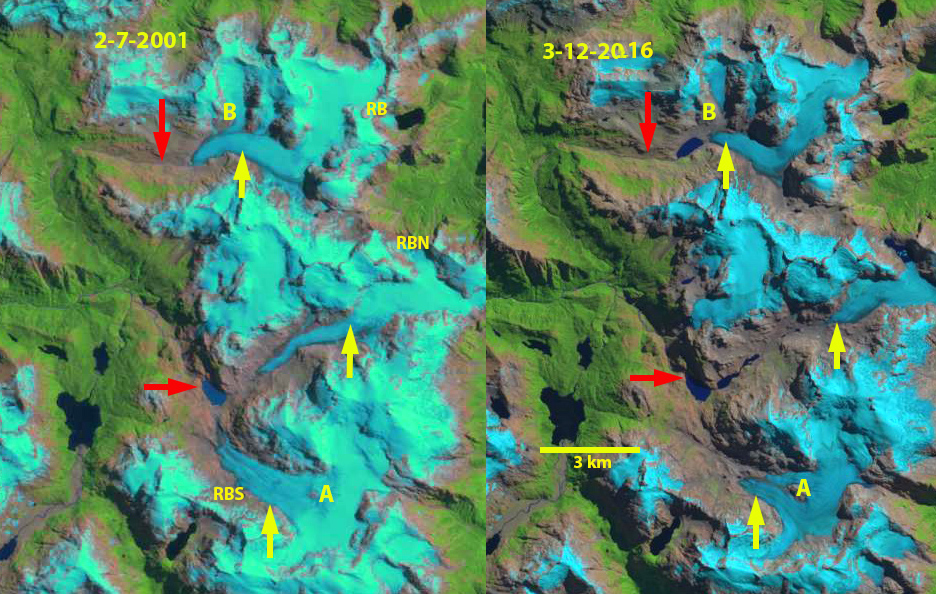
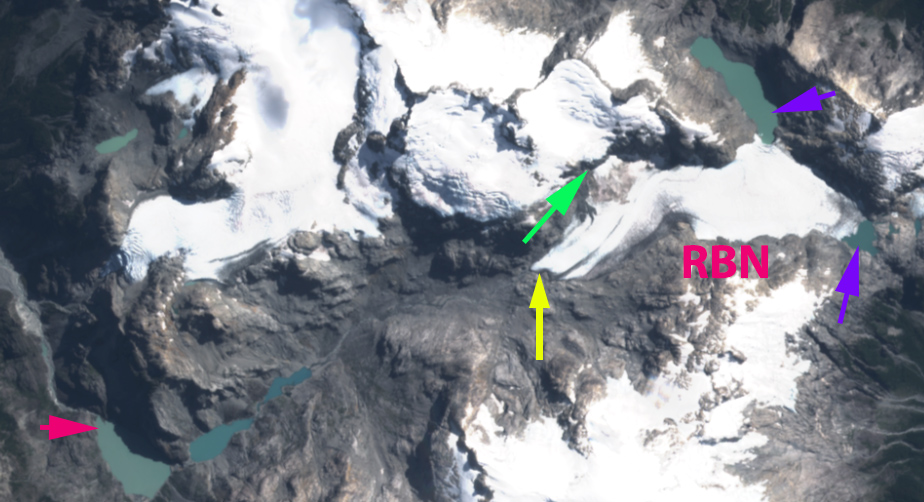
In 1985 the 8 km long RBN and RBS glaciers merged just above the terminus at 820 m, red arrow. In 1985 Inexplorado (RB) was a 7.5 km long glacier terminating at The snowline was at 1300 m. By 2001 RBN and RBS had separated by ~1 km with the formation of a new lake at the former terminus. RBS is developing a nunatak at Point A. Inexplorado had retreated 1 km with a proglacial lake just beginning to develop at the terminus, while the northern tributary at Point B is still feeding the main glacier. By 2016 the retreat of RBN has led to the development of three new alpine lakes in the deglaciated valley. By 2016 RBS thinning and retreat has led to the Point A nunatak in the lower section of RBS becoming a significant bedrock exposure. In 2016 The retreat of Inexplorado has led to the formation of a nearly 0.9 km long proglacial lake and the former northern tributary at Point B has separated. By 2022 RBN has retreated 4.8 km losing 60% of its length since 1985, it has detached from the accumulation and the eastern margin has two lobes now terminating in proglacaial lakes. RBS has retreated 4 km, losing 45% of its length since 1985. Point A is beginning to merge with terminus and the main terminus is likely retreating into a new lake basin. Both RBS and RBN terminate at ~1200 m. Inexplorado has retreated 2.3 km since 1985, 30% of its length, and is still 5.3 km long, terminating at ~1300 m, A new lake basin will likely form between the current terminus and the base of the cefall 1.5 km upglacier of the terminus. The snowline in 2015, 2016 and 2022 was at 1600-1700 m. This leaves only a small percentage of the glacier area above the snowline. The large valley glaciers that just 30 years dominated the headwaters of Rio Blanco have lost ~50% of their length and area and will soon be small slope glaciers clinging to the highest peaks. Retreat here is more extensive than seen 100 km to the northwest at Calbuco Volcano or to the south at the Quelat Glacier Complex.
Rio Blanco Glaciers in Hornopirén Naitonal Park, Chile in Landsat 7 and 8 images from 2001 and 2016. Red arrows indicate 1985 terminus position, yellow arrows 2022 terminus position. Point A is an emerging bedrock nunatak and Point B is where tributary separation has occurred.
The Rio Blanco North Glacier in March 2022 Sentinel image indicating the two proglacial lakes on eastern margin, purple arrows, the detachment at the green arrow, 1985 terminus locaiton red arrow and 2022 terminus location yellow arrow.











 From a Glaciers Perspective